

Traditional Uses, Origins, Chemistry and Pharmacology of Bombyx batryticatus: A Review


Abstract
:1. Introduction
2. Traditional Usages
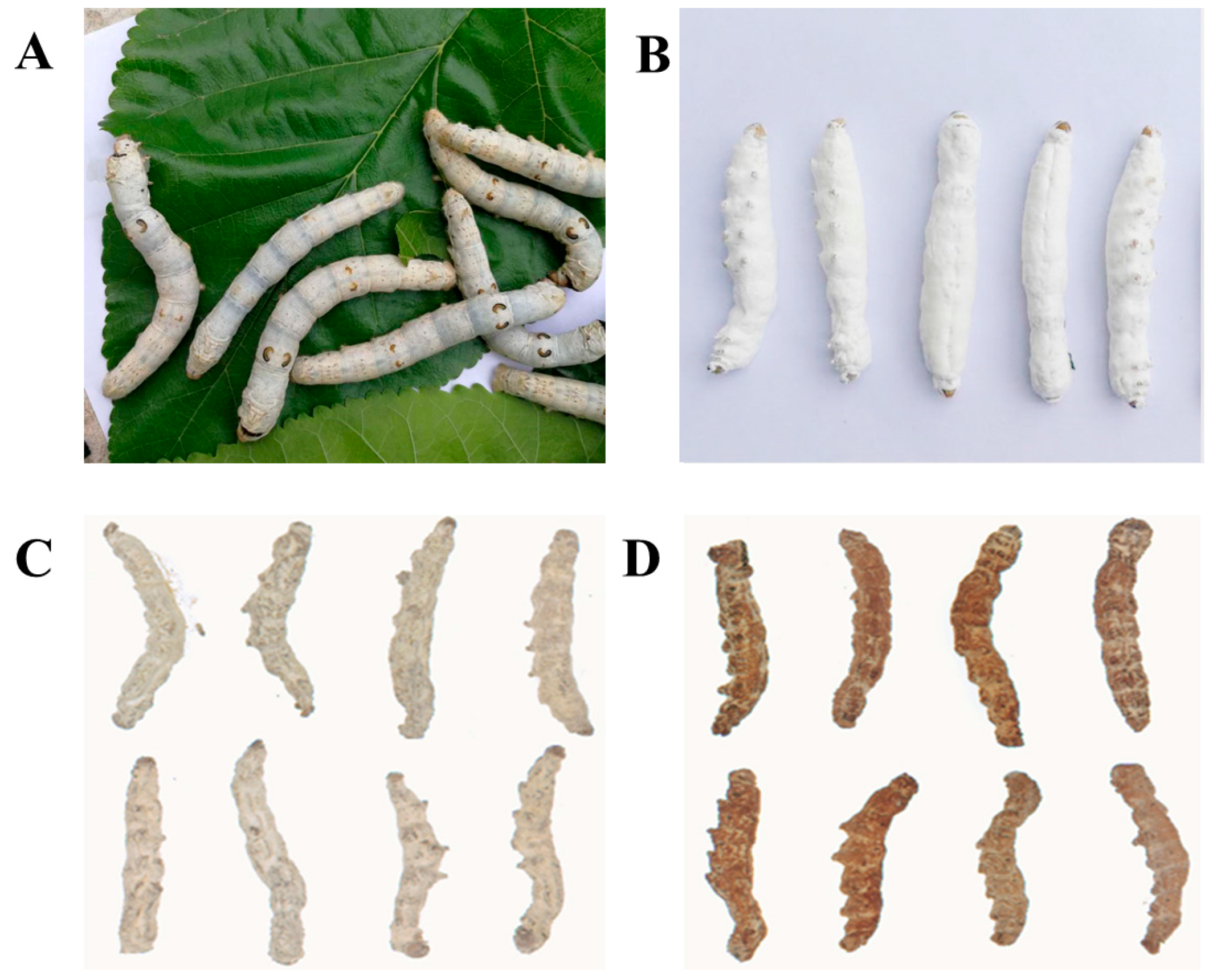
3. Origin
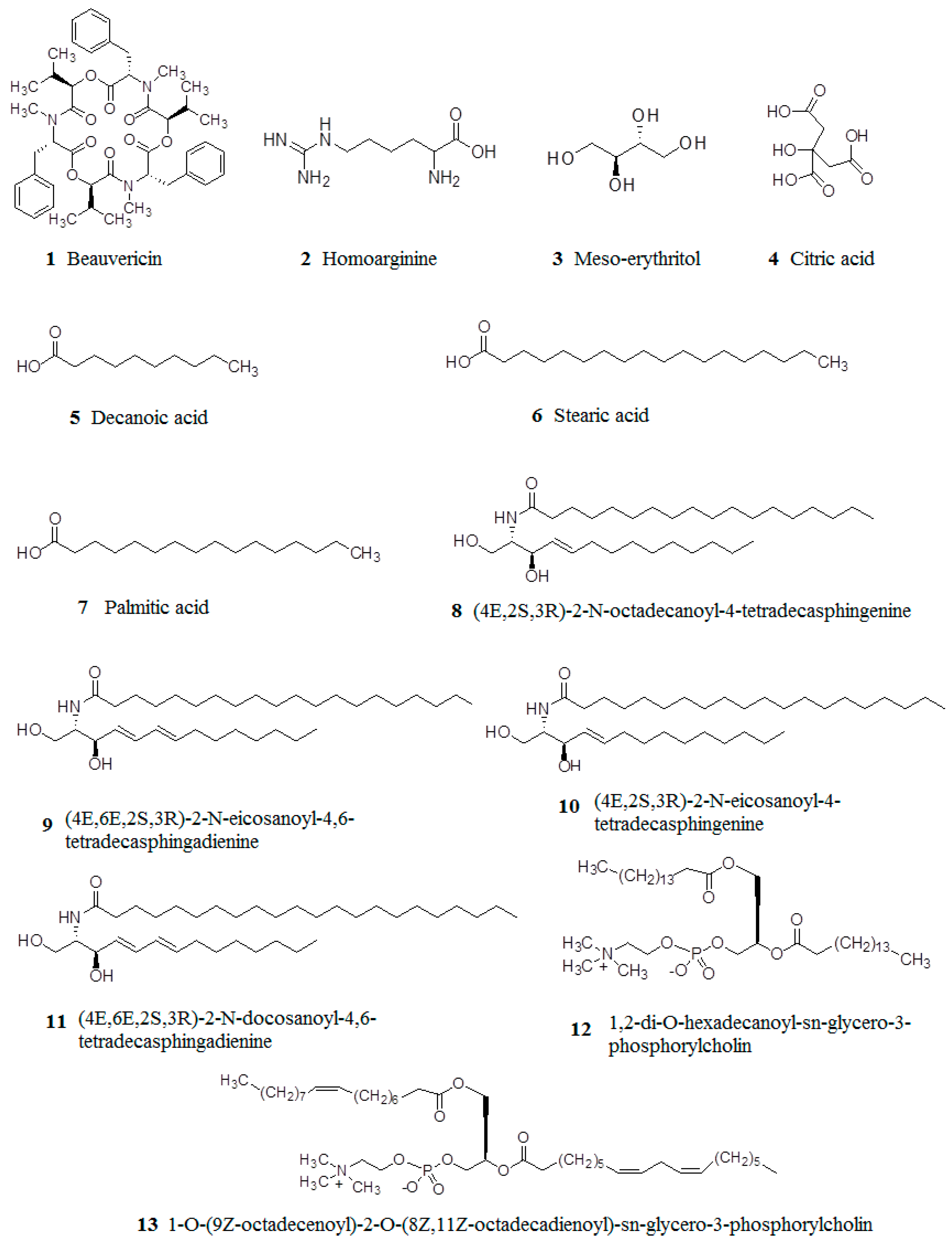
4. Chemistry
4.1. Proteins and Peptides
4.2. Fatty Acids
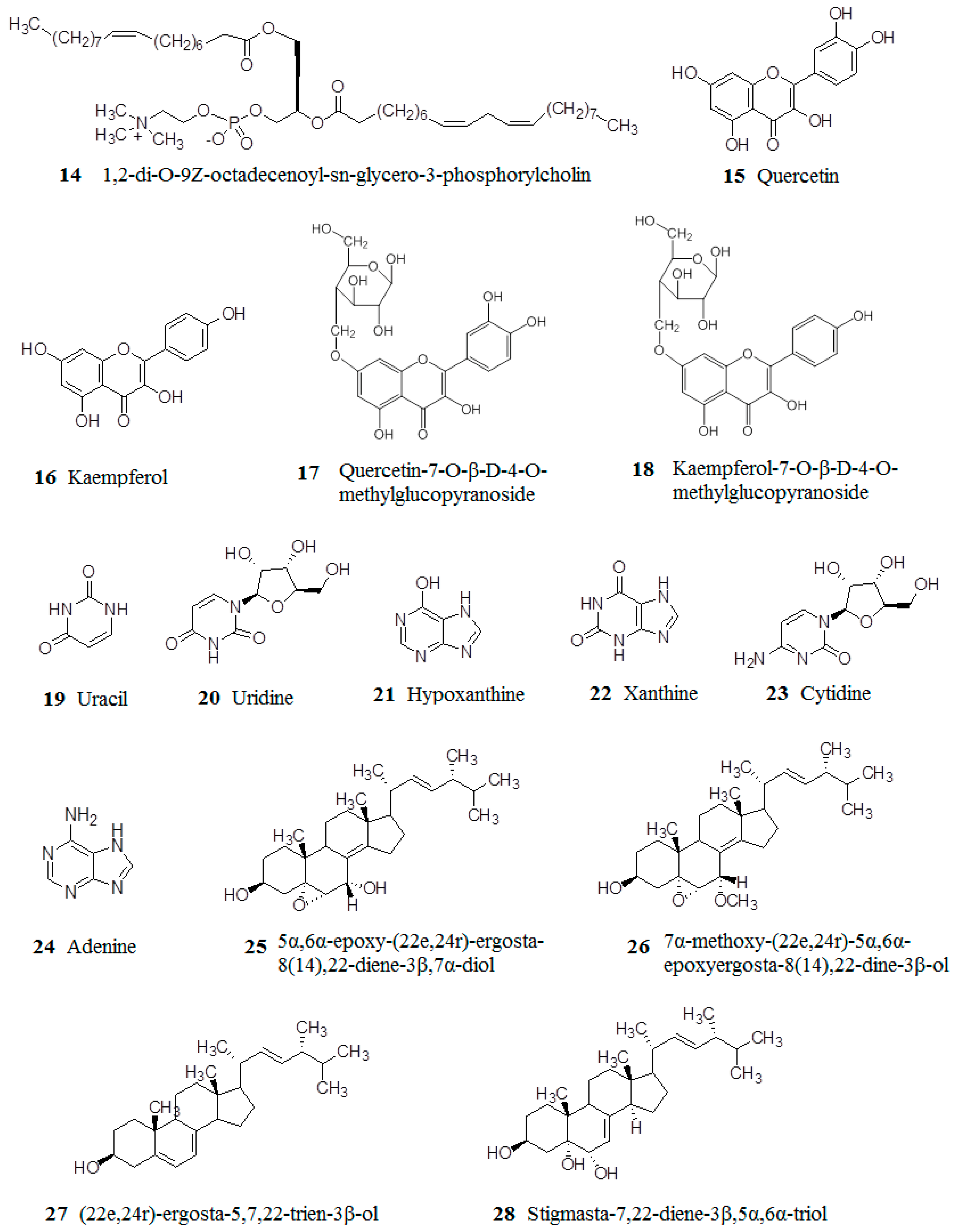
4.3. Flavonoids
4.4. Nucleosides
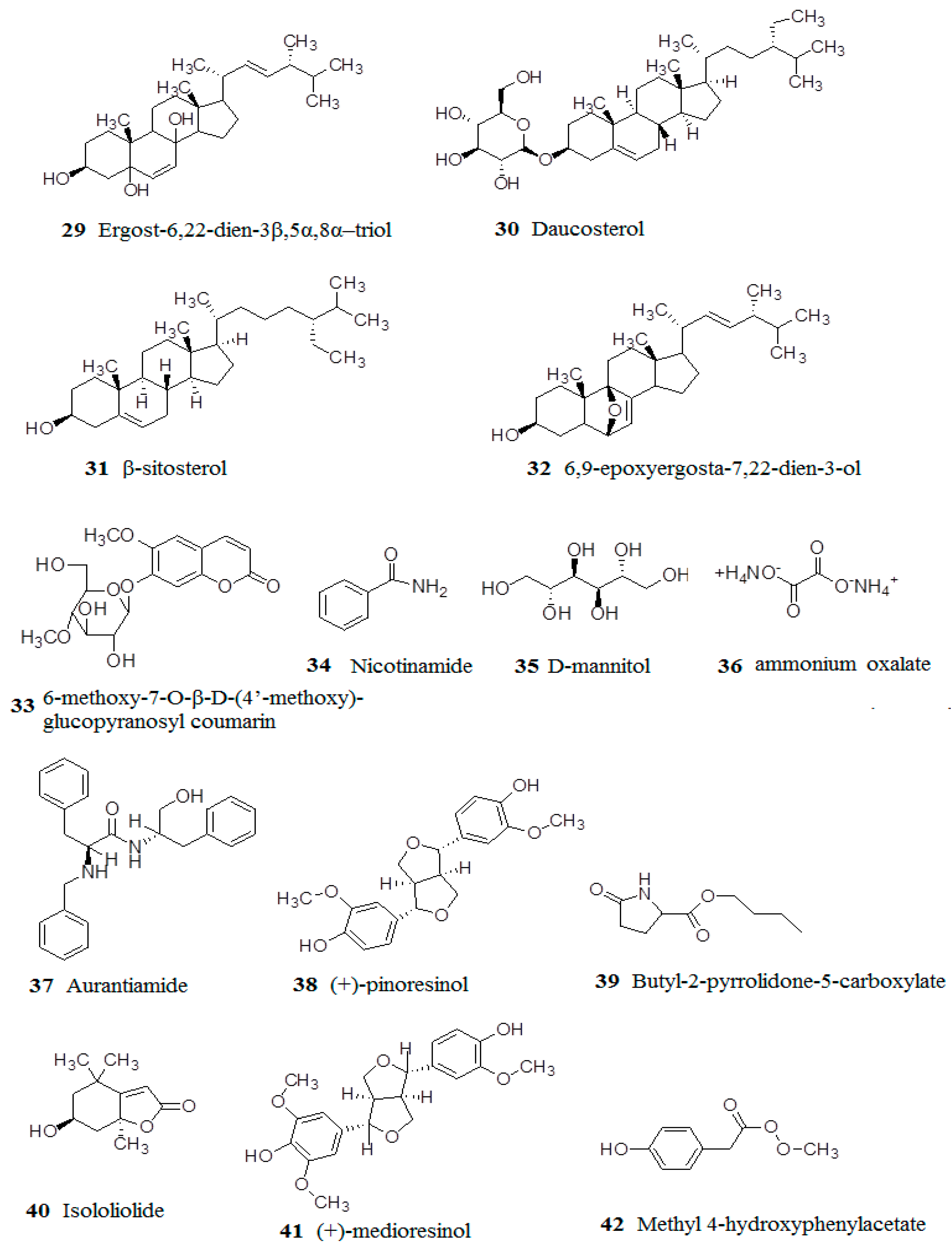
4.5. Steroids
4.6. Coumarin
4.7. Polysaccharide
4.8. Trace Elements
4.9. Other Compounds
5. Pharmacology
5.1. Effects on Nervous System
5.2. Anticoagulant Effect
5.3. Antitumor Effect
5.4. Antibacterial and Antifungal Effects
5.5. Effects on Viruses
5.6. Antioxidant Effect
5.7. Other Pharmacological Effects
5.8. Summary of Pharmacological Effects
6. Toxicity
7. Future Perspectives and Conclusions
Acknowledgments
Author Contributions
Conflicts of Interest
References
- Chinese Pharmacopoeia Commission. Pharmacopoeia of the People’s Republic of China Part I; People’s Medical Publishing House: Beijing, China, 2015; p. 375. ISBN 9787506773379. [Google Scholar]
- Kikuchi, H.; Takahashi, N.; Oshima, Y. Novel aromatics bearing 4-O-methylglucose unit isolated from the oriental crude drug Bombyx batryticatus. Tetrahedron Lett. 2004, 45, 367–370. [Google Scholar] [CrossRef]
- Ma, J.X. Sheng Nong’s Herbal Classic Jizhu; People’s Medical Publishing House: Beijing, China, 1995; p. 54. ISBN 9787117022514. (In Chinese) [Google Scholar]
- Hu, M.B.; Liu, Y.J.; Xiao, H.; Wu, C.J.; Zhang, J.X. Advance and thinking of researches on artificial culture of Bombyx batryticatus. J. Chin. Med. Mater. 2016, 39, 930–933. (In Chinese) [Google Scholar]
- Nanjing University of Traditional Chinese Medicine. Traditional Chinese Medicine Dictionary; Shanghai Science and Technology Press: Shanghai, China, 2006; p. 1020. ISBN 9787532382712. [Google Scholar]
- Pemberton, R.W. Insects and other arthropods used as drugs in Korean traditional medicine. J. Ethnopharmacol. 1999, 65, 207–216. [Google Scholar] [CrossRef]
- Wang, J.X.; Zhu, C.L.; Dai, H. The pharmacological research and clinical applications of Jiangcan and Jiangyong. Lishizhen Med. Mater. Med. Res. 1999, 10, 637–638. [Google Scholar]
- Xu, C.; Shan, S.Y.; Liu, M.; Yang, M. Progress of researches on chemical constituents and pharmacological activities of Bombyx batryticatus. China Pharm. 2014, 25, 3732–3734. (In Chinese) [Google Scholar]
- Tian, M.; Chen, F.; Yu, F. Progress of research on Bombyx batryticatus. Guid. J. Tradit. Chin. Med. Pharmacol. 2015, 21, 101–103. (In Chinese) [Google Scholar]
- Yang, Q.; Liao, S.T.; Xing, D.X.; Luo, G.Q.; Wu, F.Q. Advances in chemical composition of Bombyx batryticatus and its identification techniques. Sci. Ser. 2009, 35, 696–699. (In Chinese) [Google Scholar]
- Zhang, C.W.; Peng, X.W. Study on processing technology of Bombyx batryticatus stir-fried with bran. J. N. Pharm. 2013, 10, 39–40. (In Chinese) [Google Scholar]
- Gong, Q.F. Processing Science of Traditional Chinese Medicine; China Press of Traditional Chinese Medicine: Beijing, China, 2004; p. 134. ISBN 9787801563088. [Google Scholar]
- Hu, M.B.; Liu, Y.J.; Xie, D.S.; Xiao, H.; Li, Y.C.; Wu, C.J. The research on the Maillard reaction in the process of Bombyx batryticatus stir-fried with bran. J. Chin. Med. Mater. 2016, 39, 2251–2254. (In Chinese) [Google Scholar]
- State Administration of Traditional Chinese Medicine. Chinese Materia Medica; Shanghai Science and Technology Press: Shanghai, China, 1998; pp. 179–182. ISBN 9787532344345. [Google Scholar]
- Zhang, X.J. Eczema Treat. J. Tradit. Chin. Med. 1986, 27, 10–16. (In Chinese) [Google Scholar]
- Zhang, Z.L. Clinical Experience of Skin Disease; China Medical Science and Technology Press: Beijing, China, 2001; p. 333. ISBN 9787506723343. (In Chinese) [Google Scholar]
- Xu, G.X. Treatments of 100 skin disease cases with modified Shufeng Huoxue decoction. J. Sichuan Tradit. Chin. Med. 1994, 11, 49–50. (In Chinese) [Google Scholar]
- Wang, F.Q.; Wang, L.Y.; Wang, L.P.; Li, Y.N. Observation on the treatment of allergic dermatosis by using modified Xiaofeng powder. China’s Naturop. 1996, 4, 33–34. (In Chinese) [Google Scholar]
- Lin, S.J. 4 cases of skin diseases. New. J. Tradit. Chin. Med. 2002, 35, 62. (In Chinese) [Google Scholar]
- Yao, L.Q. Experience in the treatment of diabetic complications using Bombyx batryticatus. Clin. J. Tradit. Chin. Med. 2004, 16, 222. (In Chinese) [Google Scholar] [CrossRef]
- Li, H.M. Clinical observation of 38 prurigo nodularis cases treated with comprehensive TCM. Guid. J. Tradit. Chin. Med. Pharmacol. 2005, 11, 45–46. (In Chinese) [Google Scholar]
- Liu, H.Y. Treatments of 33 pediatric multiple cases using Bombyx batryticatus powder. Tianjin Tradit. Chin. Med. 1995, 12, 21. (In Chinese) [Google Scholar]
- Xie, Y.L. The treatment of chloasma using Bombyx batryticatus. J. Tradit. Chin. Med. 2009, 50, 725. (In Chinese) [Google Scholar] [CrossRef]
- Zheng, J.G.; Du, W. Exact effect on allergic rhinitis with Bombyx batryticatus. J. Tradit. Chin. Med. 2009, 50, 725. (In Chinese) [Google Scholar] [CrossRef]
- Zhang, M.; Yang, Z.J. Clinical application of Bombyx batryticatus. Inf. Tradit. Chin. Med. 1999, 17, 23. (In Chinese) [Google Scholar]
- Wang, Y.Y.; Han, Y.; He, X.Z.; Zhang, Z.L. Zhang Zong-li experience in treatment of intractable proteinuria by using Bombyx batryticatus and Cicadae Periostracum. Hunan J. Tradit. Chin. Med. 2016, 32, 34–36. (In Chinese) [Google Scholar]
- Ding, Z. Experience of Professor Ba Yuanming in using TCM herb pairs to treating kidney disease. Acta Chin. Med. 2017, 32, 229–231. (In Chinese) [Google Scholar]
- Zhang, W.Q.; Zhang, H.L.; Liu, R.J.; Zhang, W.B. Example for experience cases on the clinical application of Bombyx batryticatus of Zhang wen tai aged traditional Chinese medicine doctors. Guangming Tradit. Chin. Med. 2015, 30, 138–139. (In Chinese) [Google Scholar]
- Wei, Y.B.; Zhang, Q.; Cheng, W.P.; Jing, W. Clinical applications of Bombyx batryticatus. Shandong J. Tradit. Chin. Med. 2015, 34, 961–962. (In Chinese) [Google Scholar]
- Liu, D.M.; Xiong, M.B. Bombyx batryticatus has good effect on fever. J. Tradit. Chin. Med. 2009, 50, 1108. [Google Scholar]
- Zhu, L.M.; Zhou, S.J. Treatment of hypertension using Bombyx batryticatus. J. Tradit. Chin. Med. 2009, 50, 1108. (In Chinese) [Google Scholar] [CrossRef]
- Chen, C.R. Dictionary of Chinese Pharmacy; People’s Medical Publishing House: Beijing, China, 2010; p. 423. ISBN 9780325454252. [Google Scholar]
- Wang, Y.A. Research reports of Beauveria bassiana and related problems on the production of Bombyx batryticatus. J. Xinxiang Teach. Coll. 1982, 23, 63–67. (In Chinese) [Google Scholar]
- Wen, C.W.; Shi, L.; Zhao, Y.Q.; Ouyang, Z.; Zhan, Z.L. Herbal textual research on origin and development of Bombyx batryticatus. Lishizhen Med. Mater. Med. Res. 2017, 28, 171–173. (In Chinese) [Google Scholar]
- Kong, Y.; Xu, C.; He, Z.L.; Zhou, Q.M.; Wang, J.B.; Li, Z.Y.; Ming, X. A novel peptide inhibitor of platelet aggregation from stiff silkworm, Bombyx batryticatus. Peptides 2014, 53, 70–78. [Google Scholar] [CrossRef] [PubMed]
- Huang, J.M.; Su, M.S.; Zhang, Y.M.; Shao, F.; Yang, M.; Zhang, P.Z. Chemical Constituents from Bombyx batryticatus. J. Chin. Med. Mater. 2017, 41, 87–89. (In Chinese) [Google Scholar]
- Li, X.H. Study on the Quality Standard of Bombyx batryticatus. Master’s Thesis, Chengdu University of Traditional Chinese Medicine, Chengdu, China, 2006. (In Chinese). [Google Scholar]
- Wang, J.H. The pharmacological research and clinical application of batryticated silkworms and muscardine pupae. Lishizhen Med. Mater. Med. Res. 2003, 14, 492–494. (In Chinese) [Google Scholar]
- Huang, J.M.; Deng, H.Y.; Cai, Y.; Li, Y.; Zhang, P.Z.; Yang, M. Chemical constituents from Bombyx batryticatus. Chin. Tradit. Herb. Drug. 2015, 46, 2377–2380. (In Chinese) [Google Scholar]
- Huang, H.Y. The Study on the Isolation and Purifition about the Anticoagulation of Bombyx batryticatus. Master’s Thesis, Hunan College of Traditional Chinese Medicine, Changsha, China, 2004. (In Chinese). [Google Scholar]
- Cheng, S.M.; Li, G.Y.; Wang, H.Y.; Huang, J.; Wang, J.H. Study on chemical constituents of Bombyx batryticatus. Mod. Chin. Med. 2013, 15, 544–547. (In Chinese) [Google Scholar]
- Li, C.; Hou, L.; Yu, R.X.; Zhang, Y.J. Analysis of enzymolysis polypeptide from Bombyx batryticatus by LC–MS. Chem. Anal. Meter. 2017, 26, 11–15. [Google Scholar]
- Yin, Z.Q.; Ye, W.C.; Zhao, S.X. Studies on the chemical constituents of Bombyx batryticatus. China J. Chin. Mater. Med. 2004, 28, 52–54. (In Chinese) [Google Scholar]
- Li, J.F.; Sun, J.M.; Zhang, H. Bombyx batryticatus’s chemical components and pharmacological activities. Jilin J. Tradit. Chin. Med. 2015, 35, 175–177. (In Chinese) [Google Scholar]
- Li, D.S.; Wang, J.H.; Hu, Z.; Li, Y.Q. Main chemical constituents of Bombyx batryticatus and its volatile oil analysis. Chem. Bioeng. 2003, 20, 22–24. (In Chinese) [Google Scholar]
- Kwon, H.C.; Lee, K.C.; Cho, O.R.; Jung, I.Y.; Cho, S.Y.; Kim, S.Y.; Lee, K.R. Sphingolipids from Bombycis Corpus 101A and their neurotrophic effects. J. Nat. Prod. 2003, 66, 466–469. [Google Scholar] [CrossRef] [PubMed]
- Kwon, H.C.; Jung, I.Y.; Cho, S.Y.; Cho, O.R.; Yang, M.C.; Lee, S.O.; Hur, J.Y.; Kim, S.Y.; Yang, J.B.; Lee, K.R. Phospholipids from Bombycis corpus and their neurotrophic effects. Arch. Pharm. Res. 2003, 26, 471–477. [Google Scholar] [CrossRef] [PubMed]
- Wang, J.J.; Zhang, M.; Zhang, X.M. Content analysis of quercetin and kaempferol in Bombyx batryticatus by RP-HPLC. Feed Ind. 2009, 30, 48–50. (In Chinese) [Google Scholar]
- Li, W.; Wen, H.M.; Zhang, A.H.; Yu, L.; Guo, R. The content determinations of 4 kinds of nucleosides and bases in HPLC method. Chin. J. Pharm. Anal. 1996, 6, 46–47. (In Chinese) [Google Scholar]
- Cheng, S.M.; Wang, H.Y.; Li, G.Y.; Huang, J.; Wang, J.H. Study on steroids constituents of Bombyx batryticatus. Study on steroids constituents of Bombyx batryticatus. J. Shihezi Univ. 2013, 31, 724–728. (In Chinese) [Google Scholar]
- Yin, Z.Q.; Ye, W.C.; Zhao, S.X. A new coumarin glycoside from Bombyx batryticatus. Chin. Tradit. Herb. Drug. 2004, 35, 1205–1207. (In Chinese) [Google Scholar]
- Jiang, X.; Zhang, Z.; Chen, Y.; Cui, Z.; Shi, L. Structural elucidation and in vitro antitumor activity of a novel oligosaccharide from Bombyx batryticatus. Carbohydr. Polym. 2014, 15, 434–441. [Google Scholar] [CrossRef] [PubMed]
- Peng, X.J.; Xu, G.M.; Li, M.J.; Jiang, X.M. Determination of oxalic acid ammonium in Bombyx batryticatus by HPLC. Cent. S. Pharm. 2006, 4, 255–257. (In Chinese) [Google Scholar]
- Huang, A.X.; Song, Y.Y.; Yao, L.H.; Zhou, Q.; Yu, J.Y. Determination of ammonium oxalate in Bombyx batryticatus by ultrasonic extraction-high performance liquid chromatography. Chin. J. Anal. Lab. 2016, 35, 941–944. (In Chinese) [Google Scholar]
- Peng, X.J.; Peng, Y.G.; Zeng, X.Q.; Zhao, J.G.; Jiang, X.M.; Gao, J. Quantitative analysis of protein and ammonium oxalate in the extract liquide from Bombyx batryticatus. Chin. J. Inform. TCM 2005, 12, 38–40. (In Chinese) [Google Scholar]
- Xing, D.X.; Liao, S.T.; Luo, G.Q.; Li, L.; Xiao, Y.; Li, Q.R.; Ye, M.Q.; Yang, Q. Extraction process optimization and antioxidant activity determination of polysaccharide from Bombyx batryticatus. Sci. Seric. 2015, 41, 1088–1093. (In Chinese) [Google Scholar]
- Wei, G.Q.; Ju, G.C.; Li, H.P.; Zhao, J. Analysis of chemical constituents of Bombyx batryticatus. J. Jilin Agric. Univ. 1995, 7, 44–46. (In Chinese) [Google Scholar]
- Guo, X.H.; Yan, Z.Y.; Liu, T.; Song, D.M.; Li, X.H. Anticonvulsive activity of three compounds isolated from Beauveria bassiana. Chin. J. Exp. Tradit. Med. Form. 2013, 19, 248–250. (In Chinese) [Google Scholar]
- Guo, X.H.; Wu, Y.Y.; Song, D.M.; Yan, Z.Y.; Liu, T. Compounds isolated and purified from chloroform active part of Bombyx batryticatus and their anticonvulsive activities. Chin. J. Pharm. 2014, 45, 431–433. (In Chinese) [Google Scholar]
- Yan, Z.Y.; Li, X.H.; Chen, X.; Peng, C.; Liu, Y.P.; Xiang, C. Aprimary study on anticonvulsant parts of BombyxmoriL. Lishizhen Med. Mater. Med. Res. 2006, 17, 696–697. (In Chinese) [Google Scholar]
- Yao, H.W.; He, X.G.; He, Q.Y.; Yang, L.H.; Ma, Y.G. Comparative study on the anticonvulsant effect of alcohol extract of Bombyx batryticatus and Scolopendra. Chin. Remed. Clin. 2006, 3, 221–223. (In Chinese) [Google Scholar]
- Li, W.; Xu, M.T.; Xia, Z.Y.; Cheng, F. Effects of ammonium oxalate on the epilepsy rat model caused by penicillin. Med. J. Wuhan Univ. 2009, 30, 97–100. (In Chinese) [Google Scholar]
- Huang, H.Y.; Peng, X.J.; Peng, Y.G. Modern research progress of Bombyx batryticatus. J. Hunan Coll. Tradit. Chin. Med. 2003, 25, 62–64. (In Chinese) [Google Scholar]
- Hu, P.F.; Wang, J.P.; Fan, R.P.; Chen, X.J.; Xu, Y.X.; Pang, C.Y. Study on the sedation of Bombyx batryicatus. Lishizhen Med. Mater. Med. Res. 2005, 16, 1113–1114. (In Chinese) [Google Scholar]
- Koo, B.S.; An, H.G.; Moon, S.K.; Lee, Y.C.; Kim, H.M.; Ko, J.H.; Kim, C.H. Bombycis corpus extract (BCE) protects hippocampal neurons against excitatory amino acid-induced neurotoxicity. Immunopharm. Immun. 2003, 25, 191–201. [Google Scholar] [CrossRef]
- Kim, H.J.; Lee, W.H.; Yoon, C.H.; Jeong, J.C.; Nam, K.S.; Kim, H.M.; Choo, Y.K.; Lee, M.C.; Kim, C.H. Bombycis corpus extract prevents amyloid-beta-induced cytotoxicity and protects superoxide dismutase activity in cultured rat astrocytes. Pharmacol. Res. 2001, 43, 11–16. [Google Scholar] [CrossRef] [PubMed]
- Wang, J.D.; Narui, T.; Kurata, H.; Takeuchi, K.; Hashimoto, T.; Okuyama, T. Hematological studies on naturally occurring substances. II. Effects of animal crude drugs on blood coagulation and fibrinolysis systems. Chem. Pharm. Bull. 1989, 37, 2236. (In Chinese) [Google Scholar] [CrossRef] [PubMed]
- Zhao, J.G.; Peng, X.J.; Peng, Y.G.; Zeng, X.Q.; Jiang, X.M.; Zhang, Y.H.; Lu, M.F. Influence of ammonium oxalate on the action of anticoagalation on stiff silkworm. Lishizhen Med. Mater. Med. Res. 2005, 16, 468–469. [Google Scholar]
- Peng, Y.G.; Lei, T.X.; Fu, C.Y.; Zeng, X.Q.; Li, L.D. Effect of anticoagulant components in Bombys batryticatus on thrombosis. Pharmacol. Clin. Chin. Mater. Med. 2007, 23, 27–29. (In Chinese) [Google Scholar]
- Peng, Y.G.; Li, L.D.; Deng, Y.H. Study on anti-venous thrombosis and its mechanism in Bombys batryticatus. Chin. J. Thromb. Hemo 2001, 8, 104–105. (In Chinese) [Google Scholar]
- Hao, X.Y.; Su, Y.; Peng, Y.G. Effect of Bombyx batryticatus injection on the balance of fibrinolytic system of human umbilical vascular endothelial cell induced by thrombin. Chin. J. Integr. Tradit. West. Med. Intens. Crit. Care 2007, 14, 70–72. (In Chinese) [Google Scholar]
- Cao, J. Studies on Toxicology of Hela Which Treat with Ethanol Extracts of Bombyx baticatus. Master’s Thesis, Northwest A & F University, Xianyang, China, 2011. (In Chinese). [Google Scholar]
- Jiang, X.; Chen, Y.; Shi, L.G. Optimization of flavonoids extraction from Bombyx batryticatus using response surface methodology and evaluation of their antioxidant and anticancer activities in vitro. Food Sci. Biotechnol. 2013, 22, 1707–1715. [Google Scholar] [CrossRef]
- Wu, W.P.; Cao, J.; Wu, J.Y.; Chen, H.; Wang, D. Anticancer activity of Bombyx batryticatus ethanol extract against the human tumor cell line HeLa. Genet. Mol. Res. 2015, 15, 79–88. [Google Scholar] [CrossRef] [PubMed]
- Wu, J.Y.; Sheikho, A.; Ma, H.; Li, T.C.; Zhao, Y.Q.; Zhang, Y.L.; Wang, D. Molecular mechanisms of Bombyx batryticatus ethanol extract inducing gastric cancer SGC-7901 cells apoptosis. Cytotechnology 2017, 24, 1–9. [Google Scholar] [CrossRef] [PubMed]
- Cheng, X.G.; Jiang, X.H.; Liu, Z.M.; Huang, S.Q.; Zhou, J.Y. Study on anti-tumor activity of seven chemical constituents of Bombyx batryticatus. J. Zhongkai Univ. Agric. Eng. 2015, 28, 35–39. (In Chinese) [Google Scholar]
- Xiang, L.P.; Chai, W.L.; Wang, J.; Zheng, Y.W.; Tang, G.H.; Lv, L.; Wang, D. Analysis on antibacterial components from Bombyx batryticatus and its antibacterial activity against Escherichia coli. J. Northwest Agric. For. Univ. 2010, 38, 150–153. (In Chinese) [Google Scholar]
- Chai, W.L.; Xiang, L.P.; Wang, Y.; Zheng, Y.W.; Tang, G.H.; Lv, L.; Wang, D. Inhibitory effect of alcohol extract of Bombyx batryticatus on pathogenic fungi of forest. For. Pract. Technol. 2009, 52, 33–34. (In Chinese) [Google Scholar]
- Wang, Q.; Niu, W.F.; Zhang, J.Z.; Hou, B.S.; Liu, Y.T.; Zhou, C.Z. To determine the effective in vitro antiviral part of Bombyx Batryticatus. Shandong J. Tradit. Chin. Med. 2016, 35, 909–911. (In Chinese) [Google Scholar]
- Zhang, R.F.; Ma, H.; Zhao, S.N.; Niu, M.M.; Xing, Y.Y.; Wang, D. Enhancement of HearNPV by ethanol extact of Bombyx batryticatus. J. Northwest Agric. For. Univ. 2014, 42, 119–123. (In Chinese) [Google Scholar]
- Zhao, Q.; Huo, L.Q.; Jia, T.Z. Effects of Different Processing Methods on in vitro Antioxidant Activity and Inhibiting Capacity for Tyrosinase of Bombyx batryticatus. Chin. J. Exp. Tradit. Med. Form. 2014, 20, 17–23. [Google Scholar]
- Ma, F.Y. Treatments of 52 diabetes cases using powder of Bombyx batryticatus. Hunan J. Tradit. Chin. Med. 1990, 17, 37. (In Chinese) [Google Scholar]
- Yang, X.J. Treatments of type 2 diabetes using Bombyx batryticatus. China’s Naturop. 2016, 24, 57. [Google Scholar]
- Hou, X.L.; Zhang, D.F. Treatments of headache using Bombyx batryticatus singly. J. Tradit. Chin. Med. 2009, 50, 1011. (In Chinese) [Google Scholar]
- Mao, X.J.; Mao, X.P.; Xiao, Q.C.; Jiang, Q.; Yang, X.Y. Pharmacological study of antifertility on Bombyx batryticatus. J. Yunnan Coll. Tradit. Chin. Med. 2002, 25, 26–28. (In Chinese) [Google Scholar]
- Jiang, X. Researches on Separation, Purification and Pharmacological Effects of Active Components of Bombyx batryticatus. Doctor’s Thesis, Zhejiang University, Zhejiang, China, 2013. (In Chinese). [Google Scholar]
- Cheng, C.Y. Clinical treatment of 46 acute poisoning cases caused by Bombyx batryticatus. Mod. J. Integr. Tradit. Chin. West. Med. 2007, 16, 371–372. (In Chinese) [Google Scholar]
- Gao, H. Clinical observation of toxicity of Bombyx batryticatus. Chin. Commun. Doc. 2011, 13, 167. [Google Scholar] [CrossRef]
- Li, D.H.; Yan, Y.H.; Qiu, S.S.; Guo, X.F. Retrospective analysis of 425 poisoning cases caused by Bombyx batryticatus. Strait. Pharm. J. 2011, 23, 244–245. (In Chinese) [Google Scholar]
- Liu, C.S.; Xiang, S.H. Clinical analysis of 248 poisoning cases caused by Bombyx batryticatus. Clin. Focus 2004, 18, 495. (In Chinese) [Google Scholar]
- Li, W.; Qian, J.; Tang, W.J. Analysis of one poisoning case taking powder of Bombyx batryticatus. Clin. Misdiag. Misther. 2011, 24, 73–74. (In Chinese) [Google Scholar]
- Zhu, Y.H. Emergency nursing to one extrapyramidal reaction cases caused by Bombyx batryticatus. Chin. Commun. Doc. 2011, 13, 134. (In Chinese) [Google Scholar]
- Zhang, Z.H. 2 cases of muscular myoclonus caused by Bombyx batryticatus. J. Tradit. Chin. Med. 2011, 52, 1889. (In Chinese) [Google Scholar]
- Feng, R.X.; Zhang, Z.W.; Zhang, Z.K. Reports of 2 poisoning cases caused by Bombyx batryticatus and countermeasures. J. Tradit. Chin. Med. 2013, 54, 808–810. (In Chinese) [Google Scholar]
- Kao, X.L. Report of 1 poisoning cases caused by Bombyx batryticatus. J. Zhejiang Univ. Tradit. Chin. Med. 2013, 37, 306–307. (In Chinese) [Google Scholar]
- Yang, M.H. Research progress in fungi and mycotoxin infection of medicinal plants and their products. Guizhou Agric. Sci. 2008, 36, 59–63. (In Chinese) [Google Scholar]
- Chen, Y.T.; Cheng, D.Q.; Lin, M.A.; Ding, Z.S.; Pan, P.L. Research on the toxic effect of extracellular proteins secreted by Beauveria bassiana on mice. Chin. Arch. Tradit. Chin. Med. 2008, 27, 1541–1542. (In Chinese) [Google Scholar]

| Preparation Name | Main Compositions | Traditional and Clinical Uses | References |
|---|---|---|---|
| Qi Zhen Pills | Bombyx Batryticatus, Scorpio, Moschus Artifactus, Cinnabaris, Realgar, Arisaema Cum Bile, Bambusae Concretio Silicea, Crotonis Semen Pulveratum | Relieving convulsion, eliminating sputum, promoting digestion and laxativing, curing acute infantile convulsions, irritability and constipation | “Chinese Pharmacopoeia (2015)”, vol. 1 a |
| Zhong Feng Hui Chun Pills (Tablets) | Bombyx Batryticatus, Angelicae Sinensis Radix, Carthami Flos, Salviae Miltiorrhizae, Lonicerae Japonicae Caulis, Pheretima, Lycopodii Herba, Scolopendra, Scorpio, Bungarus Parvus | Promoting blood circulation and relaxing tendons, treating apoplexy | “Chinese Pharmacopoeia (2015)”, vol. 1 a |
| Ru Bi San Jie Capsules | Bombyx Batryticatus, Prunellae Spica, Bupleuri Radix, Rosae Rugosae Flos, Angelicae Sinensis Radix, Ostreae Concha | Activating blood circulation and softening hardness, curing cyclomastopathy | “Chinese Pharmacopoeia (2015)”, vol. 1 a |
| Bao Ying Powder | Bombyx Batryticatus, Arisaema Cum Bile, Uncariae Ramulus Cum Uncis, Bovis Calculus Artifactus, Scorpio, Margaritifera, Moschus, Typhonii Rhizoma, Gastrodiae Rhizoma, Cicadae Periostracum, Succinum, Saposhnikoviae Radix, Concretio Silica Praeparata, Cinnabaris | Eliminating sputum, relieving convulsion and clearing heat, curing infantile convulsions, fever, excessive phlegm and cough | “Zhong Yao Cheng Fang Zhi Ji”, vol. 6 c |
| Li Yan Ling Pills | Bombyx Batryticatus, Manis Squama, Eupolyphaga Steleophaga, Ostreae Concha, Scrophulariae Radix | Activating blood circulation and relaxing tendons, relieving sore throat and pain. | “Zhong Yao Cheng Fang Zhi Ji”, vol. 8 c |
| Li Yan Jie Du Granule | Bombyx Batryticatus, Isatidis Radix, Lonicerae Japonicae Flos, Forsythiae Fructus, Menthae Haplocalycis Herba, Arctii Fructus, Crataegi Fructus, Platycodonis Radix, Isatidis Folium, Scrophulariae Radix, Scutellariae Radix, Rehmanniae Radix, Trichosanthis Radix, Rhei Radix et Rhizoma, Fritillariae Thunbergii Bulbus, Ophiopogonis Radix | Relieving sore throat and clearing heat, curing amygdalitis, pharyngitis and mumps | “Chinese Pharmacopoeia (2015)”, vol. 1a |
| Jia Wei She Dan Chen Pi Pills | Bombyx Batryticatus, Fel Serpentis Siccum, Citri Reticulatae Pericarpium, Pheretima, Cinnabaris, Succinum | Dispelling wind, eliminating sputum and relieving convulsion, treating fever, cough and psychosis | “Zhong Yao Cheng Fang Zhi Ji”, vol. 15 c |
| Yi Xian Pills | Bombyx Batryticatus, Typhonii Rhizoma, Pinelliae Rhizoma, Scolopendra, Alumen, Cinnabaris | Dispelling wind, eliminating sputum and relieving convulsion, curing epilepsy | “Chinese Pharmacopoeia (2015)”, vol. 1 a |
| Qian Jin Powder | Bombyx Batryticatus, Scorpio, Bovis Calculus Artifactus, Cinnabaris, Borneolum Syntheticum, Coptidis Rhizoma, Arisaema Cum Bile, Gastrodiae Rhizoma, Glycyrrhizae Radix Et Rhizoma | Clearing heat and relieving convulsion, treating fever and twitch of child | “Zhong Yao Cheng Fang Zhi Ji”, vol. 9 c |
| Fu Fang Qian Zheng Gao | Bombyx Batryticatus, Typhonii Rhizoma, Pheretima, Scorpio, Chuanxiong Rhizoma, Angelicae Dahuricae Radix, Angelicae Sinensis Radix, Paeoniae Radix Rubra, Saposhnikoviae Radix, Zingiberis Rhizoma Recens, Camphor, Borneolum Syntheticum, Menthol, Thymol | Dispelling wind, activating blood, relaxing tendons and curing apoplexy | “Chinese Pharmacopoeia (2015)”, vol. 1 a |
| Tai Ji Sheng Jiang Pills | Bombyx Batryticatus, Cicadae Periostracum, Curcumae Longae Rhizoma, Rhei Radix et Rhizoma, Borneolum Syntheticum, Arisaema Cum Bile, | Dispelling wind, clearing heat, eliminating sputum and relieving convulsion, curing fever, twitch, heat phlegm and constipation | “Zhong Yao Cheng Fang Zhi Ji”, vol. 2 c |
| Wa Wa Ning | Bombyx Batryticatus, Atractylodis, Macrocephalae Rhizoma, Bambusae Concretio Silicea, Uncariae Ramulus Cum Uncis, Glycyrrhizae Radix et Rhizoma, Menthae Haplocalycis Herba, Cinnabaris, Codonopsis Radix, Succinum | Treating cold, fever, spasm, vomiting | “Zhong Yao Cheng Fang Zhi Ji”, vol. 2 c |
| Niu Huang Xiao Er Powder | Bombyx Batryticatus, Uncariae Ramulus Cum Uncis, Gastrodiae Rhizoma, Scorpio, Picrorhizae Rhizoma, Rhei Radix Et Rhizoma, Arisaema Cum Bile, Fritillariae Thunbergii Bulbus, Bambusae Concretio Silicea, Pinelliae Rhizoma, Citri Exocarpium Rubrum, Talcum, Bovis Calculus Artifactus, Cinnabaris, Moschus Artifactus, Borneolum Syntheticum | Clearing heat, relieving convulsion, eliminating sputum, and dispelling wind, curing cough with sputum and abdominal pain of child | “Zhong Yao Cheng Fang Zhi Ji”, vol. 4 c |
| Xiao Er Jing Feng Powder | Bombyx Batryticatus, Scorpio, Realgar, Cinnabaris, Glycyrrhizae Radix Et Rhizoma | Relieving convulsion, dispelling wind and treating spasm and coma of child | “Chinese Pharmacopoeia (2015)”, vol. 1 a |
| Xiao Er Liang You Powder | Bombyx Batryticatus, Menthae Haplocalycis Herba, Gastrodiae Rhizoma, Uncariae Ram, Lus Cum Uncis, Scorpio, Cicadae Periostracum, Bambusae Concretio Silicea, Cinnabaris, Bovis Calculus, Realgar, Succinum | Relieving convulsion, dispelling wind and eliminating sputum, curing infantile convulsions and cough with sputum | “Zhong Yao Cheng Fang Zhi Ji”, vol. 2 c |
| Jing Feng Pills | Bombyx Batryticatus, Gastrodiae Rhizoma, Atractlodis Rhizoma, Rhei Radix Et Rhizoma, Angelicae Dahuricae Radix, Realgar, Arisaema Cum Bile, Bambusae Concretio Silicea, Bufonis Venenum, Asari Radix et Rhizoma, Scorpio, Cinnabaris | Clearing heat, relieving convulsion and eliminating sputum, treating convulsions, spasm and cough with sputum of child | “Zhong Yao Cheng Fang Zhi Ji”, vol. 4 c |
| Niu Huang Qian Jin Powder | Bombyx Batryticatus, Scorpio, Bovis Calculus, Cinnabaris, Borneolum Syntheticum, Coptidis Rhizoma, Arisaema Cum Bile, Gastrodiae Rhizoma, Glycyrrhizae Radix Et Rhizoma | Clearing heat and relieving convulsion, curing convulsions, high fever, spasm and cough with sputum of child | “Chinese Pharmacopoeia (2015)”, vol. 1 a |
| Niu Huang Xiao Er Powder | Bombyx Batryticatus, Arisaema Cum Bile, Pheretima, Uncariae Ramulus Cum Uncis, Aquilariae Lignum Resinatum, Houttuyniae Herba, Bovis Calculus, Borneolum Syntheticum, Margaritifera | Clearing heat, relieving convulsion, dispelling wind and eliminating sputum | “Zhong Yao Cheng Fang Zhi Ji”, vol. 4 c |
| Niu Huang Bao Long Pills | Bombyx Batryticatus, Bovis Calculus, Arisaema Cum Bile, Bambusae Concretio Silicea, Poria, Succinum, Moschus Artifactus, Scorpio, Realgar, Cinnabaris | Clearing heat, relieving convulsion, dispelling wind and eliminating sputum | “Chinese Pharmacopoeia (2015)”, vol. 1 a |
| Dian Xian Kang Capsuls | Bombyx Batryticatus, Gastrodiae Rhizoma, Acori Tatarinowii Rhizoma, Arisaema Cum Bile, Fritillariae Cirrhosae Bulbus, Salviae Miltiorrhizae, Radix et Rhizoma, Polygalae Radix, Scorpio, Ophiopogonis Radix, Lophatheri Herba, Zingiberis Rhizoma Recens, Succinum, Ginseng Radix et Rhizoma, Borneolum Syntheticum, Bovis Calculus Artifactus | Relieving convulsion, dispelling wind, and dissipating sputum for resuscitation, treating epilepsy, spasm and vomiting | “Chinese Pharmacopoeia (2015)”, vol. 1 a |
| Shu Mian Tablets (Capsuls) | Bombyx Batryticatus, Ziziphi Spinosae Semen, Albiziae Cortex, Bupleuri Radix, Paeoniae Radix Alba, Cicadae Periostracum, Albiziae Flos, Junci Medulla | Soothing the liver and calming the heart and tranquilizing the mind, curing insomnia and dizziness | “Xin Yao Zhuan Zheng Biao Zhun”, vol. 81 (33) d |
| Jin Sang Qing Yin Pills | Bombyx Batryticatus, Scrophulariae Radix, Rehmanniae Radix, Ophiopogonis Radix, Scutellariae Radix, Moutan Cortex, Paeoniae Radix Rubra, Fritillariae Cirrhosae Bulbus, Alismatis Rhizoma, Coicis Semen, Dendrobii Caulis, Menthae Haplocalycis Herba, Sterculiae Lychnophorae Semen, Cicadae Periostracum, Oroxyli Semen, Glycyrrhizae Radix et Rhizoma | Soothing the liver and calming the heart and tranquilizing the mind, curing insomnia | “Zhong Yao Cheng Fang Zhi Ji”, vol. 18 c |
| Jin Su Dan | Bombyx Batryticatus, Arisaema Cum Bile, Scorpio, Aconiti Coreani Radix, Haematitum, Moschus, Gastrodiae Rhizoma, Borneolum Syntheticum, Olibanum | Dispelling wind and dissipating sputum, and relieving convulsion, treating spasm of child | “Zhong Yao Cheng Fang Zhi Ji”, vol. 6 c |
| She Xiang Kang Shuang Capsuls | Bombyx Batryticatus, Moschus Artifactus, Saigae Tataricae Cornu, Scorpio, Zaocys, Hirudo, Chuanxiong Rhizoma, Gastrodiae Rhizoma, Rhei Radix Et Rhizoma, Carthami Flos, Arisaema Cum Bile, Spatholobi Caulis, Paeoniae Radix Rubra, Puerariae Thomsonii Radix, Rehmanniae Radix, Astmgali Radix, Lonicerae Japonicae Caulis, Angelicae Sinensis Radix, Trachlospermi Caulis Et Folium, Pheretima, Siegesbeckiae Herba | Promoting blood circulation to remove meridian obstruction, treating apoplexy | “Chinese Pharmacopoeia (2015)”, vol. 1 a |
| Ling Zhu Powder | Bombyx Batryticatus, Saigae Tataricae Cornu, Shuirongxingzhengzhufen, Bovis Calculus, Cinnabaris, Succinum, Arisaema Cum Bile, Borneolum Syntheticum, Acori Tatarinowii Rhizoma Oil | Clearing heat, and relieving convulsion, curing fever, cough with sputum | “Zhong Yao Cheng Fang Zhi Ji”, vol. 5 c |
| Dian Xian Ping Tablets | Bombyx Batryticatus, Acori Tatarinowii Rhizoma, Scorpio, Scolopendra, Gypsum Fibrosum, Paeoniae Radix Alba, Magnetitum, Ostreae Concha, Gleditsiae Fructus Abnormalis, Bupleuri Radix | Dissipating sputum to induce resuscitation, clearing heat and relieving convulsion, treating epilepsy | “Guo Jia Zhong Cheng Yao Biao Zhun” vol. of Brain Meridian Limb b |
| Xiao Er Qing Re Zhen Jing Powder | Bombyx Batryticatus, Coptidis Rhizoma, Arisaema Cum Bile, Bambusae Concretio Silicea, Scorpio, Glycyrrhizae Radix et Rhizoma, Bovis Calculus, Cinnabaris, Borneolum Syntheticum | Clearing heat, and relieving convulsion, curing convulsion, spasm and cough with sputum of child | “Zhong Yao Cheng Fang Zhi Ji”, vol. 4 c |
| Xiao Er Hua Tang Pills | Bombyx Batryticatus, Bambusae Concretio Silicea, Trichosanthis Radix, Fritillariae Cirrhosae Bulbus, Arisaematis Rhizoma Preparatum, Gastrodiae Rhizoma, Menthae Haplocalycis Herba, Platycodonis Radix, Pinelliae Rhizoma, Acori Tatarinowii Rhizoma, Citri Reticulatae Pericarpium, Cinnabaris | Dispelling wind and dissipating sputum, treating cold, cough with sputum and fever of child | “Zhong Yao Cheng Fang Zhi Ji”, vol. 15 c |
| Ding Chu Hua Feng Pills | Bombyx Batryticatus, Scorpio, Cicadae Periostracum, Saposhnikoviae Radix, Notopterygii Rhizoma Et Radix, Ephedrae Herba, Platycodonis Radix, Pinelliae Rhizoma, Coptidis Rhizoma, Rhei Radix Et Rhizoma, Glycyrrhizae Radix et Rhizoma, Bovis Calculus Artifactus, Cinnabaris, Moschus, Borneolum Syntheticum | Clearing heat, relieving convulsion, dispelling wind and dissipating sputum, curing convulsion, excessive phlegm and spasm of child | “Zhong Yao Cheng Fang Zhi Ji”, vol. 1 c |
| Wu she chan yi decoction | Bombyx Batryticatus, Zaocys, Cicadae Periostracum, Vespae Nidus, Senecionis Scandentis Hebra, Dictamni Cortex | Treating acute or chronic eczema | [15] |
| Bombyx Batryticatus, Ephedrae Herba, Armeniacae Semen Amarum, Zingiberis Rhizoma, Spirodelae Herba, Dictamni Cortex, Moutan Cortex, Citri Reticulatae Pericarpium, Paeoniae Radix Rubra, Glycyrrhizae Radix et Rhizoma | Treating urticaria | [16] | |
| Shu feng huo xue decoction | Bombyx Batryticatus, Rehmanniae Radix, Kochiae Fructus, Dictamni Cortex, Angelicae Sinensis Radix, Cicadae Periostracum, Xanthii Fructus, Polygoni Multiflori Radix, Praeparata, Lonicerae Japonicae Flos | Treating papular pruritus | [17] |
| Xiao feng powder | Bombyx Batryticatus, Sophorae Flavescentis Radix, Dictamni Cortex, Rehmanniae Radix, Schizonepetae Herba, Saposhnikoviae Radix, Cicadae Periostracum, Atractylodis Rhizoma, Smilacis Glabrae Rhizoma, Clematidis Armandii Caulis, Angelicae Sinensis Radix | Curing urticaria | [18] |
| Sheng jiang powder | Bombyx Batryticatus, Cicadae Periostracum, Curcumae Longae Rhizoma, Rhei Radix et Rhizoma | Treating urticarial and pruritus | [19] |
| Bombyx Batryticatus, Rhei Radix et Rhizoma, Cicadae Periostracum, Lycii Cortex | Treating diabetes and pruritus | [20] | |
| Wu she san chong decoction | Bombyx Batryticatus, Zaocys, Scorpio, Scolopendra, Sparganii Rhizoma, Curcumae Rhizoma, Manis Squama, Coicis Semen, Smilacis Glabrae Rhizoma, Saposhnikoviae Radix, Bupleuri Radix, Tribuli Fructus, Astragali Radix, Rehmanniae Radix, Glycyrrhizae Radix Et Rhizoma | Curing prurigo nodularis | [21] |
| Jiang can formula | Bombyx Batryticatus, Violae Herba, Taraxaci Herba, Lonicerae Japonicae Flos, Astmgali Radix, Paeoniae Radix Rubra, | Treating pediatric multiple furuncle | [22] |
| Xiao ban decoction | Bombyx Batryticatus, Angelicae Dahuricae Radix, Angelicae Sinensis Radix, Chuanxiong Rhizoma, Moutan Cortex, Carthami Flos, Bupleuri Radix, Atractylodis Macrocephalae Rhizoma, Poria, Rehmanniae Radix, Rehmanniae Radix Praeparata, Dioscoreae Rhizoma, Epimedii Folium, Crataegi Fructus, Glycyrrhizae Radix Et Rhizoma | Treating pediatric multiple furuncle | [23] |
| Xiao ban plaster | Bombyx Batryticatus, Angelicae Dahuricae Radix, Atractylodis, Macrocephalae Rhizoma, Kaempferia Galanga, Carthami Flos, Margarita | Treating chloasma | [23] |
| Decoction 1 | Bombyx Batryticatus, Cmnamomi Mmulus, Paeoniae Radix Alba, Cicadae Periostracum, Astmgali Radix, Atractylodis Macrocephalae Rhizoma, Saposhnikoviae Radix, Glycyrrhizae Radix et Rhizoma, Zingiberis Rhizoma Recens, Jujubae Fructus | Treating rhinallergosis | [24] |
| Decoction 2 | Bombyx Batryticatus, Notoginseng Radix et Rhizoma, Arctii Fructus | Treating verruca plana | [25] |
| Decoction 3 | Bombyx Batryticatus, Cicadae Periostracum | Treating intractable albuminuria and nephropathy | [26,27] |
| Decoction 4 | Bombyx Batryticatus, Lonicerae Japonicae Caulis, Bupleuri Radix, Fritillariae Thunbergii Bulbus, Meretricis Concha, Cyclinae Concha, Cicadae Periostracum, Scorpio, Pheretima, Hirudo, Coicis Semen, Bambusae Caulis In Taenias, Sargassum, Scrophulariae Radix, Paeoniae Radix Rubra, Glycyrrhizae Radix et Rhizoma, Cyathulae Radix, Chaenomelis Fructus, Gypsum Fibrosum, Lycii Cortex | Treating leg pain of the old | [28] |
| Decoction 5 | Bombyx Batryticatus, Lonicerae Japonicae Caulis, Paeoniae Radix Alba, Glycyrrhizae Radix et Rhizoma, Scorpio, Pheretima, Scolopendra, Cicadae Periostracum, Chaenomelis Fructus | Curing trigeminal neuralgia | [28] |
| Decoction 6 | Bombyx Batryticatus, Siphonostegiae Herba, Speranskiae Tuberculatae Herba, Glechomae Herba, Artemisiae Argyi Folium, Croci Stigma | Treating localized scleroderma | [28] |
| Decoction 7 | Bombyx Batryticatus, Astmgali Radix, Atractlodis Rhizoma, Atractylodis, Macrocephalae Rhizoma, Poria, Paeoniae Radix Rubra, Spatholob Caulis, Clematidis Radix et Rhizoma, Coicis Semen, Angelicae Sinensis Radix, Arnebiae Radix, Persicae Semen, Carthami Flos, Sinomenii Caulis, Trachlospermi Caulis et Folium, Piperis Kadsurae Caulis, Galli Gigerii Endothelium Corneum, Glycyrrhizae Radix et Rhizoma Praeparata Cum Melle | Treating dermatomyositis | [28] |
| Decoction 8 | Bombyx Batryticatus, Spatholob Caulis, Violae Herba, Rhei Radix et Rhizoma, Angelicae Sinensis Radix, Bupleuri Radix, Paeoniae Radix Alba, Aurantii Fructus Immaturus, Cicadae Periostracum, Scolopendra, Coicis Semen, Coganargiope, Glycyrrhizae Radix et Rhizoma | Curing chronic appendicitis | [28] |
| Tian jiang ge gou decoction | Bombyx Batryticatus, Gastrodiae Rhizoma, Puerariae Lobamle Radix, Uncariae Ramulus Cum Uncis, Poria, Pinelliae Rhizoma Praeparatum, Glycyrrhizae Radix et Rhizoma | Relieving convulsion, dispelling wind and treating tremor syndrome | [29] |
| Chu bi decoction | Bombyx Batryticatus, Scorpio, Schizonepetae Herba, Saposhnikoviae Radix, Notopterygii Rhizoma Et Radix, Angelicae Pubescentis Radix, Glycyrrhizae Radix et Rhizoma | Treating arthromyodynia | [29] |
| Xiao yin decoction | Bombyx Batryticatus, Sargassum, Laminariae Thallus Eckloniae Thallus, Prunellae Spica, Bambusae Caulis In Taenias, Pinelliae Rhizoma, Sepiae Endoconcha, Glycyrrhizae Radix Et Rhizoma | Treating goiter | [29] |
| Xiao yong decoction | Bombyx Batryticatus, Violae Herba, Taraxaci Herba, Forsythiae Fructus, Chrysanthemi Flos, Mori Folium, Paeoniae Radix Rubra, Scutellariae Radix, Glycyrrhizae Radix et Rhizoma | Curing multiple furuncle | [29] |
| Cai ge jie ji jia wei decoction | Bombyx Batryticatus, Bupleuri Radix, Puerariae Lobamle Radix, Angelicae Dahuricae Radix, Gypsum Fibrosum, Notopterygii Rhizoma et Radix, Scutellariae Radix, Platycodonis Radix, Cicadae Periostracum, Rhei Radix Et Rhizoma, Isatidis Folium, Magnoliae Officmalis Cortex | Dispelling wind and clearing heat and treating fever and cold | [30] |
| Wen dan jia wei decoction | Bombyx Batryticatus, Bambusae Caulis In Taenias, Pinelliae Rhizoma Praeparatum, Cum Alumine, Arisaema Cum Bile, Scutellariae Radix, Ginkgo Folium, Prunellae Spica, Sargassum, Chuanxiong Rhizoma, Ostreae Concha, Alismatis Rhizoma, Fritillariae Thunbergii Bulbus, Cyathulae Radix, Bambusae Concretio Silicea | Treating hypertension | [31] |
| Classification | Chemical Component | Molecular Formula | Characteristic Signals or IUPAC Name | References |
|---|---|---|---|---|
| Peptide | BB octapeptide | --- | The molecular mass is 885.0 Da, and the amino acid sequence is Asp-Pro-Asp-Ala-Asp-IIe-Leu-Gln | [35] |
| Beauvericin (1) | C45H57N3O9 | (3S,6R,9S,12R,15S,18R)-3,9,15-Tribenzyl-6,12,18-triisopropyl-4,10,16-trimethyl-1,7,13-trioxa-4,10,16-triazacyclooctadecane-2,5,8,11,14,17-hexone | [36,37,38] | |
| Cyclo(D)-Pro-(D)-Val | C10H16O2N2 | --- | [39] | |
| Cyclo(S)-Pro-(R)-Leu | C11H18O2N2 | --- | [39] | |
| Cyclo(D)-Pro-(D)-Ile | C11H18O2N2 | --- | [39] | |
| Cyclo(D)-Pro-(D)-Phe | C14H16O2N2 | --- | [39] | |
| Cyclo-(Ala-Pro) | C8H12O2N2 | --- | [36] | |
| ACIBB | --- | The molecular mass is 1200.0 Da, and consisting of 7 kinds of amino acids | [40] | |
| Enzymolysis polypeptides by pepsin | --- | The molecular mass were 500.0–1000.0 Da, and the number of amino acid was less than 10 | [41] | |
| Homoarginine (2) | C7H16N4O2 | N6-Carbamimidoyl-l-lysin | [42] | |
| Fatty acids | Meso-erythritol (3) | C4H10O4 | 1,2,3,4-Butanetetrol | [43] |
| Citric acid (4) | C6H8O7 | Acide citrique | [44] | |
| Decanoic acid (5) | C10H20O2 | Decanoic acid | [45] | |
| Stearic acid (6) | C18H36O2 | Octadecanoic acid | [45] | |
| Palmitic acid (7) | C16H32O2 | Hexadecanoic acid | [43] | |
| (4E,2S,3R)-2-N-octadecanoyl-4-tetradecasphingenine (8) | C32H63NO3 | N-[(2S,3R,4E)-1,3-Dihydroxy-4-tetradecen-2-yl]octadecanamide | [46] | |
| (4E,6E,2S,3R)-2-N-eicosanoyl-4,6-tetradecasphingadienine (9) | C34H65NO3 | N-[(2S,3R,4E,6E)-1,3-Dihydroxy-4,6-tetradecadien-2-yl]icosanamide | [46] | |
| (4E,2S,3R)-2-N-eicosanoyl-4-tetradecasphingenine (10) | C34H67NO3 | N-[(2S,3R,4E)-1,3-Dihydroxy-4-tetradecen-2-yl]icosanamide | [46] | |
| (4E,6E,2S,3R)-2-N-docosanoyl-4,6-tetradecasphingadienine (11) | C36H69NO3 | N-[(2S,3R,4E,6E)-1,3-Dihydroxy-4,6-tetradecadien-2-yl]docosanamide | [46] | |
| 1,2-di-O-hexadecanoyl-sn-glycero-3-phosphorylcholin (12) | C40H80NO8P | 1,2-di-O-hexadecanoyl-sn-glycero-3-phosphorylcholin | [47] | |
| 1-O-(9Z-octadecenoyl)-2-O-(8Z,11Z-octadecadienoyl)-sn-glycero-3-phosphorylcholin (13) | C40H72NO8P | 1-O-(9Z-octadecenoyl)-2-O-(8Z,11Z-octadecadienoyl)-sn-glycero-3-phosphorylcholin | [47] | |
| 1,2-di-O-9Z-octadecenoyl-sn-glycero-3-phosphorylcholin (14) | C41H76NO8P | 1,2-di-O-9Z-octadecenoyl-sn-glycero-3-phosphorylcholin | [47] | |
| Flavonoids | Quercetin (15) | C15H10O7 | 2-(3,4-Dihydroxyphenyl)-3,5,7-trihydroxy-4H-chromen-4-one | [36,48] |
| Kaempferol (16) | C15H12O6 | 3,5,7-Trihydroxy-2-(4-hydroxyphenyl)-4H-chromen-4-one | [36,48] | |
| Quercetin-7-O-β-d-4-O-methylglucopyranoside (17) | C22H23O13 | --- | [2,36] | |
| Kaempferol-7-O-β-d-4-O-methylglucopyranoside (18) | C22H25O12 | --- | [2,36] | |
| Nucleosides | Uracil (19) | C4H4N2O2 | 2,4(1H,3H)-Pyrimidinedione | [43,49] |
| Uridine (20) | C9H12N2O6 | 4-Hydroxy-1-(β-d-ribofuranosyl)-2(1H)-pyrimidinone | [49] | |
| Hypoxanthine (21) | C5H4N4O | 3,9-Dihydro-6H-purin-6-one | [49] | |
| Xanthine (22) | C5H4N4O2 | Xanthine | [49] | |
| Cytidine (23) | C9H13N3O5 | 4-Imino-1-(β-d-ribofuranosyl)-1,4-dihydro-2-pyrimidinol | [47] | |
| Adenine (24) | C5H5N5 | 1H-Purin-6-amine | [47] | |
| Steroids | 5α,6α-Epoxy-(22E,24R)-ergosta-8(14),22-diene-3β,7α-diol (25) | C28H44O3 | 5α,6α-Epoxy-(22E,24R)-ergosta-8(14),22-diene-3β,7α-diol | [50] |
| 7α-Methoxy-(22E,24R)-5α,6α-epoxyergosta-8(14),22-dine-3β-ol (26) | C29H46O3 | 7α-Methoxy-(22E,24R)-5α,6α-epoxyergosta-8(14),22-dine-3β-ol | [50] | |
| (22E,24R)-Ergosta-5,7,22-Trien-3β-ol (27) | C28H44O | (22E,24R)-Ergosta-5,7,22-Trien-3β-ol | [50] | |
| Stigmasta-7,22-diene-3β,5α,6α-triol (28) | C28H46O3 | Stigmasta-7,22-diene-3β,5α,6α-triol | [50] | |
| Ergost-6,22-dien-3β,5α,8α–triol (29) | C27H43O2 | Ergost-6,22-dien-3β,5α,8α–trio | [43] | |
| Daucosterol (30) | C35H60O6 | (3β)-Stigmast-5-en-3-yl-β-d-glucopyranoside | [37,43] | |
| β-Sitosterol (31) | C29H50O | (3β)-Stigmast-5-en-3-ol | [37,43] | |
| 6,9-Epoxyergosta-7,22-dien-3-ol (32) | C28H44O2 | (22E)-6,9-Epoxyergosta-7,22-dien-3-ol | [37] | |
| Coumarin | 6-methoxy-7-O-β-d-(4′-methoxy)-glucopyranosyl coumarin (33) | C17H20O9 | --- | [51] |
| Oligosaccharide | BBPW-2 | --- | Consisting of β-d-(1 → 2,6)-glucopyranose and β-d-(1 → 2,6)-mannosyl units serving as the backbone, α-d-(1 → 2)-galactopyranose and α-d-(1 → 3)-mannosyl units as branches, and α-d-Manp and β-d-Glcp as terminals | [52] |
| Other compounds | Nicotinamide (34) | C6H6N2O | 6-Aminonicotinamide | [47] |
| d-Mannitol (35) | C6H14O6 | d-Mannitol | [43] | |
| Ammonium oxalate (36) | C2H8N2O4 | Diammonium oxalate | [53,54] | |
| Aurantiamide (37) | C27H28N2O4 | Nα-Benzoyl-N-[(2S)-1-hydroxy-3-phenyl-2-propanyl]-l-phenylalaninamide | [39] | |
| (+)-Pinoresinol (38) | C21H24O6 | 4,4′-(1S,3aR,4S,6aR)-Tetrahydro-1H,3H-furo[3,4-c]furan-1,4-diylbis(2-methoxyphenol) | [39] | |
| Butyl-2-pyrrolidone-5-carboxylate (39) | C9H15NO3 | butyl 5-oxo-pyrrolidine-2-carboxylate | [39] | |
| Isololiolide (40) | C11H16O3 | (6S,7aS)-6-hydroxy-4,4,7a-trimethyl-6,7-dihydro-5H-1-benzofuran-2-one | [39] | |
| (+)-Medioresinol (41) | C21H24O7 | 4-[(1S,3aR,4S,6aR)-4-(4-Hydroxy-3-methoxyphenyl)tetrahydro-1H,3H-furo[3,4-c]furan-1-yl]-2,6-dimethoxyphenol | [39] | |
| Methyl 4-hydroxyphenylacetate (42) | C9H10O3 | Methyl(4-hydroxyphenyl)acetate | [39] |
| Pharmacological Effects | Detail | Extracts/Compounds | Minimal Active Concentration/Dose | In Vitro/In Vivo | Reference |
|---|---|---|---|---|---|
| Effects on nervous system | Anticonvulsant effect | Beauvericin | 125.0 mg/kg (s.c.) | in vivo | [58,59] |
| β-Sitosterol | 125.0 mg/kg (s.c.) | in vivo | [59] | ||
| Ergost-6,22-dien-3,5,8-triol | 125.0 mg/kg (s.c.) | in vivo | [59] | ||
| Chloroform fraction of alcohol extract | 20.0 g/kg (p.o.) | in vivo | [60] | ||
| Antiepileptic effect | Ethanol extracts | ED50 = 18.7 g/kg (p.o.) | in vivo | [61] | |
| Ammonium oxalate | 30.0 mg/kg (i.v.) | in vivo | [62] | ||
| Hypnotic effect | Ethanol extracts | 25.0 g/kg (p.o.) or 12.5 g/kg (s.c.) | in vivo | [63] | |
| Inhibiting spontaneous activity | Water extraction and ethanol precipitation extract | 2.0 g/kg (p.o.) | in vivo | [64] | |
| Neurotrophic effect | (4E,2S,3R)-2-N-octadecanoyl-4-tetradecasphingenine | 10.0 μM | in vitro | [46] | |
| (4E,6E,2S,3R)-2-N-eicosanoyl-4,6-tetradecasphingadienine | 10.0 μM | in vitro | [46] | ||
| (4E,2S,3R)-2-N-eicosanoyl-4-tetradecasphingenine | 10.0 μM | in vitro | [46] | ||
| (4E,6E,2S,3R)-2-N-docosanoyl-4,6-tetradecasphingadienine | 10.0 μM | in vitro | [46] | ||
| 1-O-(9Z-octadecenoyl)-2-O-(8Z,11Z-octadecadienoyl)-sn-glycero-3-phosphorylcholine | 10.0 μM | in vitro | [47] | ||
| 1,2-Di-O-hexadecanoyl-sn-glycero-3-phosphorylcholine | 10.0 μM | in vitro | [47] | ||
| 1,2-Di-O-9Z-octadecenoyl-sn-glycero-3-phosphorylcholin | 10.0 μM | in vitro | [47] | ||
| Preventing Aβ 25-35 induced neurotoxicity | BCE | 1.0 μg/mL | in vitro | [65] | |
| Water extracts | 2.0 × 10⁻⁷ g/mL | in vitro | [66] | ||
| Anticoagulant effect | Reducing platelet aggregation induced by collagen and epinephrine | BB octapeptide | IC50 = 91.1 μM and 104.5, respectively | in vitro | [35] |
| Preventing paralysis and death | BB octapeptide | 10.0 mg/kg (i.v.) | in vivo | [35] | |
| Reducing ferric chloride-induced thrombus formation | BB octapeptide | 5.0 mg/kg (i.v.) | in vivo | [35] | |
| Inhibiting blood coagulation fibrinolytic | Water extracts | 20.0 mg/mL | in vitro | [67] | |
| Prolonging TT | Increasing whole the concentration of ammonium oxalate in water extracts | 33. 7 mg/mL | in vitro | [68] | |
| Inhibiting venous thrombosis and prolonging APTT, PT, TT | ACIBB | 9.0 mg/kg (i.v.) | in vivo | [69] | |
| Water extracts | 350.0 mg/kg (i.v.) | in vivo | [70] | ||
| Increasing tPA activity and decreasing PAI-1 activity | Injection | 150.0 mg/L | in vitro | [71] | |
| Antitumor effect | Anti-cervical cancer (HeLa) | Ethanol extracts | 3.0 mg/mL | in vitro | [72] |
| Flavonoids | 50.0 µg/mL | in vitro | [73] | ||
| BBPW-2 | 1.0 mg/mL | in vitro | [52] | ||
| ethanol extracts | IC50 = 1.6 mg/mL | in vitro | [74] | ||
| Anti-liver cancer (HepG2) | BBPW-2 | 1.0 mg/mL | in vitro | [52] | |
| Anti-breast cancer (MCF-7) | BBPW-2 | 1.0 mg/mL | in vitro | [52] | |
| Anti-gastric cancer (SGC-7901) | ethanol extracts | IC50 = 3.2 mg/mL | in vitro | [75] | |
| Anti-melanoma activity | Ergosterol | 0.1 mmol/L | in vitro | [76] | |
| β-Sitosterol | 0.1 mmol/L | in vitro | [76] | ||
| Palmitic acid | 0.3 mmol/L | in vitro | [76] | ||
| Antibacterial and antifungal effects | Anti-Escherichia coli | Ethanol extracts | MIC = 0.6 mg/mL | in vitro | [77] |
| Anti-colletotrichum gloeosporioides | Ethanol extracts | EC50 = 4.8 × 10⁻² g/mL | in vitro | [78] | |
| Anti-valsa mali | Ethanol extracts | EC50 = 9.9 × 10⁻² g/mL | in vitro | [78] | |
| Anti-leaf cast of Pericarpium Zanthoxyli | Ethanol extracts | EC50 = 7.8 × 10⁻² g/mL | in vitro | [78] | |
| Effect on viruses | Antiviral effect against RSV viruses | Ethanol extraction and water precipitation supernatant | EC50 = 2.7 × 10⁻² g/mL | in vitro | [79] |
| Increasing the virulence of HearNPV | Ethanol extracts | 40.0 µg/mL | in vitro | [80] | |
| Antioxidant effect | Scavenging DPPH | Flavonoids | 5.0 × 10⁻³ mg/mL | in vitro | [73] |
| Methanol extract | 2.0 mg/mL | [81] | |||
| Scavenging hydroxyl radicals | Flavonoids | 0.1 mg/mL | in vitro | [73] | |
| Polysaccharide | 2.5 × 10⁻² mg/mL | in vitro | [56] | ||
| Methanol extract | 4.0 mg/mL | in vitro | [81] | ||
| Scavenging ferric ion | Polysaccharide | 2.5 × 10⁻² mg/mL | in vitro | [56] | |
| Methanol extract | 8.0 mg/mL | in vitro | [81] | ||
| Scavenging lipoxygenase | Methanol extract | 4.0 mg/mL | in vitro | [81] | |
| inhibiting lipid peroxidation | Water extracts | 2.0 × 10⁻⁷ g/mL | in vitro | [66] | |
| Enhancing SOD activity | Water extracts | 2.0 × 10⁻⁷ g/mL | in vitro | [66] | |
| Other pharmacological effects | Promoting proliferation of HEK293 cell | Flavonoids | 50.0 µg/mL | in vitro | [73] |
| Inhibiting tyrosinase activity | Methanol extract | 5.0 mg/mL | in vitro | [81] | |
| Hypoglycemic effect | Crude powder | 15.0 g/day (p.o., for 2 months) | in vivo | [82,83] | |
| Relieving headache | Crude powder | 18.0 g/day (p.o., for 3 days) | in vivo | [84] | |
| Anti-fertility effect | Water extracts | 5.0 g/kg (p.o.) | in vivo | [85] | |
| Improving immune function | Polysaccharide | 100.0 mg/kg (p.o.) | in vivo | [86] |
© 2017 by the authors. Licensee MDPI, Basel, Switzerland. This article is an open access article distributed under the terms and conditions of the Creative Commons Attribution (CC BY) license (http://creativecommons.org/licenses/by/4.0/).
Share and Cite
Hu, M.; Yu, Z.; Wang, J.; Fan, W.; Liu, Y.; Li, J.; Xiao, H.; Li, Y.; Peng, W.; Wu, C. Traditional Uses, Origins, Chemistry and Pharmacology of Bombyx batryticatus: A Review. Molecules 2017, 22, 1779. https://doi.org/10.3390/molecules22101779
Hu M, Yu Z, Wang J, Fan W, Liu Y, Li J, Xiao H, Li Y, Peng W, Wu C. Traditional Uses, Origins, Chemistry and Pharmacology of Bombyx batryticatus: A Review. Molecules. 2017; 22(10):1779. https://doi.org/10.3390/molecules22101779
Chicago/Turabian StyleHu, Meibian, Zhijie Yu, Jiaolong Wang, Wenxiang Fan, Yujie Liu, Jianghua Li, He Xiao, Yongchuan Li, Wei Peng, and Chunjie Wu. 2017. "Traditional Uses, Origins, Chemistry and Pharmacology of Bombyx batryticatus: A Review" Molecules 22, no. 10: 1779. https://doi.org/10.3390/molecules22101779
APA StyleHu, M., Yu, Z., Wang, J., Fan, W., Liu, Y., Li, J., Xiao, H., Li, Y., Peng, W., & Wu, C. (2017). Traditional Uses, Origins, Chemistry and Pharmacology of Bombyx batryticatus: A Review. Molecules, 22(10), 1779. https://doi.org/10.3390/molecules22101779

