


Abstract
The study of N-heterocyclic carbenes (NHCs) as organocatalysts has proliferated in recent years, and they have been found to be useful in a variety of reactions. In an attempt to further expand their utility and to study their recyclability, we designed and synthesized a series of self-supported NHCs in which the catalytic carbene groups form part of a densely functionalized polymer backbone, and studied them as organocatalysts. Of the self-Supported NHCs examined, a benzimidazole derived polymer with flexible linkers connecting the catalytic groups was found to be the most efficient organocatalyst in a model benzoin condensation reaction, and thus it was used in a variety of such reactions, including some involving catalyst recycling. Furthermore, it was also used to catalyze a set of redox esterification reactions involving conjugated unsaturated aldehydes. In all of these reactions the catalyst afforded good yield of the desired product and its polymeric nature facilitated product purification.
1. Introduction
As research regarding N-hereocyclic carbenes (NHCs) has increased in recent years, it has become clear that they are highly useful organocatalysts for a wide range of molecular transformations due to their ability to react with aldehydes and generate the corresponding homoenolate reactive intermediates [1,2,3,4,5,6,7,8,9,10,11,12]. In light of their great utility and specialized reactivity, efforts have been made to simplify their use and facilitate their recycling, and one strategy to achieve these aims has been to attach NHCs to a polymer support that allows for them to be easily removed at the end of a reaction and potentially reused. For example, imidazolium and related ionic liquids have been attached to various inert polymer carriers [13,14,15,16,17], and these can serve as protonated precursors to the corresponding NHC organocatalysts [18,19,20,21,22,23,24]. However, a drawback of this strategy is that the use of an inert polymer support lowers the loading level of the catalyst, even more so if a linker group is used for attachment, and increases the amount of solvent required for reactions (Figure 1a). An emerging strategy to work around this issue that potentially reduces the amount of dead weight, especially for imidazolium NHC precursors that require substituents on both nitrogen atoms (vide infra), is to self-support the catalyst by linking the catalytic groups in such a manner so that they are located in the main polymer chain, rather than attached to it (Figure 1b).

Figure 1.
(a) Polymer-supported NHC organocatalysts. (b) Self-supported NHC organocatalysts.
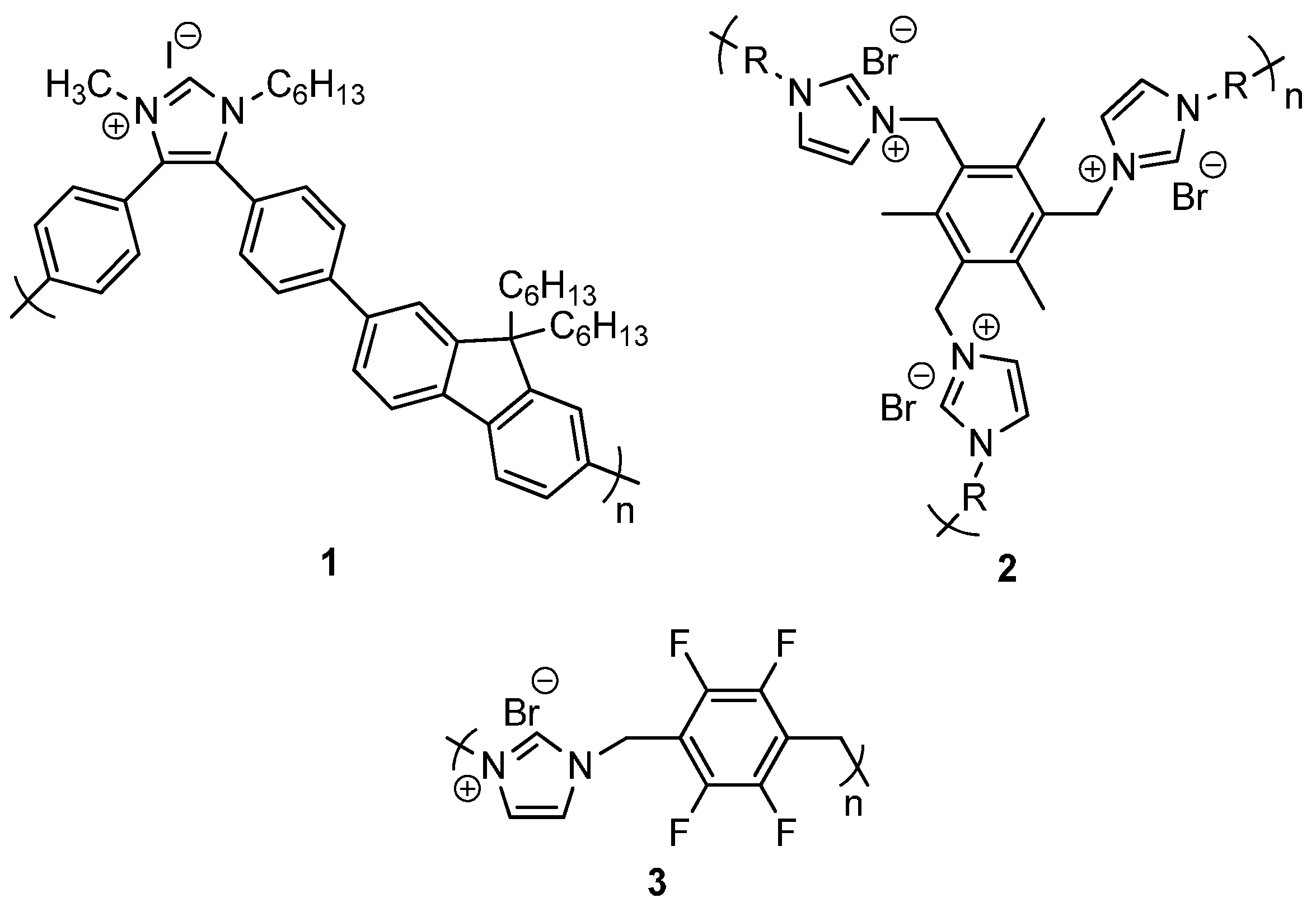
For example, Cowley et al. described the use of 1 as a recyclable self-supported organocatalyst precursor for benzoin condensation reactions (Figure 2) [25]. However, relatively large solubilizing groups were used to link the imidazolium groups, which significantly lowered the catalytic group loading level of the polymer. Additionally, the linking groups were not attached to the nitrogen atoms, reducing the loading efficiency even further. In related research, Ying and co-workers used multifunctional linker groups to join imidazolium groups that did not bear solubilizing groups, and were attached at the nitrogen atoms to generate heterogeneous polymers, such as 2 [26,27,28,29]. These polymers were used as NHC precursors in catalytic applications, often in the presence of a metal such as Pd or Cu. Also, Liu et al. synthesized polymers, such as 3, using fluorinated linker groups to connect imidazolium groups [30]. However, these polymers were not used as NHC precursors, but were directly applied as salts to catalyze CO2 cycloaddition reactions with epoxides to form cyclic carbonates.
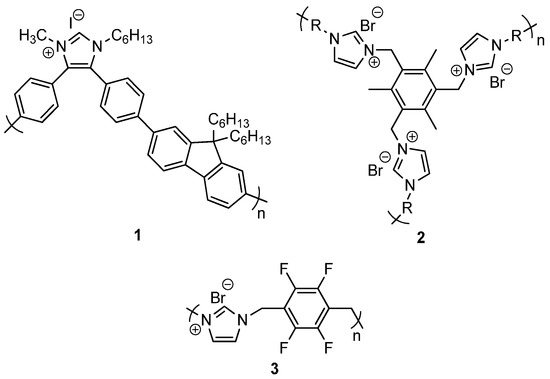
Figure 2.
Examples of self-supported imidazolium salts used as N-hereocyclic carbene (NHC) precursors and catalysts.
Our group has had a longstanding interest in studying polymer-supported catalysts and reagents in general [31,32,33,34], and we have recently reported a self-supported oxime ligand for use in Pd-catalyzed Suzuki-Miyaura reactions [35]. This research has motivated us to examine self-supported imidazolium and benzimidazolium salts with flexible linker groups as NHC organocatalyt precursors. The premise underlying this research was that while the self-supported polymeric salts themselves would be insoluble in most organic solvents, the use of flexible linker groups would allow for the polymers to become soluble after deprotonation to generate the corresponding neutral self-supported NHC groups, which could then serve as homogeneous catalytic groups. Furthermore, it was expected that reprotonation of the polymers at the end of reactions would precipitate them from the reaction mixtures so that they could be separated from the desired products simply by filtration, and be ready for reuse. Herein we report the results of our research.
2. Results and Discussion
2.1. Synthesis of Self-Supported NHC Precursors
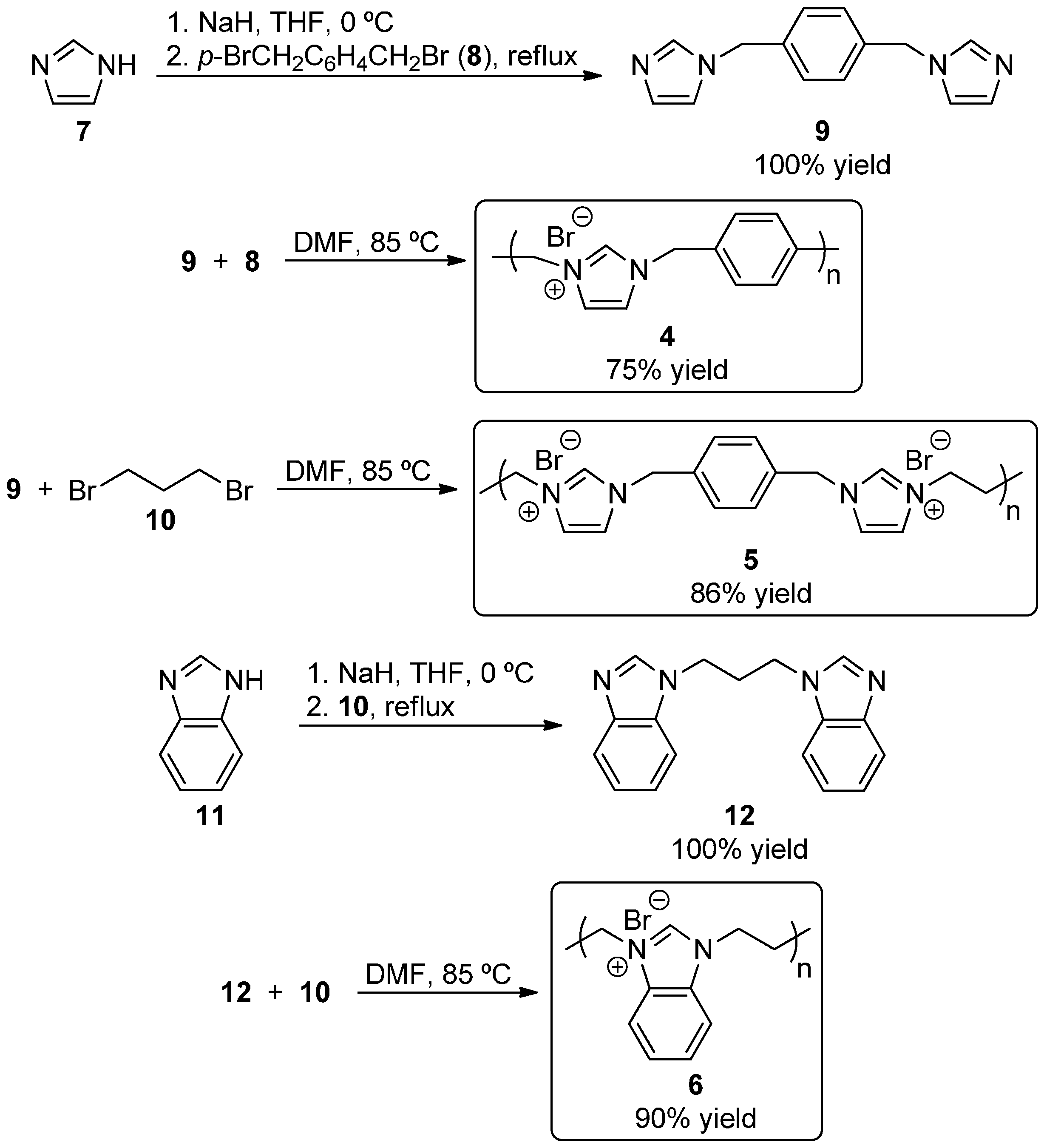
Since one of the major objectives of this research project was to examine what effect, if any, the use of flexible linker groups to connect the NHC groups has on their solubility, and thus catalytic utility, we targeted polymers 4–6 for study (Scheme 1), and methods similar to those utilized by Ying and co-workers were used for their preparation [26]. For the synthesis of 4 and 5, two equivalents of imidazole (7) were deprotonated using NaH and then alkylated with a single equivalent of 1,4-bis(bromomethyl)benzene (8) to afford 9 in quantitative yield. Alkylation of 9 using 8 again in DMF at elevated temperature afforded polymeric imidazolium salt 4 in 75% yield. Using 1,3-dibromopropane (10) to alkylate 9 afforded polymer 5 in 86% yield. Similarly, two equivalents of benzimidazole (11) were alkylated as before with one equivalent of 10 to afford 12 in quantitative yield, and 12 was subsequently alkylated with 10 a second time to afford polymer 6 in 90% yield. Thus, polymers 4 (with relatively rigid linkers), 5 (with one relatively rigid linker and one flexible linker), and 6 (with two flexible linkers) were prepared in short order and high overall yield from simple starting materials.
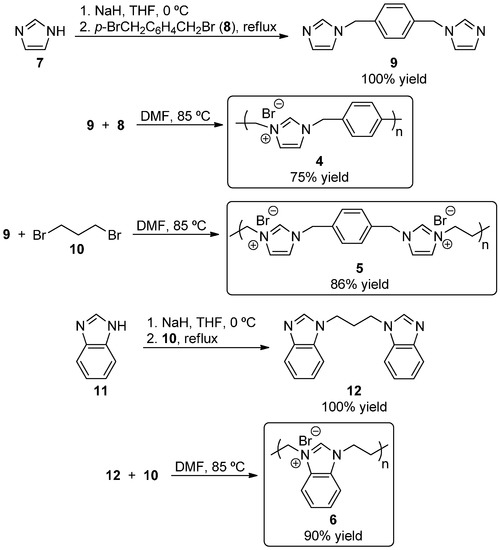
Scheme 1.
Synthesis of polymers 4–6.
2.2. Self-Supported NHCs as Catalysts in Benzoin Condensation Reactions
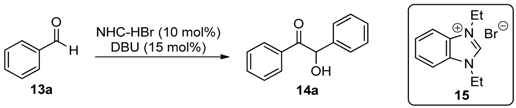
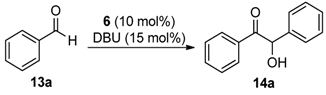
With our target polymeric salts in hand, we examined their utility as NHC precursors in the benzoin condensation of benzaldehyde (13a) to produce the alpha-hydroxy ketone product 14a. The base DBU was used in DMSO for deprotonation of the polymers to generate the NHC catalytic groups, and in side-by-side reactions when no polymer or polymer 4 was used, no desired product 14a was detected after 18 h (Table 1, entries 1 and 2). DBU was chosen as the base for these studies since it is typically used in such reactions, and we believe that the lack of reactivity of 4 was due to its complete insolublity. When polymers 5 and 6 were used, 14a was formed in 74% and 82% isolated yield, respectively (entries 3 and 4). Thus, it does appear that incorporating flexible linker groups into the polymers does increase the catalytic utility of the self-supported NHC organocatalysts by increasing polymer solubility. While polymers 5 and 6 performed similarly, we chose to use 6 for our further studies. Changing the reaction solvent to THF resulted in significantly lower yield (entry 5), but using DMF allowed for high yield (84%) after only 5 h (entry 6). Increasing the reaction concentration further enhanced the isolated yield to 92% (entry 7). When no DBU was added, no reaction occurred, confirming the role of NHC catalysis (entry 8). For the sake of comparison, we prepared N,N’-diethylbenzi midazolium bromide (15, see Experimental Section) as a small molecule analogue of polymer 6, and found that the corresponding NHC was much less effective as an organocatalyst (entry 9). Perhaps locating the NHC groups closely in a polymer allows for increased local concentration of the catalytic groups compared to the case of a molecular catalyst what would be more evenly distributed throughout the solution, and this high local concentration allows for synergism between the functional groups that results in improved catalytic efficiency [36,37].

Table 1.
Benzoin condensation reaction of 13a using polymers 4–6 and 15 a.
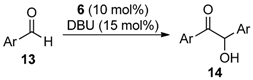
Using the best identified reaction conditions, a variety of aromatic aldehydes were used as substrates in benzoin condensation reactions using polymer 6 as the precatalyst. As can be seen in Table 2, simple electron-donating and electron–withdrawing group substituted benzldehydes 13b–d worked well in these reactions to produce the expected products 14b–d in high isolated yields (entries 1–3). Highly electron-rich 13e and highly electron-poor 13f also worked well in these reactions, producing 14e and 14f, respectively (entries 5 and 6). Even napthaldehyde 13g could be converted into product 14g in excellent yield.
Table 2.
Substrate scope of benzoin condensation reactions using polymer 6 a.
The possibility of recovering and reusing 6 was also explored using 13a as the substrate (Table 3). After the reaction to form 13a was complete, a solution of HCl in 1,4-dioxane (4.0 M) was added slowly dropwise into the mixture. The reaction mixture was stirred for an additional 1 h at room temperature, followed by the addition of ethyl acetate (20 mL). The liquid containing the crude 13a was decanted and the light yellow precipitate 6 was washed with additional ethyl acetate (10 mL), and dried under vacuum (quantitative recovery). This was then directly used in the next reaction cycle. As can be seen in Table 3, polymer 6 was used five times with no obvious decrease in catalytic efficiency.
Table 3.
Recycling experiments using polymer 6 a.
2.3. Self-Supported NHCs as Catalysts in Redox Esterification Reactions of α,β-Unsaturated Aldehydes
We next applied 6 in the redox esterification reactions of conjugated unsaturated aldehydes described by Chan and Scheidt [38]. Since it was previously reported that these reactions require a balance between the ability to generate the NHC catalyst through deprotonation of the benzimidazolium salt and the acidity needed to protonate the homoenolate equivalent [39], we examined the use of weakly acidic phenol additives in these reactions. Initial reactions were performed using cinnamaldehyde (16A) and benzyl alcohol (17a) as substrates (Table 4). When no additive was used, only 44% yield of ester 18Aa was obtained in toluene at 100 °C after 4 h using 10 mol % 6 (entry 1). However, when PhOH (1 equiv.) was added and the reaction time was increased to 48 h, 86% of 18Aa was obtained (entry 2). Switching to 4-nitrophenol (1 equiv.) further increased the yield of 18Aa to 91% under otherwise identical reaction conditions (entry 3). Doubling the amount of 6 to 20 mol % allowed the reaction time to be shortened to 3 h (entry 4), but diluting the reaction only served to lower the yield and increase the reaction time necessary for completion (entry 5). Interestingly, using 15 in place of 6 lead to lowering of the isolated yield of 18Aa to 51% even after 8 h.
Table 4.
NHC-catalyzed redox esterification reactions using polymer 6 a.
Using the best identified reaction conditions we next examined the substrate scope of such redox esterification reaction using 6 as summarized in Table 5. Primary benzyl alcohols 17b–d were reacted with 16A to produce the corresponding esters 18Ab–d in excellent yields (entries 1–3). When secondary benzyl alcohol 17e was used, only low yield of 18Ae was obtained (entry 4), as was the case with menthol (17f) to form 18Af (entry 5). Perhaps not surprisingly, when no substrate alcohol was used, 4-nitrophenyl ester 18Ag was obtained in very low yield (entry 6). Electron-withdrawing group substituted cinnamaldehydes 16B and 16C reacted with 17a to form 18Ba and 18Ca in excellent yields, respectively (entries 7 and 8), as did electron-donating group substituted cinnamaldehydes 16D and 16E to form 18Da and 18Ea, respectively (entries 9 and 10). Even heterocyclic analogue of cinnamaldehyde 16F produced the corresponding ester 18Fa in very high yield (entry 11).
Table 5.
Substrate scope of redox esterification reactions using 6 a.
3. Experimental Section
3.1. General Information
Unless otherwise noted, all reagents were obtained from the Acros (Bridgewater, NJ, USA), Aldrich (St. Louis, MO, USA), or Alfa Aesar (Ward Hill, MA, USA) companies, and were used directly without purification. Toluene was dried using a Solv-Tek purification system employing activated Al2O3 (Innovative Technology China Ltd., Hong Kong, China). Tetrahedrofuran (THF) was distilled from Na metal under a N2 atmosphere before use. All reactions were carried out in dry glassware under a N2 atmosphere, and were monitored by TLC analysis using GF254 silica gel coated plates. The corresponding Rf values and solvents used as eluents are listed. Column chromatography was performed with silica gel (230–400 mesh). NMR spectra were recorded on a Bruker (Billerica, MA, USA) DRX-300 or DRX-400 spectrometer operating at 300/400 MHz for 1H and 75/100 MHz for 13C analysis. Chemical shift data is expressed in ppm with reference to TMS. The following abbreviations were used for the assignment of the signals and their multiplicities: s (singlet), bs (broad singlet), d (doublet), t (triplet), q (quartet), p (pentet), m (multiplet), dt (double of triplet). Mass spectra data were obtained on a Finnigan MAT 96 mass spectrometer (Thermo Electron Corp., Madison, WI, USA).
3.2. Synthesis of NHC Precursors
Synthesis of 9 and 12. Sodium hydride (60% in oil, 2.2 g, 55.0 mmol) was slowly added to imidazole (7, 3.5 g, 51.4 mmol) or benzimidazole (11, 6.0 g, 50.8 mmol) in dry THF (150 mL) at 0 °C, and the resulting suspension was stirred at rt for 2 h (until the hydrogen gas evolution ceased). Then 8 (for 9, 13.2 g, 50.0 mmol) or 10 (for 12, 10.1 g, 50 mmol) was added, and the resulting mixture was refluxed for 6 h more. The solvent was then removed under vacuum and the thus obtained crude product was dissolved in dichloromethane (150 mL) and washed with water (100 mL). The aqueous phase was extracted with dichloromethane (2 × 150 mL). The combined organic layers were washed with a saturated NaCl solution (200 mL), dried over anhydrous magnesium sulfate and filtered. After removal of the solvent under reduced pressure, the product was redissolved in dichloromethane (15 mL) and slowly added dropwise into diethyl ether (350 mL) to precipitate the pure product. The product 9 or 12 was dried at 70 °C under vacuum overnight and obtained in quantitative yield. See Supplementary Materials for NMR spectra.
1,1′-(p-Phenylenedimethylene)bisimidazole (9). White solid. 1H-NMR (400 MHz, CDCl3, ppm): δ 5.11 (s, 4H), 6.88 (s, 2H), 7.09 (s, 2H), 7.13 (s, 4H), 7.53 (s, 2H). 13C-NMR (100 MHz, CDCl3): δ 50.4, 119.3, 127.9, 130.1, 136.5, 137.5. LRMS for C14H14N4: calcd 238.1, found 238.0.
1,1′-(1,3-Propanediyl)bis-1H-benzimidazole (12). Light yellow solid. 1H-NMR (400 MHz, CDCl3, ppm): δ 2.56 (p, 2H, J = 4.0 Hz), 4.21 (t, 4H, J = 4.0 Hz), 7.277.34 (m, 6H), 7.84–7.86 (m, 2H), 7.87 (s, 2H). 13C-NMR (100 MHz, CDCl3): δ 29.4, 41.7, 109.3, 120.6, 122.5, 123.3, 133.3, 142.6, 143.9. LRMS for C17H16N4: calcd 276.1, found 276.0.
Synthesis of the polymeric salts 4–6. The polymeric salts were made via direct alkylation of the 9 or 12 using 8 or 10 in a 1:1 molar ratio on a 10 mmol scale in dry DMF (150 mL). The reaction mixture was heated for two days at 85 °C. The solid product that precipitated from the solution and was filtered, washed with additional DMF (50 mL) and Et2O (2 × 50 mL), and dried under vacuum at 70 °C for 24 h. See Supplementary Materials for NMR spectra.
Polymer 4 was obtained in 75% yield as a white powder. It was completely insoluble in all solvents examined and thus was not characterized by NMR analysis.
Polymer 5 was obtained as light yellow powder with 86% yield. 1H-NMR (400 MHz, d6-DMSO, ppm): δ 2.42 (bs, 2H), 4.24–4.30 (m, 4H), 5.39–5.49 (m, 4H), 7.31–7.53 (m, 4H), 7.78–7.88 (m, 4H), 9.33–9.57 (m, 2H).
Polymer 6 was obtained as white powder with 90% yield. 1H-NMR (400 MHz, d6-DMSO, ppm): δ 2.67 (bs, 2H), 4.46–4.76 (m, 4H), 7.63–7.71 (m, 4H), 9.88–10.27 (m, 1H).
Synthesis of 15. Sodium hydride (60% in oil, 2.2 g, 55.0 mmol) was added to a solution of 11 (6.0 g, 50.8 mmol) in THF (150 mL) at 0 °C and the resulting suspension was stirred at room temperature for 2 h (until hydrogen gas evolution ceased). Bromoethane (5.4 g, 50.0 mmol) was added to the reaction mixture and the resulting solution was heated at 70 °C for 6 h more. The solvent was removed under vacuum and the crude product was dissolved in dichloromethane (150 mL) and washed with water. The aqueous phase was extracted with dichloromethane (2 × 150 mL). The combined organic layers were washed with a saturated NaCl solution (200 mL), dried over anhydrous magnesium sulfate and filtered. The crude product was purified by silica gel chromatography to afford the desired product N-ethyl-1H-benzimidazole (93% yield) as yellow/brown oil. N-Ethyl-1H-benzimidazole (5.8 g, 40.0 mmol) and bromoethane (4.4 g, 40.0 mmol) were dissolved in 100 mL of THF. The reaction vial was sealed and the resulting solution was heated at 70 °C for 12 h. The slightly yellow solid product that precipitated from the solution was filtered, washed with diethyl ether (2 × 25 mL), and dried under vacuum at 70 °C for 24 h to afford 15 (95% yield). See Supplementary Materials for NMR spectra.
1,3-Diethyl-1H-benzimidazolium bromide (15). Pale yellow solid. 1H-NMR (400 MHz, CDCl3, ppm): δ 1.76 (t, 6H, J = 8.0 Hz), 4.71 (q, 4H, J = 8.0 Hz), 7.68–7.70 (m, 2H), 7.77–7.80 (m, 2H), 11.42 (s, 1H). 13C-NMR (100 MHz, CDCl3): δ 15.0, 43.0, 113.2, 127.3, 131.3, 142.2. LRMS for [C11H15N2]+: calcd 175.1, found 175.0.
3.3. General Procedure for the Benzoin Condensation Reactions
A Schlenk flask was charged with 13 (2.94 mmol) and 6 (10 mol %). Dry, degassed DMF (2 mL) was added via syringe, followed by DBU (15 mol %). The reaction mixture was stirred at room temperature under an atmosphere of nitrogen for the indicated time. Then a solution of HCl in dioxane (4.0 M, 0.2 mL) was added via syringe, and the reaction mixture was stirred for an additional 1 h at room temperature under nitrogen. Ethyl acetate (20 mL) was then added dropwise to precipitate the polymer. The liquid phase was decanted and the light yellow precipitate 6 was washed with additional ethyl acetate (10 mL), and dried under vacuum. The combined organic phase was then extracted into ethyl acetate (100 mL), washed with brine (3 × 100 mL) and the aqueous layer was back-extracted with ethyl acetate (100 mL). The organic layers were combined, dried with anhydrous magnesium sulfate, filtered, concentrated and purified by column chromatography (SiO2; hexanes: ethyl acetate). Characterization details for each compound are shown below. See Supplementary Materials for NMR spectra.
2-Hydroxy-1,2-diphenylethanone (14a). TLC (3:1 v/v hexanes:ethyl acetate): Rƒ = 0.45. 1H-NMR (400 MHz, CDCl3, ppm): δ 4.56 (d, 1H, J = 8.0 Hz), 5.95 (d, 1H, J = 8.0 Hz), 7.24–7.36 (m, 4H), 7.39–7.44 (m, 2H), 7.52–7.58 (m, 1H), 7.89–7.93 (m, 2H). 13C-NMR (100 MHz, CDCl3): δ 76.4, 127.9, 128.7, 128.8, 129.2, 133.6, 134.0, 139.1, 199.1. LRMS for C14H12O2: calcd 212.1, found 212.1.
2-Hydroxy-1,2-di(4-chloro-phenyl)ethanone (14b). TLC (3:1 v/v hexanes:ethyl acetate): Rƒ = 0.45. 1H-NMR (400 MHz, CDCl3, ppm): δ 4.52 (d, 1H, J = 8.0 Hz), 5.88 (d, 1H, J = 8.0 Hz), 7.23–7.26 (m, 2H), 7.30–7.32 (m, 2H), 7.37–7.40 (m, 2H), 7.81–7.84 (m, 2H). 13C-NMR (75 MHz, CDCl3): δ 75.6, 129.2, 129.3, 129.6, 130.6, 131.7, 134.9, 137.3, 140.9, 197.6. LRMS for C14H10Cl2O2: calcd 280.0, found 280.0.
2-Hydroxy-1,2-di(4-bromo-phenyl)ethanone (14c). TLC (3:1 v/v hexanes:ethyl acetate): Rƒ = 0.45. 1H-NMR (400 MHz, CDCl3, ppm): δ 4.49 (d, 1H, J = 8.0 Hz), 5.86 (d, 1H, J = 8.0 Hz), 7.17–7.20 (m, 2H), 7.44–7.47 (m, 2H), 7.54–7.57 (m, 2H), 7.72–7.76 (m, 2H). 13C-NMR (100 MHz, CDCl3): δ 75.7, 129.5, 129.7, 130.6, 132.1, 132.3, 132.6, 137.8, 138.3, 197.8. LRMS for C14H10Br2O2: calcd 367.9, found 367.9.
2-Hydroxy-1,2-di(4-methoxy-phenyl)ethanone (14d). TLC (1:1 v/v hexanes:ethyl acetate): Rƒ = 0.60. 1H-NMR (400 MHz, CDCl3, ppm): δ 3.73 (s, 3H), 3.80 (s, 3H), 4.55 (d, 1H, J = 8.0 Hz), 5.85 (d, 1H, J = 8.0 Hz), 6.87–6.83 (m, 4H), 7.27–7.23 (m, 2H), 7.92–7.88 (m, 2H). 13C-NMR (100 MHz, CDCl3): δ 55.7, 56.0, 75.7, 115.0, 126.9, 129.3, 131.7, 132.1, 160.1, 164.1, 197.6. LRMS for C16H16O4: calcd 272.1, found 272.1.
2-Hydroxy-1,2-di(3,4,5-trimethoxy-phenyl)ethanone (14e). TLC (1:5 v/v hexanes:ethyl acetate): Rƒ = 0.56. 1H-NMR (300 MHz, CDCl3, ppm): δ 3.81 (s, 3H), 3.82–3.83 (m, 12H), 3.90 (m, 3H), 4.58 (d, 1H, J = 6.0 Hz), 5.77 (d, 1H, J = 6.0 Hz), 6.56 (s, 2H), 7.20 (s, 2H). 13C-NMR (75 MHz, CDCl3): δ 56.29, 56.31, 60.93, 61.09, 76.54, 104.83, 106.95, 128.31, 135.12, 153.07, 153.98, 197,43. LRMS for C20H24O8: calcd 392.1, found 392.2.
2-Hydroxy-1,2-di(4-trifluoromethyl-phenyl)ethanone (14f). TLC (3:1 v/v hexanes:ethyl acetate): Rƒ = 0.22. 1H-NMR (400 MHz, CDCl3, ppm): δ 4.45 (bs, 1H), 6.03 (s, 1H), 7.46 (d, 2H, J = 8.0 Hz), 7.60 (d, 2H, J = 8.0 Hz), 7.69 (d, 2H, J = 8.0 Hz), 8.00 (d, 2H, J = 8.0 Hz). 13C-NMR (100 MHz, CDCl3): δ 76.1, 122.0, 124.7, 126.1, 126.4, 128.2, 129.5, 136.1, 138.3, 142.1, 197.8. LRMS for C16H10F6O8: calcd 348.1, found 348.1.
2-Hydroxy-1,2-di(2-napthyl)ethanone (14g). TLC (3:1 v/v hexanes:ethyl acetate): Rƒ = 0.52. 1H-NMR (300 MHz, CDCl3, ppm): δ 4.83 (s, 1H), 6.31 (s, 1H), 7.42–7.57 (m, 5H), 7.75–8.03 (m, 8H), 8.52 (s, 1H), 7.72–7.76 (m, 2H). 13C-NMR (75 MHz, CDCl3): δ 76.5, 124.3, 125.0, 126.5, 126.6, 127.0, 127.6, 127.78, 127.81 128.1, 128.7, 129.1, 129.2, 129.8, 130.9, 131.5, 132.3, 133.3, 133.5, 135.9, 136.7, 199.0. LRMS for C22H16O2: calcd 312.1, found 312.1.
3.4. Recycling of Polymer 5 from Benzoin Condensation Reactions
After the reaction was complete, the precipitated polymer was separated as above, and the light yellow polymer was washed with additional ethyl acetate (10 mL) and dried under vacuum (quantitative recovery of 6), and used directly for the next reaction cycle.
3.5. General Procedure for the Redox Esterification of α,β-Unsaturated Aldehydes
Aldehyde 16 (1.5 mmol), alcohol 17 (3.0 mmol), and 6 (20 mol %) were mixed in toluene (1 mL) in a reaction vial. The vial was flushed with N2. DBU (25 mol %) was then added slowly dropwise into the reaction vial and the reaction mixture, followed by the addition of 4-nitrophenol (100 mol %), the reaction mixture was then stirred at 100 °C. The reaction was monitored by TLC and stirred for time indicated in Table 5. The mixture was then cooled to room temperature and the reaction was quenched by a solution of HCl in 1,4-dioxane (4.0 M, 0.2 mL). Ethyl acetate (20 mL) was dropwise into the vial to precipitate the polymeric catalyst. The precipitate was filtered and the filtrate was washed with additional ethyl acetate (10 mL). The combined organic phase was concentrated under vaccum and purified by column chromatography (SiO2; hexanes: ethyl acetate). Characterization details for each compound are shown below. See Supplementary Materials for NMR spectra.
Benzyl 3-phenylpropanoate (18Aa). TLC (1:20 v/v hexanes:ethyl acetate): Rƒ = 0.52. 1H-NMR (300 MHz, CDCl3, ppm): δ 2.67 (t, 2H, J = 7.5 Hz), 2.96 (t, 2H, J = 7.5 Hz), 7.15–7.39 (m, 10H). 13C-NMR (75 MHz, CDCl3): δ 31.0, 36.0, 66.3, 118.0, 128.6, 128.7, 129.0, 130.4, 136.0, 140.5, 145.3, 172.8. LRMS for C14H12O2: calcd 240.1, found 240.1.
4-Bromobenzyl 3-phenylpropanoate (18Ab). TLC (1:20 v/v hexanes:ethyl acetate): Rƒ = 0.45. 1H-NMR (300 MHz, CDCl3, ppm): δ 2.68 (t, 2H, J = 7.5 Hz), 2.94 (t, 2H, J = 7.5 Hz), 5.04 (s, 2H), 7.14–7.50 (m, 9H). 13C-NMR (75 MHz, CDCl3) δ 31.0, 35.9, 65.6, 122.4, 126.5, 128.4, 128.7, 130.0, 131.8, 135.1, 140.4, 172.7. HRMS for C16H15BrO2: calcd 318.0255, found 318.0245.
2-Bromobenzyl 3-phenylpropanoate (18Ac). TLC (1:20 v/v hexanes:ethyl acetate): Rƒ = 0.50. 1H-NMR (300 MHz, CDCl3, ppm): δ 2.76 (t, 2H, J = 7.5 Hz), 3.04 (t, 2H, J = 7.5 Hz), 5.23 (s, 2H), 7.17–7.34 (m, 8H), 7.60 (d, 1H, J = 9.0 Hz). 13C-NMR (75 MHz, CDCl3) δ 31.0, 35.8, 65.9, 123.5, 126.4, 127.5, 128.4, 128.6, 129.7, 129.9, 132.9, 135.3, 140.4, 172.6. HRMS for C16H15BrO2: calcd 318.0255, found 318.0245.
2-Chlorobenzyl 3-phenylpropanoate (18Ad). TLC (1:20 v/v hexanes:ethyl acetate): Rƒ = 0.50. 1H-NMR (300 MHz, CDCl3, ppm): δ 2.72 (t, 2H, J = 7.5 Hz), 2.99 (t, 2H, J = 7.5 Hz), 5.22 (s, 2H), 7.19–7.40 (m, 9H). 13C-NMR (75 MHz, CDCl3) δ 31.0, 35.9, 63.7, 126.4, 126.9, 128.2, 128.4, 128.6, 129.0, 129.5, 129.9, 133.7, 140.4, 172.6. HRMS for C16H15BrO2: calcd 274.0761, found 274.0759.
1-Phenylethyl 3-phenylpropanoate (18Ae). TLC (1:20 v/v hexanes:ethyl acetate): Rƒ = 0.50. 1H-NMR (300 MHz, CDCl3, ppm): δ 1.49 (d, 3H, J = 6.0 Hz), 2.64 (t, 2H, J = 7.5 Hz), 2.94 (t, 2H, J = 7.5 Hz), 5.88 (q, 1H, J = 6.0 Hz), 7.15–7.35 (m, 10H). 13C-NMR (75 MHz, CDCl3) δ 22.2, 31.0, 36.2, 72.4, 126.2, 126.3, 127.9, 128.4, 128.6, 140.5, 141.7, 172.2. LRMS for C17H13O2: calcd 254.1, found 254.1.
2-Isopropyl-4-methyl-cyclohexyl 3-phenylpropanoate (18Af). TLC (1:20 v/v hexanes:ethyl acetate): Rƒ = 0.56. 1H-NMR (400 MHz, CDCl3, ppm): δ 0.69 (d, 3H, J = 4.0 Hz), 0.80–0.93 (m, 8H), 1.25–1.36 (m, 1H), 1.41–1.52 (m, 1H), 1.61–1.76 (m, 4H), 1.91–1.95 (m, 1H), 2.58–2.62 (m, 2H), 2.92–2.96 (m, 2H), 4.67 (dt, 1H, J = 12.0 Hz), 7.18–7.28 (m, 5H). 13C-NMR (100 MHz, CDCl3): δ 16.4, 20.9, 22.1, 23.5, 26.3, 31.2, 31.5, 34.4, 36.3, 41.0, 47.1, 74.3, 126.3, 128.4, 128.5, 140.7, 172.6. HRMS for C19H28O2: calcd 288.2089, found 288.2082.
4-Nitrophenyl-3-phenylpropanoate (18Ag). TLC (1:20 v/v hexanes:ethyl acetate): Rƒ = 0.50. 1H-NMR (400 MHz, CDCl3): δ 2.94 (t, 2H, J = 8.0 Hz), 3.09 (t, 2H, J = 8.0 Hz), 7.17–7.20 (m, 2H), 7.26–7.27 (m, 2H), 7.32–7.36 (m, 2H), 8.24–8.26 (m, 2H, J = 7.5 Hz). 13C-NMR (CDCl3, 100 MHz): 30.1, 35.6, 120.5, 122.3, 125.2, 130.1, 131.7, 139.0, 145.3, 155.5, 170.3. LRMS for C15H13NO4: calcd 271.1, found 271.1.
Benzyl 3-(4-bromophenyl)propanoate (18Ba). TLC (1:20 v/v hexanes:ethyl acetate): Rƒ = 0.38. 1H-NMR (300 MHz, CDCl3, ppm): δ 2.68 (t, 2H, J = 9.0 Hz), 2.95 (t, 2H, J = 7.5 Hz), 5.11 (s, 2H), 7.11–7.14 (m, 2H), 7.29–7.35 (m, 6H). 13C-NMR (75 MHz, CDCl3): δ 30.36, 35.65, 66.40, 120.14, 128.30, 128.32, 128.61, 130.17, 131.59, 135.85, 139.38, 172.40. LRMS for C16H15BrO2: calcd 318.0, found 318.0.
Benzyl 3-(4-cyanophenyl)propanoate (18Ca). TLC (1:15 v/v hexanes:ethyl acetate): Rƒ = 0.40. 1H-NMR (400 MHz, CDCl3, ppm): δ 2.69 (t, 2H, J = 8.0 Hz), 3.02 (t, 2H, J = 6.0 Hz), 5.10 (s, 2H), 7.26–7.29 (m, 4H), 7.33–7.36 (m, 2H), 7.63–7.55 (m, 2H). 13C-NMR (100 MHz, CDCl3): δ 30.8, 35.0, 66.4, 110.1, 118.9, 128.2, 128.3, 128.5, 129.1, 132.2, 135.6, 145.9, 171.9. HRMS for C17H15O2N: calcd 265.1103, found 265.1101.
Benzyl 3-(4-tert-butylphenyl)propanoate (18Da). TLC (1:20 v/v hexanes:ethyl acetate): Rƒ = 0.42. 1H-NMR (300 MHz, CDCl3, ppm): δ 2.68 (t, 2H, J = 9.0 Hz), 2.95 (t, 2H, J = 7.5 Hz), 5.11 (s, 2H), 7.11–7.14 (m, 2H), 7.29–7.35 (m, 6H). 13C-NMR (75 MHz, CDCl3): δ 30.5, 31.3, 31.5, 36.0, 66.4, 125.5, 128.1, 128.3, 128.6, 136.1, 137.4, 149.2, 173.0. HRMS for C20H24O2: calcd 296.1776, found 296.1174.
Benzyl 3-(4-methoxyphenyl)propanoate (18Ea). TLC (1:15 v/v hexanes:ethyl acetate): Rƒ = 0.55. 1H-NMR (300 MHz, CDCl3, ppm): δ 2.65 (t, 2H, J = 7.5 Hz), 2.91 (t, 2H, J = 7.5 Hz), 3.78 (s, 3H), 5.10 (s, 2H), 6.82 (d, 2H, J = 9.0 Hz), 7.09 (d, 2H, J = 9.0 Hz), 7.29–7.36 (m, 5H). 13C-NMR (75 MHz, CDCl3): δ 30.2, 36.2, 55.3, 66.3, 113.9, 128.3, 128.6, 129.3, 132.5, 135.8, 158.1, 172.8. LRMS for C17H16O3: calcd 270.1, found 270.0.
Benzyl 3-(furan-2-yl)propanoate (18Fa). TLC (1:20 v/v hexanes:ethyl acetate): Rƒ = 0.36. 1H-NMR (400 MHz, CDCl3, ppm): δ 2.68 (t, 2H, J = 8.0 Hz), 2.97 (t, 2H, J = 8.0 Hz), 5.11 (s, 2H), 5.98–5.99 (m, 1H), 6.23–6.24 (m, 1H), 7.26–7.35 (m, 6H). 13C-NMR (100 MHz, CDCl3): δ 23.5, 32.7, 66.4, 105.4, 110.0, 110.2, 128.3, 128.6, 135.9, 141.3, 154.1, 172.3. LRMS for C14H14O3: calcd 230.1, found 210.1.
4. Conclusions
In conclusion, we have prepared a series of self-supported imidazolium and benzimidazolium polymeric salts (4–6) that can function as NHC precursors by attaching the linker groups as nitrogen substituents. These were heterogeneous at the outset of reactions, but when deprotonated in situ using DBU to generate the corresponding NHC organocatalytic groups, they became soluble, and were examined in benzoin condensation reactions. Polymer 6 performed best in the model reaction and it was used in a range of benzoin condensation and conjugated unsaturated aldehyde redox esterification reactions. Importantly polymer 6 could be recovered and reused from the former reactions by protonation to regenerate and precipitate it with no apparent decrease in utility through five reaction cycles. Furthermore, it appeared that the self-supported catalytic groups exhibited synergistic effects that were not observed when analogous molecular catalyst precursor 14 was used. Further study of this observation is currently ongoing, as is identification of additional applications for 6. Results of this research will be reported shortly.
Supplementary Materials
Copies of the NMR spectra can be accessed at: http://www.mdpi.com/1420-3049/21/8/1100/s1.
Acknowledgments
This research was supported financially by the University of Hong Kong and the Research Grants Council of the Hong Kong S. A. R., P. R. of China (Project No. 17305915).
Author Contributions
Experiments were performed by Ms. Shuang Ma and supervised by Prof. Patrick H. Toy.
Conflicts of Interest
The authors declare no conflicts of interest.
References
- Breslow, R. Rapid deuterium exchange in thiazolium salts. J. Am. Chem. Soc. 1957, 79, 1762–1763. [Google Scholar] [CrossRef]
- Breslow, R. On the mechanism of thiamine action. IV. Evidence from studies on model systems. J. Am. Chem. Soc. 1958, 80, 3719–3726. [Google Scholar] [CrossRef]
- Bugaut, X.; Glorius, F. Organocatalytic umpolung: N-heterocyclic carbenes and beyond. Chem. Soc. Rev. 2012, 41, 3511–3522. [Google Scholar] [CrossRef] [PubMed]
- Grossmann, A.; Enders, D. N-heterocyclic carbene catalyzed domino reactions. Angew. Chem. Int. Ed. 2012, 51, 314–325. [Google Scholar] [CrossRef] [PubMed]
- Izquierdo, J.; Hutson, G.E.; Cohen, D.T.; Scheidt, K.A. A continuum of progress: Applications of N-heterocyclic carbene catalysis in total synthesis. Angew. Chem. Int. Ed. 2012, 51, 11686–11698. [Google Scholar] [CrossRef] [PubMed]
- Douglas, J.; Churchill, G.; Smith, A.D. NHCs in asymmetric organocatalysis: Recent advances in azolium enolate generation and reactivity. Synthesis 2012, 44, 2295–2309. [Google Scholar]
- Ryan, S.J.; Candish, L.; Lupton, D.W. Acyl anion free N-heterocyclic carbene organocatalysis. Chem. Soc. Rev. 2013, 42, 4906–4917. [Google Scholar] [CrossRef] [PubMed]
- Hopkinson, M.N.; Richter, C.; Schedler, M.; Glorius, F. An overview of N-heterocyclic carbenes. Nature 2014, 510, 485–496. [Google Scholar] [CrossRef] [PubMed]
- Flanigan, D.M.; Romanov-Michailidis, F.; White, N.A.; Rovis, T. Organocatalytic reactions enabled by N-heterocyclic carbenes. Chem. Rev. 2015, 115, 9307–9387. [Google Scholar] [CrossRef] [PubMed]
- Mahatthananchai, J.; Bode, J.W. On the mechanism of N-heterocyclic carbene-catalyzed reactions involving acyl azoliums. Acc. Chem. Res. 2014, 47, 696–707. [Google Scholar] [CrossRef] [PubMed]
- Martin, D.; Canac, Y.; Lavallo, V.; Bertrand, G. Comparative reactivity of different types of stable cyclic and acyclic mono- and diamino carbenes with simple organic substrates. J. Am. Chem. Soc. 2014, 136, 5023–5030. [Google Scholar] [CrossRef] [PubMed]
- Paul, M.; Breugst, M.; Neudörfl, J.-M.; Sunoj, R.B.; Berkessel, A. Keto-Enol thermodynamics of Breslow intermediates. J. Am. Chem. Soc. 2016, 138, 5044–5051. [Google Scholar] [CrossRef] [PubMed]
- Kim, D.W.; Chi, D.Y. Polymer-supported ionic liquids: Imidazolium salts as catalysts for nucleophilic substitution reactions including fluorinations. Angew. Chem. Int. Ed. 2004, 43, 483–485. [Google Scholar] [CrossRef] [PubMed]
- Yuan, J.; Antonietti, M. Poly(ionic liquid)s: Polymers expanding classical property profiles. Polymer 2011, 52, 1469–1482. [Google Scholar] [CrossRef]
- Yuan, J.; Mecerreyes, D.; Antonietti, M. Poly(ionic liquid)s: An update. Prog. Polym. Sci. 2013, 38, 1009–1036. [Google Scholar] [CrossRef]
- Nishimura, N.; Ohno, H. 15th anniversary of polymerized ionic liquids. Polymer 2014, 55, 3289–3297. [Google Scholar] [CrossRef]
- Prakash, C.; Shinde, S.S.; Biradar, A.V. Tailor made ionic liquids: catalyst and media for organic transformations. Curr. Org. Chem. 2015, 19, 728–742. [Google Scholar]
- Zhou, H.; Zhang, W.-Z.; Wang, Y.-M.; Qu, J.-P.; Lu, X.-B. N-Heterocyclic carbene functionalized polymer for reversible fixation-release of CO2. Macromolecules 2009, 42, 5419–5421. [Google Scholar] [CrossRef]
- Pawar, G.M.; Buchmeiser, M.R. Polymer-supported carbon dioxide-protected N-heterocyclic carbenes: Synthesis and application in organo- and organometallic catalysis. Adv. Synth. Catal. 2010, 352, 917–928. [Google Scholar] [CrossRef]
- Pinaud, J.; Vignolle, J.; Gnanou, Y.; Taton, D. Poly(N-heterocyclic carbene)s and their CO2 adducts as recyclable polymer-supported organocatalysts for benzoin condensation and transesterification reactions. Macromolecules 2011, 44, 1900–1908. [Google Scholar] [CrossRef]
- Gondo, C.A.; Bode, J.W. Catalytic redox amidations of aldehydes with a polymer-supported peptide-N-heterocyclic carbene multifunctional catalyst. Synlett 2013, 24, 1205–1210. [Google Scholar] [CrossRef]
- Coupillaud, P.; Pinaud, J.; Guidolin, N.; Vignolle, J.; Fèvre, M.; Veaudecrenne, E.; Mecerreyes, D.; Taton, D. Poly(ionic liquid)s based on imidazolium hydrogen carbonate monomer units as recyclable polymer-supported N-heterocyclic carbenes: Use in organocatalysis. J. Polym. Sci. Part A Polym. Chem. 2013, 51, 4530–4540. [Google Scholar]
- Bortolini, O.; Cavazzini, A.; Dambruoso, P.; Giovannini, P.P.; Caciolli, L.; Massi, A; Pacifico, S.; Ragnoa, D. Thiazolium-functionalized polystyrene monolithic microreactors for continuous-flow umpolung catalysis. Green Chem. 2013, 15, 2981–2992. [Google Scholar] [CrossRef]
- Coupillaud, P.; Vignolle, J.; Mecerreyes, D.; Taton, D. Post-polymerization modification and organocatalysis using reactive statistical poly(ionic liquid)-based copolymers. Polymer 2014, 55, 3404–3414. [Google Scholar] [CrossRef]
- Powell, A.B.; Suzuki, Y.; Ueda, M.; Bielawski, C.W.; Cowley, A.H. A recyclable, self-supported organocatalyst based on a poly(N-heterocyclic carbene). J. Am. Chem. Soc. 2011, 133, 5218–5220. [Google Scholar] [CrossRef] [PubMed]
- Zhang, Y.; Zhao, L.; Patra, P.K.; Hu, D.; Ying, J.Y. Colloidal poly-imidazolium salts and derivatives. Nano Today 2009, 4, 13–20. [Google Scholar] [CrossRef]
- Tan, M.; Zhang, Y.; Ying, J.Y. Hydrosilylation of ketone and imine over poly-N-heterocyclic carbene particles. Adv. Synth. Catal. 2009, 351, 1390–1394. [Google Scholar] [CrossRef]
- Yu, D.; Zhang, Y. Copper- and copper-N-heterocyclic carbene-catalyzed C-H activating carboxylation of terminal alkynes with CO2 at ambient conditions. Proc. Natl. Acad. Sci. USA 2010, 107, 20184–20189. [Google Scholar] [CrossRef] [PubMed]
- Zhang, Y.; Ying, J.Y. Main-chain organic frameworks with advanced catalytic functionalities. ACS Catal. 2015, 5, 2681–2691. [Google Scholar] [CrossRef]
- Yang, Z.-Z.; Zhao, Y.; Ji, G.; Zhang, H.; Yu, B.; Gao, X.; Liu, Z. Fluoro-functionalized polymeric ionic liquids: Highly efficient catalysts for CO2 cycloaddition to cyclic carbonates under mild conditions. Green Chem. 2014, 16, 3724–3728. [Google Scholar] [CrossRef]
- Xia, X.; Toy, P.H. Rasta resin-triphenylphosphine oxides and their use as recyclable heterogeneous reagent precursors in halogenation reactions. Beilstein J. Org. Chem. 2014, 10, 1397–1405. [Google Scholar] [CrossRef] [PubMed]
- Ma, S.; Yang, Y.-C.; Toy, P.H. Rasta resin-TBD-catalyzed γ-selective Morita–Baylis–Hillman reactions of α,γ-disubstituted allenones. Synlett 2015, 26, 1732–1736. [Google Scholar] [CrossRef]
- Xia, X.; Toy, P.H. Polyethyleneimine-supported triphenylphosphine and its use as a highly loaded bifunctional polymeric reagent in chromatography-free one-pot Wittig reactions. Synlett 2015, 26, 1737–1743. [Google Scholar] [CrossRef]
- Ma, S.; Toy, P.H. Chromatography-free esterification reactions using a bifunctional polymer. Synlett 2016, 27, 1207–1210. [Google Scholar]
- Yang, Y.-C.; Toy, P.H. Self-supported ligands as a platform for catalysis: Use of a polymeric oxime in a recyclable palladacycle precatalyst for Suzuki–Miyaura reactions. Synlett 2014, 25, 1319–1324. [Google Scholar]
- Marti, J.; López-Calahorra, F.; Bofill, J.M. A theoretical study of benzoin condensation. J. Mol. Struct. THEOCHEM 1995, 339, 179–194. [Google Scholar] [CrossRef]
- Moore, J.L.; Silvestri, A.P.; de Alaniz, J.R.; DiRocco, D.A.; Rovis, T. Mechanistic investigation of the enantioselective intramolecular Stetter reaction: Proton transfer is the first irreversible step. Org. Lett. 2011, 13, 1742–1745. [Google Scholar] [CrossRef] [PubMed]
- Chan, A.; Scheidt, K.A. Conversion of α,β-unsaturated aldehydes into saturated esters: An umpolung reaction catalyzed by nucleophilic carbenes. Org. Lett. 2005, 7, 905–908. [Google Scholar] [CrossRef] [PubMed]
- Maki, B.E.; Chan, A.; Scheidt, K.A. Protonation of homoenolate equivalents generated by N-heterocyclic carbenes. Synthesis 2008, 40, 1306–1315. [Google Scholar]
- Sample Availability: Samples of the compounds are available from the authors.



© 2016 by the authors. Licensee MDPI, Basel, Switzerland. This article is an open access article distributed under the terms and conditions of the Creative Commons Attribution (CC-BY) license ( http://creativecommons.org/licenses/by/4.0/).