

Two New Phenolic Glycosides from Gnaphalium affine D. Don and Their Anti-Complementary Activity

Abstract
:1. Introduction
2. Results and Discussion
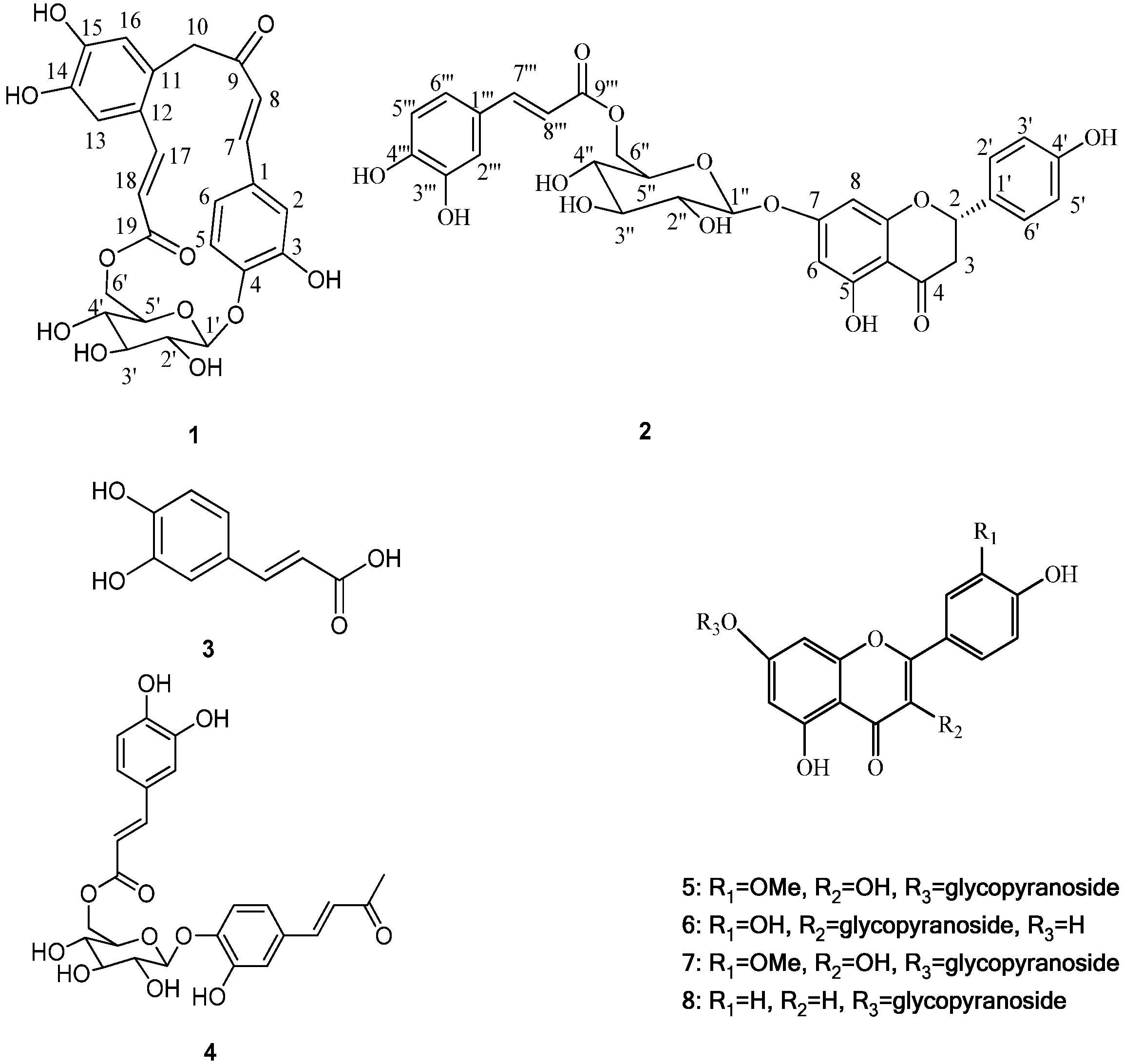
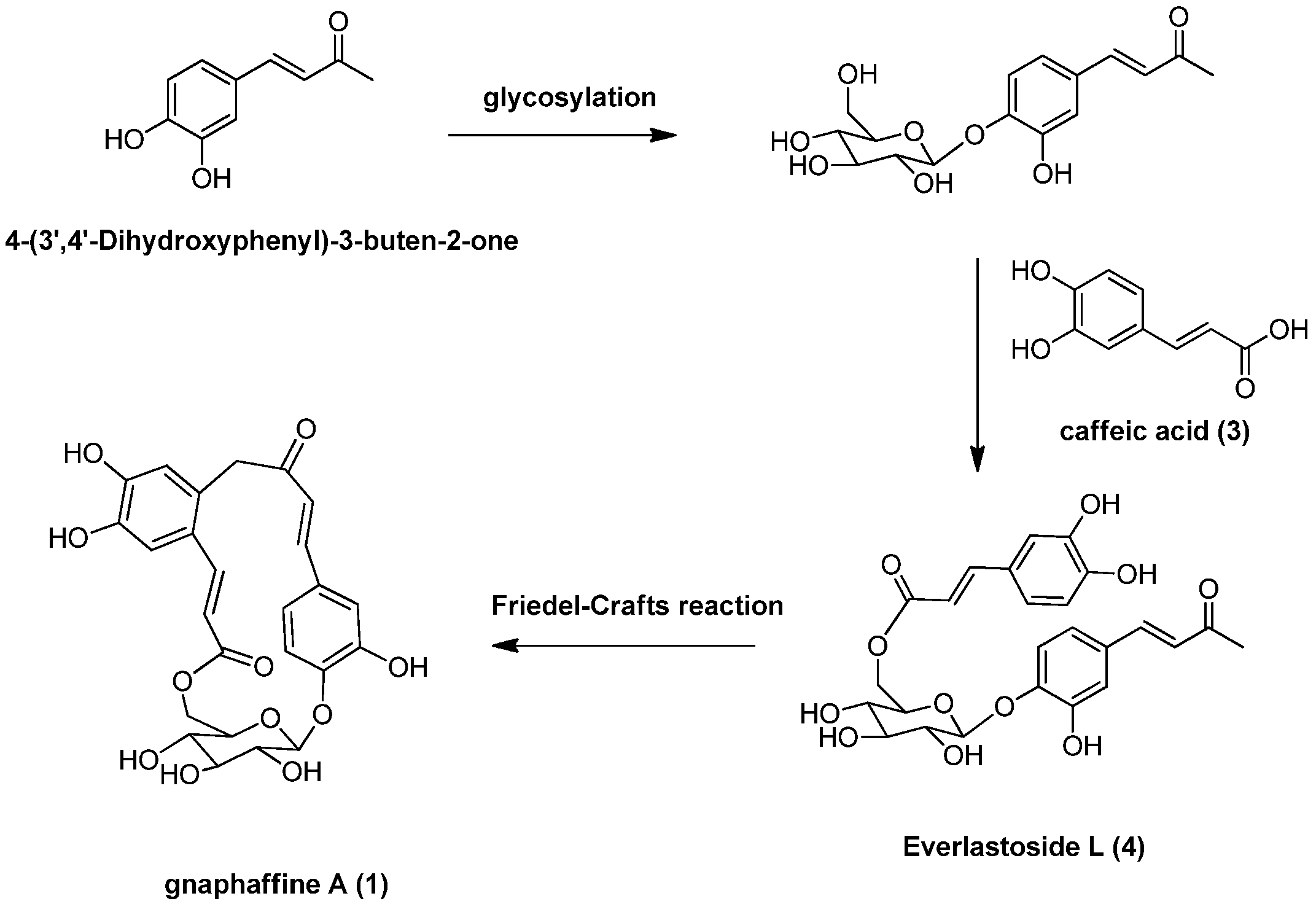
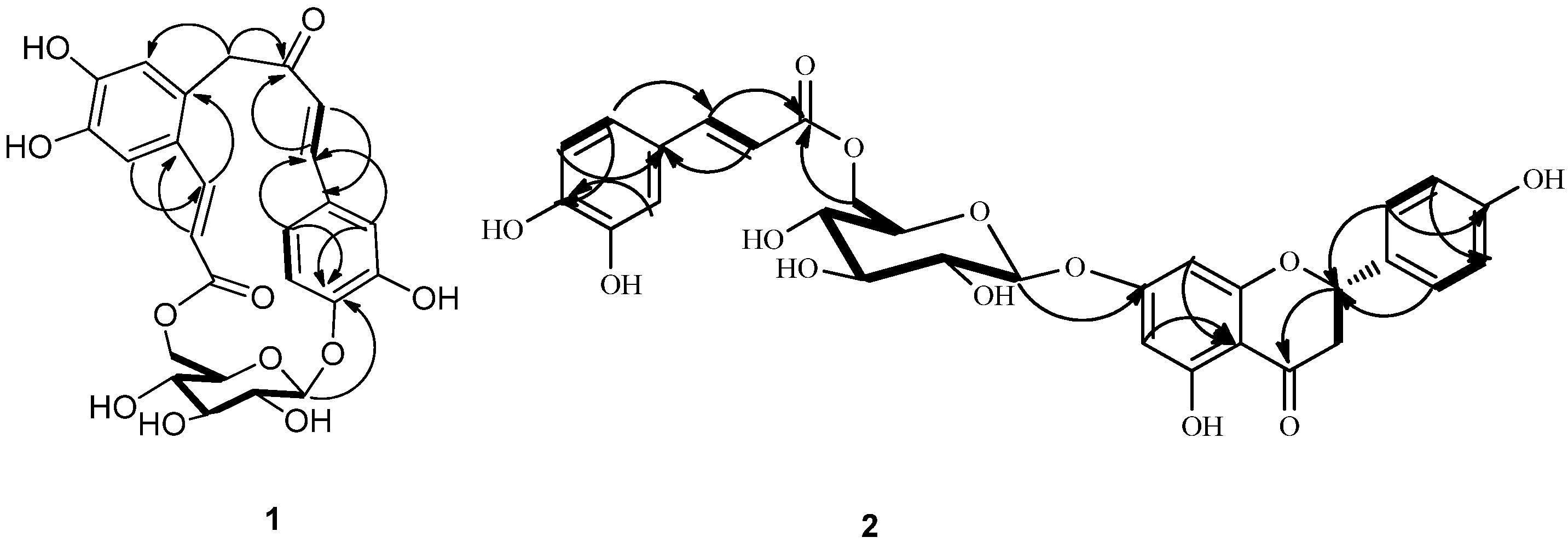
 +38.2 (c 0.15, H2O). The glucopyranose moiety was determined to have a β-configuration at C-1' from the large coupling constant of H-1' (J = 7.8 Hz) [2]. The 1H-NMR spectrum (Table 1) displayed signals for an ABX spin system at δ 7.40 (1H, d, J = 1.8 Hz, H-2), 7.08 (1H, dd, J = 8.4, 1.8 Hz, H-6) and 6.80 (1H, d, J = 8.4 Hz, H-5); two trans-configured double bonds at δ 7.33 (1H, d, J = 15.6 Hz, H-7) and δ 6.90 (1H, d, J = 15.6 Hz, H-8), δ 8.02 (1H, d, J = 15.6 Hz, H-17) and δ 6.10 (1H, d, J = 15.6 Hz, H-18) which were further confirmed by the HMQC correlations (H-7/C-7, H-8/C-8, H-17/C-17 and H-18/C-18) and 1H-1H COSY (Figure 2) correlations (H-7/H-8 and H-17/H-18); two singlet signals at δ 7.00 (1H, s, H-13) and δ 6.75 (1H, s, H-16) which suggests the presence of an 1,2,4,5-tetrasubstituted aromatic ring; one methylene group signals at δ 3.38 (1H, m, H-10a) and δ 4.26 (1H, m, H-10b) showed a correlation with δ 44.3 (C-10) in the HMQC. In addition to the above signals, a sugar moiety was identified due to the distinct anomeric signal at δ 4.88 (1H, d, J = 7.8 Hz, H-1'), four oxymethine protons signals between δ 4.10 and δ 3.38 and two oxymethylene protons signals at δ 4.38 and δ 4.29, which were further confirmed by the HMQC correlations and 1H-1H COSY correlations (Figure 2). Since the above-mentioned groups accounted for 13 degrees of unsaturation, the remaining degree suggested the presence of an additional ring system in the structure of 1. The HMBC experiment (Figure 2) showed clear correlations of ABX protons H-2 and H-6 with C-7, H-7 with C-2 and C-6 and of H-8 with C-1, which confirmed the presence of the carbon-carbon double bond attached at C-1 of the ABX system, while correlations of H-7 with C-9 and of H-8 with C-9 and C-10 confirmed the presence of the carbonyl group C-9 attached at C-8. Correlations of H-10a and H-10b with C-9, C-12 (δ 123.4) and C-16 (δ 117.9), and of H-16 with C-10 confirmed the attachment of C-10 at carbonyl group (C-9) and C-11 of the tetrasubstituted aromatic ring at C-10.
| Position | δ H | δ C |
|---|---|---|
| 1 | - | 125.7 |
| 2 | 7.40 (d, 1.8) | 112.4 |
| 3 | - | 145.6 |
| 4 | - | 149.4 |
| 5 | 6.80 (d, 8.4) | 116.0 |
| 6 | 7.08 (dd, 8.4, 1.8) | 126.4 |
| 7 | 7.33 (d, 15.6) | 143.2 |
| 8 | 6.90 (d, 15.6) | 122.3 |
| 9 | - | 196.1 |
| 10a | 3.38 (m) | 44.3 |
| 10b | 4.26 (m) | |
| 11 | - | 127.5 |
| 12 | - | 123.4 |
| 13 | 7.00 (s) | 113.2 |
| 14 | - | 144.8 |
| 15 | - | 148.3 |
| 16 | 6.75 (s) | 117.9 |
| 17 | 8.02 (d, 15.6) | 140.9 |
| 18 | 6.10 (d, 15.6) | 116.4 |
| 19 | - | 166.1 |
| 1' | 4.88 (d, 7.8) | 100.7 |
| 2' | 3.38 (m) | 72.7 |
| 3' | 3.38 (m) | 75.5 |
| 4' | 3.15 (m) | 70.6 |
| 5' | 4.10 (t, 9.4) | 73.7 |
| 6'a | 4.38 (d, 11.4) | 65.2 |
| 6'b | 4.29 (m) |
| Position | δ H | δ C |
|---|---|---|
| 2 | 5.45 (1H, dd, 3.0, 12.0) | 78.7 |
| 3 | 3.26 (1H, dd, 12.0, 17.4) | 42.1 |
| 2.70 (1H, dd, 17.4, 3.0) | ||
| 4 | - | 197.1 |
| 5 | - | 162.7 |
| 6 | 6.18 (1H, brs) | 96.3 |
| 7 | - | 163.2 |
| 8 | 6.13 (1H, dd, 1.8, 4.8) | 95.5 |
| 9 | - | 165.0 |
| 10 | - | 103.3 |
| 1' | - | 128.6 |
| 2', 6' | 7.27 (2H, d, 8.4) | 12.4 |
| 3', 5' | 6.76 (2H, d,8.4) | 115.2 |
| 4' | - | 157.8 |
| 1'' | 5.05 (1H, d, 7.8) | 99.3 |
| 2'' | 3.24 (1H, m) | 73.79 |
| 3'' | 3.30 (1H, m) | 76.4 |
| 4'' | 3.15 (1H, m) | 69.6 |
| 5'' | 3.40 (1H, m) | 77.1 |
| 6'' | 4.42 (1H, brd, 12.0) | 63.2 |
| 4.11 (1H, dd, 18.0,6.6) | ||
| 1''' | - | 125.5 |
| 2''' | 7.02 (1H, d, 4.2 ) | 114.9 |
| 3''' | - | 145.6 |
| 4''' | - | 148.4 |
| 5''' | 6.76 (1H, d, 8.4) | 115.7 |
| 6''' | 6.94 (1H, dd, 8.4,2.4) | 121.2 |
| 7''' | 6.24 (1H, d, 15.6) | 113.7 |
| 8''' | 7.45(1H, d, 15.6) | 145.3 |
| 9''' | - | 166.4 |
+40.3 (c 0.20, H2O). The glucopyranose moiety was determined to have a β-configuration at C-1'' from the large coupling constant of H-1'' (J = 7.8 Hz) [2]. Furthermore, presence of a caffeoly moiety was confirmed by the detection of ABX spin system signals at 7.02 (1H, d, J = 4.2 Hz, H-2'''), 6.76 (1H, d, J = 8.4Hz, H-5'''), 6.94 (1H, dd, J = 8.4, 2.4 Hz, H-6'''), and the trans-configuration of the double bond was recognized by the large coupling constant (J = 15.6) observed for the olefinic resonances H-7''' and H-8'''. The glucopyranose attachment at C-7 was supported by the HMBC (Figure 2) correlation of H-1'' (5.05) to C-7 (165.0). The glucopyranose group was linked to C-9''' through C-6''', as confirmed by the HMBC correlation from H-6'' (δ 4.42 and 4.11) to C-9'''. These suggested the glucopyranose group was linked to C-9''' through C-6''. All proton and carbon signals were assigned via HMQC, HMBC (Figure 2) and 1H-1H COSY spectra. Therefore, compound 2 was identified as naringenin-7-O-β-d-(6''-E-caffeoyl)-glucopyranoside, and named gnaphaffine B.3. Experimental
3.1. General
3.2. Plant Material
3.3. Extraction and Isolation
3.4. Characterization of Compounds 1 and 2
3.5. Acid Hydrolysis of Compounds 1 and 2
+38.2 (c 0.15, H2O); 0.8 mg, +40.3 (c 0.20, H2O).3.6. Anti-Complementary Activity Assay
4. Conclusions
Acknowledgments
Conflicts of Interest
References
- Qian, C.P.; Chen, H.Y. Flora reipublicae popularis sinicae. In Tomus 75 Anglospermae dicotyledonae Compositae (2); Lin, R., Ed.; Science Press: Beijing, China, 1959; Volume 26, pp. 221–242. [Google Scholar]
- Xi, Z.X.; Chen, W.S.; Wu, Z.J.; Wang, Y.; Zeng, P.Y.; Zhao, G.J.; Li, X.; Sun, L.N. Anti-complementary activity of flavonoids from Gnaphalium affine D. Don. Food Chem. 2012, 130, 165–170. [Google Scholar] [CrossRef]
- Aritomi, M.; Kawasaki, T. Dehydro-para-asebotin, a new chalconeglucoside in the flowers of Gnaphalium affine D. Don. Chem. Pharm. Bull. 1974, 22, 1800–1805. [Google Scholar] [CrossRef]
- Aritomi, M.; Shimojō, M.; Mazaki, T. Chemical Constituents in Flowers of Gnaphalium Affine D. Don. Yakugaku Zasshi 1964, 84, 895–896. [Google Scholar]
- Morimoto, M.; Kumeda, S.; Komai, K. Insect Antifeedant Flavonoids from Gnaphalium affine D. Don. J. Agric. Food Chem. 2000, 48, 1888–1891. [Google Scholar] [CrossRef]
- Cuadra, P.; Harborne, J.B.; Waterman, P.G. Increases in surface flavonols and photosynthetic pigments in Gnaphalium luteo-album in response to UV-B radiation. Phytochemistry 1997, 45, 1377–1383. [Google Scholar] [CrossRef]
- Iwashina, T.; Kitajima, J.; Takemura, T. Flavonoids from the leaves of six Corylopsis species (Hamamelidaceae). Bio. System. Eco. 2012, 44, 361–363. [Google Scholar] [CrossRef]
- Torrengra, R.D.; Escarria, S.; Raffelsberger, B.; Achenbach, H. 5,7-dihydroxy-3,6,8-trimethoxyflavone from the flowers of Gnaphalzum elegans. Phytochemistry 1980, 19, 2795–2796. [Google Scholar] [CrossRef]
- Shikov, A.N.; Kundracikova, M.; Palama, T.L.; Pozharitskaya, O.N.; Kosman, V. M.; Makarov, V.G.; Galambosi, B.; Kim, H.J.; Jang, Y.P.; Choi, Y.H.; et al. Phenolic constituents of Gnaphalium uliginosum L. Phytochemistry 2010, 3, 45–47. [Google Scholar]
- Aoshima, Y.; Hasegawa, Y.; Hasegawa, S.; Nagasaka, A.; Kimura, T.; Hashimoto, S.; Torii, Y.; Tsukagoshi, N. Isolation of GnafC, a Polysaccharide Constituent of Gnaphalium affine, and Synergistic Effects of GnafC and Ascorbate on the Phenotypic Expression of Osteoblastic MC3T3-E1 Cells. Bios. Biotechnol. Biochem. 2003, 67, 2068. [Google Scholar] [CrossRef]
- Wei, C.Z.; Rui, X.Z.; Li, R.J.; Hong, G.; Yue, Z.; Qun, S. Chemical composition, antimicrobial and antioxidant activities of essential oil from Gnaphlium affine. Food Chem. Toxicol. 2011, 49, 1322. [Google Scholar] [CrossRef]
- Meragelman, T.L.; Silva, G.L.; Mongelli, E.; Gil, R.R. ent-Pimarane type diterpenes from Gnaphalium gaudichaudianum. Phytochemistry 2003, 62, 569–572. [Google Scholar] [CrossRef]
- Urzúa, A.; Torres, R.; Bueno, C.; Mendoza, L. Flavonoids and diterpenoids in the trichome resinous exudate from Pseudognaphalium cheiranthifolium, P. heterotrichium and P. vira vira. Biochemical Systematics and Ecology 1995, 23, 459. [Google Scholar] [CrossRef]
- Xi, Z.X.; Wan, Y.; Zhao, G.J.; Li, X.; Wu, Z.J.; Sun, L.N. Chemical constituents of petroleum ether fractions of Gnaphalium affine D. Don. Acad. J. Sec. Mil. Med. Univ. 2011, 32, 311–313. [Google Scholar]
- Wu, Z.J.; Ouyang, M.A.; Yang, C.R. Polyphenolic constituents of Salvia sonchifolia. Acta Bot. Yunnan 1999, 21, 393–398. [Google Scholar]
- Morikawa, T.; Wang, L.B.; Ninomiya, K.; Nakamura, S.; Matsuda, H.; Muraoka, O.; Wu, L.J.; Yoshikawa, M. Eight New Glycosides, Everlastosides F-M, from the Flowers of Helichrysum arenarium. Chem. Pharm. Bull. 2009, 57, 853–859. [Google Scholar] [CrossRef]
- Xiang, Y.; Li, Y.B.; Zhang, J.; Li, P.; Yao, Y.Z. Studies on chemical constituents of Salsola collina. Zhongguo Zhong Yao Za Zhi 2007, 32, 409–413. [Google Scholar]
- Zhou, Z.H.; Yang, C.R. Chemical Constituents of Crude Green Tea, the Material of Pu-er Tea in Yunnan. Acta Bot. Yunnanica 2000, 22, 343–350. [Google Scholar]
- Wang, L.B.; Toshio, M.; Gao, H.Y.; Huang, J.; Masayuki, Y.; Wu, L.J. Isolation and identification of chemical constituents of flavones from Flos Helichrysi Arenarii. J. Shengyang Pharm. Univ. 2009, 26, 792–795. [Google Scholar]
- Calzada, F. Additional antiprotozoal constituents from Cuphea pinetorum, a plant used in Mayan traditional medicine to treat diarrhoea. Phytother. Res. 2005, 19, 725–727. [Google Scholar] [CrossRef]
- Zan, L.F.; Qin, J.C.; Zhang, Y.M.; Yao, Y.H.; Bao, H.Y.; Li, X. Antioxidan hipidin derivatives from medicinal mushroom Inonotus hispidus. Chem. Pharm. Bull. 2011, 59, 770–772. [Google Scholar] [CrossRef]
- Helle, T.O.; Gary, I.S.; Johannes, V.S.; Søren, B.C.; Anna, K.J. Isolation of the MAO-inhibitor naringenin from Mentha aquatica L. J. Ethnopharmacol. 2008, 117, 500–502. [Google Scholar] [CrossRef]
- Li, X.C.; Joshi, A.S.; Tan, B.; Elsohly, H.N.; Walker, L.A.; Zjawiony, J.K.; Ferreira, D. Absolute configuration, conformation, and chiral properties of flavanone-(3–8′′)-flavone biflavonoids from Rheedia acuminate. Tetrahedron 2002, 58, 8709–8717. [Google Scholar] [CrossRef]
- Liu, Y.M.; Yang, J.S.; Liu, Q.H. Chemical constituents research from Carthamus tinctorius L. J. Chin. Med. Mater. 2005, 28, 289. [Google Scholar]
- Zhu, H.W.; Di, H.Y.; Zhang, Y.Y.; Zhang, J.W.; Chen, D.F. A protein-bound polysaccharide from the stem bark of Eucommia ulmoides and its anti-complementary effect. Carbohydr. Res. 2009, 344, 1319–1324. [Google Scholar] [CrossRef]
- Sample Availability: Samples of the compounds 1−8 are available from the authors.
© 2013 by the authors; licensee MDPI, Basel, Switzerland. This article is an open access article distributed under the terms and conditions of the Creative Commons Attribution license (http://creativecommons.org/licenses/by/3.0/).
Share and Cite
Li, J.; Huang, D.; Chen, W.; Xi, Z.; Chen, C.; Huang, G.; Sun, L. Two New Phenolic Glycosides from Gnaphalium affine D. Don and Their Anti-Complementary Activity. Molecules 2013, 18, 7751-7760. https://doi.org/10.3390/molecules18077751
Li J, Huang D, Chen W, Xi Z, Chen C, Huang G, Sun L. Two New Phenolic Glycosides from Gnaphalium affine D. Don and Their Anti-Complementary Activity. Molecules. 2013; 18(7):7751-7760. https://doi.org/10.3390/molecules18077751
Chicago/Turabian StyleLi, Junli, Doudou Huang, Wansheng Chen, Zhongxin Xi, Cheng Chen, Guanghui Huang, and Lianna Sun. 2013. "Two New Phenolic Glycosides from Gnaphalium affine D. Don and Their Anti-Complementary Activity" Molecules 18, no. 7: 7751-7760. https://doi.org/10.3390/molecules18077751
APA StyleLi, J., Huang, D., Chen, W., Xi, Z., Chen, C., Huang, G., & Sun, L. (2013). Two New Phenolic Glycosides from Gnaphalium affine D. Don and Their Anti-Complementary Activity. Molecules, 18(7), 7751-7760. https://doi.org/10.3390/molecules18077751

