1. Introduction
Let
be an
alphabet with
q distinct symbols, where
and the alphabet do not have any structure. For instance,
A can be
, the finite field with
q elements, or
, the ring of integers modulo
q. Moreover, a linear
code is a subspace of the vector space
and
k is the dimension of the subspace. For every two vectors
,
, the (Hamming) distance
between
and
is defined as the number of coordinates where they are different. A nonempty subset
C of
with cardinality
M is called a
q-ary
code, whose elements are called
codewords. The minimum distance
d of the code
C is the minimum distance between any two different codewords in
C. The distance distribution of
C is defined as
Assume that the code C is used for error detection on a discrete memoryless channel with q inputs and q outputs. Each symbol transmitted has a probability of being received correctly and a probability of being transformed into each of the other symbols. It is natural to let . Such a channel model is called a q-ary symmetric channel . When such a code is used on the symmetric q-ary channel , errors occur with a probability per symbol.
Let
be the codeword transmitted and
be the vector received, where
is the error vector from the channel noise. Obviously,
if and only if
. Note that the decoder will accept
as error free if
. Clearly, this decision is wrong, and such an error is not detected. Thus, when error detection is being used, the decoder will make a mistake and accept a codeword which is not the one transmitted if and only if the error vector is a nonzero codeword [
1,
2]. In this way, the probability that the decoder fails to detect the existence of an error is called the probability of undetected error and denoted by
, which is defined as
In general, the smaller the probability of undetected error
for some
p, the better the code performs in error detection. However, this function is difficult to characterize in general.
As for the code
C, comparing its
with the average probability
[
3,
4] for the ensemble of all
q-ary linear
codes is a natural way to decide whether
C is suitable for error detection or not, where
According to [
4], there exists a code
C such that
and there are many codes, the
of each of whom is smaller than
. In fact, it was commonly assumed that
for the linear
code
C in [
5], where
is called the
bound. The
bound is satisfied for certain specific codes, e.g., Hamming codes and binary perfect codes, when
.
For the worst channel condition, i.e., when
,
From the above formula, a code
C is called
good if
for all
. In particular, if
is an increasing function of
p in the interval
, then the code is good, and the code is called
proper. There are many proper codes [
1], for example, perfect codes (and their extended codes and their dual codes), primitive binary 2-error correcting BCH codes, a class of punctured of Simplex codes, MDS codes, and near MDS codes (see [
5,
6,
7,
8,
9] for details). Moreover, for practical purposes, a
good binary code
C may be defined a bit different, i.e.,
for every
and a reasonably small
. Furthermore, an infinite class
of binary codes is called
uniformly good if there exists a constant
c such that for every
and
, the inequality
holds. Otherwise, it is called
ugly, for example, some special Reed–Muller codes are ugly (see [
10]).
Another way to assess the performance of a code for error detection is to give bounds of the probability of undetected error. In [
11], Abdel-Ghaffar defined the
combinatorial invariant of the code
C and proved that
where
Using combinatorial arguments, Abdel-Ghaffar [
11] obtained a lower bound on the undetected error probability
. Later, Ashikhmin and Barg called
the binomial moments of the distance function and derived more bounds for
(see [
12,
13]).
In particular, constant weight codes are attractive and many bounds are developed, for example, binary constant weight codes (see [
14,
15]) and
q-ary constant weight codes (see [
16]). In fact, the probability of an undetected error for binary constant weight codes has been studied and can be given explicitly (see [
14,
16]).
Note that when
and
, according to Equation (
2), we have
where
,
d is the minimum distance of
C and
is called the
kissing number of the linear code
C. In 2021, Solé et al. [
17] studied the kissing number by Linear Programming and the Polynomial Method. They gave bounds for
under different conditions and made tables for some special parameters. Motivated by the work, this paper is devoted to studying the function
using the same techniques.
The rest of this paper is organized as follows. In
Section 2, we briefly give the definition of the (dual) distance distribution of
q-ary codes and give some trivial bounds of the probability of an undetected error. In
Section 3.1, linear programming bounds are discussed. The applications of Krawtchouk polynomial (Polynomial Method) to error detection are given in
Section 3.2. In
Section 4, some bounds better than the
bound are given for binary Hamming codes. Finally, we end with some concluding remarks in
Section 5.
3. Universal Bounds for q-Ary Codes
In this section, we will discuss the bounds for
using different methods. These bounds are for general codes, thus they do not look so good. Meanwhile, compared with some known bounds, they do not perform better. However, it is the first as far as we know to give bounds for
using the following two methods, though they have been shown in [
21,
22] due to different thoughts.
3.1. Linear Programming Bounds
Consider the linear programming problem
that maximizes the objec- tive function
under the constraints:
- (1)
- (2)
,
- (3)
,
- (4)
.
Likewise, let be the minimization of the same objective function under the same constraints.
Theorem 3. If C is a q-ary code of parameters then
Proof. The objective function expression comes from (2). Constraint
is immediate by the definition of the distance distribution. Constraints
and
come from Equation (
6) and Equation (
5), respectively. Constraint
is a consequence of the definition of minimum distance. □
Remark 2. Let and be two functions of x, then if or , when , where . For example, let and , then when . But , then when and .
Motivated by Equation (
3) and [
17], we have the following result.
Theorem 4. Let C be a q-ary linear code, then when ,where L (resp. S) denotes the maximum (resp. minimum) of subject to the constraintsfor and . Proof. It is clear that
, then by [
17], we get the left side of Equation (
8). As for the right side, if
and
p is small enough, then by Equation (
3),
. Otherwise,
and then,
. □
Table 2 is a part of Table I in [
17], which is helpful to give bounds for
.
Example 2. Let be a binary code, thenAs for the binary code , we haveObviously, for any code, one can give bounds for its . Remark 3. From the above discussion, it is clear that our bounds depend solely on the three parameters of the code, and is the minimal requirement to use a code in practice.
3.2. Polynomial Method
In this section, we will give some general bounds for for any binary code. Recall the definition of the Krawtchouk polynomials and some properties. The following identity is a Polynomial Method of expressing the duality of LP.
Lemma 1. Let be the polynomial whose Krawtchouk expansion isThen we have the following identity Proof. Immediate by Equation (
4), upon swapping the order of summation. □
From now on, we denote the coefficient of Krawtchouk expansion of the polynomial of degree n by , , i.e., .
The first main result of this section is inspired by Theorem 1 in [
23], and given as follows.
Theorem 5. Let and be polynomials over such that , for and for all i with . Then we have the upper boundand the lower bound Proof. By Lemma 1, we have
Returning to the definition of
and using the property of
, we get
The proof of the lower bound is analogous and ommitted. □
Remark 4. The above result is a special case of Proposition 5 in [22]. More general setting of the linear programming bounds from Section 3 (Theorem 5) were already considered in [21,22]. The following are some properties of the Krawtchouk expansion, and we omit the proof, since they are not difficult.
Lemma 2 ([
24] Corollary 3.13)
. Let and be polynomials over , where , . Then the coefficients of the Krawtchouk expansion of are nonnegative, where are nonnegative rational numbers. 3.2.1. Upper Bounds
For convenience, let
be the Kronecker symbol, i.e.,
Lemma 3. For general q, the coefficients of the Krawtchouk expansion of the following polynomialare all nonnegative if and only if i is odd, where is an integer and . Moreover, . Proof. Let
where
. Then, by Proposition 5.8.2 in [
20],
Note that if
, we have
According to Lemma 2, the coefficients of the Krawtchouk expansion of
are all nonnegative.
Obviously, for any
,
, because
j is a root of
. Moreover,
which means
. □
Theorem 6. Let C be a binary code with the distance distribution , where for all possible odd j, thenwhere even i means that i runs through the even intergers between d and n. Proof. According to Lemma 3, the coefficients of the Krawtchouk expansion of the following polynomial:
are nonnegative if and only if
i is odd. Then, let
Hence,
,
for even
i and
for odd
i. By the proof of Theorem 5,
where
and
Thus, the upper bound follows from Theorem 5. □
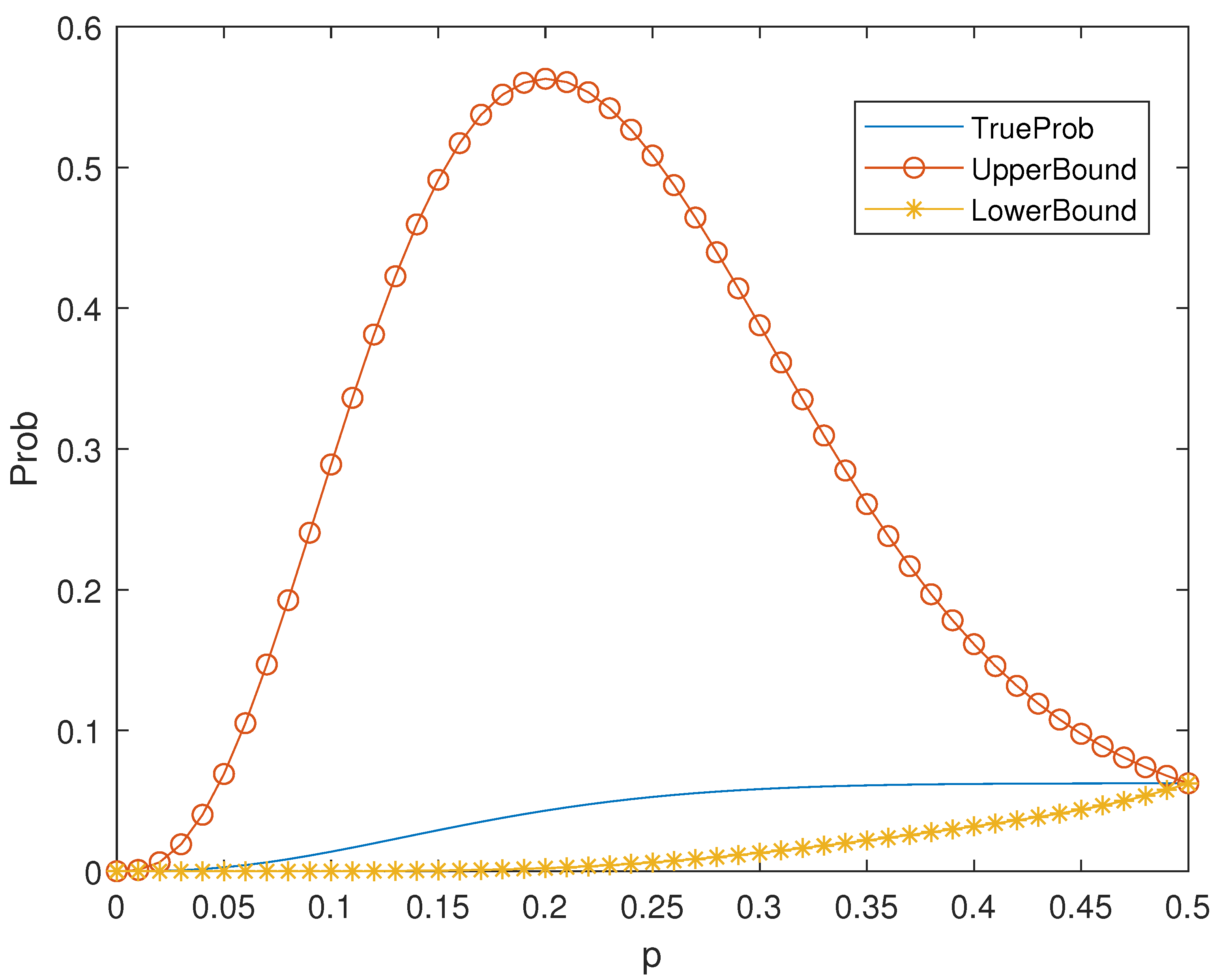
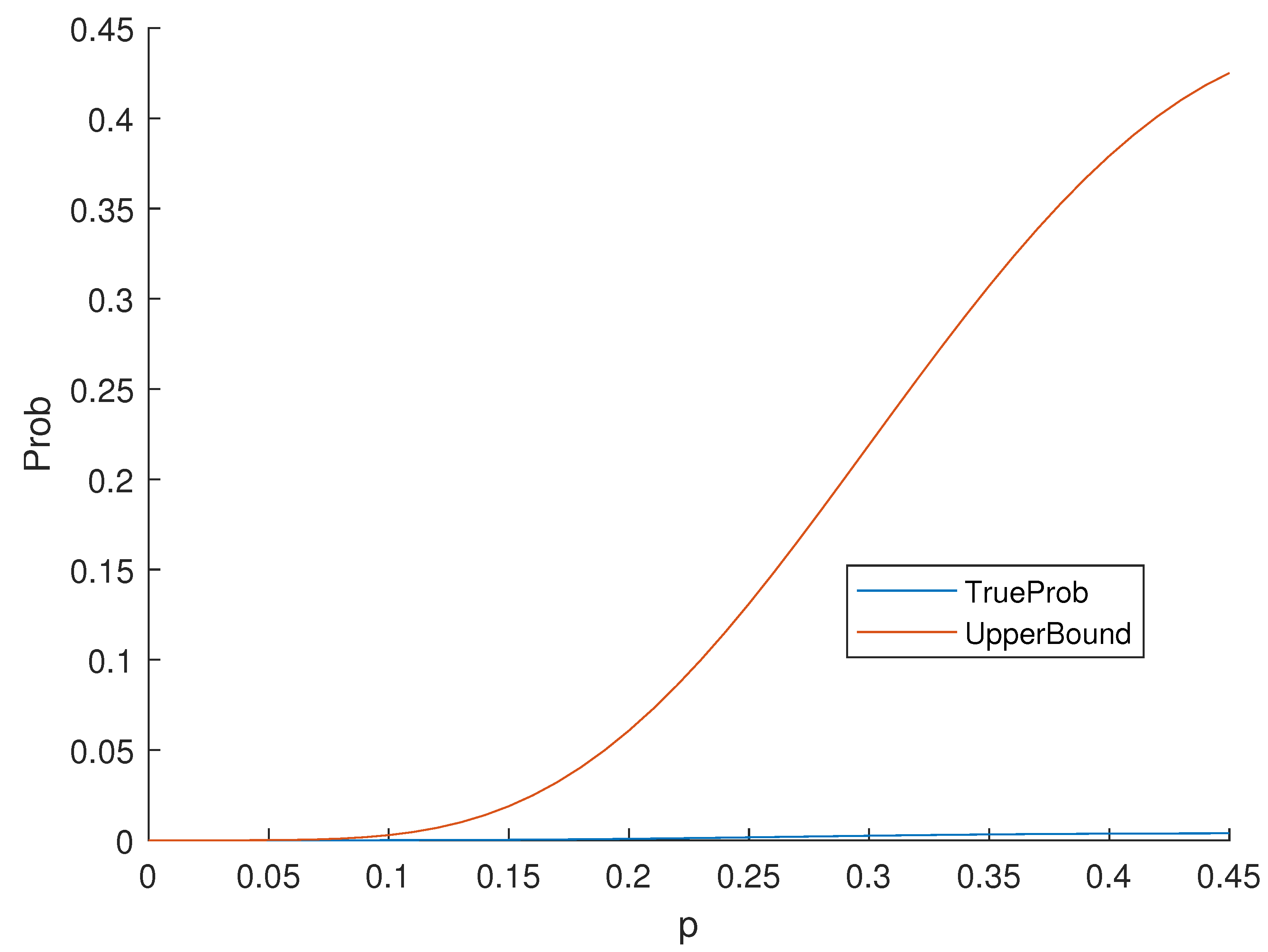
Remark 5. If C is linear, then is the number of codewords of weight i, which implies that . Hence,where . Moreover, if for all odd i, then Example 3. Consider the Nordstrom–Robinson code, it is a binary nonlinear code with the distance distribution in Table 3. Moreover, the weight distribution is the same as the distance distribution. By Equation (2),According to Theorem 6, the values of the upper bound and true probability can be seen in Figure 2. Example 4. Let be the set of binary vectors of length n and even weight, then it is actually the Reed–Muller code in Problem 5 in [2] and is generated by all the binary vectors of weight 2. Hence, Remark 6. The bound is suitable for many codes, and thus it seems not good. In fact, there exists some code C, whose is very large.
Motivated by [
17], we have the following upper bounds for linear codes over
.
Proposition 1. When C is a q-ary linear code and p is small enough, we have the following statements:
- (1)
If , then - (2)
If , then - (3)
If , , , and only if , then
Proof. These three bounds can be deduced easily by Equation (
3) and Corollaries 4–6 in [
17]. □
Remark 7. The results in Corollary 4–6 in [17] are actually the upper bounds of under different conditions. Considering Equation (3), it is necessary to make p small enough. According to the proof of Theorem 4, if does not meet such bounds, then “<” holds. 3.2.2. Lower Bounds
Similar to Proposition 1, by Corollaries 1–3 in [
17], we have
Proposition 2. If C is a q-ary linear code, then we have the following statements:
- (1)
If , then - (2)
If , then - (3)
If and all weights of C are in , with and , then
When using quadratic polynomials, we have the following bound.
Proposition 3. Let , and be nonnegative rational numbers such thatthen, for a binary code, we havewhere . Proof. It is known that, when
,
,
and
. Let
and then it is a quadratic function whose axis of symmetry is
. Considering that
, it is sufficient to show that
i.e.,
for
. Equivalently,
The result follows from Theorem 5. □
4. Good Bounds for Hamming Codes
Recall that the
weight enumerator of the code
C is the homogeneous polynomial
where
means the Hamming weight the codeword
. The binary Hamming code
is a
code, with the weight enumerator
whose distance distribution
satisfies
and the recurrence
,
,
Moreover,
Let
be a primitive element and let
be the minimal polynomial of
with respect to
. According to Exercise 7.20 in [
20],
can be regarded as the generator polynomial of a Hamming code. Since
, then
which implies that the all-one vector is a codeword of the Hamming code and
.
Note that
Hence,
Let
, where
, then
According to Chapter 6, Exercise(E2), page 157 in [
2], there are
nonzero weights of
. Considering that
, we have
if and only if
. Since
, then
and we have
Obviously,
Similarly,
Thus,
and
Summarize the above discussions, we get
Theorem 7. Let be the binary Hamming code, then when and , we have the upper bound Equation (14) and the lower bound Equation (15) for , respectively. Proof. Note that the upper bound should be larger or equal than the lower bound, then
It is sufficient to solve the inequality
, due to
. Hence,
. □
Remark 8. The difference of the upper bound and the lower bound is small.
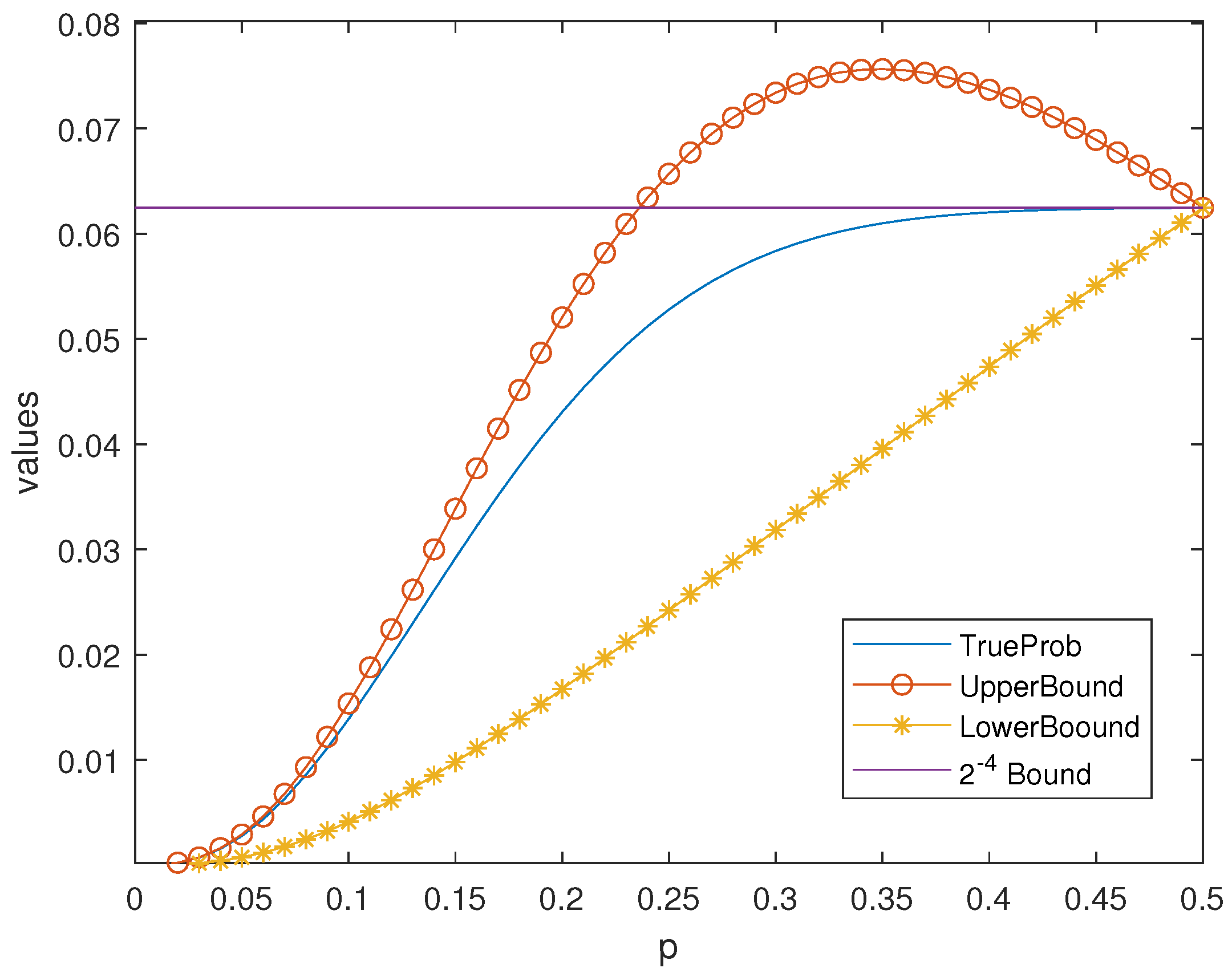
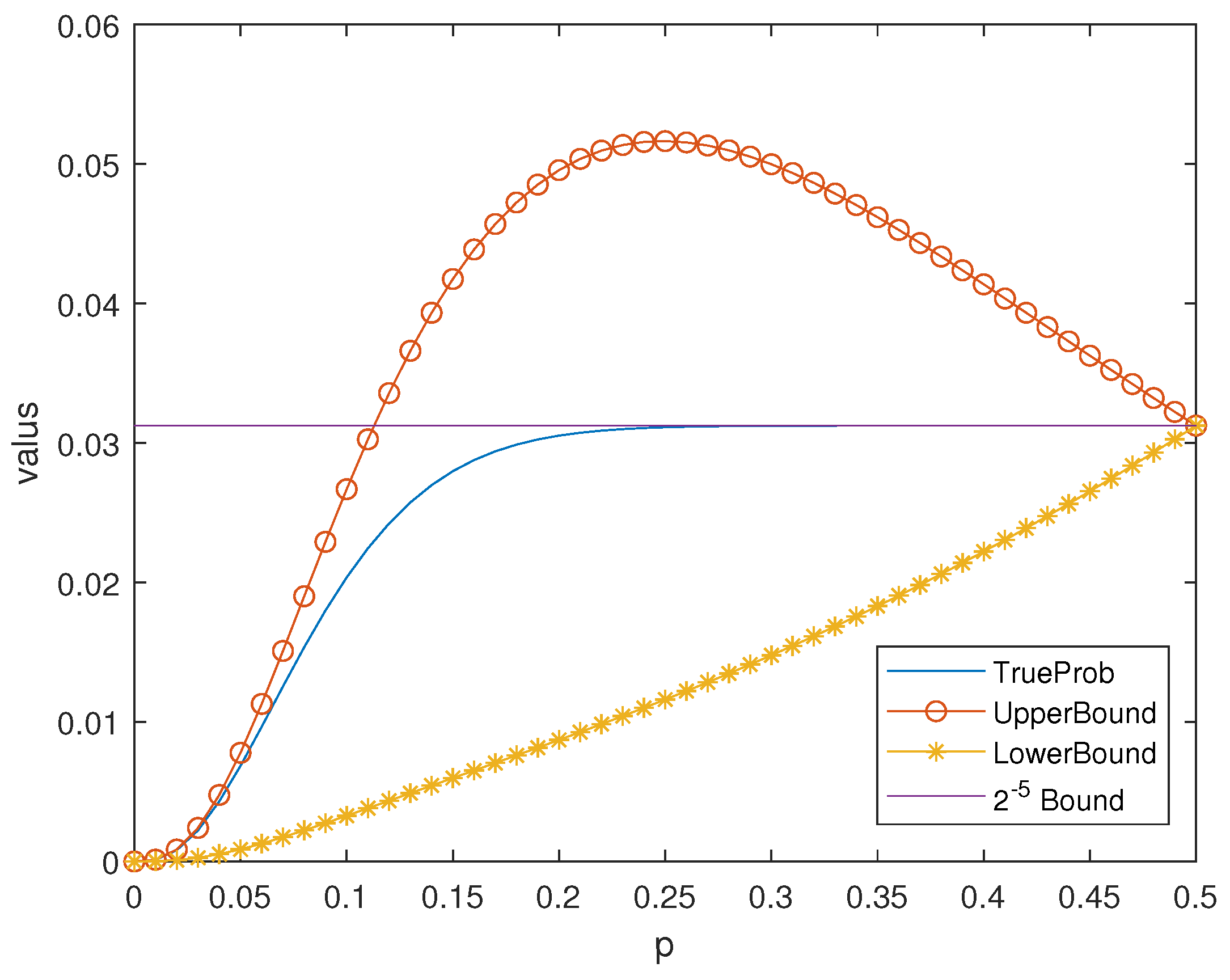
Let and be the bound given by Equation (14) and Equation (15), respectively, where , andIn fact, H is a polynomial of p whose degree and the leading coefficient iswhile the product is just a polynomial whose degree is 4. Then,That is to say, the lower bound and the upper bound are very close. On the other hand,Then,Here, let , then its derivative is . Note that the roots of are . Since , then we choose the root . Hence,Thus the difference of the upper bound and the lower bound is about at most, and tends to 0 when . Example 5. Using the bounds in Theorem 7, the results in Figure 1 can be improved. See Figure 3. When , the bounds Equations (15) and (14) are also valid. See Figure 4. Note that the difference of the bounds Equations (15) and (14) is about , which is much smaller than the given . It is known that the Hamming codes satisfy the
bound when
i.e.,
. See [
5] for more details. In fact, the obtained new bound is better than the ordinary
bound, when
p is not large.
Theorem 8. Let be the binary Hamming code, then when and , we haveMoreover, if , this upper bound is better than the bound, where is the smaller root of the equation . Proof. Assume that
then it is sufficient to solve the inequality
Obviously, the inequality holds when
, where
is the smaller root of the equation
. □
Example 6. It is clear that when p is small enough, the new upper bound Equation (14) is smaller than the bound in Figure 3 and Figure 4. Remark 9. Of course, the weight distribution of the binary Hamming codes can be computed and expressed by the sum of combinatorial numbers, which are usually very large when m is large. So, the method in this section is to estimate quickly. Compared with the bound, our bounds are better when p is small enough.
5. Conclusions
In this paper, we studied the probability of an undetected error and gave many bounds for . The main contributions of this paper are the following:
- (1)
The bounds obtained from the linear programming problem are given in Theorem 4. The bounds obtained from the Polynomial Method are given. According to the main Theorem 5, we get Theorem 6 (applied to the codes with even distances) and Proposition 3.
- (2)
Combining the results of [
17], we give the bounds in Propositions 1 and 2.
- (3)
We find sharper bounds for binary Hamming codes (see Theorems 7 and 8).
To the best of our knowledge, that is the very first time that the LP method has been applied to bound . Even though computing exactly requires knowledge of the code weight spectrum, our bounds depend solely on the three parameters , of the code. The weight frequencies are only used as variables in the LP program. Knowing the three parameters is the minimal requirement to use a code in applications.
To sum up, our bounds are most useful when the exact weight distribution is too hard to compute. Our bounds perform well when p is small enough and the kissing number is known, and there are many such codes.
We mention the following open problems. The readers interested in Hamming codes are suggested to derive bounds for general q-ary Hamming codes with Moreover, it is worth mentioning that the linear programming problem works better numerically than the Polynomial Method. The interest of the latter lies in producing bounds with closed formulas. It is a challenging open problem to derive better bounds with polynomials of degree higher than 2.