1. Introduction
Polarization modulation schemes have achieved much attention for their high spectral efficiency and low power consumption [
1]; they transmit bits with polarization state on a plane constellation. The polarization shift keying (PolarSK) and corresponding schemes [
2,
3] are proposed and analyzed for high spectral efficiency. Another way to realize high spectral efficiency is dual-polarized modulation and 3D polarization modulation [
4,
5], although they suffer from polarization-dependent loss (PDL) on frequency selective fading channels [
6,
7]. M-ary differential chaos shift keying (MDCSK) with polarization has high spectral efficiency and without suffering from PDL [
8]. The scheme utilizes the advantages of MDCSK, such as low cost, less complexity, little power, and excellent anti-interference capabilities over multi-path fading channels [
9,
10]. Moreover, it only requires a simple non-coherent demodulator without channel estimation and equalization [
11].
In order to verify the correctness of the system performance, the bit error rate (BER) performance analysis is often carried out using the Gaussian approximation [
12,
13], which is feasible under AWGN and multipath environments. For the polarization modulation, the exact BER expression is difficult to obtain. Thus, the approximate BER expression is usually derived as a tight upper or lower bound [
4,
5]. For example, lower bounds have also been proposed in various scenarios [
14,
15]; they provide the corresponding lower bound-derived methods to different system environments and requirements. In [
8], a unified upper bound of BER of polarization-MDCSK(P-MDCSK) was derived. However, for both the traditional MDCSK and P-MDCSK, their BER can be approximately expressed as an expression with a Q-function [
12]. The Q-function is not a closed-form expression; in order to obtain the closed form of the BER expressions, a lot of work has proved that the closed form of BER can be courted [
16,
17,
18] by representing the Q function approximately [
19]. In this paper, we utilize polynomial approximation of the Q-function to obtain a simple closed-form BER formula for the P-MDCSK scheme.
The contributions of the paper are summarized as follows:
(1) The polarization M-ary differential chaos shift keying (P-MDCSK) is introduced, which uses the upper bound instead of the exact BER as a theoretical verification. Since the Q-function in the tight upper bound is not a closed form, the paper derives a close expression. It makes use of polynomial approximation instead of the Q-function.
(2) To achieve the closed expression, the bounds of the Q-function are used. It provides a generalized analytical expression of the closed-form on the upper bound, and calculates each of the three subsections in the upper bound for their different cases. The results show that there is only a very small gap between the simulations and the closed-form expressions
The study is organized as follows.
Section 2 presents the system model of the P-MDCSK system briefly.
Section 3 provides the closed-form expressions. Next, in
Section 4, we show by numerical examples that the closed-form expression has a tight gap with simulations. Finally,
Section 5 concludes the study.
2. System Model of P-MDCSK
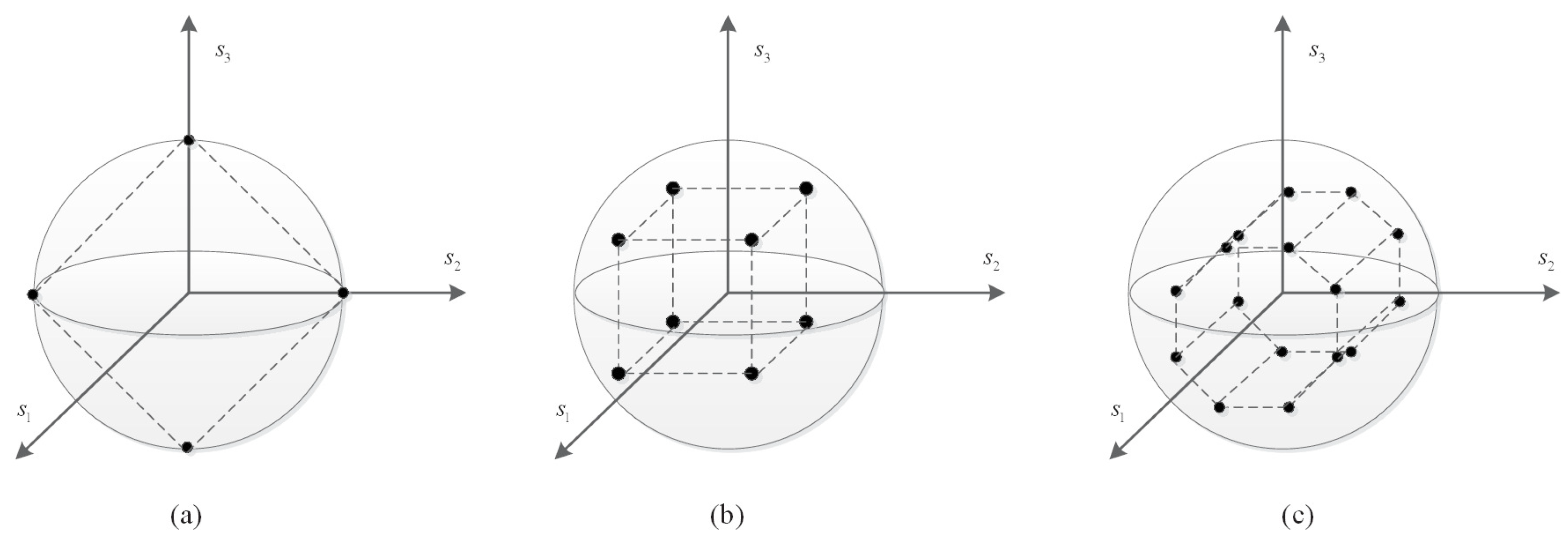
A P-MDCSK constellation is characterized by a horizontal polarization state, a vertical polarization state, and a phase, which is shown in
Figure 1. The information bit sequence consists of polarization and phase parts. By packing
bits on the sphere and
bits on the MDCSK phase, a total of
bits can be conveyed. Thus, the
symbols lie on the sphere and the
symbol is in constellation with MDCSK, where
.
We assume that
(This paper is based on the P-MDCSK in [
8]). The
is set to 1. Symbols lie on the sphere and
symbols are with the MDCSK constellation. The transmitted signal with Stokes parameters [
5] is written as
where
is the angle of polarization,
and
are the phase of the signal in the horizontal and vertical state of polarization, respectively, considering
,
, and
. The
is the symbol with MDCSK modulation, which is written as
where
is
-length chaotic signal. The
denotes Hilbert transform operator; thus,
. And
is the phase of MDCSK modulation with
, where
.
The received signals of P-MDCSK over the multipath Rayleigh fading channel are expressed as
where
, are the received signals in the horizontal and vertical polarized states, and
and
are the composite gain of the input
and the output
polarization components. The
and
are the additive white Gaussian noise (AWGN) with zero mean and variance
, and ⊗ denotes the convolution operator.
The
are set to 0 [
8], and
and
have the same parameters as
, where
L is the number of paths of the multipath channel, and
and
are the channel coefficients and the path delay of the
lth path.
The demodulation of the receiver is implemented in two parts: MDCSK and polarization states. Each part is demodulated by an independent process. In the polarization modulation part, considering the characteristics of differential modulation and polarization modulation, the maximum energy comparator is represented, where the
t-th polarization state on the sphere is estimated by the following method:
where
and
are expressed as
where
denotes the absolute value, and
is Hilbert transform operator. After
is determined, for the MDCSK part, the decision variables
and
are obtained as
where
is determined from
h and
v,
is either
or
, and
is either
or
, depending on
. Then, the phase of MDCSK is decided by
and
. The corresponding phase arccot
and the decision boundaries are used for recovering the corresponding phase parts of information bits. It is important to remark that the MDCSK estimation depends on the estimation of
. Note that the use of MDCSK does not affect the Stokes parameter.
The P-MDCSK detection algorithm is shown in Algorithm 1. The first step of the algorithm is polarization demodulation. After estimating the polarization state,
is selected from
and
and
is selected from
and
. Then the corresponding phase arccot
is estimated by MDCSK demodulation.
| Algorithm 1: P-MDCSK detection algorithm |
Input: , , , Output: .
←, ← ← ←, ← ← arccot ←,
|
3. Closed Expression over Multipath Rayleigh Fading Channels
A tight upper bound is used to calculate the BER of polarization modulation [
5]. Thus, in our previous work [
8], we derived a BER upper bound of P-MDCSK, which is described as
where
where
is the Hamming distance, i.e., the number of different bits between symbols defined by
and
,
and
denote the wrong symbols. The same definition is true of
. The generic distance of
in the Euclidean space is expressed as
where
,
is the MDCSK component of symbol
n,
,
is the polarization of the
l symbol. The
is obtained from (
11) when
[
8].
The closed expression is then calculated for each of these three components. The
(
, for
= 1) for
2 can be approximated to a simpler form in [
12,
20] as
where
, and
, and
is the total energy of one symbol. The
and
, for
. Then, the total system BER of the proposed scheme over Rayleigh fading channel is given by (Here we base our performance analysis more on the system from a mathematical point of view in the original reference. In the real situation, it is necessary to consider whether there is a Rayleigh multipath fading in reality.)
where
, and
is the PDF of
which can be found in [
13].
In order to solve complex integrals of the BER expressions (
13), the bounds of the Q-function are used. This part provides a generalized analytical expression of the closed form on approximate BER as the (
7) is the upper bound of BER. However, this approach can still provide a trend of the BER. In the derivation of [
19], a single-term exponential bound with adaptive parameters is considered. The general form of the bound is written as
The function of
is a lower bound if the
and
are established in [
21] as
In order to simplify the calculation, the right side of the Formula (
7) is expressed as
Thus, (
13) can be separated as
By applying the bound to the given BER formula over the multipath Rayleigh fading channel, the lower bound of
is calculated separately, and the lower bound of
becomes
where
F is expressed as
where
. Moreover, the integral in (
18) is not analytically integrable. Thus, the exponential function is upper-bounded by [
19]
where
. The expression of the lower bound X can be derived by taking the sum of the items in (
18) and replacing them with the upper bounds, which is expressed as
Thus, the integral of the closed expression of
over multipath Rayleigh fading channels can be written as
Similarly, the closed expressions of
and
can also be derived by the same derivation process which is given in
Appendix A. Finally, the total closed expression of
can be expressed as
.
4. Numerical Results and Discussions
In this section, simulations are presented to verify the derived closed expression over multipath Rayleigh fading channel and AWGN. In all figures, denotes the spreading factor.
A three-path fading channel with equal channel average power gain is considered, i.e., , and time delays . Here, is the sampling period of the chaotic signal .
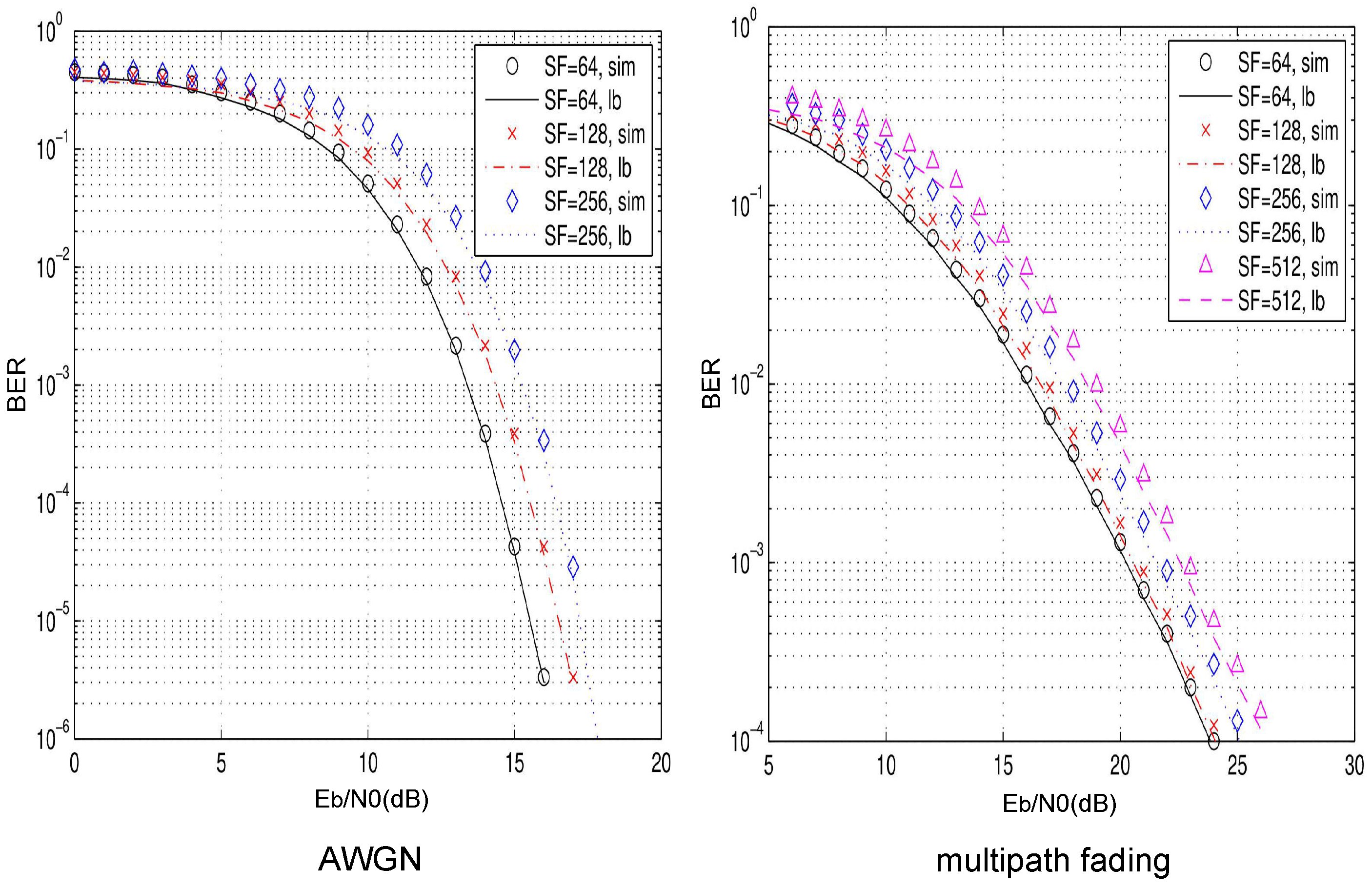
Figure 2 shows the comparisons between the derived closed expression of BER and the simulated BER of the P-MDCSK system over AWGN and multipath fading channels. The modulation order is
. The spreading factor is
over AWGN channel and
over multipath Rayleigh fading channels, respectively. The result shows that the closed expression is close to the simulations. The theoretical boundaries are roughly
dB away from the simulations when BER is
.
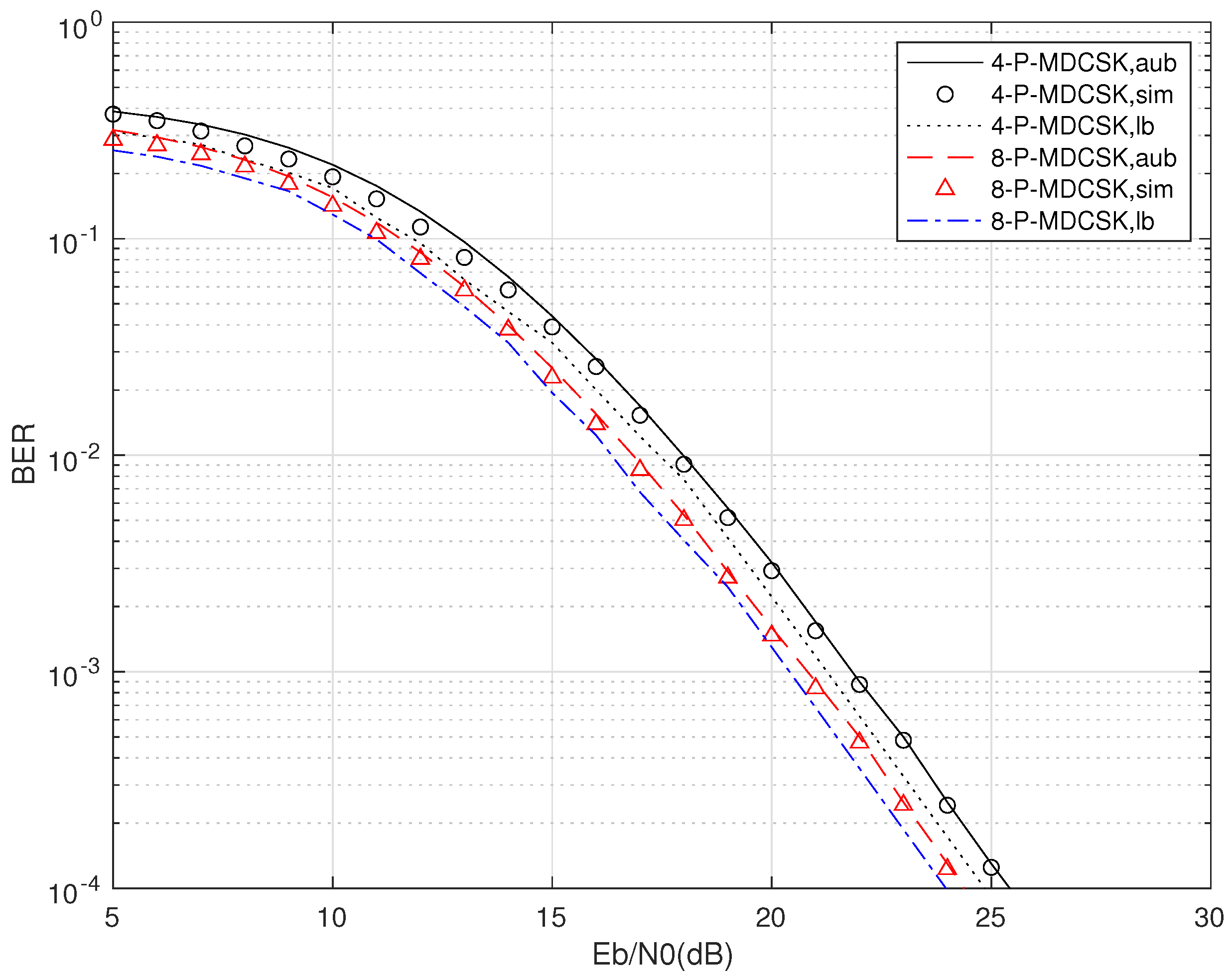
The results of the simulation and the bounds analyzed in
Section 3 for P-MDCSK are shown in
Figure 3, with the parameters
,
,
and
. The upper bound is very close to the simulated BER curves, and the trend and gap with the tight upper bound of the derived closed-form expression are in the reasonable range zone. The theoretical upper and the closed-form boundaries are
dB and
dB away from the simulations when BER is
. The derived closed expression and upper bounds closely match the simulation curves and can constrain them from above and below. The simulation point at 23, 24, and 25 dB for 4-P-MDCSK is slightly higher than other points. It is caused by the theory
, whose theoretical derivation is an approximate expression, and the tendency of simulation and theory is similar in [
12]. Thus, the BER performance of P-MDCSK over multipath Rayleigh fading channels can be predicted by upper and closed-form expressions.