
Abstract
As with probability theory, uncertainty theory has been developed, in recent years, to portray indeterminacy phenomena in various application scenarios. We are concerned, in this paper, with the convergence property of state trajectories to equilibrium states (or fixed points) of time delayed uncertain cellular neural networks driven by the Liu process. By applying the classical Banach’s fixed-point theorem, we prove, under certain conditions, that the delayed uncertain cellular neural networks, concerned in this paper, have unique equilibrium states (or fixed points). By carefully designing a certain Lyapunov–Krasovskii functional, we provide a convergence criterion, for state trajectories of our concerned uncertain cellular neural networks, based on our developed Lyapunov–Krasovskii functional. We demonstrate under our proposed convergence criterion that the existing equilibrium states (or fixed points) are exponentially stable almost surely, or equivalently that state trajectories converge exponentially to equilibrium states (or fixed points) almost surely. We also provide an example to illustrate graphically and numerically that our theoretical results are all valid. There seem to be rare results concerning the stability of equilibrium states (or fixed points) of neural networks driven by uncertain processes, and our study in this paper would provide some new research clues in this direction. The conservatism of the main criterion obtained in this paper is reduced by introducing quite general positive definite matrices in our designed Lyapunov–Krasovskii functional.
1. Introduction
By simulating the function of the biological brain, neural networks (NNs), the totality of mathematics-based computational models, deliver outstanding performance in recognition and/or classification of patterns, signal processing, engineering optimization, associative memory and so forth. Therefore, various types of NNs have been created for specific purposes; see [1,2,3,4,5,6,7,8,9,10,11] and the vast references cited therein. For example, in the 1980s, Chua and Yang invented a class of NNs, called cellular NNs (CNNs); see [1,2] for the details. Different from the classical Hopfield NNs (HNNs), the (dynamical) behavior of nodes (cells) of CNNs can merely be influenced by their nearly neighboring nodes (cells); see [1,2,12,13,14]. In the last three decades, CNNs have been extensively applied in diverse areas such as image processing, associative memory and parallel computing. As a consequence, CNNs have been extensively and intensively investigated, among scientific and engineering communities, in recent years from the point of view of mathematics (dynamical system theory and/or mathematical control theory, say); see References [3,6,10,11,12,13,14], for example.
The convergence property of state trajectories to equilibrium states (or fixed points) of NNs is usually referenced as the stability of equilibrium states (or fixed points), and is termed occasionally as the stability of the NNs. Convergence is one of the key properties to guarantee the NNs be successfully applied in the engineering community. And therefore, CNNs have been widely investigated for the existence and the stability of equilibrium states (or fixed points); see the pioneering works [1,12,13] and the references mentioned therein. For example, Chua and Yang [1] briefly discussed the importance of studying the existence and stability of equilibrium states (or fixed points) of CNNs via using dynamical system theory, and obtained some interesting existence and convergence criteria.
As is well known to all, probability theory has been widely used to model the indeterminacy phenomena brought about by randomness of the environment; see References [4,6,11,15]. In recent years, Liu has developed, based on the understanding an individual’s belief degree, uncertainty theory to portray the indeterminacy in individual’s subjective cognition; see Reference [16] (see also [17,18] and the vast references therein). Since its birth date, uncertainty theory has attracted extensive attentions in both the research and application communities. Up to now, uncertainty theory nearly has all theoretical results parallel to probability theory; see References [16,17,18,19,20,21,22,23,24,25,26,27,28,29]. In particular, the theory of uncertain processes and the uncertain calculus have been already developed well; see Reference [16] (see also [17,18,28], say). The well-established uncertain calculus has paved the area of studying behaviors of dynamical systems subject to uncertain perturbations (for example, the concerned dynamics is driven by the so-called canonical Liu process). In this paper, we shall consider a class of NNs whose dynamics is driven by the canonical Liu process.
It would certainly cost time for nodes (cells) themselves to process information and in the procedure of transmission of information between every pair of nodes (cells), therefore, time delay exists unavoidably in real world NNs; see [3,4,5,6,9,10,12,14,15,23,30,31], among the vast existing references. Generally speaking, time delay in NNs would certainly bring about more challenges in proving the convergence of state trajectories of NNs.
By reviewing the aforementioned references, we are inspired to study time-delayed uncertain CNNs (DUCNNs) for the convergence of their state trajectories. One of the main aims in this respect is to provide a criterion ensuring the existence of equilibrium states (or fixed points); and another main aim is to put forward a criterion to guarantee that state trajectories of the concerned DUCNNs converge to equilibrium states (or fixed points). In this direction, some interesting results have already been published in the literature. As alluded to previously, the existence and stability of equilibrium states (or fixed points) of deterministic CNNs (whose dynamics is not influenced by stochastic or uncertain environment) were discussed in References [1,12,13]. (Almost) periodic state trajectories of NNs play similar roles as equilibrium states (or fixed points). Kong, Zhu et al. [5] studied a class of discontinuous bidirectional associative memory NNs (briefly referenced as BAMNNs, and can be viewed as a specific class of CNNs) with hybrid time-varying delays and D operator, and obtained a criterion ensuring the existence of almost periodic state trajectories of their concerned BAMNNs, and provided another criterion guaranteeing the stability of the almost periodic state trajectories. We shall discuss briefly (almost) periodic state trajectories of NNs in Section 5 again. When the dynamics of CNNs is influenced by some stochastic environment, the problem concerning the almost surely exponential stability almost stochastic was investigated in [14,15,30,31,32,33,34] and some related references therein. For example, Cong [33] obtained an interesting robust almost sure stability result for continuous-time linear systems subject to exogenous disturbance.
As with stochastic dynamical systems driven by Brownian motions (Lévy processes, semimartingales with/without jumps, and so on), the problem concerning the existence of state trajectories for uncertain dynamical systems driven by canonical processes has aroused extensive research interest in recent years. In this respect, a large number of meaningful results were published; see References [16,17,18,21,29,35], for example. Chen and Liu [18] considered general uncertain differential equations and obtained some important (unique) existence results. Shu and Li [35] studied a class of switched nonlinear uncertain systems and proved, via the Contraction Mapping Principle, the existence and uniqueness of state trajectories for their concerned systems. The results concerning the convergence property of state trajectories or the stability of equilibrium states (or fixed points) can be seen in References [21,22,23,24,25,26,27,28,29]. Jia and Liu [29] studied, besides the (unique) solvability, the convergence property of age-dependent uncertain population equations subject to stochastic perturbations. Lu and Zhu [23] investigated a class of uncertain dynamical systems, and came up with several criteria ensuring the convergence of state trajectories of their concerned time delayed uncertain dynamical systems in the sense of moments. Jia and Li [21] obtained a criterion to ensure almost sure exponential stability of uncertain HNNs (UHNNs) under stochastic perturbations. For (deterministic, stochastic, uncertain) dynamical systems, the continuous dependence of state trajectories on initial states is also very important. In the context of uncertain dynamical systems, the continuous dependence of state trajectories on initial states is frequently referenced as the stability (of the concerned dynamical systems). Yao, Gao et al. [36] obtained some general stability (continuous dependence) theorems of uncertain differential equations. In References [19,20], some interesting stability (continuous dependence) results in the mean sense for uncertain differential equation were obtained. Some other interesting stability (continuous dependence) results can also be seen in References [22,28] and the references therein.
Our principal contributions in this paper are as follows.
- We investigate in-depth in this paper a class of DUCNNs driven by a canonical Liu process for the stability of their equilibrium states (or fixed points). As alluded to previously, the dynamics of NNs is inevitably influenced by a random (stochastic) environment. And analogously, humans’ subjective cognition based on intuition or inspection (in terms of belief degree) may have some influence on the structure of NNs when the workers are designing the NNs, and therefore have a certain influence on the dynamics of the constructed NNs. Therefore, the research results concerning uncertain NNs may be more suitable and reliable for the decision makers. Uncertainty theory laid the foundation (the notion of belief degree on measurable spaces) of the mathematical theory that are capable of portraying quantitatively humans’ subjective cognition. Therefore, it is of great importance to study uncertain NNs for the large time behavior of their state trajectories. By reviewing the existing references, we conclude that our research results in this paper seem to be new. For example, in comparison with Reference [23], in which stability criteria were provided in terms of moments, our aim in this paper is to provide a stability criterion in the sample sense for DUCNNs. For another example, in contrast with Reference [21], our concerned model DUCNNs include discrete time and finitely distributed time delay.
- Via applying the classical Contraction Mapping Principle, we establish a criterion (see Theorem 1 in Section 3), and prove that this criterion can guarantee that our concerned model DUCNNs have unique equilibrium states (or fixed points).
- We design meticulously a class of Lyapunov–Krasovskii functionals, which take into account the after-effect (or time delay) in our concerned model DUCNNs, analyze in detail our concerned model DUCNNs with these coined Lyapunov–Krasovskii functionals as the key tools, and establish a criterion to ensure that equilibrium states (or fixed points) of our concerned model DUCNNs be almost surely exponentially stable; see Theorem 2 in Section 3. We also come up with a specific example DUCNN to validate our theoretical results; see Section 4.
Notational Conventions.
We write for the totality of real numbers, and for the interval of non-negative real numbers. We write N for a positive integer throughout this paper. We denote by the N-dimensional Euclidean space, and by the algebra of N-th order real square matrices. Following the common convention, we designate by the usual Lebesgue measure space. We denote by (or ) a complete filtered uncertainty space (whose definition would be explained in detail in Section 2; see Definition 1), in which, the filtration is assumed to satisfy the usual conditions; that is, the σ-algebra contains all -null sets in the σ-algebra , and the filtration is right-continuous in the sense that
“ almost surely” is abbreviated as -a.s. Let X be an arbitrarily given uncertain variable on Γ, denote by (see Definition 5) the expected value of X, and by (see Definition 4) the uncertainty distribution of ξ. denotes the product σ-subadditive measure space of and ; , an -adapted uncertain process, denotes a one dimensional canonical Liu process defined on the uncertainty space . Let A be a positive definite matrix, we write and , respectively, for the smallest and largest eigenvalues of A. Let A be a square matrix, which we denote by (or , occasionally) the trace of A, and by the symmetric matrix with designating the transpose of A here and hereafter. For any positive definite matrix , we designate its Cholesky decomposition by with an upper triangular matrix ( is actually nonsingular and unique). For any pair of symmetric matrices A and , if is positive definite, then we write . In particular, if the matrix is positive definite, then we write .
The rest of this paper is organized as follows. In Section 2, we recall some preliminaries necessary for our later presentation and formulate our concerned existence and convergence problems for DUCNNs. In Section 3, we state the principal results in this paper and present their proofs in detail. In Section 4, we justify, in both numeric and visual ways, the effectiveness of our theoretical results, via bringing forward a specific example DUCNN of which state trajectories converge to the unique equilibrium state (or fixed point). In Section 5, we conclude our discussion in this paper by presenting several remarks.
2. Preliminaries and Formulation of the Problems
2.1. Some Preliminaries
Let be a measurable space with a nonempty set and a -algebra over . We equip throughout this paper the filtration satisfying the usual conditions. In other words, is a collection of sub--algebra of and satisfies (i) The -algebra contains all -null sets in the -algebra ; and (ii) is right-continuous in the sense of (1). Here and hereafter, we shall write for the measurable space equipped with the filtration satisfying the usual conditions.
Definition 1.
Given a measurable space , equipped with a filtration that satisfies the usual conditions, and a given function mapping into . The given function is called a uncertainty measure on the filtered measurable space provided that the following three axioms are fulfilled:
- (Normality). It holds always that ;
- (Self-duality). It holds always that for every event A in ;
- (Countable subadditivity). For every sequence in , it holds always that
The quadruple , obtained by equipping the filtered measurable with the uncertainty measure , is called a uncertainty space.
From now on, we abide by the convention that is a complete filtered uncertainty space in which the filtration satisfies the usual conditions.
Definition 2.
The measurable function is called a uncertain variable. In more detail, if for any Borel subset B of , then the set
belongs to the σ-algebra , then ξ is said to be a uncertain variable.
Definition 3.
Let ξ be a uncertain variable on the uncertainty space . The following associated real-valued function
is called the uncertainty distribution of ξ.
Definition 4.
Let ξ be a uncertain variable on the uncertainty space . If the uncertainty distribution of ξ is exactly
with a given constant in and σ a given positive constant, then we call ξ a normal uncertain variable with expected value and variance . If and , we call ξ a standard normal uncertain variable, and write its uncertainty distribution as
It is obvious that the function given by (4) is strictly increasing in . We can conclude therefore that the function has inverse function . Actually, by some routine calculations, we have immediately
We shall call the function (the inverse function of given by (4)), given as in (5), the inverse standard normal uncertainty distribution throughout this paper.
Definition 5.
Suppose that ξ is an uncertain variable on the uncertainty space . If at least one of the following two integrals:
and
are finite, then we call
the expected value of the uncertain variable ξ.
Based on the definitions of and , it is straightforward to verify that
This identity facilitates the calculations of expected values of uncertain variables. To provide some intuitions for our later theoretical development in this paper, we would like to share the next two examples on the computations of expected values of uncertain variables.
Example 1.
Example 2.
Let ξ be a normal uncertain variable, with expected value and variance , on the uncertainty space . Following the steps to derive (7) in Example 1, we have
where is Euler’s Beta function.
Definition 6.
Let be a nonempty subset of . The function is said to be an uncertain process provided that it is progressively measurable.
Definition 7.
Let be an uncertain process. The given process is called a canonical Liu process provided that the following three assertions hold:
- , and
- has stationary and independent increments;
- For every and every , the increment is a normal uncertain variable with expected value 0 and variance .
Definition 8.
Let be the aforementioned canonical Liu process. We denote
Some remarks concerning the uncertain variable , given by (8) in Definition 8, are in order here. It was proved by Yao, Gao et al. [36] that
where the function , given as in (4), is the uncertainty distribution of a standard normal uncertain variable. By the definition of limit superior of a sequence of sets, we have
This, together with (9), implies immediately
which implies further
This, alongside with the definition of the uncertainty measure (see Definition 7), implies
This implies, in particular, that possibly there exists a -null set in such that, for every sample in the sample space , it holds that (see (8) for the definition of ).
Definition 9.
Let a, with , a canonical Liu process, and a given -adapted uncertain process. If there exists an uncertain variable ξ such that
where Δ: is a partition of the compact interval , and
then the uncertain process is said to be integrable, and the limit uncertain variable ξ is said to be the uncertain integral of in the interval with respect to the canonical Liu process . In this situation, we denote
Suppose that the uncertain process is uncertain integrable in with respect to the canonical Liu process . By virtue of Definition 9, we can conclude that for every , the uncertain process is uncertain integrable in the compact subinterval with respect to the canonical Liu process , and that is also an uncertain process with given by
Let a, with , a canonical Liu process, , and three given -adapted uncertain processes. If is -almost surely Lebesgue integrable in , is uncertain integrable in with respect to the canonical Liu process , and moreover it holds that
then we call a Liu process, and write equivalently
in which, and are called the drift and diffusion terms, respectively.
Lemma 1
(see References [16,17]). Let be a (by , we mean the totality of continuous functions whose first order derivative is continuous) function on , and a Liu process with and as its drift and diffusion coefficients, respectively, or equivalently
Then, is a Liu process with and as its drift term and diffusion term coefficients, respectively, in other words,
Lemma 2
(see Reference [18]). Let be the aforementioned canonical Liu process, and the uncertain variable given as in Definition 8 (see (8) for the details). For any two constants a and with , and any integrable -adapted uncertain process , it holds that
Let a, with and a canonical Liu process. If for every , the uncertain process is uncertain integrable in the interval with respect to the canonical Liu process , then we write
where . By virtue of this definition, as with (10), we can define the following -valued uncertain process
And as with the one-dimensional case, we can define -valued Liu process. And it is not difficult to imagine that we can establish a counterpart of Lemma 1 for the -valued Liu process given by
In comparison with this, it seems to be unapparent and therefore much more laborious to establish a counterpart of Lemma 2 for uncertain integrals of -valued uncertain processes with respect to one dimensional canonical Liu processes.
Lemma 3.
Let be the aforementioned canonical Liu process, and the uncertain variable given as in Definition 8 (see (8) for the details). For any two constants a and with , and any integrable -adapted uncertain process (), it holds that
Proof.
Thanks to Lemma 2, we have
By virtue of some careful calculations, we have further that
in which, the ‘⩽’ follows from the well-known Cauchy–Schwarz inequality. On the other hand, we can deduce from (16) immediately that
Plug (17) into (15), and conduct some easy calculations, to end the proof of Lemma 3. □
It is worth pointing that, as can be seen from (8) in Definition 8, the uncertain variable depends merely on the aforementioned canonical Liu process , in particular, is independent of a, b and the uncertain process .
Let be a positive definite matrix. Then, by the well-known theorem of Linear Algebra, A admits a unique Cholesky decomposition, that is, there exists a unique a upper triangular matrix ⨿ with positive diagonal entries such that . Hereafter, we shall write for the unique aforementioned upper triangular matrix in the Cholesky decomposition of any positive definite matrix A; It is straightforward to see that the matrix is nonsingular. With the help of the notion of Cholesky decomposition, we can prepare the following lemma which is extremely useful in our later presentation.
Lemma 4.
Let be a positive definite matrix, and a positive semi-definite matrix. Then, the following two identities hold true:
and
Proof.
It is obvious that the matrix is positive definite (a fortiori, symmetric). By Jordan’s decomposition theorem, there exists an orthogonal matrix Q such that
Pre- and post-multiply both sides of this equation by and , respectively, to obtain
where (). This, together with the definition of , implies
Aided by (19), we can complete the proof of Lemma 4, via some routine calculations. □
Lemma 5.
Let be a positive definite matrix.
(Jensen’s inequality). Let a, be any two constants with . For any square integrable vector-valued function in Lebesgue’s sense, it holds that
(Extrema of Rayleigh’s quotient). It holds always that
and that
2.2. Formulation of the Problems and Main Assumptions
In this paper, we consider the model DUCNNs
in which: is a state trajectory and can be re-written in component form as
the matrix in the leakage term is positive definite; and are the connection weight coefficient matrices (real square matrices) in the transmission terms, ; the activation functions and can be written in component form as
and
respectively, ; the positive constants , , and are the time delay; as stated previously, is a canonical Liu process on the uncertainty space ; the initial state is measurable.
Definition 10.
A -measurable N dimensional uncertain variable is said to be a equilibrium state (or fixed point) of the model DUCNNs (23), provided that
and that
Definition 11.
Suppose that the uncertain variable , required to be -measurable, is a equilibrium state (or fixed point) of the model DUCNNs (23). is said to be -a.s. exponentially stable provided that there exists a positive definite matrix , as well as two uncertain variables and such that for any state trajectory of DUCNNs (23), it holds that
From the perspectives of the mathematical complexity and application, it seems to be more interesting to require the decaying exponent 𝚥 in (28) (see Definition 11) be essentially bounded, or equivalently, to require 𝚥 be an absolute positive constant.
By some routine but seemingly tedious calculations, we can conclude that the decay estimate (28) in Definition 11 holds true if and only if the assertion holds true: either (i) there exists a positive time instant such that
which is equivalent to
or (ii) for every and
Based on the analysis conducted in this paragraph, we conclude that proving that the equilibrium state (or fixed point) of DUCNNs (23) boils down to proving the inequality (31) holds true under the assumption that for any . The positive valued uncertain variable 𝚥 in (28) and (31) is called a (exponential) decay rate.
Assumption 1.
Assumption 2.
The constants and , independent of sample and time, (occurred in the model DUCNNs (23)) are all non-negative, . Moreover, it holds always that
Assumption 3.
The activation function is Lipschitz continuous and satisfies the linear growth condition at infinity, , 1, 2. More precisely, it holds that
where is a diagonal matrix defined by
with the diagonal entry , a non-negative constant, given by
The activation function satisfies Carathéodory’s condition, is Lipschitz continuous and satisfies linear growth condition at infinity, , 1, 2. In addition, it holds that
where the diagonal matrix , as with the matrix , assumes the form
with the function , defined in the interval , being Lebesgue integrable in , being essentially bounded in and defined explicitly by
3. Main Results and the Proofs
Theorem 1.
Suppose that Assumptions 1 and 3 hold true. DUCNNs (23) admit unique equilibrium states (or fixed points), provided with the non-negative constant ς defined by
Proof.
Let us recall that , equipped with the mapping
is indeed a Banach space, and the natural induced metric space is complete.
Let us write, in this proof, (it is worth reminding that for every , -a.s.). Since D is positive definite, it is non-singular. This implies, in particular, that for any x, there exists a unique such that
Thus, we obtain a mapping of into itself. For any and , we have
and
We have therefore
which implies further that
Recalling the notation defined by (38), we conclude immediately
By Banach’s fixed-point theorem, this, together with the assumption that , implies that admits a unique fixed point . Recalling (39), we conclude that implies that satisfies (26), and furthermore satisfies automatically (27). Since D is non-singular (positive definite, actually), the activation function is globally Lipschitz continuous (), and U is -measurable, is -measurable. By Definition 10, is indeed a a equilibrium state (or fixed point) of the model DUCNNs (23).
Assume that and are equilibrium states (or fixed points) of DUCNNs (23). By the above analysis, and are fixed points of . In view of (40), we have
Noting that , we conclude that , or equivalently, .
In conclusion, the proof of Theorem 1 is complete. □
Theorem 2.
Suppose that Assumptions 1, 2 and 3 hold true. If the non-negative constant ς given by (38) is strictly less than 1, there exists a positive definite matrix , four positive definite matrices , , as well as , and three positive constants , alongside with such that
and
where the symmetric matrix (can be proved to be positive definite) ℧ is given by
then DUCNNs (23) have unique equilibrium states (or fixed points), and the equilibrium states (or fixed points) are almost surely exponentially stable at a decay rate κ given by
where the matrix is given by
Proof.
In view of the assumption that (see (38)), by Theorem 1, we conclude that DUCNNs (23) have unique equilibrium states (or fixed points). It remains to prove the almost surely exponential stability part of Theorem 2. In the rest of this proof, we write for an equilibrium state (or fixed point) of DUCNNs (23). As remarked previously, to prove Theorem 2, it suffices to establish the inequality (31) for every state trajectory of DUCNNs (31) fulfilling ().
For the sake of convenience of our later presentation, we introduce
and consider the new DUCNNs
where the initial datum is given by
is given by
is given by
and is given by
The stability of the equilibrium state (or fixed point) of DUCNNs (31) is equivalent to that of the equilibrium state (or fixed point) of DUCNNs (46). The time delay in DUCNNs (31) (or equivalently, in DUCNNs (46)) brings about extreme difficulty in the stability analysis procedure. To overcome the aforementioned difficulty, our basic idea is to make full use of a certain Lyapunov–Krasovskii functional, associated to DUCNNs (46), to take in the after-effect in DUCNNs (31) (or equivalently, in DUCNNs (46)). Let us introduce the positive definite functional for DUCNNs (46)
in which the positive parameter will be chosen appropriately (actually, the parameter will be specified deliberately to be equal to with the constant given ‘implicitly’ by (43)), and is a Lyapunov–Krasovskii functional candidate and can be expressed as
where the functionals , and are given, respectively, by
and
By the chain rule of differentiation for Liu processes (see Lemma 1), we have
Taking into account of (49), we have immediately
Thanks to that the uncertain process (Liu process, more precisely) is a state trajectory of DUCNNs (46), again we apply Lemma 1 (the chain rule of differentiation for Liu processes) to the uncertain process , given explicitly by (50), to obtain
With the help of the experience of deriving the differential identity (55), illuminated by the definition (51) of the uncertain process , we have, by Lemma 1, that
Enlightened by the experience gathered in the procedure of deducing the differential and (see (55) and (56) for the details) of the uncertain processes and , by Lemma 1, we can deduce from the definition (52) of the uncertain process that
Plug the differential identities (55), (56) and (57) into the differential identity (54), and perform some routine calculations, to eventually arrive at
By the fundamental theorem of uncertain calculus, we can deduce from (53) that
Substitute (58) into (59), and conduct some simple computations, to yield
To continue, our idea is to treat (60) part by part. By Lemmas 2 and 3, we have
where the uncertain variable is given exactly by (8) in Definition 8, the positive constant can be chosen as small as desired, and is therefore imagined to be very close to zero in the calculations here and hereafter. Mimic the steps in (61), to obtain
in which Lemmas 2 and 3 played a key role, the positive constant , as with the positive constant in (61), can be picked to be very close to zero (when necessary), and the uncertain variable is defined as in Definition 8 (see (8) for the details). By performing calculations analogous to those taken in the procedure of deriving (61) as well as (62) and apply Lemmas 2 and 3, we can show finally that
where , as in (61) and (62), is an uncertain variable whose definition lies in (8) of Definition 8, and the real constant , required to be positive, can be chosen to be as close to zero as desired. Now let us plug (61), (62) and (63) into (60), to arrive at
in which, the occurred diagonal matrix is defined as in (36) alongside with (37) in Assumption 3, , 1, 2. By recalling that the nontrivial entries of the diagonal matrix are Lebesgue integrable and essentially bounded, , 1, 2, and in view of
we can conclude immediately that the terms (occurred in (64), (61), (62) as well as (63))
are well-defined as uncertain processes (Liu process, more precisely). Based on (33) along with (34) in Assumption 3, and by the famous Cauchy–Schwarz inequality, we have
By Lemmas 5 (especially (22)) and 4 ((18), in particular), we have directly
Based on the idea used in (66), with the Cauchy–Schwarz inequality as the main tool, we apply Lemmas 5 and 4 ((22) and (18), in particular), to obtain
As with in (65), the diagonal matrices and , occurred in (66) and (67), are defined as in (33) alongside with (34) in Assumption 3. Based on (32) in Assumption 3, the right hand sides of (65), (66) and (67) are all well-defined.
With (48), (49) as well as (50) at our disposal, we perform some routine but seemingly tedious calculations, to arrive at
This implies automatically
Borrowing the idea ‘to establish first the inequality (68) and based on this new established inequality (68), to prove our desired (69)’, based on (48), (49) and (50), we have analogously
Enlightened by the experience of deducing (68), based on (48), (49) and (51), we conduct some careful computations, to yield
As can be seen already in (69), this implies directly
By recalling (35) in Assumption 3, we conclude that the terms in (69), (70) and (71)
are all well-defined as non-negative constants.
Plug (69), (70) and (71) into (64), to directly obtain
which can be written compactly into
in which the uncertain process is defined by
and the symmetric block matrix is defined as in (42). Since the block matrix is positive definite, it follows immediately from Lemma 4 that
where is given as in (73) and the symmetric block matrix is given by (44). Since the matrices , and are all positive definite, , and (see Assumption 2), it follows from the Cauchy–Schwarz inequality, Lemmas 5 and 4 that
It is not difficult to find that
Plug (74), (75) and (76) into (49), to obtain
This implies immediately that
where the positive constant is given such that (43) is fulfilled.
Thanks to the assumption that the matrices and are both positive definite, we plug (77) into (72) to arrive at
Fix , and pass to the limit as to finally obtain that
For every state trajectory of DUCNNs (23), if (recall that is an equilibrium state or a fixed point of DUCNNs (23)) for every , then it holds that
The proof of Theorem 2 is complete. □
4. Numerical Validation of the Theoretical Observations
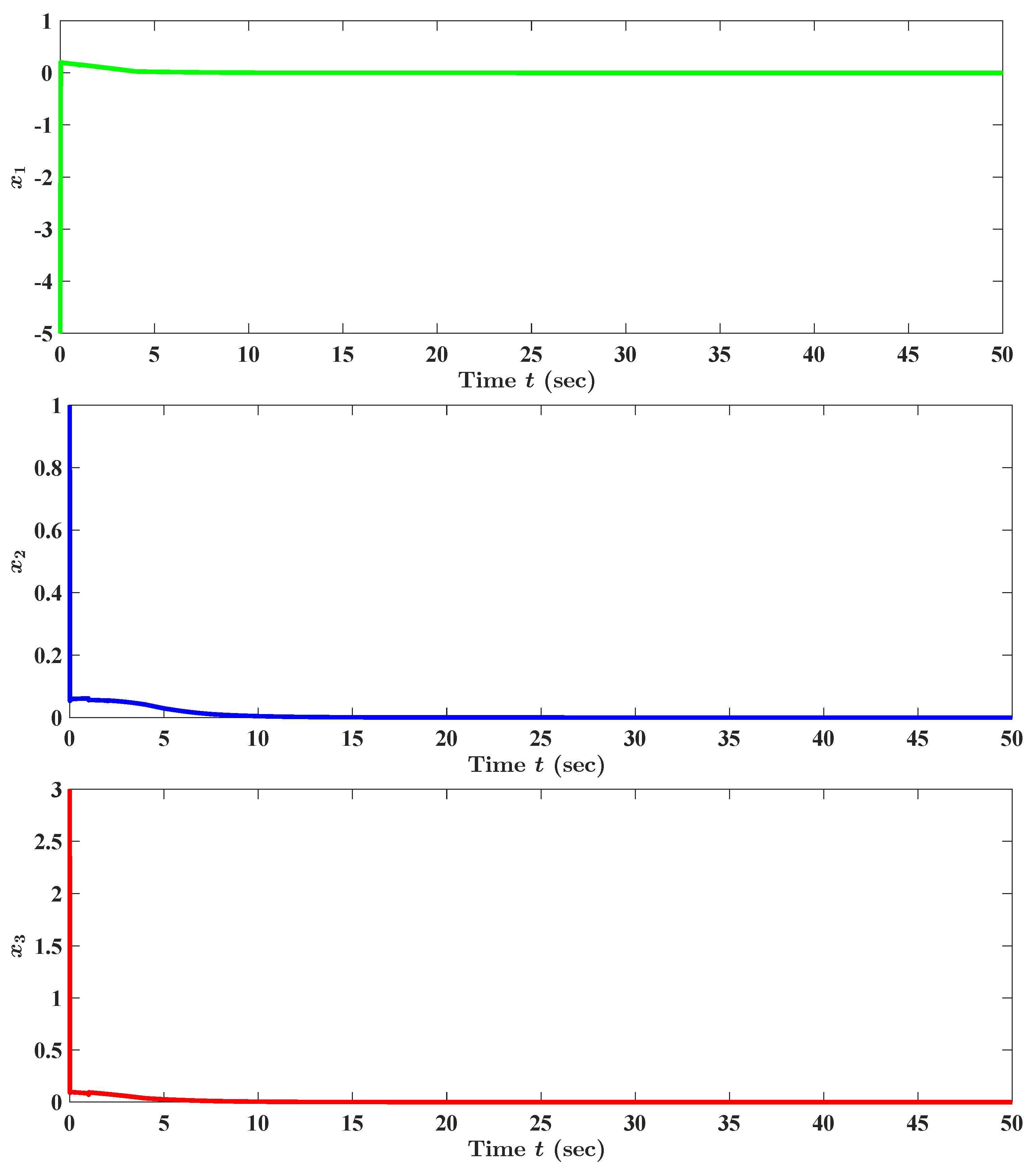
In Section 3, we provided a criterion ensuring the (unique) existence of the equilibrium state (or fixed point) of DUCNNs (23) and proved a criterion guaranteeing the convergence of state trajectories of our concerned NNs. In this section, we are focused in coming up with an example to illustrate that the aforementioned theoretical results are indeed effective.
We consider a DUCNN having the form (23) with , . We assume that the delay , , and are given by , , and , respectively. We assume in our concerned example that the matrix in the leakage term is
and that the connection weight coefficient matrices , , , , and of the transmission terms are given, respectively, by
For the sake of convenience of our later computations, we assume in this example that the exogenous disturbance and are zero for all .
We assume in our concerned example DUCNN that the activation functions , , , , and are given, respectively, by
and
With the above given , , , , , , , , , , , , , , , , and , we can prove easily that our concerned example DUCNN admits as its equilibrium state (or fixed point). Next, we would like to check numerically and graphically that is actually the unique equilibrium state (or fixed point) of our concerned example DUCNN, moreover, it is almost surely exponentially stable. By some routine but seemingly tedious calculations, we have
To reduce the computational burden, we choose to fix and as
We determine , and by solving linear matrix inequalities (LMIs) (41) and (42) (with merely , and as the decision variables) via exploiting MATLAB (®2015b), to obtain
and
With the above fixed , , , , , , , , , , , , and with the obtained , , , , , , , and , we again perform some numerical computations via MATLAB (®2015b) and obtain and ; see (38) and (43) for the detailed definitions of and , respectively.
In view of , we conclude by Theorem 1 that our concerned example DUCNN has a unique equilibrium state (or fixed point), namely . In addition, by Theorem 2, it follows from the conclusion the LMIs (41) and (42) (with merely , and as the decision variables) are both feasible that is almost surely exponentially stable. More precisely, combine (78) and (79) to arrive at
whenever for every , -a.s. Let be the (unique) state trajectory of our concerned example DUCNN satisfying the initial condition
By viewing Figure 1, we find readily that the state trajectory of our concerned example DUCNN supplemented by the initial condition (80) tends to , the equilibrium state (or fixed point) of the concerned example DUCNN, as time t escapes to infinity. To summarize, all the observations in this paragraph validate our theoretical results.
Figure 1.
Numerical and graphical illustration of the criterion (see Theorem 1) ensuring the (unique) existence of equilibrium states (or fixed points) of our concerned DUCNNs (23), and the criterion (see Theorem 2) guaranteeing the almost surely exponential stability of the equilibrium states (or fixed points) of DUCNNs (23). , , is the state trajectory of our concerned example DUCNN in this section (i.e., Section 4) fulfilling the initial condition (80).
5. Concluding Remarks
We studied, in this paper, a class of DUCNNs, namely DUCNNs (23), driven by a one-dimensional canonical Liu process; see Section 2. Our concerned model DUCNNs include discrete time and finitely distributed time delay in transmission terms. In the context of uncertain dynamical systems, it seems to be new and difficult to investigate the influence of time delay on the long time behavior of state trajectories. Our research, in this paper, is inspired noticeably by the results in References [5,14,15,21,22,23,24,25,26,27,28,29,30,31,32,33,34], but we are faced with some new challenges. For example, it is not difficult to recognize that the Brownian motion is beneficial, in a certain sense, for proving almost surely the exponential convergence of state trajectories of stochastic NNs, while the canonical Liu process is actually ‘harmful’ for proving almost surely exponential convergence of state trajectories of uncertain NNs; see References [5,14,15,30,31,32,33,34]. Therefore, it seems to be much more challenging and laborious to perform convergence analysis on state trajectories for ‘indeterminate’ NNs driven by uncertain processes than for those driven by stochastic processes.
Based on some rudimentary analysis, we come up with a criterion (see (38)) under which our concerned model DUCNNs (23) were demonstrated, via a standard contraction mapping argument, to admit unique equilibrium states (or fixed points); see Theorem 1 and its proof for the details. By designing meticulously a class of Lyapunov–Krasovskii functionals, we brought forward, based on the analysis of our designed Lyapunov–Krasovskii functionals, a criterion (see (41) as well as (42)) to guarantee that the equilibrium states (or fixed points) of our concerned model DUCNNs (23) be almost surely exponentially stable; see Theorem 2 and its proof for the details. The aforementioned theoretical analysis and the corresponding results are collected in Section 3, and our theoretical results are ‘demonstrated’, numerically and graphically, to be actually effective.
Dynamical systems governed by CNNs of nonlinear differential equations driven by uncertain processes can be chaotic, in the sense some of the time series generated by (i.e., state trajectories of) the dynamical systems are of great complexity (for example, they are flexible and/or exhibit high entropy values). By exploiting machine learning, we can establish model to predict accurately flexible time series based on NNs. NNs whose state trajectories converging to their equilibrium states (or fixed points) perform better than those having divergent state trajectories. And therefore, our convergence criterion (see Theorem 2) helps us to design accurate CNN models to predict complex time series.
As pointed out in Section 1, to take sufficiently use of the after-effect in our concerned model DUCNNs (23), a class of Lyapunov–Krasovskii functionals, the main ingredients of this paper, were carefully created. Among the merits, general positive definite matrices are included in our designed Lyapunov–Krasovskii functionals to reduce the conservatism of our stability results. An interesting notion that is closely related to the main theme of our research in this paper is stabilization. By stabilization, we mean that extra control is added in uncertain NNs to guarantee that state trajectories of the controlled uncertain NNs converge to the equilibrium states (or fixed points). In the literature, various stabilization problems have been extensively studied for deterministic and stochastic NNs. Inspired by these observations, we shall work in the direction of designing suitable (impulsive control, intermittent control, quantized control, adaptive control, pinning control, sliding mode control, event-triggered control, and so forth) feedback control to stabilize DUCNNs.
As pointed out above, and by inspecting DUCNNs (23), it is not difficult to find that the model DUCNNs considered in this paper are driven by merely one dimensional canonical Liu processes. By reviewing all our mathematical derivations throughout this paper, it is not difficult to conclude that our methods can be adapted to treat similar problems associated to UCNNs (with or without time delay) driven by multi-dimensional Liu processes. Recently, the multi-dimensional Liu processes situation was considered in References [21,29]. Inspired by the results presented in these references, we plan to consider, in the near future, the problems concerning the existence and stability of equilibrium states (or fixed points) of DUCNNs driven by multi-dimensional Liu processes.
As can be seen above, we are merely focused, in this paper, on the existence and stability of equilibrium states (or fixed points). For NNs, equilibrium states (or fixed points) are special cases of periodic trajectories, and equilibrium states (or fixed points) as well as periodic trajectories latter are special cases of almost periodic trajectories. As mentioned in Section 1, in Reference [5], the problem concerning the stability of almost periodic trajectories of a certain class of NNs was considered. From the presentation of this reference, we can find that it is actually important to generalize the notion of equilibrium states (or fixed points) to that of (almost) periodic trajectories. In quite a few situations, NNs have no equilibrium state (or fixed point), but have (almost) periodic trajectories. In the procedure of investigating large time behavior of state trajectories of NNs, (almost) periodic trajectories act in nearly the same role as equilibrium states (or fixed points). We are therefore tempted to study the existence and stability of (almost) periodic trajectories of DUCNNs.
The notion of synchronizability is very close to that of stability. By synchronizability, we mean the phenomenon: Every difference trajectory of two NNs (the two NNs may have different structure) (i) tends to zero as time escapes to infinity or (ii) tends to zero as time approaches a finite instant (the so-called settling time), and remains to be zero constantly thereupon; see References [4,6,10,11]. As can be seen in many situations, complicated NNs display chaos phenomena. This would certainly bring about difficulty in the application of these NNs. To remove or attenuate the difficulty, synchronization control should be introduced into these chaotic NNs to improve their structural properties. Inspired by these brief disscusions here, we shall consider the (asymptotical, finite-time, fixed-time and/or pre-specified time) synchronization problem for DUCNNs.
Author Contributions
Conceptualization, C.W., Y.Z. and X.Z.; Methodology, Z.J. and X.Z.; Software, C.W.; Validation, C.W.; Formal analysis, C.W., Y.Z. and X.Z.; Investigation, C.W., Z.J., Y.Z. and X.Z.; Writing—original draft, C.W.; Writing—review & editing, C.W.; Visualization, C.W., Z.J., Y.Z. and X.Z.; Supervision, Z.J., Y.Z. and X.Z.; Funding acquisition, C.W. All authors have read and agreed to the published version of the manuscript.
Funding
Chengqiang Wang is supported partially by Startup Foundation for Newly Recruited Employees and Xichu Talents Foundation of Suqian University (#2022XRC033), by NSFC (#11701050), by Qing Lan Project of Jiangsu, by Innovation and Entrepreneurship Education Reform Research Program of Suqian University (#2023cxcy08) and by ‘High Quality Public Course Teaching Reform’ Special Program for colleges and universities in Jiangsu (#2022JDKT106).
Conflicts of Interest
The authors declare that they have no conflict of interest.
References
- Chua, L.O.; Yang, L. Cellular neural networks: Theory. IEEE Trans. Circuits Syst. 1988, 35, 1257–1272. [Google Scholar] [CrossRef]
- Chua, L.O.; Yang, L. Cellular neural networks: Applications. IEEE Trans. Circuits Syst. 1988, 35, 1273–1290. [Google Scholar] [CrossRef]
- Wang, F.; Wang, C. Mean-square exponential stability of fuzzy stochastic BAM networks with hybrid delays. Adv. Differ. Equ. 2018, 2018, 235. [Google Scholar] [CrossRef]
- Wang, C.; Zhao, X.; Wang, Y. Finite-time stochastic synchronization of fuzzy bi-directional associative memory neural networks with Markovian switching and mixed time delays via intermittent quantized control. AIMS Math. 2023, 8, 4098–4125. [Google Scholar] [CrossRef]
- Kong, F.; Zhu, Q.; Wang, K.; Nieto, J.J. Stability analysis of almost periodic solutions of discontinuous BAM neural networks with hybrid time-varying delays and D operator. J. Frankl. Inst. 2019, 356, 11605–11637. [Google Scholar] [CrossRef]
- Yang, X.; Qi, Q.; Shi, P.; Xiang, Z.; Qing, L. Non-weighted L2-gain analysis for synchronization of switched nonlinear time-delay systems with random injection attacks. IEEE Trans. Circuits Syst. I Regul. Pap. 2023, 6, 3759–3769. [Google Scholar] [CrossRef]
- Wang, M.; Yang, X.; Mao, S.; Fai, K.; Yiu, C.; Park, J.H. Consensus of multi-agent systems with one-sided Lipschitz nonlinearity via nonidentical double event-triggered control subject to deception attacks. J. Frankl. Inst. 2023, 360, 6275–6295. [Google Scholar] [CrossRef]
- Zhang, M.; Yang, X.; Xiang, Z.; Liu, X. Consensus of nonlinear MAS via double nonidentical mode-dependent event-triggered switching control. Appl. Math. Comput. 2023, 453, 128085. [Google Scholar] [CrossRef]
- Zhang, M.; Yang, X.; Xiang, Z.; Sun, Y. Monotone decreasing LKF method for secure consensus of second-order mass with delay and switching topology. Syst. Control Lett. 2023, 172, 105436. [Google Scholar] [CrossRef]
- Guo, B.; Shi, P.; Zhang, C. Aperiodically intermittent control for synchronization of stochastic coupled networks with semi-Markovian jump and time delays. Nonlinear Anal. Hybrid Syst. 2020, 38, 100938. [Google Scholar] [CrossRef]
- Guo, B.; Xiao, Y. Synchronization of Markov switching inertial neural networks with mixed delays under aperiodically on-off adaptive control. Mathematics 2023, 11, 2906. [Google Scholar] [CrossRef]
- Li, X.; Rakkiyappan, R.; Balasubramaniam, P. Existence and global stability analysis of equilibrium of fuzzy cellular neural networks with time delay in the leakage term under impulsive perturbations. J. Frankl. Inst. 2011, 348, 135–155. [Google Scholar] [CrossRef]
- Gilli, M.; Biey, M.; Civalleri, P.P. On the existence of stable equilibrium points in cellular neural networks. In Proceedings of the IEEE International Symposium on Circuits and Systems, Phoenix-Scottsdale, AZ, USA, 26–29 May 2002; p. 7431968. [Google Scholar] [CrossRef]
- Zhou, L.; Hu, G. Almost sure exponential stability of neutral stochastic delayed cellular neural networks. J. Control Theory Appl. 2008, 6, 195–200. [Google Scholar] [CrossRef]
- Zhu, Q.; Li, X. Exponential and almost sure exponential stability of stochastic fuzzy delayed Cohen–Grossberg neural networks. Fuzzy Sets Syst. 2012, 203, 74–94. [Google Scholar] [CrossRef]
- Liu, B. Uncertainty Theory; Springer: Berlin/Heidelberg, Germany, 2015. [Google Scholar] [CrossRef]
- Chen, X.; Ralescu, D.A. Liu process and uncertain calculus. J. Uncertain Anal. Appl. 2013, 1, 3. [Google Scholar] [CrossRef]
- Chen, X.; Liu, B. Existence and uniqueness theorem for uncertain differential equations. Fuzzy Optim. Decis. Mak. 2010, 9, 69–81. [Google Scholar] [CrossRef]
- Gao, R. Stability in mean for uncertain differential equation with jumps. Appl. Math. Comput. 2019, 346, 15–22. [Google Scholar] [CrossRef]
- Yao, K.; Ke, H.; Sheng, Y. Stability in mean for uncertain differential equation. Fuzzy Optim. Decis. Mak. 2015, 14, 365–379. [Google Scholar] [CrossRef]
- Jia, Z.; Li, C. Almost sure exponential stability of uncertain stochastic Hopfield neural networks based on subadditive measures. Mathematics 2023, 11, 3110. [Google Scholar] [CrossRef]
- Tao, N.; Ding, C.; Zhu, Y. Stability and attractivity in pessimistic value for uncertain dynamical system. J. Intell. Fuzzy Syst. 2022, 42, 3029–3036. [Google Scholar] [CrossRef]
- Lu, Z.; Zhu, Y. Asymptotic stability in pth moment of uncertain dynamical systems with time-delays. Math. Comput. Simul. 2023, 212, 323–335. [Google Scholar] [CrossRef]
- Lu, Q.; Zhu, Y. Finite-time stability in measure for Nabla uncertain discrete linear fractional order systems. Math. Sci. 2022. [CrossRef]
- Lu, Q.; Zhu, Y.; Li, B. Finite-time stability in mean for Nabla uncertain fractional order linear difference systems. Fractals 2021, 29, 2150097. [Google Scholar] [CrossRef]
- Lu, Z.; Zhu, Y.; Xu, Q. Asymptotic stability of fractional neutral stochastic systems with variable delays. Eur. J. Control 2021, 57, 119–124. [Google Scholar] [CrossRef]
- Lu, Q.; Zhu, Y. Finite-time stability of uncertain fractional difference equations. Fuzzy Optim. Decis. Mak. 2020, 57, 239–249. [Google Scholar] [CrossRef]
- Tao, N.; Zhu, Y. Stability and attractivity in optimistic value for dynamical systems with uncertainty. Int. J. Gen. Syst. 2016, 45, 418–433. [Google Scholar] [CrossRef]
- Jia, Z.; Liu, X. Uncertain stochastic hybrid age-dependent population equation based on subadditive measure: Existence, uniqueness and exponential stability. Symmetry 2023, 15, 1512. [Google Scholar] [CrossRef]
- Li, H.; Zhu, Q. The pth moment exponential stability and almost surely exponential stability of stochastic differential delay equations with Poisson jump. J. Math. Anal. Appl. 2019, 471, 197–210. [Google Scholar] [CrossRef]
- Liu, L.; Zhu, Q. Almost sure exponential stability of numerical solutions to stochastic delay Hopfield neural networks. Appl. Math. Comput. 2015, 266, 698–712. [Google Scholar] [CrossRef]
- Wang, B.; Zhu, Q. The novel sufficient conditions of almost sure exponential stability for semi-Markov jump linear systems. Syst. Control Lett. 2020, 137, 104622. [Google Scholar] [CrossRef]
- Cong, S. Almost sure stability criterion for continuous-time linear systems with uniformly distributed uncertainty. Automatica 2023, 149, 110848. [Google Scholar] [CrossRef]
- Sun, X.; Zhao, D. An augmented result on almost sure exponential stability of semi-Markov jump systems. Syst. Control Lett. 2023, 171, 105414. [Google Scholar] [CrossRef]
- Shu, Y.; Li, B. Existence and uniqueness of solutions for uncertain nonlinear switched systems. Automatica 2023, 149, 110803. [Google Scholar] [CrossRef]
- Yao, K.; Gao, J.; Gao, Y. Some stability theorems of uncertain differential equation. Fuzzy Optim. Decis. Mak. 2013, 12, 3–13. [Google Scholar] [CrossRef]
Disclaimer/Publisher’s Note: The statements, opinions and data contained in all publications are solely those of the individual author(s) and contributor(s) and not of MDPI and/or the editor(s). MDPI and/or the editor(s) disclaim responsibility for any injury to people or property resulting from any ideas, methods, instructions or products referred to in the content. |
© 2023 by the authors. Licensee MDPI, Basel, Switzerland. This article is an open access article distributed under the terms and conditions of the Creative Commons Attribution (CC BY) license (https://creativecommons.org/licenses/by/4.0/).