


Abstract
Quantum verification has been highlighted as a significant challenge on the road to scalable technology, especially with the rapid development of quantum computing. To verify quantum states, self-testing is proposed as a device-independent concept, which is based only on the observed statistics. Previous studies focused on bipartite states and some multipartite states, including all symmetric states, but only in the case of three qubits. In this paper, we first give a criterion for the self-testing of a four-qubit symmetric state with a special structure and the robustness analysis based on vector norm inequalities. Then we generalize the idea to a family of parameterized four-qubit symmetric states through projections onto two subsystems.
1. Introduction
In recent years, quantum technology has developed rapidly and is expected to gain new real-world applications in communication, simulation, sensing, and computing [1,2,3,4]. Quantum devices promise to effectively solve some problems that are difficult to deal with in the classical field [5,6]. However, it also brings a thorny problem. How do we verify the solutions? The task of ensuring the correct operations of quantum devices in terms of accuracy of output is known as quantum verification [7], which is attracting more attention.
A common quantum state verification technology was quantum state tomography (QST) [8] in the past. It has been implemented in systems with few components, but unfortunately, it becomes unfeasible for larger systems because the complexity grows exponentially with the system size. To solve this problem, another alternative technique called self-testing [9] was proposed. These two techniques could be used to verify the quantum systems.
Self-testing is a device-independent approach to verifying that the previously unknown quantum system state and uncharacterized measurement operators are to some degree close to the target state and measurements (up to local isometries) based only on observed statistics, without assuming the dimension of the quantum system. The device-independent (DI) approach [10] is important in practical quantum communications. One of the main applications of self-testing is quantum key distribution (QKD) [11,12], which is of great interest because of its high security. For the users, the quantum key distribution system is purchased from the device providers. However, if a device provider deliberately creates a “dishonest” quantum device, which does not perform key distribution according to the correct protocol, then the key distribution performed with such a device will be insecure. Therefore, it is imperative to test the trustworthiness of quantum cryptographic devices. Fortunately, based on the idea of self-testing quantum systems, it is possible to design device-independent quantum cryptography protocols. For example, in the device-independent QKD protocols, even if the device provider is not trusted, the user can still ensure that the keys generated by the device are secure. The essence is that the user self-tests the quantum device and uses its output as the key under the condition that the test is passed, and the key must be trusted in this case. In addition to quantum key distribution, various protocols, such as random number generation [13], and entanglement witness [14], have been designed in a device-independent framework so far.
Let us consider a scenario where N distant observers share an unknown N-partite quantum state . Each party can perform uncharacterized measurements on the state with their quantum devices, where i marks different parties, marks different measurement settings for party i, and marks the corresponding measurement outcomes. In a device-independent scenario, the process of measuring an unknown quantum state can be viewed as a black box for the N observers: they can only query their devices with possible measurement settings , and to any query, the black box produces a corresponding outcome. As we do not assume the dimension of the quantum system, the dimension of the Hilbert space is not fixed. Without loss of generality, we assume that the unknown state is pure. There is no loss of generality because an extra system can be added to some of the parties, if necessary, to purify the state, and the purification of the state can be included in the black boxes. Similarly, we can further assume that the measurement operators are projective without loss of generality, as an auxiliary system in some known state can be added to the measured system to replace a general POVM on this system by a projective measurement on the extended system [9]. According to the postulates of quantum mechanics [15], the data they observe are given by
which is referred to as a correlation [16] based on the quantum nonlocality [17] of entangled states [18]. As the possibility to self-test quantum states and measurements usually relies on quantum nonlocality, only the entangled states can be device-independently verified by self-testing techniques. The self-testing problem consists of deciding if the knowledge of the correlation allows us to deduce the structure of the unknown quantum system.
Symmetric states [19] have been found useful in many quantum information tasks, such as measurement-based quantum computation (MBQC) [20], as they are not too entangled to be computationally universal. Due to the important role of symmetry in the field of quantum entanglement, it is important to explore the properties of symmetric states.
This paper is organized as follows. The basic definitions and preliminaries are given in Section 2. In Section 3, we prove analytically that a particular symmetric four-qubit state can be self-tested and give bounds that are robust to inevitable experimental errors. In addition, we show the self-testing of a family of parameterized four-qubit symmetric states, which are superpositions of four-qubit Dicke states through projections onto two subsystems in Section 4, and we give the conclusions in Section 5.
2. Basic Definitions and Preliminaries
In this section, we present the definitions of self-testing [21] and give the known results as several lemmas, which may be used as building blocks for our work.
Definition 1
(Self-testing). A known correlation allows for self-testing the state and measurements ; if any state and measurements and reproduce the correlation, there exists a local isometry Φ such that
where the state is an auxiliary state which will be traced out and thus not taken into consideration.
The currently known self-testing protocols are mainly tailored for bipartite states [22,23,24,25,26]. We first review two-qubit self-testing. As given in [23,24], all pure two-qubit entangled states can be self-tested by observing the maximum violation of the tilted CHSH inequality [27]
where and and are observables with outcomes . The maximal violation is given by .
Lemma 1.
Any pure two-qubit states in their Schmidt form can be self-tested by achieving the maximal quantum violation of the tilted CHSH inequality Equation (3). The corresponding measurements and for two distant parties, Alice and Bob, are set as
Here, and .
Especially for the maximally entangled two-qubit states in the form , there exist another two criteria [25].
Lemma 2
(Mayers–Yao criterion). Consider five unknown dichotomic measurements . If the following statistics are observed
then up to a local isometry, the state is self-tested into the maximally entangled two-qubit state , and the measurements are the suitable complementary Pauli operators.
Lemma 3
(XOR game). Consider four unknown operators with binary outcomes and let . The state can be self-tested into the maximally entangled two-qubit state by winning the binary nonlocal XOR game defined by the figure of merit if it satisfies . The coefficients are constructed by
However, the self-testing of multipartite scenarios has not been fully explored. In this paper, we work on the four-qubit symmetric entangled states.
Definition 2
(Symmetric states). Symmetric quantum states preserve invariance under any permutation of their subsystems. We say that an n-partite state is symmetric if for all , where is the symmetric group of n elements. The n-qubit Dicke states are typical examples of symmetric state, which are the equally weighted sums of all permutations of computational basis states with qubits being and k being :
Let be a state vector in an N-fold tensor product space , where and . As the generalization of the Schmidt decomposition given in [28], if , any multipartite states can be written in the expansion as
where some coefficients satisfy
and the rest orthogonal product states
can be seen as a set of local bases. To characterize the symmetric multi-qubit states, we only need to make the rest coefficients have properties
3. Self-Testing of a Four-Qubit Symmetric State
In this section, we focus on a four-qubit symmetric state with a special structure by using the known results. In the case of , as given in Equation (10), the set of local bases is
3.1. Self-Testing of a Specific Four-Qubit Symmetric State
The specific four-qubit symmetric state we consider is
which is shared by four distant observers, Alice, Bob, Charlie and David.
Rewrite the state as
The concept of partial measurements [29] is involved in our scheme, which appears very often in reality. A similar approach for quantum nonlocality chracterization is given in [30], where quantum imcompatibility is used to characterize nonlocality. According to the partial measurement postulate given in [29], if any two parties, without loss of generality, e.g., Alice and Bob, each measure in the basis, the remaining two parties share a maximally entangled two-qubit state conditioned on the outcome and , respectively, which can be self-tested combining Lemma 2.
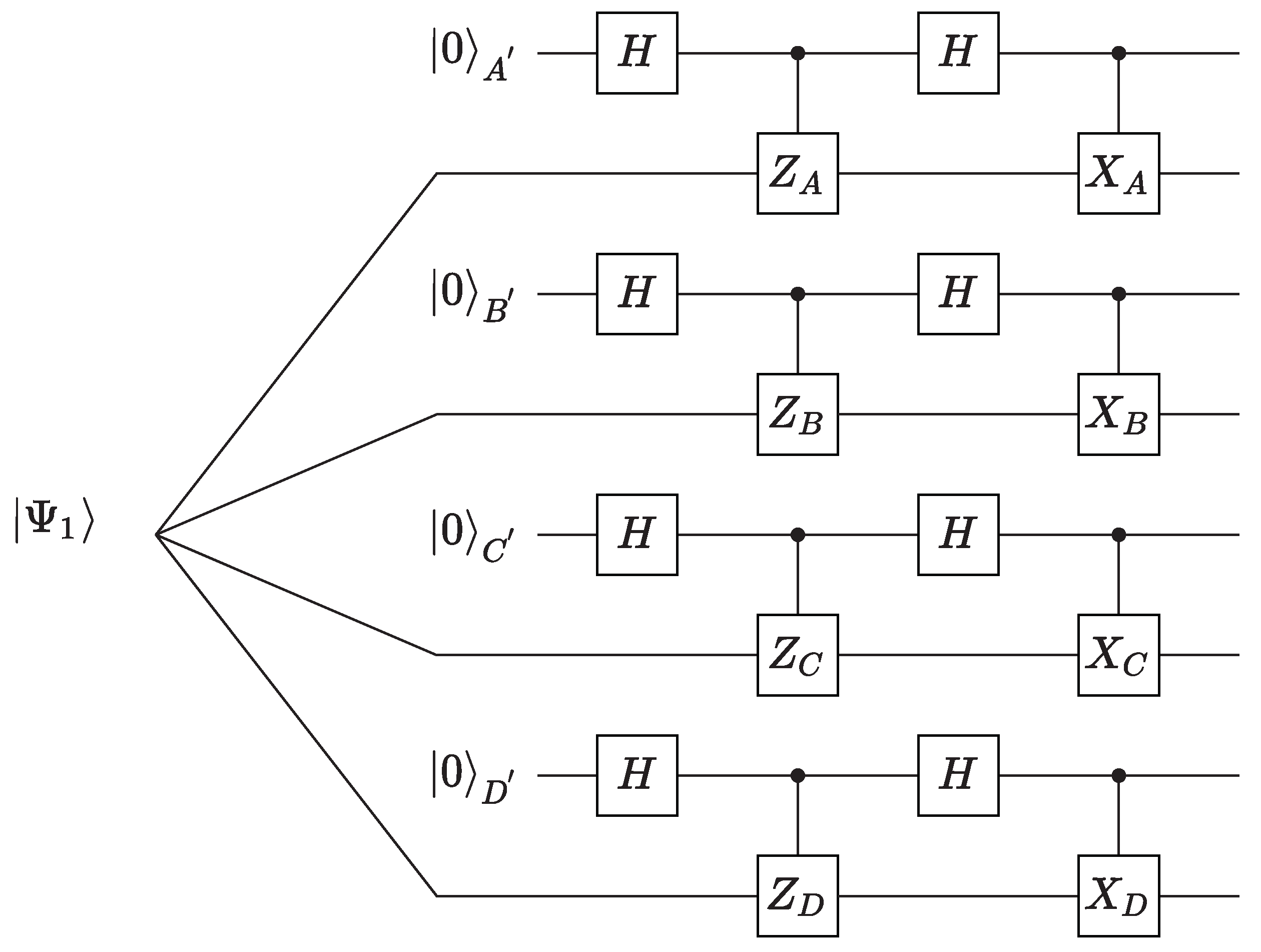
We construct the local isometry as Figure 1. Here, H is the usual Hadamard gate. Obviously, if , we can extract the essential information on the unknown state into auxiliary systems. Inspired by this, and should act analogously to the Pauli operators on to guarantee the feasibility of the protocol. However, in order to make the protocol device-independent, we cannot directly consider and of each party as Pauli operators, but should construct them with the measurements properly. We sum the result up as below.
Figure 1.
Swap circuit of the isometry to self-test the target state .
Result 1.
Consider four spatially separated parties, Alice, Bob, Charlie and David, each performing three measurements with binary outcomes on an unknown shared quantum state . The target symmetric state is self-tested if the statistics are observed as the following:
where and , where are projectors for the measurement.
Proof.
To begin with, the output after the isometry given in Figure 1 is
Observation Equation (15) implies that
and thus for other eight projectors. Based on the fact that implies , observation of Equation (16) implies
and
Obviously, we have . Since , we have . Hence, we obtain the following anti-commutation relation
for all , and similarly,
All these properties of the operators will help to reduce the output Equation (17). By using Equation (21), is equal to . As shown in Equation (19), this term becomes . We can simplify the other five terms similarly. For the last term, we can obtain using Equations (20) and (22), which can also be simplified to . As a reminder, there are eight terms equal to zero. Hence, the output Equation (17) is reduced to
and can be normalized into the form of , here . □
3.2. Robustness Analysis Based on the Norm
In this section, we give the analysis of robustness based on the vector norm inequality. Result 1 relies on the observation of Equations (15) and (16) exactly; however, which may be impossible in actual experiments due to the inevitable deviation from the ideal case. Suppose each observation in Equations (15) and (16) admits a deviation at most around the ideal value. We say that the self-testing of is robust [31] if the isometry still extracts a state close to it and satisfies
where when .
We show that
in Appendix A, which proves the robustness of Result 1.
4. Self-Testing of a Family of Parameterized Four-Qubit Symmetric States
In this part, we consider a more general state
where and . The parameterized state is a superposition of W state, state and state, where the ratio of the coefficient of state and state is a constant value, which is equal to . Rewrite the states as
Denote
The state in its Schmidt form is
where . Here, , are the corresponding new bases for C and D. (See detail in Appendix C).
If , is not an entangled state and the lack of nonlocality may result in the failure of the self-testing. Following the framework of [32], we intend to divide the four parties into two parts, and one of them performs local measurements on . If we divide randomly into groups that each have two parties, for example, and , as a result, the projection measurements may collapse the state shared by the remaining parts into some unknown pure bipartite entangled states. Then the remaining two parts should check whether the projected state they share violates maximally Equation (3) for the appropriate . Without loss of generality, if A and B perform the measurement in the bases, and should be self-tested by C and D, respectively, and simultaneously conditioned on the outcomes and .
Following the result given in Lemma 1, can be self-tested by reaching the maximal violation of the tilted CHSH Bell inequality
where and the optimal measurement are set as Lemma 1 with . Meanwhile, is still a maximally entangled two-qubit state under the same transformation of bases
and hence, we can use the same measurement settings as . As the definition given in Lemma 3, , and thus it will satisfy the condition .
Define
Then can be self-tested by winning the XOR game and we give the criterion to self-test as the following Result 2.
Result 2
(See proof in Appendix B). Consider four spatially separated parties, Alice, Bob, Charlie and David, each performing five measurements with binary outcomes denoted as on an unknown shared quantum state . The target state is self-tested if the statistics are observed as the following
where , , where are projectors for the measurement and . At the same time, we find a proper construction of the local isometry , where and are based on the measurement settings
and thus makes the protocol device-independent. In addition, each party may need another fifth measurements to obtain the observation of Equation (36). Since , the fifth measurements are feasible in practical experiments.
5. Conclusions
In this paper, we propose schemes to self-test a large family of four-qubit symmetric states. The target states we focus on are the superposition of the four-qubit Dicke states.
We first present a procedure for self-testing of a particular four-qubit symmetric state with a special structure, and this procedure makes use of the self-testing of the maximally entangled two-qubit state . At the same time, we prove that this protocol is robust against inevitable experimental errors based on norm inequality. In addition, we propose an approach to self-test a one-parameter family of four-qubit pure states through projections onto two systems. Here in our work, only the simplest Pauli measurements are used, which is quite helpful in the experiments.
It would also be of interest to work on a more general state with two parameters by using the swap method and semidefinite programming (SDP) [26] in the form
where , which may provide better robustness than the analytical bounds. What is more, our work could potentially be generalized to a higher dimension scenario. These are reserved for our future work.
Author Contributions
Methodology, validation, investigation, resources, writing—original draft preparation, D.B.; writing—review and editing, project administration, funding acquisition, supervision, X.T.; discussion, Q.X., H.W. and R.H. All authors have read and agreed to the published version of the manuscript.
Funding
The research was partly funded by the Natural Science Foundation of Guangdong Province of China under Grant No. 2021A1515011440, the Major Program of Guangdong Basic and Applied Research under Grant No. 2019B030302008, the National Natural Science Foundation of China under Grant No. 62032009, and the Outstanding Innovative Talents Cultivation Funded Programs for Doctoral Students of Jinan University under Grant No. 2021CXB007.
Informed Consent Statement
Not applicable.
Conflicts of Interest
The authors declare no conflict of interest.
Appendix A. Proof of the Robustness
In this section, we give the proof of Equation (25) based on the norm. Rewrite the norm Equation (24) as
Obviously, we need to find the upper bounds for and respectively. Suppose each observation in Equations (15) and (16) has a deviation at most around the ideal value. Then we can obtain some inequalities, for instance
In addition, for convenience and rigorous of the derivation, we assume that
which may not direct the observation statistics. We can now write
and similarly,
In addition,
where from
by using the Cauchy–Schwarz inequality [33] and Equation (A5). Hence, we obtain
Since the norm of the projectors is equal to 1, we have
Similarly,
which implies
Finally, since
Similarly,
therefore we can obtain
Hence, we obtain
and
where . In addition, we have
With a similar derivation in [34], we have and , which implies that
and thus
We now can write
which implies
Appendix B. Proof of the Self-Testing of a Family of Parameterized Four-Qubit Symmetric States
Observation Equation (33) implies that
and thus for other four projectors.
For convenience, we use as an example to prove Result 2. Define the operators for party C and D as
Then we have
by Equations (A25a) and (A25b). The observation of Equation (34) implies
and combined with the relation Equation (A25a) from the tilted CHSH inequality, we have
We can write the in the subspace of as
by Equation (34) and thus we can define the vector orthogonal to as
From Equations (A25a) and (A25c), we obtain
Hence, we obtain
Similarly, we obtain the following relations
for all . The maximal violation of the XOR game Equation (35) implies
We can use a similar method as above and obtain
At last, the observation Equation (36) implies that
for all .
We construct the local isometry similar to Figure 1: just replace with . The output after the isometry is
By using Equation (A26), is equal to . Combining with Equation (A36), one can simplify this term to . The third to fifth terms share a similar simplification process.
In addition, is equal to and then can be replaced by using Equation (A33). Terms from the seventh to eleventh are similar. For the last term, we can obtain using Equation (A35), which is then the same as the eleventh term. We remind that there are four terms equal to zero. Finally, the output is reduced to
which can be normalized to the form , here . Then the unknown state is self-tested as , which proves that Result 2 holds with the required observations Equations (33)–(36). The protocol is also robust by a norm-inequality-based analysis similar to the Result 1 and the detailed derivation process is omitted here.
Appendix C. Relations between Pauli Operators and the Unknown Measurements
In this section, we give details of the relations between Pauli operators and the unknown measurements in Result 2 by Schmidt decomposition.
The coefficient matrix of is
which has the Schmidt decomposition , where
and
Hence, if t < 1, we have
If t > 1,
Now we can consider the relation between operators and with new bases and Pauli operators for part A,
For part B, if t < 1,
and if t > 1,
Hence, if the operators performed by each party are the same as Lemma 1 with new bases, they can be transformed into Pauli matrices
References
- Dowling, J.P.; Milburn, G.J. Quantum technology: The second quantum revolution. Philos. Trans. R. Soc. A 2003, 361, 1655–1674. [Google Scholar] [CrossRef] [PubMed] [Green Version]
- Gisin, N.; Thew, R. Quantum communication. Nat. Photon. 2007, 1, 165–171. [Google Scholar] [CrossRef] [Green Version]
- Georgescu, I.M.; Ashhab, S.; Nori, F. Quantum simulation. Rev. Mod. Phys. 2014, 86, 153–158. [Google Scholar] [CrossRef] [Green Version]
- Degen, C.L.; Reinhard, F.; Cappellaro, P. Quantum sensing. Rev. Mod. Phys. 2017, 89, 035002. [Google Scholar] [CrossRef] [Green Version]
- Yu, C.H.; Gao, F.; Liu, C.; Huynh, D.; Reynolds, M.; Wang, J. Quantum algorithm for visual tracking. Phys. Rev. A 2019, 99, 022301. [Google Scholar] [CrossRef] [Green Version]
- Liu, H.; Wu, Y.; Wan, L.; Pan, S.; Qin, S.; Gao, F.; Wen, Q. Variational quantum algorithm for Poisson equation. Phys. Rev. A 2021, 104, 022418. [Google Scholar] [CrossRef]
- Eisert, J.; Hangleiter, D.; Walk, N.; Roth, I.; Markham, D.; Parekh, R.; Chabaud, U.; Kashefi, E. Quantum certification and benchmarking. Nat. Rev. Phys. 2020, 2, 382–390. [Google Scholar] [CrossRef]
- Cramer, M.; Plenio, M.B.; Flammia, S.T.; Somma, R.; Gross, D.; Bartlett, S.D.; Landon-Cardinal, O.; Poulin, D.; Liu, Y.-K. Efficient quantum state tomography. Nat. Commun. 2010, 1, 149. [Google Scholar] [CrossRef] [Green Version]
- Mayers, D.; Yao, A. Self testing quantum apparatus. Quant. Inf. Comput. 2004, 4, 273–286. [Google Scholar] [CrossRef]
- Gallego, R.; Brunner, N.; Hadley, C.; Acín, A. Device-independent tests of classical and quantum dimensions. Phys. Rev. Lett. 2010, 105, 230501. [Google Scholar] [CrossRef] [Green Version]
- Long, G.; Liu, X. Theoretically efficient high-capacity quantum-key-distribution scheme. Phys. Rev. A 2002, 65, 032302. [Google Scholar] [CrossRef] [Green Version]
- Kwek, L.; Cao, L.; Luo, W.; Wang, Y.; Sun, S.; Wang, X.; Liu, A. Chip-based quantum key distribution. Assoc. Asia Pac. Phys. Soc. Bull. 2021, 31, 15. [Google Scholar] [CrossRef]
- Pironio, S.; Acín, A.; Massar, S.; de la Giroday, A.B.; Matsukevich, D.N.; Maunz, P.; Olmschenk, S.; Hayes, D.; Luo, L.; Manning, T.A.; et al. Random numbers certified by Bell’s theorem. Nature 2010, 464, 1021–1024. [Google Scholar] [CrossRef] [PubMed] [Green Version]
- Bancal, J. Device-independent witnesses of genuine multipartite entanglement. Phys. Rev. Lett. 2011, 106, 250404. [Google Scholar] [CrossRef] [Green Version]
- Nielsen, M.A.; Chuang, I.L. Quantum Computation and Quantum Information; Cambridge University Press: Cambridge, UK, 2000. [Google Scholar]
- Bancal, J.-D.; Navascués, M.; Scarani, V.; Vértesi, T.; Yang, T.H. Physical characterization of quantum devices from nonlocal correlations. Phys. Rev. A 2015, 91, 022115. [Google Scholar] [CrossRef] [Green Version]
- Popescu, S.; Rohrlich, D. Generic quantum nonlocality. Phys. Rev. A 1992, 166, 293–297. [Google Scholar] [CrossRef]
- Horodecki, M.; Horodecki, P.; Horodecki, R. Quantum entanglement. Rev. Mod. Phys. 2009, 81, 865–942. [Google Scholar] [CrossRef] [Green Version]
- Fannes, M.; Lewis, J.T.; Verbeure, A. Symmetric states of composite systems. Lett. Math. Phys. 1988, 15, 255–260. [Google Scholar] [CrossRef]
- Briegel, H.J.; Browne, D.E.; Dür, W.; Raussendorf, R.; Van den Nest, M. Measurement-based quantum computation. Nat. Phys. 2009, 5, 19–26. [Google Scholar] [CrossRef] [Green Version]
- Šupić, I.; Coladangelo, A.; Augusiak, R.; Acín, A. Self-testing multipartite entangled states through projections onto two systems. New J. Phys. 2018, 20, 083041. [Google Scholar] [CrossRef]
- Coladangelo, A.; Goh, K.T.; Scarani, V. All pure bipartite entangled states can be self-tested. Nat. Commun. 2017, 8, 15485. [Google Scholar] [CrossRef] [PubMed]
- Yang, T.H.; Navascués, M. Robust self-testing of unknown quantum systems into any entangled two-qubit states. Phys. Rev. A 2013, 87, 050102. [Google Scholar] [CrossRef] [Green Version]
- Bamps, C.; Pironio, S. Sum-of-squares decompositions for a family of Clauser-Horne-Shimony-Holt-like inequalities and their application to self-testing. Phys. Rev. A 2015, 91, 052111. [Google Scholar] [CrossRef] [Green Version]
- Wang, Y.; Wu, X.; Scarani, V. All the self-testings of the singlet for two binary measurements. New J. Phys. 2016, 18, 025021. [Google Scholar] [CrossRef]
- Navascues, M.; Pironio, S.; Acín, A. A convergent hierarchy of semidefinite programs characterizing the set of quantum correlations. New J. Phys. 2008, 10, 073013. [Google Scholar] [CrossRef] [Green Version]
- Acín, A.; Massar, S.; Pironio, S. Randomness versus nonlocality and entanglement. Phys. Rev. Lett. 2012, 108, 100402. [Google Scholar] [CrossRef] [Green Version]
- Carteret, H.A.; Higuchi, A.; Sudbery, A. Multipartite generalization of the Schmidt decomposition. J. Math. Phys. 2000, 41, 7932–7939. [Google Scholar] [CrossRef] [Green Version]
- Long, G. Collapse-in and collapse-out in partial measurement in quantum mechanics and its wise interpretation. Sci. China Phys. Mech. Astron. 2021, 64, 280321. [Google Scholar] [CrossRef]
- Zhang, X.; Qu, R.; Chang, Z.; Quan, Q.; Gao, H.; Li, F.; Zhang, P. A geometrical framework for quantum incompatibility resources. Assoc. Asia Pac. Phys. Soc. Bull. 2022, 32, 17. [Google Scholar] [CrossRef]
- Wu, X.; Cai, Y.; Yang, T.H.; Le, H.N.; Bancal, J.-D.; Scarani, V. Robust self-testing of the three-qubit W state. Phys. Rev. A 2014, 90, 042339. [Google Scholar] [CrossRef] [Green Version]
- Li, X.; Wang, Y.; Han, Y.; Qin, S.; Gao, F.; Wen, Q. Self-Testing of Symmetric Three-Qubit States. IEEE J. Sel. Areas Commun. 2020, 38, 589–597. [Google Scholar] [CrossRef] [Green Version]
- Bhatia, R.; Davis, C. A Cauchy-Schwarz inequality for operators with applications. Linear Algebra Appl. 1995, 223–224, 119–129. [Google Scholar] [CrossRef] [Green Version]
- McKague, M.; Yang, T.H.; Scarani, V. Robust self-testing of the singlet. J. Phys. A Math. Theor. 2012, 45, 455304. [Google Scholar] [CrossRef] [Green Version]
Publisher’s Note: MDPI stays neutral with regard to jurisdictional claims in published maps and institutional affiliations. |
© 2022 by the authors. Licensee MDPI, Basel, Switzerland. This article is an open access article distributed under the terms and conditions of the Creative Commons Attribution (CC BY) license (https://creativecommons.org/licenses/by/4.0/).

