1. Introduction
The Lyapunov exponent (LE) is the most commonly used measure for quantifying the chaos of non-linear dynamical systems. The LE measures the average exponential separation rate of orbits with infinitesimally close initial points. The orbit produced by a smooth map
f on
is referred to as chaotic if the largest LE among all
d LEs is positive. In principle, the Jacobian matrix:
is necessary to compute LEs. However, in general, obtaining an explicit formula for
for a large
n is challenging. In actual numerical computations, the LEs of a map
f are obtained by approximating the image ellipsoid
of the unit sphere
U. This approach involves the chain rule and the Gram–Schmidt orthogonalization procedure to compute the LEs of the map
f [
1]. Subsequently, all the LEs of the map
f on
can be computed, provided the Jacobian matrix
can be obtained.
Thus, LEs for a time series are generally incomputable in the absence of any information regarding the Jacobian matrix,
. Therefore, researchers have suggested various estimation methods of LEs for a time series [
2,
3,
4,
5,
6,
7]. The largest LE for a time series may be estimated using these methods. However, estimating all the LEs and their total sum for the time series is not always possible.
The chaos degree quantifies the chaos of a dynamical system as follows:
in Information Dynamics [
8]. Here,
is referred to as the state and
as a channel associated with the state change
.
is the complexity of the state
and
is the transmitted complexity associated with the state change
. A channel
is referred to as chaotic in the definition of Information Dynamics, provided chaos degree is positive. In a classical dynamical system, state
and channel
are provided as a probability distribution
at time
n and a transition probability matrix from
at time
n to
at time
. By substituting the Shannon entropy
and the mutual entropy
for
and
respectively, the entropic chaos degree (ECD) is obtained from
in classical dynamical systems [
9]. Thus, the ECD becomes an information quantity equivalent to conditional entropy:
in classical dynamical systems. The ECD offers the advantage of being directly computable for time-series data, even if the dynamical equation generating the time-series data is unknown. Using the ECD, an attempt to characterize chaotic behaviors has been made [
9,
10,
11].
There exists a relationship between the LE and ECD [
12]. Unfortunately, the ECD is not always sufficient to be used as an alternative to the LE because it always attains a higher value than the LE for any chaotic map [
13]. Therefore, based on the interpretation of the difference between the ECD and LE, an improved ECD was proposed for a one-dimensional chaotic map, and it was shown that the improved ECD is equivalent to the LE under typical chaotic conditions [
13,
14]. Furthermore, the extended entropic chaos degree (EECD) was introduced as an extended improved ECD to a multidimensional chaotic map. Further, it has also been shown that the EECD coincides with the sum of all LEs in typical chaotic conditions [
15].
However, the above relationship between the EECD and LEs assumes several conditions, such that the numbers of mapping points and all components of the equipartition of
I in the map from
I to
I must take the limit of infinity. However, these numbers must be set as finite numbers in actual numerical computations. Therefore, an improved calculation formula for the EECD was proposed, such that the EECD is almost computable as the sum of all LEs of a typical multidimensional chaotic map in actual numerical computations [
16].
This study shows that all LEs of a multidimensional chaotic map can be estimated using an improved calculation formula for the EECD and proposes a computational algorithm for the EECD. Moreover, the computational algorithm of the EECD was applied to specific typical chaotic maps.
2. Entropic Chaos Degree
This section briefly reviews the definition of the ECD for a difference equation system.
Let
f be a map, such that
(
). Consider the following difference equation:
Let
be an initial value and let
be a finite partition of
I such that:
where
is a Borel measurable subset of
I.
Then, the probability distribution
at time
n is expressed as
and the joint distribution
at times
n and
, associated with the difference equation, is expressed as:
where
is the characteristic function of the set
A.
Subsequently, the ECD
D of an orbit
is defined as in [
8] as:
where
is the conditional probability from one component
to another
for the finite partition
of
I.
Further, using the ECD, the orbit
associated with the map
f is uniquely determined in the definition of Information Dynamics (ID) in [
8] as follows:
Here, the ECD is denoted as
without
n, provided the orbit
does not depend on time
n. In a similar manner, the ECD is denoted as
without
f, provided the orbit
is not generated by the map
f.
However, the unique definitions of the orbit in ID may not be consistent with the original properties of the orbit. The basic properties of the ECD in [
12] are briefly reviewed.
Let
M be a sufficiently large natural number and let
f be a one-dimensional map from
I to
I where
. Let
be the
L-equipartition of
I, such that
where
Subsequently, the following theorems are proved in [
12]:
Theorem 1. If the map f creates a stable periodic orbit, then the following equality holds: for the L-equipartition of .
Theorem 2. Further, if the LE of f is positive, the following inequality holds: for the L-equipartition of .
Theorem 3. Let be the LEs of such that are differentiable almost everywhere in I. Assume that the absolute values are constants for all .
If , the following inequality holds for sufficiently large M: for the L-equipartition of .
However, in Theorem 2, not vice versa because
for a quasi-periodic orbit [
12]. In Theorem 3, it is assumed that the maps
are piecewise linear functions, such as the Bernoulli shift map and the tent map.
Next, the relationship between the ECD and the metric entropy is focused on. Let
T be a measurable transformation from
I to
I, preserving a probability measure
on
I, and
provides a measurable partition of
I. Then, the metric entropy of
T with respect to
and
of
I is defined by in [
17],
Then, for sufficiently large
M, ECD
is equal to or larger than the metric entropy
: see [
16].
Using the ECD, the characterization of certain chaotic behaviors has been attempted by the authors of papers such as [
9,
10,
11]. Unfortunately, the ECD is not always sufficient for use as an alternative to the LE because the ECD always attains a higher value than the LE for chaotic maps [
13].
3. Extended Entropic Chaos Degree
This section briefly reviews the definition of the EECD for a difference equation system.
Let
be the
-equipartition of
, such that
where
for
.
Further, for any component
of
, another component
is divided into the equipartition
of smaller components, such that
where
and
for
.
Using the function
for any two components
of
, function
is introduced by
here, the numerator of
is the number of
in
for any
and
and the denominator of
is the number of
in
for any
and
. Thus,
represents the volume rate of
to
at the
scale. Moreover, it was directly obtained from [
15]
where
m denotes the Lebesgue measure of
.
Then, the EECD
is defined in [
15] as
where
,
Clearly, the EECD becomes the ECD only if
for any
and
. In other words, from Equation (
8), the ECD always regards
as
in the infinite limit of
. This results in a difference between the ECD and LE for chaotic maps [
15].
First, the following theorem holds with respect to a periodic orbit [
15]:
Theorem 4. Let be sufficiently large natural numbers. If map f creates a stable periodic orbit with period T, then the following equality holds: where , , .
Second, the relationship between the EECD and LE in a chaotic dynamical system is briefly reviewed. Let map
f be a (piecewise)
function on
. For any
,
, let
be an approximate Jacobian matrix, such that
Let
be the eigenvalues of
.
Now, let us consider a piecewise linear function
for a (piecewise)
function
f such that:
where
Here,
is randomly sampled from
and
such that
where
.
In order to consider the piecewise linear function as an approximate formula of the (piecewise) function f, the following assumption is introduced.
Assumption 1. Assume that for sufficiently large natural numbers L and M, the points in are uniformly distributed over , such that, for any subset of where m is the Lebesgue measure on and is the number of points included in among n points, which are randomly sampled from .
Then, the following theorem is proven with respect to an aperiodic orbit.
Theorem 5. Let f be a (piecewise) function. Then the following equality is valid. and represent the Lyapunov spectrum of the map f.
Proof. Let
be a (piecewise) linear function given as Equation (
10) for a (piecewise)
function
f under Assumption 1.
As shown in
Section 4, for a large natural number
L,
□
According to Theorem 5, the EECD becomes the sum of all the LEs of a (piecewise) function f as L, M, and reach infinity.
At the end of this section, the relationship between the EECD and metric entropy is explained. Let
T be a measurable transformation from
I to
I, preserving a probability measure
on
I, and
provides a measurable partition of
I. Let
denote the metric entropy for the pair
[
17]. Subsequently, the EECD
is equal to 0 for sufficiently large
M and
without depending on
n [
16]. Hence, the EECD
is equal to or less than the metric entropy
for sufficiently large
M and
.
4. Computational Algorithm of the EECD
In this section, by reviewing the derivation processes of the improved calculation formula of the EECD in [
16], it is shown that all the LEs for an aperiodic orbit can be estimated by calculating the EECD.
To satisfy the relation in Theorem 5, the infinite values of
L,
M, and
must be used. However, in the actual numerical computations of the EECD, these numbers must be set as finite values. Therefore, an improved calculation formula for the EECD was proposed in [
16].
First, the derivation of the improved EECD calculation formula is reviewed for a stable periodic orbit. It is assumed that the map
f creates a stable periodic orbit. Then, for any component
, there exists a component
such that:
where
is the number of elements of the set
A.
From Equation (
15),
because the conditional probability
is expressed as
Setting
then the following is obtained:
From Equation (
17), it is evident that
does not depend on
: Thus, the following improved calculation formula for the EECD for a stable orbit is obtained:
Second, the derivation process of the improved EECD calculation formula was reviewed for an aperiodic orbit. It is assumed that the map f does not create stable periodic orbits.
Let
L and
M be any sufficiently large natural numbers and let
m be the Lebesgue measure on
. Let
f be a piecewise linear function
given as Equation (
10) under Assmption 1. Let us assume that
f has the unique invariant measure
.
Then, the following is obtained:
Here, the following relationship is used in the second approximation (Equation (
19)).
For any set
,
The variance–covariance matrix
for all points
on
X, is expressed as
where
Let be the eigenvalues of such that .
Thus, an improved calculation formula of the EECD for an aperiodic orbit is obtained as:
Thus, the improved calculation formula for the EECD is expressed as
It is shown that all the LEs for an aperiodic orbit can be estimated for calculating the EECD as follows. Now, it is assumed that all the points
on
are almost uniformly distributed over
: see Equation (
12)
Consider a random variable
that follows a uniform distribution on
. Subsequently, the standard deviation
of
is expressed as
From Equation (
22), the following is obtained:
Let
be the eigenvector corresponding to the eigenvalue
, and
From Equations (
23) and (
24),
and
are expressed as:
Using Equations (
25) and (
26) yields:
Furthermore, using Equations (
27) and (
28) the following is obtained:
From Equation (
29),
Now, let
be the eigenvalues of
such that
(
k = 1, 2, …,
d) and let
be the density function of
. Further, let
be the Lyapunov spectrum of
f. Then,
Here the
kth item (
) of the EECD in Equation (
30) is defined such that:
where
and
.
Further, using Equations (
30) and (
31), the following is obtained:
Thus, the computational of the EECD for the map
f is proposed as follows Algorithm 1:
| Algorithm 1: Computational algorithm of the EECD |
Step 0. Consider a map f and create a partition in the following way: for any . Step 1. Check whether the map f creates a stable periodic orbit. Step 2. If it does, then compute the EECD such that: Step 3. If not, then compute the such that: for , the process proceeds to Step 4. Step 4. Moreover, compute the EECD such that: |
5. Application of the Computational Algorithm of the EECD to Chaotic Dynamics
In this section, the computational algorithm of the EECD is applied to typical chaotic maps.
The essential basic elements for producing chaotic behavior are operations: “stretching” and “folding,” which are explained using a baker’s map as an example of a chaotic map.
The baker’s map
f is defined as:
where
,
The baker’s map f comprises two operations. In the first operation (stretching), the unit square was stretched twice in the direction and is compressed by half in the direction. Whereas, during the second operation (folding), the right part sticking out from the unit square was cut vertically and stacked on top of the left part.
Using the unit interval instead of the unit square, the Bernoulli shift map
f is expressed as:
where
.
Thus, several typical one-dimensional chaotic maps exist with both the stretching and folding operations. In the next section, the computational algorithm of the EECD is applied for typical one and two-dimensional chaotic maps.
In general, the double type in the C language has been used for numerical computations. However, to ensure calculation accuracy, the floating-point type with a 1024-bit mantissa was used in the numerical computations of the eigenvalues of the variance-covariance matrix using GNU Multiprecision Library (GMP).
5.1. Application of the Computational Algorithm of the EECD to a One-Dimensional Chaotic Map
Consider a one-dimensional chaotic map
, where
. Let
be the
L-equipartition of
I given as Equation (
2) The improved formula of the EECD for a one-dimensional aperiodic map
f is then expressed as:
where
Here
is the variance of all points
x on
X.
In the following, and are set.
5.1.1. Numerical Computation Results for a Generalized Bernoulli Shift Map
In this section, the computational algorithm of the EECD is applied to a generalized Bernoulli shift map as the most straightforward one-dimensional chaotic map. The generalized Bernoulli shift map has derivative that depends only on parameter a.
The generalized Bernoulli shift map
is defined as:
where
and
. Then, the derivative
of the generalized Bernoulli shift map
is calculated as constant
. Thus, the LE of the generalized Bernoulli shift map
was
.
Now, consider the orbit
associated with the generalized Bernoulli shift map
such that:
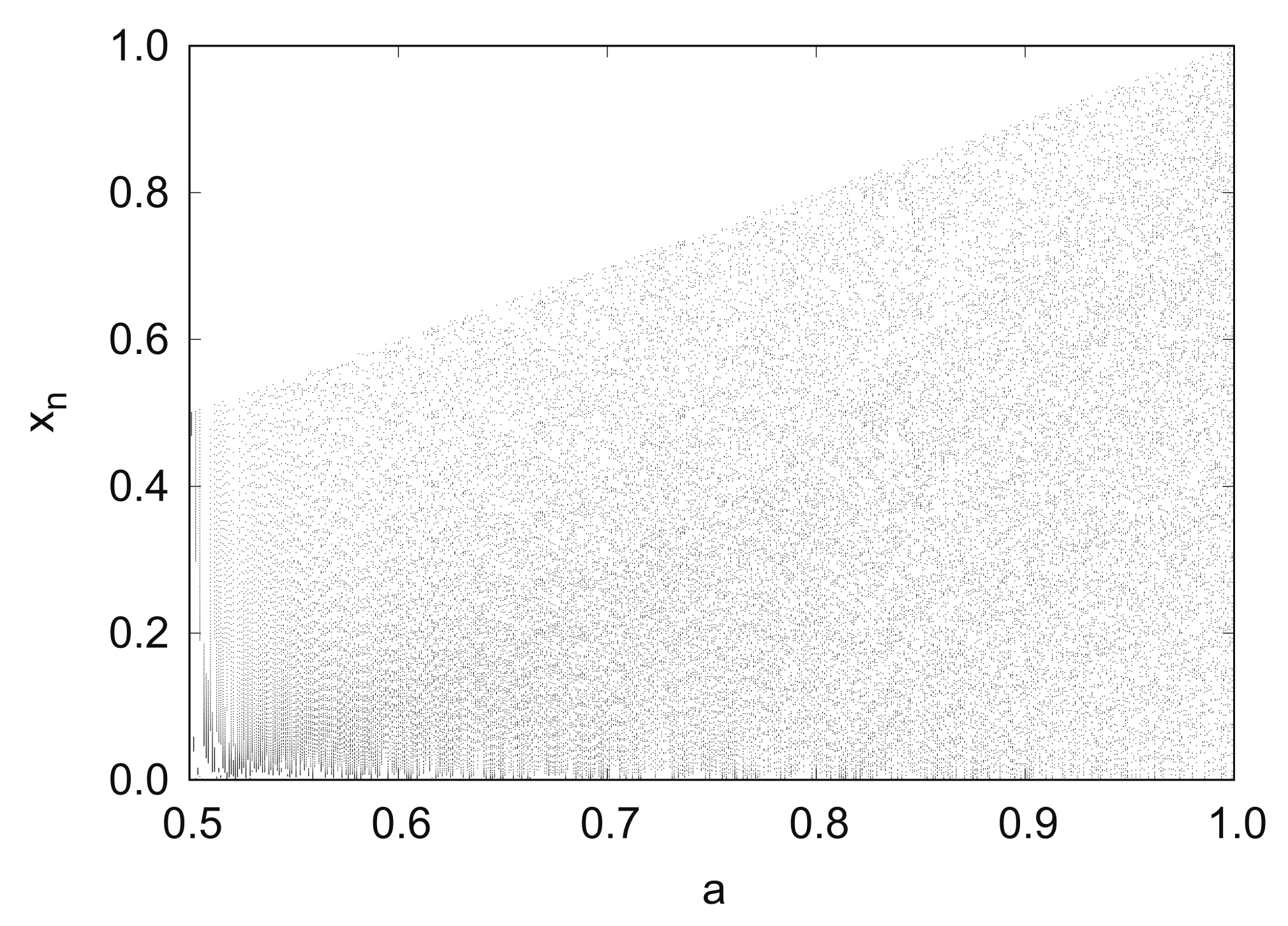
Figure 1 shows the bifurcation diagram of the generalized Bernoulli shift map
in
. With an increase in parameter
a, the points continue to spread over the entire unit interval.
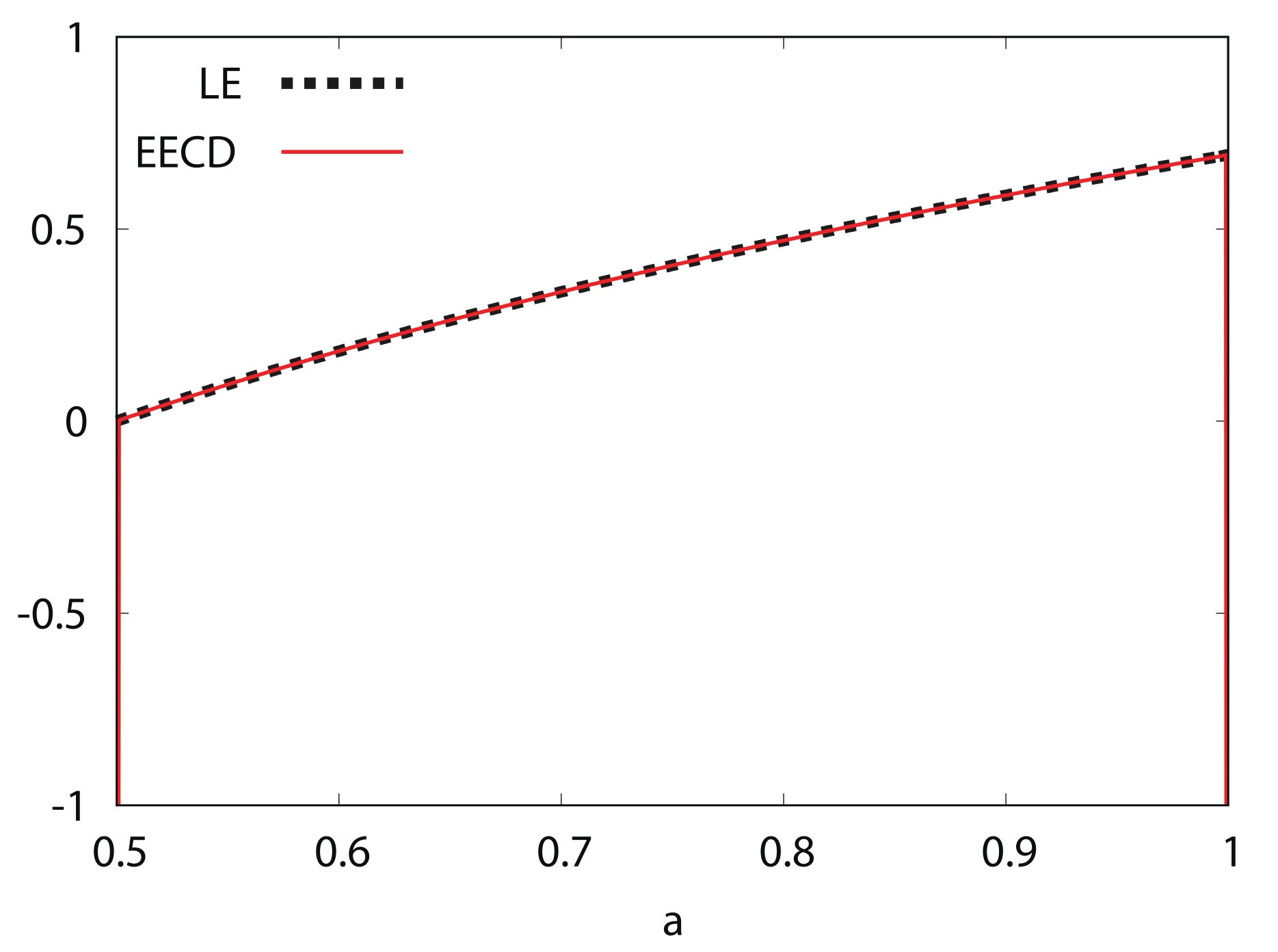
Figure 2 shows the numerical computation results for the LE
and the EECD
for the generalized Bernoulli shift map
. Comparisons of the EECD with the LE indicates that the EECD is approximately the same as the LE for the generalized Bernoulli shift map
.
5.1.2. Numerical Computation Results for a Logistic Map
In this section, the computational algorithm of the EECD is applied to a logistic map as a typical one-dimensional chaotic map. The logistic map contains the derivative depending on x as well as parameter a.
The logistic map
is defined as:
where
and
. Then, the derivative
of the logistic map
was calculated as
. Thus,
depends on both parameters
a and
x.
Now, consider the orbit
associated with logistic map
such that
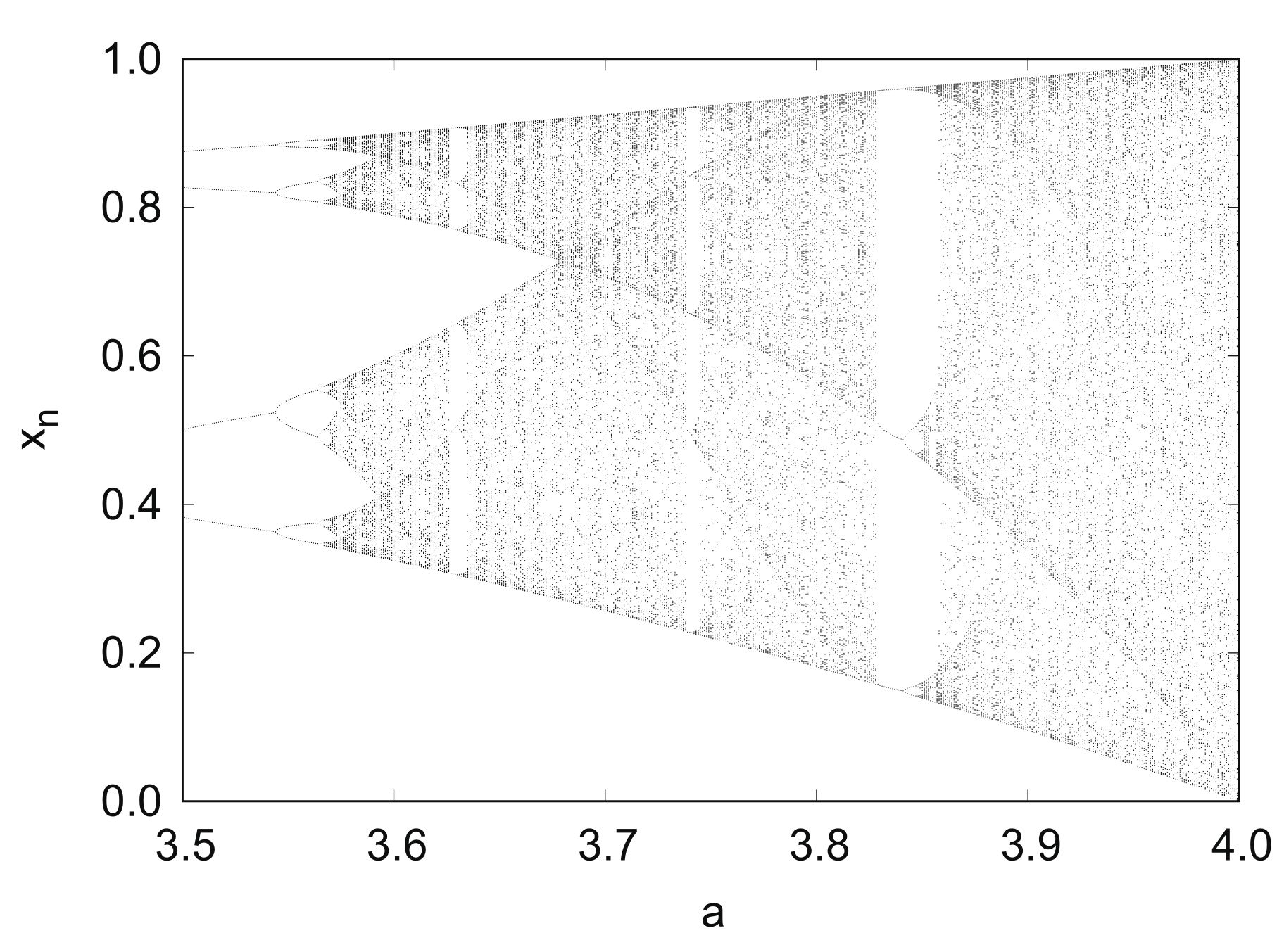
Figure 3 shows the bifurcation diagram of the logistic map
in
.
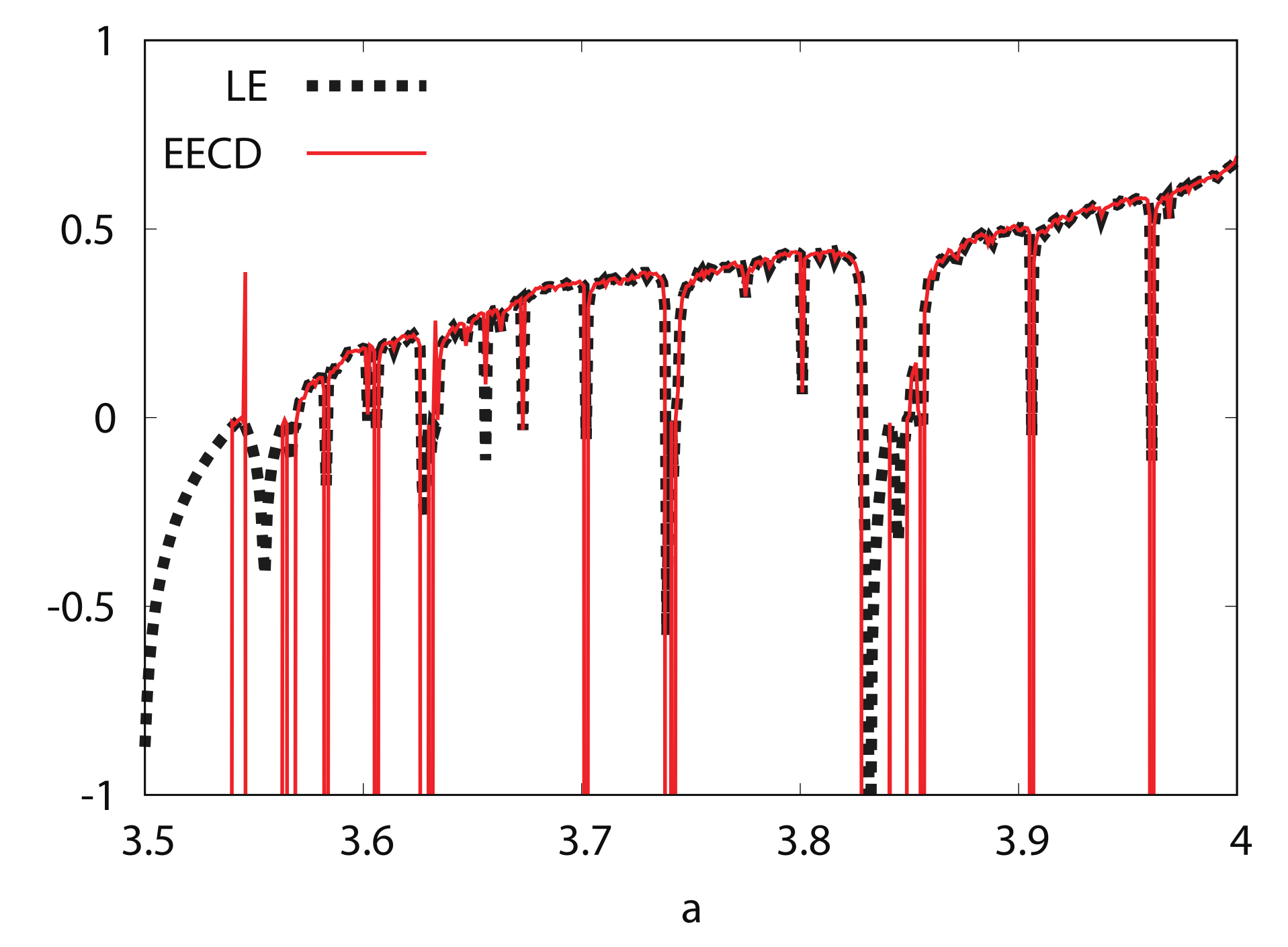
Figure 4 shows the numerical computation results for the LE
and EECD
for the logistic map
. Comparing the EECD with the LE, the EECD is approximately the same as the LE for the logistic map
, except for several
as, where the orbit of
is periodic.
5.2. Application of the Computational Algorithm of the EECD to a Two-Dimensional Chaotic Map
Consider a two-dimensional chaotic map
, where
. Let
be the
-equipartition of
Igiven as Equation (
7) at
. Then, the improved formula of the EECD for a two-dimensional aperiodic map
f is expressed as:
where
Here,
are the eigenvalues of
such that:
. The variance–covariance matrix
for all points
on
X, is expressed as:
The eigenvalues of
can be expressed as those numbers
such that:
. Using Equation (
40), the following is obtained:
Because
, the following is true:
In the following, and are set.
5.2.1. Numerical Computation Results for a Generalized Baker’s Map
In this section, the computational algorithm of the EECD is applied to a generalized baker’s map as one of the simplest two-dimensional chaotic maps. The generalized baker’s map has Jacobian matrices that depend only on parameter a. In addition, its determinant is also only dependent on parameter a.
The generalized baker’s map
is defined as follows:
where
and
. Then, the Jacobian matrix of the baker’s map
is calculated as:
Thus,
depends only on parameter
a. The dynamics associated with the generalized baker’s map
are dissipative for
, because
[
18].
Now, consider the orbit
associated with the generalized baker map
such that:
Let
be the transformation from
to
on
. This directly yields:
Thus,
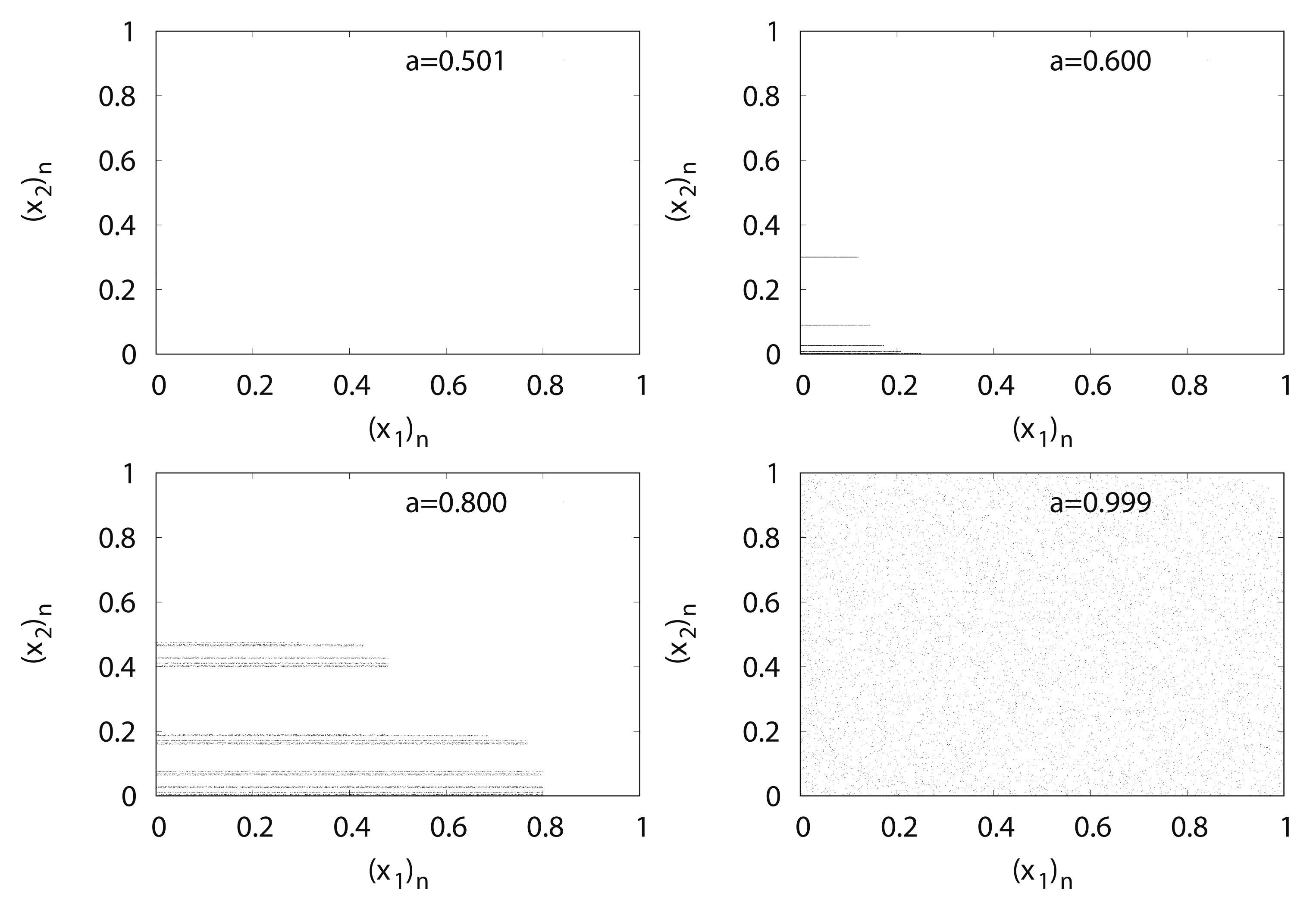
Figure 5 shows the typical orbits of the generalized baker’s map
. With an increase in parameter
a, points spread from certain lines over to the entire unit square.
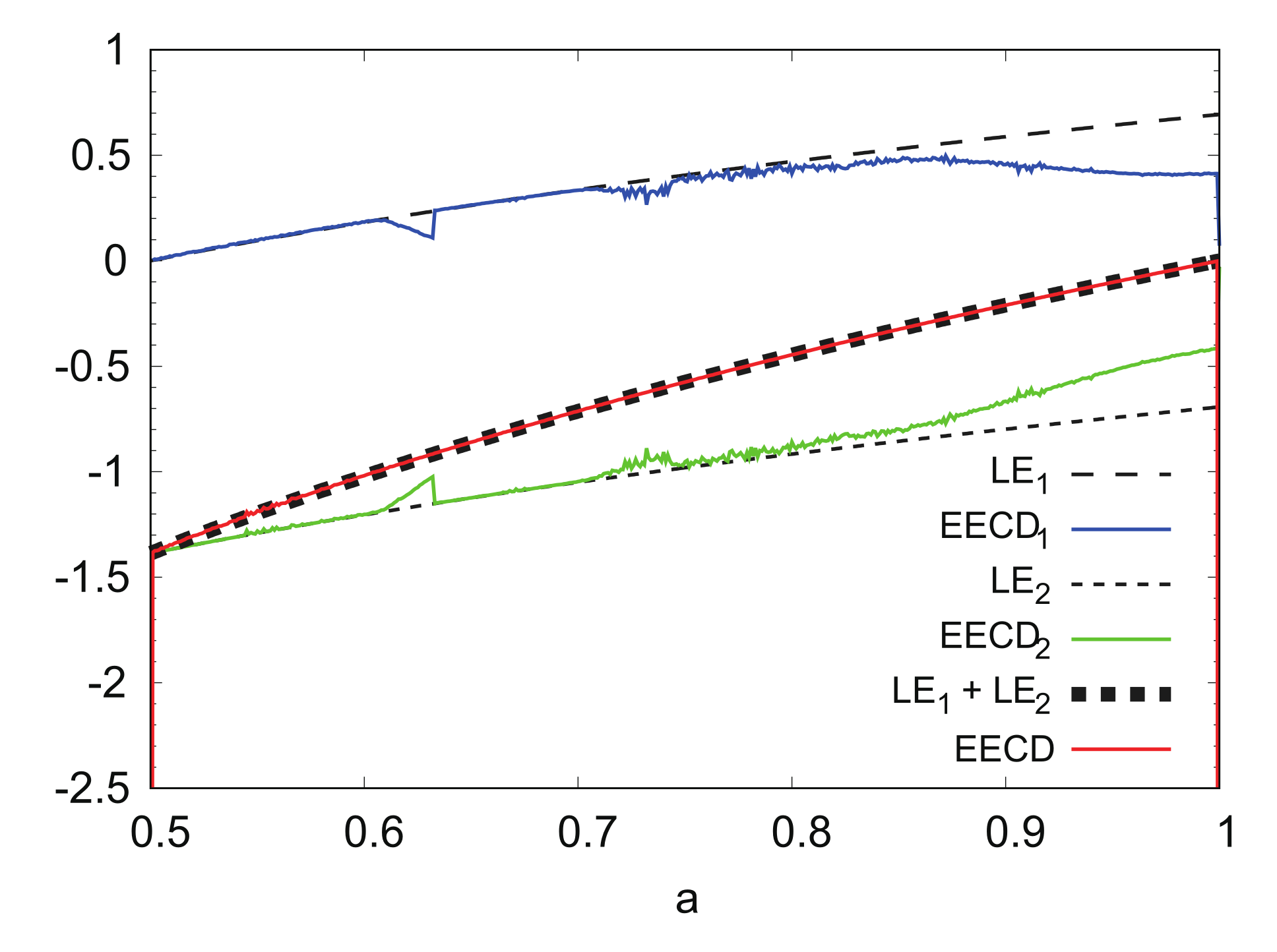
Figure 6 shows the numerical computation results for the
k-th LE (
)
,
of the EECD, and total sum (
)
of the LEs and EECD for the generalized baker’s map
. Comparisons of the EECD with
indicate that the EECD is approximately the same as
for the generalized baker map
. The same is true for the
and
for
in
. However, as parameter
a increases in
, the difference between
and
for
increases.
With an increase in parameter a in , the shape of the domain of the points included in changes from multiple lines over the entire plane. Considering this feature, increasing the number M of points was considered because the number M of points may not be sufficient to cover the entire region at .
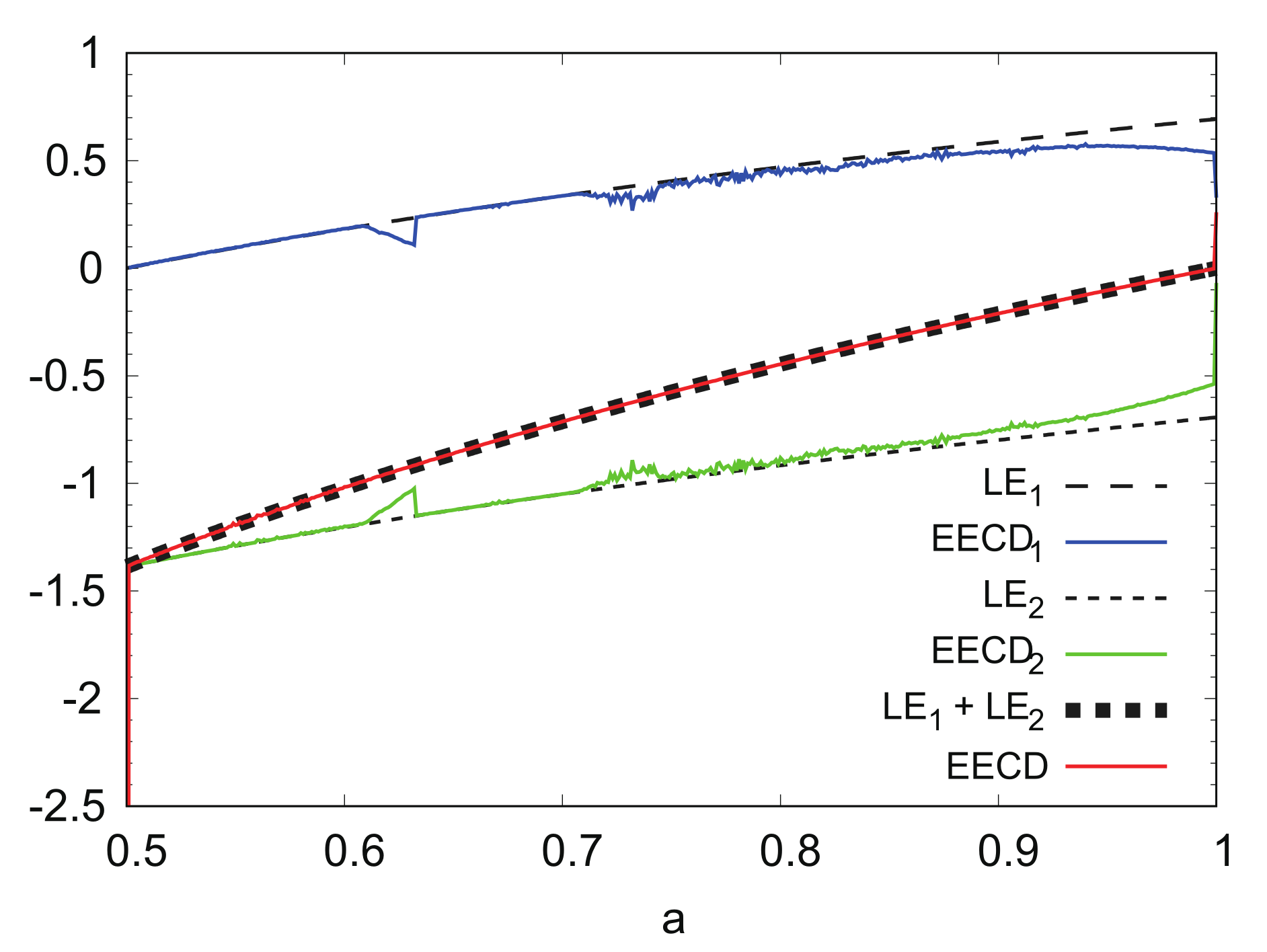
Figure 7 shows the numerical computation results for
,
,
, and EECD at
instead of
. By increasing the number of points
M, the difference between
and
for
was reduced to
.
For any two-dimensional chaotic map f, the average expansion rate in the stretching of f and the average contraction rate during the folding of f correspond to and , respectively.
5.2.2. Numerical Computation Results for a Tinkerbell Map
In this section, the computational algorithm of the EECD is applied to a Tinkerbell map
as a two-dimensional dissipative chaotic map [
18]. The Jacobian matrix
of the Tinkerbell mapping
depends on
and parameter
a. The same is true for its determinant
.
The Tinkerbell map
is defined as:
where
for
.
The Jacobian matrix of the Tinkerbell map
is calculated as:
Thus,
depends on
and parameter
a.
Now, consider the orbit
associated with the Tinkerbell map
, such that:
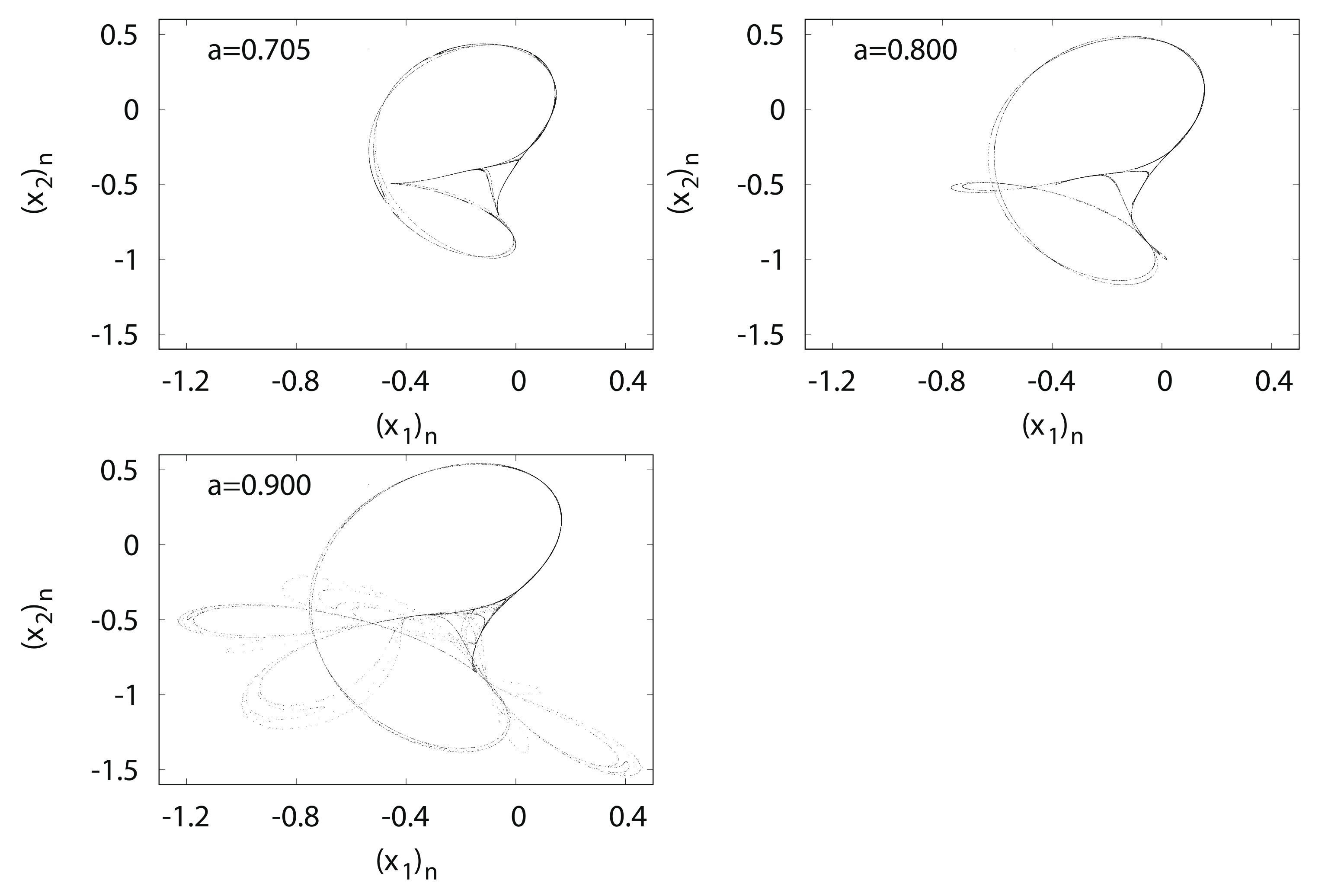
Figure 8 shows typical orbits of the Tinkerbell map
. The trajectory of the Tinkerbell map
draws an unusual attractor at
. The origin of the name of the Tinkerbell map
is based on the shape of a strange attractor that appears similar to the movement of a fairy named Tinker Bell, who appeared in a Disney film.
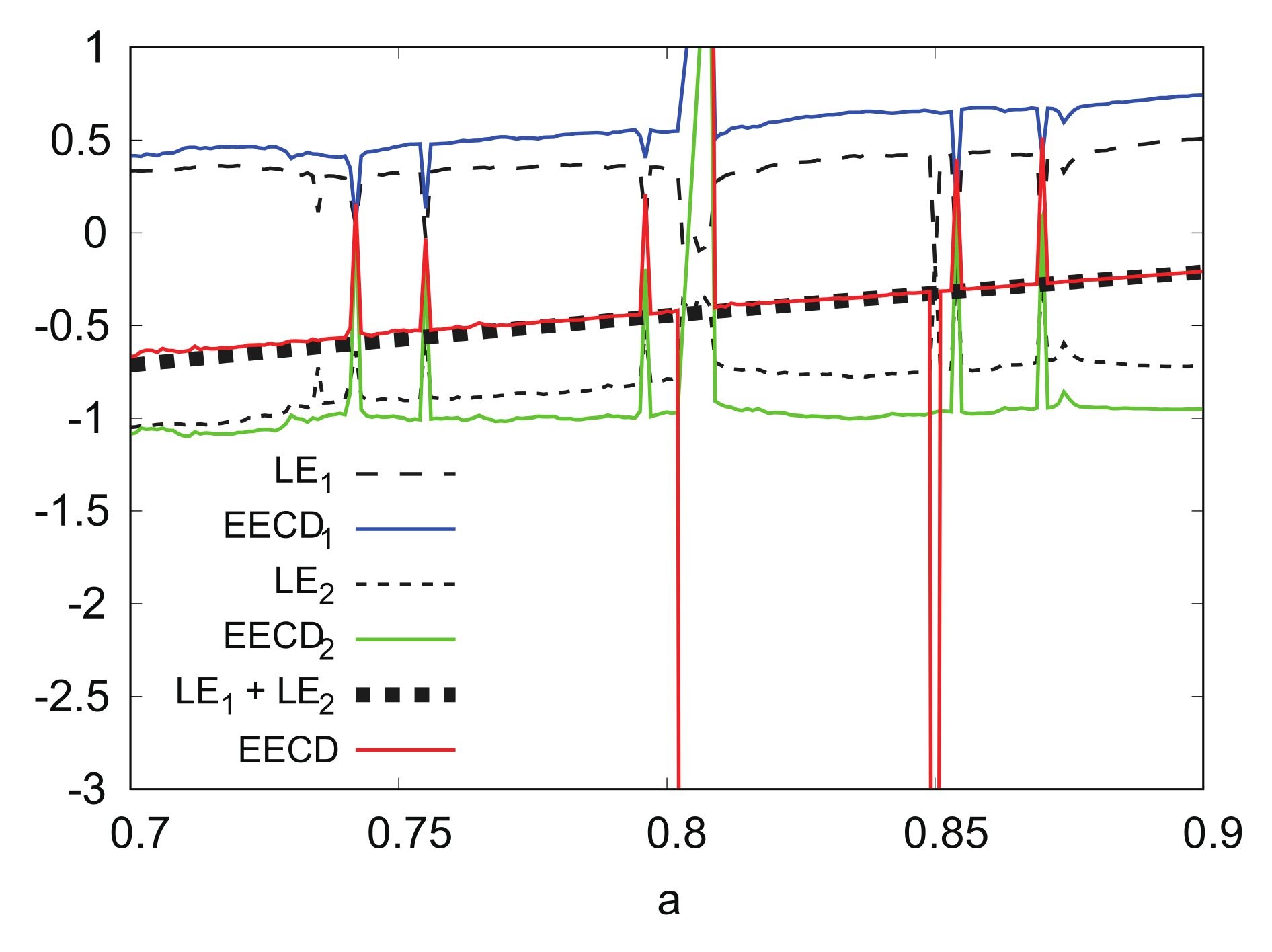
Figure 9 shows the numerical computation results for
,
,
, and the EECD for the Tinkerbell map
. Comparisons of the EECD with
indicate that EECD is approximately the same as
for the Tinkerbell map
in
, except for several
as, where the orbit of
is periodic. The same is true for the
and
for
.
5.2.3. Numerical Computation Results for an Ikeda Map
In this section, the computational algorithm of the EECD is applied to an Ikeda map
as a two-dimensional dissipative chaotic map [
18]. The Ikeda map
contains the Jacobian matrix
that depends on
and parameter
a. However, its determinant
depends only on parameter
a.
The modified Ikeda map is expressed as a complex map in [
19,
20]:
The Ikeda map
is defined as a real two-dimensional example of Equation (
50) as:
where
and
for
.
The Jacobian matrix of the Ikeda map
is calculated as:
where
Thus,
depends on
and parameter
a. Further, the dynamics associated with the Ikeda map
are dissipative for
, because
.
Now, consider the orbit
associated with the Ikeda map
such that:
Let
be the transformation from
to
on
. By using the chain rule and
for the Ikeda map
, the following equation is obtained:
Thus,
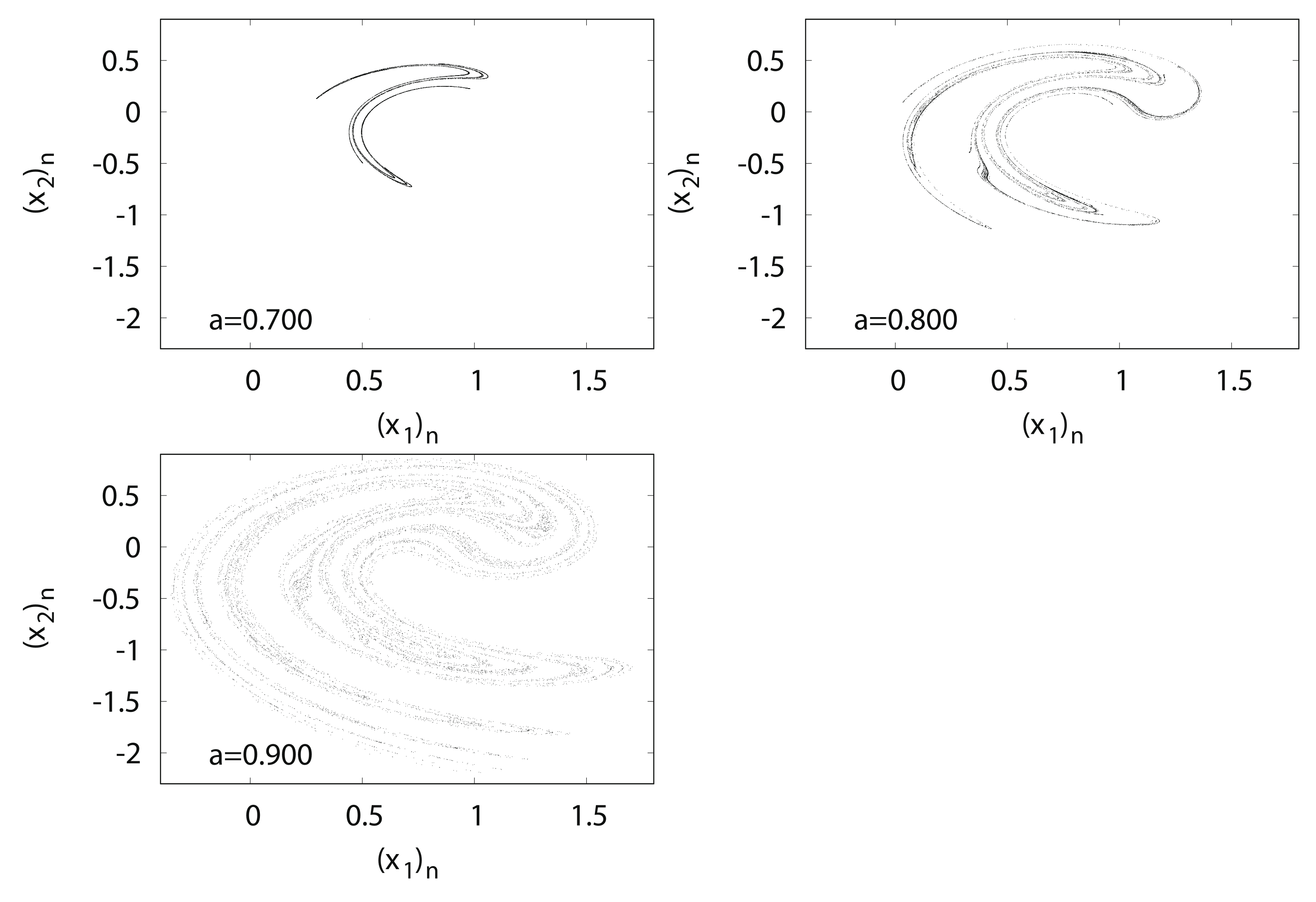
Figure 10 shows typical orbits of the Ikeda map
. With an increase in parameter
a, the attractor generated by the Ikeda map
grows in size. Moreover, regarding the
plots, the Ikeda map might be conjugate to a Hénon map [
21].
Figure 11 shows the numerical computation results for
,
,
, and the EECD for the Ikeda map
. Comparisons of the EECD with the
indicate that the EECD is approximately the same as
for the Ikeda map
, except for several values of
a, where the orbit of
is periodic. However, there is a small difference between
and
for
in
. These differences cannot necessarily decrease, even if the number
M of points and the number
of all the components of the equipartition of
I are increased.
This problem may be related to the shape of the trajectory generated by the Ikeda map
. The shape of the minimum region, including all the points in
of
I for the Ikeda map
, is a partial spiral. However, the region above is regarded as a rectangle
(Equation (
25)), as evident in the computational algorithm of the EECD. This region above the EECD may cause the difference between
and
for
.
5.2.4. Numerical Computation Results for a Hénon Map
In this section, the computational algorithm of the EECD is applied to a Hénon map as a two-dimensional dissipative chaotic map. The Hénon map has the Jacobian matrix , which is dependent on and parameter b. However, its determinant depends only on parameter b.
The Hénon map
is defined as:
where
for
.
In the following section, is rewritten.
The Jacobian matrix of the Hénon map
is calculated as follows:
Thus,
depends on
and parameter
b. Further, dynamics associated with the Hénon map
are dissipative at
, because
.
Now, consider the orbit
associated with the Hénon map
such that:
Let
be the transformation from
to
on
. By using the chain rule and
for the Hénon map
, the following is obtained:
Thus,
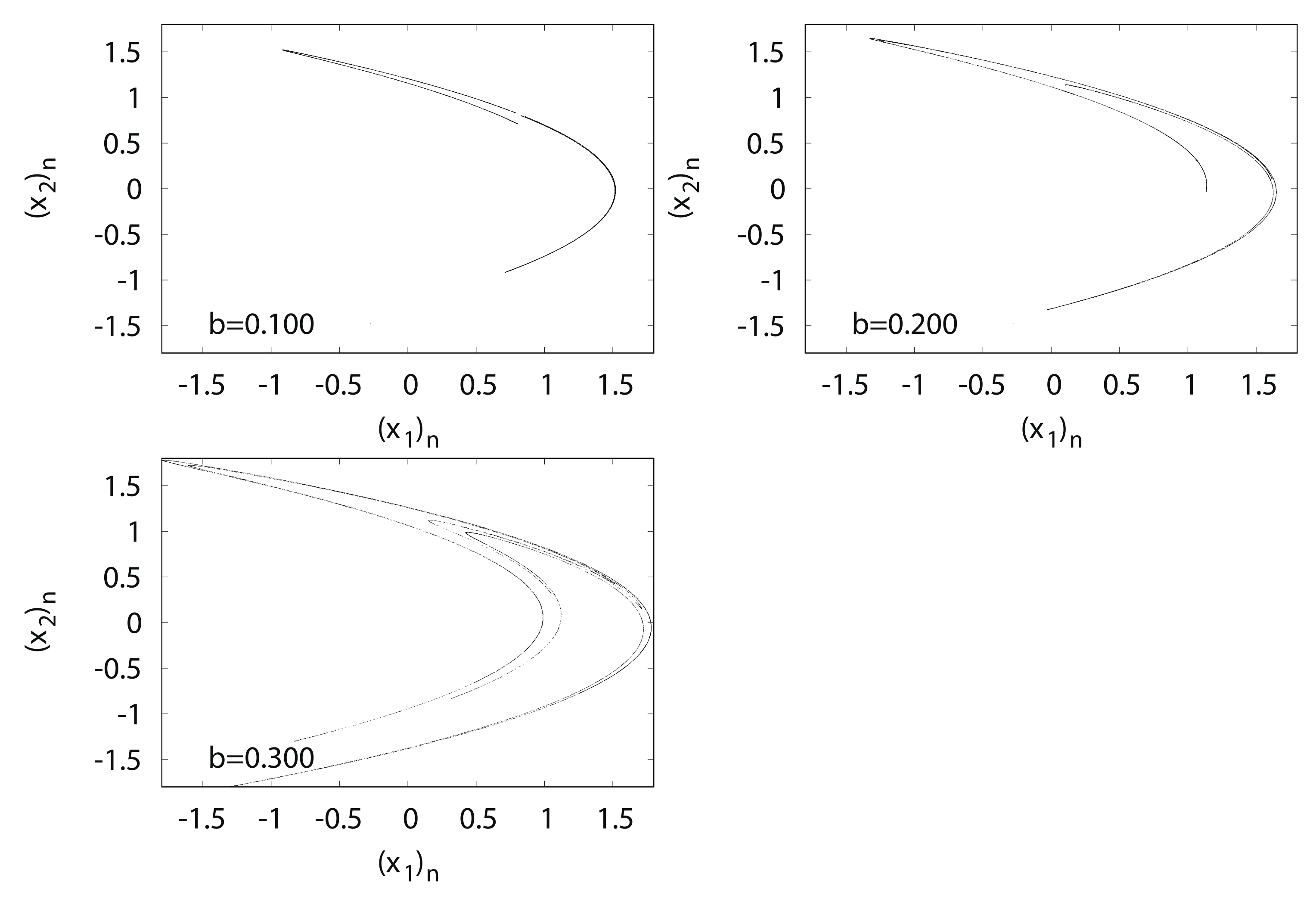
Figure 12 shows typical orbits of the Hénon map
. The trajectory of the Hénon attractor exhibits a fractal structure such that upon expanding the strip region, innumerable parallel curves reappear in the strip.
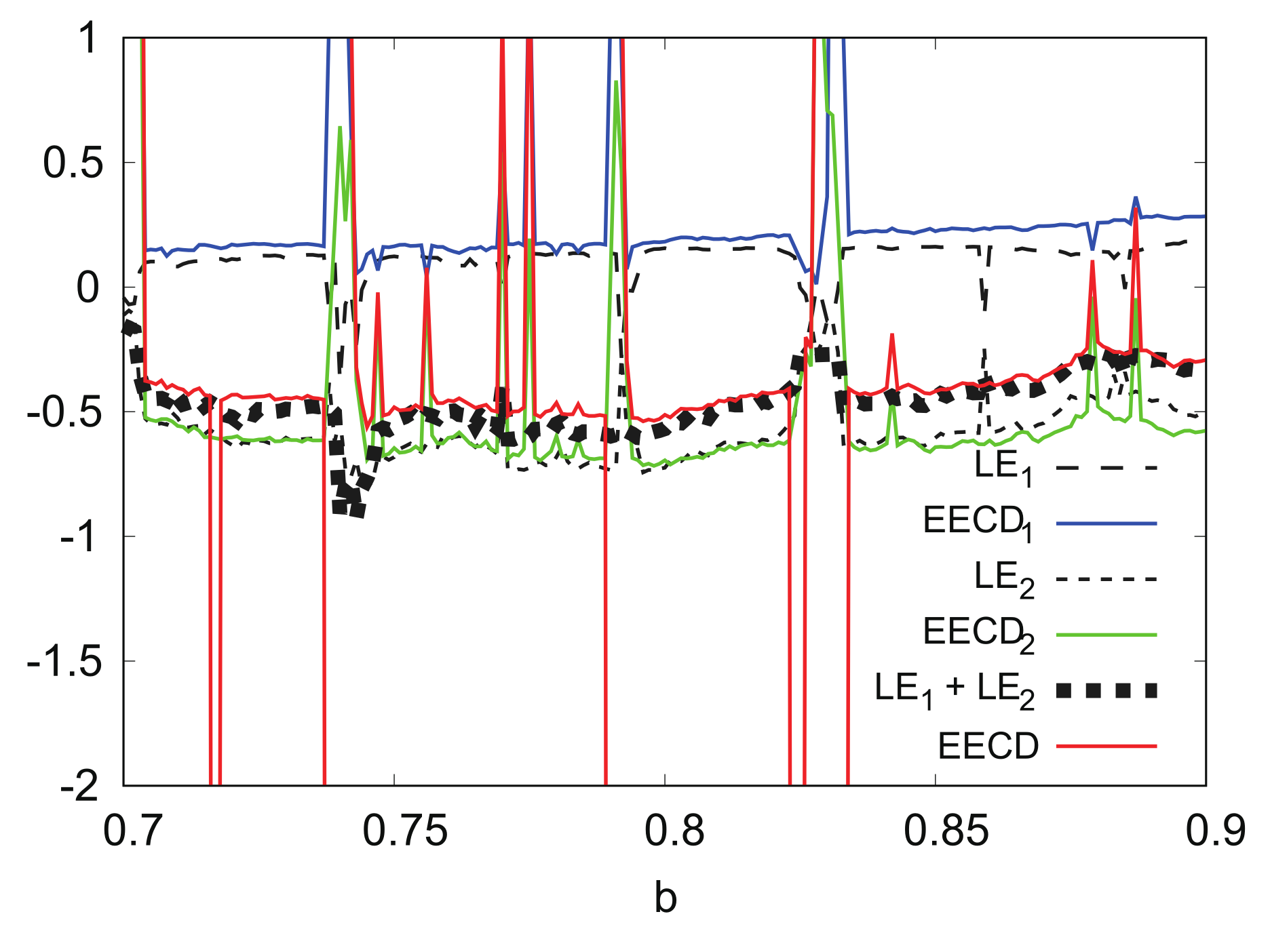
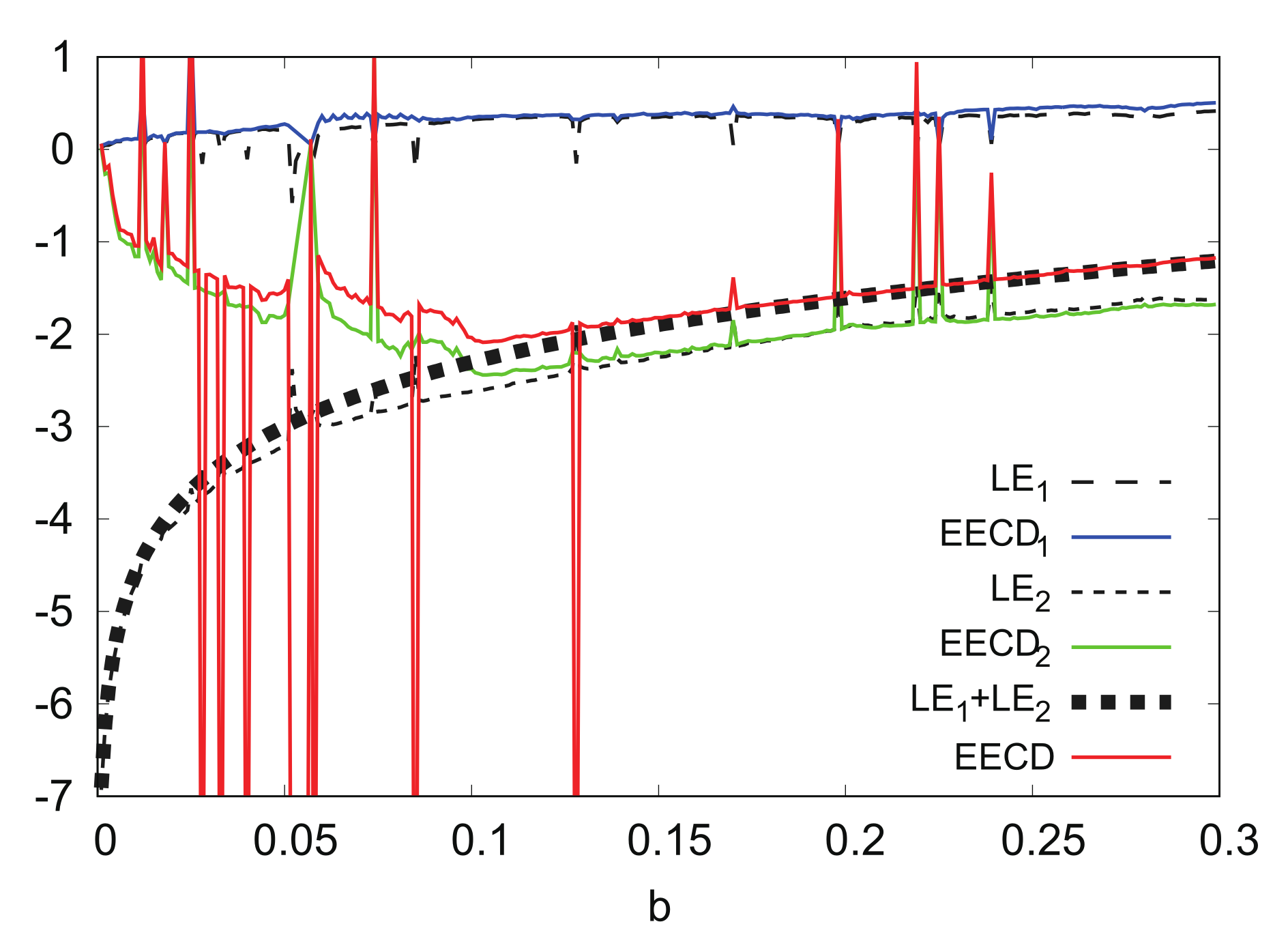
Figure 13 shows the numerical computation results for
,
,
, and EECD for the Hénon map
. Comparisons of the
and
indicate that
is approximately the same as
for the Hénon map
, except for several
bs, where the orbit of the Hénon map
is periodic. The same is true for the
and
, as well as for the EECD and
in
. However, there was a remarkable difference between
and
in
, the EECD attained noticeably different values from
for
. The orbit of the map
is not periodic at
.
Now, consider another expression for the smaller eigenvalue
among the eigenvalues of the variance-covariance matrix
such that:
where
is the autocorrelation function for all points
on component
X.
From Equation (
59), if the absolute value of
is equal to 1, then
The ratio of
to
is included in the formula:
(Equation (
39)). Thus, if the absolute value of
is almost equal to 1, then accurately computing
is challenging because
must be divided by
, close to 0.
Let
be the average of
, such that:
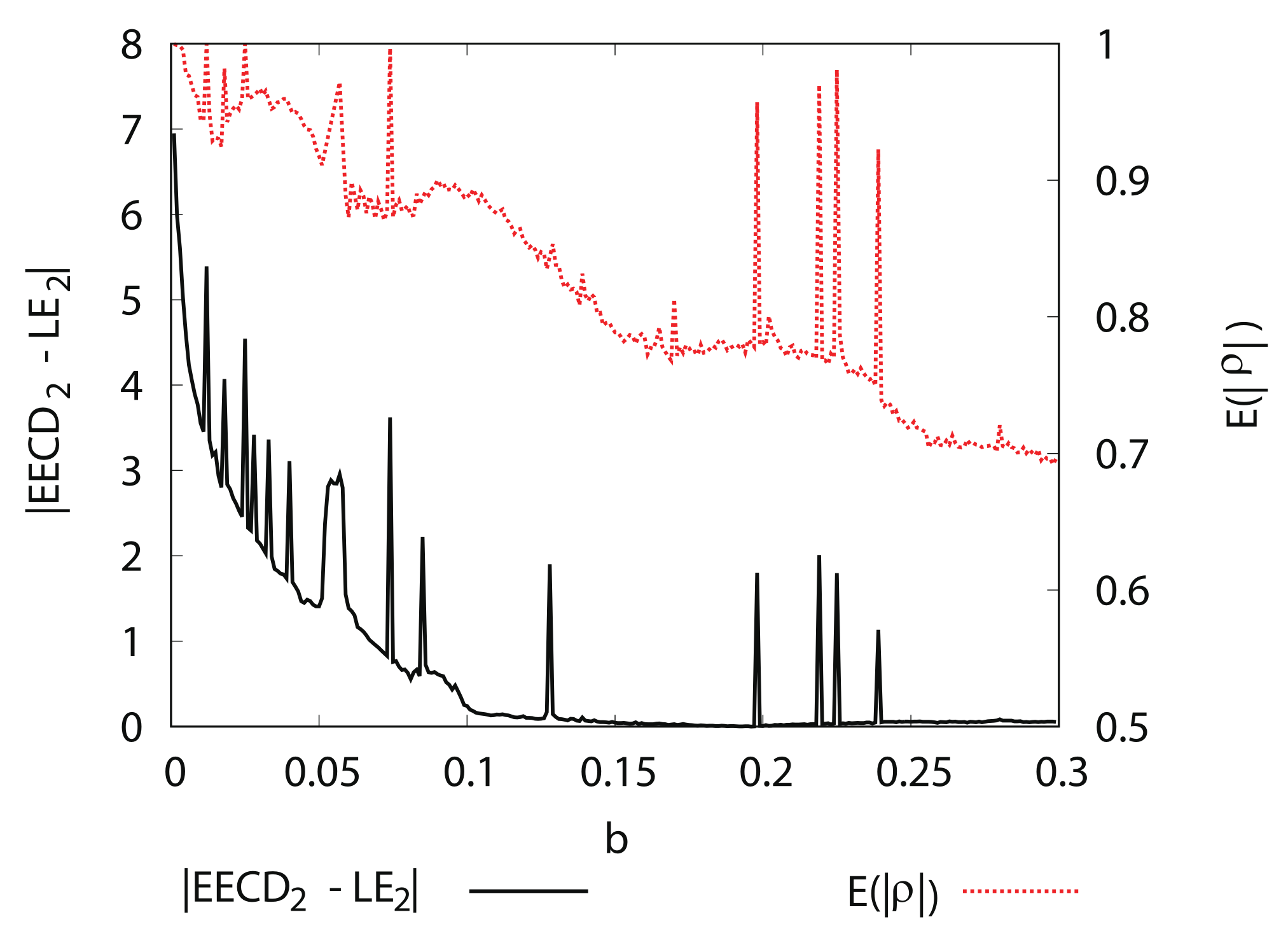
Figure 14 shows the numerical computation results for
, and
for the Hénon map
.
is very close to 1 in
. Therefore, it can be concluded that the remarkable difference between the
and
is caused by
, for any
.
5.2.5. Numerical Computation Results for a Standard Map
In this section, the computational algorithm of the EECD is applied to a standard map as a two-dimensional conservative chaotic map. The standard map has the Jacobian matrix , which is dependent on and parameter K. However, its determinant remains constant at 1.
The standard map
is defined as:
where
.
The Jacobian matrix of the standard map
is calculated as follows:
Thus,
depends on
and the parameter
K. Moreover, the dynamics associated with standard map
are conservative because
.
Now, consider orbit
associated with the standard map
such that:
Let
be the transformation from
to
in
. By using the chain rule and
for the standard map
, the following is obtained:
Thus,
As mentioned in [
16], the standard map
is reversible [
22]. Thus, LEs
and
of
satisfy the condition such that
according to Theorem 3.2 in [
23].
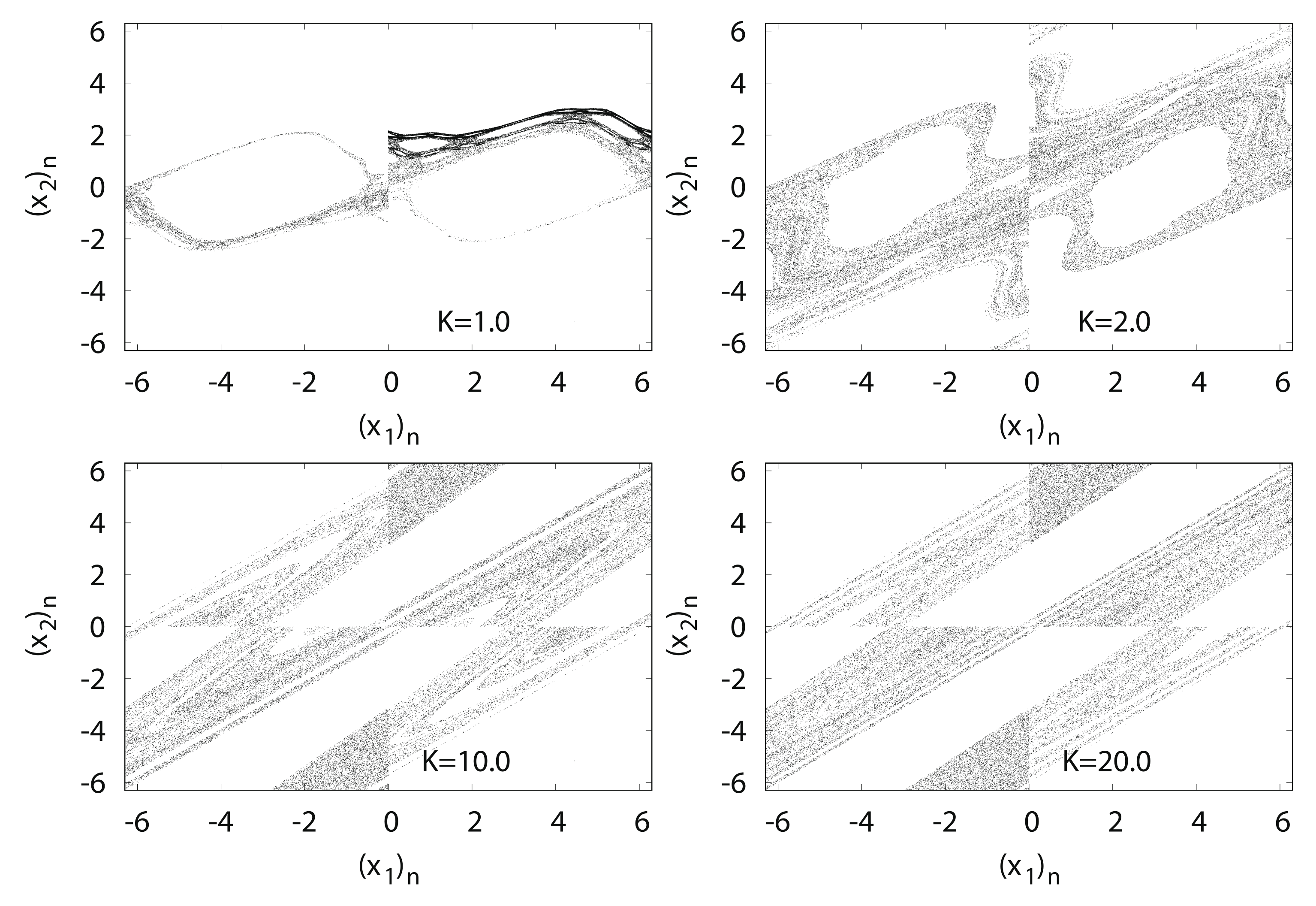
Figure 15 shows typical orbits of the standard map
with the initial point
. The standard map is composed of the Poincaré’s surface in the kicked rotator section, and
has a linear structure at approximately
. However, with the increase in
K, the map generates a non-linear structure with chaos under appropriate initial conditions.
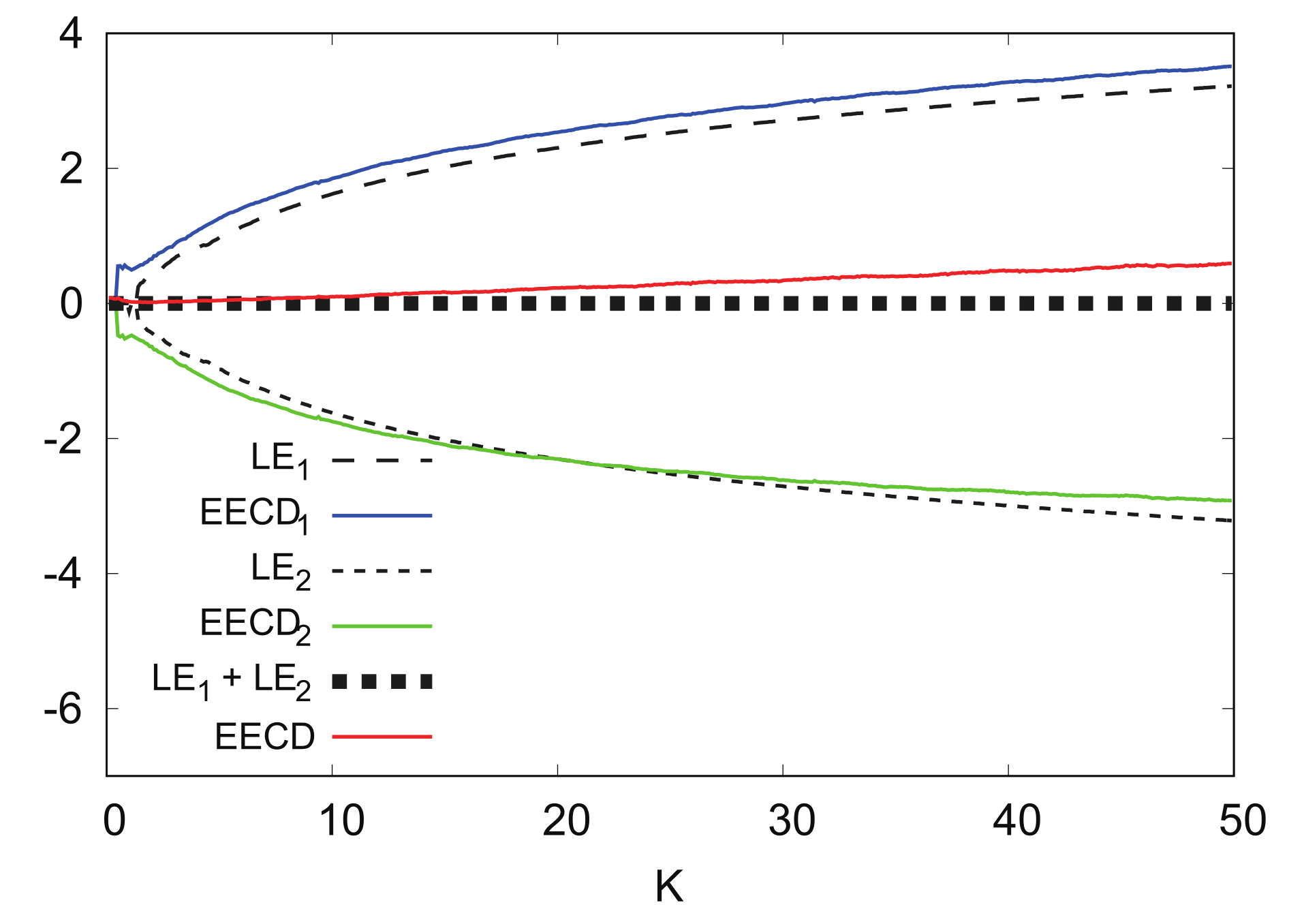
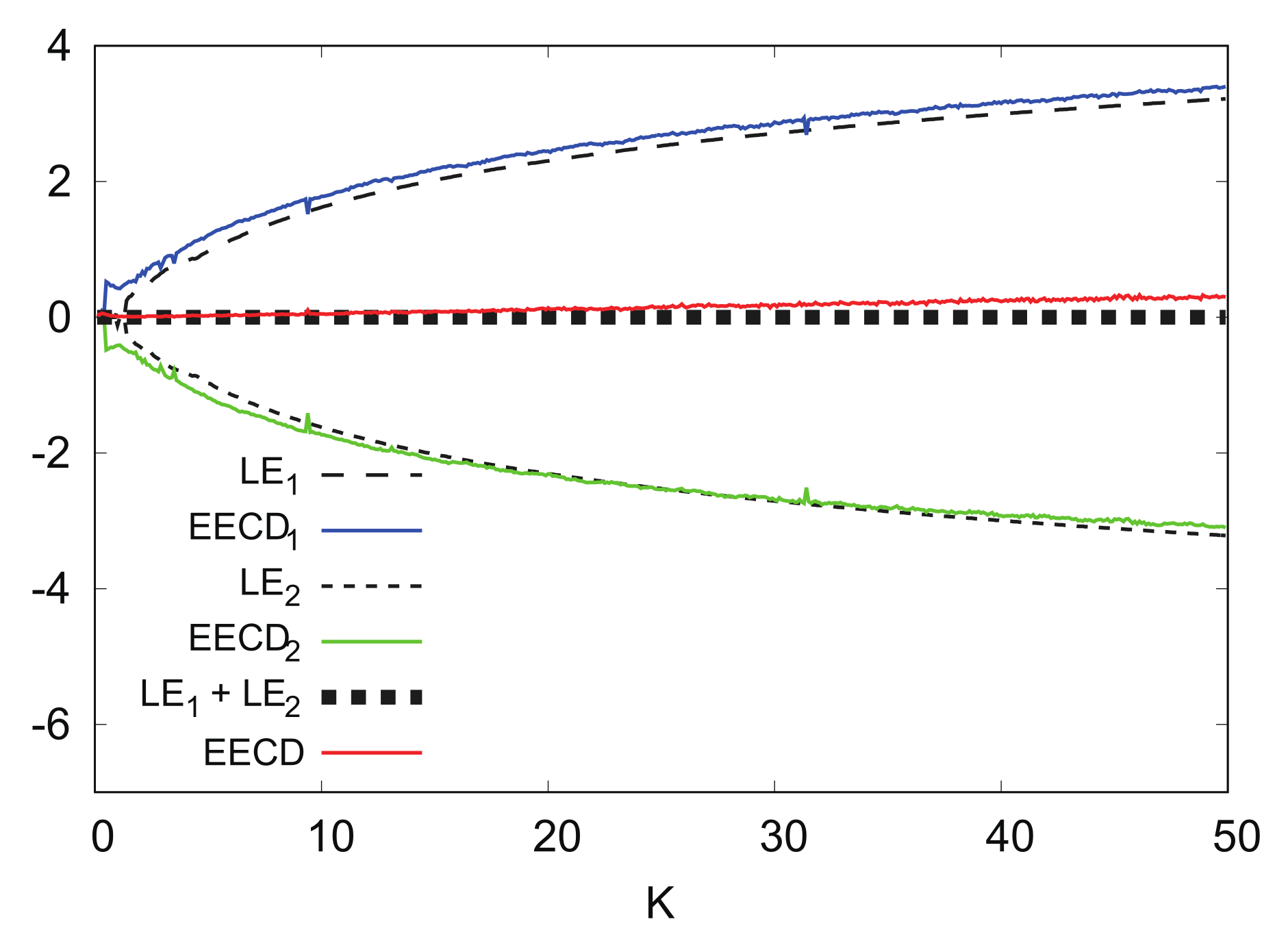
Figure 16 shows the numerical computation results for
,
,
, and EECD for the standard map
. Comparisons of
and
indicate that
appears larger than the
in
for a certain small value.
Now, consider increasing the number of all components of the equipartition of I. In principle, downsizing by increasing L, is necessary to compute more precisely for any K, because the Jacobian matrix of the standard map depends on as well as K.
Figure 17 shows the numerical computation results for
,
,
, and EECD for the standard map
at
instead of
. By increasing
L, it is possible to reduce the difference between the
and
such that the EECD may approach
.
6. Conclusions
In this study, by reviewing the derivation process of the improved calculation formula of the EECD, it is shown that all the LEs for an aperiodic orbit could be estimated when calculating the EECD; furthermore, a computational algorithm for the EECD is proposed. This computational algorithm is applied to typical one and two-dimensional chaotic maps.
First, the computational algorithm of the EECD is applied to typical one-dimensional chaotic maps, such as the generalized Bernoulli shift and logistic maps. The numerical computation results for these one-dimensional chaotic maps indicate that the EECD is approximately the same as the LE in all chaotic cases.
Thereafter, the computational algorithm of the EECD is applied to two-dimensional typical chaotic maps, such as the generalized baker’s, Tinkerbell, Ikeda, Hénon, and standard maps. The numerical computation results for these typical two-dimensional chaotic maps show that the EECD is approximately the same as the total sum of the LEs in most chaotic cases; however, the kth item of the EECD is also approximately the kth LE for , which can be slightly larger or smaller.
Therefore, it can be concluded that the EECD may be an alternative to the LE for both one and two-dimensional chaotic dynamics. In future studies, attempts will be made to characterize higher-dimensional chaotic dynamics and non-linear real-time series using the EECD.