


Abstract
We derive the lower bounds for a non-Gaussianity measure based on quantum relative entropy (QRE). Our approach draws on the observation that the QRE-based non-Gaussianity measure of a single-mode quantum state is lower bounded by a function of the negentropies for quadrature distributions with maximum and minimum variances. We demonstrate that the lower bound can outperform the previously proposed bound by the negentropy of a quadrature distribution. Furthermore, we extend our method to establish lower bounds for the QRE-based non-Gaussianity measure of a multimode quantum state that can be measured by homodyne detection, with or without leveraging a Gaussian unitary operation. Finally, we explore how our lower bound finds application in non-Gaussian entanglement detection.
1. Introduction
Non-Gaussian quantum resources, such as non-Gaussian states and operations, are indispensable in continuous-variable (CV) quantum information [1,2] because their Gaussian counterparts have fundamental limitations in CV quantum information tasks. For instance, there are Gaussian no-go theorems for quantum entanglement distillation [3,4,5], quantum error correction [6], and quantum bit commitment [7]. Furthermore, non-Gaussian quantum resources can be advantageous over Gaussian quantum resources. Non-Gaussian states can be more noise-resilient than Gaussian states in optical nonclassicality [8] and quantum entanglement [9,10,11,12,13]. Non-Gaussian operations can improve nonclassical properties including optical nonclassicality [14,15,16], quantum entanglement [17,18,19,20,21,22,23,24,25,26], and quantum nonlocality [26,27,28,29]. Moreover, they can enhance the performance of CV quantum information protocols, such as quantum teleportation [30,31,32,33,34], quantum linear amplification [35,36,37], quantum dense coding [38], quantum key distribution [39], and quantum target detection [40].
Probing non-Gaussianity in CV quantum information, it is essential to obtain a faithful quantifier for non-Gaussianity. Thus, non-Gaussianity measures for quantum states have been proposed by employing the quantum Hilbert–Schmidt distance [41], quantum relative entropy (QRE) [42], Wehrl entropy [43], quantum Rényi relative entropy [44], Wigner–Yanase skew information [45], and Kullback–Leibler divergence (KLD) [46]. Furthermore, quantum non-Gaussianity, i.e., a stronger form of non-Gaussianity, has been introduced to distinguish genuinely non-Gaussian states from classical mixtures of Gaussian states [47]. The quantum non-Gaussianity measures have been proposed by using the Wigner logarithmic negativity [48,49], quantum relative entropy [50], stellar representation [51], and robustness [52]. Additionally, quantum non-Gaussianity witnesses have been theoretically proposed [47,53,54,55,56,57,58,59,60,61,62,63,64,65] and experimentally demonstrated [62,63,64,65,66,67] to certify quantum non-Gaussianity efficiently. Here, our main interest is in non-Gaussianity measures that characterize the difference between a quantum state and its reference Gaussian state. Although the non-Gaussianity measures are helpful in characterizing non-Gaussian quantum resources, resource-intensive quantum state tomography [68] is generally required to obtain the exact value of the measures in general. For the case of QRE-based non-Gaussianity measure, observable lower bounds have been developed to address this issue by using the information of the covariance matrix in conjunction with the photon number distribution [69] and the negentropy of a quadrature distribution [46]. The former, i.e., the lower bound in [69], works better than the latter, i.e., the lower bound in [46], especially for quantum states with rotational symmetry in phase space but demands two measurement setups, i.e., homodyne detection and photon-number-resolving detection, in general. If there is a priori information that the quantum state has rotational symmetry in phase space, the lower bound in [69] can be deduced from a quadrature distribution. By contrast, the latter requires only homodyne detection always. In addition, the latter can be used to detect non-Gaussian entanglement in conjunction with partial transposition [46], which may be impossible for the former. Here, we investigate whether an improved lower bound can be obtained by exploiting the negentropy of more than one quadrature distribution, which may open the way to detect non-Gaussian entanglement untestable by the method proposed in [46].
In this study, we show that the sum of the negentropies for two quadrature distributions with the maximum and minimum variances provides a lower bound for the QRE-based non-Gaussianity measure of a single-mode quantum state. We demonstrate that our lower bound can be greater than the maximum negentropy of quadrature distributions, i.e., the lower bound proposed in [46]. We also extend our method to estimate the non-Gaussianity of multimode quantum states with or without the help of a Gaussian unitary operation. We finally propose a method to detect non-Gaussian entangled states beyond the Gaussian positive partial transposition (PPT) entanglement criteria with our lower bound.
2. Non-Gaussianity Measures
Here, we briefly discuss the non-Gaussianity measures based on QRE [42] and KLD [46].
The non-Gaussianity measure of a quantum state using QRE was introduced in [42] as
where denotes the quantum relative entropy of with respect to , denotes the von Neumann entropy of , and denotes the reference Gaussian state of with the same first- and second-order quadrature moments. The first order quadrature moments of an N-mode quantum state are given by the expectation value of quadrature operators as with and being the position and momentum operators, respectively, for the jth mode. The covariance matrix of the N-mode quantum state is a matrix with elements described by the first- and second-order quadrature moments as follows:
with . Note that an N-mode Gaussian state is uniquely determined by its first-order quadrature moments and the covariance matrix [2]. Furthermore, the von Neumann entropy of the Gaussian state is obtained as follows:
where is the jth symplectic eigenvalue of the covariance matrix and the function is given by [2]. We also note that Equation (3) can be simplified as
when is a single-mode Gaussian state.
The non-Gaussianity measure of a quantum state by KLD was developed in [46] as
where denotes the negentropy [70] of the probability distribution for an N-mode quadrature operator . Here, is a rotated quadrature operator for the jth mode, is the set of rotation angles , and is the set of angular coordinates that determines the superposition coefficient as
Furthermore, the negentropy of a probability distribution X is given by
where is the KLD between two probability distributions X and Y [71], and is the reference Gaussian distribution of X with the same first- and second-order moments as X. Equation (7) can be rewritten as follows:
where denotes the differential entropy of the probability distribution X [71].
3. A Lower Bound for Single-Mode Non-Gaussianity
Here, we show that a function of the negentropies for two quadrature distributions provides a lower bound of the non-Gaussianity for a single-mode quantum state as
where and are the phase angles minimizing and maximizing the variance of the quadrature distributions, i.e., and , respectively, with .
To this aim, we first show that
where is the quantum Rényi- entropy of a quantum state , which becomes the von Neumann entropy in the limit of . Every single-mode Gaussian state can be described as a displaced squeezed thermal state:
where is the thermal state with mean photon number , is the displacement operator with complex amplitude , and is the squeezing operator with squeezing strength r and squeezing direction . The elements of the covariance matrix for the state are given by
In this case, the variance of the quadrature distribution with the phase angle is given by
which is minimized and maximized at and , respectively. Since the differential entropy of a Gaussian distribution with the variance v is expressed as [71] and the quantum Rényi-2 entropy of the single-mode Gaussian state in Equation (13) is determined by [72], we obtain
Using the ordering property of the quantum Rényi- entropy and the entropic quantum uncertainty relation [73] in conjunction with Equation (12), we finally have
which proves Equation (11).
It should be noted that can fail to be positive because of the negative constant, i.e., . For a single-mode quantum state with , is always greater than . Therefore, it is necessary to determine whether can outperform or not. Some examples are presented in the following subsections.
3.1. Fock States
The quadrature distribution for a Fock state is expressed by
where is a Hermite polynomial of the order n [74]. The covariance matrix of the Fock state is given by a diagonal matrix, i.e., , which yields .
In Figure 1, we plot , , and as black diamonds, red circles, and blue triangles, respectively, for the Fock states . It is straightforward to obtain the values of and , because the Fock states are rotationally symmetric in the phase space. We observe that exceeds for .
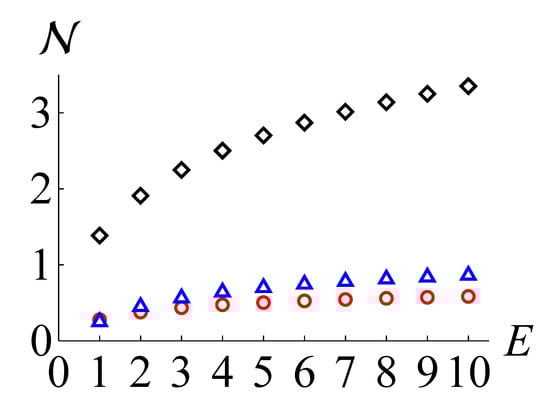
Figure 1.
The non-Gaussianity measure based on QRE (black diamond), the maximum negentropy of quadrature distributions (red circle), and our lower bound (blue triangle) for Fock states against the mean photon number .
3.2. Four-Headed Cat States
We now examine a four-headed cat state [75], where denotes a coherent state with complex amplitude and the normalization factor is given by
The quadrature distribution for the four-headed cat state is written by
where the expression with [74] is given by
where .
The covariance matrix of the four-headed cat state is denoted by a diagonal matrix, i.e., , with
which yields .
In Figure 2, we depict , , and as black solid, red dashed, and blue dot-dashed curves, respectively, for the four-headed cat states . For the blue dot-dashed curves, we have optimized the value of over the phase angle , because the variance of the quadrature distribution is the same for all phase angles. We observe that becomes greater than for ().
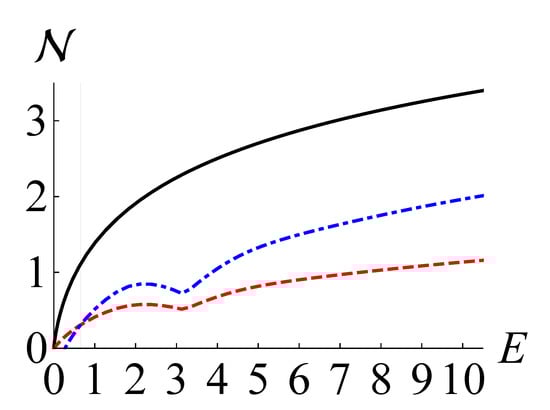
Figure 2.
The non-Gaussianity measure based on QRE (black solid), the maximum negentropy of quadrature distributions (red dashed), and our lower bound (blue dot-dashed) for four-head cat states against the mean photon number .
3.3. Mixture of Coherent States
We now examine a mixture of coherent states in the form of . Its quadrature distribution is given by
and its covariance matrix is described by a 2×2 diagonal matrix, i.e., . The QRE-based non-Gaussianity measure is obtained by
where , , , and are the eigenvalues of :
In Figure 3, we plot , , and as black solid, red dashed, and blue dot-dashed curves, respectively, for the mixture of four coherent states. We observe that becomes greater than for ().
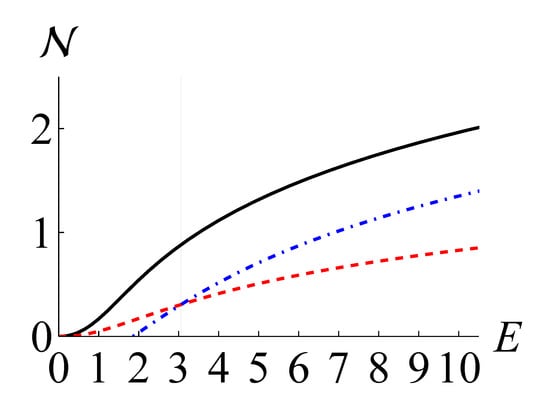
Figure 3.
The non-Gaussianity measure based on QRE (black solid), the maximum negentropy of quadrature distributions (red dashed), and our lower bound (blue dot-dashed) for a mixture of coherent states against the mean photon number .
3.4. Quantum Non-Gaussianity
The mixtures of coherent states are non-Gaussian states but in the convex hull of Gaussian states. In contrast, the Fock states and four-headed cat states are quantum non-Gaussian states, i.e., the states out of the convex hull of Gaussian states. One may ask whether our lower bound can discriminate quantum non-Gaussian states from classical mixtures of Gaussian states or not. Comparing Figure 2 and Figure 3, it is apparent that itself cannot serve as a quantum non-Gaussianity witness. However, we want to point out that the dynamics of under a loss channel can be used for detecting quantum non-Gaussianity. If the following condition is satisfied for a single-mode quantum state , it signifies that is quantum non-Gaussian:
where denotes the phase-randomization, represents the loss channels with the effective transmittance , and is the mean photon number of . We can derive Equation (29) by reformulating the quantum non-Gaussianity condition in [58]:
Starting from the fact that the reference Gaussian state of is a thermal state with mean photon number , it is straightforward to derive and , which yields
It signifies that a sufficiently large decrease in under a loss channel is only possible for quantum non-Gaussian states.
4. Lower Bounds for Multimode Non-Gaussianity
For a multimode state, quantum state tomography becomes increasingly difficult as the number of modes increases [68]. Thus, it is favorable to estimate the non-Gaussianity of a global quantum state without multimode quantum state tomography.
For an N-mode quantum state , the total correlation of the quantum state [76] is given by:
where represents the local quantum state of the jth mode. If the total correlation of an N-mode quantum state has a Gaussian extremality [77] as , it allows us to estimate the non-Gaussianity of the global state by measuring the non-Gaussianity of local states as
However, there are counterexamples for the Gaussian extremality, i.e., [78].
Therefore, we establish two lower bounds for the non-Gaussianity of a multimode quantum state :
and
where denotes the local quantum state for the jth mode of , and represents a symplectic transformation that diagonalizes the covariance matrix of the global quantum state . Note that such a transformation always exists because of the Williamson’s theorem [79].
The first lower bound is a direct consequence of the monotonicity of the non-Gaussianity under a partial trace [69]:
The second lower bound can be derived by using the invariance of the non-Gaussianity under Gaussian unitary operations, i.e., , the non-negativity of the total correlation, i.e., , and as
Using Equations (34) and (35) in conjunction with and , we further establish lower bounds as
and
These allow us to estimate the non-Gaussianity of a multimode quantum state using quadrature measurements without extensive experimental efforts, i.e., multimode quantum state tomography.
Here, we investigate the CV Werner state [80,81] in the form of , where is a two-mode squeezed vacuum with the squeezing parameter r. Its covariance matrix is given by
where and , which yields
where and
with . Note that the eigenvalues of a classical mixture of two pure states, i.e., , are given by
The local quadrature distributions are given by
where and . The covariance matrix can be diagonalized by using a 50:50 beamsplitter. It transforms the CV Werner state into , where is a single-mode squeezed vacuum with the squeezing parameter r. The covariance matrix of the transformed state becomes which yields
with . The local quadrature distributions are given by
where and .
For the CV Werner states, we investigated the performance of the estimation methods without and with the help of a Gaussian unitary operation, as shown in Figure 4a,b, respectively. It is observed that and occur when and , respectively. In addition, the results clearly show that a Gaussian unitary operation can significantly increase the values of the lower bounds.
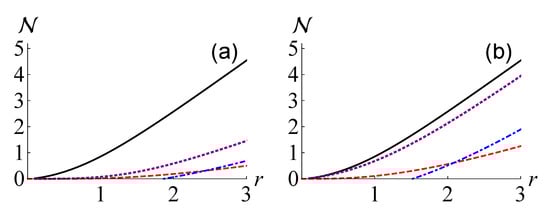
Figure 4.
The non-Gaussianity measure based on QRE (black solid curve) and its lower bounds for the CV Werner state with against the squeezing parameter r. We examine the cases without and with the help of the Gaussian unitary operation in (a,b), respectively. The lower bounds based on local non-Gaussianity measures, i.e., for (a) and for (b), the maximum negentropy of quadrature distributions, i.e., for (a) and for (b), and our lower bound, i.e., for (a) and for (b), are plotted as purple dotted, red dashed, and blue dot-dashed curves, respectively.
5. Application in Entanglement Detection
Here, we explore how our lower bound can be used to detect quantum entanglement. Following Refs. [44,46], we first reformulate Equation (4) as follows:
As is a monotonically increasing function of x, , and , we have
where we take the maximum between zero and by considering that can be negative. Note that Equation (50) is an improved version of the Robertson–Schrödinger (RS) uncertainty relation, i.e., :
We now explain how Equation (50) can be used for entanglement detection. First, we apply partial transposition to a multimode quantum state . The partially transposed state remains as a legitimate quantum state if is separable. Therefore, if the partially transposed state fails to be a legitimate quantum state, then it witnesses that is entangled. If we know the density matrix of , it is straightforward to test the legitimacy of . A negative eigenvalue of is enough to reveal that is entangled. However, we need to perform resource-intensive quantum state tomography to obtain the complete information on . Here, we are interested in resource-efficient certification of entanglement using uncertainty relations. After partial transposition, we apply a symplectic transformation to for diagonalizing the covariance matrix of . Following Williamson’s theorem [79], such a transformation always exists. If there is a local mode of violates the RS uncertainty relation, i.e., , it shows that the entanglement of is detectable by the Gaussian PPT criteria. Here, we employ Equation (50) instead of the RS uncertainty relation to detect non-Gaussian entanglement beyond the Gaussian PPT criteria. If there is a local mode fulfills the following condition,
it certifies the entanglement of .
Before going further, let us describe a standard procedure to test Equation (52) experimentally. We first determine the covariance matrix of a multi-mode quantum state by homodyne detection [82]. As partial transposition on jth mode only flips the sign of the jth momentum quadrature, we can deduce the covariance matrix of the partially transposed state simply changing the sign of the relevant covariance matrix elements [83]. For instance, if we apply partial transposition on the second mode of a two-mode quantum state whose covariance matrix is given by
we obtain the covariance matrix of the partially transposed state as
We, then, determine the symplectic transformation that diagonalizes the covariance matrix by using the algorithm in [84]. Examining the diagonalized covariance matrix, we can calculate , i.e., the left-hand side of Equation (52). The symplectic transformation is a Gaussian unitary operation directly related to a linear transformation of quadrature operators as [2]. We assume that partial transposition is applied on the last mode without loss of generality. Then, we have
which indicates that we can measure the quadrature distributions for , i.e., the right-hand side of Equation (52), by using an adequately chosen Gaussian unitary operation and homodyne detection. For instance, if the covariance matrix of a two-mode quantum state has a symmetry, such as Equation (42), becomes a 50:50 beam-splitting operation. In this case, we can obtain by measuring the quadrature distributions for and .
Here, we investigate the CV Werner states in the form of . Without loss of generality, we assume that the squeezing parameter r is positive. By applying partial transposition and a 50:50 beam-splitting operation, we have with . Note that and are positive and negative, respectively, for . Although is always physical, can be unphysical. The negativity in the photon number distribution of exhibits the entanglement of the CV Werner state. For instance, with and becomes unphysical for .
In Figure 5, we plot , , and as black solid, red dashed, and blue dot-dashed curves, respectively, for the CV Werner states with and whose entanglement is undetectable by the Gaussian PPT entanglement criteria. It is noteworthy that is the entanglement condition derived in [46]. We observe that and allow the detection of the entanglement of the CV Werner states when and , respectively. The results indicate that our method can detect non-Gaussian entangled states that cannot be detected by the method proposed in [46].
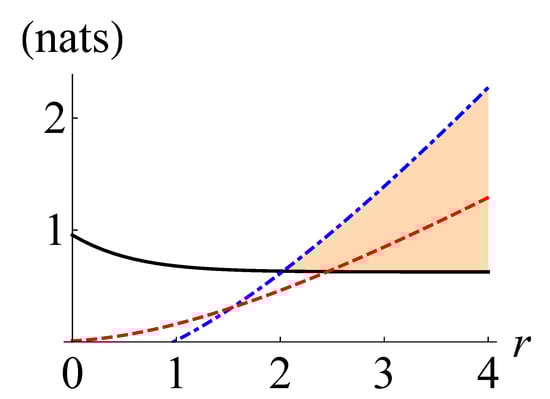
Figure 5.
The entropic quantities , , and for a CV Werner state with and are plotted with respect to the squeezing parameter r as black solid, red dashed, and blue dot-dashed curves, respectively. The shaded region indicates that Equation (52) reveals the quantum entanglement of the CV Werner state , which is undetectable by using the Gaussian PPT criteria.
6. Concluding Remarks
We derived observable lower bounds for a non-Gaussianity measure based on QRE. We first established a lower bound for a single-mode quantum state as a function of the negentropies of quadrature distributions with the maximum and minimum variances, and we showed that it could perform better than the previously proposed bound in [46]. We also formulated the strategies for estimating the QRE-based non-Gaussianity of a multimode quantum state using local quantities with or without leveraging a Gaussian unitary operation. Furthermore, we explored how our lower bound could be employed to detect non-Gaussian entanglement beyond the Gaussian PPT entanglement criteria.
We hope that our contributions will facilitate efficient and experimentally friendly certification methods for CV quantum resources. Although we here employed the quadrature distributions to address the non-Gaussianity of quantum states, there also exist other forms of probability representation for quantum states [85]. It will be intriguing to find a quantitative relation between the non-Gaussianity of the tomographic probability distributions and other non-Gaussianity measures. In addition, it will be worthwhile to extend our estimation method to more elaborate measures, such as the non-Gaussianity measure for quantum-state correlation [78] and the measures for quantum non-Gaussianity [48,49,50,51,52], i.e., a more robust form of non-Gaussianity. This topic will be investigated in future research.
Funding
This research was supported by newly appointed professor research fund of Hanbat National University in 2018. J.P. acknowledges support by the National Research Foundation of Korea (NRF) grant funded by the Korea government (MSIT) (NRF-2019R1G1A1002337).
Institutional Review Board Statement
Not applicable.
Informed Consent Statement
Not applicable.
Conflicts of Interest
The authors declare no conflict of interest.
Abbreviations
The following abbreviations are used in this manuscript:
| CV | Continuous-Variable |
| QRE | Quantum Relative Entropy |
| KLD | Kullback–Leibler Divergence |
References
- Braunstein, S.L.; Van Loock, P. Quantum information with continuous variables. Rev. Mod. Phys. 2005, 77, 513. [Google Scholar] [CrossRef] [Green Version]
- Weedbrook, C.; Pirandola, S.; García-Patrón, R.; Cerf, N.J.; Ralph, T.C.; Shapiro, J.H.; Lloyd, S. Gaussian quantum information. Rev. Mod. Phys. 2012, 84, 621. [Google Scholar] [CrossRef]
- Eisert, J.; Scheel, S.; Plenio, M.B. Distilling Gaussian States with Gaussian Operations is Impossible. Phys. Rev. Lett. 2002, 89, 137903. [Google Scholar] [CrossRef] [PubMed]
- Fiurášek, J. Gaussian Transformations and Distillation of Entangled Gaussian States. Phys. Rev. Lett. 2002, 89, 137904. [Google Scholar] [CrossRef] [Green Version]
- Giedke, G.; Cirac, J.I. Characterization of Gaussian operations and distillation of Gaussian states. Phys. Rev. A 2002, 66, 032316. [Google Scholar] [CrossRef] [Green Version]
- Niset, J.; Fiurášek, J.; Cerf, N.J. No-Go Theorem for Gaussian Quantum Error Correction. Phys. Rev. Lett. 2009, 102, 120501. [Google Scholar] [CrossRef]
- Magnin, L.; Magniez, F.; Leverrier, A.; Cerf, N.J. Strong no-go theorem for Gaussian quantum bit commitment. Phys. Rev. A 2010, 81, 010302(R). [Google Scholar] [CrossRef]
- Lee, C.T. Measure of the nonclassicality of nonclassical states. Phys. Rev. A 1991, 44, R2775. [Google Scholar] [CrossRef]
- Allegra, M.; Giorda, P.; Paris, M.G.A. Role of Initial Entanglement and Non-Gaussianity in the Decoherence of Photon-Number Entangled States Evolving in a Noisy Channel. Phys. Rev. Lett. 2010, 105, 100503. [Google Scholar] [CrossRef] [Green Version]
- Adesso, G. Simple proof of the robustness of Gaussian entanglement in bosonic noisy channels. Phys. Rev. A 2011, 83, 024301. [Google Scholar] [CrossRef] [Green Version]
- Sabapathy, K.K.; Ivan, J.S.; Simon, R. Robustness of Non-Gaussian Entanglement against Noisy Amplifier and Attenuator Environments. Phys. Rev. Lett. 2011, 107, 130501. [Google Scholar] [CrossRef] [Green Version]
- Lee, J.; Kim, M.S.; Nha, H. Comment on “Role of Initial Entanglement and Non-Gaussianity in the Decoherence of Photon-Number Entangled States Evolving in a Noisy Channel”. Phys. Rev. Lett. 2011, 107, 238901. [Google Scholar] [CrossRef]
- Allegra, M.; Giorda, P.; Paris, M.G.A. Allegra, Giorda, and Paris Reply. Phys. Rev. Lett. 2021, 107, 238902. [Google Scholar] [CrossRef]
- Agarwal, G.S.; Tara, K. Nonclassical properties of states generated by the excitations on a coherent state. Phys. Rev. A 1991, 43, 492. [Google Scholar] [CrossRef] [PubMed]
- Lee, S.Y.; Park, J.; Ji, S.W.; Ooi, C.H.R.; Lee, H.W. Nonclassicality generated by photon annihilation-then-creation and creation-then-annihilation operations. J. Opt. Soc. Am. B 2009, 26, 1532. [Google Scholar] [CrossRef]
- Lee, S.Y.; Nha, H. Quantum state engineering by a coherent superposition of photon subtraction and addition. Phys. Rev. A 2010, 82, 053812. [Google Scholar] [CrossRef] [Green Version]
- Takahashi, H.; Neergaard-Nielsen, J.S.; Takeuchi, M.; Takeoka, M.; Hayasaka, K.; Furusawa, A.; Sasaki, M. Entanglement distillation from Gaussian input states. Nat. Photon. 2010, 4, 178. [Google Scholar] [CrossRef] [Green Version]
- Lee, S.Y.; Ji, S.W.; Kim, H.J.; Nha, H. Enhancing quantum entanglement for continuous variables by a coherent superposition of photon subtraction and addition. Phys. Rev. A 2011, 84, 012302. [Google Scholar] [CrossRef] [Green Version]
- Navarrete-Benlloch, C.; García-Patrón, R.; Shapiro, J.H.; Cerf, N.J. Enhancing quantum entanglement by photon addition and subtraction. Phys. Rev. A 2012, 86, 012328. [Google Scholar] [CrossRef]
- Lee, S.Y.; Park, J.; Lee, H.W.; Nha, H. Generating arbitrary photon-number entangled states for continuous-variable quantum informatics. Opt. Express 2012, 20, 14221–14233. [Google Scholar] [CrossRef] [Green Version]
- Lee, S.Y.; Ji, S.W.; Lee, C.W. Increasing and decreasing entanglement characteristics for continuous variables by a local photon subtraction. Phys. Rev. A 2013, 87, 052321. [Google Scholar] [CrossRef] [Green Version]
- Lee, J.; Nha, H. Entanglement distillation for continuous variables in a thermal environment: Effectiveness of a non-Gaussian operation. Phys. Rev. A 2013, 87, 032307. [Google Scholar] [CrossRef] [Green Version]
- Kurochkin, Y.; Prasad, A.S.; Lvovsky, A.I. Distillation of The Two-Mode Squeezed State. Phys. Rev. Lett. 2014, 112, 070402. [Google Scholar] [CrossRef] [PubMed] [Green Version]
- Ulanov, A.E.; Fedorov, I.A.; Pushkina, A.A.; Kurochkin, Y.V.; Ralph, T.C.; Lvovsky, A.I. Undoing the effect of loss on quantum entanglement. Nat. Photon. 2015, 9, 764. [Google Scholar] [CrossRef] [Green Version]
- Hu, L.; Liao, Z.; Zubairy, M.S. Continuous-variable entanglement via multiphoton catalysis. Phys. Rev. A 2017, 95, 012310. [Google Scholar] [CrossRef]
- Kim, H.J.; Kim, J.; Nha, H. Enhanced multipartite quantum correlation by non-Gaussian operations. Phys. Rev. A 2013, 88, 032109. [Google Scholar] [CrossRef] [Green Version]
- Nha, H.; Carmichael, H.J. Proposed Test of Quantum Nonlocality for Continuous Variables. Phys. Rev. Lett. 2004, 93, 020401. [Google Scholar] [CrossRef] [Green Version]
- García-Patrón, R.; Fiurášek, J.; Cerf, N.J.; Wenger, J.; Tualle-Brouri, R.; Grangier, P. Proposal for a Loophole-Free Bell Test Using Homodyne Detection. Phys. Rev. Lett. 2004, 93, 130409. [Google Scholar] [CrossRef] [Green Version]
- Park, J.; Lee, S.Y.; Lee, H.W.; Nha, H. Enhanced Bell violation by a coherent superposition of photon subtraction and addition. J. Opt. Soc. Am. B 2012, 29, 906. [Google Scholar] [CrossRef]
- Opatrný, T.; Kurizki, G.; Welsch, D.G. Improvement on teleportation of continuous variables by photon subtraction via conditional measurement. Phys. Rev. A 2000, 61, 032302. [Google Scholar] [CrossRef] [Green Version]
- Cochrane, P.T.; Ralph, T.C.; Milburn, G.J. Teleportation improvement by conditional measurements on the two-mode squeezed vacuum. Phys. Rev. A 2002, 65, 062306. [Google Scholar] [CrossRef] [Green Version]
- Olivares, S.; Paris, M.G.A.; Bonifacio, R. Teleportation improvement by inconclusive photon subtraction. Phys. Rev. A 2003, 67, 032314. [Google Scholar] [CrossRef] [Green Version]
- Dell’Anno, F.; Siena, S.D.; Albano, L.; Illuminati, F. Continuous-variable quantum teleportation with non-Gaussian resources. Phys. Rev. A 2007, 76, 022301. [Google Scholar] [CrossRef] [Green Version]
- Lee, J.; Park, J.; Nha, H. Optimal continuous-variable teleportation under energy constraint. Phys. Rev. A 2017, 95, 052343. [Google Scholar] [CrossRef] [Green Version]
- Nha, H.; Milburn, G.J.; Carmichael, H.J. Linear amplification and quantum cloning for non-Gaussian continuous variables. New J. Phys. 2010, 12, 103010. [Google Scholar] [CrossRef]
- Zavatta, A.; Fiurášek, J.; Bellini, M. A high-fidelity noiseless amplifier for quantum light states. Nat. Photon. 2011, 5, 52–56. [Google Scholar] [CrossRef] [Green Version]
- Kim, H.J.; Lee, S.Y.; Ji, S.W.; Nha, H. Quantum linear amplifier enhanced by photon subtraction and addition. Phys. Rev. A 2012, 85, 013839. [Google Scholar] [CrossRef] [Green Version]
- Kitagawa, A.; Takeoka, M.; Wakui, K.; Sasaki, M. Effective squeezing enhancement via measurement-induced non-Gaussian operation and its application to the dense coding scheme. Phys. Rev. A 2005, 72, 022334. [Google Scholar] [CrossRef] [Green Version]
- Huang, P.; He, G.; Fang, J.; Zeng, G. Performance improvement of continuous-variable quantum key distribution via photon subtraction. Phys. Rev. A 2013, 87, 012317. [Google Scholar] [CrossRef] [Green Version]
- Fan, L.; Zubairy, M.S. Quantum illumination using non-Gaussian states generated by photon subtraction and photon addition. Phys. Rev. A 2018, 98, 012319. [Google Scholar] [CrossRef]
- Genoni, M.G.; Paris, M.G.A.; Banaszek, K. Measure of the non-Gaussian character of a quantum state. Phys. Rev. A 2007, 76, 042327. [Google Scholar] [CrossRef] [Green Version]
- Genoni, M.G.; Paris, M.G.A.; Banaszek, K. Quantifying the non-Gaussian character of a quantum state by quantum relative entropy. Phys. Rev. A 2008, 78, 060303(R). [Google Scholar] [CrossRef] [Green Version]
- Ivan, J.S.; Kumar, M.S.; Simon, R. A measure of non-Gaussianity for quantum states. Quantum Inf. Process. 2012, 11, 853–872. [Google Scholar] [CrossRef] [Green Version]
- Baek, K.; Nha, H. Non-Gaussianity and entropy-bounded uncertainty relations: Application to detection of non-Gaussian entangled states. Phys. Rev. A 2018, 98, 042314. [Google Scholar] [CrossRef] [Green Version]
- Fu, S.; Luo, S.; Zhang, Y. Quantifying non-Gaussianity of bosonic fields via an uncertainty relation. Phys. Rev. A 2020, 101, 012125. [Google Scholar] [CrossRef]
- Park, J.; Lee, J.; Baek, K.; Nha, H. Quantifying non-Gaussianity of a quantum state by the negative entropy of quadrature distributions. Phys. Rev. A 2021, 104, 032415. [Google Scholar] [CrossRef]
- Filip, R.; Mišta, L., Jr. Detecting Quantum States with a Positive Wigner Function beyond Mixtures of Gaussian States. Phys. Rev. Lett. 2011, 106, 200401. [Google Scholar] [CrossRef] [PubMed]
- Albarelli, F.; Genoni, M.G.; Paris, M.G.A.; Ferraro, A. Resource theory of quantum non-Gaussianity and Wigner negativity. Phys. Rev. A 2018, 98, 052350. [Google Scholar] [CrossRef] [Green Version]
- Takagi, R.; Zhuang, Q. Convex resource theory of non-Gaussianity. Phys. Rev. A 2018, 97, 062337. [Google Scholar] [CrossRef] [Green Version]
- Park, J.; Lee, J.; Baek, K.; Ji, S.W.; Nha, H. Faithful measure of quantum non-Gaussianity via quantum relative entropy. Phys. Rev. A 2019, 100, 012333. [Google Scholar] [CrossRef] [Green Version]
- Chabaud, U.; Markham, D.; Grosshans, F. Stellar Representation of Non-Gaussian Quantum States. Phys. Rev. Lett. 2020, 124, 063605. [Google Scholar] [CrossRef] [Green Version]
- Lami, L.; Regula, B.; Takagi, R.; Ferrari, G. Framework for resource quantification in infinite-dimensional general probabilistic theories. Phys. Rev. A 2021, 103, 032424. [Google Scholar] [CrossRef]
- Genoni, M.G.; Palma, M.L.; Tufarelli, T.; Olivares, S.; Kim, M.S.; Paris, M.G.A. Detecting quantum non-Gaussianity via the Wigner function. Phys. Rev. A 2013, 87, 062104. [Google Scholar] [CrossRef] [Green Version]
- Hughes, C.; Genoni, M.G.; Tufarelli, T.; Paris, M.G.A.; Kim, M.S. Quantum non-Gaussianity witnesses in phase space. Phys. Rev. A 2014, 90, 013810. [Google Scholar] [CrossRef] [Green Version]
- Park, J.; Nha, H. Demonstrating nonclassicality and non-Gaussianity of single-mode fields: Bell-type tests using generalized phase-space distributions. Phys. Rev. A 2015, 92, 062134. [Google Scholar] [CrossRef] [Green Version]
- Happ, L.; Efremov, M.; Nha, H.; Schleich, W.P. Sufficient condition for a quantum state to be genuinely quantum non-Gaussian. New J. Phys. 2018, 20, 023046. [Google Scholar] [CrossRef]
- Kühn, B.; Vogel, W. Quantum non-Gaussianity and quantification of nonclassicality. Phys. Rev. A 2018, 97, 053823. [Google Scholar] [CrossRef] [Green Version]
- Park, J.; Lee, J.; Nha, H. Entropic nonclassicality and quantum non-Gaussianity tests via beam splitting. Sci. Rep. 2019, 9, 17835. [Google Scholar] [CrossRef] [Green Version]
- Chabaud, U.; Roeland, G.; Walschaers, M.; Grosshans, F.; Parigi, V.; Markham, D.; Treps, N. Certification of Non-Gaussian States with Operational Measurements. PRX Quantum 2021, 2, 020333. [Google Scholar] [CrossRef]
- Fiurášek, J.; Lachman, L.; Filip, R. Quantum non-Gaussianity criteria based on vacuum probabilities of original and attenuated state. New J. Phys. 2021, 23, 073005. [Google Scholar] [CrossRef]
- Park, J.; Lee, J.; Nha, H. Verifying single-mode nonclassicality beyond negativity in phase space. Phys. Rev. Res. 2021, 3, 043116. [Google Scholar]
- Park, J.; Zhang, J.; Lee, J.; Ji, S.W.; Um, M.; Lv, D.; Kim, K.; Nha, H. Testing Nonclassicality and Non-Gaussianity in Phase Space. Phys. Rev. Lett. 2015, 114, 190402. [Google Scholar] [CrossRef] [PubMed] [Green Version]
- Park, J.; Lu, Y.; Lee, J.; Shen, Y.; Zhang, K.; Zhang, S.; Zubairy, M.S.; Kim, K.; Nha, H. Revealing nonclassicality beyond Gaussian states via a single marginal distribution. Proc. Nat. Acad. Sci. USA 2017, 114, 891. [Google Scholar] [CrossRef] [PubMed] [Green Version]
- Straka, I.; Lachman, L.; Hloušek, J.; Miková, M.; Mičuda, M.; Ježek, M.; Filip, R. Quantum non-Gaussian multiphoton light. NPJ Quantum Inf. 2018, 4, 4. [Google Scholar] [CrossRef] [Green Version]
- Lachman, L.; Straka, I.; Hloušek, J.; Ježek, M.; Filip, R. Faithful Hierarchy of Genuine N-Photon Quantum Non-Gaussian Light. Phys. Rev. Lett. 2019, 123, 043601. [Google Scholar] [CrossRef] [Green Version]
- Ježek, M.; Straka, I.; Mičuda, M.; Dušek, M.; Fiurášek, J.; Filip, R. Experimental Test of the Quantum Non-Gaussian Character of a Heralded Single-Photon State. Phys. Rev. Lett. 2011, 107, 213602. [Google Scholar] [CrossRef] [Green Version]
- Straka, I.; Predojević, A.; Huber, T.; Lachman, L.; Butschek, L.; Miková, M.; Mičuda, M.; Solomon, G.S.; Weihs, G.; Ježek, M.; et al. Quantum non-Gaussian Depth of Single-Photon States. Phys. Rev. Lett. 2014, 113, 223603. [Google Scholar] [CrossRef]
- Lvovsky, A.I.; Raymer, M.G. Continuous-variable optical quantum-state tomography. Rev. Mod. Phys. 2009, 81, 299. [Google Scholar] [CrossRef]
- Genoni, M.G.; Paris, M.G.A. Quantifying non-Gaussianity for quantum information. Phys. Rev. A 2010, 82, 052341. [Google Scholar] [CrossRef] [Green Version]
- Schrödinger, E. What Is Life? The Physical Aspect of the Living Cell; Cambridge University Press: Cambridge, UK, 1944. [Google Scholar]
- Cover, T.M.; Thomas, J.A. Elements of Information Theory, 2nd ed.; Wiley-Interscience: New York, NY, USA, 2006. [Google Scholar]
- Serafini, A. Quantum Continuous Variables: A Primer of Theoretical Methods; CRC Press: Boca Raton, FL, USA, 2017. [Google Scholar]
- Coles, P.J.; Berta, M.; Tomamichel, M.; Wehner, S. Entropic Uncertainty Relations and their Applications. Rev. Mod. Phys. 2017, 89, 015002. [Google Scholar] [CrossRef] [Green Version]
- Barnett, S.M.; Radmore, P.M. Methods in Theoretical Quantum Optics; Clarendon Press: Oxford, UK, 1997. [Google Scholar]
- Lee, S.Y.; Lee, C.W.; Nha, H.; Kaszlikowski, D. Quantum phase estimation using a multi-headed cat state. J. Opt. Soc. Am. B 2015, 32, 1186–1192. [Google Scholar] [CrossRef] [Green Version]
- Modi, K.; Paterek, T.; Son, W.; Vedral, V.; Williamson, M. Unified View of Quantum and Classical Correlations. Phys. Rev. Lett. 2010, 104, 080501. [Google Scholar] [CrossRef] [Green Version]
- Wolf, M.M.; Giedke, G.; Cirac, J.I. Extremality of Gaussian Quantum States. Phys. Rev. Lett. 2006, 96, 080502. [Google Scholar] [CrossRef] [Green Version]
- Park, J.; Lee, J.; Ji, S.W.; Nha, H. Quantifying non-Gaussianity of quantum-state correlation. Phys. Rev. A 2017, 96, 052324. [Google Scholar] [CrossRef] [Green Version]
- Williamson, J. On the Algebraic Problem Concerning the Normal Forms of Linear Dynamical Systems. Am. J. Math. 1936, 58, 141. [Google Scholar] [CrossRef]
- Mišta, L., Jr.; Filip, R.; Fiurášek, J. Continuous-variable Werner state: Separability, nonlocality, squeezing, and teleportation. Phys. Rev. A 2002, 65, 062315. [Google Scholar] [CrossRef] [Green Version]
- McNulty, D.; Tatham, R.; Mišta, L., Jr. Nonexistence of entangled continuous-variable Werner states with positive partial transpose. Phys. Rev. A 2014, 89, 032315. [Google Scholar] [CrossRef] [Green Version]
- D’Auria, V.; Fornaro, S.; Porzio, A.; Solimeno, S.; Olivares, S.; Paris, M.G.A. Full Characterization of Gaussian Bipartite Entangled States by a Single Homodyne Detector. Phys. Rev. Lett. 2009, 102, 020502. [Google Scholar] [CrossRef]
- Simon, R. Peres-Horodecki Separability Criterion for Continuous Variable Systems. Phys. Rev. Lett. 2000, 84, 2726. [Google Scholar] [CrossRef] [Green Version]
- Pirandola, S.; Serafini, A.; Lloyd, S. Correlation Matrices of Two-Mode Bosonic Systems. Phys. Rev. A 2009, 79, 052327. [Google Scholar] [CrossRef]
- Man’ko, O.V.; Man’ko, V.I. Probability Representation of Quantum States. Entropy 2021, 23, 549. [Google Scholar] [CrossRef] [PubMed]
Publisher’s Note: MDPI stays neutral with regard to jurisdictional claims in published maps and institutional affiliations. |
© 2022 by the author. Licensee MDPI, Basel, Switzerland. This article is an open access article distributed under the terms and conditions of the Creative Commons Attribution (CC BY) license (https://creativecommons.org/licenses/by/4.0/).