1. Introduction
In the field of wireless communication, multi-input multi-output (MIMO) systems have been widely used for their superior performance like increasing channel capacity and improving user anti-interference performance [
1]. However, MIMO systems also have the following disadvantages. First, when the distances between users and targets are large, the signal cannot reach the targets directly due to the heavy shadow and path loss [
2,
3,
4,
5]. Therefore, there is no Line-of-Sight (LOS) between users and targets and only Rayleigh channels can be applied between [
6,
7]. Second, when a large number of transmitting and receiving antennas are equipped with high-resolution Analog-to-Digital Converters (ADCs), the system will consume tremendous amounts of energy. To be specific, if a high-resolution ADC is with b-bit precision and the sampling frequency is
,
conversions will be required per second, which means the energy consumption of the system increases exponentially with the quantization accuracy [
2].
With the development of multi-hop communication, we can decrease the distances between relays so that LOS can appear. Then we can apply Rician channels instead of Rayleigh channels to reduce the achievable sum rate. Besides, using low-resolution ADCs instead of high-resolution ADCs can alleviate the energy consumption burden of the MIMO system and achieve a fairly considerable achievable sum rate at the same time.
1.1. Related Works
The authors of [
8,
9] applied Rician channels to MIMO systems. However, the study only concentrated on the one-hop scenario. Therefore, it can only cover a limited communication distance in real problems. In order to reduce the power consumption of ADCs, scholars have made plenty of attempts with the idea of using low-resolution ADCs. The authors of [
10] studied the hybrid ADCs/DACs relay system and proposed the power scaling law. This law revealed that the transmission power could be reduced inversely proportional to the number of relay antennas, and an effective power allocation scheme was further proposed based on this law. The authors of [
11] studied the one-bit low-resolution ADCs relay system for the MIMO system, which is a special case of low-resolution ADCs, and proved one-bit low-resolution ADCs is effective for reducing energy consumption. The authors of [
12,
13] applied low-resolution ADCs to the Rician channels relay system. However, they only considered the one-hop relay system scenario, so the communication distance was limited. Since it is very important for the MIMO system to increase the achievable sum rate, reduce the energy consumption and maintain long-distance communication, we consider the uplink of a two-hop low-resolution ADCs massive MIMO relaying system over the Rician channel in our paper.
1.2. Contributions
Our work considers the uplink of a two-hop low-resolution ADCs massive MIMO relay system over Rician channels. Firstly, we derive the closed-form expression of the achievable sum rate of the uplink of the low-resolution ADCs massive MIMO relay system over two-hop Rician channels and one-hop Rayleigh channels based on the higher-order statistics of perfect channel state information (CSI). Secondly, we derive the asymptotic closed-form expressions when the number of antennas tends to infinity. Next, we further achieve the law of power scaling and asymptotic values under different power scales, and conclude that the transmission power scaled down inversely proportional to the number of antennas at relays. Finally, we compare the achievable sum rates of the two-hop Rician system and the one-hop Rayleigh system, and validate the correctness of the theoretical analysis with numerical simulation results.
More specifically, the contributions of this work are summarised as follows:
1. We design a two-hop Rician channel system, which guarantees the LOS between users, relays and targets, and takes the advantage of Rician channels to increase the achievable sum rate while maintaining long-distance communication.
2. We use both mathematical approaches and simulation results to prove the superiority of achievable sum rate of our two-hop Rician channel system over the one-hop Rayleigh channel system, which is more widely applied to MIMO systems.
3. We apply low-resolution ADCs to our two-hop Rician system to reduce the energy consumption, and use mathematical analysis and simulation results to find that when quantization bits , the system achieves a fairly considerable achievable sum rate while greatly reduces the energy consumption.
1.3. Notations
Notation: The superscripts , , and represent the transpose, Hermitian transpose, trace of the matrix, and diagonal matrix, respectively. represents the Euclidean norm. represents the complex Gaussian distribution with the mean of ∗ and the variance of . represents the expectation. denotes an identify matrix. or represents the entry of .
2. System Model and Signal Processing
2.1. One-Hop Rayleigh Channel System
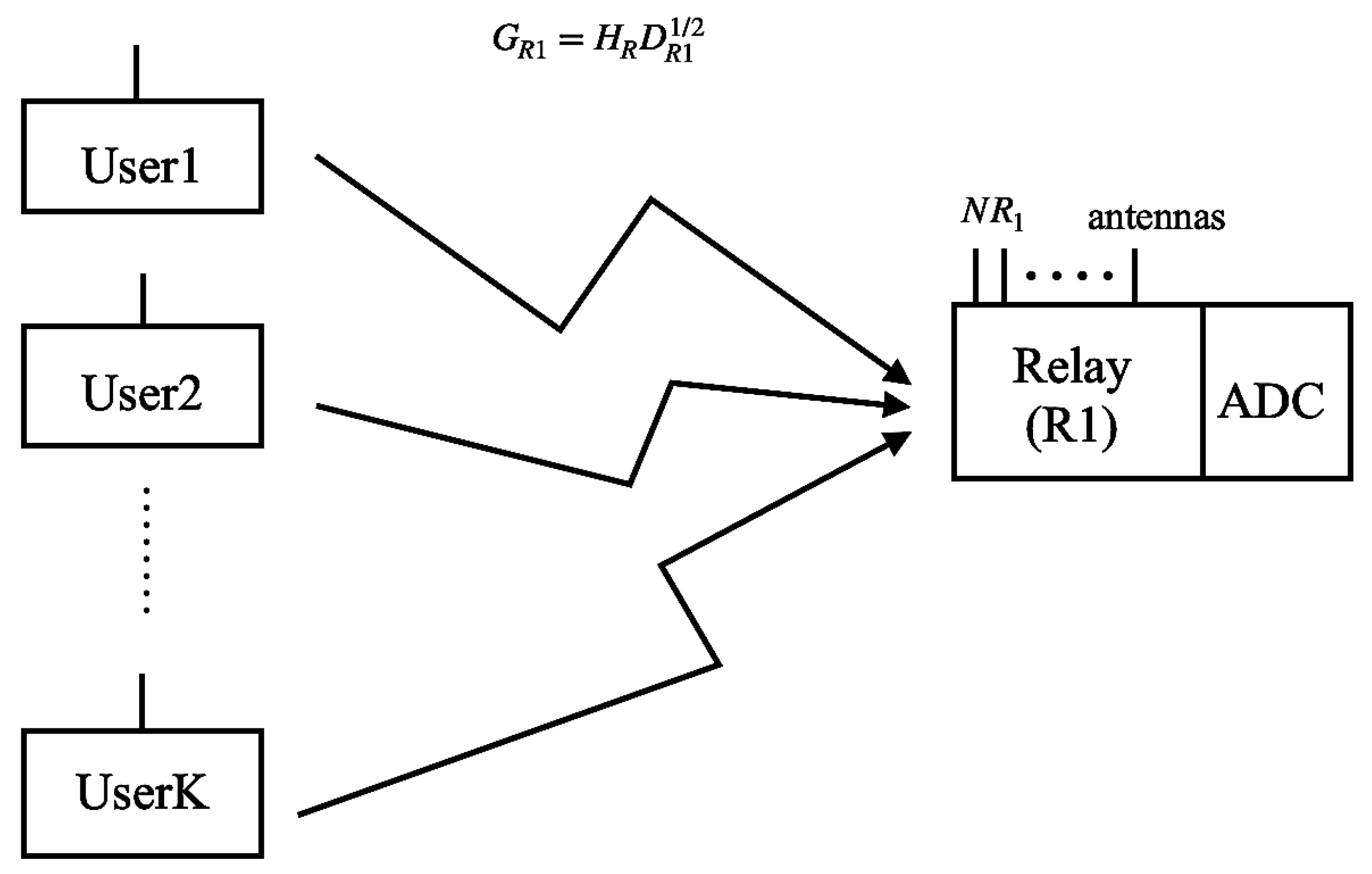
Figure 1 shows the system model of the uplink of a one-hop massive MIMO relay with low-resolution ADCs under Rayleigh channels. This system contains relay
with
antennas, and
K users with single antenna. The system works under Rayleigh channels because the distances between users and the relay are very large and there is no LOS between users and the relay.
We use
to denote the MIMO channel matrix. According to [
9],
can be represented as
where
is a
diagonal matrix representing the large-scale fading between
K users and
K different randomly selected antennas from
antennas in relay
with the probability of
, and
.
, where
represents the reference distance,
represents the distance from node
i to node
j,
v is the power exponent coefficient.
denotes the fast-fading matrix of the Rayleigh channels. Every column of follows .
Assume that the signal transmitted by
K user antennas is
, where
. After one time slot, the signal received by relay
can be expressed as
where
is the transmission power of each user,
is the white noise follows i.i.d complex Gaussian distribution at relay
,
.
is then quantized by low-resolution ADCs at
. Based on Additive Quantization Noise Model (AQNM) [
14,
15], the quantized signal can be represented as
where
denotes the additive quantization noise vector and is independent from the received signal
,
m denotes the linear quantization gain. According to [
10,
16,
17],
m satisfies the following equation
, where
represents the quantization distortion factor and equals the ratio of the quantizer error variance over received signal variance. For relay
,
. When the number of quantization bits
, the values of
is shown in
Table 1. When
,
.
According to [
18], the covariance matrix of the quantization noise can be expressed as
Because Maximum Ratio Combining (MRC) has low-complexity and is able to achieve the optimal reception performance, we use MRC to linear process the quantized signal
, where the MRC matrix
. Therefore, the processed signal
can be written as
Noticing that the signal of the
user and the other users in (
5) are uncorrelated, the received signal of the
user at relay
can be written as
2.2. Two-Hop Rician Channel
In order to increase the achievable sum rate, we convert the one-hop MIMO system to two-hop MIMO system, so that the distance between users and relays can be reduced. As a result, LOS will appear between users and relays and Rician channels can be applied to increase the achievable sum rate.
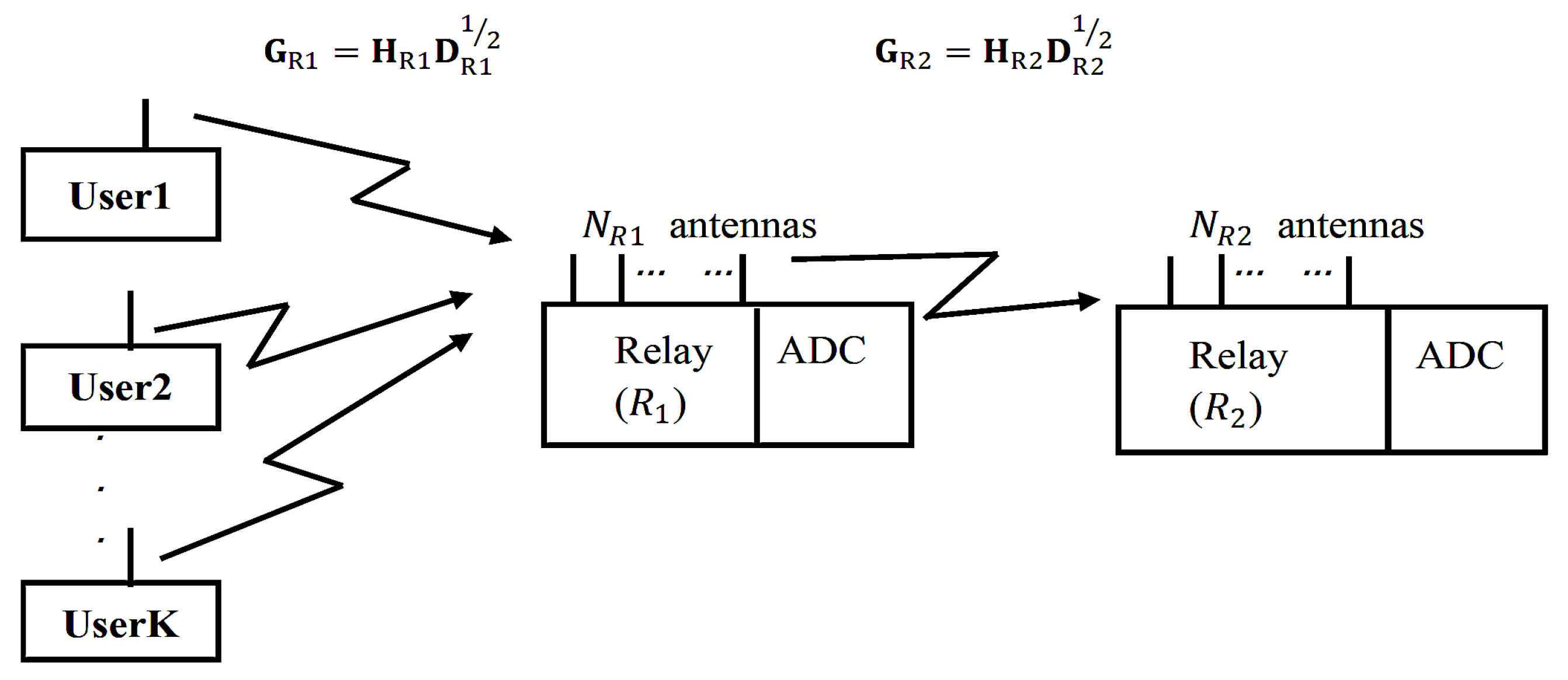
Figure 2 shows the system model of the uplink of a two-hop massive MIMO system with low-resolution ADCs under Rician channels. This system contains relay
with
antennas, relay
with
antennas and
K users with a single antenna. The system works under Rician channels because LOS exists between users and
and between
and
.
We use
to denote the MIMO channel matrix between users,
to denote the MIMO channel matrix between
and
.
can be represented as
can be represented as
where
is a diagonal matrice representing the large-scale fading between
K users and the
K different randomly selected antennas from
antennas with the probability of
at relay
, and
.
is a diagonal matrice representing the large-scale fading between
K users and
K different randomly selected antennas from
antennas at relay
with the probability of
, and
.
,
, where
represents the reference distance,
represents the distance from node
i to node
j,
v is power exponent coefficient.
and
denote the fast-fading matrix of Rician channels. According to [
19],
and
can be represented as:
Same as the previous chapter, we can get the quantized signal
at
as
From (
4), we can get the covariance matrix of the quantization noise
at
as
where
denotes the linear quantization gain at
,
denotes the quantization distortion factor at
.
The processed signal
can be expressed as
Then, we apply the technique of Amplify-and-Forward (AF) to signal
and transmit the processed signals to
with
K randomly selected antennas. The signal
received at relay
can be denoted as
where
is the Rayleigh fading channel between relay
and
,
, which is the white noise follows i.i.d complex Gaussian distribution at relay
.
is an amplification factor at relay
, which satisfies the power constraint
. Therefore,
can be expressed as
where
represents the transmit power at relay
,
.
To simplify the expression, we make the following definitions.
Therefore,
can be expressed as follows, the proof is attached in
Appendix A.
Similar to the quantization at relay
, the quantized signal
at relay
can be modeled as
The covariance matrix of the quantization noise
can be written as
where
denotes the linear quantization gain at
,
denotes the quantization distortion factor at
,
,
.
Same as MRC processing at relay
, we also use MRC to process signals at
, where the MRC matrix
. Therefore, the processed signal
can be written as
Noticing that the signal of the
user and the other users in (
15) are uncorrelated, the received signal of the
user at relay
can be written as
3. System Achievable Rate Analysis
3.1. One-Hop Rayleigh Channel
3.1.1. Closed-Form Expression
Supposing that the CSI is perfect, based on Shannon Entropy and according to (
6), we can get the rate of the
user in one-hop low-precision ADCs MIMO relay system over Rayleigh channels as
where
represents the power of desired signal of the
user,
represents the power of interference signal and the noise of the
user.
According to [
20], the rate of
user can also be denoted as
where
represents the Signal-to-noise Ratio (SNR) of the
user at the receiving end
.
Based of (
20) and (
21), we can derive the closed-form expression for the achievable sum rate of the
user in the one-hop low-precision ADCs MIMO relay system over Rayleigh channels is
In Formula (
22),
and
can be represented as follows, the proof is attached in
Appendix B.
3.1.2. Power Scaling Laws and Asymptotic Analysis
Based on the closed-form expression over Rayleigh channels given by (
22), we further analyze their performances and derive the law of energy scaling in different conditions.
Suppose that the transmit power at the user end is
,
a is the power scaling constant. When the number of antennas tends to infinity, the limit of
in (
21) can be represented as
When
a takes different values, we can obtain the following power scaling law
As can be seen from (
26), when
tends to infinity, the transmit power at the user end can be scaled down by
. When the scale index
a satisfies
, the achievable rate remains stable. Based on (
21), (
22) and (
26), when the prefect CSI exists from users to
, we assume that
, the large-scale fading between users and
satisfies
, the user transmit power
,
can be approximated as
The uplink achievable sum rate can be approximated as
3.2. Two-Hop Rician Channels
3.2.1. Closed-Form Expression
Similar to (
17), the achievable rate of the
user in two-hop low-precision ADCs MIMO relay system over Rician channels can be represented as
where
represents the power of desired signal of the
user, and
represents the power of interference signal and the of noise of the
user.
The detailed formula of
and
can also be represented as
Similar to (
20), the rate of
user can be denoted as
where
represents the SNR of the
user at the receiving end
.
Based of (
32) and (
33), we can derive the closed-form expression for the achievable sum rate of the two-hop low-precision ADCs MIMO relay system over Rician channels is
In Formula (
34),
and
can be represented as follows, the proof is attached in
Appendix D.
3.2.2. Power Scaling Laws and Asymptotic Analysis
Based on the closed-form expressions over Rician channel given by (
33) and (
34), we further analyze their performances and derive the law of energy scaling in different conditions.
Suppose that the transmit power at the user end is
, the transmit power at relay
is
,
a and
b are power scaling constants,
. When the
and
tend to infinity, the limit of
in (
33) can be represented as
When
a and
b take different values, we can obtain the following power scaling law, the proof is attached in
Appendix E.
where
. As can be seen from (
38), when
tends to infinity, the transmit power at the user end can be scaled down by
and
. When the scale index
a and
b satisfy
,
or
, the achievable rate remains stable.
Based on (
38) and according to [
13], when the prefect CSI exists from users to
and from
to
, we assume that
, the large-scale fading between users and
satisfies
, the fading between
and
satisfies
, the user transmit power
,
transmit power
,
,
can be approximated as
Therefore, no matter the system is under Rayleigh channel or Rician channel, we can derive the approximate uplink achievable sum rate as
4. Results
In this section, we use system 1 to represent the one-hop Rayleigh system, system 2 to represent the two-hop Rician system. We set different experiments and visualize the 1000-time Monte Carlo simulation results and the achievable sum rate calculated from the closed-form expressions. Then we compare the results of system 1 and system 2 to verify the correctness of theoretical analysis. In our experiments, we set the number of users , the transmission power of users , the transmission energy , the noise energy at and as , respectively. We assume , the large-scale fading coefficient , , where represents the reference distance, represents the distance from node i to node j, v is the power exponent coefficient. During the simulation, we set , , . In system 1, we set . In system 2, we set . We use to represent the arrival angle from users to , to represent the arrival angle from to , and obeys the uniform distribution on .
4.1. Experiment 1: Achievable Sum Rates with Different
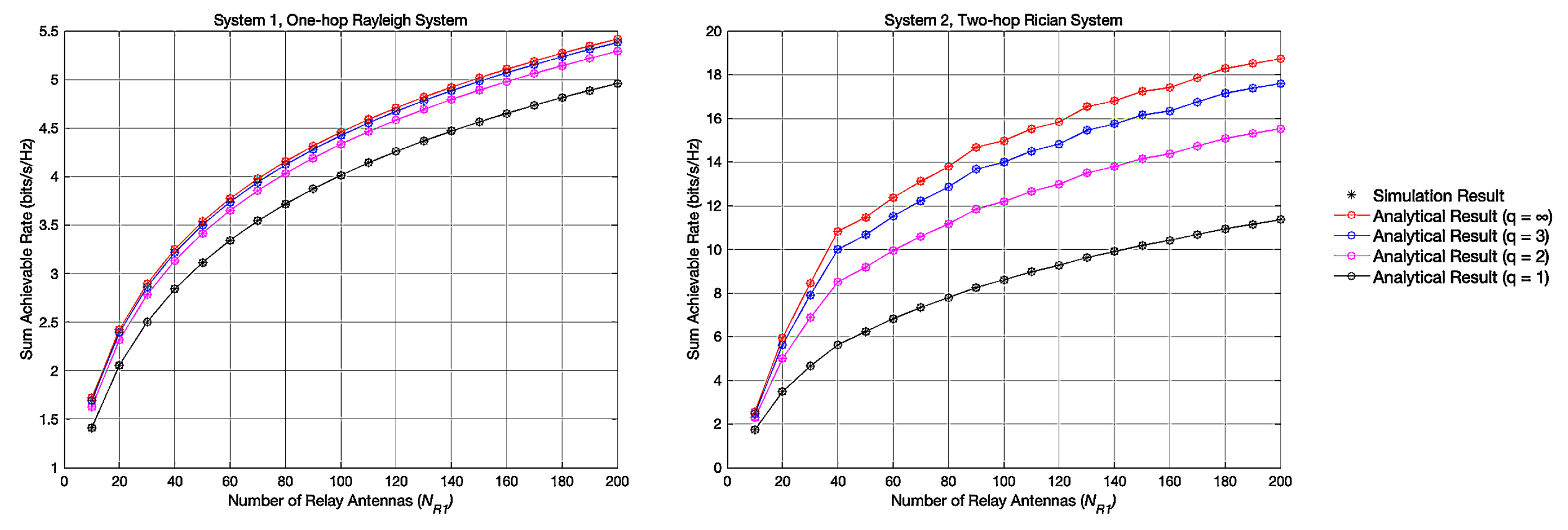
Figure 3 shows the variation curve of the achievable sum rate in systems 1 and 2 with the variation of
. The asterisks indicate the experimental result obtained through 1000 times Monte Carlo simulations, and the circles indicate the simulation result of the achievable sum rate calculated by the closed-form expression (
22) and (
34). As is shown in
Figure 3, the curve of the Monte Carlo simulations perfectly matches the curve derived from the closed-form expressions, which proves the correctness of the derived closed-form expressions (
22) and (
34). Obviously, when the simulation parameters are the same, the achievable sum rate of the two-hop Rican system is higher than the achievable sum rate of the one-hop Rayleigh system. This result proves that converting one-hop Rayleigh system to two-hop Rician system can improve the achievable sum rate. It is in consistent with the actual communication process where there is LOS signal, and the communication quality under Rician channel is better.
4.2. Experiment 2: Achievable Sum Rates with Different q
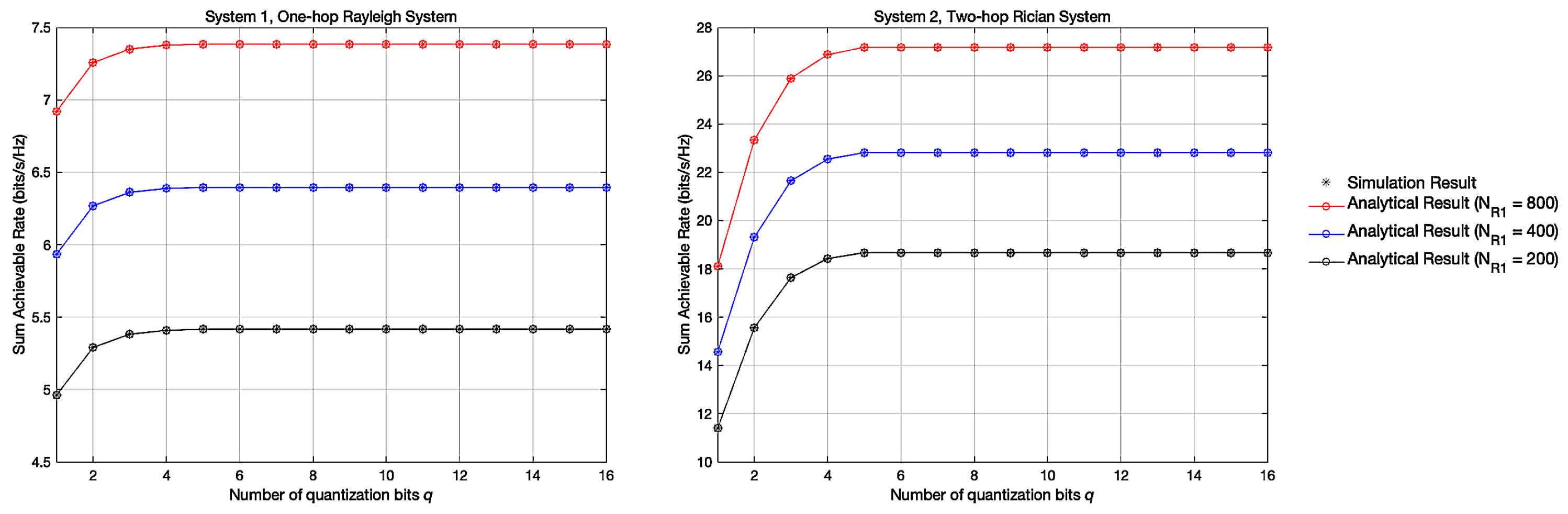
Figure 4 shows the variation curve of the achievable sum rate in systems 1 and 2 with the variation of
q when
. Apart from previous findings, we can also discover that the low-resolution quantization brings performance loss. This is because when the quantization occurs, it reduces the SNR and causes performance degradation. We can also discover that when the number of quantization bits
, the achievable sum rate can persist at a stable rate.
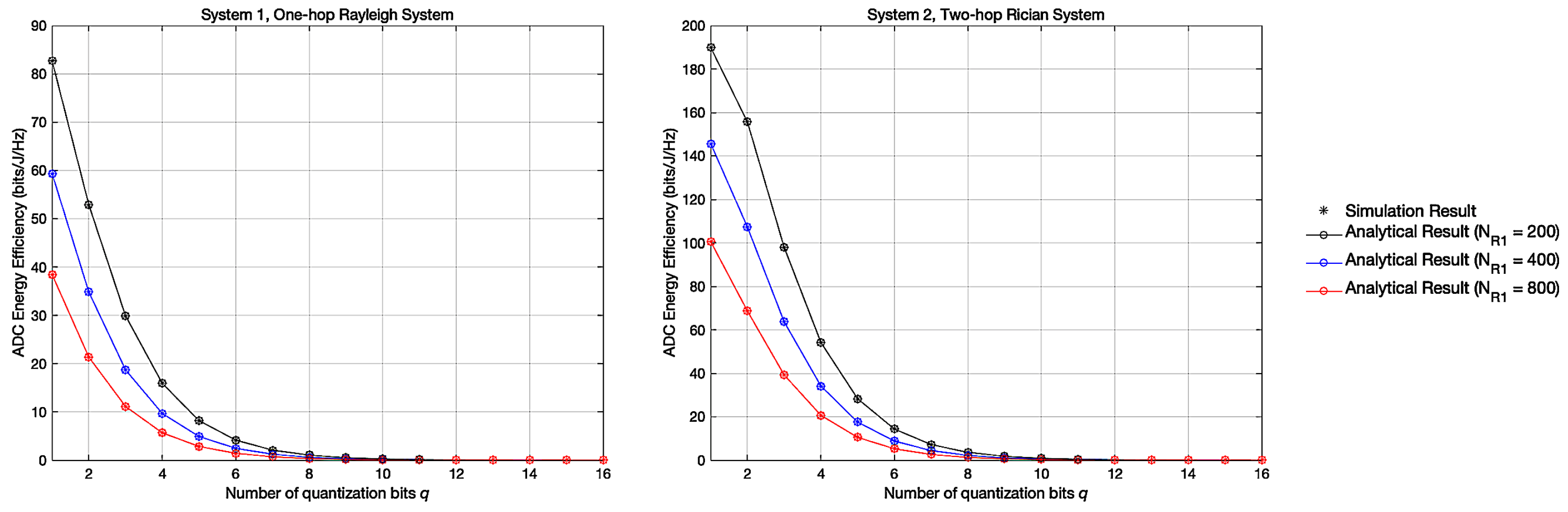
4.3. Experiment 3: ADC Energy Efficiency with Different q
Figure 5 shows the variation curve of the ADC Energy Efficiency in systems 1 and 2 with the variation of
q when
. In
Figure 5, the ADC energy efficiency can be obtained by
, where
R represents the achievable sum rate,
P represents the energy loss. According to [
20,
21],
,
. The result shows that in both systems, the energy efficiency of the ADC shows a logarithmic downtrend when
q increases, which denotes that the low-resolution ADC can improve the energy efficiency and reduce the energy consumption during signal transmission. Besides, we can clearly find that when
q is small, system 2 has a higher ADC energy efficiency compared with system 1, which proves the superiority of system 2.
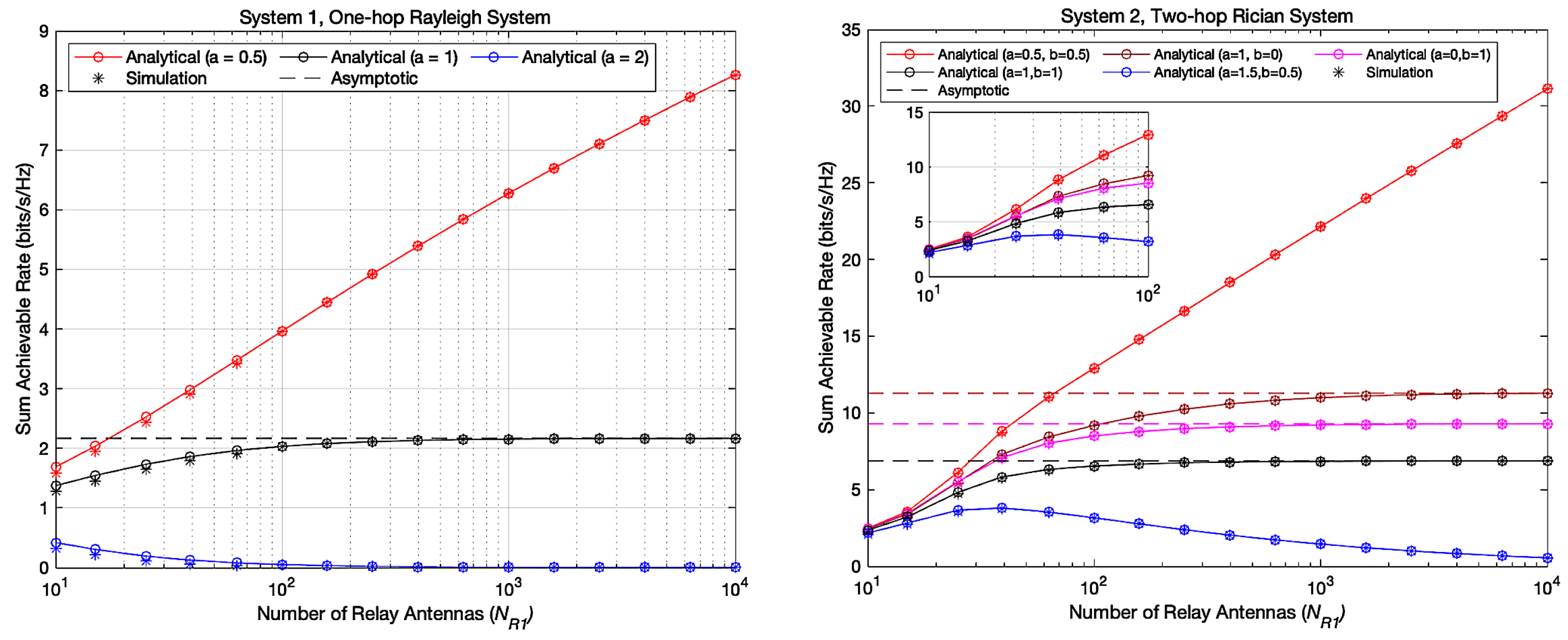
4.4. Experiment 4: Asymptotic Achievable Sum Rates in Two Systems
Figure 6 shows the variation curve of achievable sum rates when
increases with different scaling indexes and the corresponding asymptotic values. When
is relatively small, the results of the 1000-time Monte Carlo simulation do not match with the analytical results precisely. However, as the number of antennas continues to increase, the 1000-time Monte Carlo simulation results can perfectly match the analytical results. It is because the law of power scaling is derived when
is large enough.
Besides,
Figure 6 shows that in system 1,
can be scaled down inversely proportional to
when scaling index
while maintain a desirable achievable sum rate when
grows large. In system 2,
and
can be scaled down inversely proportional to
and
when
, or
, or
and maintain desirable achievable sum rates when
grows large. The results shown in
Figure 6 are consistent with the theoretical analysis given by Equations (
26) and (
38).
5. Conclusions
In this paper, we investigate the uplink of a two-hop low-resolution ADCs massive MIMO relaying system over Rician channels and compare its superiority of the achievable sum rate with the one-hop Rayleigh channel system. Firstly, we use the higher-order statistics to derive the closed-form expression of achievable sum rate. From the simulation results, we discover that converting a one-hop Rayleigh channel system into a two-hop Rician channel system can increase the achievable sum rate. Besides, the use of low-resolution ADCs only causes limited loss of achievable sum rate, but greatly improves the energy efficiency. Secondly, we discover that as the number of relay antennas continues to increase, the achievable sum rate eventually reaches a stable state. Finally, the power scaling law shows that when the number of antennas at the relay grows large, both and can be scaled down inversely proportional to and , while maintaining a desirable achievable sum rate.