1. Introduction
Recent years have seen an abundance of approaches aimed at describing the ‘connectivity’ between sets of observed time series. To this end,
Granger causality-based ideas [
1] stand out prominently and involve a wide variety of time series techniques comprising time [
1,
2] and frequency domain [
3,
4,
5] descriptions.
Granger causality descriptions are centered on determining how helpful the past of a time series can be insofar as predicting another time series. As such, eventual simultaneous relationships are not taken into account. This aspect is described via the so-called instantaneous Granger causality (iGC), which is deemed to be present whenever modeling residues between different time series are correlated.
This latter aspect has received relatively far less attention and, for a long time, this time series residue connection meant that the idea remained restricted to time domain considerations. This state of affairs was changed following the work of Faes and Nollo [
6,
7], who proposed adding extra coefficients to model interactions that are not mediated by delay from which such descriptors as
directed transfer function (DTF) [
3] and
partial directed coherence (PDC) [
4] could be generalized. More recently, an alternative [
8] based on comparing models over suppressed time series has surfaced.
Rather than contrasting the latter descriptions, here, we wish to show that the formalism behind DTF and PDC can be naturally extended to include a reasonable frequency domain description of instantaneous Granger effects when their information versions iDTF/iPDC [
9] are considered without the need for employing modified models as required by the other previous approaches [
6,
7,
8].
This development is interesting furthermore since it also allows a rounded closed form description, not previously available for directed frequency domain relationships, that can be deduced from second order statistical information alone.
In the developments that follow, we shall employ the concepts of
Granger connectivity (G–C) and
Granger influentiability (G–I), introduced in [
10], which refer respectively to PDC- and DTF-based descriptions of the ties between time series. The first one focuses on immediate connections between time series as opposed to the second one, which summarizes all possible signal pathways that join them. More information is available in [
11].
The paper is organized as follows.
Section 2 describes the main results after a brief recap of the essential concepts (
Section 2.1), including how to write coherency and partial coherency in terms of iDTF/iPDC. This is followed by the newly proposed quantities of the
total directed transfer function (tDTF) and
total partial directed coherence (tPDC) in
Section 3.
Section 4 contains some brief numerical examples to illustrate the new concepts followed by a brief discussion (
Section 5) and the ensuing conclusions (
Section 6).
3. Total DTF and Total PDC
Before introducing the new quantities, some comments are due.
First of all, Equations (
9) and (
17) confirm the roles of iDTF and iPDC as factors of coherency and partial coherency as we have repeatedly stated [
4], where the standard plots for them are organized as graph panels with the same layout, portraying the magnitude squared values of the entries in
and
, respectively.
The originally defined directed transfer function [
3] and partial directed coherence [
4] are simplified forms of (
7) and (
14), respectively, by fully dispensing with the instantaneous aspects by replacing
with
. Directed coherence [
13] and generalized PDC (gPDC) [
5] lend scale invariance to the latter quantities by replacing
with a matrix comprised only of its diagonal elements in (
7)/(
14). This means that the latter forms do not suffer contamination from instantaneous effects as opposed to iDTF/iPDC which contain the full
matrix in their definitions.
A couple of things are easy to show regarding DTF (DC)/PDC (gPDC). The first one is that, when
,
(
) and
(
). It is easy to show that the same properties hold between iDTF and the rescaled version of iPDC (
15).
The second one is that fixing the target structure and adding the DTF/DC magnitude squared contributions from all sources adds to 1. A similar result holds for PDC/gPDC, except that now, one must fix the source and sum over the magnitude squared target structures.
However, even though at first sight, a strict normalization does not encompass iDTF or iPDC, one may show a similar property by noticing that
and that
for
so that indeed it is the latter terms that lead to a normalization that reduces to that of DTF(DC)/PDC(gPDC) when
is suitably replaced.
For future reference, we define
and
of (
20) and (
21) as the
to
latent directed instantaneous influentiability and connectivity, respectively. They represent would-be frequency domain repercussions due to instantaneous Granger causality when their respective
iDTF or iPDC are not zero.
Finally, one should note that, even though iDTF and iPDC have interpretations of their own in terms of mutual information rates between processes that describe the multivariate
process [
9], the fuller impact of the presence of instantaneous Granger causality is, however, mostly concentrated at the correlation
and partial correlation
coefficient matrices.
We can write down all terms whose addition produce the various
along the rows of a single matrix:
where ⊙ is Hadamard’s element-wise product, and
stands for complex conjugation.
However,
where
stands for a matrix containing correlation coefficients as off-diagonal terms and whose main diagonal has only zeros.
Therefore, we may rewrite (
22) as
whose first term is readily recognizable as a matrix whose elements contain the magnitude squared of iDTF in the standard form. The second term isolates influences associated with iGC. Whereas the elements of the first term are real non-negative, the entries of the second term are inherently complex.
We propose to call (
24)
total DTF and denote it as
where its first term contains the customary
Granger influentiability description [
10] and the second its
directed instantaneous influentiability counterpart. Both
and
are complex quantities.
Clearly, the row elements of (
25) sum to 1. Because the elements in the rows of
are all real and non-negative, the sum of
along a row is also a real number.
Since we can write
we may define
total PDC as
where the entries in
describe what we called
Granger connectivity [
10] and
its
directed instantaneous connectivity counterpart.
The column-wise sum of the elements of (
27) adds to one, whereas those of the columns of
sum to a real number since the elements of
are non-negative real.
To facilitate reference, the key symbols are given in
Table 1.
4. Numerical Examples
To provide some intuition, we examine the following numerical examples.
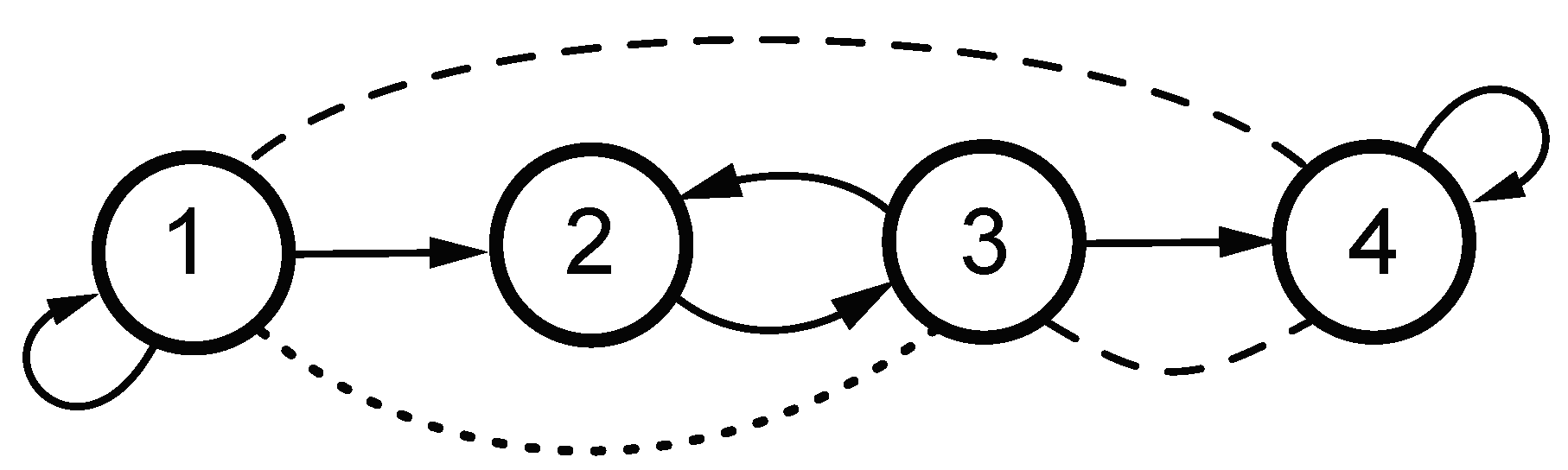
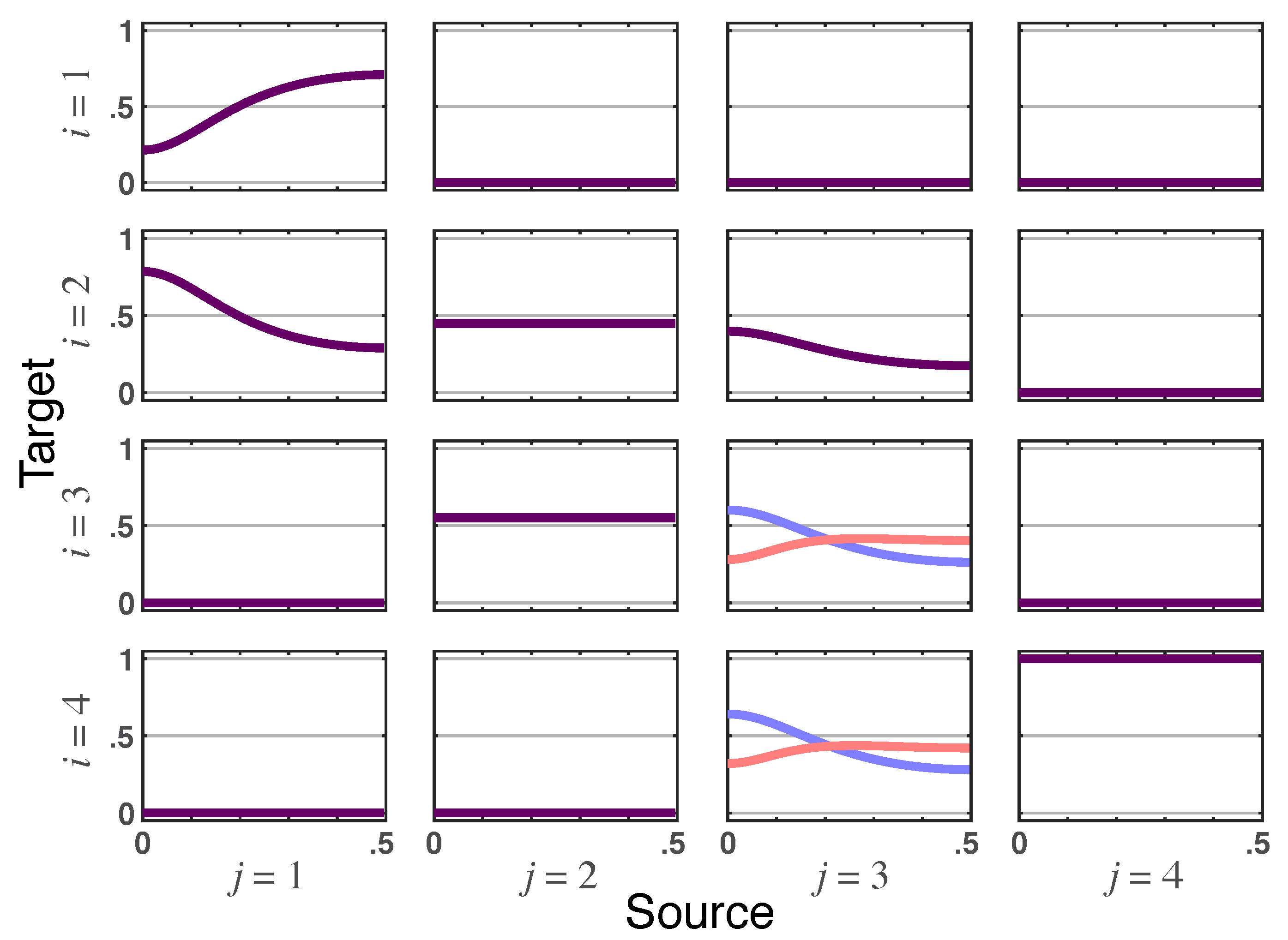
Example 1. Consider a system whose connections are contained in Figure 1. Dashed lines represent instantaneous interaction aspects, while dotted lines reflect the additional instantaneous interaction aspect that becomes explicit upon computation (Equation (30)). The underlying system is a first order one given by (1) and defined bywithwhich allows appreciating the interplay of instantaneous effects with the connectivity/influentiability structures, where the lack of connections/influences measured by iPDC/iDTF is immediately apparent. The computed are contained in and rounded to two decimal places.
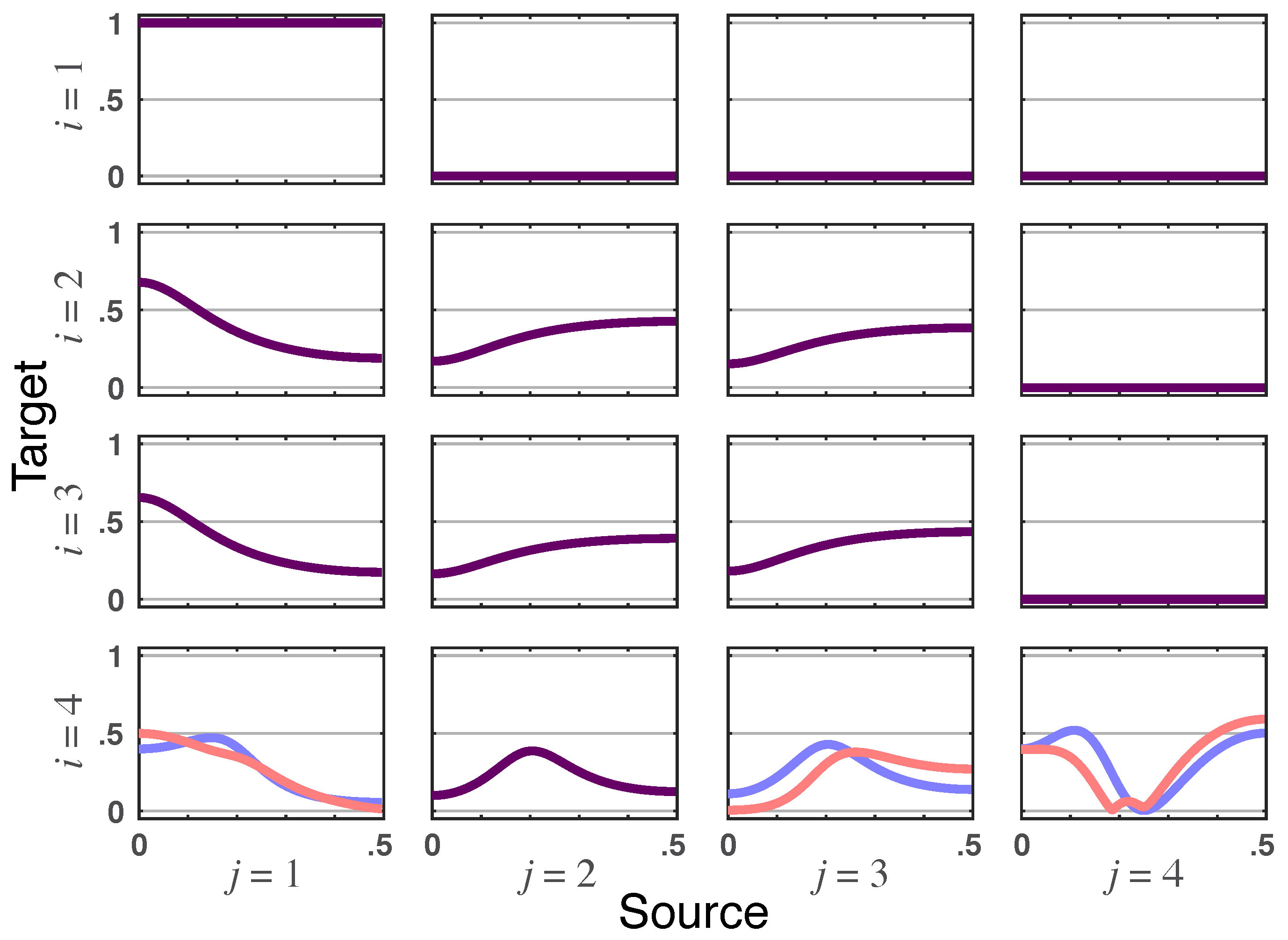
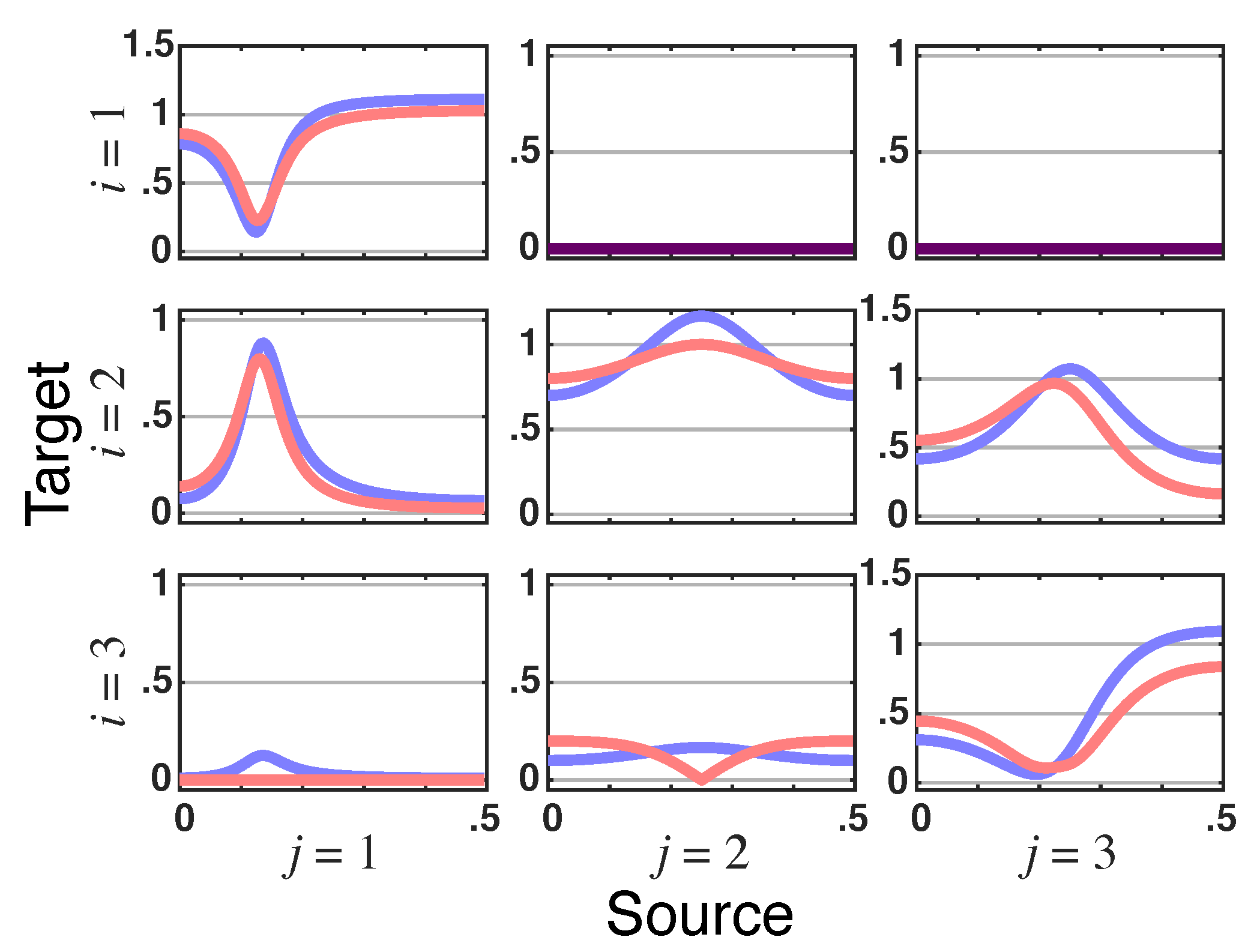
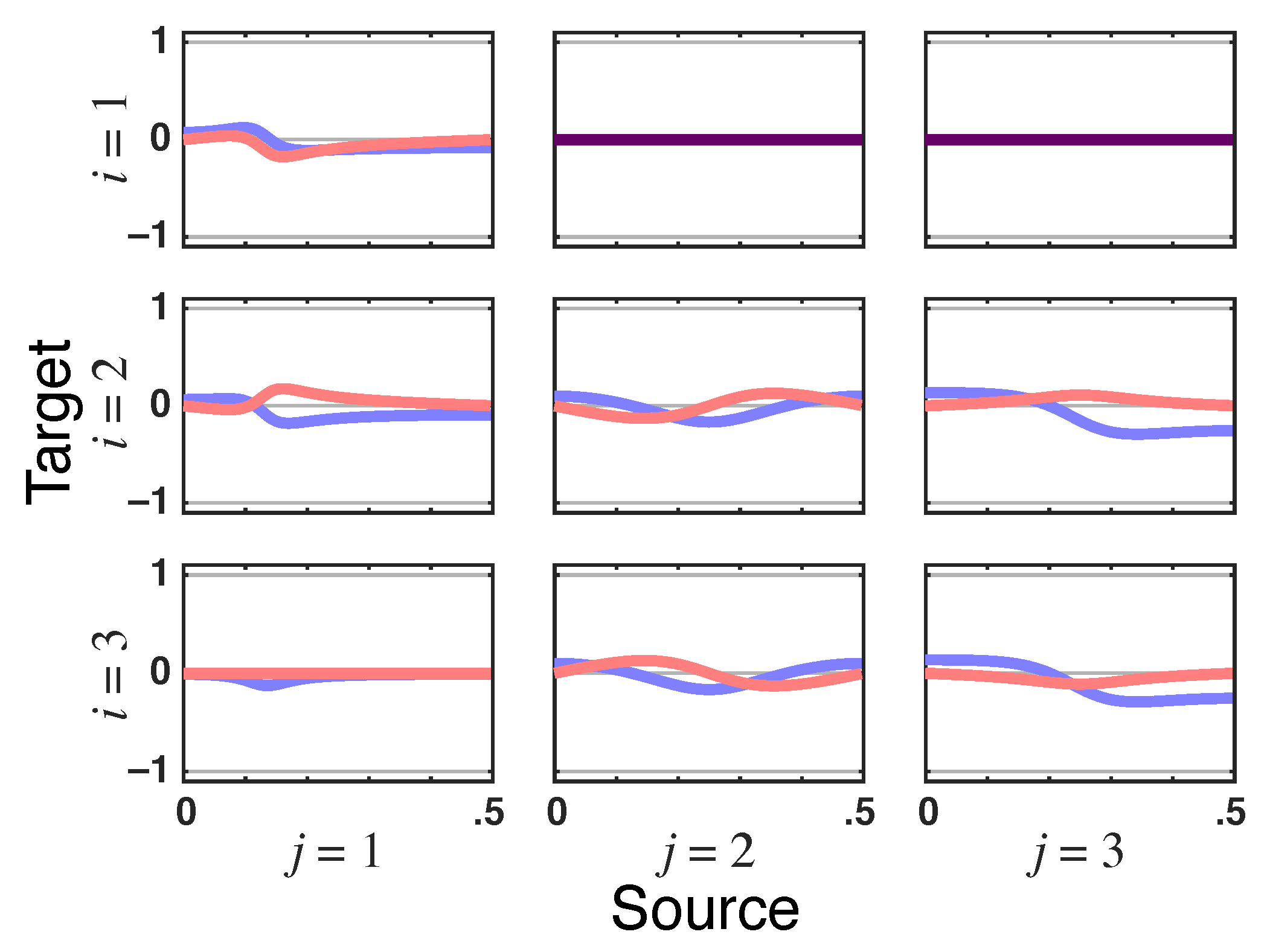
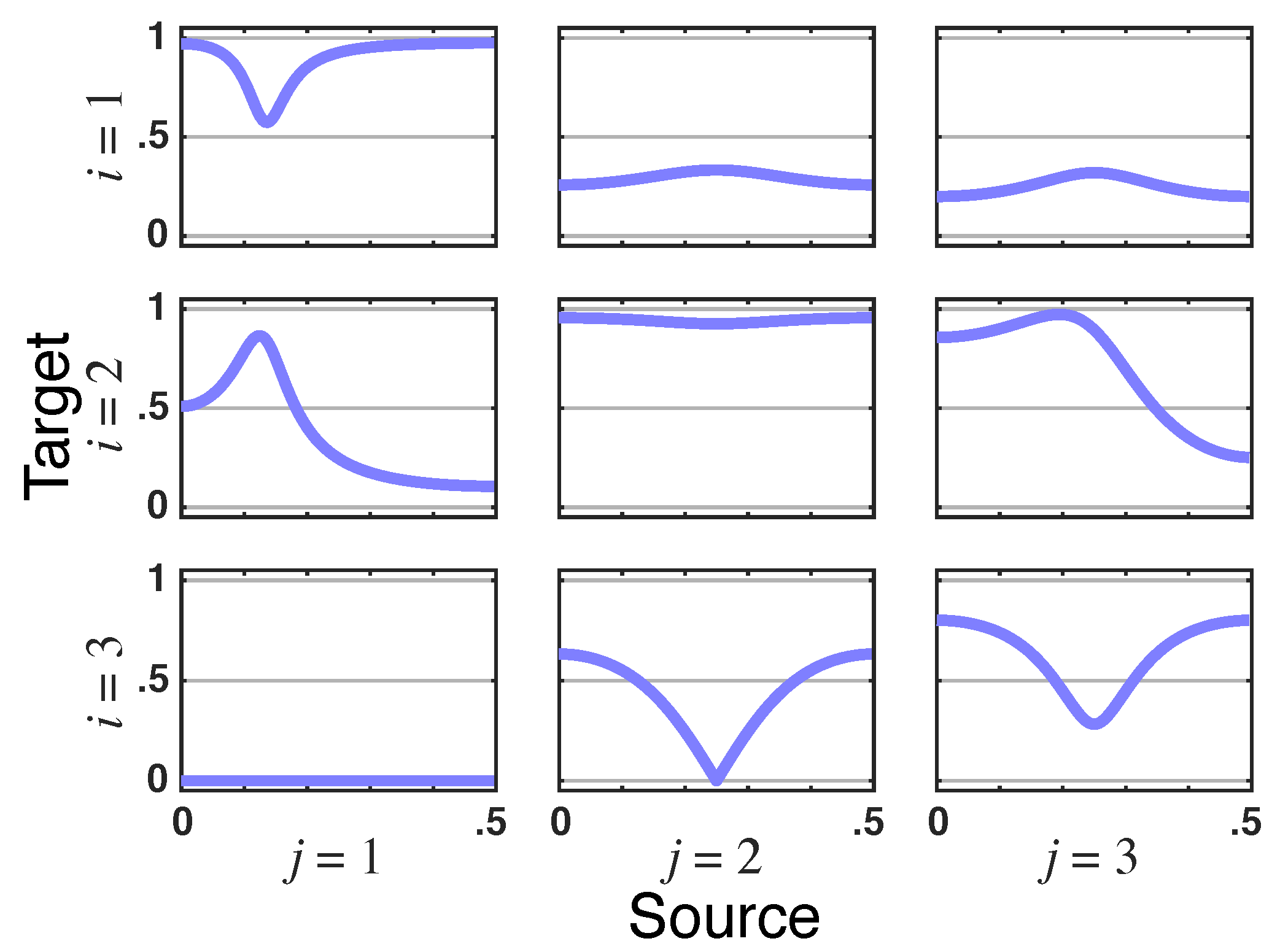
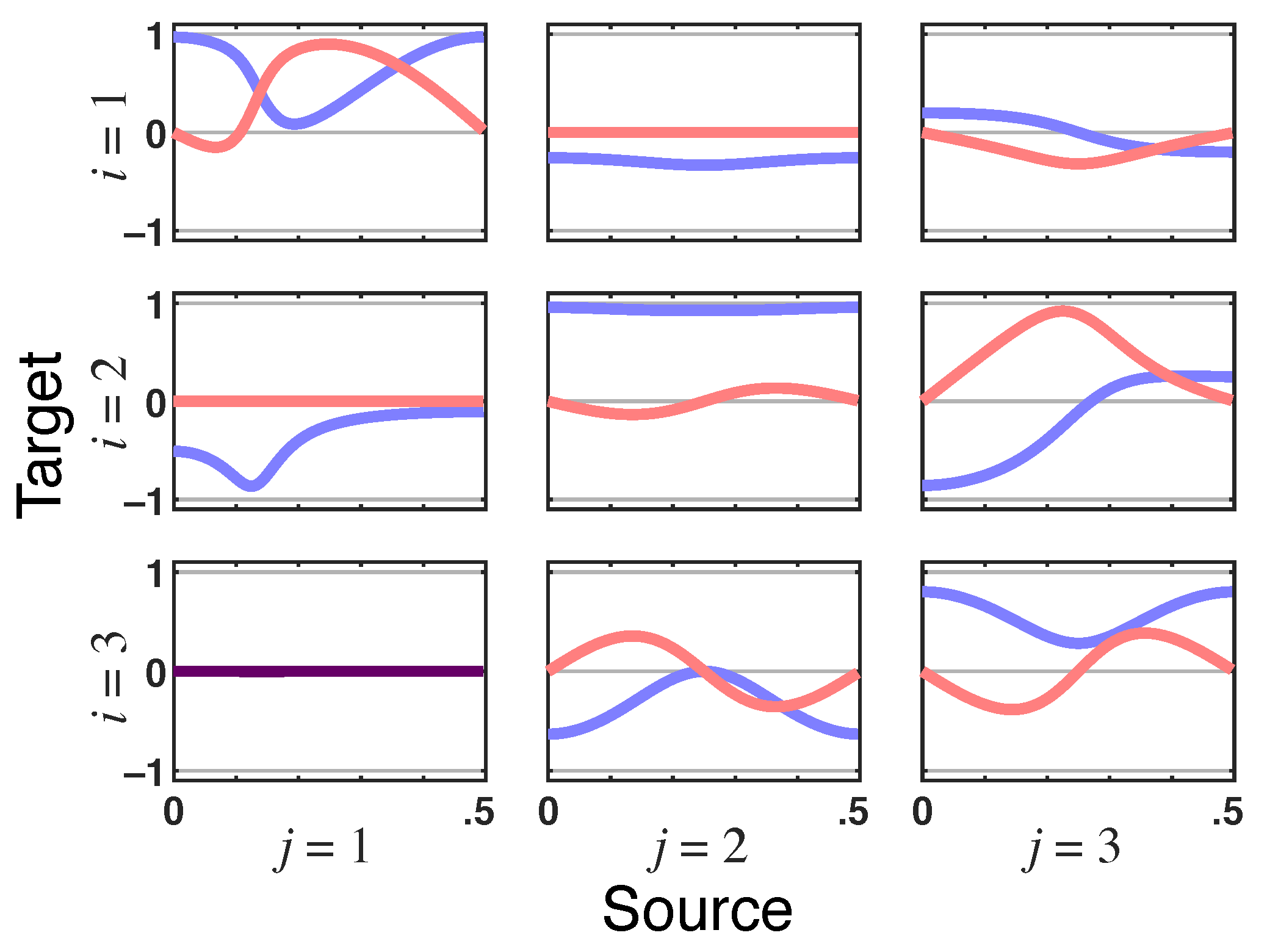
The various quantities are represented in the allied graphs showing that iPDC instantaneous effects require the joint presence of partial correlations in and the presence of immediate connections (see Figure 2). This conjunction only occurs from to . Likewise, iDTF instantaneous impacts require the existence of correlations in so that altered influentiability occurs from to but not in the opposite direction. Something similar also takes place when toward is examined but not in the reverse direction (see Figure 3). Example 2. To provide a clearer idea of iGC frequency domain repercussions for the same time domain characterization as summarized by we consider a set of four slightly different bivariate systems.
Example2.1Disconnected System
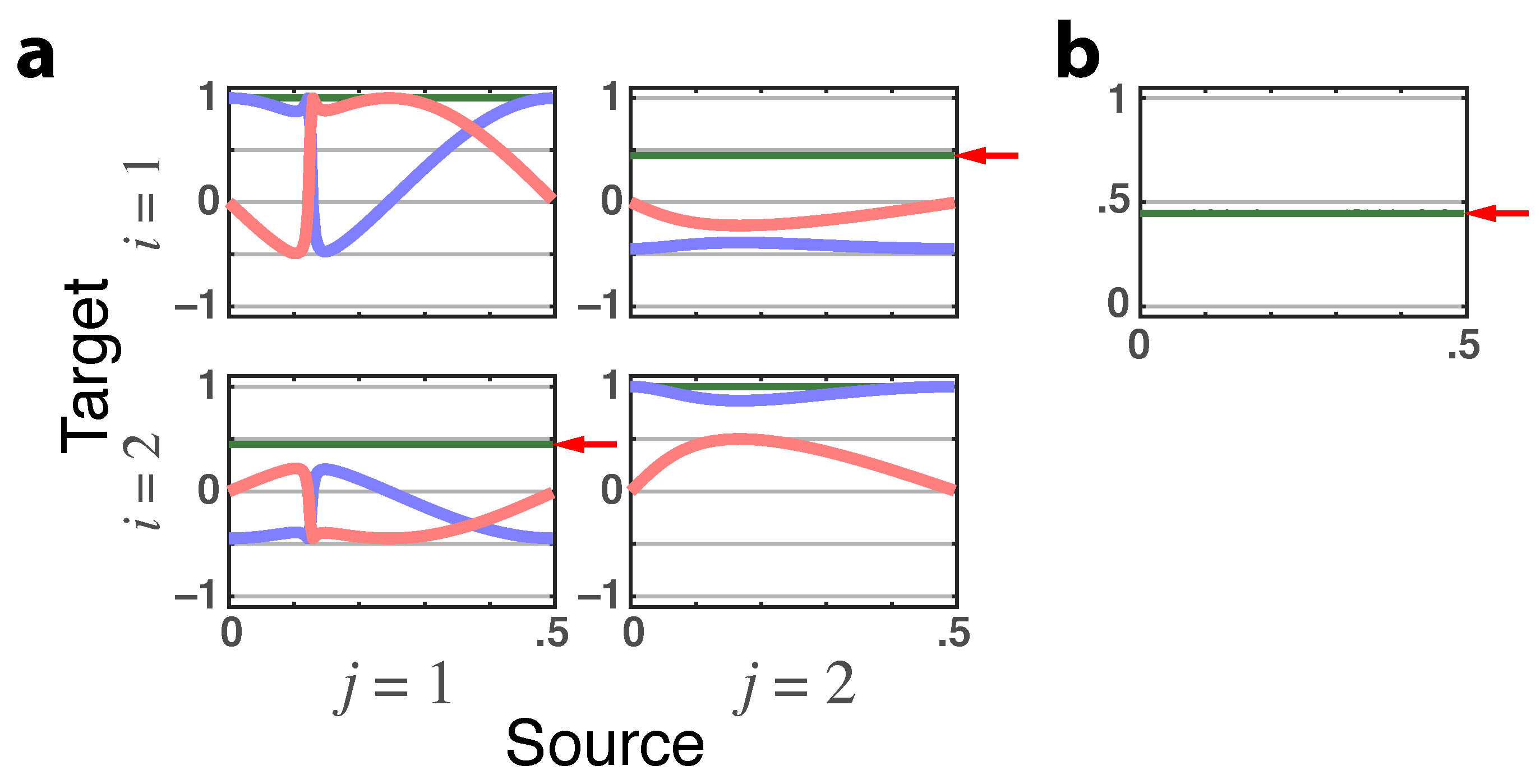
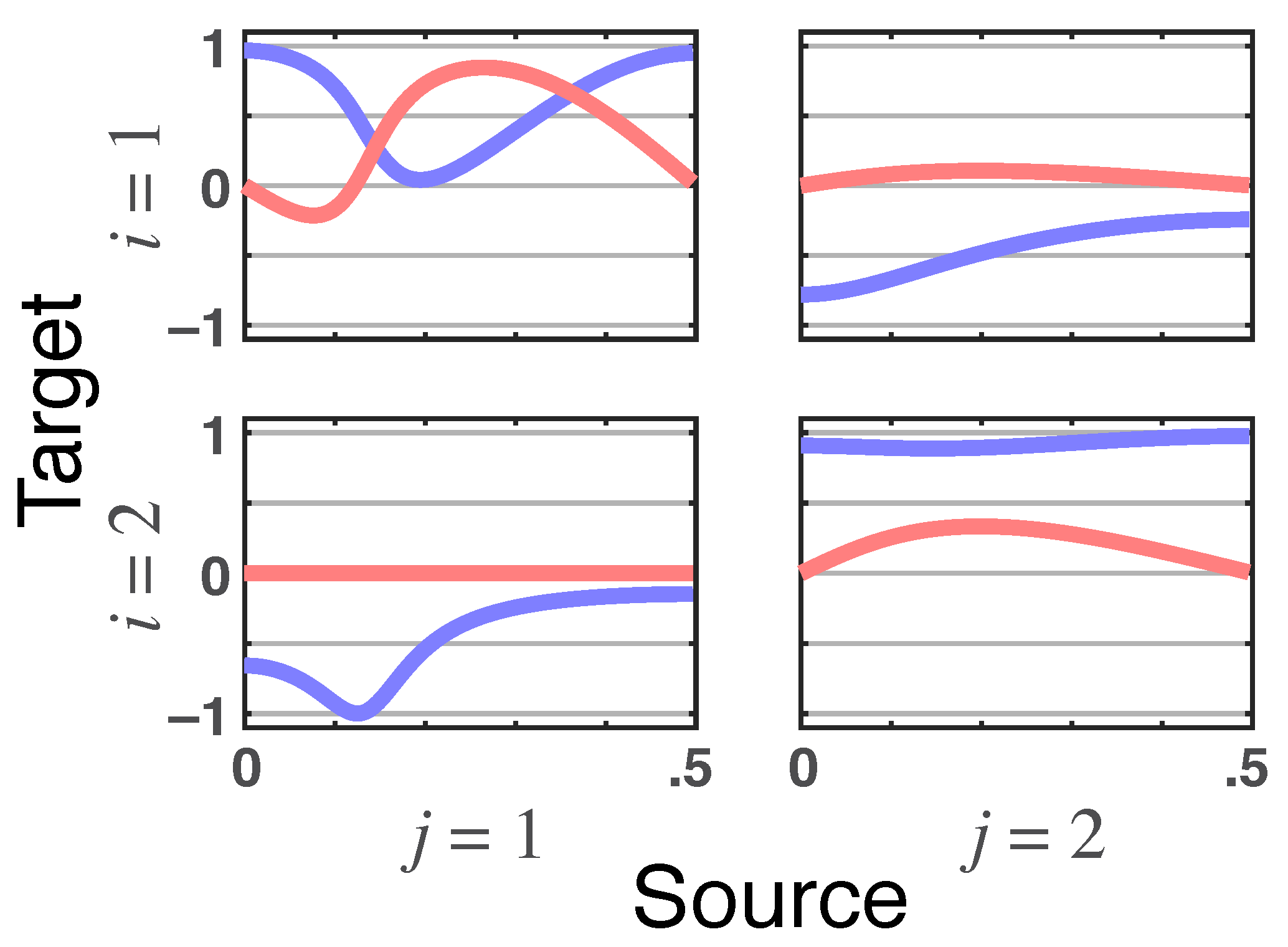
Let the simplest one be described by The observed total DTF/PDC are trivially equal to zero for , yet because of iGC as represented by (31), one sees that it manifests itself through a constant that, in turn, leads to a constant magnitude coherence of the same value as indicated by red arrows on Figure 4a,b. In fact, it is possible to show that absence of G-connectivity implies is constant. The converse, however, is not generally valid. The results are in accord with the absence of delayed effects between channels (no Granger causality).
Example2.2Unidirectional Granger Causality
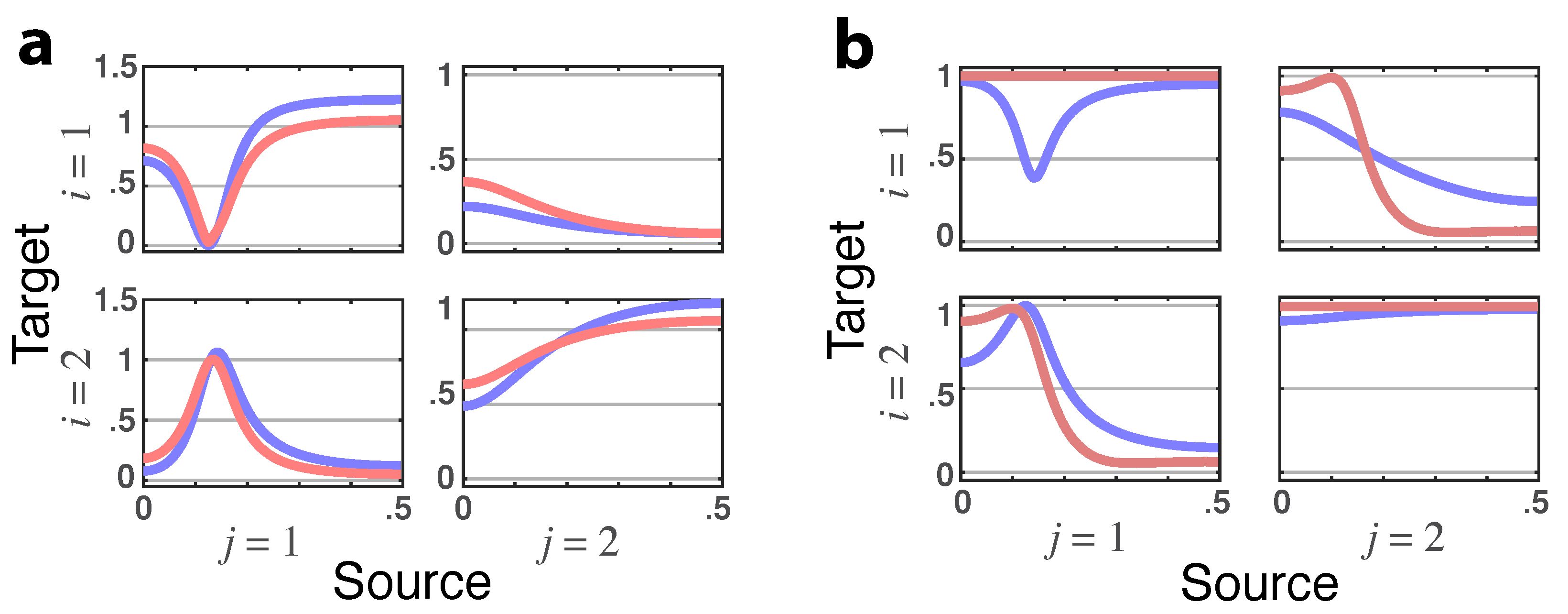
we obtain a total PDC that reflects this change and still detects the lack of feedback (Figure 5a). Furthermore, comparing to in Figure 5b, we see that the unidirectional effect of over is what solely determines the magnitude of the resulting partial coherence. Example2.3Instantaneous link between and .
Now consider the data generation model given by where are independent identically distributed zero mean innovation processes.
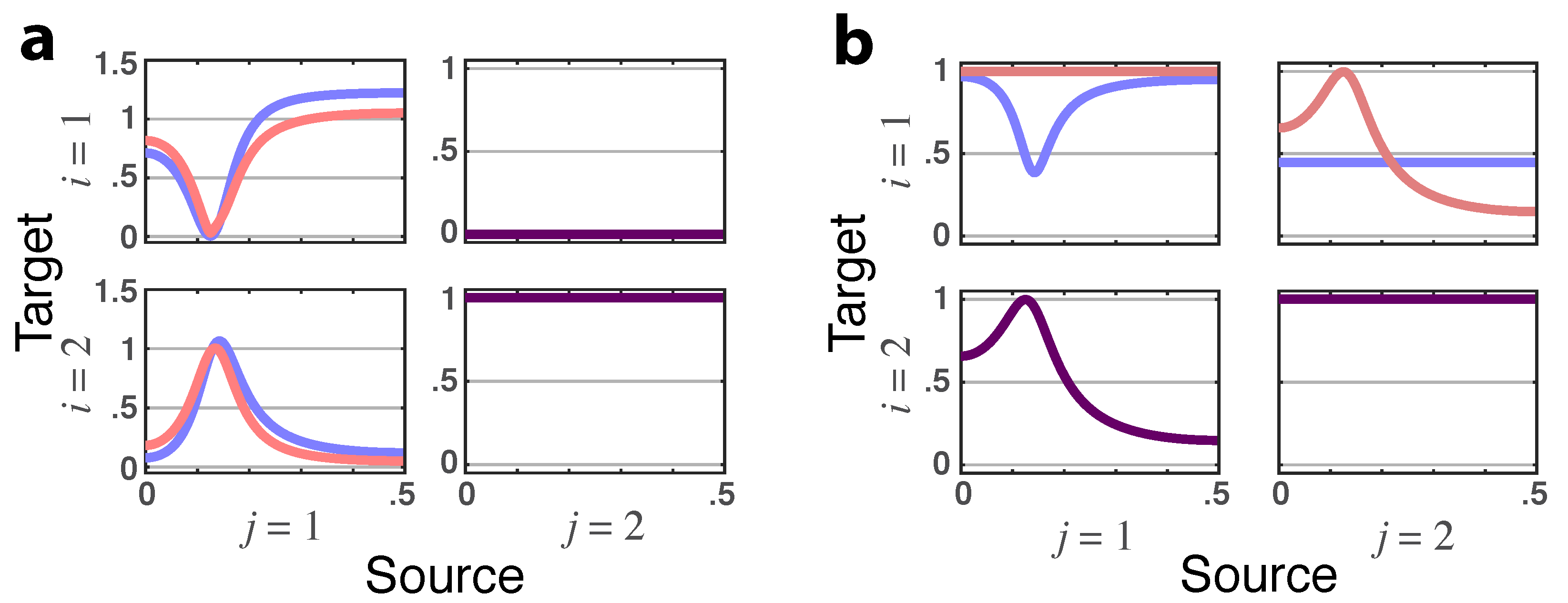
Under least squares estimation, (1) ideally results in the model given by whose residual covariance matrix is also given by (31). This is easy to show by inserting (35) into (36). The resulting total PDC is shown in Figure 6a (red lines) whereas the magnitude of (Figure 6b) is further broken into its real and imaginary parts in Figure 7, where again the nullity of the imaginary part of constitutes a signature of the delayless relationship between and . Again, because iPDC from to is zero, the partial coherence magnitude ().
Example2.4Bidirectional Feedback
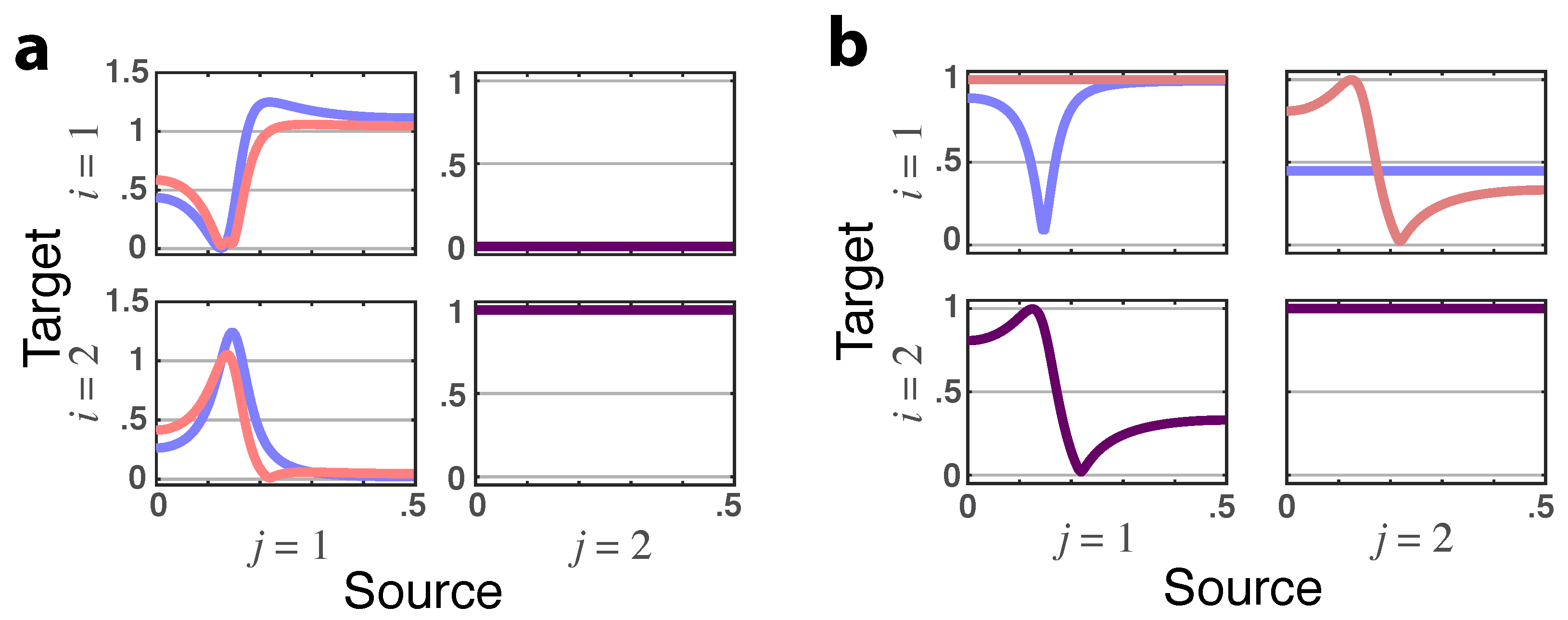
The introduction of a feedback into (35) leads to the total PDC in Figure 8a with the allied magnitude —latent directed instantaneous connectivity—in Figure 8b split into its real and imaginary parts in Figure 9 where the delayless to instantaneous description remains unaffected, while the partial coherence now depends on both directions. Example 3. This example is borrowed from [7] whose theoretically equivalent model (Figure 6.3a in [7]) as obtained by fitting (1) is given by: which leads to and rounded to two decimal digits.
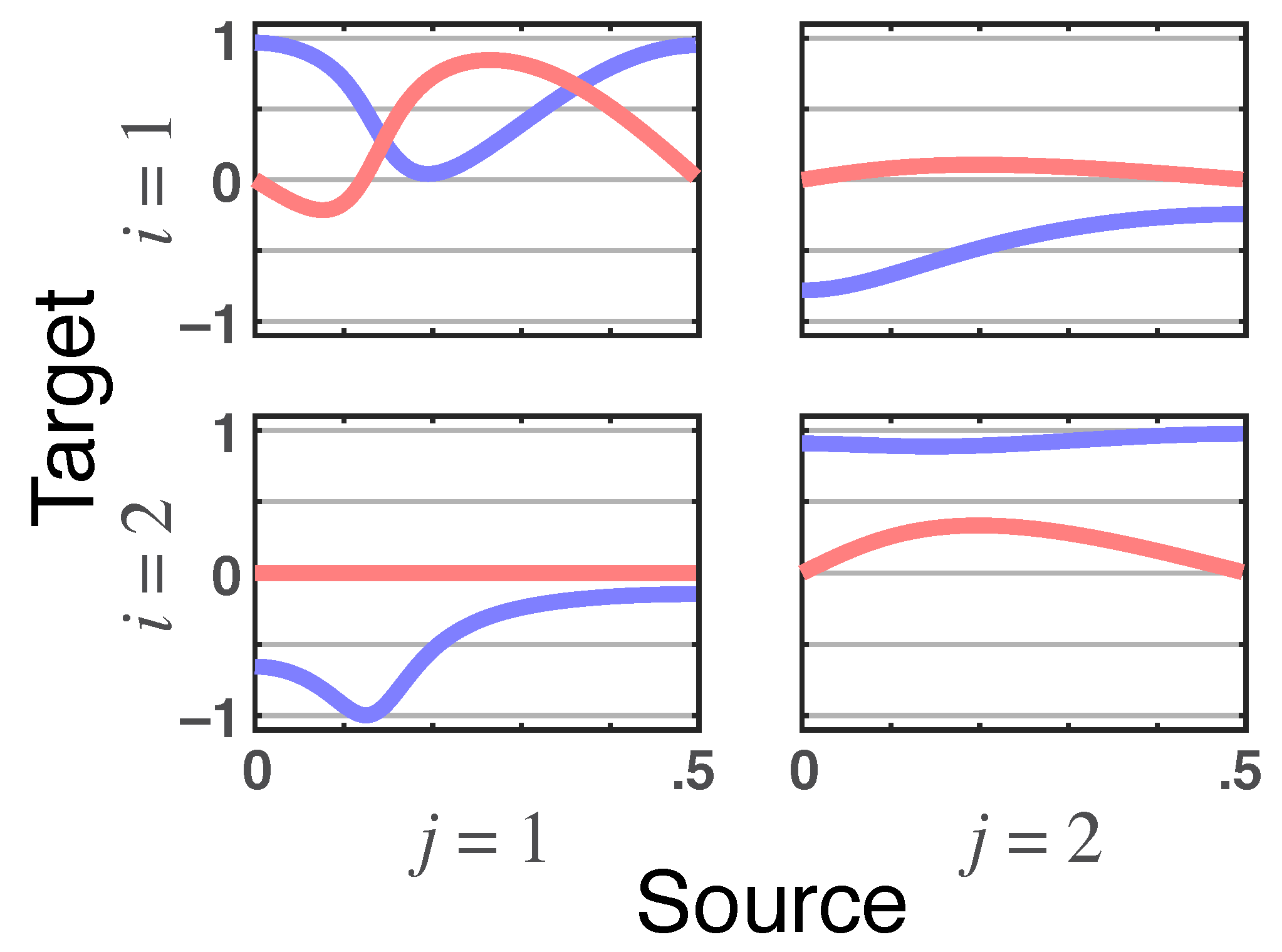
What stands out is that total PDC is identically zero for due to the presence of instantaneous Granger interactions (Figure 10). This nullity is consistent with the structure inferred in [7] when instantaneous quantities are considered by including a zero term lag in (1) (Figure 6.3b in [7]). This happens because —the residual directed PDC from —in (27) is of the opposite sign and instantaneously undoes the effect of iPDC ( as it too has no delay (look at the panel in Figure 11). Since the relationship of to is also instantaneous as portrayed by the nullity of the imaginary part of , it is clear that mediates this total PDC nullity from to . Note as well that (Figure 12). The instantaneous link from to is apparent in the nullity of the imaginary part of in Figure 13; note also the same nullity in , whose real part is also zero consistently with zero total PDC from to . Together, these observations lead to the conclusion that the relationship from to both and are instantaneous and mediated without delay, and that the one from must occur through since the total PDC from it to is zero.
5. Discussion
The present expanded formulation takes care of the problem frequently met in data analysis whose residuals in fitting (
1) result in being mutually correlated and its consequences.
By examining the decomposition of coherencies and partial coherencies in terms of the information versions of DTF and PDC [
9], we managed several things that lend the latter quantities a fundamental theoretical character.
The first such result was to show that the allied properly generalized total quantities enjoy the same kind of normalization as the original DTF/PDC [
3,
4] (DC/gPDC [
5,
13]). Likewise, the same ’inversion’ properties of the latter hold for the former when
. A key point in obtaining the present symmetry of treatment between DTF and PDC was iPDC’s rescaling (
15).
The second result is that of emphasizing the importance of the magnitude squared iDTF/iPDC in portraying, respectively, G-influentiability and G-connectivity that now allow an extended picture to be drawn: that of Granger instantaneous influentiability (G–iI) and connectivity (G–iC) by now considering the total DTF and total PDC, which are also directed quantities.
One important aspect as portrayed in Example 1 is that instantaneous directedness effects are due to the combined effect of non-zero off-diagonal terms and non-zero iDTF/iPDC.
Likewise the role of latent instantaneous iPDC (
21) permits the careful analysis of instances of instantaneous interaction as illustrated in Example 2.3 and Example 3.
Through Example 2, we learned that the very same time domain description of instantaneous Granger causality has quite a few distinct repercussions depending on the underlying G-connectivity that can only be properly described in the frequency domain.
When compared to other Granger dynamical characterizations that include instantaneous considerations, the present formulation has the advantage of dispensing with special model estimation approaches. No special model to include the
lag in (
1) is required with its more elaborate estimation considerations [
7]. Likewise, also unneeded are the estimations of multiple models as in [
8]. All that is required is a standard least squares model adjustment via (
1), wherefrom all conclusions can be drawn.
There is still much work ahead. Here, to keep focus, we have exclusively examined the details of
and
; when
, our next step is to examine the more general
case. Also needed now is the establishment of detailed asymptotic results for the newly introduced total quantities as are available for iDTF [
14] and iPDC [
15].