Abstract
The well-known Jarzynski equality, often written in the form , provides a non-equilibrium means to measure the free energy difference of a system at the same inverse temperature based on an ensemble average of non-equilibrium work W. The accuracy of Jarzynski’s measurement scheme was known to be determined by the variance of exponential work, denoted as . However, it was recently found that can systematically diverge in both classical and quantum cases. Such divergence will necessarily pose a challenge in the applications of Jarzynski equality because it may dramatically reduce the efficiency in determining . In this work, we present a deformed Jarzynski equality for both classical and quantum non-equilibrium statistics, in efforts to reuse experimental data that already suffers from a diverging . The main feature of our deformed Jarzynski equality is that it connects free energies at different temperatures and it may still work efficiently subject to a diverging . The conditions for applying our deformed Jarzynski equality may be met in experimental and computational situations. If so, then there is no need to redesign experimental or simulation methods. Furthermore, using the deformed Jarzynski equality, we exemplify the distinct behaviors of classical and quantum work fluctuations for the case of a time-dependent driven harmonic oscillator dynamics and provide insights into the essential performance differences between classical and quantum Jarzynski equalities.
1. Introduction
Work fluctuation theorems constitute one key topic in modern non-equilibrium statistical mechanics [1,2,3,4,5]. Of particular interest here is the Jarzynski equality (JE) [3], which links free energy differences at the same inverse temperature with the ensemble average of exponential work , where work W here refers to the inclusive form [1]. The JE holds regardless of the details of a specific work protocol, so long as the initial and final system configurations are fixed. JE has stimulated vast interests in theory and experiments because it gives a mean of direct measurement of free energy difference by a finite sampling of work values W. For N sampled work values, one obtains
This measurement scenario has been verified in a number of experiments for both classical and quantum systems [6,7,8,9,10,11,12,13,14,15,16].
Note that JE involves the ensemble of an exponential function of W. As such, rare events with large and negative W could dominate the sample average [17,18,19,20,21,22,23]. This motivated people to study the error of through and some important insights have been obtained. For example, assuming a given precision to be reached for , the corresponding required number of work realizations, N, can be estimated by the central limit theorem (CLT) from the variance of exponential work, i.e., . Intuitively, a larger requires more realizations to reach the same precision in predicting . Suppression of work fluctuations by some control mechanism is hence desirable before applying JE. For example, in [24,25] we studied some classical and quantum control scenarios in efforts to minimize .
Somewhat surprisingly, we recently found the possibility of obtaining a systematic divergence in in classical systems, as verified computationally in simple models isolated from a bath [26]. This divergence has immediate implications for the applicability of JE in measuring , but was seldom mentioned previously except in some general discussions made in [27] and a specific result on a one-dimensional gas undergoing an adiabatic work protocol [20]. That the divergence in is not accidental can be understood as follows. For systems where the principle of minimal work fluctuations [28] applies, if an adiabatic protocol yields a diverging , the same quantity is expected to diverge as well with increasing non-adiabaticity in the work protocols. We stress that a divergent makes CLT no longer applicable, and the converging rate of towards with respect to increasing N is not obvious. In one particular class of models [26], a generalized version of CLT indicates that the converging rate is much slower than the conventional scaling law. Instead, the error is found to scale as , with the scaling exponent being arbitrarily close to zero in extremely non-adiabatic cases. The lesson learned is that the average from experiments or simulations may barely converge to the expected value as N increases.
Our further study reveals even more severe divergence problems in quantum systems isolated from a bath [29]. This indicates that quantum effects can play a crucial role in work fluctuations. Quantum JE and classical JE can thus have much different domains for meaningful applications. For example, a work protocol could still lead to divergence in quantum even if its classical counterpart has a finite . In particular, as the temperature characterizing a quantum system initially at thermal equilibrium decreases, quantum effects become more appreciable and then tends to diverge purely due to nonclassical effects [29]. This finding should have an important impact on future experimental studies of the quantum JE.
Our early results hence motivate us to consider the following situation. Suppose an experiment or a computer simulation has been carried out, and the ensemble average based on finite sampling does not seem to converge. A further checking on the quantity hints that it is probably a diverging quantity as N increases. Given such a situation, is there a scheme to reprocess the data to extract useful predictions about equilibrium properties of the system (throughout this study, we assume no bath is involved during the work protocol)? The aim of this work is to give a partially positive answer to this question. We do so by deforming the definition of the physical work to some quantity tunable, which in turn then yields a deformed JE. So long as the variance of the exponential function of the newly defined quantity can be suppressed to a finite value, then the deformed JE will work effectively. We argue that our deformed JE proposed here is relevant to existing experiments [6,7,8,9,10,11,12,13,14,15,16] and computational methods [23,30,31,32] motivated by JE. As learned from our model studies, the deformed JE can eliminate the above-mentioned divergence issue in classical cases effectively, but may not work well in the deep quantum regime. This observation itself also exposes again the intrinsic difference between classical and quantum JEs in terms of their potential applications.
This paper is organized as follows. We propose in Section 2 a deformed classical JE. The model for illustration is a simple classical parametric harmonic oscillator (because such a model already suffices to show the divergence in ). In Section 3 we present a parallel deformed JE in the quantum domain and discuss why its usefulness is different from the classical version. Section 4 concludes this paper. Throughout, our notation follows closely our early studies [26,29].
2. Classical Deformed JE
2.1. General Discussion
We consider a general closed system whose Hamiltonian is given by , with phase space coordinates and a time-dependent control parameter . The protocol starts at and ends at , i.e., . Given an initial phase space coordinate as well as an arbitrary work protocol , the inclusive work [1] is obtained from
with being the final phase space coordinate. Note also that a proper gauge for the Hamiltonian is assumed here such that its value does equal to the energy of the system with no additional time-dependent gauge relying on [1]. Moreover (see below), we assume that this Hamiltonian is bounded from below while not being bounded from above. Let be the partition function with parameter and inverse temperature , which we assume to exist with . Then the JE, which is valid for any protocol , assumes the following form
Here represents taking average w.r.t. the initial Gibbs distribution . We also assume that this ensemble average itself does exist (which may not be always the case [33]). From the JE above, it is seen that over the initial Gibbs state (at inverse temperature ) will yield the same once and are fixed. It is also clear that, the variance of exponential work, namely, , can be readily obtained through the second moment ; i.e.,
To better illustrate the relation between classical and quantum cases, we choose to use the adiabatic invariant [34,35,36,37,38,39,40] as an analogue of a quantum number indexing quantum energy levels. The adiabatic invariant is defined as the phase space volume up to an energy E
where denotes the step function. Given that equals the positive valued integrated density of states, is monotonically growing with increasing energy E [41]; therefore, the inverse function of could be found from in principle. Equation (3) could be rewritten as
where and act like the initial and final “energy index” while is the transition probability between the states under a certain protocol, which is defined in [26] and is proven to be bi-stochastic. Note here that the lower bounds correspond to minimum of the lower bounded energy under fixed , . Likewise, Equation (5) can now be written as
One can note from Equation (8) that (and hence ) diverges if, for example, we have for all . To see this possibility clearly, consider an adiabatic work protocol applied to a system with a constant density of states, with . Then, because must be an adiabatic invariant, we have , or . Thus, if , diverges. One can then infer [28] that any nonadiabatic protocol under fixed and will also yield a diverging .
In order to overcome the divergence issue illustrated above, we now propose a deformed version of JE for not bounded from above. The main idea is to treat the statistics of an exponential function of (with if ) as a deformed W. Specifically, for an arbitrary value , we define as follows:
The motivation to introduce the g-factor is to make the quantity less negative as compared with W itself when it applies to transitions from high-energy initial states to low-energy final states. Then, for positive values (which is assumed throughout this study) [42], the exponential function would yield less dominating rare events and as a result, we hope that the variance in could be finite even when diverges [43].
Consider then the ensemble average of over the same initial Gibbs state as used in the standard JE. We have
In obtaning the second equality above we have used the bi-stochastic nature of . Equation (10) indicates the following useful deformed JE:
As seen from above, by calculating , we do not directly arrive at a free energy difference at the same inverse temperature . Rather, we would obtain a class of relations between the free energy at the inverse temperature and a free energy at inverse temperature . This result for the special case recovers the original JE. The potential benefit is that the second moment of , i.e.,
can be finite for a range of g values even if it diverges for .
In a typical classical experiment setup, the inclusive work W is usually measured along the work protocol in various ways [13,14,15,16]. So is it feasible that defined in Equation (9) can be indirectly measured along a classical trajectory? The answer is yes under certain conditions. We suppose that in an experiment each individual value of W is already measured. Then we may calculate as
if additionally the initial energy of each trajectory can be measured [44]. That is, our knowledge of the initial energy values is the additional cost we have to pay in order to process our experimental data through and . In addition, since all the initial energy values sampled from the Gibbs state are known, it is natural to assume that is already known. Then from Equation (11) we can obtain . Under these assumptions, we barely need to change an experiment setup to make use of our deformed JE. Note also that in non-equilibrium numerical simulations [19,27,30], the situation is even more obvious, because all the initial energy values of each sampling trajectory are by default registered in the simulations.
Let us now outline how to actually use our deformed JE for free energy measurements. We assume that the aim is to measure the free energy with being the target inverse temperature. As discussed above, this task may not be easily solved by use of JE because of the divergence in the second moment of exponential work. We hence first choose a trial g. Then, before applying a non-equilibrium work protocol, we prepare the system at thermal equilibrium at the inverse temperature . Finally, we use the relation
to obtain . We stress that the above procedure is mainly about a new way of reprocessing the experimental or simulation data, with experimental or simulation details untouched. Regarding the g value to be determined, it can be in a range of values so long as the second moment of is not too large. This would be most appreciated, when JE suffers from the efficiency issue due to a diverging . Next we illustrate the method by using the classical harmonic oscillator as an example to show how a proper choice of g indeed eliminates divergence in .
2.2. Classical Harmonic Oscillator
We investigate a 1-dimensional (1D) harmonic oscillator with angular frequency
The equilibrium partition function for this system is given by . The phase space volume is given by
and . Clearly, this system belongs to the class of systems with a constant density of states we used earlier for discussions. Work is done to the system as is forced to change with time, from to . Under an arbitrary time-dependent , the transition probability can be calculated analytically. Particularly, the transition probability under adiabatic driving is known to be [26], thus by choosing ,
Since adiabatic protocols minimize , we conclude all work protocols produce divergent as long as .
For an arbitrary non-adiabatic protocol, the transition probability can be calculated explicitly for the harmonic oscillator (see Appendix A) , yielding the following expression
Here, are dimensionless constants satisfying and , which are determined merely by the protocol . Equation (18) indicates that, given an initial , the final always fall in the interval . One can also verify the bi-stochastic property, i.e., . With Equation (18), the second moment of can be found from
The above inequality shows that if we choose ( a sufficient but not necessary condition), then becomes finite. For such g values, we can safely look into
whose second moment must be finite. We have thus offered an explicit example where the practical issue in applying JE due to a diverging second moment can be overcome by considering a deformed JE.
3. Deformed Quantum JE
3.1. General discussion
The inclusive work in quantum cases is obtained by two-time measurements [1], with
where and are the energies of projected eigenstates after measurements before and after the work protocol. With the initial canonical distribution and transition probability , the quantum JE can be obtained as follows:
where the bi-stochastic nature of , i.e., , has been used. The second moment in is given by
As shown recently [29], this quantum second moment can also diverge in systems with an infinite-dimensional Hilbert space. As a matter of fact, the divergence in the quantum case occurs more frequently than in the classical case.
Driven by the same motivation as outlined in Section 2, we now define the corresponding quantum as
According to the two-time measurement scheme of quantum work, the energy values of both the initial and final states need to be measured first. Hence, there is no problem in obtaining from Equation (24), based on known values of and . One may then proceed to treat the ensemble average of and arrives at
This deformed quantum JE assumes precisely the same form as our previous classical result summarized by Equation (10). Equation (11) hence also applies to the quantum case here. The corresponding second moment in is given by
It is hoped that by also choosing proper values of g, may merge as finite even when diverges. However, as we will show next, the situation in quantum cases can be much more challenging than in classical cases due to some intrinsic differences between classical and quantum state-to-state transition probabilities.
As a side note, in Appendix B we have also presented a deformed quantum Crooks relation [4] based on . This will also help us understand better quantum deformed JE while motivating more interests in possible extensions of known fluctuation theorems.
3.2. Quantum Harmonic Oscillator
A closed quantum harmonic oscillator is described by the following Hamiltonian
where is still changing with time under a general work protocol. For the quantum work statistics, it is convenient to examine the so-called characteristic function [1,29,45] , which is the Fourier transformation of the probability distribution function for . That is, we have
By choosing , we find (as a straightforward extension of the result for inclusive work W in [29])
where is the Husimi coefficient determined solely by the protocol [46]. The deviation of from unity describes the non-adiabaticity [46] of a work protocol. Note that the case of reproduces our previous result [29] for the standard quantum work characteristic function.
Because our previous work provides sufficient details regarding the precise quantum-classical correspondence in terms of in the high temperature limit [29], here we will not dive into the technical details regarding the quantum-classical correspondence for with . Instead, we just briefly mention that the quantum should also reduce to the corresponding classical distribution in the high temperature limit.
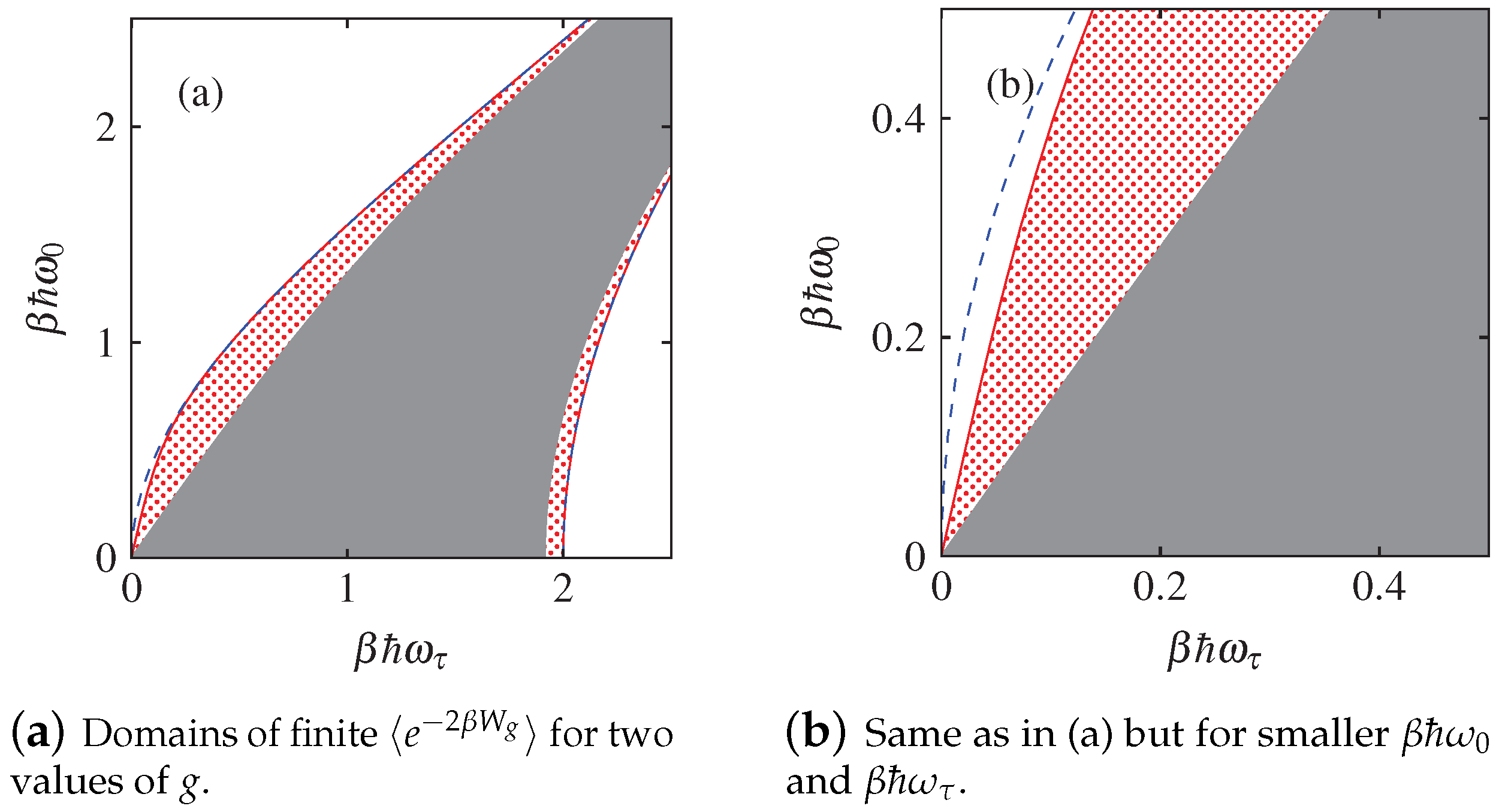
Remarkably though, the situation in the low temperature regime is much different. Figure 1 depicts the domain of finite for (grey area) and (grey area plus patterned area, with panel (b) focusing on cases with smaller values of and (hence more classical cases). Panel (b) clearly indicates that the use of has dramatically diminished the domain of divergence (white area) in . However, if we examine panel (a) featuring more quantum regimes (large values of and ), it is seen that does not achieve much in suppressing the divergence domain. We will explain this finding in the next subsection.
Figure 1.
Domains of convergence/divergence for under a sudden quench protocol from ω0 to ωτ, which is applied to a quantum harmonic oscillator. The Husimi coefficient is given by . Here and denote the initial and final dimensionless angular frequencies , of the oscillator scaled by , which is prepared initially at thermal equilibrium at the inverse temperature β. For g = 1, the second moment is finite only in the gray regime. For g = 0.1 the domain for finite has grown to include the (red) patterned regimes as well. The (blue) dashed line is given by Equation (34), independent of g. Note that this line almost exactly overlaps with the boundary of the (red) patterned domain in the lower right corner in (a). The part (b) depicts a zoom into the parameter regime of smaller dimensionless angular frequencies.
3.3. Persistent Divergence of
To gain analytical insights we stick with the quantum harmonic oscillator case. Without loss of generality, we will focus on the even-parity states. The transition probabilities between even-parity states under an arbitrary frequency-driving protocol are given by
We next look into the asymptotic behaviour of the transition probabilities between the initial th state to the final ground state () for very large i:
where we have used Stirling’s formula for very large n.
We are now ready to examine the contribution made by an individual transition to the second moment relevant to applications of the standard JE. It is found to be
Clearly, even this individual contribution diverges with increasing i if the following condition is met:
Dramatically, such a diverging contribution to has no classical analog. Indeed, according to Equation (18), the classical transition probability from an initial highly excited state to a final low energy state is always strictly zero. That is, it is the quantum non-vanishing transition probabilities that open ups a possibility for highly rare transitions to make contributions to exponential work fluctuations. Put differently, the nonzero quantum transition probability , though decreasing very fast with increasing i, can nevertheless make a diverging contribution to due to the exponential increasing factor arising from negative work values. As a consequence, the more rare the initial state sampled from the Gibbs distribution is, the more it contributes to . This mechanism for quantum divergence in the second moment of exponential work can take effect, irrespective of whether or not the corresponding classical second moment of exponential work is finite. This uncovers the potential difficulty in applying the standard quantum JE without first suppressing quantum work fluctuations [29].
Inspecting the parallel situation for reveals a similar problem. The contribution made by the to is given by
This expression is essentially the same as Equation (33), except for some irrelevant factors. Thus, we can again conclude that no matter what the g value is, diverges under the condition of Equation (34). This observation has important implications. Specifically, within the domain specified by Equation (34), the second moment always diverges, regardless of our choice of the g values. This theoretical insight is confirmed by our computational results in Figure 1. In particular, from Figure 1 it is seen that upon introducing , the enlarged domain for finite cannot go beyond the dashed line. Figure 1 in connection with the quantum divergence domain beyond the dashed line also shows that, closer to the quantum regime (larger values of and ), most of the quantum divergence domain is occupied by the divergence domain determined by the above simple insight focusing on transitions from highly excited states to a single ground state. Thus, most of the quantum divergence domain shown in Figure 1a cannot be removed by considering . Given this insight, we note that closer to the classical regime, the divergence in can occur outside the domain given by Equation (34) (for example, due to many other classical-like transitions). For the latter cases, is effective in removing divergences (see Figure 1b).
4. Conclusions
Exponential work fluctuations characterized by or may systematically diverge [26,29]. This presents an obstacle for a direct application of JE without effectively suppressing work fluctuations. To meet this challenge in connecting non-equilibrium statistics with equilibrium properties, we propose in this work a deformed work expression, denoted as and obtained deformed JE for both classical and quantum cases. This deformed JE is based on an ensemble average of exponential quantities and connects this average with free energy values at different temperatures. Using the parametric harmonic oscillator as a test example, we show that the classical deformed JE exhibits improved convergence features as compared to the case with the standard JE (with ), because a possible divergent second moment can be be rendered convergent (i.e., finite) by a proper choice of . This tailored modification does not require a different design of simulation methods, but constitutes a beneficial possibility to reprocess the experimental data based on a finite number of work realizations, yielding better performance. As to the quantum deformed JE, it is shown that its performance may not be improved as effectively as compared with the standard quantum JE. This is because the divergence in may not be lifted by introducing a reduced positive g value smaller than unity. This feature reflects a fundamental difference between classical and quantum work statistics over exponential work functions. While in classical cases, state-to-state transition probabilities can have very sharp cutoffs suppressing effectively the contributions from rare events; the state-to-state transition probabilities in quantum cases, though already exponentially suppressed, are not cut off sharply enough and can still create a scenario where more rare events make even larger contributions to . These findings indicate that the efficiency of employing the quantum (standard or deformed) JE in predicting equilibrium properties is more limited than in the classical regime. Given the insights gained from this study, it may serve as an inspiration to seek other variants of deformed JEs and to apply those to different physical quantities that intrinsically make use of the conventional JE, classical or in its quantum form [47,48,49,50,51,52,53,54].
Acknowledgments
Jiangbin Gong is supported by Singapore Ministry of Education Academic Research Fund Tier-2 project (Project No. MOE2014-T2-2-119 with WBS No. R-144-000-350-112). Peter Hanggi also acknowledges support by the Singapore Ministry of Education and the National Research Foundation of Singapore.
Author Contributions
Jiangbin Gong planned research; Jiawen Deng, Juan D Jaramillo, Peter Hanggi and Jiangbin Gong performed research. All authors contributed extensively to the analysis of the results and to the writing of the paper. All authors have read and approved the final manuscript.
Conflicts of Interest
The authors declare no conflict of interest.
Appendix A. Transition Probabilities for Classical Harmonic Oscillator
As discussed in the main text, we consider the classical harmonic oscillator with a general time-dependent angular frequency , whose Hamiltonian is given by
The phase space volume as defined in the main text is given by
with any at fixed time t.
We define the transition probabilities as in [26]:
where denotes the time evolution starting with and ending at , while represents the density of states. is also the normalization constant for a micro-canonical ensemble at , with
Note that here there is no essential difference between using and using E for a harmonic oscillator. We however still stick to using since this notation is general.
To evaluate Equation (A3) we examine the time evolution during
where X, Y represent two special solutions satisfying and [46]. X, Y are independent of due to the fact that the equations of motion are linear. Let
Equation (A3) then becomes
where and , and
is a symmetric matrix. Diagonalizing M yields
where
is diagonal with and O is an orthogonal matrix. Note also that M is positive definite, therefore . One can further show that by noticing that throughout the protocol. With these results, Equation (A7) becomes
by letting . We next replace by as a change of integration variables, we obtain
For , we require
Under this condition we arrive at
One can then also verify the following bi-stochastic condition
Appendix B. Deformed Crooks Relation
Consider the forward characteristic function of work,
where,
Substituting Equation (A15) into Equation (A14), one has
Further,
where in the last line we have simultaneously multiplied by . Identifying the following Gibbs distribution at inverse temperature as
and using , we end up with
Observing that
we find
Likewise we obtain
Consequently we have the relation that
After Fourier transform in both sides, one obtains the Crooks relations. Indeed, for the LHS of (A23)
while for the RHS of (A23),
Therefore, (A23) can be written as
This result then coincides with the standard Crooks relation for .
References and Notes
- Campisi, M.; Hänggi, P.; Talkner, P. Colloquium: Quantum fluctuation relations: Foundations and applications. Rev. Mod. Phys. 2011, 83, 771–791. [Google Scholar] [CrossRef]
- Bochkov, G.N.; Kuzovlev, Y.E. General theory of thermal fluctuations in nonlinear systems. Zh. Eksp. Teor. Fiz. 1977, 72, 238–247. [Google Scholar]
- Jarzynski, C. Nonequilibrium Equality for Free Energy Differences. Phys. Rev. Lett. 1997, 78, 2690–2693. [Google Scholar] [CrossRef]
- Crooks, G.E. Entropy production fluctuation theorem and the nonequilibrium work relation for free energy differences. Phys. Rev. E 1999, 60, 2721–2726. [Google Scholar] [CrossRef]
- Hänggi, P.; Talkner, P. The other QFT. Nat. Phys. 2015, 11, 108–110. [Google Scholar] [CrossRef]
- An, S.; Zhang, J.N.; Um, M.; Lv, D.; Lu, Y.; Zhang, J.; Yin, Z.Q.; Quan, H.T.; Kim, K. Experimental test of the quantum Jarzynski equality with a trapped-ion system. Nat. Phys. 2015, 11, 193–199. [Google Scholar] [CrossRef]
- Dudko, O.K.; Hummer, G.; Szabo, A. Intrinsic Rates and Activation Free Energies from Single-Molecule Pulling Experiments. Phys. Rev. Lett. 2006, 96, 108101. [Google Scholar] [CrossRef] [PubMed]
- Batalhão, T.B.; Souza, A.M.; Mazzola, L.; Auccaise, R.; Sarthour, R.S.; Oliveira, I.S.; Goold, J.; De Chiara, G.; Paternostro, M.; Serra, R.M. Experimental Reconstruction of Work Distribution and Study of Fluctuation Relations in a Closed Quantum System. Phys. Rev. Lett. 2014, 113, 140601. [Google Scholar] [CrossRef] [PubMed]
- Huber, G.; Schmidt-Kaler, F.; Deffner, S.; Lutz, E. Employing Trapped Cold Ions to Verify the Quantum Jarzynski Equality. Phys. Rev. Lett. 2008, 101, 070403. [Google Scholar] [CrossRef] [PubMed]
- Harris, N.C.; Song, Y.; Kiang, C.H. Experimental Free Energy Surface Reconstruction from Single-Molecule Force Spectroscopy using Jarzynski’s Equality. Phys. Rev. Lett. 2007, 99, 068101. [Google Scholar] [CrossRef] [PubMed]
- Hummer, G.; Szabo, A. Free energy reconstruction from nonequilibrium single-molecule pulling experiments. Proc. Natl. Acad. Sci. USA 2001, 98, 3658–3661. [Google Scholar] [CrossRef] [PubMed]
- Alemany, A.; Mossa, A.; Junier, I.; Ritort, F. Experimental free-energy measurements of kinetic molecular states using fluctuation theorems. Nat. Phys. 2012, 8, 688–694. [Google Scholar] [CrossRef]
- Douarche, F.; Ciliberto, S.; Petrosyan, A.; Rabbiosi, I. An experimental test of the Jarzynski equality in a mechanical experiment. EPL 2005, 70, 593. [Google Scholar] [CrossRef]
- Liphardt, J.; Dumont, S.; Smith, S.B.; Tinoco, I.; Bustamante, C. Equilibrium Information from Nonequilibrium Measurements in an Experimental Test of Jarzynski’s Equality. Science 2002, 296, 1832–1835. [Google Scholar] [CrossRef] [PubMed]
- Blickle, V.; Speck, T.; Helden, L.; Seifert, U.; Bechinger, C. Thermodynamics of a Colloidal Particle in a Time-Dependent Nonharmonic Potential. Phys. Rev. Lett. 2006, 96, 070603. [Google Scholar] [CrossRef] [PubMed]
- Perišić, O. Pulling-spring modulation as a method for improving the potential-of-mean-force reconstruction in single-molecule manipulation experiments. Phys. Rev. E 2013, 87, 013303. [Google Scholar] [CrossRef] [PubMed]
- Jarzynski, C. Rare events and the convergence of exponentially averaged work values. Phys. Rev. E 2006, 73, 046105. [Google Scholar] [CrossRef] [PubMed]
- Halpern, N.Y.; Jarzynski, C. Number of trials required to estimate a free-energy difference, using fluctuation relations. Phys. Rev. E 2016, 93, 052144. [Google Scholar] [CrossRef] [PubMed]
- Zuckerman, D.M.; Woolf, T.B. Theory of a Systematic Computational Error in Free Energy Differences. Phys. Rev. Lett. 2002, 89, 180602. [Google Scholar] [CrossRef] [PubMed]
- Lechner, W.; Dellago, C. On the efficiency of path sampling methods for the calculation of free energies from non-equilibrium simulations. J. Stat. Mech. Theory Exp. 2007, 2007, P04001. [Google Scholar] [CrossRef]
- Lechner, W.; Oberhofer, H.; Dellago, C.; Geissler, P.L. Equilibrium free energies from fast-switching trajectories with large time steps. J. Chem. Phys. 2006, 124, 044113. [Google Scholar] [CrossRef] [PubMed]
- Hartmann, A.K. High-precision work distributions for extreme nonequilibrium processes in large systems. Phys. Rev. E 2014, 89, 052103. [Google Scholar] [CrossRef] [PubMed]
- Daura, X.; Affentranger, R.; Mark, A.E. On the Relative Merits of Equilibrium and Non-Equilibrium Simulations for the Estimation of Free-Energy Differences. Chem. Phys. Chem. 2010, 11, 3734–3743. [Google Scholar] [CrossRef] [PubMed]
- Deng, J.; Wang, Q.; Liu, Z.; Hänggi, P.; Gong, J. Boosting work characteristics and overall heat-engine performance via shortcuts to adiabaticity: Quantum and classical systems. Phys. Rev. E 2013, 88, 062122. [Google Scholar] [CrossRef] [PubMed]
- Xiao, G.; Gong, J. Suppression of work fluctuations by optimal control: An approach based on Jarzynski equality. Phys. Rev. E 2014, 90, 052132. [Google Scholar] [CrossRef] [PubMed]
- Deng, J.; Tan, A.M.; Hänggi, P.; Gong, J. Merits and qualms of work fluctuations in classical fluctuation theorems. Phys. Rev. E 2017, 95, 012106. [Google Scholar] [CrossRef] [PubMed]
- Zuckerman, D.M.; Woolf, T.B. Systematic Finite-Sampling Inaccuracy in Free Energy Differences and Other Nonlinear Quantities. J. Stat. Phys. 2004, 114, 1303–1323. [Google Scholar] [CrossRef]
- Xiao, G.; Gong, J. Principle of minimal work fluctuations. Phys. Rev. E 2015, 92, 022130. [Google Scholar] [CrossRef] [PubMed]
- Jaramillo, J.D.; Deng, J.; Gong, J. Quantum Work Fluctuations in connection with Jarzynski Equality. arXiv, 2017; arXiv:1701.07603. [Google Scholar]
- Dellago, C.; Hummer, G. Computing Equilibrium Free Energies Using Non-Equilibrium Molecular Dynamics. Entropy 2014, 16, 41–61. [Google Scholar] [CrossRef]
- Pohorille, A.; Jarzynski, C.; Chipot, C. Good Practices in Free-Energy Calculations. J. Phys. Chem. B 2010, 114, 10235–10253. [Google Scholar] [CrossRef] [PubMed]
- Latorre, J.C.; Hartmann, C.; Schütte, C. Free energy computation by controlled Langevin dynamics. Procedia Comput. Sci. 2010, 1, 1597–1606. [Google Scholar] [CrossRef]
- Yi, J.; Kim, Y.W.; Talkner, P. Work fluctuations for Bose particles in grand canonical initial states. Phys. Rev. E 2012, 85, 051107. [Google Scholar] [CrossRef] [PubMed]
- Berdichevskii, V. The connection between thermodynamic entropy and probability. J. Appl. Math. Mech. 1988, 52, 738–746. [Google Scholar] [CrossRef]
- Brown, R.; Ott, E.; Grebogi, C. Ergodic adiabatic invariants of chaotic systems. Phys. Rev. Lett. 1987, 59, 1173–1176. [Google Scholar] [CrossRef] [PubMed]
- Brown, R.; Ott, E.; Grebogi, C. The goodness of ergodic adiabatic invariants. J. Stat. Phys. 1987, 49, 511–550. [Google Scholar] [CrossRef]
- Ott, E. Goodness of Ergodic Adiabatic Invariants. Phys. Rev. Lett. 1979, 42, 1628–1631. [Google Scholar] [CrossRef]
- Kasuga, T. On the adiabatic theorem for the Hamiltonian system of differential equations in the classical mechanics, I. Proc. Japan Acad. 1961, 37, 366–371. [Google Scholar] [CrossRef]
- Kasuga, T. On the adiabatic theorem for the Hamiltonian system of differential equations in the classical mechanics, II. Proc. Japan Acad. 1961, 37, 372–376. [Google Scholar] [CrossRef]
- Kasuga, T. On the adiabatic theorem for the Hamiltonian system of differential equations in the classical mechanics, III. Proc. Japan Acad. 1961, 37, 377–382. [Google Scholar] [CrossRef]
- Here we assume that the density of states and thus Ω(E,λ) is not growing in energy exponentially, as otherwise the free energy would not excist at sufficiently large temperature β → 0.
- Hänggi, P.; Hilbert, S.; Dunkel, J. Meaning of temperature in different thermostatistical ensembles. Phil. Trans. R. Soc. A 2016, 374, 20150039. [Google Scholar] [CrossRef] [PubMed]
- Heuristically, divergent e−2βW is a consequence of negative work W < 0.Because we assume the system to be lower bounded but not upper bounded, then choosing implies for large Ωτ, therefore suppressing the emergence of negative work.
- For example this is feasible for the class of single particle Hamiltonians of known structure (e.g., set of harmonic oscillators) with their mutual interaction being switched on via the control parameter λ(t) only for times t ≥ 0+.
- Talkner, P.; Lutz, E.; Hänggi, P. Fluctuation theorems: Work is not an observable. Phys. Rev. E 2007, 75, 050102. [Google Scholar] [CrossRef] [PubMed]
- Husimi, K. Miscellanea in Elementary Quantum Mechanics, I. Prog. Theor. Phys. 1953, 9, 238–244. [Google Scholar] [CrossRef]
- Deffner, S.; Lutz, E. Nonequilibrium Entropy Production for Open Quantum Systems. Phys. Rev. Lett. 2011, 107, 140404. [Google Scholar] [CrossRef] [PubMed]
- Kafri, D.; Deffner, S. Holevo’s bound from a general quantum fluctuation theorem. Phys. Rev. A 2012, 86, 044302. [Google Scholar] [CrossRef]
- Allahverdyan, A.E. Nonequilibrium quantum fluctuations of work. Phys. Rev. E 2014, 90, 032137. [Google Scholar] [CrossRef] [PubMed]
- Fusco, L.; Pigeon, S.; Apollaro, T.J.G.; Xuereb, A.; Mazzola, L.; Campisi, M.; Ferraro, A.; Paternostro, M.; De Chiara, G. Assessing the Nonequilibrium Thermodynamics in a Quenched Quantum Many-Body System via Single Projective Measurements. Phys. Rev. X 2014, 4, 031029. [Google Scholar] [CrossRef]
- Watanabe, G.; Venkatesh, B.P.; Talkner, P.; Campisi, M.; Hänggi, P. Quantum fluctuation theorems and generalized measurements during the force protocol. Phys. Rev. E 2014, 89, 032114. [Google Scholar] [CrossRef] [PubMed]
- Watanabe, G.; Venkatesh, B.P.; Talkner, P. Generalized energy measurements and modified transient quantum fluctuation theorems. Phys. Rev. E 2014, 89, 052116. [Google Scholar] [CrossRef] [PubMed]
- Talkner, P.; Hänggi, P. Aspects of quantum work. Phys. Rev. E 2016, 93, 022131. [Google Scholar] [CrossRef] [PubMed]
- Perarnau-Llobet, M.; Bäumer, E.; Hovhannisyan, K.V.; Huber, M.; Acin, A. No-Go Theorem for the Characterization of Work Fluctuations in Coherent Quantum Systems. Phys. Rev. Lett. 2017, 118, 070601. [Google Scholar] [CrossRef] [PubMed]
© 2017 by the authors. Licensee MDPI, Basel, Switzerland. This article is an open access article distributed under the terms and conditions of the Creative Commons Attribution (CC BY) license (http://creativecommons.org/licenses/by/4.0/).