You are currently viewing a new version of our website. To view the old version click .
  • Article
  • Open Access

20 February 2021

Pricing and Profit Management Models for SaaS Providers and IaaS Providers


School of Computer Sciences, College of Business and Technology, Western Illinois University, Macomb, IL 61455, USA

Abstract

Cloud computing has rapidly penetrated enterprise and user computing markets with three prominent service models: software as a service (SaaS), platform as a service (PaaS), and infrastructure as a service (IaaS). Cloud computing has also proven to be one of the most important environmentally sustainable technological innovations in the year of Industrial Revolution 4.0. While SaaS and IaaS are the two largest revenue generating services in the cloud service market, the pricing and profit generating mechanisms of the SaaS and IaaS providers have not yet been well understood. Unless the SaaS providers’ profit-maximizing decision is considered, any pricing decision by the IaaS providers is likely to be suboptimal. Hence, this paper proposes a Stackelberg game pricing decision model with the aim of maximizing the profit of the IaaS provider, given the best response of the SaaS provider. This paper develops an analytical closed-form solution to the pricing problem and presents sensitivity analyses to give valuable insights into the pricing dynamics and negotiation between the SaaS provider and IaaS provider. Finally, implications of these findings and future research directions are discussed.

1. Introduction

Cloud computing is one of the most paradigm-shifting Internet technology developments. With the development of hyper-speed Internet, cloud computing has become the central computing resource in almost every industry. Cloud computing makes it possible for companies to use IT resources as a service without upfront investment costs, and is expected to grow at a rapid speed primarily because of the flexibility to satisfy fluctuating demands [1,2]. Cloud computing has the potential to shift business to business (B2B) e-commerce toward more open, loosely-coupled electronic exchanges [3]. Additionally, countries around the world have been adopting new energy-efficient technologies that help create a more sustainable economy [4]. Cloud computing is energy efficient and an environmentally sustainable innovation that offers rich opportunities for innovating existing services and introducing creative new ones [5]. Cloud computing also helps companies achieve rapid process and product innovations designed for sustainable economic, social, and environmental growth [6].
The pricing clarity and transparency to cloud customers are two of the key success factors for the growth of cloud services [7]. Cloud customers often commit more for services than needed when the cloud providers’ pricing strategies are designed to maximize their own profit and revenue [8]. However, proper pricing can not only increase their profit but also help customers purchase cloud services efficiently [9]. To meet the fluctuating demands of cloud customers created by peak and seasonal demands, cloud providers charge services via on-demand pricing and reserve pricing [10]. The software industry is also heavily affected by cloud computing. Moving from on-premise software to cloud-based SaaS affects all business model components including the customer value proposition, resource base, value configuration, and financial flows [11].
According to Gartner [12], SaaS will remain the largest market segment in the future. The second-largest market segment is IaaS, which will reach $50 billion in 2020. While major cloud providers provide all types of services, many SaaS providers depend on the IaaS providers. Many specialized niche software applications have been developed by relatively small/medium-sized software vendors and have been offered as SaaS with infrastructure support from IaaS providers. For example, HubSpot’s CRM is hosted on Amazon Web Services (AWS) and the Google Cloud Platform (GCP) [13].
SaaS provides the opportunity to not only lower cost, but also deliver software applications to end-users over the Internet, providing a much more flexible experience regarding time and location of access [14]. While SaaS providers are software providers to users, most of them are customers of IaaS providers, which provide infrastructure hosting services to customers. Pricing and performance of IaaS are important factors for the sustainable revenues and profits of the SaaS providers and the IaaS providers. Despite potential benefits of mixing the on-demand instance, spot instance, and reserved instance under a highly fluctuating demand, there has been no study on how the pricing of the IaaS provider affects the SaaS provider’s purchasing decision on the three pricing options.
In light of the gap in the prior studies, this paper investigates the pricing and purchasing dynamics between SaaS providers and IaaS providers. This paper develops a Stackelberg game pricing decision model in which the IaaS provider is a leader and the SaaS provider is a follower in the pricing and purchasing decisions. In Section 2, prior studies are reviewed. In Section 3, a Stackelberg game pricing decision model is proposed which maximizes the profit of the IaaS provider given the best response of the SaaS provider. An optimal solution to the pricing problem is derived using a backward induction process and the Newton Raphson root-finding algorithm. In Section 4, sensitivity analyses of pricing decisions are conducted. In Section 5, implications for researchers and managers, limitations of the study, and future research directions are discussed.

3. Determining Optimal Pricing of IaaS with a Stackelberg Game

This section discusses the development of a pricing and profit management model based on a Stackelberg game in which the IaaS provider determines the price of IaaS, given the knowledge of the best response of the SaaS provider to the prices of the three instance types. The IaaS provider considers the best response functions of the SaaS provider through a backward induction process. Currently, the three popular pricing schemes are reserved instance pricing, on-demand pricing, and spot instance pricing. This model helps cloud providers understand how the pricing of the IaaS provider affects the SaaS provider’s purchasing decision on the three pricing options. The nomenclature used for the Stackelberg game pricing and profit management models is given at the end of this paper.
In the following, the decision model of the SaaS provider is discussed first and the decision model of the IaaS provider follows.

3.1. SaaS Provider’s Decision Model

The SaaS provider’s decision is to choose the best mix of the reserved instances and autoscaling group of the on-demand instances and the spot instances to maximize his/her profit given the prices of the three instance types. Autoscaling monitors the computing demand of SaaS users and automatically adjusts capacity to maintain steady, predictable performance at the lowest possible cost. While a proper autoscaling of the on-demand instances and the spot instances gives a reduced expense for the SaaS provider, spot instances suffer from frequent service interruptions when the resources are short and allocated to other tasks. The SaaS provider chooses their autoscaling ratio between the on-demand instances and the spot instances. While the price of the spot instance is typically 10% of the price of the on-demand instance, the interruption rate of the spot instances should be taken into account in determining the autoscaling ratio of the on-demand instances and the spot instances. For example, assume that the spot instance has a 10% interruption rate. The autoscaling group of 50% for spot instances and 50% for on-demand instances would result in a 5% overall interruption rate for the autoscaling group.
Given the price differential, the SaaS provider attempts to maximize his/her profit with an optimal mix of the reserved instances, the on-demand instances, and the spot instances. The purchase of the on-demand instances and the spot instances is made in an autoscaling weight of the on-demand instance (e.g., 50% for the on-demand instances and the remaining 50% for the spot instances). The optimal number of reserved instances, s*, and the autoscaling weight of the on-demand instance, a*, are obtained from the following profit function T P S a a S of the SaaS provider:
( s , a ) = arg   max s , a T P S a a S = ( n · m ) ( k · s ) ( 1 ( 1 a ) · r ) · ( a · s λ e λ x x s d x · p + ( 1 a ) · s λ e λ x x s d x · ( o · p ) ) ( 1 a ) · r s λ e λ x x s d x · ( n · m · λ )
where n · m is the SaaS subscription revenue, k · s is the total cost for the IaaS reserved instances, 1 a · r is the interruption rate for the autoscaling group (i.e., for both the on-demand instances and the spot instances), 1 1 a · r · a · s λ e λ x x s d x · p is the total cost of the on-demand instances, 1 1 a · r · 1 a · s λ e λ x x s d x · o · p is the total cost of the spot instances, and 1 a · r s λ e λ x x s d x · n · m · λ is the revenue loss related to a service outage due to the interruption of the spot instances.
In the SaaS providers’ decision model, the number of reserved instances, s, and the autoscaling weight of the on-demand instance, a, are the decision variables. Equation (1) assumes that if the actual computing need exceeds the number of the reserved instances, the autoscaling group of the on-demand and spot instances is used to meet the shortage of the IaaS instances, s λ e λ x x s d x . However, if the actual computing need is lower than the number of the reserve instances purchased, there will be underutilized reserved instances, 0 s λ e λ x s x d x , unless the idle portion is allowed to be sold to the cloud marketplace. In this model, an exponential distribution of the computing demand is assumed. However, it is possible to extend the model with other types of probabilistic distributions.
Applying integration techniques, Equation (1) is transformed into Equation (2).
( s , a ) = arg   max s , a T P S a a S ( s , a ) = ( n · m ) ( k · s ) ( 1 r + r a ) · ( a · p ) · 1 λ e λ s ( 1 r + r a ) · ( 1 a ) ( o · p ) · 1 λ e λ s ( 1 a ) · r · ( n · m · λ ) · 1 λ e λ s
Differentiating T P S a a S s , a in terms of s leads to:
d T P S a a S   s , a d s = k + e λ s a p r a p + r a 2 p + o p   orp   + 2   orap   a o p a 2   orp   + n m λ r n m λ r a = 0
Then, the optimal number of IaaS reserved instances, s*, is:
s = ln k a p r a p + r a 2 p + o p o r p + 2 o r a p a o p a 2 orp + n m λ r n m λ r a λ
Next, differentiating T P S a a S s , a in terms of a leads to:
d T P S a a S   s , a d a = 1 λ e λ s p + r p 2 r p a + o p 2 o r p   + 2 o r p   a + n m λ r = 0
Then, the optimal autoscaling weight of the on-demand instances, a*, is:
a = p r p o p + 2 o r p n m λ r 2 r p + 2 o r p
Equation (6) shows that a* is independent of the optimal number of reserved instances, s*. Equation (7) is the second derivative of Equation (2) in terms of s. Given a is fixed, the second derivative is always negative for positive values of s, indicating concave down with a local maximum at s*.
d 2 T P S a a S   s , a d s 2 = λ e λ s a p r a p + r a 2 p + o p   o r p   + 2 o r a p   a o p a 2   o r p   + n m λ r n m λ r a
Equation (8) is the second derivative of Equation (2) in terms of a. The second derivative is negative, indicating concave down, for all values of a with the maximum at a*.
d 2 T P S a a S   s , a d a 2 = 1 λ e λ s 2 r p + 2   o r p < 0

3.2. IaaS Provider’s Decision Model

Depending on the way the SaaS provider chooses the autoscaling group and the reserve instances, the IaaS provider will offer different prices for the instance types to maximize his/her profit. Currently, the price of the on-demand instance is comparable among IaaS cloud providers, but the discount rates of their reserved instances vary widely. For example, Microsoft offers customers 40–70% discount for one- or two-year reserved instances compared to the price of the on-demand instance. Amazon offers a 75% discount to some of EC2’s reserved instance compared to the price of their on-demand instance. In this decision model, the IaaS provider makes a pricing decision on the reserve instance with the knowledge of the best response of the SaaS provider, while fixing the price of the on-demand instance. Discounting the price of the reserved instance would encourage the SaaS provider to purchase more reserved instances over the autoscaling group up to the point where the marginal profit from the use of the reserved instance is equal to marginal profit from the use of the autoscaling group.
For the IaaS provider, finding the optimal price of the reserved instance is a complicated task, since the IaaS provider needs to know the best response of the SaaS provider. This situation is modeled as a Stackelberg game in which the IaaS provider is the leader, whose strategy is determining the optimal pricing of the reserved instance, k*, and the SaaS provider is the follower whose strategy is determining the optimal number of the reserved instances, s*, and the optimal autoscaling weight of the on-demand instance, a*. The Stackelberg equilibrium is defined as:
k = arg   max k T P I a a S ( k ) = ( k c ) · s + ( 1 r + r a ) · ( a · s λ e λ x x s d x · ( p g ) + ( 1 a ) · s λ e λ x x s d x · ( o · p g ) ) s . t . k = arg   max s , a T P S a a S ( s , a )
Applying integration techniques, Equation (9) is transformed into Equation (10).
k = arg   max k T R I a a S ( k ) = ( k c ) · s + ( ( 1 r + r a ) ( a p a g ) + ( 1 r + r a ) · ( o p g a o p + a g ) ) 1 λ e λ s s . t . k = arg   max s , a T P S a a S ( s , a )
To get the optimal price of the IaaS provider, differentiate T R I a a S k with respect to k:
d T R I a a S   k d k = 1 λ 1 + ln k ln a p r a p + r a 2 p + o p   o r p   + 2 o r a p     a o p   a 2   o r p   + n m λ r n m λ r a c k + 1 r + r a a p a g + 1 r + r a · o p g a o p + a g λ a p r a p + r a 2 p + o p o r p + 2   o r a p   a o p a 2   o r p   + n m λ r n m λ r a
Note that a = p r p o p + 2 o r p n m λ r 2 r p + 2 o r p .
Equation (12) is the second derivative of Equation (10) in terms of k. Since d 2 T R I a a S k d k 2 < 0   for   k > 0 , it is proven that there is a maximum profit in the positive price range.
d 2 T R I a a S k d k 2 = = 1 λ   1 k + c k 2
Since there is no closed-form optimal value of k, the Newton Raphson root-finding algorithm is used to find k* of the IaaS provider’s Stackelberg game.

3.3. An Illustration of the Stackelberg Equilibrium for the SaaS Provider and the IaaS Provider

Table 2 lists assumptions for an illustration of the Stackelberg equilibrium with the IaaS provider as the leader and the SaaS provider as the follower. Table 3 shows the three decision variables and their optimal values.
Table 2. Assumptions for the Illustration.
Table 3. Decision Variables and Their Optimal Values.
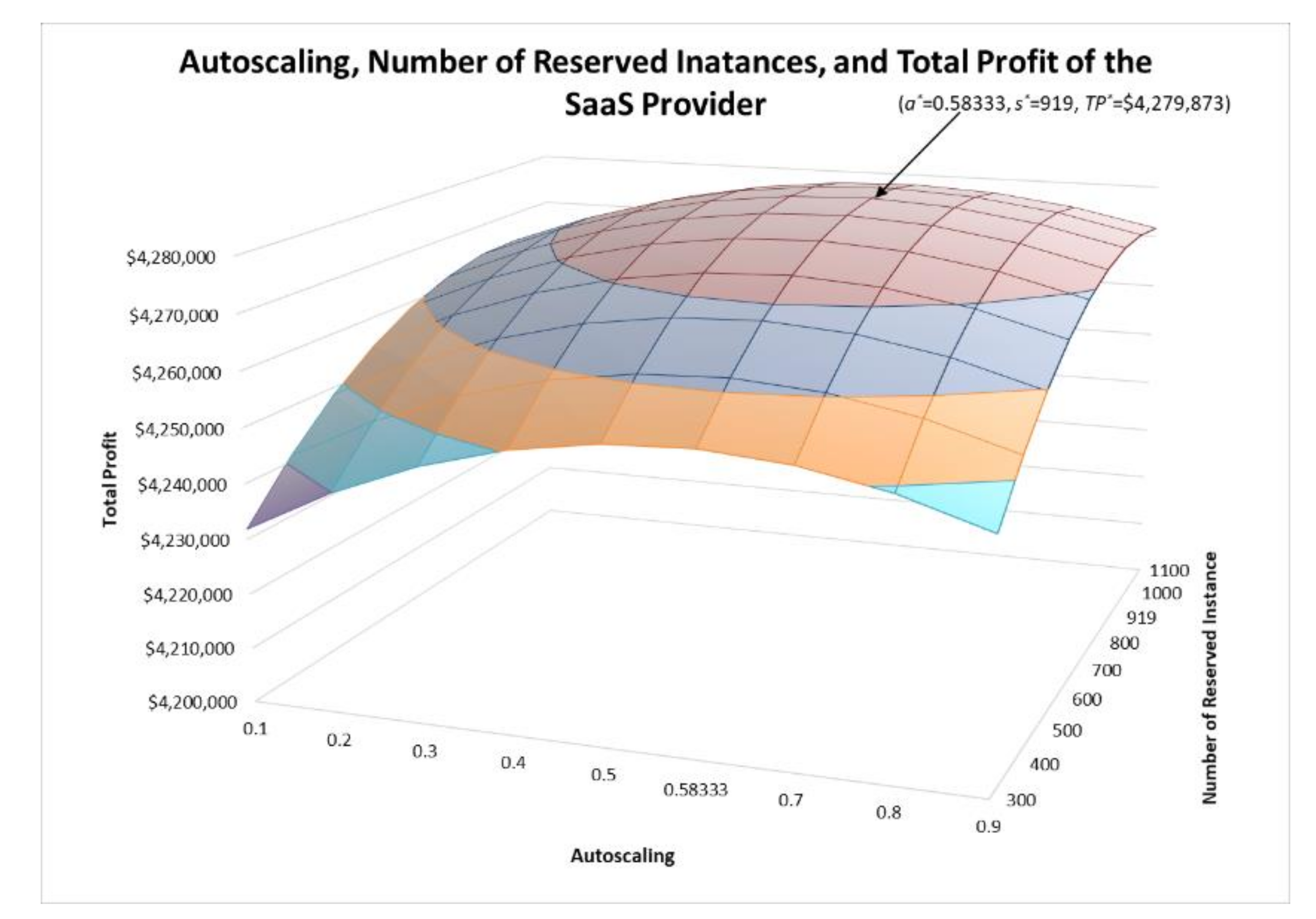
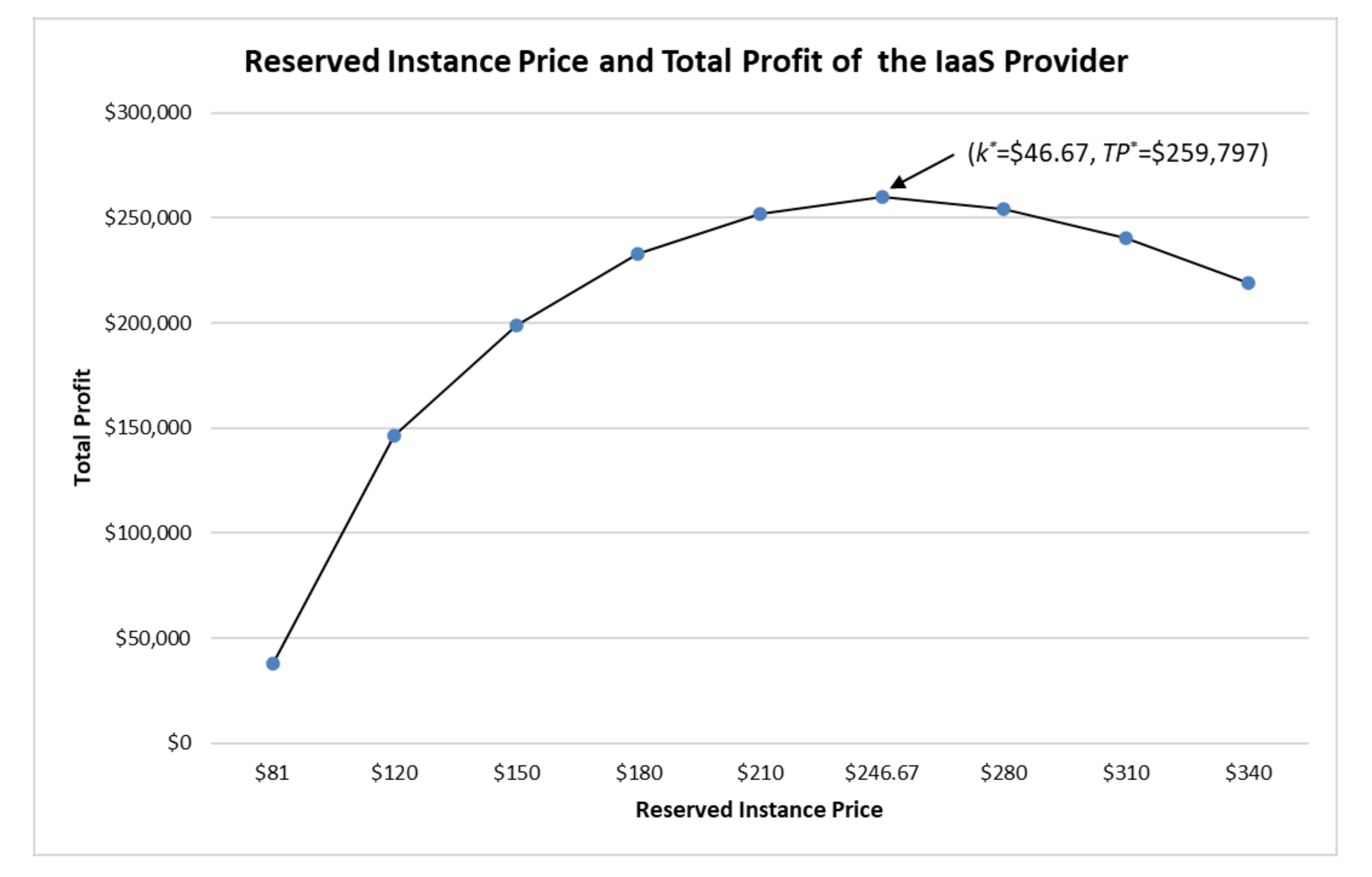
Applying the Newton Raphson method and Stackelberg game’s backward induction process, the optimal decision by the IaaS provider for the optimal reserved instance price, k*, is $246.67 which is about a 39% discount from the price of the on-demand instance. Then, the best response of the SaaS provider for the optimal number of the reserved instances, s*, is 919. The best response of the SaaS provider for the optimal autoscaling weight of the on-demand instance, a*, is 0.58333 determined by a = p r p o p + 2 o r p n m λ r 2 r p + 2 o r p .
Figure 1 shows that the total profit function of the IaaS provider is concave down with the optimal profit at the price of $246.67 for the reserved instance, given the SaaS provider’s best response. The best response (s* = 919, a* = 0.58333) of the SaaS provider is shown in Figure 2, given the price of $246.67 for the reserved instance. At the Stackelberg equilibrium, the total profit of the IaaS provider is $259,797 and the total profit of the SaaS provider is $ 4,279,873. Deviating from the Stackelberg equilibrium would render either provider a less total profit.
Figure 1. Reserved Instance Price and the Total Profit of the IaaS Provider.
Figure 2. Autoscaling Weight of On-demand by the SaaS Provider and the Total Profit.
It is noted that in the Stackelberg game, the leader has an advantage over the follower. The follower makes the best response given the leader’s strategy. While the Stackelberg game shows there exists an equilibrium between the two providers, the leader may want to deviate from the equilibrium at his own expense to have a sustainable strategic relationship with the follower. For example, despite the reduced total profit, the IaaS provider may want to offer to the SaaS provider a deeper price discount of the reserved instance in order to build a strategic partnership (e.g., a strategic partnership between HubSpot and Amazon AWS). Figure 1 shows that a price decrease (i.e., to the left of the optimal price) will lower the total profit of the IaaS provider. However, the price decrease of the reserved instance will increase the total profit of the SaaS provider. Raising the price of the reserved instance beyond $246.67 (i.e., to the right of the optimal price) will decrease not only the total profit of the IaaS provider, but also that of the SaaS provider. The Stackelberg game proves to be a powerful tool for the IaaS provider in negotiating volume discounts with major SaaS providers.

4. Sensitivity Analyses of Pricing Decisions

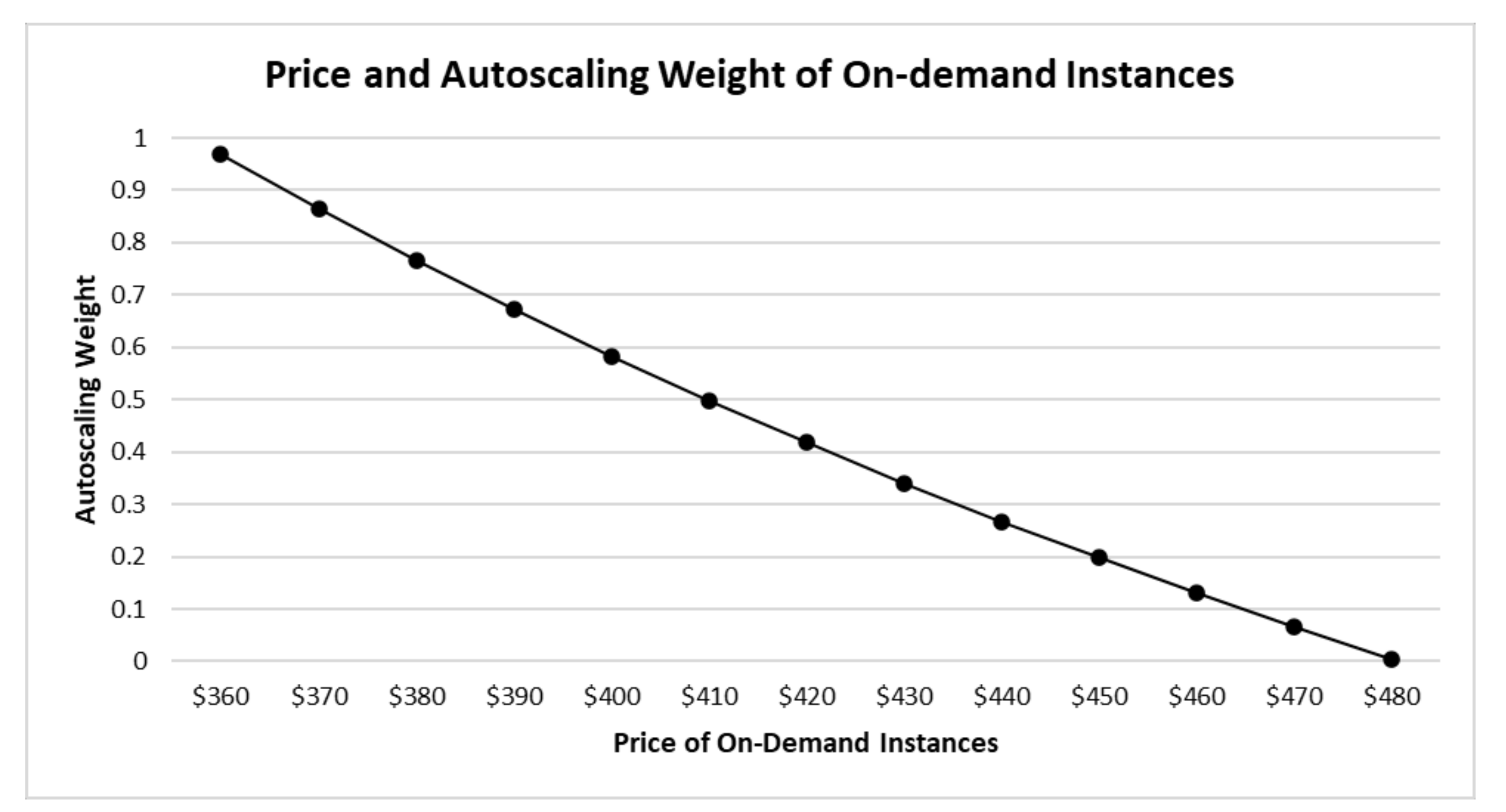
This section conducts sensitivity analyses of the Stackelberg game to understand the model’s behavior when changing the parameter values of the decision models. The parameter values in Table 2 are used in the sensitivity analyses. Figure 3 shows the impact of the price of the on-demand instance on the autoscaling weight of the on-demand instance. The result shows that the increase of the price of the on-demand instance lowers the autoscaling weight of the on-demand instance. The autoscaling weight of the on-demand instance is nearly 100% at $360 for the on-demand instance and declines to nearly 0% at $480. A further analysis reveals the upper bound price to include the on-demand instance to the autoscaling group is $480.76.
Figure 3. Price of On-demand Instance and Autoscaling Weight of On-demand Instances.
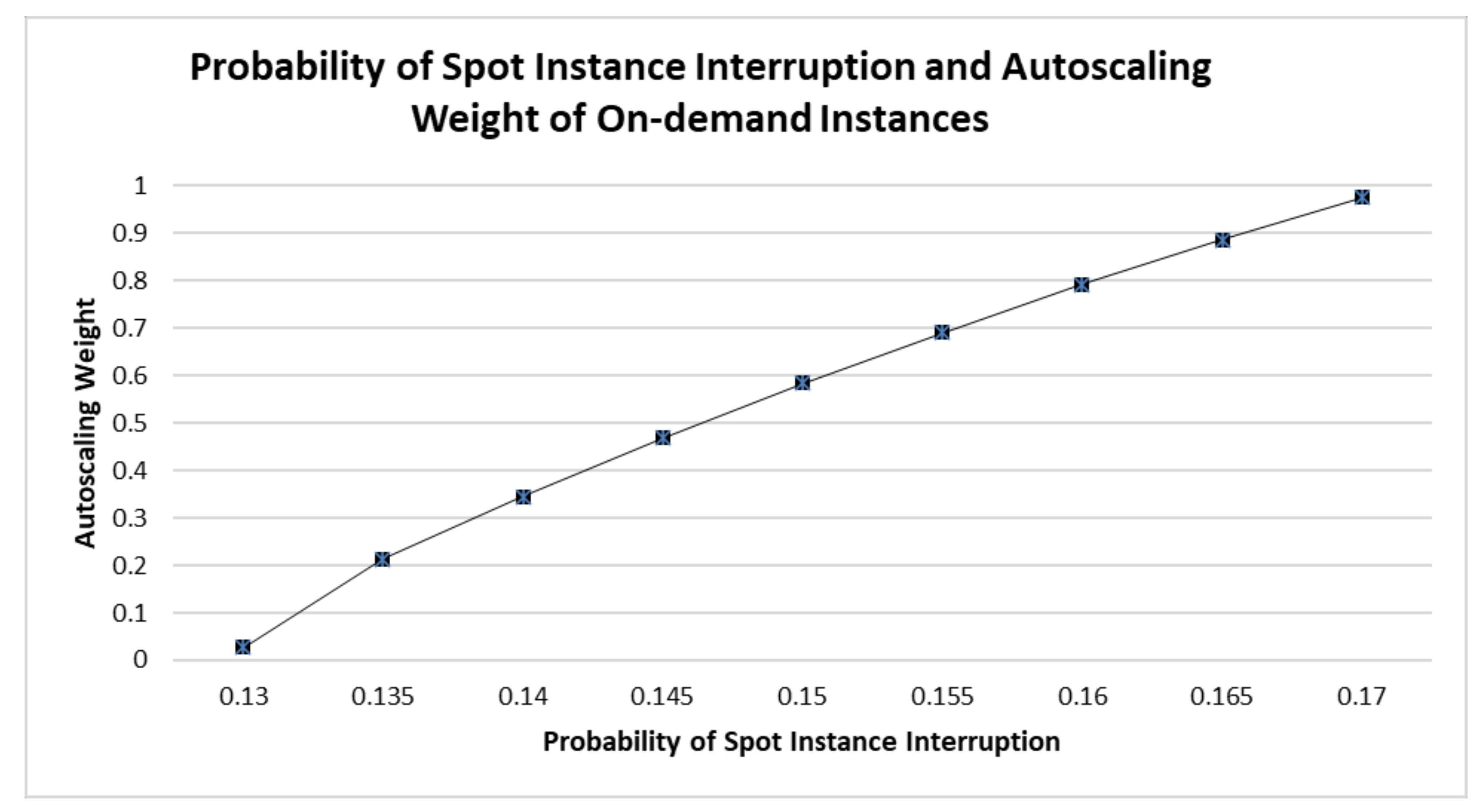
On the other hand, an increase of the probability of spot instance interruptions increases the autoscaling weight of the on-demand instance (Figure 4). The autoscaling weight of the on-demand instance goes down to nearly 0% at a 0.13 probability of a spot instance interruption and increases to nearly 100% at a probability 0.17. Further analysis reveals a lower bound probability of a spot instance interruption to include any amount of on-demand instance to the autoscaling group is 0.12766.
Figure 4. Probability of Spot Instance Interruption and Autoscaling Weight of On-demand Instances.
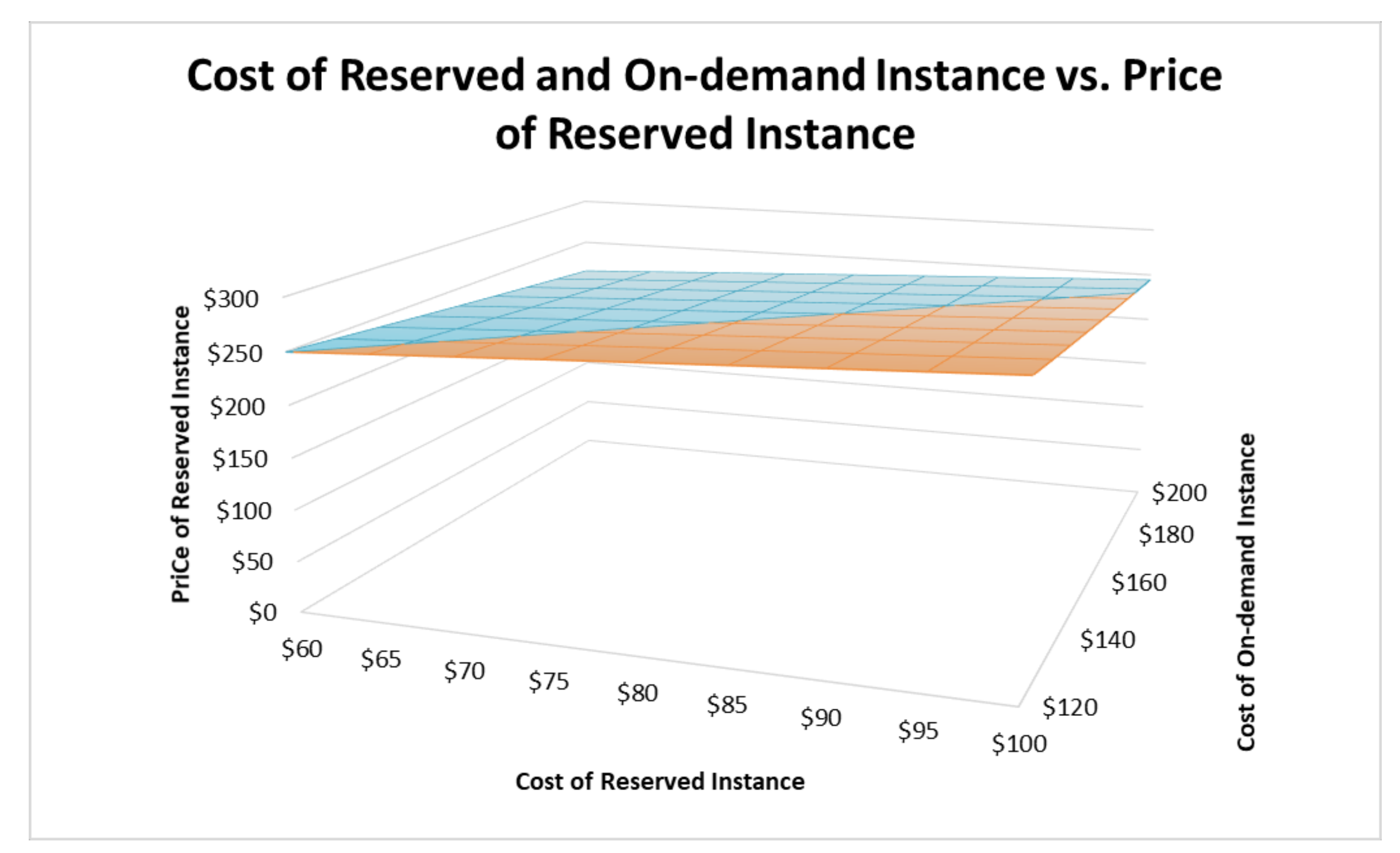
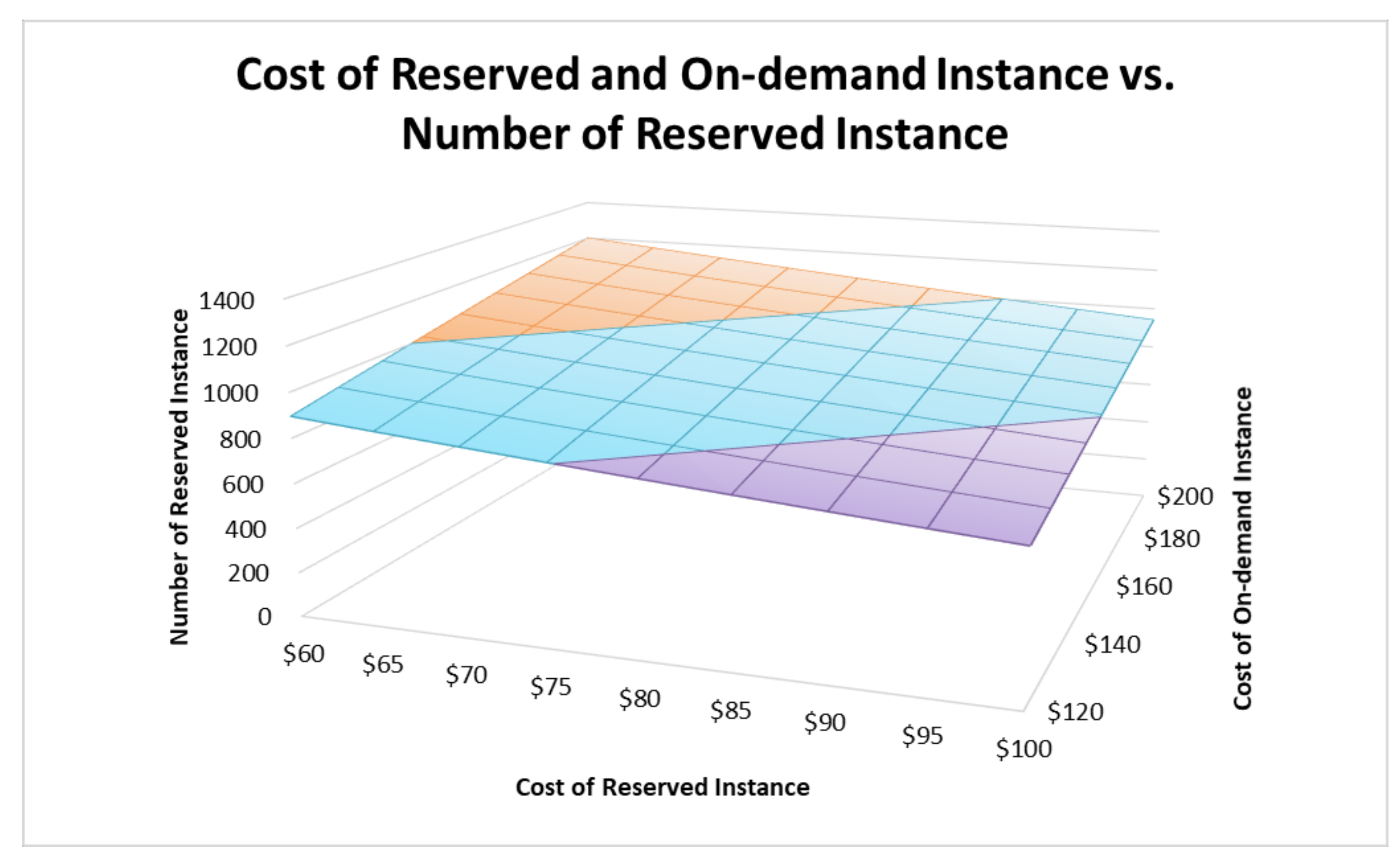
This section continues the sensitivity analyses by varying values of the IaaS providers’ cost per reserved instance, c, and the cost per on-demand/spot instance of the IaaS provider, g. When there is an increase in the cost of the reserved instance and a decrease in the cost of the on-demand instance, the IaaS provider should increase the price of the reserved instances (Figure 5), and the SaaS provider should decrease the number of the reserved instances, but increase the autoscaling group (Figure 6).
Figure 5. Costs of Reserved Instance and On-demand Instance vs. Price of Reserved Instance.
Figure 6. Costs of Reserved Instance and On-demand Instance vs. Number of Reserved Instance.
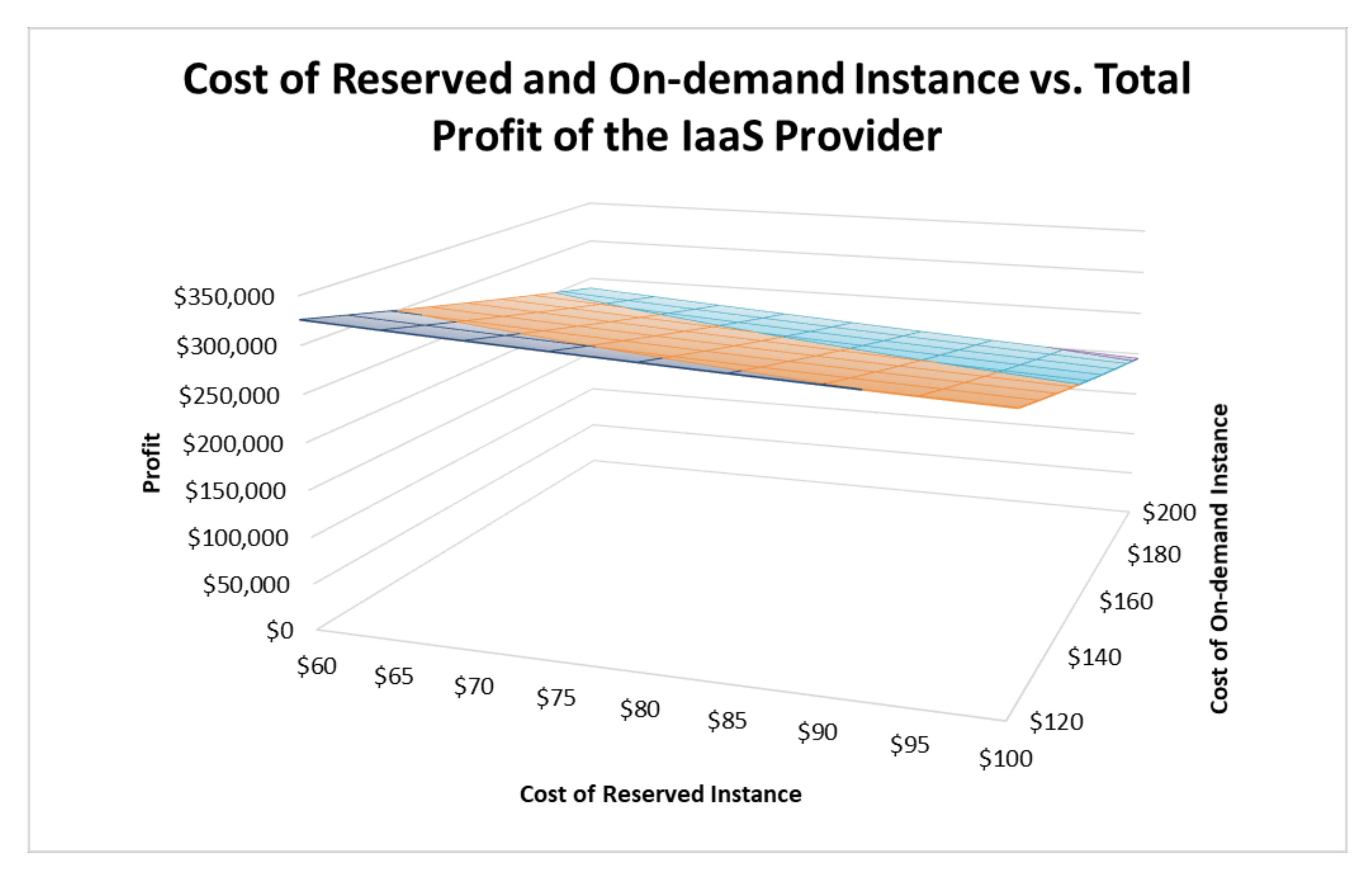
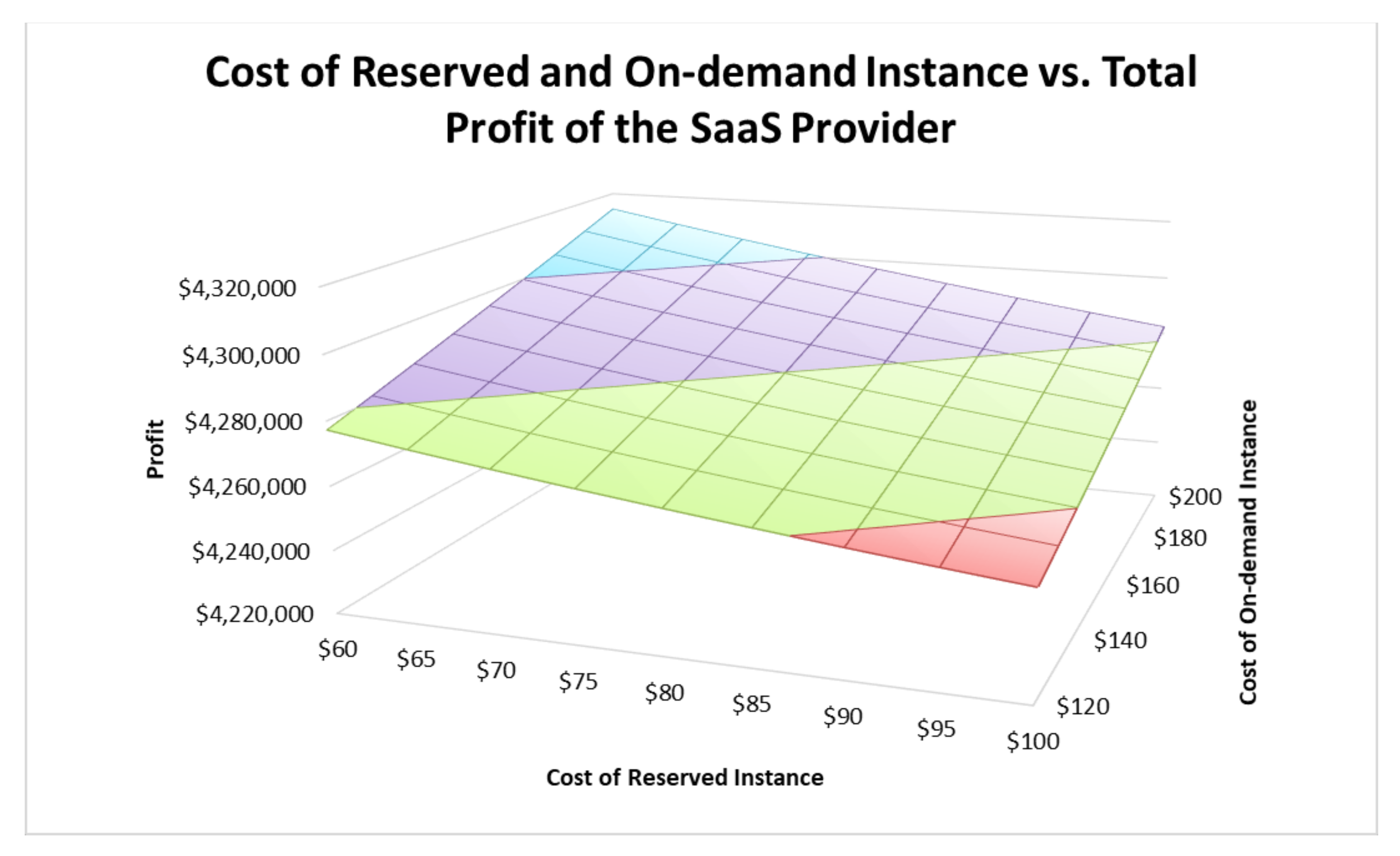
Figure 7 and Figure 8 show how the changes in the cost of the reserved instance and the cost of the on-demand instance affect the profits of the IaaS provider and the SaaS provider. As the cost of the reserved instance and the cost of the on-demand instance increase, the optimal total profit of the IaaS provider decreases due to the declining margin of the cloud services. However, contrary to conventional wisdom, while an increase in the cost of the reserved instance decreases the profit of the SaaS provider, an increase in the cost of the on-demand instance increases the profit of the SaaS provider. This is explained by the fact that an increase in the cost of the on-demand instance encourages the IaaS provider to sell more reserved instances by lowering the price of the reserved instance, given the price of the on-demand instance is fixed. Therefore, the profit of the SaaS provider increases, but the profit of the IaaS provider decreases. These results provide valuable insights on the impact of the costs of IaaS on the profits of both providers.
Figure 7. Cost of Reserved Instance and On-demand Instance vs. Total Profit of IaaS Provider.
Figure 8. Cost of Reserved Instance and On-demand Instance vs. Total Profit of SaaS Provider.

5. Conclusions

While a well-developed pricing strategy increases cloud providers’ profits and revenues, most previous studies focus on the technological aspects of cloud computing such as resource allocation and scheduling. However, understanding pricing dynamics between different types of cloud providers is critical to improving their profits and revenues. For example, without taking into account the SaaS providers’ profit-maximizing decision, any pricing decision of the IaaS providers is likely to be suboptimal. Based on the literature review on pricing of cloud services, this paper proposes a Stackelberg game pricing decision model. In the proposed Stackelberg game, the IaaS provider identifies the optimal price of the reserved instance price given the knowledge of the SaaS provider’s best response to the prices of the reserved instance, on-demand instance, and spot instance. The Stackelberg equilibrium was derived from the game pricing decision model.
This study found that for the SaaS provider, the optimal autoscaling weight of the on-demand instance is independent of the optimal number of reserved instances. The price increase of the on-demand instance lowers the autoscaling weight of the on-demand instance. On the other hand, an increased probability of spot instance interruptions increases the autoscaling weight of the on-demand instance. When there is an increase in the cost of the reserved instance and a decrease in the cost of the on-demand instance, the IaaS provider should increase the price of the reserved instances. Contrary to conventional wisdom, while a cost increase of the reserved instance decreases the profit of the SaaS provider, a cost increase of the on-demand instance increases the profit of the SaaS provider.
This paper has a few implications for cloud providers. First, cloud providers need to understand complex interactions among costs and prices of multiple service categories. The cost increase of the on-demand instance encourages the IaaS provider to sell more reserved instances by lowering the price of the reserved instance, given the price of the on-demand instance is fixed. Therefore, the profit of the SaaS provider increases due to the price decrease of the reserved instance, but the profit of the IaaS provider decreases. Second, SaaS providers need to carefully decide the autoscaling weight between the on-demand instance and the spot instance. They need to measure the complex interactions among the on-demand price, the spot price, and the interruption rate of the spot instances. Third, the insights gained from this Stackelberg game decision model can also be used for negotiating volume discounts with the SaaS provider. For example, if the IaaS provider wants to deviate from the Stackelberg equilibrium at his own expense to have a sustainable strategic relationship with the SaaS provider, the Stackelberg equilibrium of the proposed decision model provides a starting point for the price negotiation. The IaaS provider needs to decide how much discount is necessary beyond the Stackelberg equilibrium price in order to have s sustainable relationship with the SaaS provider in a competitive market.
Like many studies, this study has limitations. First, it is noted that the successful use of these models would require accurate estimation of the model parameters and the use of various modeling techniques. Future research may explore various estimation techniques of the model parameters to develop more realistic models. Second, future studies need to investigate additional variables for the pricing model. For example, different IaaS providers employ different pricing schemes. Each SaaS may have a different level of QoS preference and a different willingness to pay for the service (i.e., reservation price). Future research may include these variables for model enhancement. The SaaS is a useful application for inter-organizational supply chain management (SCM). It would be interesting to investigate how an organization’s technological maturity and its capabilities of SaaS SCM affect their adoption.

Author Contributions

In Lee is the sole author. The author has read and agreed to the published version of the manuscript.

Funding

This research received no external funding.

Institutional Review Board Statement

Not applicable.

Conflicts of Interest

The authors declare no conflict of interest.

Nomenclature

xan actual SaaS demand in terms of IaaS instances
λe−λxan exponential probability distribution function for the demand of IaaS instances
1-e−λxa cumulative exponential distribution function for the demand of IaaS instances
1/λmean value of the demand of IaaS instances
nthe number of SaaS subscriptions
mthe subscription fee per SaaS subscription
kprice per reserved instance; decision variable of the IaaS provider
sthe number of the reserved instances purchased by the SaaS provider; decision variable of the SaaS provider
aautoscaling weight of the on-demand instances; decision variable of the SaaS provider
(1-a)autoscaling weight of spot instance
pprice per on-demand instance
odiscounted rate
o·pprice per spot instance
rthe probability of spot instance interruption
ccost per reserved instance
gcost per on-demand and spot instance
(1-arthe expected rate of interruption for the entire autoscaling group
n·m·λrevenue loss per instance of spot instance interruption

References

  1. Makela, T.; Luukkainen, S. Incentives to apply green cloud computing. J. Theor. Appl. Electron. Commer. Res. 2013, 8, 74–86. [Google Scholar] [CrossRef]
  2. Chakraborty, S.; Basu, S.; Sharma, M. Pricing Infrastructure-as-a-Service for online two-sided platform providers. J. Revenue Pricing Manag. 2014, 13, 199–223. [Google Scholar] [CrossRef]
  3. Fink, L. The logic of electronic hybrids: A conceptual analysis of the influence of cloud computing on electronic commerce. J. Theor. Appl. Electron. Commer. Res. 2013, 8, 1–11. [Google Scholar] [CrossRef][Green Version]
  4. Cheng, Y.; Awan, U.; Ahmad, S.; Tan, Z. How do technological innovation and fiscal decentralization affect the environment? A story of the fourth industrial revolution and sustainable growth. Technol. Forecast. Soc. Chang. 2021, 162, 120398. [Google Scholar] [CrossRef]
  5. Ali, A.; Warren, D.; Mathiassen, L. Cloud-based business services innovation: A risk management model. Int. J. Inf. Manag. 2017, 37, 639–649. [Google Scholar] [CrossRef]
  6. Awan, U. Steering for sustainable development goals: A typology of sustainable innovation. In Innovation and Infrastructure. Encyclopedia of the UN Sustainable Development Goals; Leal Filho, W., Azul, A., Brandli, L., Lange Salvia, A., Wall, T., Eds.; Springer: Cham, Switzerland, 2020. [Google Scholar] [CrossRef]
  7. Weinhardt, C.; Anandasivam, A.; Blau, B.; Meini, T.; Michalk, W.; Stosser, J. Cloud computing—A classification, business models, and research directions. Bus. Inf. Syst. Eng. 2009, 1, 391–399. [Google Scholar] [CrossRef]
  8. Mireslami, S.; Rakai, L.; Far, B.H.; Wang, M. Simultaneous cost and QoS optimization for cloud resource allocation. IEEE Trans. Netw. Serv. Manag. 2017, 14, 676–689. [Google Scholar] [CrossRef]
  9. Chi, Y.; Li, X.; Wang, X.; Leung, V.C.M.; Shami, A. A fairness-aware pricing methodology for revenue enhancement in service cloud infrastructure. IEEE Syst. J. 2017, 11, 1006–1017. [Google Scholar] [CrossRef]
  10. Stoppel, E.; Roth, S. Consequences of usage-based pricing in industrial markets. J. Revenue Pricing Manag. 2015, 14, 140–154. [Google Scholar] [CrossRef]
  11. Boillat, T.; Legner, C. From on-premise software to cloud services: The impact of cloud computing on enterprise software vendors′ business models. J. Theor. Appl. Electron. Commer. Res. 2013, 8, 39–58. [Google Scholar] [CrossRef]
  12. Gartner. Gartner Forecasts Worldwide Public Cloud Revenue to Grow 17% in 2020. Available online: https://www.gartner.com/en/newsroom/press-releases/2019-11-13-gartner-forecasts-worldwide-public-cloud-revenue-to-grow-17-percent-in-2020 (accessed on 10 October 2020).
  13. Hotspot.com HubSpot Cloud Infrastructure Frequently Asked Questions. Available online: https://knowledge.hubspot.com/account/hubspot-cloud-infrastructure-frequently-asked-questions (accessed on 21 November 2020).
  14. Gonçalves, V.; Ballon, P. Adding value to the network: Mobile operators′ experiments with Software-as-a-Service and Platform-as-a-Service models. Telemat. Inform. 2011, 28, 12–21. [Google Scholar] [CrossRef]
  15. Vrankić, I.; Bach, M.P.; Krpan, M. Stackelberg equilibrium of the client and the producer of embedded software. Bus. Syst. Res. Int. J. Soc. Adv. Innov. Res. Econ. 2014, 5, 68–76. [Google Scholar] [CrossRef]
  16. Lancioni, R. A strategic approach to industrial product pricing: The pricing plan. Ind. Mark. Manag. 2005, 34, 177–183. [Google Scholar] [CrossRef]
  17. Hinterhuber, A. Customer value-based pricing strategies: Why companies resist. J. Bus. Strategy 2008, 29, 41–50. [Google Scholar] [CrossRef]
  18. Cong, P.; Zhou, J.; Chen, M.; Wei, T. Personality-guided cloud pricing via reinforcement learning. IEEE Trans. Cloud Comput. 2020. [Google Scholar] [CrossRef]
  19. Jahandideh, H.; Drew, J.W.; Balestrieri, F.; McCardle, K. Individualized pricing for a cloud provider hosting interactive applications. Serv. Sci. 2020, 12, 130–147. [Google Scholar] [CrossRef]
  20. Xu, H.; Li, B. Dynamic cloud pricing for revenue maximization. IEEE Trans. Cloud Comput. 2013, 1, 158–171. [Google Scholar] [CrossRef]
  21. Chun, S.-H.; Choi, B.-S. Service models and pricing schemes for cloud computing. Clust. Comput. 2014, 17, 529–535. [Google Scholar] [CrossRef]
  22. Lu, Y.; Zheng, X.; Li, L.; Xu, L.D. Pricing the cloud: A QoS-based auction approach. Enterp. Inf. Syst. 2020, 14, 334–351. [Google Scholar] [CrossRef]
  23. Song, J.; Guérin, R. Pricing (and bidding) strategies for delay differentiated cloud services. ACM Trans. Econ. Comput. 2020, 8, 1–58. [Google Scholar] [CrossRef]
  24. Wu, C.; Nadjaran Toosi, A.; Buyya, R.; Ramamohanarao, K. Hedonic pricing of cloud computing services. IEEE Trans. Cloud Comput. 2018. [Google Scholar] [CrossRef]
  25. Dimitri, N. Pricing cloud IaaS computing services. J. Cloud Comput. Adv. Syst. Appl. 2020, 9, 1–11. [Google Scholar] [CrossRef]
  26. Lee, I. Pricing schemes and profit-maximizing pricing for cloud services. J. Revenue Pricing Manag. 2019, 18, 112–122. [Google Scholar] [CrossRef]
  27. Nasiriani, N.; Wang, C.; Kesidis, G.; Urgaonkar, B.; Chen, L.Y.; Birke, R. On fair attribution of costs under peak-based pricing to cloud tenants. ACM Trans. Model. Perform. Eval. Comput. Syst. 2016, 2, 51–60. [Google Scholar] [CrossRef]
  28. Rohitratana, J.; Altmann, J. Impact of pricing schemes on a market for software-as-a-service and perpetual software. Future Gener. Comput. Syst. 2012, 28, 1328–1339. [Google Scholar] [CrossRef]
  29. Jin, H.; Wang, X.; Wu, S.; Di, S.; Shi, X. Towards optimized fine-grained pricing of IaaS cloud platform. IEEE Trans. Cloud Comput. 2015, 3, 436–448. [Google Scholar] [CrossRef]
  30. Pal, R.; Hui, P. Economic models for cloud service markets: Pricing and capacity planning. Theor. Comput. Sci. 2013, 496, 113–124. [Google Scholar] [CrossRef]
  31. Tang, L.; Chen, H. Joint pricing and capacity planning in the IaaS cloud market. IEEE Trans. Cloud Comput. 2017, 5, 57–70. [Google Scholar] [CrossRef]
  32. Chen, S.; Lee, H.; Moinzadeh, K. Pricing schemes in cloud computing: Utilization-based vs. reservation-based. Prod. Oper. Manag. 2019, 28, 82–102. [Google Scholar] [CrossRef]
  33. Huang, J.; Kauffman, R.J.; Ma, D. Pricing strategy for cloud computing: A damaged services perspective. Decis. Support Syst. 2015, 78, 80–92. [Google Scholar] [CrossRef]
  34. Kansal, S.; Kumar, H.; Kaushal, S.; Sangaiah, A.K. Genetic algorithm-based cost minimization pricing model for on-demand IaaS cloud service. J. Supercomput. 2020, 76, 1536–1561. [Google Scholar] [CrossRef]
  35. Amazon. Amazon EC2 Spot Instances. Available online: https://aws.amazon.com/cn/ec2/spot/pricing (accessed on 12 December 2020).
  36. Google. Google Preemptible Virtual Machines. Available online: https://cloud.google.com/preemptible-vms (accessed on 13 December 2020).
  37. Microsoft. Use Low-Priority VMs with Batch. Available online: https://docs.microsoft.com/en-us/azure/batch/batch-low-pri-vms (accessed on 13 December 2020).
  38. Reen, N.; Hellström, M.; Wikström, K.; Perminova-Harikoski, O. Towards value-driven strategies in pricing IT solutions. J. Revenue Pricing Manag. 2017, 16, 91–105. [Google Scholar] [CrossRef]
  39. Hinterhuber, A. Towards value-based pricing—An integrative framework for decision making. Ind. Mark. Manag. 2004, 33, 765–778. [Google Scholar] [CrossRef]
  40. Dutta, S.; Zbaracki, M.J.; Bergen, M. Pricing process as a capability: A resource-based perspective. Strateg. Manag. J. 2003, 24, 615–630. [Google Scholar] [CrossRef]
  41. Wu, C.; Buyya, R.; Ramamohanarao, K. Cloud pricing models: Taxonomy, survey, and interdisciplinary challenges. ACM Comput. Surv. 2019, 52, 108. [Google Scholar] [CrossRef]
  42. Leppaniemi, M.; Karjaluoto, H.; Saarijarvi, H. Customer perceived value, satisfaction, and loyalty: The role of willingness to share information. Int. Rev. Retail. Distrib. Consum. Res. 2017, 27, 164–188. [Google Scholar] [CrossRef]
  43. Von Stackelberg, H. The Theory of the Market Economy; Oxford University Press: Oxford, UK, 1952. [Google Scholar]
  44. Chapel, J. How to Use an AWS EDP for Discounted Cloud Resources. Available online: https://www.parkmycloud.com/blog/aws-edp/ (accessed on 15 December 2020).
Publisher’s Note: MDPI stays neutral with regard to jurisdictional claims in published maps and institutional affiliations.

Article Metrics

Citations

Article Access Statistics

Multiple requests from the same IP address are counted as one view.