

Mathematical Fundamentals of Machine Learning in Power Systems
Topic Information
Dear Colleagues,
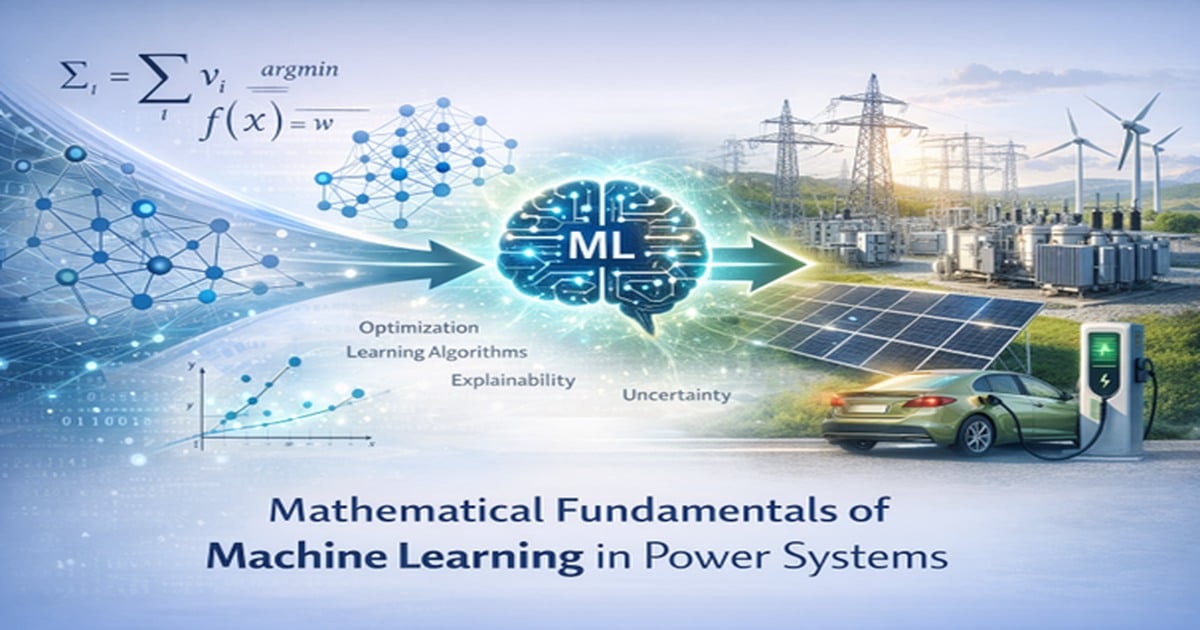
Machine learning is increasingly employed in power systems to address complex challenges related to optimization, control, forecasting, and decision-making. However, the reliable deployment of data-driven methods in electrical power systems requires a solid understanding of their underlying mathematical principles, particularly in relation to system constraints, physical consistency, and operational robustness.
This Topic focuses on the mathematical fundamentals of machine learning in power systems, emphasizing models and algorithms grounded in optimization theory, statistical learning, and numerical analysis. Contributions are encouraged that investigate the mathematical structure, stability, convergence, and interpretability of machine learning techniques applied to power generation, transmission, and distribution systems.
Relevant applications include smart grids, renewable energy integration, electric vehicle coordination, voltage and loss optimization, demand response, and energy management systems. Particular attention is given to hybrid approaches that combine physical modeling with data-driven learning, as well as to explainable and uncertainty-aware machine learning methods. By bringing together researchers from applied mathematics, machine learning, and power engineering, this Topic aims to advance trustworthy, transparent, and mathematically sound machine learning solutions for modern power systems.
Dr. Bogdan Neagu
Dr. Andrea Mazza
Topic Editors
Keywords
- machine learning
- power systems
- mathematical modeling
- optimization theory
- numerical methods
- statistical learning
- hybrid modeling
Participating Journals


5,034 Articles
Launched in 2008
2.6Impact Factor
5.4CiteScore
43 DaysMedian Time to Publication
Q2Highest JCR Category Ranking

92,929 Articles
Launched in 2011
2.9Impact Factor
6.1CiteScore
38 DaysMedian Time to Publication
Q2Highest JCR Category Ranking

5,301 Articles
Launched in 2012
1.5Impact Factor
-CiteScore
45 DaysMedian Time to Publication
Q2Highest JCR Category Ranking

1,414 Articles
Launched in 2017
5.3Impact Factor
11.4CiteScore
56 DaysMedian Time to Publication
Q1Highest JCR Category Ranking

897 Articles
Launched in 2021
-Impact Factor
10.1CiteScore
58 DaysMedian Time to Publication
-Highest JCR Category Ranking

28,822 Articles
Launched in 2013
2.3Impact Factor
5.4CiteScore
39 DaysMedian Time to Publication
Q1Highest JCR Category Ranking

728 Articles
Launched in 2019
4.1Impact Factor
5.4CiteScore
66 DaysMedian Time to Publication
Q1Highest JCR Category Ranking

18,106 Articles
Launched in 2009
2.2Impact Factor
5.2CiteScore
40 DaysMedian Time to Publication
Q2Highest JCR Category Ranking