


Abstract
Telehealth has improved patient access to healthcare services and has been shown to have a positive impact in various healthcare settings. In any case, little is understood regarding the utilization of telehealth in hypertension management in primary healthcare (PHC) settings. This study aimed to identify and classify information about the types of interventions and types of telehealth technology in hypertension management in primary healthcare. A scoping review based on PRISMA-ScR was used in this study. We searched for articles in four databases: Pubmed, Scopus, Science Direct, and Embase in English. The selected articles were published in 2013–2023. The data were extracted, categorized, and analyzed using thematic analysis. There were 1142 articles identified and 42 articles included in this study. Regarding the proportions of studies showing varying trends in the last ten years, most studies came from the United States (US) (23.8%), were conducted in urban locations (33.3%), and had a quantitative study approach (69%). Telehealth interventions in hypertension management are dominated by telemonitoring followed by teleconsultation. Asynchronous telehealth is becoming the most widely used technology in managing hypertension in primary care settings. Telehealth in primary care hypertension management involves the use of telecommunications technology to monitor and manage blood pressure and provide medical advice and counselling remotely.
1. Background
Most health systems share common goals of improving patient health, being responsive to patient needs, and ensuring financial sustainability [1]. Health systems differ between countries in terms of their structure, financing, and outcomes. Factors such as socioeconomic status, political framework, and cultural diversity contribute to these differences. For example, the US does not have a universal healthcare system, and most Americans receive health insurance through their employers [2]. In contrast, countries like Canada and the UK have universal healthcare systems that are publicly funded [3]. Countries like Japan, Republic of Korea, Singapore, the United Arab Emirates, Australia, and New Zealand provide healthcare to almost all residents, with residents paying some healthcare costs out of pocket [4]. Economic globalization has also played a role, leading to the commercialization of healthcare services and weakening national health systems, particularly in low-income countries [5]. The healthcare spending also varies significantly between countries, with North America spending more than twice as much per capita as the European Union on average [6].
Hypertension has become the major cause of cardiovascular disease and early mortality globally [7]. In 2019, it was found that around 1.28 billion adults aged 30–79 years worldwide had hypertension, with most (two-thirds) living in middle and low-income countries [8]. Elevated blood pressure was responsible for an estimated 4.5 million deaths in men and 4.0 million in women in 2015 [9]. The association between hypertension and premature deaths has also been recorded in several countries [10,11,12].
The increase in the incidence of hypertension is expected to continue [13]. Therefore, hypertension should be detected early and managed properly through education and treatment [14]. This can be managed through the use of telehealth [15]. Telehealth can improve access for isolated people with hypertension in rural areas [16]. Moreover, it might be an acceptable tool by using simple telehealth to diagnose and monitor hypertension among users [17]. In addition, Blood Pressure Telemonitoring is useful both for screening and diagnosing hypertension as well as for improving hypertension management [18]. Likewise, eHealth will support the creation of a network between healthcare professionals in improving screening, hypertension management, and related comorbidities and in the effective prevention of cardiovascular disease [19].
Telehealth technology in developing countries differs from that in developed countries in several ways. Firstly, in developing countries, there is a lack of resources in the health system, leading to challenges in implementing eHealth services [20]. Additionally, the level of development in each country and the commitment of their governments to provide affordable healthcare services play significant roles in determining the success of eHealth models [21]. Furthermore, the asymmetry among healthcare centers, hospitals, and user-ends poses a challenge in fully adopting telehealth technology in developing countries [22]. On the other hand, in developed countries, telehealth services have been slow to be adopted, with uptake being piecemeal and ad hoc [23].
Telehealth can possibly work on the nature of medical services and patient fulfillment. Healthcare providers have widely adopted remote patient monitoring to reduce hospitalization rates and disease management to improve patient self-efficacy [24]. Telehealth can potentially reform and transform the industry by reducing costs and improving quality, access, and patient satisfaction [25,26]. Telehealth is well suited to support patients with chronic, complex, or comorbid conditions, [27] including hypertension. Several previous studies have reported the potential of telehealth to have a positive impact on hypertension management in primary healthcare [28,29,30,31].
The key barriers to hypertension control in primary care include a lack of effective screening and awareness, challenges with accessing treatment, difficulties in managing hypertension once it is treated, medication adherence barriers, lifestyle-related barriers, barriers related to the affordability and accessibility of care, and awareness-related barriers [32,33,34,35]. Patient-related barriers, such as the misinterpretation of blood pressure readings, also contribute to the challenges in hypertension control [36].
Telehealth has shown benefits for hypertension management in primary healthcare. It has the potential to reduce barriers to accessing healthcare and improve clinical outcomes [37]. Telehealth interventions have been used to treat patients with hypertension, heart failure, and stroke, with most interventions employing a team-based care approach [38]. These interventions utilize the expertise of physicians, nurses, pharmacists, and other healthcare professionals to collaborate on patient decisions and provide direct care [39]. Patients using telehealth have seen significant improvements in clinical outcomes such as blood pressure control, which are comparable to patients receiving in-person care [40]. Telehealth can also support team-based care delivery and benefit patients and healthcare professionals by increasing opportunities for communication, engagement, and monitoring outside a clinical setting [41].
Previous literature review studies focused on the benefits and challenges of implementing telehealth in hypertension management in primary healthcare [42,43]. However, research exploring the type of intervention and technology type of telehealth in hypertension management in primary healthcare has not been widely documented. This paper describes the characteristics of telehealth in hypertension management, which can later be used to improve the quality of hypertension services in primary healthcare. The purpose of this review was to identify information on types of interventions and technology from telehealth in the management of hypertension in primary healthcare (PHC) settings.
2. Method
The review follows the procedures and recommendations of the Joanna Briggs Institute (JBI) for conducting scoping reviews [44]. The recent JBI guidelines categorize a scoping review as the optimal approach to comprehensively explore the existing literature on a subject by mapping and condensing accessible evidence. Additionally, scoping reviews are well suited to address areas lacking knowledge and offer valuable perspectives to aid decision-making. This evaluation also included PRISMA checklist instructions for reporting an accurate literature review [45].
2.1. Research Questions
In this study, we identified the characteristics of telehealth in hypertension management in primary healthcare through a scoping review by answering the research questions below:
- What kind of interventions are carried out in the management of hypertension in PHC settings?
- What types of technology are used in the management of hypertension in PHC settings?
2.2. Research Strategy
The bibliographic databases, such as PubMed, Scopus, Science Direct, and Embase, with the aid of a medical research librarian, were used as a structured literature search in conducting the study. Research questions were developed using a PCC (hypertension, telehealth, and primary healthcare). The search strategy compromised search terms using Medical Subject Headings (MESH) for the concepts “telehealth”, “hypertension”, and “primary healthcare” in the health topic database. We used the Boolean operator AND OR. All references from the databases were exported to Mendeley for duplicating removal and final screening. For a total overview of the applied search, see Table 1. To find the selected article, the authors attempted to obtain full-text versions of the articles using Google Scholar, ResearchGate, and other databases.

Table 1.
Search strategy for databases.
2.3. Eligible Criteria
All reviewers used the inclusion and exclusion criteria to screen the titles, abstracts, and full articles. The articles we submitted referred to articles in the form of research results published in the last ten years (2013–2023) using the document language English. Articles in the form of scoping reviews, systematic reviews, and literature reviews, not in English and not available in full-text form, were excluded from this study. Publications meeting the inclusive criteria, and those for which the first reviewer (Y.P.) was in doubt, were reviewed a second time by other reviewers (S.N., N.S.). In terms of disagreement, a discussion between all reviewers determined inclusion or exclusion.
2.4. Study Selection
We searched and selected papers according to the criteria created and checked for duplicates of existing papers. Three people independently screened them according to title and abstract. The reasons for excluding existing papers until the final results of the selected studies were found are shown in Figure 1.
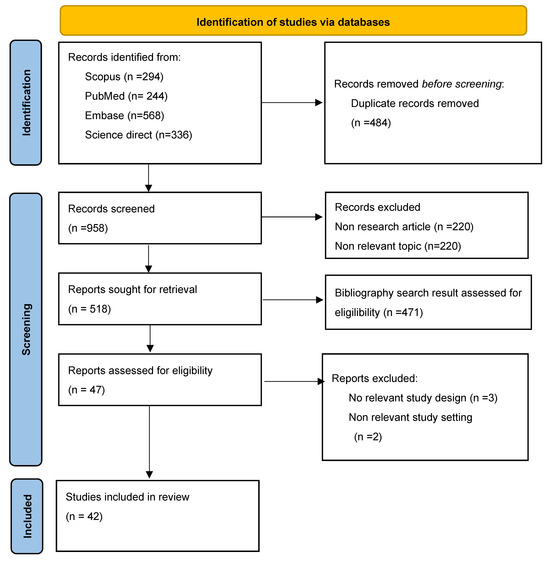
Figure 1.
Flowchart of the PRISMA scoping review study identification and selection process.
2.5. Data Extraction and Analysis
The data were extracted from chosen documents in full text in the following format: author, year, subject, intervention, type of population, type of technology, telehealth objectives, study design, country, software/hardware tools, and study outcomes. The extraction table is presented in Table 2. The results are presented in descriptive statistics, including frequency and percentage values, using Microsoft Excel 2019. The results of the scoping review of this study are presented in the form of map data on the distribution of telehealth use in various countries using the ArcGIS application. Data are presented in the form of diagrams and tables, according to the aim and scope of the review. Thematic analysis is presented based on the themes found. This procedure includes finding emerging patterns, assigning codes to the data, and combining these codes into broad themes that accurately express information to answer research questions [46].
Table 2.
Data extraction results.
3. Results
A sum of 1442 documents were identified after searching the selected databases. Also, 484 duplicates were removed. After sifting through 958 titles and abstracts, 440 articles were excluded. The remaining 518 articles were checked based on eligibility requirements, and we found 471 bibliography search results assessed for eligibility (including those papers that could not be obtained in full text). The remaining 47 articles were selected. Articles that were not set in primary healthcare and used the wrong document type were excluded in the final selection process, resulting in 42 articles being included in this study. The process of study selection is outlined in Figure 1.
3.1. Characteristics of Study
The articles included in this study were articles published between 2013 and 2023. Most of the research came from the United States (USA) (n = 10), followed by Brazil (n = 5) and the UK (n = 3), as shown in Figure 2a. According to the type of research, most of the studies included in this study used a quantitative approach followed by qualitative methods and mixed methods, as presented in Figure 2b. Regarding geographical settings, most studies were conducted in urban locations followed by rural locations, as presented in Figure 2c. The number of studies reporting the use of telehealth in hypertension management tended to fluctuate from 2013 to 2023. The highest numbers of published studies were reported in 2019 and 2022 (n = 7), as presented in Figure 2d.
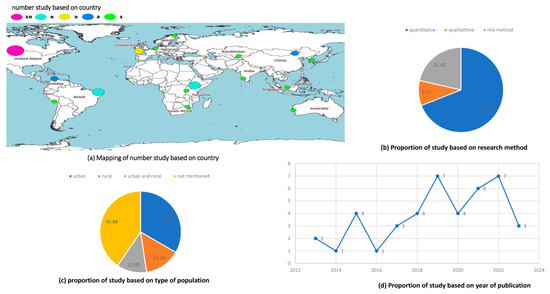
Figure 2.
Characteristics of telehealth in hypertension management in primary care settings.
3.2. Type of Intervention
We referred types of telehealth interventions based on the digital intervention categories promoted by WHO to ensure interoperability, i.e., teleconsultation, telemonitoring, teleassistance, and tele-expertise [88]. We added one category telehealth intervention, i.e., tele-education, because some articles used tele-education as an intervention for hypertension management. In this study, we divided types of telehealth interventions into five categories, namely teleconsultation, telemonitoring, teleassistance, tele-expertise, and tele-education. The synthesis of selected paper data using thematic analysis shows that most hypertension management interventions in primary care are of the telemonitoring type, followed by teleconsultation and tele-education interventions, as presented in Table 3.
Table 3.
Thematic synthesis based on type of intervention.
RQ 1. What are the interventions carried out in the management of hypertension in primary healthcare?
3.3. Technology
RQ 2. What is telehealth technology in hypertension management in primary healthcare?
We divided the types of telehealth intervention into three categories based on the study by Mechanic et al. [89], i.e., asynchronous, synchronous, and remote patient monitoring. The results of the data synthesis of selected papers using thematic analysis show that most interventions are of the telemonitoring type, followed by teleconsultation and tele-education interventions, as presented in Table 4.
Table 4.
Thematic synthesis based on the type of technology.
4. Discussion
This study aims to identify information related to the types of interventions and types of telehealth technology in managing hypertension in primary healthcare. There were 42 relevant studies in total that were included in the final synthesis. This study was a scoping review describing the utilization of telehealth in hypertension management in primary healthcare. The articles included in this study were published between 2013 and 2023. Most articles were from the US, followed by Brazil and the UK, most of which were implemented in urban areas. Based on research methods, most articles were analyzed using quantitative methods.
The results of our review show that telehealth management interventions in primary healthcare are dominated by telemonitoring (69%). Telemedicine in hypertension management should include the transmission of vital signs and remote monitoring [90]. In the short-to-medium term, telemonitoring may be more effective than usual care [91]. The implementation of telemonitoring for hypertension can be for routine primary healthcare on a large scale with little impact on physician workload [92]. Telemonitoring can potentially improve the primary care management of Cardiovascular Disease (CVD) by improving patient outcomes and reducing healthcare costs [93]. A literature review also reported that almost all studies reported that telemonitoring was able to reduce blood pressure in the subjects being measured [94].
Telehealth interventions for hypertension management often involve remote patient monitoring (RPM) devices, such as blood pressure monitors, to track patients’ blood pressure levels [95]. These interventions typically employ a team-based care approach, involving physicians, nurses, pharmacists, and other healthcare professionals collaborating on patient decisions and providing direct care [38]. Patients using telehealth for hypertension management have seen significant improvements in clinical outcomes, including blood pressure control, which are comparable to patients receiving in-person care [40].
Apart from telemonitoring, our findings also found teleconsultation to be a frequently used intervention in hypertension management in primary care. Teleconsultation is an effective alternative to face-to-face consultation for many patients presenting to primary healthcare [96]. Teleconsultations between non-physicians and doctors located remotely have the potential to reduce the number of referrals to central clinics [97,98]. Teleconsulting services improve the compatibility of primary services and integration with secondary services in rural communities [99].
Our findings show that hypertension management technology in primary healthcare predominantly uses asynchronous technology. Most recent generation telemedicine systems use an asynchronous telemedicine approach [100]. This technology is reliable, simple to operate, has consistent connections, uses standard communication protocols, and has efficient bandwidth. For example, eHealth and mHealth are gradually gaining key roles in managing hypertensive patients [19]. Additionally, Java client applications that send digital camera images and structured XML text as e-mails are designed for use in resource-poor, poorly networked developing countries [101]. The application of advanced technology in rural healthcare settings has the potential to lower the cost of patient care and managed care insurance plans, enabling expert consultation from remote centers [102]. Asynchronous telehealth can shorten waiting times, reduce unnecessary referrals, and increase patient and provider satisfaction levels [103].
Our findings show that telehealth is currently being utilized to help manage hypertension in primary healthcare. It also helps to provide remote access to healthcare professionals and enables the monitoring of blood pressure [37,95]. It has been increasingly used during the COVID-19 pandemic to ensure continuity of care and improve access to healthcare services [104]. Studies have shown that telehealth interventions, including remote patient monitoring (RPM) and team-based care, have been effective in treating patients with hypertension and cardiovascular disease (CVD) [37]. A collaborative nephrologist–pharmacist telehealth clinic has also been successful in improving difficult-to-control hypertension in patients with chronic kidney disease (CKD) [105]. Telehealth-delivered approaches, such as the TEAM intervention, have been shown to improve hypertension care delivery and blood pressure control [39]. The COVID-19 pandemic has further accelerated the use of telehealth for the management of hypertension and other non-communicable diseases (NCDs) [39]. Overall, telehealth has the potential to reduce barriers to accessing healthcare, improve clinical outcomes, and extend services to remote areas, making it a valuable tool in the management of hypertension in primary healthcare settings.
Health systems and healthcare differ between countries. Despite these differences, most health systems aim to improve patient health, be responsive to patient needs, and ensure financial sustainability [106]. Developing countries face more challenges in building strong and reliable health systems compared to developed countries, leading to disparities in public health status and health problems [3]. Health inequalities exist within and between countries, with socioeconomic and cultural inequalities driving health inequities [106].
Our findings show that different countries use different technologies for hypertension management. Telehealth and eHealth technology availability differ between developed and developing countries. In developed countries, the use of telehealth and eHealth services has been increasing, especially during the COVID-19 pandemic [107]. These countries have reached thresholds for telehealth provision, such as a certain level of telecommunication accessibility, a proportion of elders exceeding 10%, or a proportion of health spending occupying more than 3–5% of GDP [108]. On the other hand, developing countries are also utilizing telehealth and eHealth technology, but the models and approaches vary depending on the level of development and government commitment to providing affordable healthcare services [109].
Strengths and Limitations
This study captured the use of telehealth for hypertension management in primary healthcare. The selection process uses four databases with systematic procedures. With wide location coverage, it can describe the implementation of telehealth in various countries. One limitation of this study was that it did not include grey literature reviews in the inclusion criteria. Another limitation was language bias because we searched for articles in English only. Future studies can overcome this limitation.
5. Conclusions
Telehealth is considered to have the potential for the management of hypertension in primary care. The findings of this study show that telehealth interventions in hypertension management in primary healthcare are dominated by telemonitoring. The technology used is more common in asynchronous telehealth. Further studies are needed to evaluate telehealth services in supporting the management of hypertension in primary care.
Author Contributions
Conceptualization, H.I. and W.P.N.; methodology, T.R., A.K. and A.Y.; formal analysis, Y.P., S.N. and N.S.; data curation, D.R.F.; writing—original draft preparation, H.A., writing—review and editing, A.M. All authors have read and agreed to the published version of the manuscript.
Funding
This research received no external funding.
Institutional Review Board Statement
Not applicable.
Informed Consent Statement
Not applicable.
Data Availability Statement
The data presented in this study are available on request from the corresponding author.
Conflicts of Interest
The authors declare no conflict of interest.
References
- Darvas, Z.; Moës, N.; Myachenkova, Y.; Pichler, D. The macroeconomic implications of healthcare. In Bruegel Policy Contribution; EconStor: Bruegel, Brussels, 2018. [Google Scholar]
- Hasan, A.A.; Ambrammal, S.K. The healthcare system: Policies and performance in India and ASEAN countries. Int. J. Health Sci. 2022, 6, 9960–9980. [Google Scholar] [CrossRef]
- Shin, J.-Y.J.; Man, K.; Zhou, W. International and global issues–differences in health systems, patient populations, and medical practice. In Pragmatic Randomized Clinical Trials; Elsevier: Amsterdam, The Netherlands, 2021; pp. 257–272. [Google Scholar]
- Baum, F.E. Health systems: How much difference can they make to health inequities? J. Epidemiol. Community Health 2016, 70, 635–636. [Google Scholar] [CrossRef]
- Uchimura, H. Introduction: Key Factors for Functioning Health Systems. In Making Health Services More Accessible in Developing Countries: Finance and Health Resources for Functioning Health Systems; Springer: Berlin/Heidelberg, Germany, 2009; pp. 1–21. [Google Scholar]
- Cancarevic, I.; Plichtová, L.; Malik, B.H. Healthcare systems around the world. In International Medical Graduates in the United States: A Complete Guide to Challenges and Solutions; Springer: Berlin/Heidelberg, Germany, 2021; pp. 45–79. [Google Scholar]
- Lu, W.; Yuan, J.; Liu, Z.; Su, Z.-H.; Shen, Y.-C.; Li, S.-J.; Zhang, H. Worldwide trends in mortality for hypertensive heart disease from 1990 to 2019 with projection to 2034: Data from the Global Burden of Disease 2019 study. Eur. J. Prev. Cardiol. 2023, 31, zwad262. [Google Scholar] [CrossRef] [PubMed]
- Zhou, B.; Carrillo-Larco, R.M.; Danaei, G.; Riley, L.M.; Paciorek, C.J.; Stevens, G.A.; Gregg, E.W.; Bennett, J.E.; Solomon, B.; Singleton, R.K.; et al. Worldwide trends in hypertension prevalence and progress in treatment and control from 1990 to 2019: A pooled analysis of 1201 population-representative studies with 104 million participants. Lancet 2021, 398, 957–980. [Google Scholar] [CrossRef] [PubMed]
- Zhou, B.; Perel, P.; Mensah, G.A.; Ezzati, M. Global epidemiology, health burden and effective interventions for elevated blood pressure and hypertension. Nat. Rev. Cardiol. 2021, 18, 785–802. [Google Scholar] [CrossRef] [PubMed]
- Hatano, Y.; Yano, Y.; Fujimoto, S.; Sato, Y.; Iseki, K.; Konta, T.; Moriyama, T.; Yamagata, K.; Tsuruya, K.; Narita, I.; et al. The Population-Attributable Fraction for Premature Mortality Due to Cardiovascular Disease Associated With Stage 1 and 2 Hypertension Among Japanese. Am. J. Hypertens. 2020, 34, 56–63. [Google Scholar] [CrossRef] [PubMed]
- Mirahmadizadeh, A.; Vali, M.; Hassanzadeh, J.; Dehghani, S.P.; Razeghi, A.; Azarbakhsh, H. Mortality Rate and Years of Life Lost due to Hypertension in the South of Iran between 2004 and 2019: A Population-Based Study. Int. J. Hypertens. 2022, 2022, 7759699. [Google Scholar] [CrossRef]
- Chen, Y.; Freedman, N.D.; Albert, P.S.; Huxley, R.R.; Shiels, M.S.; Withrow, D.R.; Spillane, S.; Powell-Wiley, T.M.; de González, A.B. Association of Cardiovascular Disease with Premature Mortality in the United States. JAMA Cardiol. 2019, 4, 1230–1238. [Google Scholar] [CrossRef]
- Constant, A.; Geladari, E.V.; Geladari, C.V. The Economic Burden of Hypertension. In Hypertension and Cardiovascular Disease; Springer: Berlin/Heidelberg, Germany, 2016. [Google Scholar]
- Djasri, H.; Laras, S.; Utarini, A. Quality indicators for clinical care of patients with hypertension: Scoping review protocol. BMJ Open 2019, 9, e026167. [Google Scholar] [CrossRef]
- Chowdhury, F.M.; Ayala, C.; Chang, T.E.; Dalmat, D.; Shantharam, S.; Zhang, X. Abstract 218: Effectiveness of Telehealth on Hypertension Management and Control Among Disparate Populations—A Systematic Review and Meta-analysis. Circ. Cardiovasc. Qual. Outcomes 2018, 11, A218. [Google Scholar] [CrossRef]
- Gafane-Matemane, L.F.; Mokwatsi, G.G.; Boateng, D. Hypertension management in sub-Saharan Africa: An overview of challenges and opportunities for telemedicine. Connect. Health Telemed. 2023, 2, 9–22. [Google Scholar] [CrossRef]
- Cottrell, E.; Cox, T.; O’Connell, P.; Chambers, R. Implementation of simple telehealth to manage hypertension in general practice: A service evaluation. BMC Fam. Pract. 2015, 16, 83. [Google Scholar] [CrossRef] [PubMed]
- Omboni, S.; Panzeri, E.; Campolo, L. E-health in hypertension management: An insight into the current and future role of blood pressure telemonitoring. Curr. Hypertens. Rep. 2020, 22, 42. [Google Scholar] [CrossRef] [PubMed]
- Omboni, S.; Caserini, M.; Coronetti, C. Telemedicine and M-Health in Hypertension Management: Technologies, Applications and Clinical Evidence. High. Blood Press. Cardiovasc. Prev. 2016, 23, 187–196. [Google Scholar] [CrossRef] [PubMed]
- Gu, D.; Khan, S.; Khan, I.U.; Khan, S.U.; Xie, Y.; Li, X.; Zhang, G. Assessing the adoption of e-health technology in a developing country: An extension of the UTAUT model. Sage Open 2021, 11, 3. [Google Scholar] [CrossRef]
- Warr, D.; Luscombe, G.; Couch, D. Hype, evidence gaps and digital divides: Telehealth blind spots in rural Australia. Health 2023, 27, 588–606. [Google Scholar] [CrossRef] [PubMed]
- Sukkird, V.; Shirahada, K. E-health service model for Asian developing countries: A case of emergency medical service for elderly people in Thailand. In Optimizing Current Practices in E-Services and Mobile Applications; IGI Global: Hershey, PA, USA, 2018; pp. 214–232. [Google Scholar]
- Kaur, A.; Gupta, A.K. E-Health Approaches for Developing Countries. In Proceedings of the 2019 5th International Conference on Signal Processing, Computing and Control (ISPCC), Solan, India, 10–12 October 2019; IEEE: Piscataway, NJ, USA, 2019; pp. 269–274. [Google Scholar]
- Suter, P.; Suter, W.N.; Johnston, D. Theory-Based Telehealth and Patient Empowerment. Popul. Health Manag. 2011, 14, 87–92. [Google Scholar] [CrossRef]
- Schwamm, L.H. Telehealth: Seven Strategies To Successfully Implement Disruptive Technology And Transform Health Care. Health Aff. 2014, 33, 200–206. [Google Scholar] [CrossRef]
- Wade, V.A.; Karnon, J.; Elshaug, A.G.; Hiller, J.E. A systematic review of economic analyses of telehealth services using real time video communication. BMC Health Serv. Res. 2010, 10, 233. [Google Scholar] [CrossRef]
- Hueppmeier, R.J.; Single, A.; Welte, I. Situation, motivation, implementation and results of telehealth-enabled health care. J. Telemed. Telecare 2010, 16, 187–189. [Google Scholar] [CrossRef]
- Lamothe, L.; Fortin, J.-P.; Labbé, F.; Gagnon, M.P.; Messikh, D. Impacts of telehomecare on patients, providers, and organizations. Telemed. J. e-Health 2006, 12, 363–369. [Google Scholar] [CrossRef]
- Wakefield, B.J.; Holman, J.E.; Ray, A.; Scherubel, M.; Adams, M.R.; Hillis, S.L.; Rosenthal, G.E. Effectiveness of home telehealth in comorbid diabetes and hypertension: A randomized, controlled trial. Telemed. J. e-Health 2011, 17, 254–261. [Google Scholar] [CrossRef] [PubMed]
- Bingham, J.M.; Black, M.; Anderson, E.J.; Li, Y.; Toselli, N.; Fox, S.; Martin, J.R.; Axon, D.R.; Silva-Almodóvar, A. Impact of Telehealth Interventions on Medication Adherence for Patients With Type 2 Diabetes, Hypertension, and/or Dyslipidemia: A Systematic Review. Ann. Pharmacother. 2020, 55, 637–649. [Google Scholar] [CrossRef] [PubMed]
- Melius, B.N.; Conwell, W.D. Impact of Telehealth on Health Economics. Sleep Med. Clin. 2020, 15, 441–447. [Google Scholar] [CrossRef] [PubMed]
- Jaffe, M.G.; DiPette, D.J.; Campbell, N.R.C.; Angell, S.Y.; Ordunez, P. Developing population-based hypertension control programs. Rev. Panam. Salud Pública 2023, 46, e153. [Google Scholar] [CrossRef] [PubMed]
- Chu, R.Y.-K.; Dong, D.; Wong, S.Y.-S.; Lee, E.K.-P. Barriers and Determinants to the Underutilized Hypertension Screening in Primary Care Patients in Hong Kong: A Mixed-Method Study. Int. J. Environ. Res. Public Health 2023, 20, 985. [Google Scholar] [CrossRef]
- Elnaem, M.H.; Mosaad, M.; Abdelaziz, D.H.; Mansour, N.O.; Usman, A.; Elrggal, M.E.; Cheema, E. Disparities in prevalence and barriers to hypertension control: A systematic review. Int. J. Environ. Res. Public Health 2022, 19, 14571. [Google Scholar] [CrossRef]
- Abrahamowicz, A.A.; Ebinger, J.; Whelton, S.P.; Commodore-Mensah, Y.; Yang, E. Racial and Ethnic Disparities in Hypertension: Barriers and Opportunities to Improve Blood Pressure Control. Curr. Cardiol. Rep. 2023, 25, 17–27. [Google Scholar] [CrossRef]
- Benenson, I.; Prado, K. Difficult-to-Control Hypertension in a Primary Care Setting. J. Nurse Pract. 2023, 19, 104407. [Google Scholar] [CrossRef]
- Jackson, T.N.; Sreedhara, M.; Bostic, M.; Spafford, M.; Popat, S.; Beasley, K.L.; Jordan, J.; Ahn, R. Telehealth Use to Address Cardiovascular Disease and Hypertension in the United States: A Systematic Review and Meta-Analysis, 2011–2021. Telemed Rep. 2023, 4, 67–86. [Google Scholar] [CrossRef]
- Sreedhara, M.; Suvada, K.; Bostic, M.; Scott, A.; Blum, E.; Jordan, J.; Beasley, K.L. Rapid evaluations of telehealth strategies to address hypertension: A mixed-methods exploration at two US health systems during the COVID-19 pandemic. Prev. Chronic Dis. 2022, 19, E81. [Google Scholar] [CrossRef] [PubMed]
- Drake, C.; Lewinski, A.A.; Rader, A.; Schexnayder, J.; Bosworth, H.B.; Goldstein, K.M.; Gierisch, J.; White-Clark, C.; McCant, F.; Zullig, L.L. Addressing Hypertension Outcomes Using Telehealth and Population Health Managers: Adaptations and Implementation Considerations. Curr. Hypertens. Rep. 2022, 24, 267–284. [Google Scholar] [CrossRef] [PubMed]
- Wang, J.; Li, Y.; Chia, Y.; Cheng, H.; Van Minh, H.; Siddique, S.; Sogunuru, G.P.; Tay, J.C.; Teo, B.W.; Tsoi, K.; et al. Telemedicine in the management of hypertension: Evolving technological platforms for blood pressure telemonitoring. J. Clin. Hypertens. 2021, 23, 435–439. [Google Scholar] [CrossRef] [PubMed]
- Yatabe, J.; Yatabe, M.S.; Okada, R.; Ichihara, A. Efficacy of telemedicine in hypertension care through home blood pressure monitoring and videoconferencing: Randomized controlled trial. JMIR Cardio 2021, 5, e27347. [Google Scholar] [CrossRef] [PubMed]
- Beheshti, L.; Kalankesh, L.; Doshmangir, L.; Farahbakhsh, M. Telehealth in Primary Health Care: A Scoping Review of the Literature. Available online: https://www.ncbi.nlm.nih.gov/pmc/articles/PMC9013222/ (accessed on 3 May 2023).
- Harrison, C.E. Using telehealth in the management of hypertension. Nurs. Stand. 2017, 31, 44–49. [Google Scholar] [CrossRef] [PubMed]
- Peters, M.D.J.; Marnie, C.; Tricco, A.C.; Pollock, D.; Munn, Z.; Alexander, L.; McInerney, P.; Godfrey, C.M.; Khalil, H. Updated methodological guidance for the conduct of scoping reviews. JBI Evid. Synth. 2020, 18, 2119–2126. [Google Scholar] [CrossRef] [PubMed]
- Tricco, A.C.; Lillie, E.; Zarin, W.; O’Brien, K.K.; Colquhoun, H.; Levac, D. PRISMA extension for scoping reviews (PRISMA-ScR): Checklist and explanation. Ann. Intern. Med. 2018, 169, 467–473. [Google Scholar] [CrossRef] [PubMed]
- Clarke, V.; Braun, V.; Hayfield, N. Thematic analysis. In Qualitative Psychology: A Practical Guide to Research Methods; SAGE Publications Ltd.: Thousand Oaks, CA, USA, 2015; Volume 3, pp. 222–248. [Google Scholar]
- Barsky, J.; Hunter, R.; McAllister, C.; Yeates, K.; Campbell, N.; Liu, P. Analysis of the Implementation, User Perspectives, and Feedback from a Mobile Health Intervention for Individuals Living with Hypertension (DREAM-GLOBAL): Mixed Method Study. Available online: https://mhealth.jmir.org/2019/12/e12639 (accessed on 3 May 2023).
- Naqvi, I.; Cheung, K.; Strobino, K.; Li, J.; Schmitt, K.; Garcon, M.; Li, H. Home blood pressure telemonitoring-enhanced versus usual post-acute stroke care in an underserved setting: The telehealth after stroke care pilotrandomized clinical trial. Neurology 2022, 98, S17. Available online: https://www.embase.com/search/results?subaction=viewrecord&id=L638416316&from=export (accessed on 8 October 2023). [CrossRef]
- Vedanthan, R.; Blank, E.; Tuikong, N.; Kamano, J.; Misoi, L.; Tulienge, D. Usability and feasibility of a tablet-based Decision-Support and Integrated Record-keeping (DESIRE) tool in the nurse management of hypertension in rural western Kenya. Int. J. Med. Inform. 2015, 84, 207–219. [Google Scholar] [CrossRef]
- Dos Santos, M.V.R.; Cavalcanti De Oliveira, D.; De Araújo Novaes, M. A telehealth strategy for increasing adherence in the treatment of hypertension in primary care. Telemed. e-Health 2013, 19, 241–247. [Google Scholar] [CrossRef]
- Buis, L.R.; Roberson, D.N.; Kadri, R.; Rockey, N.G.; A Plegue, M.; Danak, S.U.; Guetterman, T.C.; Johnson, M.G.; Choe, H.M.; Richardson, C.R. Understanding the feasibility, acceptability, and efficacy of a clinical pharmacist-led mobile approach (BPTrack) to hypertension management: Mixed methods pilot study. J. Med. Internet Res. 2020, 22, e19882. [Google Scholar] [CrossRef]
- Koopman, R.J.; Wakefield, B.J.; Johanning, J.L.; Keplinger, L.E.; Kruse, R.L.; Bomar, M.; Bernt, B.; Wakefield, D.S.; Mehr, D.R. Implementing home blood glucose and blood pressure telemonitoring in primary care practices for patients with diabetes: Lessons learned. Telemed. e-Health 2014, 20, 253–260. [Google Scholar] [CrossRef] [PubMed]
- Parker, R.A.; Paterson, M.; Padfield, P.; Pinnock, H.; Hanley, J.; Hammersley, V.S.; Steventon, A.; McKinstry, B. Are self-reported telemonitored blood pressure readings affected by end-digit preference: A prospective cohort study in Scotland. BMJ Open 2018, 8, e019431. [Google Scholar] [CrossRef] [PubMed]
- Fisher, N.D.L.; Fera, L.E.; Dunning, J.R.; Desai, S.; Matta, L.; Liquori, V. Development of an entirely remote, non-physician led hypertension management program. Clin. Cardiol. 2019, 42, 285–291. [Google Scholar] [CrossRef]
- Ma, Y.; Cheng, H.Y.; Sit, J.W.H.; Chien, W.T. The effects of a smartphone-enhanced nurse-facilitated self-care intervention for Chinese hypertensive patients: A randomised controlled trial. Int. J. Nurs. Stud. 2022, 134, 104313. [Google Scholar] [CrossRef]
- Levine, D.M.; Dixon, R.F.; Linder, J.A. Association of Structured Virtual Visits for Hypertension Follow-Up in Primary Care with Blood Pressure Control and Use of Clinical Services. J. Gen. Intern. Med. 2018, 33, 1862–1867. [Google Scholar] [CrossRef] [PubMed]
- Ashjian, E.J.; Yoo, A.; Piette, J.D.; Choe, H.M.; Thompson, A.N. Implementation and barriers to uptake of interactive voice response technology aimed to improve blood pressure control at a large academic medical center. J. Am. Pharm. Assoc. 2019, 59, S104–S109.e1. [Google Scholar] [CrossRef]
- De Luca, V.; Lazic, V.; Birov, S.; Piesche, K.; Beyhan, O.; Pengo, M.F.; Melgara, M.; Sherman, M.H.; Lilja, M.; Balenovic, A.; et al. Digitally enabled health service for the integrated management of hypertension: A participatory user-centred design process. Int. J. Environ. Res. Public Health 2021, 18, 12442. [Google Scholar] [CrossRef]
- Chen, B.; Dou, Y.; Yu, X.; Ma, D. Influence of Internet-Based Health Management on Control of Clinical Parameters in Patients with Hypertension: Four-Year Longitudinal Study. J. Med. Internet Res. 2023, 25, e42896. [Google Scholar] [CrossRef]
- Jindal, D.; Gupta, P.; Jha, D.; Ajay, V.S.; Goenka, S.; Jacob, P.; Mehrotra, K.; Perel, P.; Nyong, J.; Roy, A.; et al. Development of mWellcare: An mHealth intervention for integrated management of hypertension and diabetes in low-resource settings. Glob. Health Action 2018, 11, 1517930. [Google Scholar] [CrossRef]
- Doocy, S.; Paik, K.E.; Lyles, E.; Tam, H.H.; Fahed, Z.; Winkler, E.; Kontunen, K.; Mkanna, A.; Burnham, G. Guidelines and mhealth to improve quality of hypertension and type 2 diabetes care for vulnerable populations in Lebanon: Longitudinal cohort study. JMIR mHealth uHealth 2017, 5, e158. [Google Scholar] [CrossRef]
- Leon, N.; Surender, R.; Bobrow, K.; Muller, J.; Farmer, A. Improving treatment adherence for blood pressure lowering via mobile phone SMS-messages in South Africa: A qualitative evaluation of the SMS-text Adherence SuppoRt (StAR) trial Service organization, utilization, and delivery of care. BMC Fam. Pract. 2015, 16, 80. [Google Scholar] [CrossRef]
- Buis, L.; Hirzel, L.; Dawood, R.M.; Dawood, K.L.; Nichols, L.P.; Artinian, N.T.; Schwiebert, L.; Yarandi, H.N.; Roberson, D.N.; Plegue, M.A.; et al. Text messaging to improve hypertension medication adherence in african americans from primary care and emergency department settings: Results from two randomized feasibility studies. JMIR mHealth uHealth 2017, 5, e9. [Google Scholar] [CrossRef] [PubMed]
- Ju, H.; Kang, E.; Kim, Y.; Ko, H.; Cho, B. The Effectiveness of a Mobile Health Care App and Human Coaching Program in Primary Care Clinics: Pilot Multicenter Real-World Study. JMIR mHealth uHealth 2022, 10, e34531. [Google Scholar] [CrossRef]
- Nurakysh, S.; Kurakbayev, K.; Kosherbaeva, L.; Tazhiyeva, A.; Aimakhanova, A.; Kulkaeva, G.; Asykbaeva, L.; Ainabekov, M.; Fakhradiyev, I.; Tanabayeva, S. Evaluation of the Effectiveness of the Mobile Application on Adherence of Patients With Arterial Hypertension. Acta Inform. Medica 2022, 30, 18–24. [Google Scholar] [CrossRef]
- Manusov, E.G.; Diego, V.P.; Smith, J.; Garza, J.R.; Lowdermilk, J.; Blangero, J.; Williams-Blangero, S.; Fernandez, F. UniMóvil: A Mobile Health Clinic Providing Primary Care to the Colonias of the Rio Grande Valley, South Texas. Front. Public Health 2019, 7, 215. [Google Scholar] [CrossRef] [PubMed]
- Lee, N.S.; Anastos-Wallen, R.; Chaiyachati, K.H.; Reitz, C.; Asch, D.A.; Mehta, S.J. Clinician Decisions after Notification of Elevated Blood Pressure Measurements from Patients in a Remote Monitoring Program. JAMA Netw. Open 2022, 5, e2143590. [Google Scholar] [CrossRef]
- Marcolino, M.S.; Oliveira, J.A.Q.; Cimini, C.C.R.; Maia, J.X.; Pinto, V.S.O.A.; Sá, T.Q.V.; Amancio, K.; Coelho, L.; Ribeiro, L.B.; Cardoso, C.S.; et al. Development and Implementation of a Decision Support System to Improve Control of Hypertension and Diabetes in a Resource-Constrained Area in Brazil: Mixed Methods Study. J. Med. Internet Res. 2021, 23, e18872. [Google Scholar] [CrossRef]
- Peters, R.M.; Shivakumar, N.; Xu, R.; Javaherian, K.; Sink, E.; Patel, K.; Brown, A.; Huynh, J.; Blanchard, M.; Ross, W.; et al. Assessing the utility of a novel SMS- And phone-based system for blood pressure control in hypertensive patients: Feasibility study. JMIR Cardio 2017, 1, e2. [Google Scholar] [CrossRef]
- Debon, R.; Bellei, E.A.; Biduski, D.; Volpi, S.S.; Alves, A.L.S.; Portella, M.R.; De Marchi, A.C.B. Effects of using a mobile health application on the health conditions of patients with arterial hypertension: A pilot trial in the context of Brazil’s Family Health Strategy. Sci. Rep. 2020, 10, 6009. [Google Scholar] [CrossRef]
- Davoudi, A.; Lee, N.S.; Chivers, C.; Delaney, T.; Asch, E.L.; Reitz, C.; Mehta, S.J.; Chaiyachati, K.H.; Mowery, D.L. Patient interaction phenotypes with an automated remote hypertension monitoring program and their association with blood pressure control: Observational study. J. Med. Internet Res. 2020, 22, e22493. [Google Scholar] [CrossRef] [PubMed]
- McManus, R.J.; Little, P.; Stuart, B.; Morton, K.; Raftery, J.; Kelly, J.; Bradbury, K.; Zhang, J.; Zhu, S.; Murray, E.; et al. Home and Online Management and Evaluation of Blood Pressure (HOME BP) using a digital intervention in poorly controlled hypertension: Randomised controlled trial. BMJ 2021, 372, m4858. [Google Scholar] [CrossRef]
- Chew, E.; Teo, S.H.; Tang, W.E.; Ng, D.W.L.; Koh, G.C.H.; Teo, V.H.Y. Trust and Uncertainty in the Implementation of a Pilot Remote Blood Pressure Monitoring Program in Primary Care: Qualitative Study of Patient and Health Care Professional Views. JMIR Hum. Factors 2023, 10, e36072. [Google Scholar] [CrossRef] [PubMed]
- Andersson, U.; Bengtsson, U.; Ranerup, A.; Midlöv, P.; Kjellgren, K. Patients and Professionals as Partners in Hypertension Care: Qualitative Substudy of a Randomized Controlled Trial Using an Interactive Web-Based System Via Mobile Phone. J. Med. Internet Res. 2021, 23, e26143. [Google Scholar] [CrossRef] [PubMed]
- Kassavou, A.; Houghton, V.; Edwards, S.; Brimicombe, J.; Sutton, S. Development and piloting of a highly tailored digital intervention to support adherence to antihypertensive medications as an adjunct to primary care consultations. BMJ Open 2019, 9, e024121. [Google Scholar] [CrossRef] [PubMed]
- Cottrell, E.; Cox, T.; O’Connell, P.; Chambers, R. Patient and professional user experiences of simple telehealth for hypertension, medication reminders and smoking cessation: A service evaluation. BMJ Open 2015, 5, e007270. [Google Scholar] [CrossRef] [PubMed]
- Abdullah, A.; Liew, S.M.; Hanafi, N.S.; Ng, C.J.; Lai, P.S.M.; Chia, Y.C.; Kiong, L.C. What influences patients’ acceptance of a blood pressure telemonitoring service in primary care? A qualitative study. Patient Prefer. Adherence 2016, 10, 99–106. [Google Scholar] [CrossRef]
- Nau, T.; Owen, A.; Mazza, D.; Smith, B.J. Engaging primary care providers in a mobile health strategy to support lifestyle change and blood pressure management. Digit. Health 2021, 7, 205520762110667. [Google Scholar] [CrossRef]
- Ye, S.; Anstey, D.E.; Grauer, A.; Metser, G.; Moise, N.; Schwartz, J.; Kronish, I.; Abdalla, M. The Impact of Telemedicine Visits on the Controlling High Blood Pressure Quality Measure During the COVID-19 Pandemic: Retrospective Cohort Study. JMIR Form. Res. 2022, 6, e32403. [Google Scholar] [CrossRef]
- Calderón-Anyosa, R.; Tincopa, J.P.; Raza, M.; Cárcamo, C.P. Randomized Controlled Trial of Home Telemonitoring of Blood Pressure with an Adapted Tensiometer with SMS Capability. Eur. J. Investig. Health Psychol. Educ. 2023, 13, 440–449. [Google Scholar] [CrossRef]
- Sin, D.Y.E.; Guo, X.; Yong, D.W.W.; Qiu, T.Y.; Moey, P.K.S.; Falk, M.-R.; Tan, N.C. Assessment of willingness to Tele-monitoring interventions in patients with type 2 diabetes and/or hypertension in the public primary healthcare setting. BMC Med. Inform. Decis. Mak. 2020, 20, 11. [Google Scholar] [CrossRef] [PubMed]
- Cimini, C.C.R.; Maia, J.X.; Pires, M.C.; Ribeiro, L.B.; e Almeida, V.S.D.O.; Batchelor, J. Pandemic-Related Impairment in the Monitoring of Patients With Hypertension and Diabetes and the Development of a Digital Solution for the Community Health Worker: Quasiexperimental and Implementation Study. JMIR Med. Inform. 2022, 10, e35216. [Google Scholar] [CrossRef] [PubMed]
- Shaw, R.J.; Kaufman, M.A.; Bosworth, H.B.; Weiner, B.J.; Zullig, L.L.; Lee, S.-Y.D.; Kravetz, J.D.; Rakley, S.M.; Roumie, C.L.; E Bowen, M.; et al. Organizational factors associated with readiness to implement and translate a primary care based telemedicine behavioral program to improve blood pressure control: The HTN-IMPROVE study. Implement. Sci. 2013, 8, 106. [Google Scholar] [CrossRef] [PubMed]
- Grant, S.; Hodgkinson, J.; Schwartz, C.; Bradburn, P.; Franssen, M.; Hobbs, F.R.; Jowett, S.; McManus, R.J.; Greenfield, S. Using mHealth for the management of hypertension in UK primary care: An embedded qualitative study of the TASMINH4 randomised controlled trial. Br. J. Gen. Pract. 2019, 69, e612–e620. [Google Scholar] [CrossRef] [PubMed]
- Saleh, S.; Farah, A.; El Arnaout, N.; Dimassi, H.; El Morr, C.; Muntaner, C. mHealth use for non-communicable diseases care in primary health: Patients’ perspective from rural settings and refugee camps. J. Public Health 2018, 40, ii52–ii63. [Google Scholar] [CrossRef] [PubMed]
- Vitório Silveira, D.; Marcolino, M.S.; Machado, E.L.; Ferreira, C.G.; Alkmim, M.B.M.; Resende, E.S.; Carvalho, B.C.; Antunes, A.P.; Ribeiro, A.L.P. Development and evaluation of a mobile decision support system for hypertension management in the primary care setting in Brazil: Mixed-methods field study on usability, feasibility, and utility. JMIR mHealth uHealth 2019, 7, e9869. [Google Scholar] [CrossRef] [PubMed]
- Teo, V.H.Y.; Teo, S.H.; Burkill, S.M.; Wang, Y.; AL Chew, E.; Ng, D.W.; Tang, W.E.; Koh, G.C. Effects of technology-enabled blood pressure monitoring in primary care: A quasi-experimental trial. J. Telemed. Telecare 2021, 30, 121–130. [Google Scholar] [CrossRef]
- Neculau, A.E.; Lăcătuș, A.M.; Mărginean, M. A Guide to Telemedicine in Primary Healthcare; UNICEF: New York, NY, USA, 2022; p. 44. [Google Scholar]
- Mechanic, O.J.; Persaud, Y.; Kimball, A.B. Telehealth Systems; StatPearls: Treasure Island, FL, USA, 2023. [Google Scholar]
- Omboni, S.; McManus, R.J.; Bosworth, H.B.; Chappell, L.C.; Green, B.B.; Kario, K. Evidence and Recommendations on the Use of Telemedicine for the Management of Arterial Hypertension: An International Expert Position Paper. Hypertension 2020, 76, 1368–1383. Available online: https://api.semanticscholar.org/CorpusID:221672050 (accessed on 8 July 2023). [CrossRef]
- Sivakumaran, D.; Earle, K.A. Telemonitoring: Use in the management of hypertension. Vasc. Health Risk Manag. 2014, 10, 217–224. [Google Scholar]
- Hammersley, V.; Parker, R.; Paterson, M.; Hanley, J.; Pinnock, H.; Padfield, P.; Stoddart, A.; Park, H.G.; Sheikh, A.; McKinstry, B. Telemonitoring at scale for hypertension in primary care: An implementation study. PLoS Med. 2020, 17, e1003124. [Google Scholar] [CrossRef]
- Purcell, R.; McInnes, S.; Halcomb, E.J. Telemonitoring can assist in managing cardiovascular disease in primary care: A systematic review of systematic reviews. BMC Fam. Pract. 2014, 15, 43. [Google Scholar] [CrossRef] [PubMed]
- AbuDagga, A.; Resnick, H.E.; Alwan, M. Impact of blood pressure telemonitoring on hypertension outcomes: A literature review. Telemed. J. e-Health Off. J. Am. Telemed. Assoc. 2010, 16, 830–838. [Google Scholar] [CrossRef] [PubMed]
- Heizelman, R.J. Telehealth and Hypertension Management. Prim. Care Clin. Off. Pract. 2022, 49, 621–629. [Google Scholar] [CrossRef] [PubMed]
- Carrillo de Albornoz, S.; Sia, K.-L.; Harris, A. The effectiveness of teleconsultations in primary care: Systematic review. Fam. Pract. 2022, 39, 168–182. [Google Scholar] [CrossRef]
- Dhillon, H.S.; Doermann, A.C.; Walcoff, P. Telemedicine and rural primary health care: An analysis of the impact of telecommunications technology. Socioecon. Plann Sci. 1978, 12, 37–48. [Google Scholar] [CrossRef] [PubMed]
- Marcolino, M.S.; Pereira Afonso dos Santos, J.; Neves, D.S.; Alkmim, M.B.M. Teleconsultations to Provide Support for Primary Care Practitioners and Improve Quality of care--the Experience of a Large Scale Telehealth Service in Brazil. Stud. Health Technol. Inform. 2015, 216, 987. [Google Scholar]
- Zanaboni, P.; Scalvini, S.; Bernocchi, P.; Borghi, G.; Tridico, C.; Masella, C. Teleconsultation service to improve healthcare in rural areas: Acceptance, organizational impact and appropriateness. BMC Health Serv. Res. 2009, 9, 238. [Google Scholar] [CrossRef]
- Pandian, P.S.; Safeer, K.P.; Shakunthala, D.T.I.; Gopal, P.; Padaki, V.C. Store and Forward Applications in Telemedicine for Wireless IP Based Networks. J. Netw. 2007, 2, 58–65. [Google Scholar] [CrossRef]
- Jazayeri, D.G. TeleMedMail: A Low-Cost Store-and-Forward Telemedicine System for Use in Developing Countries. Doctoral Dissertation, Massachusetts Institute of Technology, Cambridge, MA, USA, 2002. Available online: https://api.semanticscholar.org/CorpusID:110433436 (accessed on 8 July 2023).
- Lewis, P.A.; Mccann, R.L.; Hidalgo, P.; Gorman, M. Use of store and forward technology for vascular nursing teleconsultation service. J. Vasc. Nurs. 1997, 15, 116–123. [Google Scholar] [CrossRef]
- Deshpande, A.; Khoja, S.; Lorca, J.; McKibbon, A.; Rizo, C.; Husereau, D.; Jadad, A.R. Asynchronous telehealth: A scoping review of analytic studies. Open Med. 2009, 3, e69–e91. [Google Scholar]
- Karam, S.; Drawz, P.E. Telemonitoring for Hypertension Management: The Time Is Now. Kidney360 2022, 3, 1961. [Google Scholar] [CrossRef] [PubMed]
- Dopp, J.M.; Lange, A.; Maursetter, L. Interdisciplinary telehealth team positively impacts difficult-to-control hypertension in CKD. Kidney360 2023, 4, e817–e823. [Google Scholar] [CrossRef] [PubMed]
- Papanicolas, I.; Cylus, J. Comparison of healthcare systems performance. In The Palgrave International Handbook of Healthcare Policy and Governance; Springer: Berlin/Heidelberg, Germany, 2015; pp. 116–132. [Google Scholar]
- Wang, F.; Wang, J.-D. The determinants of telehealth provision: Empirical evidence from OECD countries. Int. J. Environ. Res. Public Health 2021, 18, 8288. [Google Scholar] [CrossRef] [PubMed]
- Alverson, D. The international digital transformation of healthcare: Telehealth development in the global community. J. Int. Soc. Telemed. e-Health 2020, 8, e13. [Google Scholar] [CrossRef]
- Ramnath, V.R. Global telehealth and digital health: How to support programs and infrastructure. In Emerging Practices in Telehealth; Elsevier: Amsterdam, The Netherlands, 2023; pp. 163–182. [Google Scholar]
Disclaimer/Publisher’s Note: The statements, opinions and data contained in all publications are solely those of the individual author(s) and contributor(s) and not of MDPI and/or the editor(s). MDPI and/or the editor(s) disclaim responsibility for any injury to people or property resulting from any ideas, methods, instructions or products referred to in the content. |
© 2024 by the authors. Licensee MDPI, Basel, Switzerland. This article is an open access article distributed under the terms and conditions of the Creative Commons Attribution (CC BY) license (https://creativecommons.org/licenses/by/4.0/).