


Efficacy of Treatments in Nonarteritic Ischemic Optic Neuropathy: A Systematic Review and Meta-Analysis
 , , ,
, , ,  , ,
, , 
Abstract
1. Introduction
2. Materials and Methods
2.1. Eligibility Criteria
2.2. Search and Selection Strategy
2.3. Data Extraction
2.4. Statistical Analysis
2.5. Risk of Bias Assessment
2.6. Quality of Evidence
3. Results
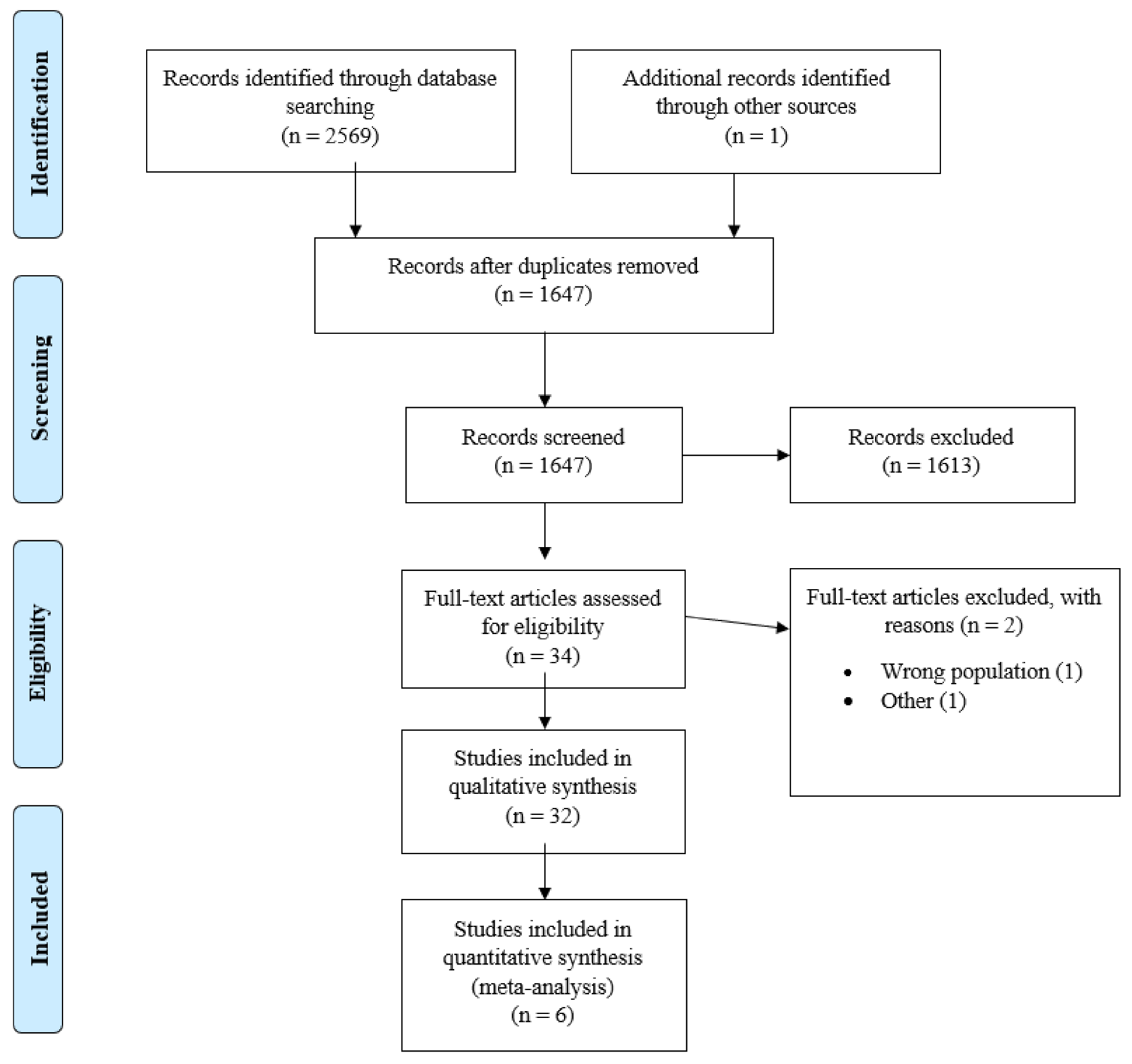
3.1. Study Selection and Characteristics of the Studies Included
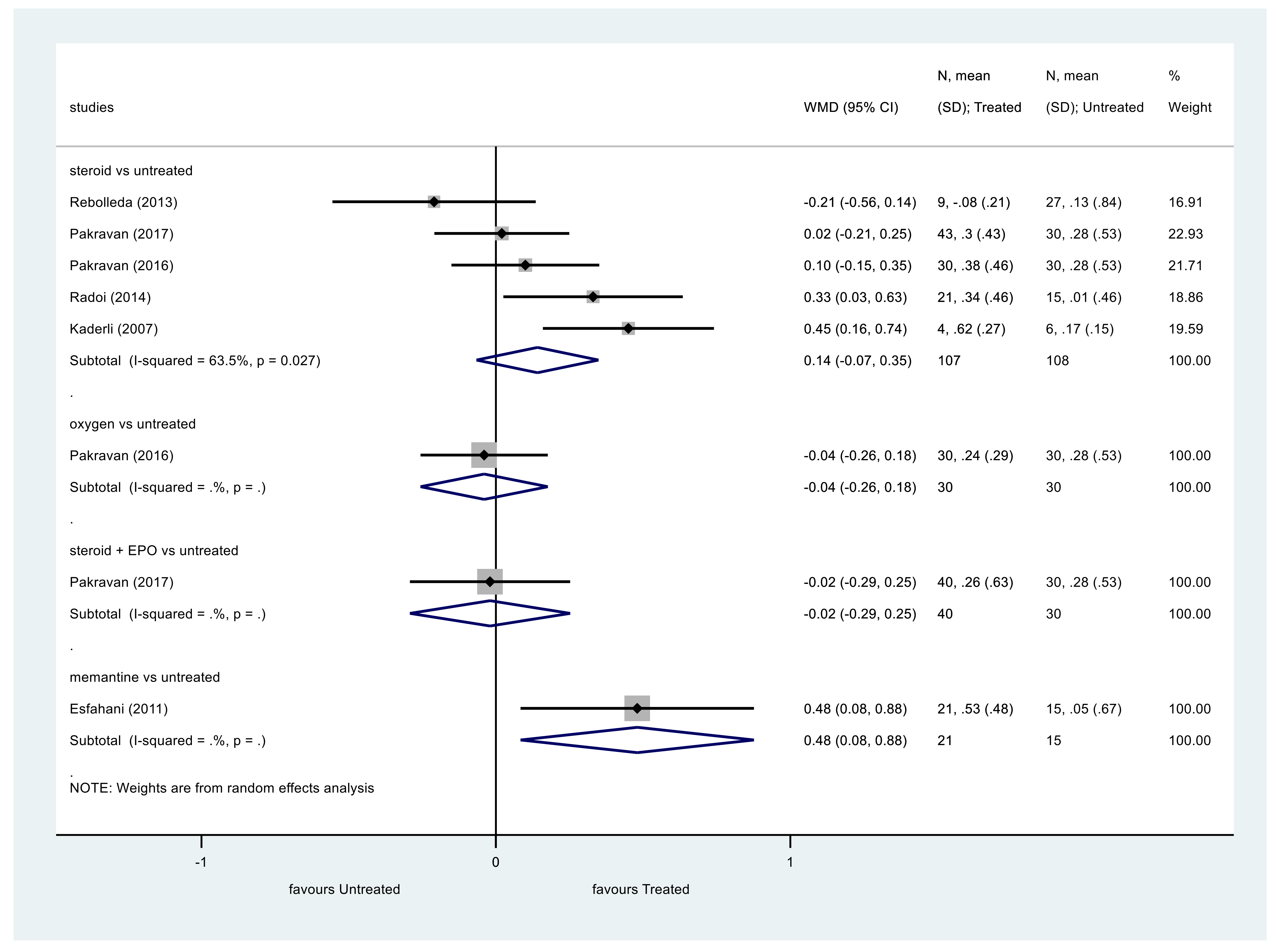
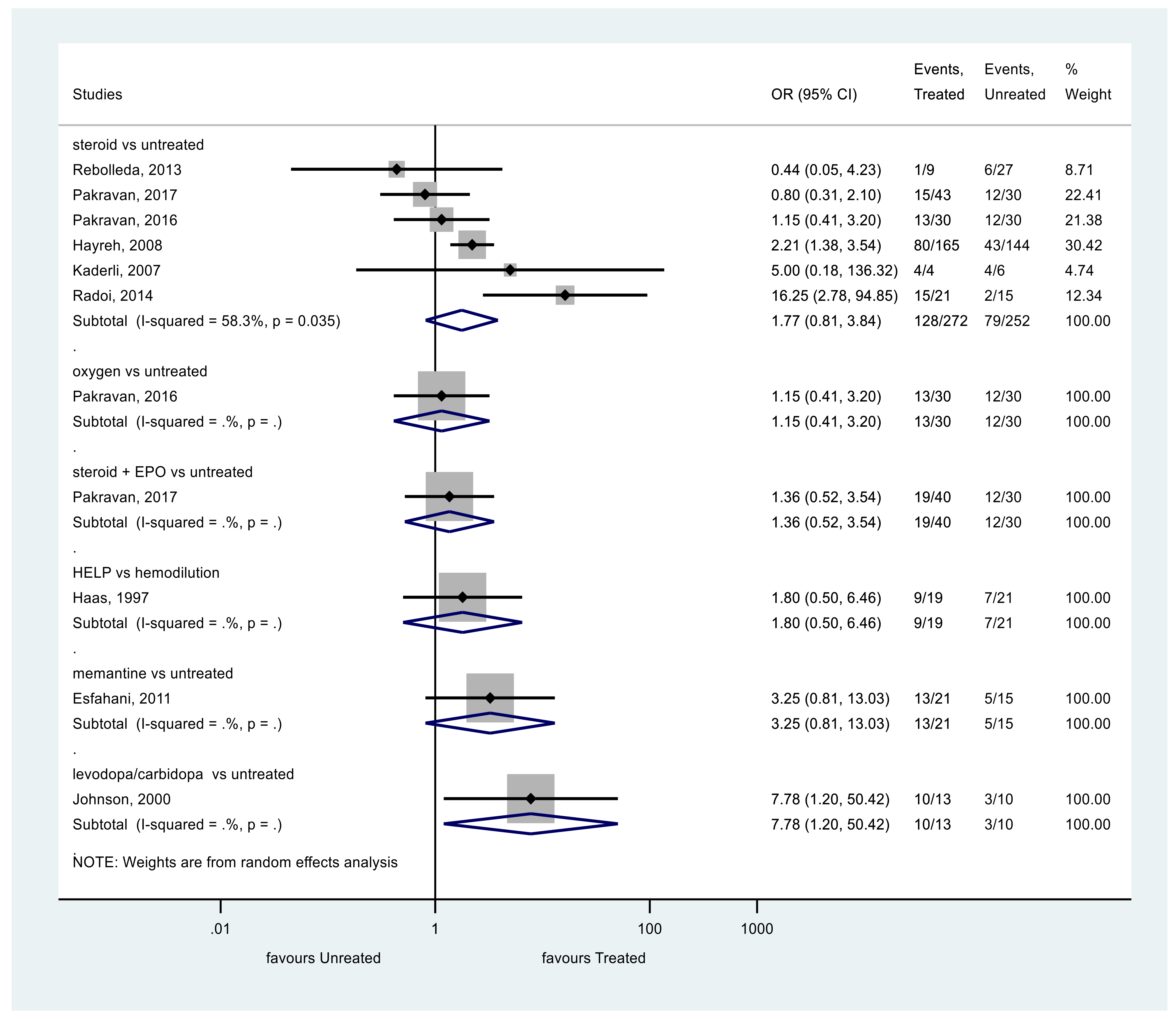
3.2. Effects of Steroid Therapy on Visual Acuity
3.3. Effects of other Therapies on Visual Acuity
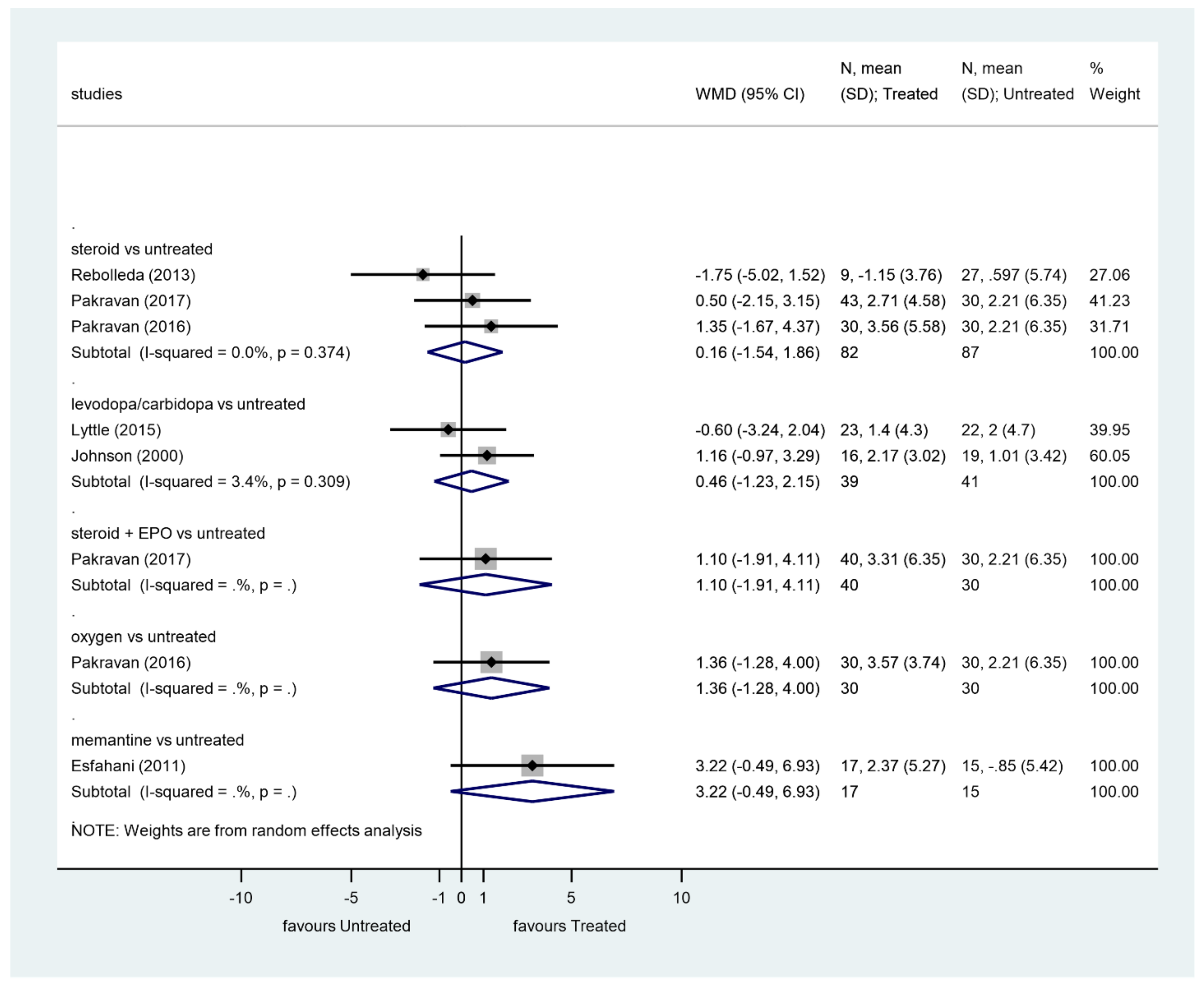
3.4. Effects of Therapies on Visual Field (VF)
3.5. GRADE of Evidence, Risk of Bias Assessment, and Publication Bias
4. Discussion
4.1. Steroid and NAION
4.2. Levodopa/Carbidopa and NAION
4.3. EPO and NAION
4.4. Brimonidine and NAION
4.5. Memantine and NAION
4.6. Heparin-Induced Extracorporeal LDL/Fibrinogen Precipitation and NAION
4.7. Anticoagulants and Thrombolytics
4.8. Limitations
5. Conclusions
Supplementary Materials
Author Contributions
Funding
Institutional Review Board Statement
Informed Consent Statement
Acknowledgments
Conflicts of Interest
References
- Pakravan, M.; Sanjari, N.; Esfandiari, H.; Pakravan, P.; Yaseri, M. The effect of high-dose steroids, and normobaric oxygen therapy, on recent onset non-arteritic anterior ischemic optic neuropathy: A randomized clinical trial. Graefe’s Arch. Clin. Exp. Ophthalmol. 2016, 254, 2043–2048. [Google Scholar] [CrossRef] [PubMed]
- Judit Somlai, T.K.E. Neuro-Ophthalmology, Vascular Diseases of the Optic Nerve: The Neuro-Ophthalmologist’s Approach; Springer International Publishing: Cham, Switzerland, 2016; p. 395. [Google Scholar]
- Atkins, E.J.; Bruce, B.; Newman, N.J.; Biousse, V. Treatment of Nonarteritic Anterior Ischemic Optic Neuropathy. Surv. Ophthalmol. 2010, 55, 47–63. [Google Scholar] [CrossRef] [PubMed]
- Rebolleda, G.; Pérez-López, M.; Casas-Llera, P.; Contreras, I.; Muñoz-Negrete, F.J. Visual and anatomical outcomes of non-arteritic anterior ischemic optic neuropathy with high-dose systemic corticosteroids. Graefe’s Arch. Clin. Exp. Ophthalmol. 2013, 251, 255–260. [Google Scholar] [CrossRef] [PubMed]
- Pakravan, M.; Esfandiari, H.; Hassanpour, K.; Razavi, S.; Pakravan, P. The Effect of Combined Systemic Erythropoietin and Steroid on Non-arteritic Anterior Ischemic Optic Neuropathy: A Prospective Study. Curr. Eye Res. 2017, 42, 1079–1084. [Google Scholar] [CrossRef] [PubMed]
- Kinori, M.; Ben-Bassat, I.; Wasserzug, Y.; Chetrit, A.; Huna-Baron, R. Visual outcome of mega-dose intravenous corticosteroid treatment in non-arteritic anterior ischemic optic neuropathy–retrospective analysis. BMC Ophthalmol. 2014, 14, 62. [Google Scholar] [CrossRef]
- Steigerwalt, R.D.; Cesarone, M.R.; Belcaro, G.; Pascarella, A.; De Angelis, M.; Bacci, S. Nonarteritic anterior ischemic optic neuropathy treated with intravenous prostaglandin E1 and steroids. Int. J. Angiol. 2008, 17, 193–196. [Google Scholar] [CrossRef]
- Radoi, C.; Garcia, T.; Brugniart, C.; Ducasse, A.; Arndt, C. Intravitreal triamcinolone injections in non-arteritic anterior ischemic optic neuropathy. Graefe’s Arch. Clin. Exp. Ophthalmol. 2013, 252, 339–345. [Google Scholar] [CrossRef]
- Kaderli, B.; Avci, R.; Yucel, A.; Guler, K.; Gelisken, O. Intravitreal Triamcinolone Improves Recovery of Visual Acuity in Nonarteritic Anterior Ischemic Optic Neuropathy. J. Neuro-Ophthalmol. 2007, 27, 164–168. [Google Scholar] [CrossRef] [PubMed]
- Hayreh, S.S.; Zimmerman, M.B. Non-arteritic anterior ischemic optic neuropathy: Role of systemic corticosteroid therapy. Graefe’s Arch. Clin. Exp. Ophthalmol. 2008, 246, 1029–1046. [Google Scholar] [CrossRef]
- Saxena, R.; Singh, D.; Sharma, M.; James, M.; Sharma, P.; Menon, V. Steroids versus No Steroids in Nonarteritic Anterior Ischemic Optic Neuropathy: A Randomized Controlled Trial. Ophthalmology 2018, 125, 1623–1627. [Google Scholar] [CrossRef]
- Vidović, T.; Cerovski, B.; Perić, S.; Kordić, R.; Mrazovac, D. Corticosteroid therapy in patients with non-arteritic anterior ischemic optic neuropathy. Coll. Antropol. 2015, 39, 63–66. [Google Scholar]
- Yaman, A.; Selver, O.B.; Saatci, A.O.; Soylev, M.F. Intravitreal triamcinolone acetonide injection for acute non-arteritic anterior ischaemic optic neuropathy. Clin. Exp. Optom. 2008, 91, 561–564. [Google Scholar] [CrossRef] [PubMed]
- Prokosch, V.; Thanos, S. Visual outcome of patients following NAION after treatment with adjunctive fluocortolone. Restor. Neurol. Neurosci. 2014, 32, 381–389. [Google Scholar] [CrossRef] [PubMed]
- Johnson, L.N.; Gould, T.J.; Krohel, G.B. Effect of Levodopa and Carbidopa on Recovery of Visual Function in Patients With Nonarteritic Anterior Ischemic Optic Neuropathy of Longer Than Six Months’ Duration. Am. J. Ophthalmol. 1996, 121, 77–83. [Google Scholar] [CrossRef]
- Simsek, T.; Eryilmaz, T.; Acaroglu, G. Efficacy of levodopa and carbidopa on visual function in patients with non-arteritic anterior ischaemic optic neuropathy. Int. J. Clin. Pr. 2005, 59, 287–290. [Google Scholar] [CrossRef]
- Johnson, L.N.; E Guy, M.; Krohel, G.B.; Madsen, R.W. Levodopa may improve vision loss in recent-onset, nonarteritic anterior ischemic optic neuropathy. Ophthalmology 2000, 107, 521–526. [Google Scholar] [CrossRef]
- Lyttle, D.P.; Johnson, L.N.; Margolin, E.A.; Madsen, R.W. Levodopa as a possible treatment of visual loss in nonarteritic anterior ischemic optic neuropathy. Graefe’s Arch. Clin. Exp. Ophthalmol. 2016, 254, 757–764. [Google Scholar] [CrossRef]
- Modarres, M.; Falavarjani, K.G.; Nazari, H.; Sanjari, M.S.; Aghamohammadi, F.; Homaii, M.; Samiy, N. Intravitreal erythropoietin injection for the treatment of non-arteritic anterior ischaemic optic neuropathy. Br. J. Ophthalmol. 2011, 95, 992–995. [Google Scholar] [CrossRef]
- Fazzone, H.E.; Kupersmith, M.J.; Leibmann, J. Does topical brimonidine tartrate help NAION? Br. J. Ophthalmol. 2003, 87, 1193–1194. [Google Scholar] [CrossRef]
- The BRAION study group; Wilhelm, B.; Lüdtke, H.; Wilhelm, H. Efficacy and tolerability of 0.2% brimonidine tartrate for the treatment of acute non-arteritic anterior ischemic optic neuropathy (NAION): A 3-month, double-masked, randomised, placebo-controlled trial. Graefe’s Arch. Clin. Exp. Ophthalmol. 2005, 244, 551–558. [Google Scholar] [CrossRef]
- Riazi, E.M.; Aalami, H.Z.; Kiumehr, S.; Gholmi, A.; Tabasi, A.; Piri, N.; Mirshahi, A.; Nili, A.M.; Movassat, M.; Fakhraee, G. Memantine treatment in acute nonarteric anterior ischemic optic neuropathy: A Randomized Clinical Trial. J. Curr. Ophthalmol. 2011, 23, 11–20. [Google Scholar]
- Aftab, A.M.; Iqbal, M.; Rauf, A.; Ali, A. Non arteritic anterior ischemic optic neuropathy; does Anticoagulation help? J. Ayub Med Coll. Abbottabad 2017, 28, 776–780. [Google Scholar]
- Haas, A.; Walzl, M.; Jesenik, F.; Walzl, B.; Berghold, A.; Berglöff, J.; Feigl, B.; Faulborn, J. Application of HELP in nonarteritic anterior ischemic optic neuropathy: A prospective, randomized, controlled study. Graefe’s Arch. Clin. Exp. Ophthalmol. 1997, 235, 14–19. [Google Scholar] [CrossRef] [PubMed]
- Ramunni, A.; Giancipoli, G.; Guerriero, S.; Lapenna, L.; Saracino, A.; Saliani, M.T.; Capurso, A.; Sborgia, C.; Coratelli, P. LDL-Apheresis Accelerates the Recovery of Nonarteritic Acute Anterior Ischemic Optic Neuropathy. Ther. Apher. Dial. 2005, 9, 53–58. [Google Scholar] [CrossRef] [PubMed]
- Guerriero, S.; Giancipoli, G.; Cantatore, A.; Sacco, G.; Brescia, P.; Saliani, M.T.; Ramunni, A.; Guerriero, G.G.S. LDL apheresis in the treatment of non-arteritic ischaemic optic neuropathy: A 6-month follow-up study. Eye 2008, 23, 1343–1344. [Google Scholar] [CrossRef] [PubMed][Green Version]
- Bajin, M.S.; Selver, O.B.; Taskin, O.; Yaman, A.; Saatci, A.O. Single intravitreal ranibizumab injection in eyes with acute non-arteritic anterior ischaemic optic neuropathy. Clin. Exp. Optom. 2011, 94, 367–370. [Google Scholar] [CrossRef] [PubMed]
- Saatci, A.O.; Taskin, O.; Selver, O.B.; Yaman, A.; Bajin, M.S. Efficacy of Intravitreal Ranibizumab Injection in Acute Nonarteritic Ischemic Optic Neuropathy: A Long-Term Follow Up§. Open Ophthalmol. J. 2013, 7, 58–62. [Google Scholar] [CrossRef]
- Rootman, D.B.; Gill, H.S.; A Margolin, E. Intravitreal bevacizumab for the treatment of nonarteritic anterior ischemic optic neuropathy: A prospective trial. Eye 2013, 27, 538–544. [Google Scholar] [CrossRef]
- Moher, D.; Shamseer, L.; Clarke, M.; Ghersi, D.; Liberati, A.; Petticrew, M.; Shekelle, P.; Stewart, L.A.; PRISMA-P Group. Preferred reporting items for systematic review and meta-analysis protocols (PRISMA-P) 2015 statement. Syst. Rev. 2015, 4, 1. [Google Scholar] [CrossRef]
- Higgins, J.P.; Thomas, J.; Chandler, J.; Cumpston, M.; Li, T.; Page, M.J.; Welch, V.A. (Eds.) Cochrane Handbook for Systematic Reviews of Interventions; Version 6.1; updated September 2020; Cochrane: Oxford, UK, 2020. [Google Scholar]
- DerSimonian, R.; Laird, N. Meta-analysis in clinical trials. Control. Clin. Trials 1986, 7, 177–188. [Google Scholar] [CrossRef]
- Holladay, J.T. Proper method for calculating average visual acuity. J. Refract. Surg. 1997, 13, 388–391. [Google Scholar] [CrossRef]
- Sweeting, M.J.; Sutton, A.; Lambert, P.C. What to add to nothing? Use and avoidance of continuity corrections in meta-analysis of sparse data. Stat. Med. 2004, 23, 1351–1375. [Google Scholar] [CrossRef] [PubMed]
- Higgins, J.P.; Altman, D.G.; Gøtzsche, P.C.; Jüni, P.; Moher, D.; Oxman, A.D.; Savović, J.; Schulz, K.F.; Weeks, L.; Sterne, J.A. The Cochrane Collaboration’s tool for assessing risk of bias in randomised trials. BMJ 2011, 343, d5928. [Google Scholar] [CrossRef] [PubMed]
- Sterne, J.A.; Hernán, M.A.; McAleenan, A.; Reeves, B.C.; Higgins, J.P. Chapter 25: Assessing risk of bias in a non-randomized study. In Cochrane Handbook for Systematic Reviews of Interventions version 6.1 (updated September 2020); Higgins, J.P.T., Thomas, J., Chandler, J., Cumpston, M., Li, T., Page, M.J., Welch, V.A., Eds.; Cochrane: Oxford, UK, 2020. [Google Scholar]
- Guyatt, G.H.; Oxman, A.D.; Vist, G.E.; Kunz, R.; Falck-Ytter, Y.; Alonso-Coello, P.; Schünemann, H.J. GRADE: An emerging consensus on rating quality of evidence and strength of recommendations. BMJ 2008, 336, 924–926. [Google Scholar] [CrossRef] [PubMed]
- Hayreh, S.S.; Zimmerman, M.B. Nonarteritic Anterior Ischemic Optic Neuropathy: Natural History of Visual Outcome. Ophthalmology 2008, 115, 298–305.e2. [Google Scholar] [CrossRef] [PubMed]
- Prescott, C.R.; Sklar, C.A.; Lesser, R.L.; Adelman, R.A. Is Intravitreal Bevacizumab an Effective Treatment Option for Nonarteritic Anterior Ischemic Optic Neuropathy? J. Neuro-Ophthalmol. 2012, 32, 51–53. [Google Scholar] [CrossRef]
- Haas, A.; Uyguner, I.; Sochor, G.; Schmut, O.; Vidic, B.; Faulborn, J. Nichtarteriitische vordere ischämische Optikusneuropathie: Langzeitergebnisse nach Hämodilutionstherapie. Klin. Mon. Für Augenheilkd. 1994, 205, 143–146. [Google Scholar] [CrossRef]
- Bojić, L.; Kovacević, H.; Andrić, D.; Karaman-Kraljević, K.; Cagalj, S. The effects of hyperbaric oxygen on visual functions in ischaemic optic neuropathy. Arch. Ind. Hyg. Toxicol. 1994, 45, 19–24. [Google Scholar]
- Sanjari, N.; Pakravan, M.; Nourinia, R.; Esfandiari, H.; Hafezi-Moghadam, A.; Zandi, S.; Nakao, S.; Shah-Heidari, M.-H.; Jamali, A.; Yaseri, M.; et al. Intravitreal Injection of a Rho-Kinase Inhibitor (Fasudil) for Recent-Onset Nonarteritic Anterior Ischemic Optic Neuropathy. J. Clin. Pharmacol. 2015, 56, 749–753. [Google Scholar] [CrossRef]
- Chen, J.; Zhu, J.; Chen, L.; Hu, C.; Du, Y. Steroids in the treatment of nonarteritic anterior ischemic optic neuropathy: A PRISMA-compliant meta-analysis. Medicine (Baltimore) 2019, 98, e17861. [Google Scholar] [CrossRef]
- Mac Grory, B.; Lavin, P.; Kirshner, H.; Schrag, M. Thrombolytic Therapy for Acute Central Retinal Artery Occlusion. Stroke 2020, 51, 687–695. [Google Scholar] [CrossRef] [PubMed]

| Study, Year | Study Design | Interventions | No.of Participants | VA Follow-Up (Months) |
|---|---|---|---|---|
| Rebodella et al., 2013 [4] | retrospective cohort study | prednisolone PO | 10 | 6 |
| untreated | 27 | |||
| Pakravan et al., 2016 [1] | randomized clinical trial | iv. methylprednisolone, prednisolone PO | 30 | 6 |
| 100% normobaric oxygen | 30 | |||
| untreated | 30 | |||
| Kinori et al., 2014 [6] | retrospective cohort study | iv. methylprednisolone, prednisolone PO | 24 | 22 |
| untreated | 24 | 36 | ||
| Steigerwalt et al., 2008 [7] | prospective cohort study | i.v methylprednisolone+ PGE1 | 8 | 6 |
| prednisolone PO | 7 | |||
| Pakravan et al., 2017 [5] | prospective cohort study | iv. methylprednisolone + EPO, prednisolone PO | 40 | 6 |
| iv. methylprednisolone, prednisolone PO | 43 | |||
| untreated | 30 | |||
| Radio et al., 2014 [8] | retrospective cohort study | intravitreal triamcinolone | 21 | 6 |
| untreated | 15 | |||
| Kaderli et al., 2007 [9] | retrospective cohort study | intravitreal triamcinolone | 4 | 12–15 |
| untreated | 6 | 9–12 | ||
| Hayreh et al., 2008/1 [10] | retrospective cohort study | prednisolone PO | 312 | 6 |
| Hayreh et al., 2008/2 [38] | untreated | 301 | ||
| Saxena et al., 2018 [11] | randomized, double-blind placebo-controlled trial | prednisolone PO | 19 | 6 |
| untreated | 19 | |||
| Prokosch et al., 2014 [14] | randomized controlled trial | iv+per os pentoxifylline | 30 | 6 |
| iv+per os pentoxifylline + fluocortolone | 30 | |||
| Vidovic et al., 2015 [12] | prospective case series | methylprednisolone PO | 38 | 6 |
| Yaman et al., 2008 [13] | case series | intravitreal triamcinolone | 4 | 3 |
| Modarres et al., 2011 [19] | prospective case series | intravitreal EPO | 31 | 6 |
| Johnson et al., 1996 [15] | randomized, double-masked placebo-controlled trial | levodopa/carbidopa | 10 | 6 |
| untreated | 10 | |||
| Lyttle et al., 2015 [18] | retrospective cohort study | levodopa/carbidopa | 33 | 8 |
| untreated | 26 | |||
| Simsek et al., 2005 [16] | randomized, placebo-controlled trial | levodopa/carbidopa | 12 | 11 |
| untreated | 12 | 10 | ||
| Johnson et al., 2000 [17] | retrospective cohort study | levodopa/carbidopa | 18 | 6 |
| untreated | 19 | |||
| Bajin et al., 2011 [27] | retrospective case series | intravitreal ranibizumab | 4 | 3 |
| Saatsi et al., 2013 [28] | retrospective case series | intravitreal ranibizumab | 17 | 12 |
| Prescott et al., 2012 [39] | retrospective case series | intravitreal bevacizumab | 5 | inconsistent |
| Rootman et al., 2013 [29] | non-randomized controlled trial | intravitreal bevacizumab | 17 | 6 |
| untreated | 8 | |||
| Fazzone et al., 2003 [20] | retrospective cohort study | topical brimonidine | 14 | 2–3 |
| untreated | 17 | |||
| Wilhelm et al., 2006 [21] | randomized, double masked, placebo-controlled trial | topical brimonidine | 11 | 3–3,5 |
| untreated | 18 | |||
| Haas et al., 1997 [24] | randomized, controlled trial | HELP | 19 | 3 |
| hemodilution | 21 | |||
| Ramunni et al., 2005 [25] | case series | HELP | 11 | 3 |
| Haas et al., 1994 [40] | retrospective case series | hemodilution | 24 | 24 |
| Guerriero et al., 2009 [26] | prospective case series | LDL apheresis | 10 | 6 |
| conventional therapy | 10 | |||
| Bojic et al., 1994 [41] | case series | hyperbaric oxygen | 9 | 6 |
| Aftab et al., 2006 [23] | prospective interventional pilot study | iv Heparin, Warfarin PO | 24 | 6 |
| Sanjari et al., 2016 [42] | case series | intravitreal Fasudil | 13 | 3 |
| Esfahani et al., 2011 [22] | randomized, double-masked controlled trial | memantine PO | 25 | 6 |
| untreated | 22 |
| Therapy | VA (as Continuous Variable) | VA (as Categorical Variable) | VF |
|---|---|---|---|
| Steroid | Did not improve | Did not improve | Did not improve |
| oxygen | Did not improve | Did not improve | Did not improve |
| EPO+steroid | Did not improve | Did not improve | Did not improve |
| memantine | Improved | Did not improve | Did not improve |
| Levodopa/carbidopa | Improved | Did not improve | |
| HELP | Did not improve |
| Outcomes | Anticipated Absolute Effects * (95% CI) | Relative Effect (95% CI) | No. of Participants (Studies) | Certainty of the Evidence (GRADE) | Comments | |
|---|---|---|---|---|---|---|
| Risk with Untreated | Risk with Treated | |||||
| Steroid vs. untreated follow up: range 6 months to 15 months | The mean steroid vs. untreated was 0 logMAR | WMD 0.14 logMAR higher (0.07 lower to 0.35 higher) | - | 215 (5 observational studies) | ⨁◯◯◯ VERY LOW a,b,c | |
| Oxygen vs. untreated | The mean oxygen vs. untreated was 0 | WMD 0.04 lower (0.26 lower to 0.18 higher) | - | 60 (1 RCT) | ⨁◯◯◯ VERY LOW d,e | |
| Steroid+EPO vs. untreated | The mean steroid+EPO vs. untreated was 0 | WMD 0.02 lower (0.29 lower to 0.25 higher) | - | 70 (1 observational study) | ⨁◯◯◯ VERY LOW d,e | |
| Memantine vs. untreated | The mean memantine vs. untreated was 0 | WMD 0.48 higher (0.08 higher to 0.88 higher) | - | 36 (1 RCT) | ⨁◯◯◯ VERY LOW d,e | |
| GRADE Working Group grades of evidence High certainty: We are very confident that the true effect lies close to that of the estimate of the effect. Moderate certainty: We are moderately confident in the effect estimate: The true effect is likely to be close to the estimate of the effect, but there is a possibility that it is substantially different. Low certainty: Our confidence in the effect estimate is limited: The true effect may be substantially different from the estimate of the effect. Very low certainty: We have very little confidence in the effect estimate: The true effect is likely to be substantially different from the estimate of effect. | ||||||
| Outcome No. of Participants (Studies) | Relative Effect (95% CI) * | Anticipated Absolute Effects (95% CI) | Certainty | ||
|---|---|---|---|---|---|
| Control | Treated | Difference | |||
| Steroid vs. untreated—assessed as a categorical variable (Visual Acuity) follow up: range 6 months to 15 months № of participants: 544 (6 observational studies) | OR 1.77 (0.81 to 3.84) | 29.0% | 42.0% (24.9 to 61.1) | 13.0% more (4.1 fewer to 32.1 more) | ⨁◯◯◯ VERY LOW a,b,c |
| Oxygen vs. untreated № of participants: 60 (1 RCT) | OR 1.15 (0.41 to 3.20) | 40.0% | 43.4% (21.5 to 68.1) | 3.4% more (18.5 fewer to 28.1 more) | ⨁◯◯◯ VERY LOW d,e |
| Steroid+EPO vs. untreated № of participants: 70 (1 observational study) | OR 1.36 (0.52 to 3.54) | 40.0% | 47.6% (25.7 to 70.2) | 7.6% more (14.3 fewer to 30.2 more) | ⨁◯◯◯ VERY LOW d,e |
| HELP vs. hemodilution № of participants: 40 (1 observational study) | OR 1.80 (0.50 to 6.46) | 33.3% | 47.4% (20 to 76.4) | 14.0% more (13.3 fewer to 43 more) | ⨁◯◯◯ VERY LOW d,e |
| Memantine vs. untreated № of participants: 36 (1 RCT) | OR 3.25 (0.81 to 13.30) | 33.3% | 61.9% (28.8 to 86.9) | 28.6% more (4.5 fewer to 53.6 more) | ⨁◯◯◯ VERY LOW d,e |
| Levodopa/carbidopa vs. untreated № of participants: 23 (1 observational study) | OR 7.78 (1.20 to 50.42) | 30.0% | 76.9% (34 to 95.6) | 46.9% more (4 more to 65.6 more) | ⨁◯◯◯ VERY LOW d,e |
| GRADE Working Group grades of evidence High certainty: We are very confident that the true effect lies close to that of the estimate of the effect. Moderate certainty: We are moderately confident in the effect estimate: The true effect is likely to be close to the estimate of the effect, but there is a possibility that it is substantially different. Low certainty: Our confidence in the effect estimate is limited: The true effect may be substantially different from the estimate of the effect. Very low certainty: We have very little confidence in the effect estimate: The true effect is likely to be substantially different from the estimate of effect. | |||||
| Outcomes | Anticipated Absolute Effects * (95% CI) | Relative Effect (95% CI) | No. of Participants (Studies) | Certainty of the Evidence (GRADE) | Comments | |
|---|---|---|---|---|---|---|
| Risk with Untreated | Risk with Treatment | |||||
| Pentoxiphilline+steroid vs. pentoxyphilline | The mean pentoxiphilline+steroid vs. pentoxyphilline was 0 | WMD 3.2 lower (4 lower to 2.4 lower) | - | 49 (1 observational study) | ⨁◯◯◯ VERY LOW a,b,c | |
| Steroid vs. untreated | The mean steroid vs. untreated was 0 | WMD 0.16 higher (1.54 lower to 1.86 higher) | - | 169 (3 observational studies) | ⨁⨁◯◯ LOW c,d | |
| Levodopa/carbidopa vs. untreated | The mean levodopa/carbidopa vs. untreated was 0 | WMD 0.46 higher (1.23 lower to 2.15 higher) | - | 80 (2 observational studies) | ⨁◯◯◯ VERY LOW c,e | |
| Steroid+EPO vs. untreated | The mean steroid+EPO vs. untreated was 0 | WMD 1.1 higher (1.91 lower to 4.11 higher) | - | 70 (1 observational study) | ⨁◯◯◯ VERY LOW b,c | |
| Oxygen vs. untreated | The mean oxygen vs. untreated was 0 | WMD 1.36 higher (1.28 lower to 4 higher) | - | 60 (1 RCT) | ⨁◯◯◯ VERY LOW b,c | |
| Memantine vs. untreated | The mean memantine vs. untreated was 0 | WMD 3.22 higher (0.49 lower to 6.93 higher) | - | 32 (1 RCT) | ⨁◯◯◯ VERY LOW b,c | |
| GRADE Working Group grades of evidence High certainty: We are very confident that the true effect lies close to that of the estimate of the effect. Moderate certainty: We are moderately confident in the effect estimate: The true effect is likely to be close to the estimate of the effect, but there is a possibility that it is substantially different. Low certainty: Our confidence in the effect estimate is limited: The true effect may be substantially different from the estimate of the effect. Very low certainty: We have very little confidence in the effect estimate: The true effect is likely to be substantially different from the estimate of effect. | ||||||
Publisher’s Note: MDPI stays neutral with regard to jurisdictional claims in published maps and institutional affiliations. |
© 2022 by the authors. Licensee MDPI, Basel, Switzerland. This article is an open access article distributed under the terms and conditions of the Creative Commons Attribution (CC BY) license (https://creativecommons.org/licenses/by/4.0/).
Share and Cite
Lantos, K.; Dömötör, Z.R.; Farkas, N.; Kiss, S.; Szakács, Z.; Garami, A.; Varga, G.; Lujber, L.; Kanaan, R.; Hegyi, P.; et al. Efficacy of Treatments in Nonarteritic Ischemic Optic Neuropathy: A Systematic Review and Meta-Analysis. Int. J. Environ. Res. Public Health 2022, 19, 2718. https://doi.org/10.3390/ijerph19052718
Lantos K, Dömötör ZR, Farkas N, Kiss S, Szakács Z, Garami A, Varga G, Lujber L, Kanaan R, Hegyi P, et al. Efficacy of Treatments in Nonarteritic Ischemic Optic Neuropathy: A Systematic Review and Meta-Analysis. International Journal of Environmental Research and Public Health. 2022; 19(5):2718. https://doi.org/10.3390/ijerph19052718
Chicago/Turabian StyleLantos, Krisztina, Zsuzsa Réka Dömötör, Nelli Farkas, Szabolcs Kiss, Zsolt Szakács, András Garami, Gábor Varga, László Lujber, Reem Kanaan, Péter Hegyi, and et al. 2022. "Efficacy of Treatments in Nonarteritic Ischemic Optic Neuropathy: A Systematic Review and Meta-Analysis" International Journal of Environmental Research and Public Health 19, no. 5: 2718. https://doi.org/10.3390/ijerph19052718
APA StyleLantos, K., Dömötör, Z. R., Farkas, N., Kiss, S., Szakács, Z., Garami, A., Varga, G., Lujber, L., Kanaan, R., Hegyi, P., Fehér, G., & Gaál, V. (2022). Efficacy of Treatments in Nonarteritic Ischemic Optic Neuropathy: A Systematic Review and Meta-Analysis. International Journal of Environmental Research and Public Health, 19(5), 2718. https://doi.org/10.3390/ijerph19052718

