


Abstract
As a result of rapid urbanization and urban sprawl, natural ecosystems are shrinking or are fragmented, affecting people’s health and quality of life. Modern people prefer to live in large cities rather than rural areas because of greater convenience and more comfortable living conditions. As a consequence, people are suffering from many psycho-physiological health problems and have a longing for natural environments to escape the concrete jungle. Forest therapy has emerged as a preventive and alternative therapy to cope with stress and enhance people’s health and wellbeing as a result of spending time in a green and healthy environment. Here, we review the activities related to forest therapy in China and discuss the commonalities and differences between the forest therapy types. Furthermore, we summarize the current achievements of forest therapy in basic research and the development of the forest therapy industry. We also describe the challenges that forest therapy has been facing. Finally, we provide suggestions for further development in research and industry.
Keywords:
forest therapy; definition; public health; forest wellness; challenges; policy suggestions As a result of rapid urbanization and urban sprawl, natural ecosystems, such as forests, green spaces, and water bodies, are adversely affected, are shrinking, or are fragmented [1,2,3], leading to changes in the structure and function of natural systems near urban areas [4,5,6]. Environmental pollution, food security, and work pressure influence people’s health and quality of life [7,8]. As people are becoming increasingly aware of their psycho-physiological health, they have a desire to escape the concrete jungle and long for a natural environment.
Forests have always played an important role on satisfying the demand for natural environments. Research has demonstrated that a forest environment has positive influences on human health [9,10,11]. When people are walking in forests or green spaces, nature helps them to regain attention and focus, improve their psychological state, and feel free and relaxed [12,13,14]. Recent medical studies have shown that forest environments provide benefits, such as lowering blood pressure, pulse rate, and sympathetic nerve activity, decreasing salivary cortisol concentrations of stress hormones, and increasing natural killer (NK) cell activity [7,15,16,17]. Therefore, forests are being viewed increasingly as being beneficial to people’s health rather than only providing timber.
Philosophical theory about the relationship between human and nature have existed since ancient times in China. People using plant and nature as a medical treatment to promote their psycho-physiological health have been highlighted. The Taoist Culture of Pre-Qin Dynasty is one of the essences of Chinese traditional culture, containing the ecological wisdom of the relationship between human health and nature [18]. The philosopher Lao Zi encouraged people to learn from nature, Zhuang Zi believes that nature is the mother of all things. They advised people to integrate their mind into nature, achieved sublimate spiritual comfort, and got the harmony between humans and nature. In traditional Chinese medicine, plants and forests have a long tradition of being used as medicine materials or backdrop to promote human health, the health preserving theory of “Nourishing yang in spring and summer, while nourishing yin in autumn and winter” has been widely used since the beginning of Yellow Emperor’ Internal Classic [19].
In recent years, over 30 percent of adults suffer from obesity, diabetes, hypertension, and other lifestyle diseases in China [20]. Driven by evidence-based research, people pay attention to the prevention and treatment effect of forests on lifestyle diseases. Forest therapy has emerged as a preventive and alternative therapy to cope with stress and enhances people’s health and wellbeing by way of spending time in a green and healthy environment [15]. However, in China, forest therapy has not been clearly defined to date, and forest therapy activities are often confused with other green fitness activities. Therefore, we review different types of forest therapy in China, describe their current status, challenges, and suggestions for further development.
1. Definitions of Forest Therapy
Forest therapy activities in China include forest rehabilitation and recreation, forest healthcare, forest tourism, forest experiences, and forest wellness. The commonalities among these activities are the forest environment, which provides the setting, and the goal of health promotion, whereas the differences are the paths used to achieve the goal.
1.1. Forest Rehabilitation and Recreation
Different government departments and scholars have defined forest rehabilitation and recreation in different ways based on their understanding and perspectives. Wu et al. [21] defined forest rehabilitation and recreation in a broad and narrow sense, respectively. In a narrow sense, it is defined as activities occurring in a high-quality forest environment benefitting people’s physical and mental health. This activities of forest rehabilitation and recreation is based on existing health theories and is supported by traditional and modern medicine, including forest healthcare, rehabilitation, recovery, health maintenance, wellness, as well as recreation, travel, and outings. In a broad sense, it refers to all activities to maintain, sustain, and restore human health occurring in a forest environment.
In March 2019, the State Forestry and Grassland Administration (SFGA), the Ministry of Civil Affairs (MCA), the National Health Commission (NHC), and the State Administration of Traditional Chinese Medicine (SATCM) jointly published the Opinions on Promoting the Development of Forest rehabilitation and recreation Industry. This report defined forest rehabilitation and recreation as a series of service activities conducted in the forest environment for the purpose of promoting public health, the forest resources, landscape resources, food and drug resources, and cultural resources were utilized and these activities integrated with medicine and health care science for health care, rehabilitation, and elderly care.
In summary, the important words in the definitions are “quality forest + medical and health care + physical and mental health”, meanwhile different types of activities are used for enhancing health, such as sports, entertainment, and outings.
1.2. Forest Healthcare
There is no clear and consistent definition of forest healthcare in China, but the following elements are included: (1) forest medicine as the core and evidence-based medical research as the foundation; (2) conducted in a forest environment; (3) focused on disease prevention, stress relief, and health promotion [21,22].
Considering these elements, we believe that forest healthcare represents a sound approach to prevent and cure disease in a forest environment. When forest healthcare is used as a preventive therapy, the health-promoting functions of forests have been proven by medical experiments, and the activities of forest healthcare are conducted under the guidance of doctors or therapists. More importantly, the forest environment for healthcare has two objectives: to stimulate the five senses of humans and have a positive effect on the human body.
1.3. Forest Tourism
Forest tourism is a type of eco-tourism and popular recreational activity in China because it meets people’s needs for a green and healthy life. Forest tourism has become an important pillar of the tertiary industry and refers to tourism activities in a forest landscape [23]. The landscape resources include not only animal and plant resources but also the eco-environment and cultural resources [24].
Forest tourism is a traditional approach for the use of forest resources. In short, it refers to any form of tourism activities in forests, either in a forest environment or by using forests as a backdrop [25]. Therefore, forest tourism can also be defined in a broad or narrow sense. Many people choose to walk, recreate, and have cook-outs in forests. In general, people regard forest tourism as an opportunity to get close to nature, and focus more on visual experiences [24].
1.4. Forest Experience
In China, forest experience is seen as an opportunity to understand nature. It expands forest tourism towards a participatory and interactive activity and gets people closer to forests.
Forest experience has been used as the general term for people’s activities focused on perceiving the forest and its environment through various senses in the Notice on Promoting Forest Experience and Forest Wellness Development proposed by SFGA (the former State Forestry Administration, SFA). Cheng et al. [26] described forest experience as a practice of using forest resources and forest landscape and guiding people to sense and understand the relationship between forest and human through sensual experience, thereby promoting physical and mental health and inspiring people to protect forests actively to achieve sustainable forest development. In forest experience, the infrastructures are built to enable recreation and enjoyment in forests, and the facilities and oral introductions are provided as a guide of exposing to forests and experiencing their beauty. Zhang et al. [27] categorized forest experiences into sightseeing, cognitive, and recreational experience.
Forest experience emphasizes the interaction between humans and nature, the collective participation of target groups, and the satisfaction of emotional needs [28].
1.5. Forest Wellness
Forest wellness is an emerging activity that combines human wellness and forest environment and was first proposed by SFGA in the Notice on Promoting Forest Experience and Forest Wellness Development. Forest wellness is based on a high-quality forest environment and green forest products, and it refers to all activities that improve people’s health and prevent, relieve, and cure diseases [23,29]. In simple words, forest wellness refers to forest-based activities to maintain health.
Forest wellness is often combined with the traditional Chinese medicine [30], and mineral hot springs in forests. Health maintenance programs have been developed to prevent disease and enhance psycho-physiological health [29].
Considering the current progress of forest therapy in China, we believe that among the five types of forest therapy, forest rehabilitation and recreation and forest healthcare best meet the international definition of forest therapy. Forest rehabilitation and recreation represents a relatively broad concept and may cover all the activities included in the five definitions. However, forest healthcare is the core of the five activities and is strongly focused on the instructions of doctors and medical evidence (Figure 1).
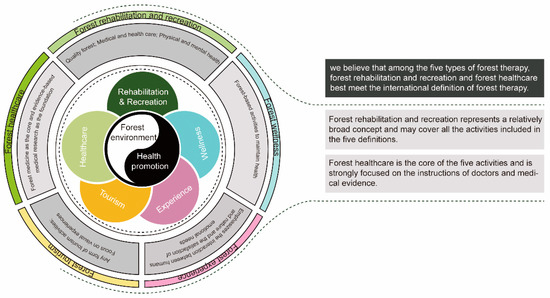
Figure 1.
Relationship between the five types of forest therapy.
2. Development and Current Status
After researching German forest therapy and Japanese Shinrin-yoku, in the 1980s, the Forestry Bureau of the Agriculture and Forestry Department of Taiwan, China and the researcher Liu published the books Forest Bathing—The Latest Fitness and Forest Bathing—Green Fitness in March and June of 1984, respectively. The two books systematically introduced the type, content, approach, case studies, and research of forest therapy in Germany, Japan, and the UK [31,32]. Subsequently, the concept of forest therapy was introduced, and a green fitness fashion swept over Taiwan, China.
In mainland China, the Foreign Project Cooperation Center (FPCC) of SFGA and the Beijing Municipal Bureau of Landscape and Forestry (BMBLF) introduced the Japanese concept and model of forest therapy in 2012. The BMBLF sponsored the translation and publishing of Li’s Forest Medicine (in Chinese) in 2013, which began the promotion and practice of forest therapy in mainland China. Today, significant achievements have been made in basic research and industry of forest therapy.
2.1. Basic Research
After the concept of Japanese forest therapy was introduced by the FPCC and BMBLF, researchers in China began to study the relationship between forest therapy and human health. Mao et al. [33] selected a group of male students (average age of 20.79 ± 0.54) as subjects of a 2-night forest therapy session and found that mid- and short-time exposure to an evergreen broad-leaved forest reduced oxidative stress and pro-inflammatory and serum cortisol levels. After seven days and nights under controlled test conditions in the forest, the patients’ blood pressure was significantly lowered, and negative emotions were reduced [34]. A pilot study in Guiyang found that exposure to forests relieved anxieties related to financial difficulties, exam pressure, and relationships [35]. Another study showed urban park scenes relieved stress and restored attention levels, whereas viewing urban roadways increased negative feelings [36]. In another study, elderly patients with chronic heart failure (CHF) who had experienced the first forest bathing trip were again recruited to a second 4-day forest bathing trip after 4 weeks. The study showed that a steady decline in the brain natriuretic peptide levels, and an attenuated inflammatory response as well as oxidative stress. The additive benefits of twice forest bathing trips in elderly patients with CHF were demonstrated [37]. Guan et al. [38] have investigated the effects of different tree species on anxiety alleviation. University students were recruited to visit urban forests dominated by birch (Bet¬ula platyphylla Suk.), maple (Acer triflorum Komarov), and oak (Quercus mongolica Fisch. ex Ledeb) trees. The results showed that the anxiety of the participants was reduced in the maple forest, the largest anxiety alleviation effects were observed in the birch forest, and female participants perceived more anxiety alleviation than male participants. This study provides information on the relationship between forest species and human health factors and guides the direction of future research.
From physiological and psychological perspectives, the evidence-based research findings pointed to a reduction in human oxidative stress, serum cortisol levels and blood pressure and an increase in relaxation for participants exposed to forests. Some studies involving the use of videos of nature had also confirmed the same psychological effects. In general, most studies, conducted by medical personnel, recruited the patients that are diagnosed with essential diseases as the participants. The methods of detecting biochemical indicators were used to quantitatively compare the changes before and after spending in the forest. The studies of researchers majoring in forestry and landscape architecture mainly recruited the healthy, young university students as the participants. Questionnaire surveys were often provided to compare the differences between different scenes, which was difficult to represent the physiological indicators of human body. Gratifyingly, due to more familiarity with the forest environment, they devoted themselves to compare the differences between the effects on humans of different green environments, such as forests, water bodies, and other green spaces.
The study methods were mainly comparative experiments, most of which take the urban environment as the control, the number of participants ranged from 20 to more than 200, and the experiment cycle is 2–7 days, as explicated within the key in Table 1.

Table 1.
Characteristics of selected studies about forest therapy in China.
The results of these studies were consistent with the conclusions of studies by Shin [43], Chun [44], and Ochiai [45] in Japan, Korea, and in the world. However, medical evidence-based studies on the effects of forests on human health in China are scarce and should be the focus of future studies. In China, researchers have focused primarily on the ecological health factors in the forest environment, e.g., the differences in ecological factors between forest and city environments [46], the dynamic changes in the comfort index of forests, volatile organic compounds (VOCs) of plants, negative oxygen ions [47,48,49,50,51], as well as the impacts of VOCs from branches and leaves of conifer species on the locomotor activities of mice [52]. The differences in the ecological health factors of different tree species were also investigated [53,54]. On this basis, the studies on the relationship between forest environment and human health should be carried out in the future.
2.2. Development of the Forest Therapy Industry
Health issues are a public concern. Since the national strategy “Healthy China” was launched, forest therapy, which is an integral part of the health industry, has developed rapidly in China [21].
In recent years, a series of policies that guide and promote the forest therapy industry have been implemented, including the Opinions of the State Council on Promoting the Health Service Industry, the Opinions of the State Council on Accelerating the Development of the Elderly Care Service Industry in 2013, the Standards for National Demonstration Base of Rehabilitation and Recreation Tourism in January 2016, the Notice of SFA on Promoting Forest Experience and Forest Wellness by the Station of Forest Farm and Nursery (SFFN) of SFA in January 2016, the Notice on the Pilot Program of the Forest Experience Base and Forest Wellness Base by the Forest Park Management Office (FPMO) of SFA in February 2016, the Outline of Ecological Culture Development in China (2016--2020), The 13th Five-year Plan for Forestry Development, and the Outline of the “Healthy China 2030” Plan. These policies provide clear guidance on the development of the forest therapy industry.
Multiple institutions and organizations dedicated to the development of forest therapy were founded after the implementation of the policies. On 18 September 2015, the Forest Medicine and Health Promotion Committee (FMHPC) of the China Forestry Industry Association (CFIA) was founded, with the goals of connecting different industries, improving forest medicine and health industry, and promoting coordinated and sustainable development of forest medicine, health care, recreation, and wellness. On 14 October 2015, the International Forest Therapy Cooperation Committee (IFTCC) of the China Forestry Economy Society (CFES) was established to promote forest-based healthcare in China. On 30 November 2017, the Forest Rehabilitation and Recreation Committee (FRRC) of the China National Forest Farm Association (CNFFA) was founded. On 1 April 2018, the Forest Therapy Committee (FTC) of the China Forestry Society (CFS) was established. Professional organizations will spread and popularize the concept of forest therapy from multiple angles and provide professional services for theoretical studies, industry development, and technological exchange.
In addition, a number of centers focused on people’s physical and psychological health were also established nationwide. In March 2019, SFGA, MCA, NHC, and SATCM jointly published the Opinions on Promoting the Development of Forest rehabilitation and recreation Industry. This report states that 300 (1200) national forest rehabilitation and recreation centers will be built by 2022 (by 2035) to provide quality forest therapy services at different levels and satisfying people’s increased need for a healthy lifestyle. The “Forest Rehabilitation and Recreation Center Contest” was organized by CFIA four times to data, and 374 centers were awarded for a national pilot program. Meanwhile Beijing, Hunan, Sichuan, Guizhou, Zhejiang, and Shanxi have built several provincial and municipal forest therapy centers.
3. Challenges
In our opinion, forest therapy is an ancient therapy based on the relationship between humans and nature. The ancient Chinese belief of “following the law of nature” and “harmony between humans and nature” and the western belief of “biophilia hypothesis”, “attention restoration theory”, and “stress recovery theory” are based on the simple ecological concept that forests can provide the health factors to humans. However, human history shows that there are contradictions between our beliefs and actions. Mentally, we are longing for nature, but our actions have been destroying and modifying nature. Today, we are developing forest therapy in China, propose an action plan, and aim to identify the correlation between human health and forests. We want to take advantage of the forest’s health functions and to improve human health. Although we have made some progress, we face many challenges.
3.1. Weak Basic Research
To date, evidence-based medical research on forest therapy has been relatively rare, and little scientific evidence has been obtained; basic research is weak. However, the forest therapy industry has developed rapidly in recent years, and a nationwide movement has resulted in the establishment of forest therapy centers and the development of forest-based health activities. If there is no answer to the core question “What kind of forest environment or what activities can alleviate what kind of health problems”, forest therapy cannot be developed. Without the essential techniques, the development model will be reduced to a backward capacity. Therefore, we need to strengthen basic research, collect scientific evidence, and address the conflict between weak basic research and the rapid development of the industry. These actions are required so that the forest environment can be used to improve human health.
3.2. Limitations of Experimental Design
During reviewing the literatures, all the experimental design of studies had been proven to be a powerful tool of exploring the relationship between nature and human health; however, the methods had some limitations due to different studies fields, experimental conditions, and theories. The sample size of studies is relatively small, which may be the limitation for the data statistics, then causing the results to be overestimated or underestimated [7]. Furthermore, individual differences such as underlying disease, educational background, physical activity and social interaction are also a difficult problem to address. Aspects of tree color, canopy shape, smell, and possibly touch feeling all need much more details to clarify the effect of forest therapy [38]. In addition, the effects of similar changes on climate and seasons is not clear [33]. More importantly, the relevant evidence of physiological response to different dominant tree species is insufficient to establish direct contact with them. Finally, based on current findings, a large-scale, multi-factor, and cohort study should be warranted.
3.3. Lack of Cooperation between Foresters and Doctors
Forest therapy is multi-disciplinary research that requires collaboration. In China, all forest therapy-related activities were led by the forest sector, which is in contrast to the activities in other countries. Since the forest provides the health function, people with forestry knowledge are required. However, medical professionals are needed to assess whether the forest environment benefits human health. Forest therapy also involves psychology, management, and other subjects. Currently, no effective cooperation has been established among the disciplines, and the latest research results in these disciplines have not been disseminated and integrated. To date, no interdisciplinary scientific concept has been established. Forest therapy centers often use the development and organizational methods of other industries.
3.4. Inadequate Policy System
In 1989, Japan promulgated special measures for increasing the function of forestry health care, defining the health function of forest in the form of a special law. The legislation strongly promoted the development of forest therapy in Japan. At present, there is no definition of healthcare forest type in China. It will be conducive to the development of forest therapy if this type is added to the five existing forest types (shelter forest, timber forest, economic forest, firewood forest, and special forest) (Figure 2).
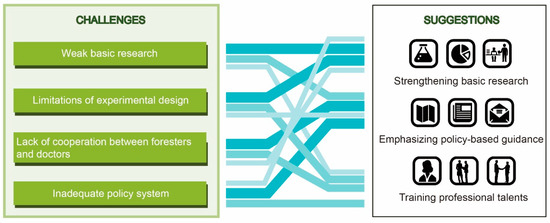
Figure 2.
Challenges and suggestions for the development of forest therapy.
4. Suggestions for the Development of Forest Therapy
Due to urbanization, the health problems of people living in the urban jungle are unavoidable. People are longing for natural forests, but the human need for health far outweighs the services that forests can provide. In the long run, the conflict between the human need for health and the services that forests provide cannot be avoided. Therefore, forest therapy may be an effective solution to address this conflict.
4.1. Strengthening Basic Research
Basic research is an important driver for innovation. Research institutions should conduct evidence-based medical research, collect experimental data, perform systematic forest therapy research, and develop a comprehensive basic research system. Professional research is usually time-consuming, but with scientific support, forest therapy can be developed rapidly. In addition, basic research requires a global vision. We need to obtain the latest research results from other countries to remain proactive. China has diverse forest types. We encourage research institutions to focus on different perspectives in research and on technological development and take a leading role in original research. In the future, both quantitative and qualitative studies on the health functions of forests should be enhanced, with particular focus on identifying a direct causative relationship between forests ecosystem services and the human health.
4.2. Emphasizing Policy-based Guidance
Many forest therapy-related policies have been issued on national and regional levels. Hunan, Sichuan, Guizhou and other provinces have witnessed the positive effects of policies in promoting the development of the forest therapy industry. What is needed right now is an improvement in the policies and the establishment of a government-led initiative in conjunction with private participation. With targeted policies and increased capital input, the whole society will take part in the industry, and the development of the industry would benefit from low-interest loans, tax cuts, and program-based financing. Meanwhile, the related costs of forest therapy activities should be committed to add in the national or regional medical insurance system, which should play a key role in enhancing overall sense of well-being and balance in life.
4.3. Training Professional Talents
As a multi-disciplinary, forest therapy involved various fields of forestry, medicine, psychology, management, and education. It includes extensive and complicated research fields and types of services. Multiple resources are needed; therefore, interdisciplinary collaboration, multi-disciplinary participation, and cultivation of professionals with multiple backgrounds are emphasized. Currently, several universities have established forest therapy-related departments to train professional talents, laying an important foundation for the development of forest therapy. We are training forest therapists and forest guides with good knowledge of the forest environment by using “online class + offline practice”.
The Ancient Chinese Philosophy and Traditional Chinese Medicine supports the idea that forests are contributing to the balance between mind, body, and spirit. When being in or viewing forests, plants, flowers, urban green spaces, and natural wooden materials, people can obtain positive health benefits [17]. How to better apply the latest research results to solve practical problems is still a major problem faced by the majority of researchers and practitioners. On the basis of what has been achieved so far, the researchers need to actively explore new development concepts, and work with decision-making departments and forest therapy centers to maximize the health functions of forests, and let the general public feel the healthcare and well-being of forests. This will be the direction of our efforts in the future.
Author Contributions
Conceptualization, Z.Z. and B.Y.; writing—original draft preparation, Z.Z., B.Y. and P.W.; writing—review and editing, Z.Z. and Y.G.; supervision, B.Y. All authors have read and agreed to the published version of the manuscript.
Funding
This research was supported by the Cooperative Forestry Science and Technology Project of Zhejiang Provincial and CAF (2016SY17), and the Fundamental Research Funds for CAF (CAFYBB2019ZC008).
Conflicts of Interest
The authors declare no conflict of interest.
References
- Yang, Y.; Xue, D.; Zhang, H.; XU, Z.; TANG, G. Analysis on dynamic development of landscape fragmentation for urban forest in fast-urbanization regions. J. South China Agric. Univ. 2016, 4, 97–104. (In Chinese) [Google Scholar]
- Giulio, M.D.; Holderegger, R.; Tobias, S. Effects of habitat and landscape fragmentation on humans and biodiversity in densely populated landscapes. J. Environ. Manag. 2009, 90, 2959–2968. [Google Scholar] [CrossRef] [PubMed]
- Fu, G.; Xiao, N.; Qiao, M.; Qin, Y.; Yan, B.; Liu, G.; Gao, X.; Li, J. Spatial-temporal changes of landscape fragmentation patterns in Beijing in the last two decades. Acta Ecol. Sin. 2017, 37, 2551–2562. (In Chinese) [Google Scholar]
- Wu, J. Urban sustainability: An inevitable goal of landscape research. Landsc. Ecol. 2010, 25, 1–4. [Google Scholar] [CrossRef]
- Filgueiras, B.K.C.; Tabarelli, M.; Leal, I.R.; Vaz-de-MellO, F.Z.; Lannuzzi, L. Dung beetle persistence in human-modified landscapes: Combining indicator species with anthropogenic land use and fragmentation-related effects. Ecol. Indic. 2015, 55, 65–73. [Google Scholar] [CrossRef]
- Mitchell, M.G.E.; Suarez-Castro, A.F.; Martinez-Harms, M.; Maron, M.; McAlpine, C.; Gaston, K.J.; Johansen, K.; Rhodes, J. Reframing landscape fragmentation’s effects on ecosystem services. Trends Ecol. Evol. 2015, 30, 190–198. [Google Scholar] [CrossRef]
- Lyu, B.; Zeng, C.; Xie, S.; Li, D.; Lin, W.; Li, N.; Jiang, M.; Liu, S.; Chen, Q. Benefits of a three-day bamboo forest therapy session on the psychophysiology and immune system responses of male college students. Int. J. Environ. Res. Public Health 2019, 16, 4991. [Google Scholar] [CrossRef]
- Nowak, D.J.; Hirabayashi, S.; Doyle, M.; McGovernc, M.; Pasherc, J. Air pollution removal by urban forests in Canada and its effect on air quality and human health. Urban For. Urban Green. 2018, 29, 40–48. [Google Scholar] [CrossRef]
- Guo, E.; Wang, C.; Qin, H.; Cai, Y. Relationships between the factors reflecting ecological health function of urban forests. Mag. Ecol. 2013, 32, 2893–2903. (In Chinese) [Google Scholar]
- Wang, Y.; Wang, C.; Dong, J.; Dong, J.; Ying, M.; Liang, W. Comprehensive evaluation about healthcare functions of typical forest communities in Qishan Mountain in Fuzhou. J. Northwest For. Univ. 2017, 32, 63–68. (In Chinese) [Google Scholar]
- Chen, F.; Wang, Y.; Li, H. The exploration to the function of the forest soundscape in health treatment. For. Econ. 2016, 9, 95–99. (In Chinese) [Google Scholar]
- Bang, K.S.; Kim, S.; Song, M.K.; Kang, K.I.; Jeong, Y. The effects of a health promotion program using urban forests and nursing student mentors on the perceived and psychological health of elementary school children in vulnerable populations. Int. J. Environ. Res. Public Health 2018, 15, 1977. [Google Scholar] [CrossRef] [PubMed]
- Bielinis, E.; Takayama, N.; Boiko, S.; Omelan, A.; Bielinis, L. The effect of winter forest bathing on psychological relaxation of young polish adults. Urban For. Urban Green. 2018, 29, 276–283. [Google Scholar] [CrossRef]
- Lee, J.; Tsunetsugu, Y.; Takayama, N.; Park, B.; Li, Q.; Song, C.; Komatsu, M.; Ikei, H.; Tyrväinen, L.; Kagawa, T.; et al. Influence of forest therapy on cardiovascular relaxation in young adults. Evid. -Based Complement. Altern. Med. 2014, 2014, 834360. [Google Scholar] [CrossRef] [PubMed]
- Song, C.; Ikei, H.; Kobayashi, M.; Miura, T.; Taue, M.; Kagawa, T.; Li, Q.; Kumeda, S.; Imai, M.; Miyazaki, Y. Effect of forest walking on autonomic nervous system activity in middle-aged hypertensive individuals: A pilot study. Int. J. Environ. Res. Public Health 2015, 12, 2687–2699. [Google Scholar] [CrossRef]
- Tsao, T.; Tsai, M.; Hwang, J.; Cheng, W.; Wu, C.; Chou, C.; Su, T. Health effects of a forest environment on natural killer cells in humans: An observational pilot study. Oncotarget 2018, 9, 16501–16511. [Google Scholar] [CrossRef]
- Hansen, M.M.; Jones, R.; Tocchini, K. Shinrin-Yoku (Forest bathing) and nature therapy: A state-of-the-art review. Int. J. Environ. Res. Public Health 2017, 14, 851. [Google Scholar] [CrossRef]
- Han, Y. Ecological philosophy and modern value in Taoist Culture of Pre-Qin Dynasty. J. Qiqihar Univ. (Phi. Soc. Sci.) 2019, 5, 47–49. [Google Scholar]
- Hu, X.; Ding, H.; Jiao, Z.; Li, L. Historical origin and development of the theory of “nourishing yang in spring and summer while nourishing yin in autumn and winter”. Mod. Tradit. Chin. Med. 2019, 39, 14–17. [Google Scholar]
- Wang, Z.; Wang, H. The influence of health management intervention on “three high diseases” of living habits. China Health Care Nutr. 2013, 5, 2412–2413. [Google Scholar]
- Wu, H.; Dan, X.; Liu, S.; Shu, Y.; Cao, H.; Huang, Y.; Lu, L. Health rehabilitation and recreation in forests: Concept connotation, product type and development route. Chin. J. Ecol. 2018, 37, 2159–2169. (In Chinese) [Google Scholar]
- Nan, H.; Wang, X.; Chen, J.; Zhu, J.; Yang, X.; Wen, Z. Forest therapy in japan and its revelation. World For. Res. 2013, 26, 74–78. (In Chinese) [Google Scholar]
- Cai, W. Depending on forest tourism to realize the development of forest eco-products. J. Hebei For. Sci. Technol. 2018, 4, 59–61. (In Chinese) [Google Scholar]
- Xie, C. On rational strategies for sustainable development of forest tourism in china. J. Chang. Univ. 2019, 33, 64–66. (In Chinese) [Google Scholar]
- Tang, J. The development of forest health tourism and health industry. J. Chengdu Univ. (Soc. Sci. Ed.) 2010, 4, 74–77. (In Chinese) [Google Scholar]
- Cheng, X.; Chen, X.; Ye, W.; Zhao, M.; Li, S. Growth of forest experience in japan and its revelation. World For. Res. 2015, 28, 75–80. (In Chinese) [Google Scholar]
- Zhang, S.; Gong, L.; Wang, J. Analysis on the construction of forest industry stations. South China Agric. 2015, 9, 80–82. (In Chinese) [Google Scholar]
- Zheng, R.; Chen, X.; Cheng, X.; Zhen, S.; He, P.; Guo, X. Study on development of forest experience based on the forest multifunctional use—Taking Xishan Forest Park in Kunming as an example. For. Resour. Manag. 2015, 5, 157–161. (In Chinese) [Google Scholar]
- Liu, J. Forest Experience and Health Care Planning: A Case Study of Distinctive Forest Town in Jianning, Fujian Province; Chinese Academy of Forestry: Being, China, 2018. (In Chinese) [Google Scholar]
- Zhang, J.; Sun, X. The basic elements of forest health preservation and suggestions for quality improving. J. Sichuan For. Sci. Technol. 2019, 40, 98–102. (In Chinese) [Google Scholar]
- Forestry Bureau, Agriculture and Forestry Department, Taiwan. Forest Bathing—The Latest Fitness; Taiwan Qingchun Press: Taibei, Taiwan, 1984. (In Chinese) [Google Scholar]
- Liu, H. Forest Bathing—Green Fitness; Taiwan Dazhan Press Co., Ltd.: Taibei, Taiwan, 1984. (In Chinese) [Google Scholar]
- Mao, G.; Lan, X.; Cao, Y.; Chen, Z.; He, Z.; Lv, Y.; Wang, Y.; Hu, X.; Wang, G.; Yan, J. Effects of short-term forest bathing on human health in a broad-leaved evergreen forest in Zhejiang Province, China. Biomed. Environ. Sci. 2012, 25, 317–324. [Google Scholar]
- Mao, G.; Cao, Y.; Lan, X.; He, Z.; Chen, Z.; Wang, Y.; Hu, X.; Lv, Y.; Wang, G.; Yan, J. Therapeutic effect of forest bathing on human hypertension in the elderly. J. Cardiol. 2012, 60, 495–502. [Google Scholar] [CrossRef] [PubMed]
- Zhou, C.; Yan, L.; Yu, L.; Wei, H.; Guan, H.; Shang, C.; Chen, F.; Bao, J. Effect of short-term forest bathing in urban parks on perceived anxiety of young-adults: A pilot study in Guiyang, Southwest China. Chin. Geogr. Sci. 2018, 1, 139–150. [Google Scholar] [CrossRef]
- Wang, X.; Rodiek, S.; Wu, C.; Chen, Y.; Li, Y. Stress recovery and restorative effects of viewing different urban park scenes in Shanghai, China. Urban For. Urban Green. 2016, 15, 112–122. [Google Scholar] [CrossRef]
- Mao, G.; Cao, Y.; Yang, Y.; Chen, Z.; Dong, J.; Chen, S.; Wu, Q.; Lyu, X.; Jia, B.; Yan, J.; et al. Additive benefits of twice forest bathing trips in elderly patients with chronic heart failure. Biomed. Environ. Sci. 2018, 31, 159–162. [Google Scholar] [PubMed]
- Guan, H.; Wei, H.; He, X.; Ren, Z.; An, B. The tree-species-specific effect of forest bathing on perceived anxiety alleviation of young-adults in urban forests. Ann. For. Res. 2017, 60, 327–341. [Google Scholar] [CrossRef]
- Tsao, T.M.; Tsai1, M.J.; Wang, Y.N.; Lin, H.L.; Wu, C.F.; Hwang, J.S.; Hsu, S.H.J.; Chao, H.; Chuang, K.J.; Chou, C.C.K.; et al. The health effects of a forest environment on subclinical cardiovascular disease and health-related quality of life. PLoS ONE 2014, 9, e0103231. [Google Scholar] [CrossRef]
- Jia, B.; Yang, Z.; Mao, G.; Lyu, Y.; Wen, X.; Xu, W.; Lyu, X.; Cao, Y.; Wang, G. Health effect of forest bathing trip on elderly patients with chronic obstructive pulmonary disease. Biomed. Environ. Sci. 2016, 29, 212–218. [Google Scholar]
- Yu, C.P.; Lin, C.M.; Tsai, M.J.; Tsai, Y.C.; Chen, C.Y. Effects of short forest bathing program on autonomic nervous system activity and mood states in middle-aged and elderly individuals. Int. J. Environ. Res. Public Health 2017, 14, 897. [Google Scholar] [CrossRef]
- Wang, X.; Shi, Y.; Zhang, B.; Chiang, Y. The influence of forest resting environments on stress using virtual reality. Int. J. Environ. Res. Public Health 2019, 16, 3263. [Google Scholar] [CrossRef]
- Shin, W.S.; Shin, C.S.; Yeoum, P.S. The influence of forest therapy camp on depression in alcoholics. Environ. Health Prev. Med. 2012, 17, 73–76. [Google Scholar] [CrossRef]
- Chun, M.H.; Chang, M.C.; Lee, S.-J. The effects of forest therapy on depression and anxiety in patients with chronic stroke. Int. J. Neurosci. 2016, 127, 199–203. [Google Scholar] [CrossRef] [PubMed]
- Ochiai, H.; Ikei, H.; Song, C.; Kobayashi, M.; Takamatsu, A.; Miura, T.; Kagawa, T.; Li, Q.; Kumeda, S.; Imai, M.; et al. Physiological and psychological effects of forest therapy on middle-aged males with high-normal blood pressure. Int. J. Environ. Res. Public Health 2015, 12, 2532–2542. [Google Scholar] [CrossRef] [PubMed]
- Zhang, Z.; Ye, B.; Yang, J.; Chen, Q.; He, Q.; Dong, J. Monitoring of dynamic changes of ecological health functions of urban forests in Hangzhou. J. Northwest For. Univ. 2014, 30, 31–36. (In Chinese) [Google Scholar]
- Gu, L.; Wang, C.; Wang, Y.; Wang, X.; Sun, Z.; Wang, Q.; Sun, R. Patterns of temporal variation of microclimate and extent of human comfort in the recreation forests in Huishan National Forest Park. Sci. Silvae Sin. 2019, 55, 150–159. (In Chinese) [Google Scholar]
- Du, W.; Wang, C.; Bao, H.; Wang, Q.; Yang, H.; Zhou, B. Public park green belt micrometeorology and its impact on human comfort under typical summer weather. J. Ecol. Rural Environ. 2017, 33, 349–356. (In Chinese) [Google Scholar]
- Xie, X. Research on Composition and Release Regularities of VOCs from Main Landscape Plants in Xi’an; Northwest A & F Science and Technology University: Yangling, China, 2016. (In Chinese) [Google Scholar]
- Liang, Z. Study on Components and Emission Laws of BVOCs in Typical Forest Communities and by Their Main Trees in Purple Mountain in Nanjing; Nanjing Forestry University: Nanjing, China, 2012. (In Chinese) [Google Scholar]
- He, P.; Chang, S.; Zhang, Y.; Li, X.; Xie, J. Spatiotemporal distribution and influence factors of negative air ion in forest recreation areas across Xinjiang. Resour. Sci. 2015, 37, 629–635. (In Chinese) [Google Scholar]
- Wang, Y.; Wang, C.; Qie, G.; Dong, J.; Jiang, J. Comparative analysis on effects of VOCs from branches and leaves of four conifer species on locomotor activity of mice. Sci. Silvae Sin. 2013, 49, 188–193. (In Chinese) [Google Scholar]
- Nguyen, T.T.T. Analysis and Evaluation of the Relationship between Different Types of Urban Forest Plant Species and Vegetation in Reducing Airborne Particulate Matter in Urban Environment; Beijing Forestry University: Beijing, China, 2014. (In Chinese) [Google Scholar]
- Zhang, K.; Zhang, J. Health function evaluation and exploring its mechanisms in the Shanghai green belt, China. Acta Ecol. Sin. 2013, 33, 4189–4198. (In Chinese) [Google Scholar] [CrossRef]
© 2020 by the authors. Licensee MDPI, Basel, Switzerland. This article is an open access article distributed under the terms and conditions of the Creative Commons Attribution (CC BY) license (http://creativecommons.org/licenses/by/4.0/).