

Interview with Dr. Anton Kutyrev—Winner of the Minerals 2023 Young Investigator Award
6 March 2024
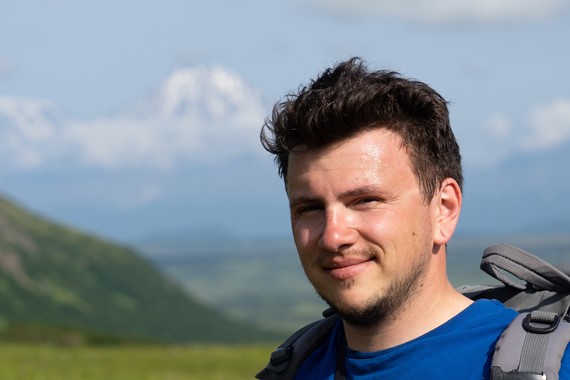
Dr. Anton Kutyrev completed his Ph.D. at the Institute of Volcanology and Seismology, Kamchatka, Russia, working on the behavior of platinum-group elements in island arc magmatic rocks and related deposits. After working as a Research Associate at the same organization, he received a Fulbright Visiting Scholar award and worked at the University of Oregon, USA, where he studied the behavior of oxygen isotopes during water–rock interactions, with implications for the early Archean climate. In 2023, he started a postdoc position at Cardiff University, UK, where his research focuses on PGE-Cr-Ti-V mineralization in the layered intrusions of Finland.
The following is an interview with Dr. Anton Kutyrev:
- Can you briefly introduce yourself to our readers and tell us a little bit about your fields of interest?
My research focuses on platinum-group elements, and everything related to them, from mineral deposits to the petrology of volcanic rocks. My Ph.D. work was dedicated to Kamchatka, the land of breathtaking landscapes and active volcanoes. Particularly, I investigated Ural-Alaskan type complexes—relatively small bodies of mafic and ultramafic rocks that occur in island arc settings and are considered the remnants of solidified chambers beneath volcanoes. Such complexes are the sources of platinum placers; they also may bear other types of mineralization. Initially, I was mostly focused on mineralogy and recently discovered two new mineral species—kufahrite PtPb and sidorovite PtFe3. My colleagues and I also studied the origin of platinum mineralization, spanning from primary ultramafic rocks and chromitites to placer deposits. However, living in a city surrounded by active volcanoes left its mark on me, and I began investigating platinum-group elements in the volcanic rocks. Soon after, I moved to the University of Oregon where I continued studying ultramafic rocks but with a different application. By measuring oxygen isotopes in the early Archean basalts and related ultramafic rocks, we addressed the question of the composition and temperature of ancient oceans. This was challenging but rewarding work. Currently, I am continuing my studies at Cardiff University and working on a SEMACERET project, where a consortium of EU and UK researchers are working on securing the continued supply of critical raw materials for EU industries. In this project, my area of responsibility is Pd-Pt-Cr-Ti-V mineralization in the layered intrusions in Finland.
- Which research topics do you think will be of particular interest to the research community in the coming years?
I am confident that the rising demand for green technologies and the general development of our species will lead to a growing need for mineral resources. As easily accessible, rich deposits become exhausted, there will be an increasing need to understand poorly mineralized complexes and formations that may soon become economically viable. Secondly, accessing deposits hidden beneath the surface will become essential. This shift in focus will prioritize geophysics (which, as a geochemist and mineralogist, I find less exciting). However, it will also challenge researchers in my field to develop new approaches with practical implications.
- Have you encountered any difficulties in your research? How did you overcome them?
I prefer to view difficulties as an inherent part of the research process. One of the hardest aspects for me has always been selecting a new research topic and taking that next step. In the past, I've been enthusiastic about studies that ultimately had limited implications or proved overly complicated. While these experiences wasted time and energy, they also taught me valuable lessons. On the other hand, once I started working on a subject, I started to understand the importance of persistence and refusing to give up easily.
- Can you briefly describe the key to a happy laboratory life?
Good personal relationships, and trust in each other. Plus, of course, good equipment, timely supplies, flexible work schedule, and as little bureaucracy as possible.
- What qualities do you think young scientists need?
Firstly, a genuine interest and excitement in your research area are crucial. Ideally, engaging in scientific exploration should be similar to immersing yourself in a captivating book or an engaging video game. However, it is important to remember that it is not always fun and games. Researchers experience setbacks, frustration, and even burnout. Therefore, maintaining boundaries and achieving a healthy work–life balance is equally important.
Secondly, successful researchers possess a unique blend of playfulness and seriousness. They have the ability to think outside the box while simultaneously adhering to rigorous research methodologies.
- Do you have any suggestions for the Minerals journal?
I have the impression that Minerals has done a good job in improving some weaknesses it has been criticized for. You are moving in the right direction, and I wish you the best of luck.