

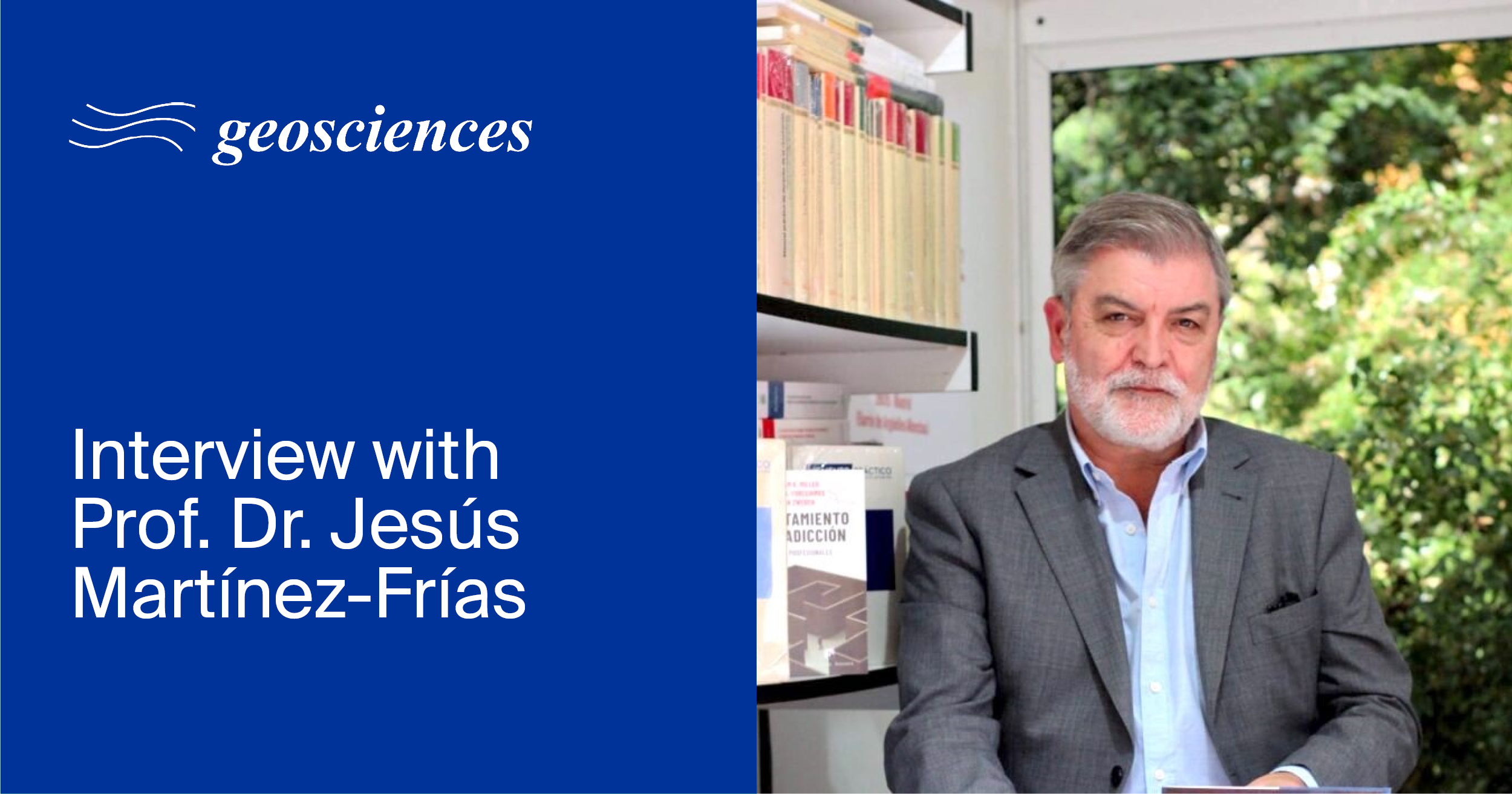
Geosciences | Interview with Founding Editor-in-Chief Prof. Dr. Jesús Martínez-Frías—Reflections on Planetary Geology and Recognition
We are pleased to share this interview with Prof. Dr. Jesús Martínez-Frías, founding Editor-in-Chief of Geosciences (ISSN: 2076-3263). Recently, the International Astronomical Union recognized his contributions to planetary science by naming an asteroid in his honor.
Prof. Dr. Martínez-Frías has long been engaged in research on meteorites, meteorite impacts, planetary geology (Mars missions), astrobiology, geoeducation, and geoethics. As the founding editor of Geosciences, he helped establish the journal as an important platform for interdisciplinary Earth and planetary sciences.
Adding to this recognition, he was also named an “Honor Geologist” by the Spanish Association of Geologists (Ilustre Colegio Oficial de Geólogos) in December 2025.
In this conversation, he shares his perspectives on these honors and reflects on his scientific journey spanning meteoritics, impact cratering, Mars geology, geoeducation, and geoethics.
1. How did you first learn that an asteroid would be named in your honor, and what was your immediate reaction?
It was truly extraordinary news, which I received with great honor, pride, and satisfaction. My nomination was submitted to the IAU by the Malaga Astronomy Society, precisely in the year it celebrated its 50th anniversary, for which it received the Plaque of Honor from the Malaga Academy of Sciences. The acceptance and the news were published in the WGSBN Bulletin, volume 5 #28, December 15, 2025.
2. What does having an asteroid bear your name mean to you personally and professionally, after years of work in planetary science and geoscience?
This news is a recognition of all the work done on meteorites, impacts, planetary geology, and astrobiology from both a scientific, educational, and public outreach perspective. Personally, I hope it will also serve as an incentive for future generations of young scientists to continue pursuing this path of research connecting Earth, space, and life.
3. Looking back on your career, which research areas or contributions do you feel most strongly led to this recognition by the IAU?
I believe that more than a specific area of research, the entire set of activities has been valued throughout my career for more than 40 years.
4. Asteroids play a key role in understanding the solar system’s evolution. How do you see their importance in current and future planetary research?
Asteroids are the primary parent bodies of meteorites. They provide us with unique information about our origins, the origin of Earth, and also the origin of life, as they contributed water and other inorganic and organic compounds. From an astrobiological approach, their importance is being increasingly recognized. The discovery of nucleobases and other organic compounds in meteorites and asteroids (e.g., Bennu, Ryugu) is of great importance as they are essential DNA and RNA building blocks. Other aspects must also be considered, such as their hazard and impact risk, the role their impacts played in geobiological coevolution, and, of course, their importance as potential future resources for humanity.
5. During your time as Editor-in-Chief of Geosciences, how did your vision for interdisciplinary planetary science evolve?
My long-term tenure as Editor-in-Chief of Geosciences was incredibly rewarding. From a single article I published in 2011, practically out of nowhere, we managed, after many years, to attract the attention of geoscience experts worldwide, publishing a monthly volume with dozens of articles. And I achieved this thanks to a superb editorial team that supported me every step of the way with effectiveness and efficiency. I am convinced that this same support will continue with my successor.
In that first article, published in May 2011, I must say that I already envisioned the journal with the breadth required by its planetary scope. As I stated, “Geosciences is an international, peer-reviewed open access journal, which publishes original papers, rapid communications, technical notes and review articles, and discussions about all interdisciplinary aspects of the Earth and planetary sciences.” I believe that planetary sciences, from this perspective of planetary geology (or astrogeology) in connection with astrobiology, have progressed very positively, probably supported by the rover and orbiter missions to Mars and the study of Earth analogs.
6. Are there any moments or milestones in your scientific journey that you now see differently in light of this honor?
Over the past few years, I have received various awards and recognition from different institutions and universities. If I had to mention a few, I would highlight the following:
- The NASA Group Achievement Awards for my research on earth analogs (Río Tinto) and as a member of the Mars rover science teams;
- The ESA group achievement awards related to my role as an astronaut instructor in Lanzarote (ESA/PANGAEA program);
- Recognitions in several Latin American countries (Colombia, Cuba, Paraguay, and Peru), especially in Arequipa, where Peruvian scientists had the courtesy of naming a laboratory after me: the “Martínez-Frías Astrobiology Laboratory”;
- My recognition as an academic in the Royal Academies of Sciences and Doctors of Spain;
- The recent appointments as Honorary Geologist of the Spanish Association of Professional Geologists and the recognition as “illustrious Cajalian” (referring to the scientific legacy of Nobel laureate Santiago Ramón y Cajal).
7. What advice would you give to early career researchers who aspire to make a lasting impact in planetary science and geosciences?
Perhaps I would use the analogy of the rovers and helicopter drone that are on Mars. Let them follow their Curiosity, their Perseverance, and their Ingenuity, because they are our future and will truly be the first interplanetary generation.
8. How do you think public recognition like this can help increase interest and awareness of planetary science among broader audiences?
I hope it will have a positive impact and foster new motivations and interests in these topics.
9. Is there a particular discovery, mission, or upcoming research direction in planetary science that excites you the most today?
I remain very excited about my participation in the Curiosity and Perseverance rover missions. This is not just due to their technological sophistication, but also because of the privilege of working in collaboration with an extraordinary multidisciplinary team of scientists and engineers. We recently published an article in Nature, which led to a NASA press conference. Our study, which has garnered over 400,000 views, raised the possibility of a potential biosignature on Mars. I am aware that the global political and geostrategic scenario is constantly changing and complex. However, I sincerely hope that this sample, and others we have selected, can be brought back to Earth in the future to either confirm or refute our findings.
10. Finally, how would you like this recognition to inspire future collaborations or scientific initiatives within the geosciences community?
I hope this will inspire scientific, academic, and outreach initiatives and collaborations. In Spain, there is a very attractive and interesting geoscientific program called Geolodía, and this year our Planetary Geology Commission of the Geological Society of Spain is dedicating it to asteroids.