

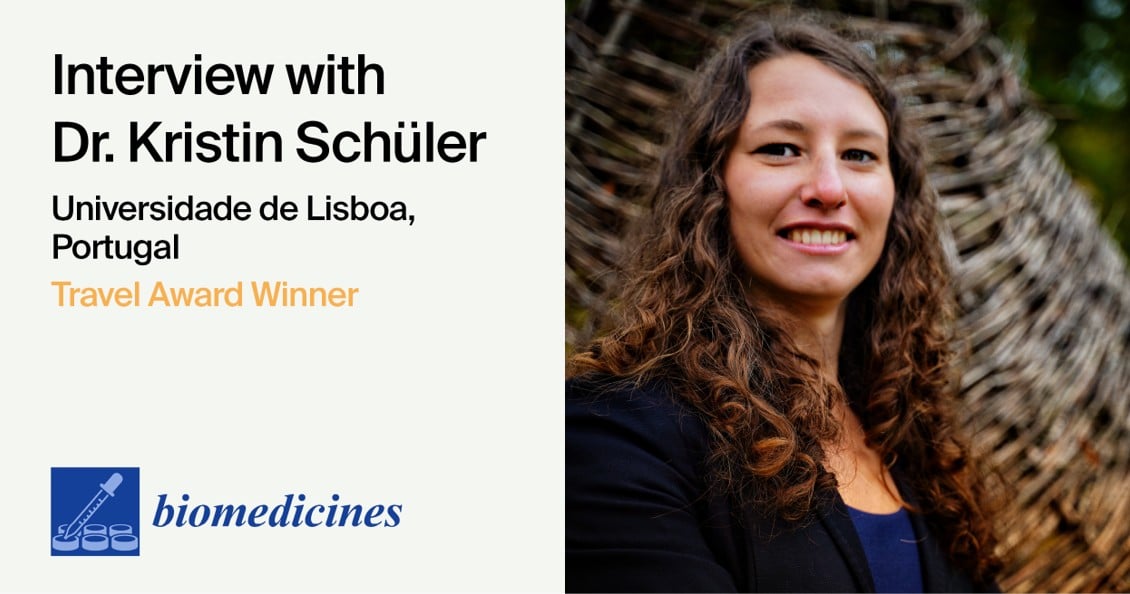
Interview with Dr. Kristin Schüler—Winner of the Biomedicines Travel Award
Biomedicines (ISSN: 2227-9059) is proud to present the winner of the 2026 Biomedicines Travel Award—Dr. Kristin Schüler.
Dr. Kristin Schüler is a biomedical engineer and PhD researcher at the Institute for Bioengineering and Biosciences in Lisbon, Portugal. Her PhD project, “Advancing cartilage tissue engineering: Innovations in hierarchical cell-laden scaffolds and bioreactor systems”, combines biological science and engineering approaches to develop physiologically relevant cartilage models. Her interest in osteoarthritis (OA)—the most common cartilage disorder, affecting over 600 million people worldwide—stems from both its biological complexity and its profound impact on patients’ quality of life. Despite its prevalence, OA remains poorly understood, and current treatment options are limited, motivating her to focus on in vitro joint models that can improve understanding of disease progression and support the development of effective therapies.
1. Can you share your current research direction and latest progress?
I am currently advancing several interconnected aspects of my PhD project, ranging from the development of biomimetic scaffolds that replicate the physiological alignment of collagen to the introduction of controlled mechanical stimulation using a self-designed bioreactor. Recently, my team and I were honoured with the HUMAIN Award 2025 from InSphero (Switzerland) and the Physicians Committee for Responsible Medicine (PCRM), which has enabled me to further pursue human-relevant, animal-free research approaches.
This award is also giving me the opportunity to shine a spotlight on a different and critically underrepresented aspect of OA research—women’s health. Despite the high prevalence of OA in postmenopausal women, physiologically relevant and complex 3D in vitro models remain scarce. To address this gap, I am developing advanced 3D tissue-engineered and organ-on-chip platforms that integrate the two main joint tissues, allowing us to investigate menopause-associated mechanisms of OA and evaluate hormone-sensitive therapeutic strategies in a highly controlled, human-relevant setting.
2. Can you share with us your feelings after winning the award?
Receiving this award is a great honour and deeply rewarding, particularly at this early stage of my scientific career. Attending conferences is an essential component of scientific development, especially for early-career researchers. More importantly, conferences provide a vital platform for openly sharing findings with the scientific community, enabling others to understand the results, learn from them, and build upon them. Scientific work reaches its full value only when it is clearly communicated and accessible, allowing it to meaningfully contribute to progress. In addition, conferences foster dialogue, feedback, and collaboration, strengthening the collective advancement of the field. This award makes it possible to participate in this exchange, ensuring that the research extends beyond the laboratory and supports continued growth within the scientific community.
3. Can you briefly introduce which conference you plan to attend with this award? What is the significance of attending such conferences in expanding your international collaboration or enhancing your academic influence?
With the Biomedicines Travel Award, I will participate in the 34th Annual Meeting of the European Orthopaedic Research Society (EORS) 2026 in Madrid, Spain, in September. This event is directly aligned with my research on advanced in vitro models of cartilage in health and disease. The EORS Annual Meeting is the leading international conference that brings together researchers, clinicians, and industry partners to share the latest advances in orthopaedic and musculoskeletal science and showcase innovative technologies and treatments. Attending this conference will give me the opportunity to receive invaluable feedback from specialists on my work in osteoarthritis in vitro modelling. I am particularly excited to present my latest research on the influence of menopause on OA and am very curious to explore the role of sex differences in this field, as well as to see which other researchers are pursuing similar directions.
4. As a winner, how do you view the role of open access journals (such as Biomedicines) in academic communication? Will you consider reviewing or contributing to them in the future?
As mentioned previously, scientific results can only reach their full potential when they are openly shared and discussed within the scientific community. In this context, I strongly believe that open access represents the future of scientific communication, as it provides the foundation for FAIR (Findable, Accessible, Interoperable, and Reusable) research practices. Openly accessible research not only increases visibility and scientific impact but also fosters collaboration and accelerates progress across disciplines. Reflecting this commitment, my PhD fellowship from “la Caixa” actively supports open access publishing, and all of my research outputs are therefore made publicly available. I would be very pleased to contribute to open access journals such as Biomedicines in the future, both as an author and as a reviewer, to support the dissemination of high-quality, transparent, and accessible research.
5. Do you have any other suggestions on how academic journals and publishers can further support young researchers and academia?
Having come from industry, where mentoring and peer guidance are a normal part of everyday work, I sometimes feel a bit lost navigating the scientific field. Of course, there is support from colleagues when writing your first paper or review article, and plenty of examples to learn from. Also, I have always greatly appreciated the feedback from reviewers and the effort they put into improving my work.
However, I think academic journals and publishers could further support young researchers by providing more structured guidance on peer review, open access, and FAIR publishing practices. Practical training, mentorship programs, or clear resources on these topics would help early-career researchers gain confidence, improve the quality of their contributions, and better navigate the publishing process while fostering a culture of transparency and high scientific standards.
6. Do you have any suggestions for Biomedicines?
I am very grateful for this opportunity and truly appreciate the journal’s support of early-career researchers. By providing visibility, recognition, and opportunities, Biomedicines plays a crucial role not only in supporting young scientists but also in strengthening the scientific community as a whole by fostering innovation, continuity, and the exchange of ideas. I hope the journal will continue to champion early-career researchers and help us grow into independent and established contributors within the scientific community.