

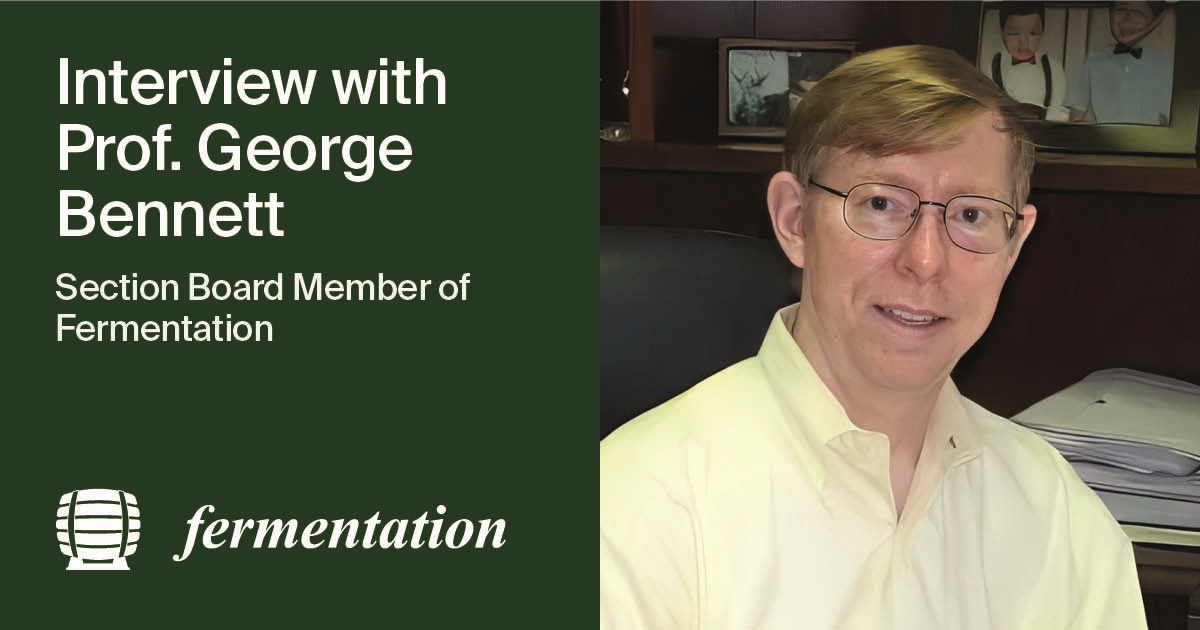
Interview with Prof. George Bennett—Section Board Member of Fermentation
- What developments in your field of expertise excite you currently?
There are several areas that I find particularly exciting these days. Among those areas are: work being done on mixed cultures or microbial community analysis and how to control such complex dynamic systems; the design of proteins and enzymes with improved or unique specificities, catalytic or binding properties, or improved performance parameters; and the studies that capture overall cell dynamics through detailed biochemical measurement providing new insight into the influence of particular reactions and redox flow, allowing a more complete understanding of the culture, process or ecological community. Advances in these areas will have an impact on many useful applications of microbial technology of societal importance.
- What topics in your field of expertise do you believe will gain importance in the future?
Some topics I consider to be gaining importance are related to the ability to collect and analyze large amounts of data on different parameters related to cell activity and how this accumulation of data can allow more detailed analysis of a culture or biological community. Such measurements and their creative analysis can give scientists the ability to test and control many parameters that can improve process performance. The application of computational methods to related biological fields of research is increasingly important. The ability to cheaply collect widespread data from natural environments can allow early responses to problems and thereby can limit impact on society. Long-term trends in improving efficiency, lowering environmental impact, and taking advantage of practical new technologies and local based materials and ingenuity can improve life around the world.
- Could you discuss individuals or experiences that have significantly influenced your research career?
I have been very fortunate to have had many mentors and colleagues who influenced my research career in good directions. My PhD research advisor, P.T. Gilham, introduced me to nucleic acids chemistry, basic chemical procedures, and the excitement of research; my postdoctoral advisor, Charles Yanofsky, led me toward advances in microbial genetics, the importance of lab organization, and applying new technologies in research (cloning & sequencing) that allow progress on fundamental biological questions, and appreciating the perspective of focusing on new levels of understanding of a particular system. At Rice U, the collaborative culture across disciplines encouraged expansion of my research into other areas of science and engineering; Professor Fred Rudolph led me to appreciate the role of enzyme properties and specificity in regulating cell processes and work with E. T. Papoutsakis oriented me to apply technologies to a new organism and to consider the industrial implications and applications of biochemical research. Work with my long-time collaborator, Professor Ka-Yiu San in bioengineering, showed how close and timely interactions between fields and expertise could accelerate progress and allow new ideas to be followed-up on quickly. Lydia Kavraki led me to observe the power and potential of applying computational approaches to metabolism and biological phenomena. Recent work with Joff Silberg opened my thinking to broader issues of microbial communities and their ecological, industrial and medical importance and the interfacing of microbes with the electronic infrastructure of our age. These interactions have opened continuous new areas for thoughtful productive collaborations.
- The journal Fermentation is celebrating its 10th anniversary in 2025. What is your vision for its development?
I have followed the journal from the beginning and have been impressed by its growth and the broad scope of articles it publishes. I imagine it will further solidify its position in publishing in several areas where advances related to production and processing of important substances have a wide impact. The worldwide article authorship in the journal is impressive and positions the journal for long-term success and incorporates a broadening view of the fermentation field. The growing importance of efficient processes for generating useful substances fits well with societal goals of sustainability and cost reduction.
- What do you think about the development of open access in the publishing field?
Open access has a good feature in making articles available for a wide scope of viewers. People with many different backgrounds and locations benefit by having access to the articles. However, submission of articles may be limited or discouraged for some authors due to fee considerations. It is important to balance these factors and achieve a broad sustained connection with both readers and authors.
- As an Editorial Board Member, what do you find to be the most important parameter for the success of the journal?
An important feature for success is publishing a variety of strong articles on topics of interest to the readership audience. It is useful to have these articles available to anyone. The ability to access can encourage innovation from a broad pool of persons besides those in particular institutions or companies. The high availability is able to generate visibility and that can lead to citations of the articles.
- Do you have any advice you would like to share with students and young researchers?
Each person is unique in their particular talents and has features of temperament that are suited for different kinds of scientific work. Among these personal attributes are patience in the time course of conducting experiments, enjoyment in tinkering with instruments, and the level of stimulation or frustration in dealing with unexpected experimental outcomes or field observations. So, an individual should try to match their talents and temperament with those that are characteristic of their chosen field of work. Another general thing to try to do is to be aware of new technologies that can be applied to the field and to try to gain skills in those techniques that will be useful toward future career goals. Also, consider that the choice of what to work on is important, and do not only focus on developing technical expertise. Finding and having a long-term relationship with mentors and helpful colleagues will allow you to build a network that opens up future possibilities.