

Journal Menu
► ▼ Journal Menu-
- Water Home
- Aims & Scope
- Editorial Board
- Reviewer Board
- Topical Advisory Panel
- Early Career Editorial Board
- Instructions for Authors
- Special Issues
- Topics
- Sections
- Article Processing Charge
- Indexing & Archiving
- Editor’s Choice Articles
- Most Cited & Viewed
- Journal Statistics
- Journal History
- Journal Awards
- Society Collaborations
- Conferences
- Editorial Office
Journal Browser
► ▼ Journal BrowserNeed Help?
Announcements
2 February 2021
The Polish Limnological Society (PLS) is Now an Affiliated Society Member of Water

In January 2021, the Polish Limnological Society (PLS) became affiliated to Water. As part of this collaboration, all members of PLS enjoy a discount on the article processing charges (APC) when submitting articles to Water.
The Polish Limnological Society (PLS), founded in 2001, is a non-profit scientific society and educational organization in Poland that aims to disseminate information on all aspects related to lakes, including their physics, chemistry, biology, geology, and management. As of 2021, it has over 100 active members. It co-operates with other limnological societies in Europe and organizes international meetings and workshops. Additionally, the members of the PLS are organizing scientific expeditions to explore threatened lake ecosystems, such as the Aral Sea. The PLS publishes the Limnological Review, a Scopus-indexed journal. It is one of the signatories of the World Climate Statement on how anthropogenic climate change is affecting marine and freshwater ecosystems, with a plea to avoid their further degradation and to speed up mitigation.
PLS is a professional organization whose functions are highly relevant to the scope of Water. We look forward to collaborating with PLS and publishing state-of-the-art research from its members in this field.
25 December 2020
Water Has Become a Semimonthly Publication
We are pleased to announce that Water became a semimonthly publication on 1 January, 2021. A semimonthly publication allows papers to be indexed in Web of Science and other indexing databases on a semimonthly basis rather than every month, and they become searchable and are cited earlier. We also acknowledge the many valuable publications from our authors and the important contribution of our dedicated reviewers.
15 December 2020
MDPI adopts C4DISC principles to improve diversity and inclusion in scholarly communications
MDPI is proud to adopt the principles of the Coalition for Diversity & Inclusion in Scholarly Communications (C4DISC) to support building equity, inclusion, diversity, and accessibility in scholarly communications.
The C4DISC represents organizations and individuals working in scholarly communications and is focused on addressing issues of diversity and inclusion within the publishing industry.

MDPI’s Managing Editors encourage the Editors-in-Chief and Associate Editors to appoint diverse expert Editorial Boards. This is also reflective in our multi-national and inclusive workplace. We are proud to create equal opportunities without regard to gender, ethnicity, geographic location, sexual orientation, age, disability, political beliefs, religion, or socio-economic status. There is no place for discrimination in our workplace and editors of MDPI journals are to uphold these principles in high regard.
Representatives from C4DISC meet monthly, and have started to implement initiatives to shed light and improve on the lack of diversity in scholarly communications. Some of the initiatives include developing a joint statement of principles; conducting market research; providing training resources, best practices, toolkits, and documentation for our collective memberships; and establishing outreach programs, curricula, events, and publications.
The Coalition is committed to:
- eliminating barriers to participation, extending equitable opportunities across all stakeholders, and ensuring that our practices and policies promote equitable treatment and do not allow, condone, or result in discrimination;
- creating and maintaining an environment that respects diverse traditions, heritages, and experiences;
- promoting diversity in all staff, volunteers, and audiences, including full participation in programs, policy formulation, and decision-making;
- raising awareness about career opportunities in our industries to groups who are currently underrepresented in the workforce;
- supporting our members in achieving diversity and inclusion within their organizations.
14 December 2020
Article Layout and Templates Revised for Future Volumes
At MDPI we have slightly revised the layout for articles to be published in the 2021 Volume, starting at the end of December 2020. As of today, the article templates available for download on ‘Instructions for Authors’ pages have been updated.
The most noticeable change can be found on the first page of the article, where a left-hand column has been created to include the following front matter elements: (i) the recommended citation style for the article, (ii) the publishing history, (iii) as well as the Creative Commons Attribution license used (iv) a standard note regarding affiliations. At the same time, the extra spacing on the left means the authors’ affiliations are now more clearly set apart than before. Other front matter key elements such as journal logo, article type, article title, authors, abstract and keywords remain unchanged.
The blank column on the left runs through all pages in an article; as a result, the main text is slightly more condensed, which improve reader friendliness for smaller screens. Small figures/tables are aligned on the left with standard indenture, while large figures/tables are centered and covering the full width of the page. The revised layout was applied in the article pictured below, to serve as an example:
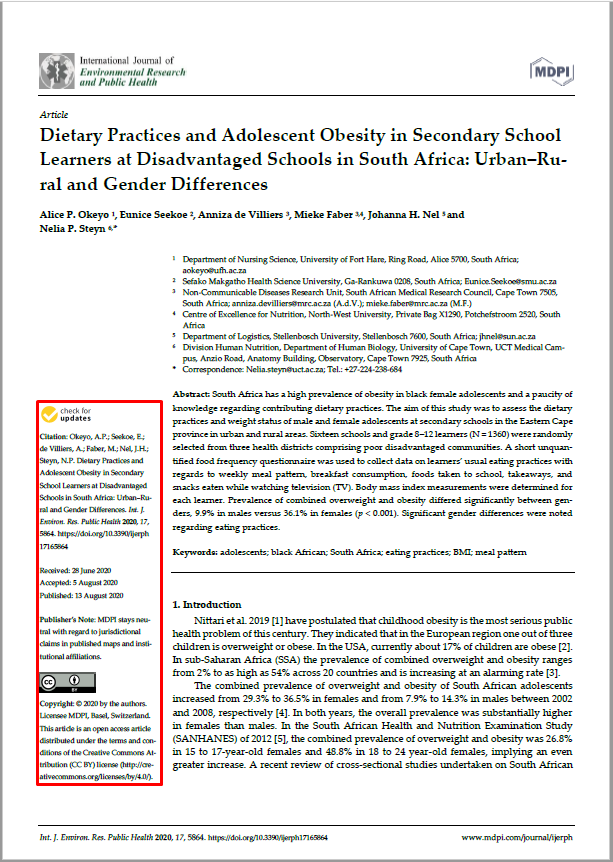
1) Information is displayed in the left information bar.
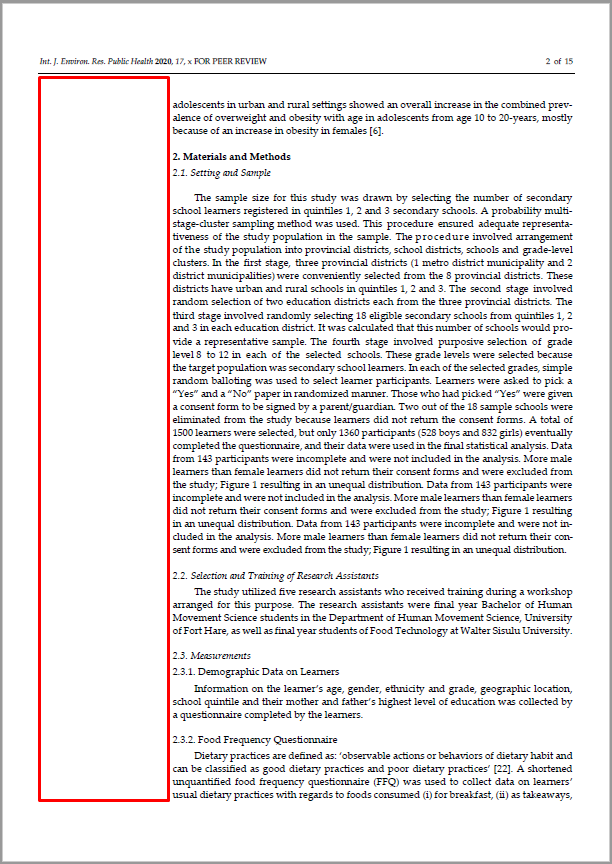
2) In the main text, there is a blank column on the left.
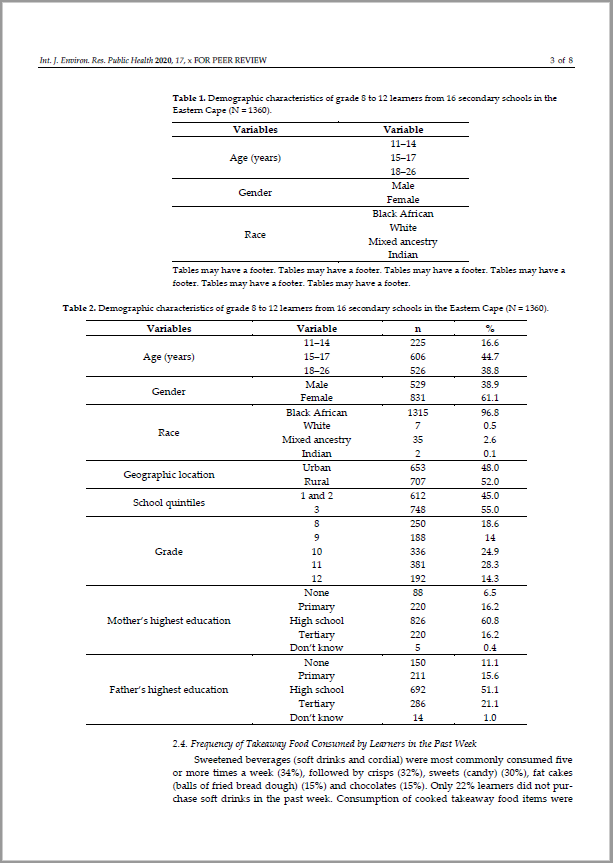
3) Small tables/figures are aligned on the left, large tables/figures are centered.
11 December 2020
2020 "Highly Cited Researchers" on MDPI Journal's Editorial Boards
We are pleased to acknowledge that many academic editors who have made an impact on MDPI journals as editorial board members, editors-in-chief, or section editors, are recognized as 2020 Highly Cited Researchers by Clarivate.
Highly Cited Researchers highlights the top 1% of researchers, by citations, in one or more of the 22 fields used in Clarivate Analytics Essential Science Indicators. We offer our congratulations to 279 academic editors of MDPI journals who were recognized as the most influential scholars in their fields in 2020.
Adams, Dave Agarwal, Ravi P. Ahn, Choon Ki Ahn, Myung-Ju Albrecht, Randy A. Andersson, Dan I. Anker, Stefan D. Apergis, Nicholas Ariga, Katsuhiko Artaxo, Paulo Balsamo, Gianpaolo Barba, Francisco J. Benediktsson, Jon Atli Benelli, Giovanni Bhatnagar, Amit Bialystok, Ellen Blaabjerg, Frede Blay, Jean-Yves Bogers, Marcel Bolton, Declan J. Boyer, Cyrille Brocca, Luca Bruix, Jordi Buhalis, Dimitrios Burdick, Jason A. Byrd, John C. Cabeza, Luisa F. Cabrerizo-Lorite, Francisco Javier Cai, Jianchao Calhoun, Vince D. Cantu, Robert C. Cerqueira, Miguel Chang, Jo-Shu Chau, Kwok-wing Chemat, Farid Chen, Jianmin Chen, Jun Chen, Min Chen, Shaowei Chen, Wei Chen, Wei-Hsin Chen, Xiaofeng Chen, Yangkang Chen, Zhi-Gang Chiclana, Francisco Corella, Dolores Cortes, Javier Cortes, Jorge Cummings, Kenneth Michael Dai, Shifeng Decker, Eric A. DePinho, Ronald A. Dimopoulos, Meletios-Athanasios Dincer, Ibrahim Du, Yihong Dupont, Didier Edwards, David Ellahi, Rahmat Ellis, Erle C. ElMasry, Gamal Esteller, Manel Estruch, Ramón Fang, Chuanglin Fasano, Alessio Fernandez-Lafuente, Roberto Ferreira, Isabel Fortino, Giancarlo Galluzzi, Lorenzo Galvano, Fabio Gandomi, Amir H. Gandomi, Amir H. Gao, Bin Gao, Feng Gao, Wei Garbe, Claus García, Hermenegildo Geschwind, Daniel H. Giampieri, Francesca Giralt, Sergio A. Glanz, Karen Goldewijk, Kees Klein Gössling, Stefan Govindan, Kannan Granato, Daniel Grosso, Giuseppe Grosso, Giuseppe Guerrero, Josep M. Haase, Dagmar Hagger, Martin S. Hamblin, Michael R. Han, Heesup Jankovic, Joseph Janotti, Anderson |
Jiang, Hai-Long Kalaji, Hazem M. Kalantar-Zadeh, Kourosh Kaner, Richard B. Karimi, Hamid Reza Kataoka, Kazunori Keesstra, Saskia Kepp, Oliver Kerminen, Veli-Matti Keyzers, Robert A. Khademhosseini, Ali Khan, Nafees A. Kim, Ki-Hyun Klemeš, Jiří Jaromír Klenk, Hans-Peter Konopleva, Marina Y. Krammer, Florian Krebs, Frederik C. Kroemer, Guido Kudo, Masatoshi Kurths, Juergen Kurzrock, Razelle Kuznetsov, Nikolay V. Kyrpides, Nikos C. La Vecchia, Carlo Lai, Yuekun Lam, James Lancellotti, Patrizio Lee, Sangmoon Leung, Victor C. M. Li, Jinghong Li, Yurui Lindahl, José M. Merigó Lip, Gregory Y. H. Loh, Xian Jun Long, Hualou Lund, Henrik Luo, Jingshan Luque, Rafael Lyons, Timothy W. Ma, Jun Ma, Wen-Xiu Ma, Yanming Maeda, Keisuke Makarova, Kira Mantovani, Alberto Martín-Belloso, Olga Martinoia, Enrico Marzband, Mousa Masclaux-Daubresse, Celine Masson, Patrick Mateos, María Victoria Mathiesen, Brian Vad Matyjaszewski, Krzysztof McArthur, Grant A. McCauley, Darren Medlock, Jolyon M. Melero, Ignacio Mezzetti, Bruno Miroshnichenko, Andrey E. Moran, Daniel Mueller, Lukas A. Mueller-Roeber, Bernd Naushad, Mu Nemeroff, Charles B. Nieto, Juan J. O'Donnell, Colm Ogino, Shuji Olabi, Abdul-Ghani O'Regan, Donal Orsini, Nicola Oswald, Isabelle P. Ozcan, Aydogan Pahl-Wostl, Claudia Pang, Huan Payne, James E. Peng, Shushi Perc, Matjaz Perez-Alvarez, Jose Angel Piquero, Alex R. Ploss, Alexander Postolache, Mihai Pradhan, Biswajeet Prinsep, Michele R. Qian, Dong Qu, Xiaogang Reiter, Russel J. Riahi, Keywan Richter, Andreas Rignot, Eric Robert, Caroline Ros, Emilio Rosell, Rafael |
Rosen, Marc A. |
The full list of 2020 Highly Cited Researchers can be accessed on https://recognition.webofsciencegroup.com/awards/highly-cited/2020/
--- Highly Cited Researchers (HCR) is a Clarivate product.
3 December 2020
Join Us at the Virtual AGU Fall Meeting 2020

The AGU Fall Meeting is the largest international Earth and space science meeting in the world. This year, for the first time, the conference is being held in virtual form.
AGU20 is scheduled from 1 to 17 December 2020 to accommodate over a thousand hours of virtual content and minimize conflicts while maximizing global engagement. The scientific program content will be available on demand, with pre-recorded oral presentations and virtual posters available for attendees to view and peruse outside of the scheduled live Q&A sessions during the meeting. Click here for a program overview and more AGU20 details.
Water will be present online at the AGU Fall Meeting 2020 as a supporter. If you are attending this conference, please feel free to visit our page. For more information about the conference, please visit https://www.agu.org/Fall-Meeting.
26 November 2020
Water Reaches 10,000 Articles Milestone

Water (ISSN 2073-4441), MDPI’s open access journal on water science and technology, has published more than 10,000 papers since its inception in 2009. On behalf of the editorial team, we would like to express our gratitude to the Editor-in-Chief of Water, Dr. Jean-Luc Probst, the Editorial Board members, as well as to Guest Editors of Special Issues and Topics Board members who have ensured the continued success of the journal through their hard work and diligence.
Water is covered in the Science Citation Index Expanded (Web of Science), Scopus, Ei Compendex and PubMed, with a 2019 Impact Factor of 2.544, which corresponds to rank 31/94 (Q2) in the JCR category “Water Resources”. The journal’s Citescore is 3.0, which equals rank 82/217 (Q2) in ‘Water Science and Technology’, rank 88/219 (Q2) in ‘Aquatic Science’ and rank 147/679 (Q1) in ‘Geography, Planning and Development’ according to Scopus data.
12 November 2020
Virtual Public Memorial Event—In Memory of Prof. Dr. Ir. Arjen Y. Hoekstra, Former Editor-in-Chief of Water
|
|
|
Prof.Dr.Ir. Arjen Y. Hoekstra (1967–2019) |

On 18 November 2019, Prof.Dr.Ir. Arjen Y. Hoekstra unexpectedly passed away. The Water Editorial Office and the tenured staff in his research group have set up a Special Issue, ‘In Memory of Prof. Arjen Y. Hoekstra’, in order to commemorate his scientific legacy in the field of water footprint assessment and the global dimension to water management.
On 18 November 2020, from 4pm to 5pm CET, a public memorial event, moderated by Dr.Ir. Rick Hogeboom (University of Twente), director of the Water Footprint Network and one of the Guest Editors of the memorial Special Issue, will be held in virtual form. We are sincerely inviting you to participate in this memorial event.
All the people close to him will always miss him. He is with us in spirit.
13 July 2020
Water Webinar Series: Climate Change Impact on the World's Oceans and Coastal Systems: Proofing, Adapting, Mitigating?—15 July 2020

Climate variations have always impacted our ocean and coastal systems. A global concern is that the near-future rate of climate change may reach levels of which the impact is beyond our capacity to respond. Is it possible to make our oceans and/or coasts climate proof or if not can we achieve successful adaptation and mitigation measures? The webinar will address these issues albeit in a focused sense. Three contributions will be presented on (1) impact of climate change on our oceans, (2) impact of climate change on the Venice Lagoon and (3) impact of climate change on the Mississippi Delta.
Date & Time: 15 July 2020 16:00 pm (CEST) | 10:00 am (EDT) | 10:00 pm (CST Asia)
Duration: Maximum 2 hour
Webinar ID: 812 8179 9326
Register for Free Here: https://water-2.sciforum.net/
Chair:
|
|
Prof. Dr. Marcel Stive Section Editor-in-Chief of “Oceans and Coastal Zones” |
|
Interests: nearshore hydrodynamics; sediment transport; coastal and estuarine morphodynamics; coastal and estuarine engineering and management; natural hazards; vulnerability and risk assessment; climate change |

Speakers:
|
|
Dr. Sam Dupont Guest Editor of “Impact of Ocean Acidification on Marine Organisms—Unifying Principles and New Paradigms” |
|
Presentation: "What do we need to limit the impact of climate change and acidification on our oceans?" |
|
|
|
Dr. Georg Umgiesser Guest Editor of “Study of Lagoons and Other Shallow Water Bodies Through the Application of Numerical Models” |
|
Presentation: "What is the future of Venice under climate change?" |
|
|
|
Dr. Kevin Xu Guest Editor of ‘’ Observation and Numerical Modeling of Sediment Transport in Coastal Areas” |
|
Presentation: "What is the future of the Mississippi delta under Climate Change and Land Loss?" |



For any questions about the webinar, please send an email to water.webinar@mdpi.com.
9 July 2020
Open Access Agreement Between Jisc Collections and MDPI
We are delighted to announce the establishment of our Open Access agreement with Jisc Collections, which will allow UK institutions to benefit from access to article processing charge (APC) discounts and streamlined payment workflows.
All institutions participating in the agreement will also gain access to the MDPI online submission system where they can find full article metadata and pricing information for easy identification and additional transparency.
Eligible authors affiliated with the participating institutions are prompted to choose the corresponding Institutional Open Access Program (IOAP) when they submit an article via our online submission system.

About Jisc
Jisc's vision is for the UK to be the most digitally advanced education and research nation in the world. At its heart is the super-fast national research and education network, Janet, with built-in cyber security protection. Jisc also provides technology solutions for its members (colleges, universities and research centres) and customers (public sector bodies), helps members save time and money by negotiating sector-wide deals and provides advice and practical assistance on digital technology. Jisc is funded by the UK higher and further education and research funding bodies and member institutions.
For more information, contact helen.dobson@jisc.ac.uk.
About MDPI
MDPI is a publisher of fully peer-reviewed, Open Access journals with a focus on thorough and rapid editorial processing. Its aim is to ensure that high-quality research is verified and made available to the research community as quickly as possible. MDPI stands at the forefront of the Open Access movement, having launched its first online journal Molecules in 1996. Today, MDPI is a leader in Open Access publishing with over 250 journals across all research disciplines, and all content published under a Creative Commons Attribution License (CC BY).
For any questions about this agreement, please contact the MDPI IOAP team at ioap@mdpi.com.
