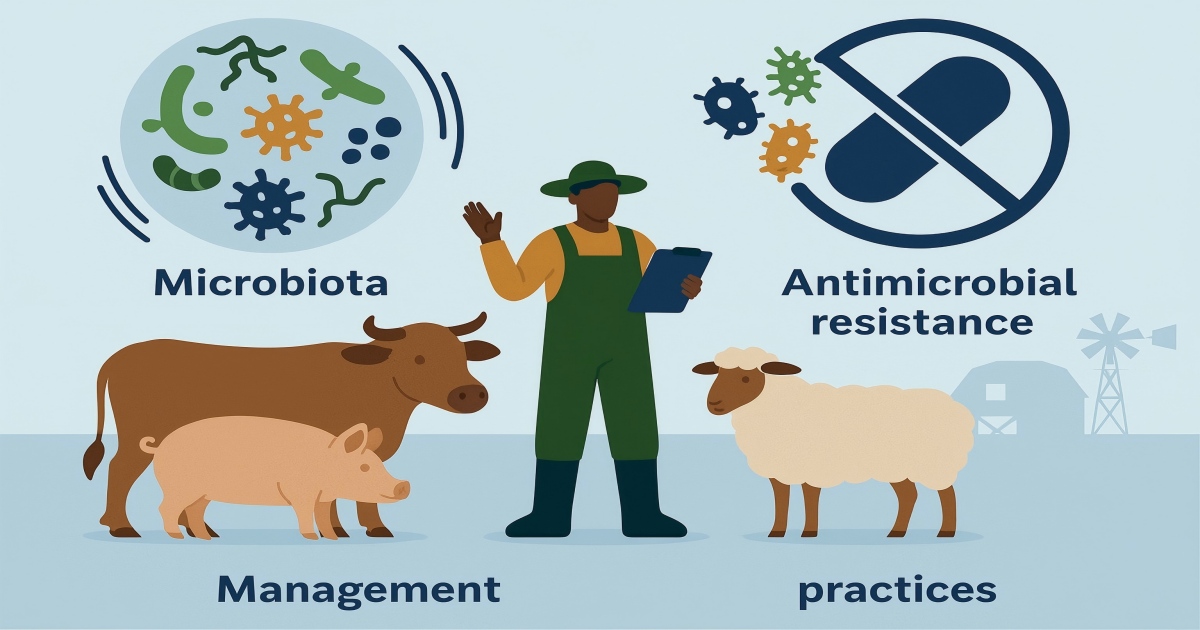
Advances in Livestock Health: Microbiota, Antimicrobial Resistance, and Management Practices

A special issue of Veterinary Sciences (ISSN 2306-7381). This special issue belongs to the section "Veterinary Microbiology, Parasitology and Immunology".

Deadline for manuscript submissions: 30 June 2026 | Viewed by 1553

Special Issue Editors


E-Mail Website
Guest Editor
Department of Agriculture and Animal Health, College of Agriculture and Environmental Sciences, University of South Africa, Roodepoort 1709, South Africa
Interests: veterinary epidemiology and veterinary public health; antimicrobial drug resistance

E-Mail
Guest Editor
Department of Agriculture and Animal Health, College of Agriculture and Environmental Sciences, University of South Africa, Science Campus, Florida, Johannesburg 1709, Gauteng, South Africa
Interests: epidemiology; surveillance; veterinary preventive medicine

Special Issue Information

Dear Colleagues,

Livestock health is crucial to global food security and public health, yet it is increasingly threatened by antimicrobial resistance (AMR) and zoonotic diseases. Addressing these interconnected issues requires a One Health approach, integrating perspectives from veterinary, human, and environmental health. This Special Issue will showcase research that elucidates the critical interactions between the animal microbiota, antimicrobial use, and management practices. We welcome evidence from surveillance and epidemiological studies to inform effective interventions that safeguard animal welfare and mitigate public health risks.

This Special Issue, entitled “Advances in Livestock Health: Microbiota, Antimicrobial Resistance, and Management Practices”, is dedicated to bridging critical knowledge gaps in the ecology of AMR and pathogens within livestock systems. We welcome submissions that investigate the prevalence, drivers, and molecular epidemiology of AMR in key bacterial pathogens (Salmonella spp., Staphylococcus spp., Campylobacter spp., Brucella spp., etc.) and the role of husbandry practices, biosecurity, and animal management in preventing disease transmission and AMR emergence.

We believe that this Special Issue will provide a vital evidence base for veterinarians, policymakers, and public health professionals, ultimately contributing to improved animal health, enhanced food safety, and the global effort to combat antimicrobial resistance.

Prof. Dr. James Wabwire Oguttu
Dr. Emmanuel Okechukwu Njoga
Guest Editors

Manuscript Submission Information

Manuscripts should be submitted online at www.mdpi.com by registering and logging in to this website. Once you are registered, click here to go to the submission form. Manuscripts can be submitted until the deadline. All submissions that pass pre-check are peer-reviewed. Accepted papers will be published continuously in the journal (as soon as accepted) and will be listed together on the special issue website. Research articles, review articles as well as short communications are invited. For planned papers, a title and short abstract (about 250 words) can be sent to the Editorial Office for assessment.

Submitted manuscripts should not have been published previously, nor be under consideration for publication elsewhere (except conference proceedings papers). All manuscripts are thoroughly refereed through a single-blind peer-review process. A guide for authors and other relevant information for submission of manuscripts is available on the Instructions for Authors page. Veterinary Sciences is an international peer-reviewed open access monthly journal published by MDPI.

Please visit the Instructions for Authors page before submitting a manuscript. The Article Processing Charge (APC) for publication in this open access journal is 2100 CHF (Swiss Francs). Submitted papers should be well formatted and use good English. Authors may use MDPI's English editing service prior to publication or during author revisions.

Keywords

  • antimicrobial resistance
  • livestock health
  • microbiota
  • veterinary epidemiology
  • public health
  • One Health
  • zoonotic diseases
  • livestock management
  • bacterial zoonotic pathogens

Benefits of Publishing in a Special Issue

  • Ease of navigation: Grouping papers by topic helps scholars navigate broad scope journals more efficiently.
  • Greater discoverability: Special Issues support the reach and impact of scientific research. Articles in Special Issues are more discoverable and cited more frequently.
  • Expansion of research network: Special Issues facilitate connections among authors, fostering scientific collaborations.
  • External promotion: Articles in Special Issues are often promoted through the journal's social media, increasing their visibility.
  • Reprint: MDPI Books provides the opportunity to republish successful Special Issues in book format, both online and in print.

Further information on MDPI's Special Issue policies can be found here.

Published Papers (2 papers)

Order results
Result details
Select all
Export citation of selected articles as:

Research

16 pages, 1053 KB  
Article
Closely Related Escherichia coli Strains with Multiple Resistances Found on Co-Managed Pig Farms Despite Marked Differences in Farm Antimicrobial Drug Usage
by Francesca Martelli, Andrew Wales, Martina Velasova, Shaun Cawthraw, Rebecca Gosling, Luke Randall, Robert Horton, Fabrizio Lemma, Margherita Rambaldi, Fabio Ostanello, Alessia de Lucia, Roderick Card, Olivia Turner, Nathaniel Storey, Manal AbuOun and Muna Anjum
Vet. Sci. 2026, 13(4), 309; https://doi.org/10.3390/vetsci13040309 - 24 Mar 2026
Viewed by 431
Abstract
Bacterial resistance on farms can be driven by antimicrobial use. Less is known about inter-farm transfer of resistance genes and their persistence under low antimicrobial pressure. Over two years and nine visits, we examined the shedding of resistant indicator bacteria (Escherichia coli [...] Read more.
Bacterial resistance on farms can be driven by antimicrobial use. Less is known about inter-farm transfer of resistance genes and their persistence under low antimicrobial pressure. Over two years and nine visits, we examined the shedding of resistant indicator bacteria (Escherichia coli) on one lower- and one higher-antimicrobial-usage pig farm. There was a unidirectional transfer of some less healthy pigs from the former to the latter. Faecal pools (180) were cultured on Chromagar ECC, with and without added cefotaxime or ciprofloxacin. Presumptive E. coli were phenotyped, and many ciprofloxacin-resistant isolates were whole-genome sequenced. Comparing farms, there was more (p < 0.0001) phenotypic resistance to the antimicrobial panel from the higher-usage unit, and markedly more (about ten-fold) multi-resistance. Significantly elevated individual drug resistances on this unit correlated with recently used antimicrobials. Ciprofloxacin and/or cefotaxime-resistant isolates were often present, although in low proportions. Neither of these antimicrobial classes had been administered recently, except for one fluoroquinolone course late in the study. AMR genes were more diverse from the higher-usage farm, but some resistant and multi-resistant isolates were closely related between farms. Thus, we demonstrated the maintenance of resistance genes in strains present on farms, even where selective pressure was low. Full article
Show Figures

Figure 1

14 pages, 244 KB  
Article
Laboratory Surveillance of Bovine Brucellosis: Predictors of Rose Bengal Test Positivity in Mpumalanga Province, South Africa (2021–2024)
by Themba Titus Sigudu, Phoka Caiphus Rathebe, Masilu D. Masekameni, Tintswalo Mercy Hlungwani, Khuthatshelo Vincent Mphaga and James Wabwire Oguttu
Vet. Sci. 2026, 13(3), 284; https://doi.org/10.3390/vetsci13030284 - 18 Mar 2026
Viewed by 782
Abstract
Bovine brucellosis is an endemic zoonotic disease in South Africa with significant consequences for livestock productivity and public health. Although routine laboratory surveillance data from the Rose Bengal Test (RBT) are widely collected, they are seldom used to investigate temporal and spatial patterns [...] Read more.
Bovine brucellosis is an endemic zoonotic disease in South Africa with significant consequences for livestock productivity and public health. Although routine laboratory surveillance data from the Rose Bengal Test (RBT) are widely collected, they are seldom used to investigate temporal and spatial patterns of disease detection. This study aimed to examine temporal, seasonal, and spatial predictors of RBT positivity for bovine brucellosis in Mpumalanga Province, South Africa. A retrospective observational study was conducted using routine laboratory records from the Mpumalanga Provincial Veterinary Laboratory between January 2021 and December 2024. The dataset included all bovine serum samples with complete information on testing date, municipality, and RBT results. Laboratory submissions were recorded as batches, defined as groups of serum samples submitted together to the laboratory as part of a single surveillance or investigation event. The primary outcome was batch-level RBT positivity, defined as the presence of at least one RBT-positive serum sample within a submission batch. Temporal (year of testing), seasonal (season of submission), and spatial (local municipality area) variables were evaluated as predictors of RBT positivity using logistic regression models. Mixed-effects logistic regression accounted for the clustering of submissions within municipalities. A total of 568 submission batches comprising 67,974 serum samples were analysed, of which 6182 tested positive, yielding an overall positivity of 9.1%. RBT positivity increased significantly in 2023 compared with 2021 (AOR = 2.47; 95% CI: 2.27–2.68). Seasonal variation was observed, with higher odds of positivity in spring (AOR = 1.80; 95% CI: 1.65–1.97) and lower odds in autumn and winter relative to summer. Mixed-effects modelling indicated significant residual spatial heterogeneity in RBT positivity across municipalities. Routine laboratory surveillance data can provide valuable epidemiological insights into the temporal, seasonal, and spatial dynamics of bovine brucellosis detection and support risk-based surveillance strategies in endemic livestock systems. Full article
Back to TopTop