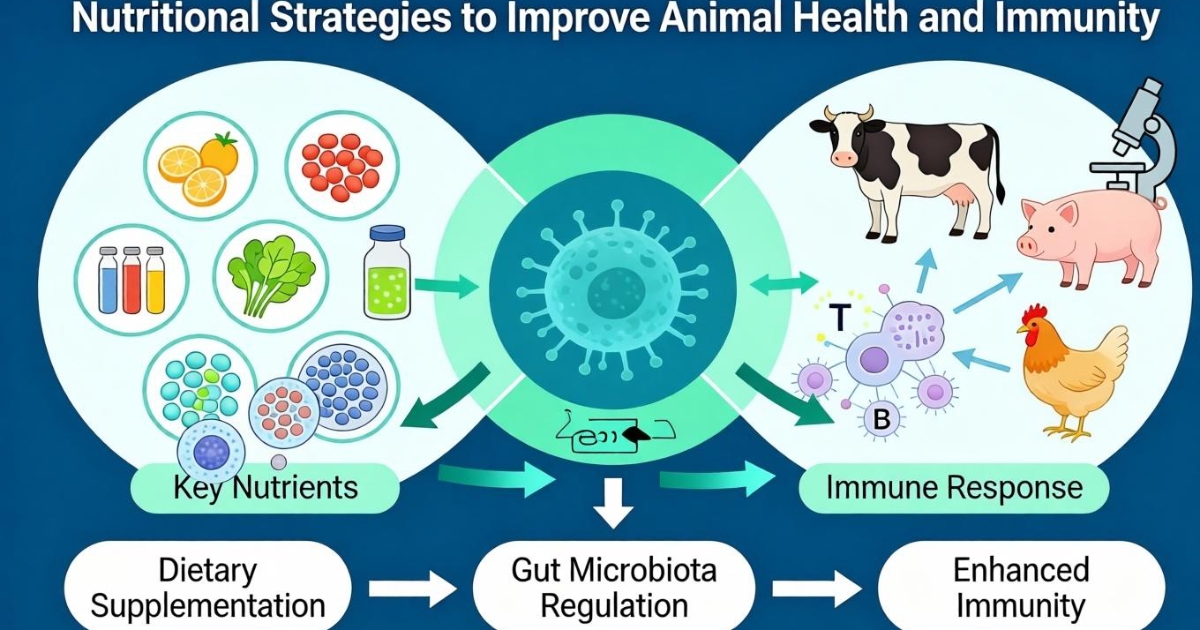
Nutritional Strategies to Improve Animal Health and Immunity

A special issue of Veterinary Sciences (ISSN 2306-7381). This special issue belongs to the section "Nutritional and Metabolic Diseases in Veterinary Medicine".

Deadline for manuscript submissions: 5 June 2026 | Viewed by 1955

Special Issue Editor


E-Mail Website
Guest Editor
Department of Veterinary Medicine and Animal Sciences (DIVAS), University of Milan, 26900 Lodi, Italy
Interests: nutrition; feed additives; gut health; weaning; livestock

Special Issue Information

Dear Colleagues,

Optimal nutrition plays a pivotal role in sustaining animal health, growth, productivity, and welfare. In recent years, increasing concerns about antimicrobial resistance, emerging diseases, and the need for sustainable livestock production have underscored the importance of nutritional strategies that enhance immune competence and disease resilience.

Nutritional interventions—ranging from balanced macro- and micronutrient formulations to the supplementation of alternative feed ingredients and functional feed additives such as probiotics, prebiotics, organic acids, and phytochemicals—represent promising approaches to strengthen the host’s natural defense mechanisms and reduce reliance on antibiotics.

This Special Issue, titled “Nutritional Strategies to Improve Animal Health and Immunity”, aims to collect original research articles and comprehensive reviews exploring how diet composition, feeding strategies, functional ingredients, and feed additives influence immune function, gut integrity, oxidative status, and overall health across animal species, including both livestock and companion animals.

Studies elucidating the molecular and physiological mechanisms underlying nutrition–immunity interactions, as well as innovative approaches for assessing immune responses are particularly encouraged.

By integrating fundamental and applied research, this Special Issue seeks to advance our understanding of the complex relationship between nutrition and immunity and to promote evidence-based nutritional strategies that contribute to improving animal health and welfare.

Dr. Luca Marchetti
Guest Editor

Manuscript Submission Information

Manuscripts should be submitted online at www.mdpi.com by registering and logging in to this website. Once you are registered, click here to go to the submission form. Manuscripts can be submitted until the deadline. All submissions that pass pre-check are peer-reviewed. Accepted papers will be published continuously in the journal (as soon as accepted) and will be listed together on the special issue website. Research articles, review articles as well as short communications are invited. For planned papers, a title and short abstract (about 250 words) can be sent to the Editorial Office for assessment.

Submitted manuscripts should not have been published previously, nor be under consideration for publication elsewhere (except conference proceedings papers). All manuscripts are thoroughly refereed through a single-blind peer-review process. A guide for authors and other relevant information for submission of manuscripts is available on the Instructions for Authors page. Veterinary Sciences is an international peer-reviewed open access monthly journal published by MDPI.

Please visit the Instructions for Authors page before submitting a manuscript. The Article Processing Charge (APC) for publication in this open access journal is 2100 CHF (Swiss Francs). Submitted papers should be well formatted and use good English. Authors may use MDPI's English editing service prior to publication or during author revisions.

Keywords

  • nutrition
  • immunity
  • gut health
  • functional ingredients
  • feed formulation
  • feed additives
  • antimicrobial resistance
  • immune regulation
  • microbiome
  • livestock
  • companion animals
  • pet food
  • pigs
  • poultry
  • cattle
  • calves
  • dairy cows
  • dogs

Benefits of Publishing in a Special Issue

  • Ease of navigation: Grouping papers by topic helps scholars navigate broad scope journals more efficiently.
  • Greater discoverability: Special Issues support the reach and impact of scientific research. Articles in Special Issues are more discoverable and cited more frequently.
  • Expansion of research network: Special Issues facilitate connections among authors, fostering scientific collaborations.
  • External promotion: Articles in Special Issues are often promoted through the journal's social media, increasing their visibility.
  • Reprint: MDPI Books provides the opportunity to republish successful Special Issues in book format, both online and in print.

Further information on MDPI's Special Issue policies can be found here.

Published Papers (2 papers)

Order results
Result details
Select all
Export citation of selected articles as:

Research

23 pages, 1677 KB  
Article
Effects of a Glycosylated Form of Active Vitamin D Combined with Natural Triterpenes on Sow Productive Performance, Mineral Homeostasis, Immune Biomarkers and Serum Proteome
by Luca Marchetti, Raffaella Rebucci, Carlotta Giromini, Elisa Margherita Maffioli, Gabriella Tedeschi and Valentino Bontempo
Vet. Sci. 2026, 13(3), 246; https://doi.org/10.3390/vetsci13030246 - 5 Mar 2026
Viewed by 465
Abstract
This study evaluated the effects of the dietary administration of a glycosylated form of active vitamin D (calcitriol, 1,25(OH)2D3) combined with ursolic acid (UA) and oleanolic acid (OA) triterpenes on sow health and productivity. Twenty-four third-parity Landrace × Large [...] Read more.
This study evaluated the effects of the dietary administration of a glycosylated form of active vitamin D (calcitriol, 1,25(OH)2D3) combined with ursolic acid (UA) and oleanolic acid (OA) triterpenes on sow health and productivity. Twenty-four third-parity Landrace × Large White sows were allocated at day 108 of gestation into three groups: a control group receiving 1800 IU/kg of vitamin D3, and two treatment groups receiving the control diet supplemented with either 0.64 µg/kg (ACTD1) or 0.96 µg/kg (ACTD2) of glycosylated 1,25(OH)2D3 plus 140 or 210 µg/kg of UA + OA (4:1 ratio), respectively. Diets were administered from late gestation through the end of lactation. Farrowing duration, sow body weight, backfat thickness, and litter growth were recorded. Blood samples collected at key physiological stages were analyzed for pro-inflammatory cytokines, mineral homeostasis, endocrine markers, and serum proteome. Farrowing time was reduced in both treatment groups compared with the control (p < 0.05). Treated sows exhibited lower backfat thickness at the end of lactation and improved litter weights at farrowing, after cross-fostering, and at weaning (p < 0.05). Plasma pro-inflammatory cytokines (TNF-α, IL-1α, and IL-1β) were reduced at the end of lactation in ACTD1 and ACTD2 sows, with TNF-α and IL-1β already decreased after farrowing (p < 0.05). Treated sows also displayed decreased plasma parathormone concentrations at the end of lactation, along with increased circulating 1,25(OH)2D3 and calcium concentrations after farrowing and at lactation end (p < 0.05), while plasma phosphate levels remained unchanged. Proteomic analysis supported the systemic availability of the supplemented compounds and their involvement in metabolic and inflammatory pathways rather than calcium transport or vitamin D binding mechanisms. Overall, this nutritional strategy influenced the immune modulation while maintaining mineral homeostasis via modest endocrine adaptations. Larger-scale trials are warranted to confirm these results and to evaluate their practical applicability under commercial production conditions. Full article
(This article belongs to the Special Issue Nutritional Strategies to Improve Animal Health and Immunity)
Show Figures

Figure 1

24 pages, 3878 KB  
Article
Effects of Dietary Supplementation with Whole Lamb Omasum on Gut Health and Metabolism in Shiba Inu Dogs
by Aolong Jin, Shuyu Zhou, Shang Cheng, You Yang, Yawang Sun, Zhipeng Sun, Yongju Zhao and Xiaochuan Chen
Vet. Sci. 2026, 13(1), 58; https://doi.org/10.3390/vetsci13010058 - 7 Jan 2026
Viewed by 880
Abstract
The growing pet economy boosts demand for fiber-enriched functional foods to improve canine gut motility and metabolic health. However, low-bioavailability commercial fibers often falter in high-energy diets. Whole lamb omasum—from grass-fed sheep omasum and gastric contents—repurposes a discarded byproduct for waste reduction and [...] Read more.
The growing pet economy boosts demand for fiber-enriched functional foods to improve canine gut motility and metabolic health. However, low-bioavailability commercial fibers often falter in high-energy diets. Whole lamb omasum—from grass-fed sheep omasum and gastric contents—repurposes a discarded byproduct for waste reduction and sustainable livestock production. This study evaluated the short-term effects of WLO supplementation on gut health and metabolism in healthy adult Shiba Inu dogs. Twelve dogs were randomly assigned to control or WLO groups in a randomized controlled trial. WLO supplementation significantly reduced fecal scores by 8.91% (p < 0.05), increased apparent crude fat and fiber digestibility by 3.70% and 11.55% (p < 0.05), and elevated serum IgA by 35.79–36.15% and T-AOC by 30.53–35.71% (p < 0.05). Serum metabolome revealed 13 between-group and 8 within-subject differences related to lipid and endocrine modulation. Fecal microbiota analysis indicated enrichment of the Bacillota phylum and Blautia genus (p < 0.05). These findings support WLO as a functional food that enhances gut and metabolic health in small-breed dogs. Full article
(This article belongs to the Special Issue Nutritional Strategies to Improve Animal Health and Immunity)
Show Figures

Figure 1

Back to TopTop