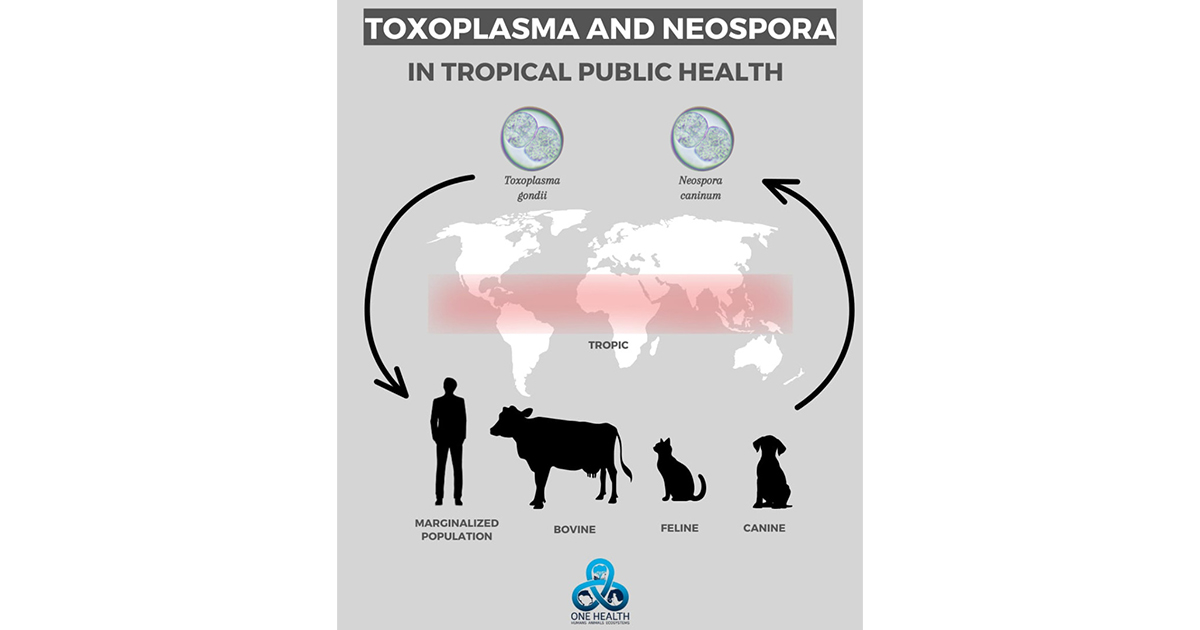



Toxoplasma and Neospora: Public Health Challenges in Tropical Regions

A special issue of Tropical Medicine and Infectious Disease (ISSN 2414-6366). This special issue belongs to the section "One Health".

Deadline for manuscript submissions: 31 August 2026 | Viewed by 2326

Special Issue Editors


E-Mail Website
Guest Editor
Departamento de Medicina Veterinária, Federal Institute of Education, Science and Technology of Paraíba, Av. João da Mata, 256, Jaguaribe, João Pessoa 58015-020, PB, Brazil
Interests: neglected diseases; toxoplasmosis; neosporosis; giardiasis; cryptosporidiosis; leishmaniases
Special Issues, Collections and Topics in MDPI journals

E-Mail Website
Guest Editor
Department of Veterinary Medicine, Federal Institute of Education, Science and Technology of Paraíba, Av. João da Mata, 256, Jaguaribe, João Pessoa 58015-020, PB, Brazil
Interests: parasitic diseases; rickettsioses; zoonoses; tick-borne diseases
Special Issues, Collections and Topics in MDPI journals

Special Issue Information

Dear Colleagues,

Toxoplasma gondii and Neospora caninum are globally distributed protozoan parasites, posing significant health challenges worldwide. While their impact is widespread, tropical regions present unique epidemiological, environmental, and socio-cultural factors that contribute to their persistence and profound public health implications for both human and animal populations. T. gondii is a leading cause of foodborne zoonoses and congenital infections, while N. caninum is one of the most important causes of reproductive losses in livestock. Warm climates, diverse host species, and often limited control measures further favor their spread and impact in these areas.

This Special Issue aims to gather cutting-edge research and comprehensive reviews addressing the epidemiology, pathogenesis, diagnosis, prevention, and control strategies of these protozoa, with a specific focus on tropical regions. We particularly welcome contributions that highlight the role of One Health approaches, molecular and serological surveillance, wildlife reservoirs, socio-cultural risk factors, and innovative interventions tailored to tropical contexts. By integrating multidisciplinary perspectives, this collection seeks to advance understanding and provide actionable insights to reduce the burden of these infections on human and animal populations in the tropics.

Dr. Thais Ferreira Feitosa
Dr. Vinícius Longo Ribeiro Vilela
Guest Editors

Manuscript Submission Information

Manuscripts should be submitted online at www.mdpi.com by registering and logging in to this website. Once you are registered, click here to go to the submission form. Manuscripts can be submitted until the deadline. All submissions that pass pre-check are peer-reviewed. Accepted papers will be published continuously in the journal (as soon as accepted) and will be listed together on the special issue website. Research articles, review articles as well as short communications are invited. For planned papers, a title and short abstract (about 250 words) can be sent to the Editorial Office for assessment.

Submitted manuscripts should not have been published previously, nor be under consideration for publication elsewhere (except conference proceedings papers). All manuscripts are thoroughly refereed through a single-blind peer-review process. A guide for authors and other relevant information for submission of manuscripts is available on the Instructions for Authors page. Tropical Medicine and Infectious Disease is an international peer-reviewed open access monthly journal published by MDPI.

Please visit the Instructions for Authors page before submitting a manuscript. The Article Processing Charge (APC) for publication in this open access journal is 2700 CHF (Swiss Francs). Submitted papers should be well formatted and use good English. Authors may use MDPI's English editing service prior to publication or during author revisions.

Keywords

  • tropical diseases
  • public health
  • epidemiology
  • One Health
  • protozoan parasites
  • Toxoplasma gondii
  • Neospora caninum
  • zoonoses
  • animal health
  • surveillance
  • control strategies

Benefits of Publishing in a Special Issue

  • Ease of navigation: Grouping papers by topic helps scholars navigate broad scope journals more efficiently.
  • Greater discoverability: Special Issues support the reach and impact of scientific research. Articles in Special Issues are more discoverable and cited more frequently.
  • Expansion of research network: Special Issues facilitate connections among authors, fostering scientific collaborations.
  • External promotion: Articles in Special Issues are often promoted through the journal's social media, increasing their visibility.
  • Reprint: MDPI Books provides the opportunity to republish successful Special Issues in book format, both online and in print.

Further information on MDPI's Special Issue policies can be found here.

Published Papers (2 papers)

Order results
Result details
Select all
Export citation of selected articles as:

Research

10 pages, 262 KB  
Article
Occurrence of Toxoplasma gondii and Neospora caninum Antibodies in Pet Cats and Dogs in Pathum Thani, Thailand
by Nhung Pho Nguyen Nguyen, Thuy Thi Nguyen, Chonchadayu Phanpha, Ketsarin Kamyingkird, Adrian B. Hehl and Tawin Inpankaew
Trop. Med. Infect. Dis. 2026, 11(4), 89; https://doi.org/10.3390/tropicalmed11040089 - 25 Mar 2026
Cited by 1 | Viewed by 761
Abstract
Toxoplasma gondii and Neospora caninum are closely related apicomplexan parasites of veterinary and public health importance. T. gondii is a zoonotic pathogen for which cats are the definitive host, whereas N. caninum is a major cause of reproductive losses in cattle, with dogs [...] Read more.
Toxoplasma gondii and Neospora caninum are closely related apicomplexan parasites of veterinary and public health importance. T. gondii is a zoonotic pathogen for which cats are the definitive host, whereas N. caninum is a major cause of reproductive losses in cattle, with dogs acting as the definitive host. Data on exposure in pet animals in Thailand remain limited. This study investigated seroprevalence and associated risk factors of T. gondii and N. caninum in pet cats and dogs in Pathum Thani Province, an urban area adjacent to Bangkok. Between June 2020 and July 2021, serum samples were collected from 169 owned animals, including 86 cats and 83 dogs, participating in a mobile sterilization program. Antibodies were detected using the indirect fluorescent antibody test (IFAT), and animal characteristics, behaviors, and environmental factors were obtained via owner questionnaires. Serological evidence of exposure to both parasites was detected. Antibodies against T. gondii were detected in 4.73% (8/169) of animals, including 4.65% (4/86) of cats and 4.82% (4/83) of dogs. For N. caninum, the overall seroprevalence was 10.06% (17/169), with a higher prevalence in dogs (15.66%, 13/83) than in cats (4.65%, 4/86). No significant risk factors were identified for T. gondii or N. caninum infection in either cats or dogs (p > 0.05). Full article
(This article belongs to the Special Issue Toxoplasma and Neospora: Public Health Challenges in Tropical Regions)
15 pages, 1617 KB  
Article
Prevalence and Risk Factors for Congenital Toxoplasmosis in Newborns in the Public Health System in the Eastern Region of the Brazilian Amazon, Northern Tocantins State, Brazil: Retrospective Cohort Study
by Stela B. C. Sousa, Cláudia D. M. Mangueira, Sandro E. Moron, Raphael G. Ferreira, Helierson Gomes, Noé M. E. P. L. Costa, Alex S. R. Cangussu, Bergmann M. Ribeiro, Fabricio S. Campos, Gil R. dos Santos, Raimundo W. S. Aguiar, Kelly M. I. Silva, Alice R. Mazutti, Julliana D. Pinheiro, Frederico Eugênio, Erica E. L. Gontijo, Sara F. de Sousa, Jaqueline C. M. Borges, João B. Neto and Marcos G. da Silva
Trop. Med. Infect. Dis. 2026, 11(1), 13; https://doi.org/10.3390/tropicalmed11010013 - 31 Dec 2025
Viewed by 1130
Abstract
Objective: To determine the prevalence of and risk factors for congenital toxoplasmosis in neonates treated in the public health network of the eastern region of the Brazilian Amazon, northern Tocantins state. Methods: A retrospective cohort study was conducted with neonates born to mothers [...] Read more.
Objective: To determine the prevalence of and risk factors for congenital toxoplasmosis in neonates treated in the public health network of the eastern region of the Brazilian Amazon, northern Tocantins state. Methods: A retrospective cohort study was conducted with neonates born to mothers with gestational toxoplasmosis who received care between 2017 and 2024. The outcome under analysis was positivity for immunoglobulin M in the electrochemiluminescence assay (CLIA). We estimated the prevalence of transplacental infection and respective 95% confidence intervals (95% CI) and its association with risk factors using the odds ratio (or) with a p-value < 0.05 in infected neonates before and after 16 gestational weeks at maternal infection diagnosis. Results: A total of 1142 neonates were surveyed, in which 496 were diagnosed with congenital toxoplasmosis (IgM positive), thus obtaining a prevalence of vertical transmission of 45.4%. The main risk factors for vertical transmission were the mother’s education level equal to or less than eight years, (OR = 1.5; 95% CI 1.2; 2.0) and having less than six prenatal consultations (OR = 22.8; 95% CI 3.0; 172.6). Conclusions: A high prevalence of congenital toxoplasmosis was observed, with higher rates of infection in neonates born to mothers with lower levels of education. Full article
(This article belongs to the Special Issue Toxoplasma and Neospora: Public Health Challenges in Tropical Regions)
Show Figures

Figure 1

Back to TopTop