



Farming the Blue: The Sustainability of Aquaculture and the Marine Environment
A special issue of Sustainability (ISSN 2071-1050). This special issue belongs to the section "Environmental Sustainability and Applications".
Deadline for manuscript submissions: 31 August 2026 | Viewed by 1252
Special Issue Editors

Interests: aquaculture; farming systems; fish farming; feed additives; fish nutrition; multi-trophic aquaculture systems (IMTAs); recirculating aquaculture systems (RASs); seaweed cultivation; sustainability in aquaculture
Special Issues, Collections and Topics in MDPI journals

Interests: marine fish farming; reproduction of aquatic organisms; marine fish larviculture; IMTA; biofloc technology; circularity; ESG

Special Issue Information
Dear Colleagues,
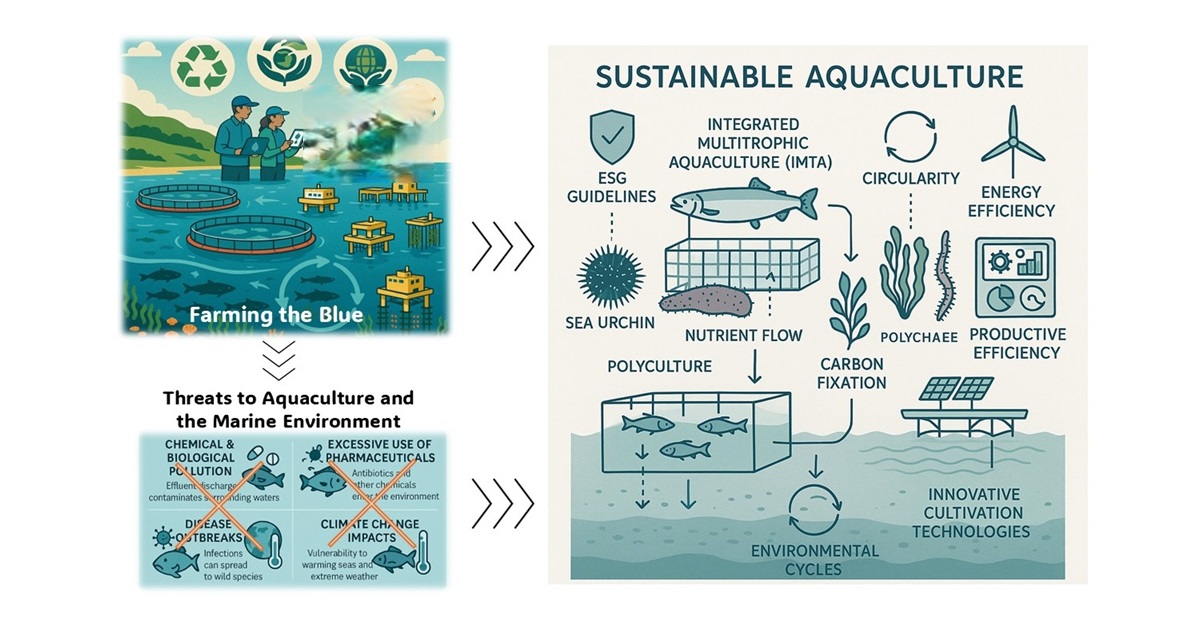
In response to the increasing global population, aquaculture has become a strategic solution to meet the rising demand for seafood due to the decline in fisheries. However, the rapid expansion of aquaculture, particularly in intensive fish farming in coastal net pens and offshore locations, has led to various environmental concerns around chemical and biological pollution, excessive use of pharmaceuticals, and disease outbreaks. Additionally, the evident impacts of climate change present an imminent threat to both aquaculture and marine ecosystems. Therefore, to ensure the sustainable growth of aquaculture, it is essential for aquaculture researchers to prioritize research efforts that develop practices and technologies that mitigate or eliminate the environmental impacts of aquaculture on the marine environment. This shift would mark a crucial step toward a sustainable transition to blue farming.
We are pleased to invite you to contribute to this Special Issue of Sustainability, ‘Farming the Blue: The Sustainability of Aquaculture and the Marine Environment’.
The purpose of this Special Issue is to promote the publication of experimental, computational, and theoretical research in the natural and applied sciences, engineering, economics, social sciences, and humanities. Our goal is to advance scientific understanding, as well as facilitate predictions and impact assessments, of global changes and developments in relation to sustainability in aquaculture and the marine environment.
We welcome high-quality original research articles, reviews, communications, commentaries, opinion papers, and case reports that explore aquaculture, the environment, and sustainable practices in the marine environment.
Topics of interest include, but are not limited to, the following: sustainable techniques (such as Environmental, Social, and Governance (ESG) guidelines), Integrated Multitrophic Aquaculture (IMTA), circularity, and energy efficiency. We welcome the submission of articles that explore mariculture, including analyses of nutrient flow, carbon fixation, production efficiency, and environmental cycles. Additionally, we welcome submissions on polycultures that incorporate the farming of marine fish with emerging species like sea urchins, sea cucumbers, algae, and polychaetes, or other innovative cultivation technologies and more efficient systems. Studies on the ecological impacts of crops, water and cultivation structure reuse, sociological research exploring the relationship between the environment and society, and their role of aquaculture in knowledge and income aggregation, as well as the alignment between aquaculture and Sustainable Development Goals (SDGs), are highly encouraged.
Prof. Dr. Marco Shizuo Owatari
Prof. Dr. Caio César França Magnotti
Prof. Dr. Aline Brum Figueredo Ruschel
Guest Editors
Manuscript Submission Information
Manuscripts should be submitted online at www.mdpi.com by registering and logging in to this website. Once you are registered, click here to go to the submission form. Manuscripts can be submitted until the deadline. All submissions that pass pre-check are peer-reviewed. Accepted papers will be published continuously in the journal (as soon as accepted) and will be listed together on the special issue website. Research articles, review articles as well as short communications are invited. For planned papers, a title and short abstract (about 250 words) can be sent to the Editorial Office for assessment.
Submitted manuscripts should not have been published previously, nor be under consideration for publication elsewhere (except conference proceedings papers). All manuscripts are thoroughly refereed through a single-blind peer-review process. A guide for authors and other relevant information for submission of manuscripts is available on the Instructions for Authors page. Sustainability is an international peer-reviewed open access semimonthly journal published by MDPI.
Please visit the Instructions for Authors page before submitting a manuscript. The Article Processing Charge (APC) for publication in this open access journal is 2400 CHF (Swiss Francs). Submitted papers should be well formatted and use good English. Authors may use MDPI's English editing service prior to publication or during author revisions.
Keywords
- aquaculture
- circularity
- environment
- feed additives
- marine fish farming
- multitrophic aquaculture
- mollusc farming
- sustainability
- sustainable development
Benefits of Publishing in a Special Issue
- Ease of navigation: Grouping papers by topic helps scholars navigate broad scope journals more efficiently.
- Greater discoverability: Special Issues support the reach and impact of scientific research. Articles in Special Issues are more discoverable and cited more frequently.
- Expansion of research network: Special Issues facilitate connections among authors, fostering scientific collaborations.
- External promotion: Articles in Special Issues are often promoted through the journal's social media, increasing their visibility.
- Reprint: MDPI Books provides the opportunity to republish successful Special Issues in book format, both online and in print.
Further information on MDPI's Special Issue policies can be found here.
