Special Issue "Sustainable Innovation in Tourism and Hospitality"

A special issue of Sustainability (ISSN 2071-1050). This special issue belongs to the section "Tourism, Culture, and Heritage".

Deadline for manuscript submissions: 30 December 2021.

Special Issue Editors

Dr. Dejan Krizaj
E-Mail Website1 Website2
Guest Editor
1. Faculty of Tourism Studies - Turistica, University of Primorska, Koper 6000, Slovenia
2. Alliance for Innovators and Researchers in Tourism and Hospitality (AIRTH)
Interests: tourism innovation; service design; e-tourism
Dr. Vinod Sasidharan
E-Mail Website
Guest Editor
1. L. Robert Payne School of Hospitality and Tourism Management, San Diego State University, San Diego, CA 92182, USA
2. Alliance for Innovators and Researchers in Tourism and Hospitality (AIRTH)
Interests: sustainable tourism; tourism ecolabels; sustainable development goals (SDGs)

Special Issue Information

Dear Colleagues,

Innovation is becoming increasingly important in tourism and hospitality, both following and dictating trends such as globalization, digitization and sustainability. More recently, the new reality imposed by Covid-19 weakened the tourism and hospitality sector while, at the same time, questioning and sharpening its sustainable development goals and priorities. The objectives of this Special Issue are therefore twofold. Firstly, we would like to present state-of-the-art scientific analyses, both empirical and theoretical, of sustainable innovation responses to current and future trends and threats. Secondly, at the same time, we wish to devote as much attention as possible to studies focusing on innovation in the tourism and hospitality sector that address the sustainability aspects of all areas, and not just those which are ecological.

More precisely, with our first objective, we are interested in the changing patterns of global trends and their impacts on sustainable innovation in the tourism and hospitality sector, including the pre-/mid-/post-Covid-19 influences on sustainable innovation behavior, approaches, dynamics and outcomes of all or selected stakeholders in the tourism and hospitality sector. Tourism organizations tend to perform better in terms of environmental and economic sustainability, compared to a generally lower commitment to the social dimension of sustainability. Underperformance in the social component of sustainability among tourism organizations can result, among other things, from misconceptions of authenticity or unclear guidelines on social sustainability as opposed to increasingly adopted environmental sustainability policies. For our second objective, we encourage authors to consider innovative approaches to integrating social sustainability, beyond the economic and environmental dimensions, within the overall performance of tourism organizations.

Dr. Dejan Krizaj
Dr. Vinod Sasidharan
Guest Editors

Manuscript Submission Information

Manuscripts should be submitted online at www.mdpi.com by registering and logging in to this website. Once you are registered, click here to go to the submission form. Manuscripts can be submitted until the deadline. All papers will be peer-reviewed. Accepted papers will be published continuously in the journal (as soon as accepted) and will be listed together on the special issue website. Research articles, review articles as well as short communications are invited. For planned papers, a title and short abstract (about 100 words) can be sent to the Editorial Office for announcement on this website.

Submitted manuscripts should not have been published previously, nor be under consideration for publication elsewhere (except conference proceedings papers). All manuscripts are thoroughly refereed through a single-blind peer-review process. A guide for authors and other relevant information for submission of manuscripts is available on the Instructions for Authors page. Sustainability is an international peer-reviewed open access semimonthly journal published by MDPI.

Please visit the Instructions for Authors page before submitting a manuscript. The Article Processing Charge (APC) for publication in this open access journal is 1900 CHF (Swiss Francs). Submitted papers should be well formatted and use good English. Authors may use MDPI's English editing service prior to publication or during author revisions.

Keywords

  • tourism innovation
  • sustainable development
  • social sustainability
  • tourism trends

Published Papers (1 paper)

Order results
Result details
Select all
Export citation of selected articles as:

Research

Article
Illuminating Opportunities for Smart Tourism Innovation That Foster Sustainable Tourist Well-Being Using Q Methodology
Sustainability 2021, 13(14), 7929; https://doi.org/10.3390/su13147929 - 15 Jul 2021
Viewed by 433
Abstract
Technology innovation has become one of the driving forces that advance the tourism industry, but the industry has yet to account for the manner in which personal technologies can foster tourists’ sustainable well-being. Generating innovation that promotes the sustainable well-being of individuals is [...] Read more.
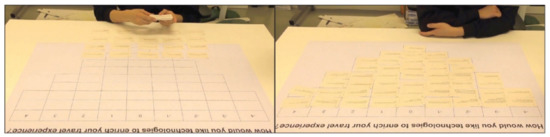
Technology innovation has become one of the driving forces that advance the tourism industry, but the industry has yet to account for the manner in which personal technologies can foster tourists’ sustainable well-being. Generating innovation that promotes the sustainable well-being of individuals is deemed to be challenging because the experience needs to account for users’ psychological well-being and their attitudes towards technology. A holistic apprehension of these needs, which requires multidisciplinary perspectives, can help designers to identify design spaces for further design investigations at the fuzzy front-end of innovation. Hence, the goal of this study is to identify design opportunities for smart tourism innovation that foster sustainable tourist well-being by using Q methodology to gather participants’ attitudes on the future use of such technology. The study involved 43 participants ranking 46 statements derived from the extant literature. The results show four opinion clusters related to the optimal use of personal technologies for sustainable tourist well-being. These clusters, which highlight both hedonic and eudaimonic user experience considerations, provide directions for designers for developing innovations that promote well-being. Recommendations of using Q as an exploratory design research method are discussed. Full article
(This article belongs to the Special Issue Sustainable Innovation in Tourism and Hospitality)
Show Figures

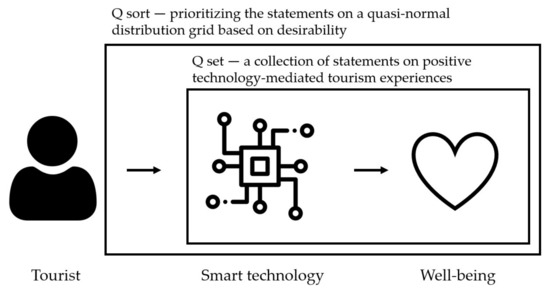
Figure 1

Back to TopTop