sustainability-logo

Journal Browser

Journal Browser

Advancing Sustainable Additive Manufacturing: Innovations in Technology and Environmental Impact Metrics

A special issue of Sustainability (ISSN 2071-1050). This special issue belongs to the section "Sustainable Engineering and Science".

Deadline for manuscript submissions: 31 December 2026 | Viewed by 1627

Special Issue Editors


E-Mail Website
Guest Editor
Department of Chemical, Materials and Production Engineering (DICMAPI), University of Naples Federico II, 80125 Naples, Italy
Interests: sustainable technologies; manufacturing processes; 3D printing; life cycle assessment; metal forming; biocomposites

E-Mail Website
Guest Editor
Department of Chemical, Materials and Industrial Production Engineering, University of Naples Federico II, 80125 Naples, Italy
Interests: lean manufacturing; remanufacturing; Industry 4.0; supply chain management
Special Issues, Collections and Topics in MDPI journals

E-Mail Website
Guest Editor
Department of Industrial Engineering and Mathematical Sciences (DIISM), Polytechnic University of Marche, 60131 Ancona, Italy
Interests: composite materials; automated manufacturing; additive manufacturing; sustainability; life cycle analyses
Special Issues, Collections and Topics in MDPI journals

Special Issue Information

Dear Colleagues,

The integration of advanced technologies with sustainable practices is becoming increasingly critical in modern manufacturing, particularly in the context of additive manufacturing (AM). In this rapidly evolving field, the primary goal is to design parts that are not only efficient in performance but also environmentally responsible, taking into account both the materials used and the energy consumption during production.

The growing adoption of AM technologies across various industries, such as automotive, aerospace, and healthcare, has highlighted the potential for producing complex geometries, lightweight structures, and customized components that are optimized for specific applications. However, despite the clear advantages, challenges remain, and the integration of sustainability metrics into the design and production of additive-manufactured parts is therefore a critical area of research and development.

The application of advanced technologies, such as high-resolution 3D printing, laser sintering, and hybrid additive-subtractive processes, is driving new possibilities in material selection, part design, and process efficiency. However, the environmental implications of these technologies are not yet fully understood. Therefore, much attention is being directed toward the development of comprehensive environmental impact metrics that can evaluate the sustainability of AM processes.

Some of the key issues currently being explored in the field include the following:

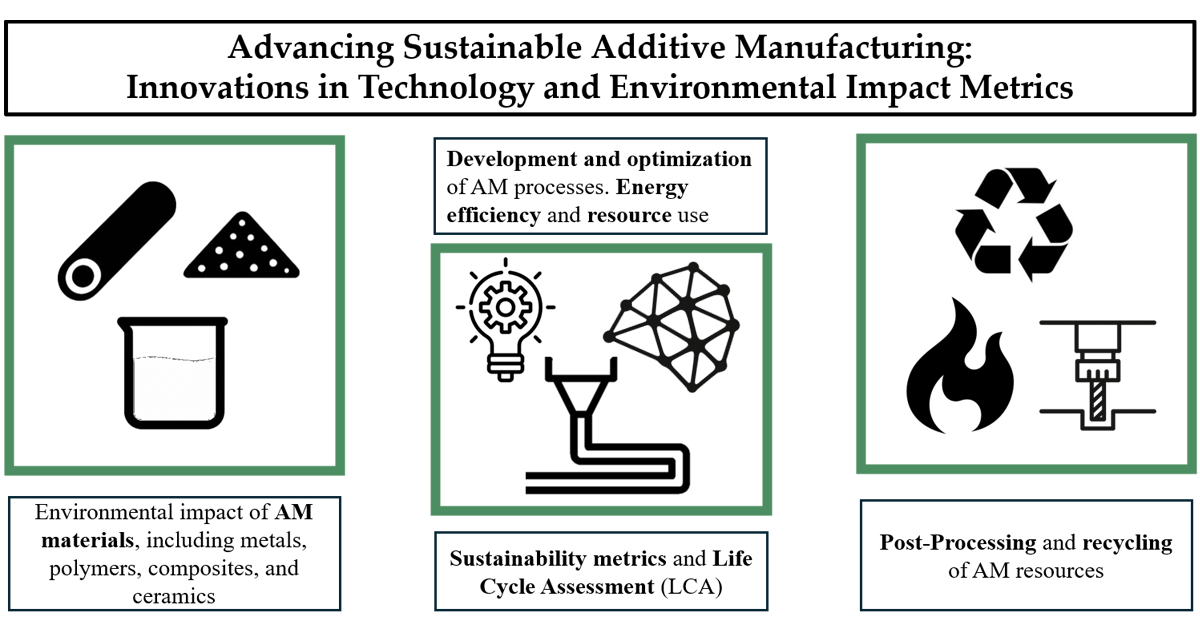
  • Development and optimization of AM processes;
  • Sustainability metrics and Life Cycle Assessment (LCA) of AM;
  • Environmental impact of AM materials, including metals, polymers, composites, and ceramics;
  • Energy efficiency and resource use in AM;
  • Post-Processing and recycling of AM resources.

This Special Issue aims to bring together the latest research on these emerging topics in sustainable additive manufacturing. By exploring either technological innovation and the development of environmental impact metrics, we aim to provide a comprehensive overview of the current state of the art in this field, highlighting the key challenges and opportunities for advancing AM toward a more sustainable future.

Dr. Ersilia Cozzolino
Prof. Dr. Mosè Gallo
Dr. Iacopo Bianchi
Guest Editors

Manuscript Submission Information

Manuscripts should be submitted online at www.mdpi.com by registering and logging in to this website. Once you are registered, click here to go to the submission form. Manuscripts can be submitted until the deadline. All submissions that pass pre-check are peer-reviewed. Accepted papers will be published continuously in the journal (as soon as accepted) and will be listed together on the special issue website. Research articles, review articles as well as short communications are invited. For planned papers, a title and short abstract (about 250 words) can be sent to the Editorial Office for assessment.

Submitted manuscripts should not have been published previously, nor be under consideration for publication elsewhere (except conference proceedings papers). All manuscripts are thoroughly refereed through a single-blind peer-review process. A guide for authors and other relevant information for submission of manuscripts is available on the Instructions for Authors page. Sustainability is an international peer-reviewed open access semimonthly journal published by MDPI.

Please visit the Instructions for Authors page before submitting a manuscript. The Article Processing Charge (APC) for publication in this open access journal is 2400 CHF (Swiss Francs). Submitted papers should be well formatted and use good English. Authors may use MDPI's English editing service prior to publication or during author revisions.

Keywords

  • additive manufacturing
  • life cycle assessment
  • sustainability
  • environmental metrics
  • energy efficiency
  • recycling
  • AM materials

Benefits of Publishing in a Special Issue

  • Ease of navigation: Grouping papers by topic helps scholars navigate broad scope journals more efficiently.
  • Greater discoverability: Special Issues support the reach and impact of scientific research. Articles in Special Issues are more discoverable and cited more frequently.
  • Expansion of research network: Special Issues facilitate connections among authors, fostering scientific collaborations.
  • External promotion: Articles in Special Issues are often promoted through the journal's social media, increasing their visibility.
  • Reprint: MDPI Books provides the opportunity to republish successful Special Issues in book format, both online and in print.

Further information on MDPI's Special Issue policies can be found here.

Published Papers (2 papers)

Order results
Result details
Select all
Export citation of selected articles as:
21 pages, 12913 KB  
Article
Process Parameter Effects on the Environmental Performance of Wire Arc Additive Manufacturing of Invar 36 Alloy: A Life Cycle Assessment Approach
by Rosa Abate, Giulio Mattera, Samruddha Kokare, Luigi Nele and Guido Guizzi
Sustainability 2026, 18(8), 4106; https://doi.org/10.3390/su18084106 - 20 Apr 2026
Viewed by 358
Abstract
This study quantitatively evaluates the impact of Wire Arc Additive Manufacturing (WAAM) process parameters on the environmental performance of components produced in Invar 36 alloy. An experimental campaign involving 49 parameter sets was carried out by varying wire feed speed, welding voltage, and [...] Read more.
This study quantitatively evaluates the impact of Wire Arc Additive Manufacturing (WAAM) process parameters on the environmental performance of components produced in Invar 36 alloy. An experimental campaign involving 49 parameter sets was carried out by varying wire feed speed, welding voltage, and welding speed. For each condition, electrical signals, shielding gas consumption, and wire usage were measured and converted into parameter-resolved Life Cycle Inventory (LCI) data. A cradle-to-gate Life Cycle Assessment (LCA) was implemented in SimaPro 9.6 using the European CML-IA baseline v3.10 midpoint method, adopting 1 kg of as-built deposited Invar 36 as the functional unit. Results show that feedstock production represents the dominant hotspot (8.68 kg CO2-eq/kg), while the WAAM stage contributes between 1.13 and 4.12 kg CO2-eq/kg, leading to a total impact ranging from 9.81 to 12.80 kg CO2-eq/kg. As a result, this study demonstrates that process parameter selection strongly influences environmental performance. Indeed, Specific Energy Consumption (SEC) ranges from 0.44 to 1.95 kWh/kg, while argon consumption varies between 0.26 and 1.51 kg/kg of deposited material. By analysing the results and excluding unstable or manufacturing-infeasible deposition regimes, the optimal trade-off between process stability and environmental impact is achieved at approximately WFS = 7 m/min, V = 20 V, and WS = 6.5 mm/s. Beyond quantifying the environmental hotspots of Invar 36 WAAM, this study provides a dedicated, parameter-resolved cradle-to-gate LCA based on experimentally measured foreground data collected across 49 process parameter combinations. By combining environmental assessment with feasibility screening of the investigated deposition regimes, the work identifies not only environmentally favourable conditions, but also parameter regions that are technologically viable for WAAM processing of Invar 36. The resulting dataset provides a benchmark foundation for future sustainability-oriented process optimisation and decision support in WAAM. Full article
Show Figures

Figure 1

56 pages, 4435 KB  
Review
Sustainability of the Fused Deposition Modelling Process—A Review
by Vlada Țisari, Andrei Marius Mihalache, Oana Dodun, Cosmin-Gabriel Grădinaru, Roxana-Gabriela Hobjâlă, Ana Ghimp and Laurențiu Slătineanu
Sustainability 2026, 18(9), 4549; https://doi.org/10.3390/su18094549 - 5 May 2026
Viewed by 806
Abstract
The expansion of fused deposition modeling (FDM) usage for manufacturing parts through 3D printing has contributed to an intensification of researchers’ concerns regarding the sustainability of the mentioned process. In this regard, the aspects considered essential for defining the FDM process were first [...] Read more.
The expansion of fused deposition modeling (FDM) usage for manufacturing parts through 3D printing has contributed to an intensification of researchers’ concerns regarding the sustainability of the mentioned process. In this regard, the aspects considered essential for defining the FDM process were first highlighted. For a rigorous approach to the research results achieved so far in the field of FDM process sustainability, a systemic analysis was carried out, taking into consideration the sustainability of the FDM process as a system, and identifying the input factors and output parameters of such a system. The evolution of knowledge regarding the approach to sustainability aspects of the FDM process has allowed for a highlighting of the main research directions addressed up to now in a direction. The main solutions proposed by various researchers for improving the sustainability of the FDM process were succinctly presented. Highlighting the results of research on the influence exerted by different input factors on the values of output parameters specific to FDM process sustainability was considered to be of interest. Various proposed solutions for modeling and optimizing the output parameters usable for evaluating the sustainability of the FDM process were investigated. A brief presentation of the evolution trends in research regarding FDM process sustainability was made. Full article
Show Figures

Figure 1

Back to TopTop