New Insights into Nanomaterials for Cancer Therapy and Drug Delivery

A special issue of Pharmaceutics (ISSN 1999-4923). This special issue belongs to the section "Nanomedicine and Nanotechnology".

Deadline for manuscript submissions: 31 January 2027 | Viewed by 2927

Editors


E-Mail Website
Guest Editor
Dipartimento di Neuroscienze-Sezione di Fisica, Università Cattolica del Sacro Cuore, 00168 Roma, Italy
Interests: nanomedicine; bioprinting; tissue engineering; multi-organ
Special Issues, Collections and Topics in MDPI journals

E-Mail Website
Guest Editor
Dipartimento di Neuroscienze-Sezione di Fisica, Università Cattolica del Sacro Cuore, 00168 Roma, Italy
Interests: nonlinear optics; plasmonics; biosensors; biophotonics

Special Issue Information

Dear Colleagues,

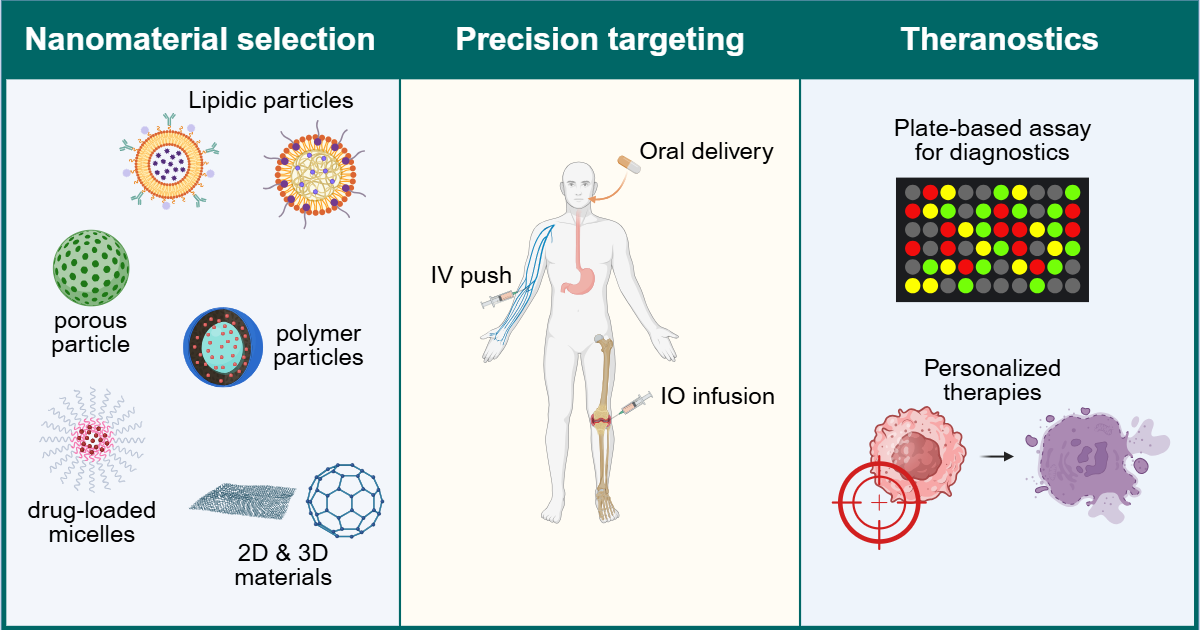
Nanotechnology has emerged as a powerful tool to revolutionize cancer therapy and drug delivery, enabling precise targeting, controlled release and reduced systemic toxicity. This Special Issue, “New Insights into Nanomaterials for Cancer Therapy and Drug Delivery”, aims to highlight recent advances in the design, synthesis and functionalization of nanomaterials for oncological applications. Contributions will cover innovative nanocarriers, multifunctional and stimuli-responsive systems, strategies for overcoming biological barriers as well as preclinical and translational studies that bridge the gap toward clinical implementation. By gathering cutting-edge research and critical reviews, this Special Issue seeks to provide a comprehensive overview of how novel nanomaterials can improve therapeutic efficacy, minimize side effects and pave the way for next-generation cancer treatments.

Dr. Giordano Perini
Dr. Antonio Minopoli
Guest Editors

Manuscript Submission Information

Manuscripts should be submitted online at www.mdpi.com by registering and logging in to this website. Once you are registered, click here to go to the submission form. Manuscripts can be submitted until the deadline. All submissions that pass pre-check are peer-reviewed. Accepted papers will be published continuously in the journal (as soon as accepted) and will be listed together on the special issue website. Research articles, review articles as well as short communications are invited. For planned papers, a title and short abstract (about 250 words) can be sent to the Editorial Office for assessment.

Submitted manuscripts should not have been published previously, nor be under consideration for publication elsewhere (except conference proceedings papers). All manuscripts are thoroughly refereed through a single-anonymized peer-review process. A guide for authors and other relevant information for submission of manuscripts is available on the Instructions for Authors page. Pharmaceutics is an international peer-reviewed open access monthly journal published by MDPI.

Please visit the Instructions for Authors page before submitting a manuscript. The Article Processing Charge (APC) for publication in this open access journal is 2900 CHF (Swiss Francs). Submitted papers should be well formatted and use good English. Authors may use MDPI's English editing service prior to publication or during author revisions.

Keywords

  • nanomaterials
  • cancer
  • targeted therapy
  • drug delivery
  • new therapeutics
  • precision nanomedicine

Benefits of Publishing in a Special Issue

  • Ease of navigation: Grouping papers by topic helps scholars navigate broad scope journals more efficiently.
  • Greater discoverability: Special Issues support the reach and impact of scientific research. Articles in Special Issues are more discoverable and cited more frequently.
  • Expansion of research network: Special Issues facilitate connections among authors, fostering scientific collaborations.
  • External promotion: Articles in Special Issues are often promoted through the journal's social media, increasing their visibility.
  • Reprint: MDPI Books provides the opportunity to republish successful Special Issues in book format, both online and in print.

Further information on MDPI's Special Issue policies can be found here.

Published Papers (4 papers)

Order results
Result details
Select all
Export citation of selected articles as:

Research

Jump to: Review

24 pages, 20745 KB  
Article
pH-Responsive Bovine Serum Albumin Nanoparticles Encapsulating Doxorubicin-Based Complexes Induce Cuproptosis in Lung Cancer Cells
by Haiying Zhang, Xuanjia Chen, Shihui Qiao, Huanfeng Meng, Hui Long, Huamin Zhong, Yiheng Liu, Yun Song, Yanan Gao, Yan Liu and Lujia Mao
Pharmaceutics 2026, 18(5), 526; https://doi.org/10.3390/pharmaceutics18050526 - 26 Apr 2026
Viewed by 889
Abstract
Background/Objectives: This study investigates the induction of cuproptosis in A549 lung cancer cells by doxorubicin (DOX) complexes and the development of pH-responsive bovine serum albumin (BSA)-based nanocarriers for their delivery. We successfully synthesized and characterized two novel complexes: DOX–Cu, where DOX acts [...] Read more.
Background/Objectives: This study investigates the induction of cuproptosis in A549 lung cancer cells by doxorubicin (DOX) complexes and the development of pH-responsive bovine serum albumin (BSA)-based nanocarriers for their delivery. We successfully synthesized and characterized two novel complexes: DOX–Cu, where DOX acts as a ligand for Cu(II), and DOX–BTZ, a conjugate formed between DOX and the proteasome inhibitor bortezomib (BTZ). Methods: Spectroscopic and NMR analyses were performed to confirm the formation of the complexes. In vitro assays were conducted to evaluate cytotoxicity in A549 cells, alongside assessment of DLAT aggregation as a marker of cuproptosis. The formulation of DOX into BSA nanoparticles (DOX–Cu@BSA NPs and DOX–BTZ@BSA NPs) was carried out to evaluate potential alleviation of DOX-induced cytotoxicity in cardiomyocytes in vitro. Fluorescence quenching and molecular docking studies were employed to investigate the binding interactions between the complexes and BSA. Cellular uptake experiments were performed to assess nanoparticle internalization into A549 cells. Results: Both complexes exhibited superior cytotoxicity against A549 cells compared to individual components. This enhanced cell death was associated with significant aggregation of dihydrolipoamide S-acetyltransferase (DLAT), a key marker of cuproptosis, suggesting the involvement of this copper-dependent cell death pathway. The BSA nanoparticles displayed favorable characteristics, including uniform size (~190 nm), high encapsulation efficiency (~75–79%), and colloidal stability. Crucially, they exhibited a pH-responsive drug release profile, with significantly accelerated release under acidic conditions (pH 5.7) mimicking the tumor microenvironment. Fluorescence quenching and molecular docking studies revealed strong, spontaneous binding between the complexes and BSA, primarily driven by hydrophobic interactions. Cellular uptake experiments confirmed efficient internalization of the nanoparticles into A549 cells. Conclusions: Collectively, this work offers a proof-of-concept for a strategy of utilizing BSA-based multidrug delivery systems for cuproptosis induction, offering a potential avenue to enhance therapeutic efficacy while reducing systemic toxicity in lung cancer treatment. Full article
(This article belongs to the Special Issue New Insights into Nanomaterials for Cancer Therapy and Drug Delivery)
Show Figures

Graphical abstract

21 pages, 2908 KB  
Article
Stable Cholesterol–Palmitic Acid Sterosomes as Smart Nanocarriers for pH-Sensitive Doxorubicin Delivery in Breast Cancer Therapy
by Jeong Min Lee, Chung-Sung Lee, Chae Yeong Lee, Min Lee and Hee Sook Hwang
Pharmaceutics 2025, 17(12), 1574; https://doi.org/10.3390/pharmaceutics17121574 - 6 Dec 2025
Cited by 1 | Viewed by 1085
Abstract
Background: Breast cancer remains one of the most prevalent and lethal malignancies worldwide. Although doxorubicin (DOX) is widely used as a first-line chemotherapeutic agent, its clinical utility is constrained by dose-limiting cardiotoxicity and systemic adverse effects. Nanoparticulate drug delivery systems have therefore [...] Read more.
Background: Breast cancer remains one of the most prevalent and lethal malignancies worldwide. Although doxorubicin (DOX) is widely used as a first-line chemotherapeutic agent, its clinical utility is constrained by dose-limiting cardiotoxicity and systemic adverse effects. Nanoparticulate drug delivery systems have therefore attracted attention for improving DOX stability, biocompatibility, and tumor selectivity. In this study, we explored sterosomes—simple non-phospholipid nanocarriers composed of cholesterol and palmitic acid—as an alternative DOX delivery platform with pH-responsive properties. Methods: DOX-loaded sterosomes (DOX-STs) were prepared using cholesterol and palmitic acid to impart acid-sensitive behavior. The nanocarriers were systematically evaluated through particle characterization, physicochemical stability assessment, in vitro pH-dependent drug release, and cellular uptake studies. Furthermore, therapeutic efficacy and systemic safety were investigated in an MDA-MB-231 breast cancer xenograft mouse model. Results: DOX-STs exhibited particle sizes below 100 nm, high encapsulation efficiency, and excellent colloidal stability for 28 days. The sterosomes demonstrated accelerated DOX release under acidic conditions relative to physiological pH, consistent with their pH-responsive design. Enhanced cellular uptake was observed in both MCF-7 and MDA-MB-231 cells. In vivo, DOX-ST treatment resulted in significant tumor growth suppression and prolonged survival without notable body weight loss, indicating reduced systemic toxicity compared to free DOX. Conclusions: This study presents a simple sterosome-based nanocarrier system that achieves pH-responsive DOX release and enhanced antitumor efficacy while minimizing toxicity. These findings highlight the potential of sterosomes as a translatable nanomedicine platform for breast cancer therapy. Full article
(This article belongs to the Special Issue New Insights into Nanomaterials for Cancer Therapy and Drug Delivery)
Show Figures

Figure 1

Review

Jump to: Research

26 pages, 6548 KB  
Review
Stimuli-Responsive Nanocarriers as Next-Generation on-Demand Drug Delivery Systems for Cancer Therapy: Mechanistic Insights, Trigger Modalities, and Translational Challenges
by Ahmed Abdulkarim Y. Alaysereen, Moath Mahmoud E. Daoud, Maha Munawar Alhoda M. Bader Alhoda, Ali Husain Ali Zayer and G. Roshan Deen
Pharmaceutics 2026, 18(7), 800; https://doi.org/10.3390/pharmaceutics18070800 (registering DOI) - 29 Jun 2026
Abstract
Chemotherapy has been used in cancer treatment for decades; however, standard chemotherapy treatments still have significant weaknesses, including collateral damage to healthy tissue, rapid development of drug resistance, and dose-limiting toxicity that limits therapeutic value. There is now an alternative approach using polymer [...] Read more.
Chemotherapy has been used in cancer treatment for decades; however, standard chemotherapy treatments still have significant weaknesses, including collateral damage to healthy tissue, rapid development of drug resistance, and dose-limiting toxicity that limits therapeutic value. There is now an alternative approach using polymer materials that are responsive to biological stimuli that will allow for improved treatment of cancer while avoiding the limitations. Responsive polymer materials are designed to be inert during circulation until they reach their site of action; then, they will respond to specific triggers. These smart carriers respond to stimuli present in the tumor microenvironment (e.g., low pH, high glutathione levels, and increased proteolytic activity) or external stimuli applied at the bedside (e.g., localized heat, light, ultrasound, and applied magnetic fields). In both cases, there is a consistent pattern where the drug is released exactly where/when it is needed, with minimal drug release occurring outside that location and timeframe. Therefore, it is theorized that the use of polymeric-based delivery systems with stimuli-regulated drug release will significantly increase the concentration of drug delivered intratumorally, decrease the drug toxicity, and provide a potential mechanism to overcome the development of multidrug resistance from a variety of cancer treatments. To date, various types of responsive polymers have been developed and could be combined to give rise to a wide variety of different vehicle systems (e.g., micelles, nanogels, hydrogels, and hybrid delivery systems), with many of these carriers designed to respond to multiple stimuli simultaneously. Nonetheless, significant challenges remain in the clinical application of these materials due to tumor heterogeneity, immune system interactions, reproducibility issues, polymer chemistry advances, surface chemistry, and other interaction mechanisms. As a result of all of these evolving regulatory systems, as well as some of the emerging areas of polymer chemistry and surface engineering, theranostic integration will allow for new routes to provide therapy for patients with cancer. Additionally, because of these scientific advances, there will also be more opportunities to provide targeted, controllable, and on-demand treatments to patients using stimuli-responsive polymers. Full article
(This article belongs to the Special Issue New Insights into Nanomaterials for Cancer Therapy and Drug Delivery)
Show Figures

Figure 1

43 pages, 5555 KB  
Review
Exosomes as Disease-Informed Nanoplatforms for Pulmonary Fibrosis: From Pathogenic Signaling to Precision Diagnosis and Therapy
by Jeong Min Lee, Kyung Tae Kim, Chung-Sung Lee and Hee Sook Hwang
Pharmaceutics 2026, 18(6), 668; https://doi.org/10.3390/pharmaceutics18060668 - 28 May 2026
Viewed by 506
Abstract
Pulmonary fibrosis (PF) is a progressive and often fatal interstitial lung disease for which the currently available pharmacological therapies remain largely limited to slowing disease progression rather than reversing established fibrosis. This limitation has stimulated increasing interest in innovative therapeutic platforms capable of [...] Read more.
Pulmonary fibrosis (PF) is a progressive and often fatal interstitial lung disease for which the currently available pharmacological therapies remain largely limited to slowing disease progression rather than reversing established fibrosis. This limitation has stimulated increasing interest in innovative therapeutic platforms capable of modulating complex fibrotic pathways. In this context, exosomes—nanoscale extracellular vesicles—have emerged as promising cell-free nanocarriers due to their intrinsic biocompatibility, low immunogenicity, and ability to be engineered for targeted drug delivery. In this review, we provide a comprehensive overview of both natural and engineered exosome-based strategies for the diagnosis and treatment of pulmonary fibrosis. We summarize recent advances in exosome engineering, including ligand functionalization, glycoengineering, and therapeutic cargo loading, highlighting how these approaches may support the development of more targeted and potentially personalized nanotherapeutic strategies. We further discuss emerging hybrid delivery platforms, such as exosome–liposome chimeras and hydrogel-based depots, which may enhance pulmonary retention, improve therapeutic durability, and enable controlled drug release. Finally, we outline key challenges and opportunities for clinical translation, including large-scale manufacturing, regulatory considerations, and clinically relevant delivery routes such as inhalation-based administration. Collectively, this review provides a translational perspective on engineered exosomes as emerging nanotherapeutic platforms for pulmonary fibrosis. Full article
(This article belongs to the Special Issue New Insights into Nanomaterials for Cancer Therapy and Drug Delivery)
Show Figures

Figure 1

Back to TopTop