

Journal Menu
► ▼ Journal Menu-
- Materials Home
- Aims & Scope
- Editorial Board
- Reviewer Board
- Topical Advisory Panel
- Early Career Editorial Board
- Instructions for Authors
- Special Issues
- Topics
- Sections & Collections
- Article Processing Charge
- Indexing & Archiving
- Editor’s Choice Articles
- Most Cited & Viewed
- Journal Statistics
- Journal History
- Journal Awards
- Society Collaborations
- Conferences
- Editorial Office
Journal Browser
► ▼ Journal BrowserNeed Help?
Announcements
23 June 2026
Prof. Dr. Sergio Torres-Giner Appointed Section Editor-in-Chief of Section “Green Materials” in Materials
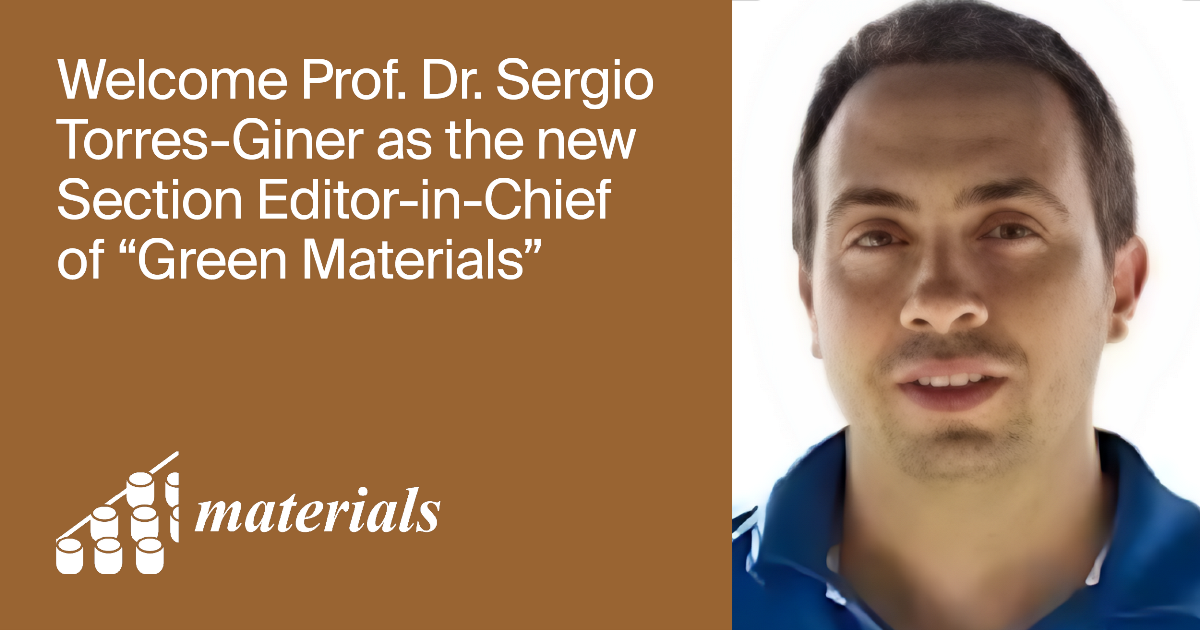
We are pleased to announce that Prof. Dr. Sergio Torres-Giner has been appointed Section Editor-in-Chief of the Section “Green Materials” in Materials (ISSN 1996-1944).
Prof. Dr. Sergio Torres-Giner is a scientist in the field of macromolecular science, with interest in its applications in food packaging technology. He has long been dedicated to the advancement of sustainable materials and green chemistry. With a comprehensive academic background spanning chemical engineering, food technology, and materials science, he combines theoretical research with practical applications in industrial processing. He has achieved significant recognition in the field of polymer science, contributing essential insights into the development and characterization of biopolymers. In particular, his research has contributed to advances in the existing knowledge of novel processes and materials that can enhance food quality, safety, and health attributes according to the circular economy and bioeconomy strategies. He has published over 120 peer-reviewed scientific papers in high-impact journals, books, and patents and his work has been widely cited globally, achieving an author’s h-index of 50. He has garnered more than 20 years of experience in both public research agencies and industrial R&D organizations.
Prof. Dr. Sergio Torres-Giner is a distinguished faculty member at the Polytechnic University of Valencia (UPV) in Valencia, Spain, specializing in sustainable polymer technologies for food packaging within a Circular Bioeconomy framework. He holds a Dipl.-Ing. in Chemical Engineering from UPV, an MSc in process systems technology from Cranfield University (UK), an MBA in industrial management, and a PhD in food science from the University of Valencia. Currently, he is leading research activities to develop novel processes and materials that aim to enhance packaged food quality, safety, and even health attributes according to the circular economy and bioeconomy strategies.
The following is a short Q&A with Prof. Dr. Sergio Torres-Giner, who shared his vision for the journal with us, as well as his views of the research area and open access publishing:
1. Why did you accept the invitation to serve as Section Editor-in-Chief for Materials?
Accepting the invitation to serve as Section Editor-in-Chief for the journal Materials represents both a distinct academic honor and a strategic commitment to the international scientific community. Leading a specific Section within such a high-impact journal provides a way in which to shape the trajectory of contemporary research. Currently, materials science is evolving at an unprecedented pace, driven by urgent demands for sustainable alternatives, advanced nanotechnology, and next-generation bioplastics. Moreover, the decision to undertake this leadership role can enhance my both institutional and professional prestige.
2. What are your expectations for the “Green Materials” Section?
From my point of view, the Section must evolve to a global benchmark for material research that accelerates the transition toward a sustainable, low-carbon, and Circular Economy scenario. I expect the Section to catalyze research that redefines waste as a resource. I proudly aim to publish pioneering work on transforming agricultural residues, industrial by-products, and post-consumer waste into high-performance materials. A key expectation is the advancement of sustainable materials by design that can be easily unzipped, separated, or naturally degraded into non-toxic components at the end of their functional lifespan.
3. In your opinion, what research topics will attract the most attention in this field over the next 3–5 years?
The Section must act as a vibrant crossroad where chemistry, engineering, and multidisciplinary science intersect. In my opinion, the vanguard areas will be as follows: (1) advanced waste valorization, including breaking down agricultural and forestry waste (e.g., lignocelluloses) into high-value chemical building blocks and additives for advanced or functional polymers without competing with food crops; (2) the upcycling of complex plastics (e.g., multilayers) by developing chemical and enzymatic methods to break down mixed plastic waste streams into pristine, virgin-quality monomers rather than low-grade downcycled products; and (3) next-generation bio-based polymers by means of designing biopolymers that match the performance of petroleum derived plastics for food packaging and other applications and can fully biodegrade in natural systems, including marine environments within months, leaving zero microplastics or toxic residues behind.
4. What suggestions do you have for journals and publishers to better support young scholars and serve the academic community?
I have a few suggestions to support young scholars, such as PhD candidates, postdocs, and assistant professors, and to better serve the wider academic community. On the one hand, we can create Junior Editorial Boards with dedicated seats or separate shadow boards for early career researchers. This grants them direct experience in editorial decision-making, Special Issue curation, and journal governance, preparing them for future leadership. On the other, we should provide concrete rewards for thorough reviews, such as cumulative fee vouchers, significant article processing charge discounts, or priority fast-track processing for their own future submissions as primary authors.
5. What are your views on the open access (OA) publishing model?
I strongly believe in the OA publishing model. Knowledge funded by public or philanthropic resources should be free, immediate, and accessible to anyone in the world without paywall restrictions. This model, furthermore, can support the fact that peer reviewers can be financially compensated finally. This is particularly relevant for postdocs, adjuncts, and researchers in developing economies, where spending several hours reviewing a paper carries a massive opportunity cost. Therefore, paying for reviews directly supports vulnerable scholars and, within this context, the OA publishing model is highly logical.
We wish Prof. Dr. Sergio Torres-Giner every success in his new position, and we look forward to his contributions to the journal.
