



Conferences
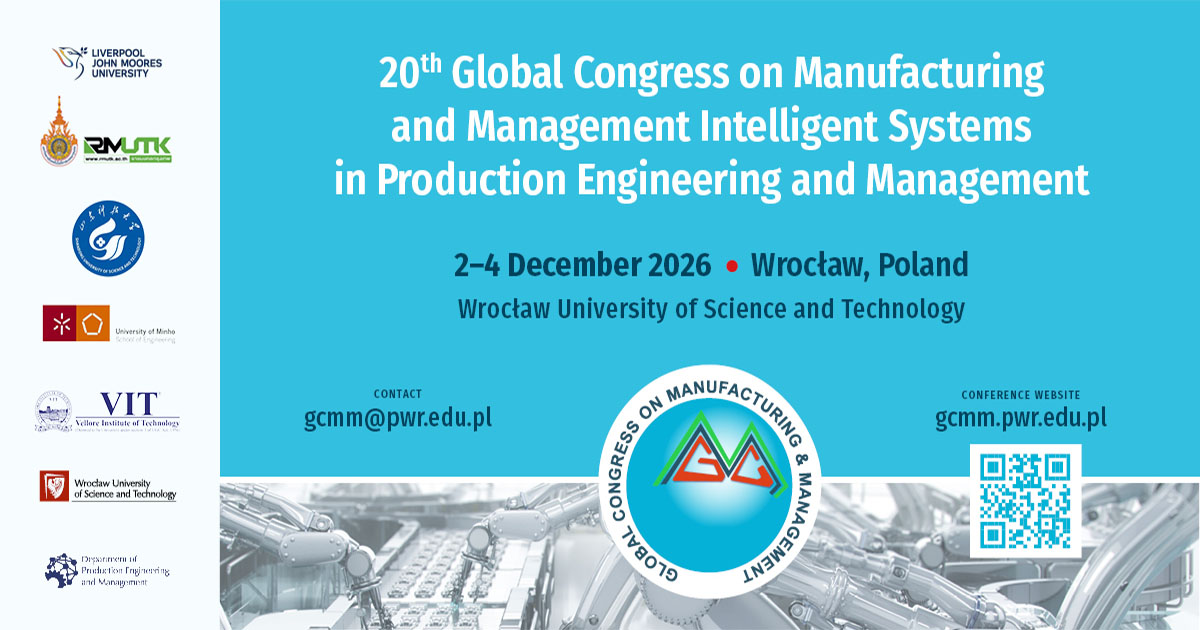
2–4 December 2026, Wrocław, Poland
20th Global Congress on Manufacturing and Management
Conference
About GCMM 2026
The Global Congress on Manufacturing and Management (GCMM) is a non-profit organization governed by the GCMM Board, comprising one or two representatives from academia and industry from each participating country. Currently, GCMM brings together members from twenty-two countries worldwide.
The Congress serves as an international platform for collaboration among leading researchers and industrial partners, enabling the exchange of knowledge, experience, and perspectives on the dynamic changes taking place in manufacturing and production management. This thematic focus is of key importance for the development and competitiveness of national economies, particularly in the context of globalization, digital transformation, and sustainable development.
Traditionally, GCMM conferences have been organized on a biennial basis; however, due to growing interest—in recent years each edition has attracted more than 1,000 participants, mainly from Asian countries—the events are now held annually. GCMM has consistently attracted high-quality research contributions and continues to serve as a central hub where global manufacturing research knowledge is integrated with industrial strategy in a globalized market.
Recent editions of GCMM, held in India (2025), Thailand (2024), Malaysia (2023), New Zealand (2022), the United Kingdom (2021), Australia (2018), China (2016), India (2014), New Zealand (2012), and Thailand (2010), were highly successful and attracted participants from over 25 countries. It is therefore a great honor for us to host the 20th anniversary edition of the Congress in Poland, at Wrocław University of Science and Technology.
Topics
Production Engineering and Management
- Production Systems Management and Maintenance;
- Application of Artificial Intelligence Methods in Production Management;
- Quality Management;
- Lean Management;
- Industry 4.0 and Industry 5.0;
- Modeling, Simulation, and Design;
- Knowledge Management and Decision-Support Systems in Production;
- Supply Chain Management;
- Reliability and Risk Assessment in Production Systems;
- Green Production and Circular Economy;
- Human Aspects in Industry;
- Project Management.
Advanced Machining
- Manufacturing Technology and System Engineering;
- Machining and Forming of Advanced Materials;
- Sustainable Machining;
- Advanced Machining Systems;
- Cutting-Tool Engineering and Management;
- Advanced Abrasive Technology;
- Water Jet Technology Machining;
- CAD/CAM/CAE;
- Modeling and Simulation;
- Laser Machining Technology.
Advanced Material and Forming
- Additive Manufacturing;
- Advanced Processing Engineering;
- Material Science and Engineering;
- Material Processing and Technology;
- Surface-Coating Technology;
- Lightweight Materials;
- Biomaterials and Tissue Engineering;
- Biomanufacturing and Biomechanics;
- Geopolymer Materials;
- Advanced Aerospace Materials and Composites.
Intelligent and Autonomous Robotics
- Mechatronics Engineering and Design;
- Autonomous Mobile Robots (AMRs)/Automatic Guided Vehicles (AGVs);
- Industrial Robots and Cobots;
- Digital Twin Technology;
- Cyber–Physical Systems (CPSs);
- Robotic Operation Systems (ROSs);
- Fuzzy Logic, Artificial Neural Networks (ANNs), and Genetic Algorithms (GAs);
- Augmented Reality and Virtual Reality;
- Control and Supervision.
Optimization, Control and Quantum Computing
- Quantum Optimization in Operational Research;
- Classification with Quantum Neural Networks;
- Hybrid Approaches in Quantum Machine Learning;
- Compilation Techniques for Gate-Based Superconducting Quantum Computers;
- Generation of True Quantum Random Numbers;
- Intelligent Control of Production Systems;
- Artificial Intelligence, Machine Learning and Deep Learning;
- Scheduling and Transport Problems.
Compliance, Regulatory and Quality Management Systems in the Life Sciences Industry
- Automated Platforms for Quality Assurance Management (eQMSs);
- Automated Platforms for Laboratories (LIMSs);
- AI in Supporting Production Sites in Compliance Areas;
- Information Security Management: Regulations for the Life Sciences Industry;
- Cybersecurity in the Life Sciences Industry;
- ALCOA++ Requirements in Practice in the Life Sciences Industry;
- Automation Testing Usage in Computer-Aided Systems for Validation in Life Sciences;
- Automated Qualification and Validation Processes in Life Sciences;
- Mechatronics Engineering and Design.
Life Science Industry: Production
- Life Science Products Technology Design and Development;
- Design of Manufacturing Processes—Use of New Tools;
- Technological Specificity of Manufacturing Single-Use and Reusable Devices;
- Scaling Up Life Science Products Manufacturing—Technological Challenges;
- Manufacturing/Application of Active Devices and Implants;
- Integration of Product and Process Design (DfM/DfA);
- Micro- and Nanotechnologies in Biomedical Engineering and Life Sciences;
- Advanced Manufacturing and Packaging Technologies for Life Sciences;
- IT Systems Supporting Design and Manufacturing in Life Sciences;
- Mechatronics Engineering and Design;
- Control and Supervision;
- Cyber–Physical Systems (CPSs);
- Robotic Operation Systems (ROSs) in Medicine and the Life Sciences Industry;
- Cybersecurity in OT Systems;
- Industrial Robots and Cobots;
- Fuzzy Logic, Artificial Neural Networks (ANNs), and Genetic Algorithms (GAs);
- Augmented Reality and Virtual Reality.
