



Sustainable Design of Fermented Dairy Products and Their Analogues: Integrating By-Product Valorization, Minimal Processing, and Precision Fermentation
A special issue of Fermentation (ISSN 2311-5637). This special issue belongs to the section "Fermentation for Food and Beverages".
Deadline for manuscript submissions: 30 November 2026 | Viewed by 327
Special Issue Editor

Interests: food safety; milk technology; food legislation; cheese production; modification of dairy products
Special Issues, Collections and Topics in MDPI journals
Special Issue Information
Dear Colleagues,
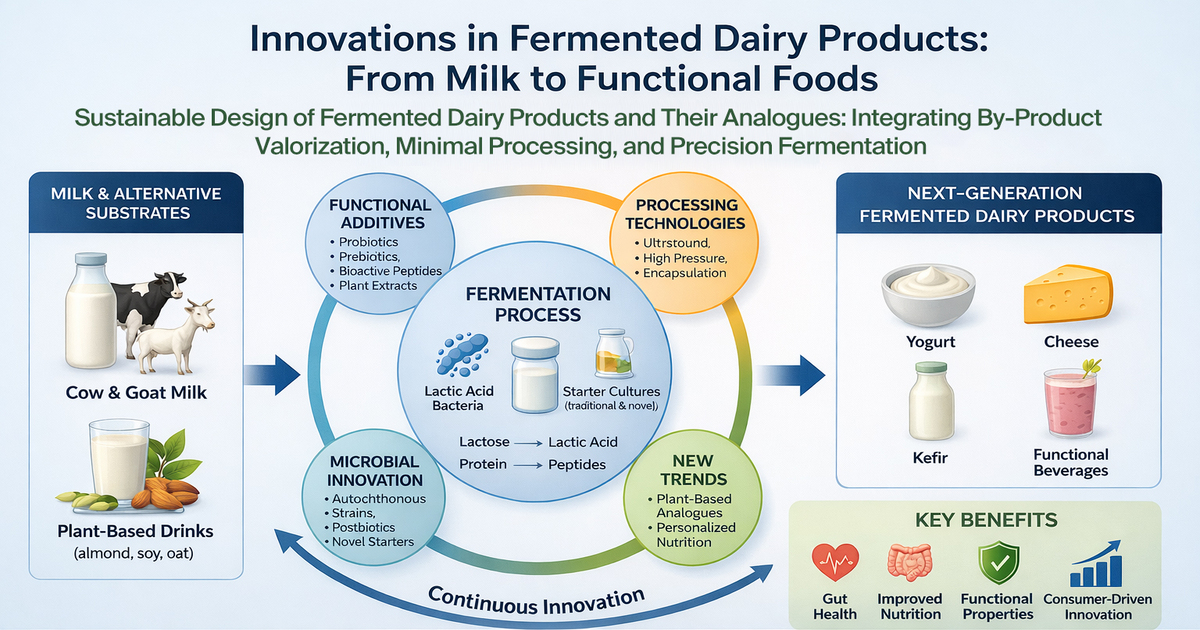
Fermented dairy products represent complex biochemical systems in which milk constituents, microbial cultures, and processing conditions interact to determine product quality, stability, and health functionality. Increasing global emphasis on sustainability, circular bioeconomy principles, and health-oriented foods is driving innovation in the field of fermented dairy products. Recent advances in Food Science, Food Biotechnology, and Food Microbiology enable a deeper understanding of fermentation ecosystems and provide tools for designing products with improved nutritional, technological, and environmental performance.
This Special Issue’s main goal is to publish scientific papers on innovative strategies for the sustainable formulation of fermented dairy products, focusing on the integration of food industry by-products and side streams as functional substrates. Attention will be given to the valorization of dairy-derived streams such as whey and components like lactose, as well as the utilization of selected plant-based agro-industrial residues rich in dietary fibres, proteins, and bioactive compounds in fermented dairy foods. These materials can serve as fermentation substrates or functional ingredients, enabling improved resource utilization while supporting microbial metabolism and enhancing the nutritional value of final products. In parallel, this Special Issue will welcome papers on minimal and mild processing technologies aimed at preserving nutritional quality, microbial viability, and product functionality, while reducing environmental impact. Technologies such as high-pressure processing, ultrafiltration, and optimized fermentation control will be considered as tools to improve product structure, stability, and shelf life, while maintaining clean-label characteristics.
The Special Issue also encourages publishing papers that emphasize the role of key lactic acid bacteria, including Lactobacillus delbrueckii subsp. bulgaricus and Streptococcus thermophilus in modulating fermentation kinetics, acidification dynamics, and metabolite formation. A special focus is put on the production of compounds such as lactic acid, exopolysaccharides, and bioactive peptides, which contribute to desirable texture, stability, and potential health-promoting properties.
An important emerging research direction is the development of fermented dairy alternatives and analogues, driven by changing consumer preferences, dietary restrictions, and sustainability considerations. Plant-based substrates such as soy milk, oat milk, and almond milk are increasingly used to produce yoghurt- and cheese-like products through controlled fermentation processes. However, these matrices differ significantly from milk in terms of protein composition, buffering capacity, and carbohydrate profile, posing technological challenges for fermentation performance and texture development. Current trends focus on the adaptation of traditional dairy starter cultures and the development of novel microbial consortia capable of efficiently fermenting non-dairy substrates, while producing desirable metabolites and sensory attributes. The application of mixed cultures and functional strains from genera such as Lactobacillus and Bifidobacterium is being explored to enhance acidification, structure formation, and production of health-related metabolites in these alternative systems. In addition, the formulation of hybrid products combining dairy ingredients with plant-based components is gaining attention as a strategy to balance nutritional quality, sustainability, and sensory acceptance. Such approaches may benefit from the incorporation of food industry by-products and fermentation-derived functional compounds, contributing to circular economy goals and innovative product development. Therefore, this Special Issue welcomes studies aimed at researching all of the above-mentioned challenges.
Finally, by integrating fermentation kinetics, sustainable ingredient utilization, minimal processing technologies, and emerging trends in dairy alternatives, this Special Issue aims to provide a comprehensive perspective on the next generation of fermented dairy and dairy-analogue products. The outcomes are expected to offer valuable insights for both academic research and industrial innovation in the rapidly evolving fermented food sector.
Dr. Irena Barukčić Jurina
Guest Editor
Manuscript Submission Information
Manuscripts should be submitted online at www.mdpi.com by registering and logging in to this website. Once you are registered, click here to go to the submission form. Manuscripts can be submitted until the deadline. All submissions that pass pre-check are peer-reviewed. Accepted papers will be published continuously in the journal (as soon as accepted) and will be listed together on the special issue website. Research articles, review articles as well as short communications are invited. For planned papers, a title and short abstract (about 250 words) can be sent to the Editorial Office for assessment.
Submitted manuscripts should not have been published previously, nor be under consideration for publication elsewhere (except conference proceedings papers). All manuscripts are thoroughly refereed through a single-blind peer-review process. A guide for authors and other relevant information for submission of manuscripts is available on the Instructions for Authors page. Fermentation is an international peer-reviewed open access monthly journal published by MDPI.
Please visit the Instructions for Authors page before submitting a manuscript. The Article Processing Charge (APC) for publication in this open access journal is 2100 CHF (Swiss Francs). Submitted papers should be well formatted and use good English. Authors may use MDPI's English editing service prior to publication or during author revisions.
Keywords
- fermented dairy products
- sustainability/circular economy
- food by-product valorization
- lactic acid bacteria (LAB)
- dairy alternatives/analogues
Benefits of Publishing in a Special Issue
- Ease of navigation: Grouping papers by topic helps scholars navigate broad scope journals more efficiently.
- Greater discoverability: Special Issues support the reach and impact of scientific research. Articles in Special Issues are more discoverable and cited more frequently.
- Expansion of research network: Special Issues facilitate connections among authors, fostering scientific collaborations.
- External promotion: Articles in Special Issues are often promoted through the journal's social media, increasing their visibility.
- Reprint: MDPI Books provides the opportunity to republish successful Special Issues in book format, both online and in print.
Further information on MDPI's Special Issue policies can be found here.
