


Body Image Perception and Body Composition in Different Populations: The Role of Physical Education and Sport
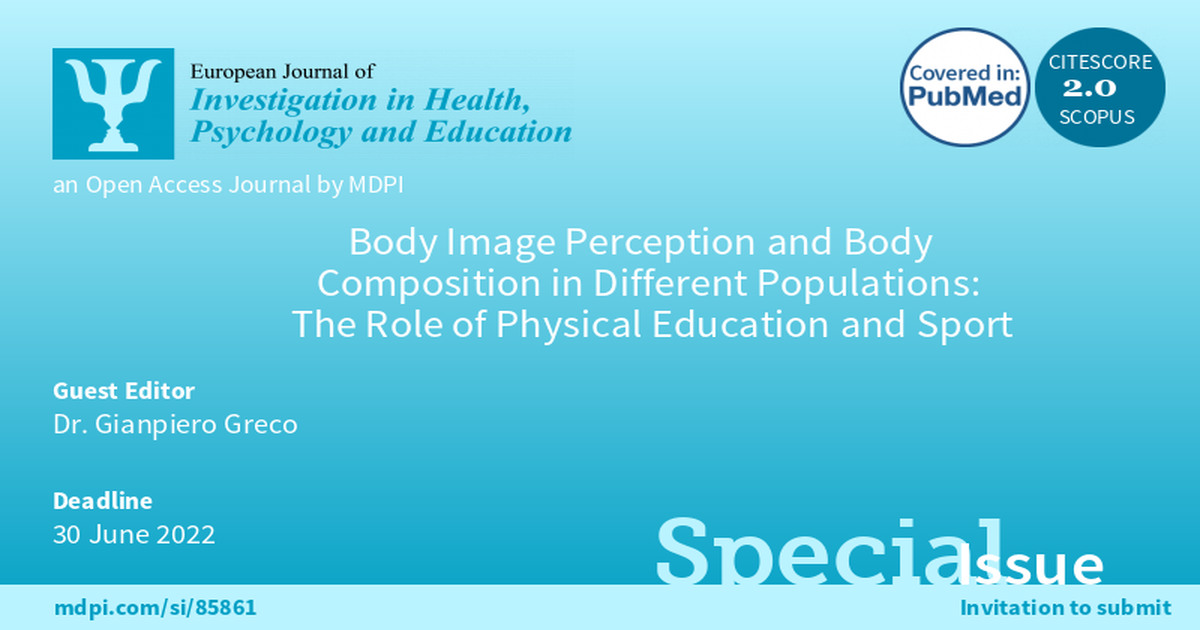
A Special Issue of European Journal of Investigation in Health, Psychology and Education (ISSN 2254-9625).
Deadline for manuscript submissions: closed (30 June 2022) | Viewed by 29161
Editor

Interests: physical activity and exercise science; exercise physiology and human performance; body composition; digital and technology-enhanced exercise interventions; health promotion and psychophysical well-being; exercise-based prevention and chronic disease management; nutrition and lifestyle factors; sports and exercise psychology; inclusive and adapted physical activity; research methodology and applied statistics.
Special Issues, Collections and Topics in MDPI journals
Special Issue Information
Dear Colleagues,
This Special Issue aims to collect and disseminate the most current research examining the role of physical education and sport in the development of a positive body image perception through education for a healthy lifestyle and the achievement of an optimal body composition.
Body image is the dynamic perception of one’s body—how it looks, feels, and moves. It can change with mood, physical experience, and environment. There are many different factors affecting body image, including gender, media, parental relationships, and puberty, as well as weight and popularity. In Western society, the ideal body for males is muscular and lean, whereas for females, a thin body is viewed as more desirable. For both genders, the desire to alter shape or weight during adolescence is common, and is associated with emotional distress and dramatic measures to alter appearance such as cosmetic surgery, depression, eating disorders and exercise addiction.
Physical education could provide the opportunity to develop a positive body image. People that are sufficiently active enjoy better psychophysical well-being and report more positive physical self-concept and global self-esteem. Sports practice and a healthy lifestyle result in optimal body composition and more positive body image.
Although being physically active is usually encouraged as a health-promoting behaviour, exercising compulsively and excessively is a common purging strategy used to compensate for caloric intake or to change one’s body weight, size or shape. This tendency to develop disordered behaviours around exercise has received numerous labels including, but not limited to, exercise dependence, exercise abuse, exercise addiction, obligatory exercise, and over exercise.
Topics of interest consist of body image intervention works including new training methodologies and programming, nutritional strategies integrated with physical activity, and interventions aimed at improving the quality of physical activity, avoiding strategies that may have a negative impact on people’s body image.
Authors are invited to contribute to this Special Issue by submitting original research articles, meta-analyses, reviews, and brief reports that contribute new knowledge to this area. Papers selected for this Special Issue will be subject to a rigorous peer-review process with the aim of rapid and wide dissemination of research results, developments, and applications.
Dr. Gianpiero Greco
Guest Editor
Manuscript Submission Information
Manuscripts should be submitted online at www.mdpi.com by registering and logging in to this website. Once you are registered, click here to go to the submission form. Manuscripts can be submitted until the deadline. All submissions that pass pre-check are peer-reviewed. Accepted papers will be published continuously in the journal (as soon as accepted) and will be listed together on the special issue website. Research articles, review articles as well as short communications are invited. For planned papers, a title and short abstract (about 250 words) can be sent to the Editorial Office for assessment.
Submitted manuscripts should not have been published previously, nor be under consideration for publication elsewhere (except conference proceedings papers). All manuscripts are thoroughly refereed through a single-anonymized peer-review process. A guide for authors and other relevant information for submission of manuscripts is available on the Instructions for Authors page. European Journal of Investigation in Health, Psychology and Education is an international peer-reviewed open access monthly journal published by MDPI.
Please visit the Instructions for Authors page before submitting a manuscript. The Article Processing Charge (APC) for publication in this open access journal is 1600 CHF (Swiss Francs). Submitted papers should be well formatted and use good English. Authors may use MDPI's English editing service prior to publication or during author revisions.
Keywords
- body image perception
- physical activity
- physical fitness
- physical education
- body composition
- psychophysical well-being
- body size
- self-esteem
- self-concept
- exercise addiction
Benefits of Publishing in a Special Issue
- Ease of navigation: Grouping papers by topic helps scholars navigate broad scope journals more efficiently.
- Greater discoverability: Special Issues support the reach and impact of scientific research. Articles in Special Issues are more discoverable and cited more frequently.
- Expansion of research network: Special Issues facilitate connections among authors, fostering scientific collaborations.
- External promotion: Articles in Special Issues are often promoted through the journal's social media, increasing their visibility.
- Reprint: MDPI Books provides the opportunity to republish successful Special Issues in book format, both online and in print.
Further information on MDPI's Special Issue policies can be found here.