

Drugs Drug Candidates 2025, 4(1), 6; https://doi.org/10.3390/ddc4010006 - 15 Feb 2025
Viewed by 1809
Abstract
►
Show Figures
Background/Objectives: The marine sponge Plakortis halichondrioides is notable for its capacity to accumulate a large array of secondary metabolites. The present research aims at discovering new secondary metabolites from P. halichondrioides with potential applications in medicine. Methods: Plakortilactone (1) and seco
[...] Read more.
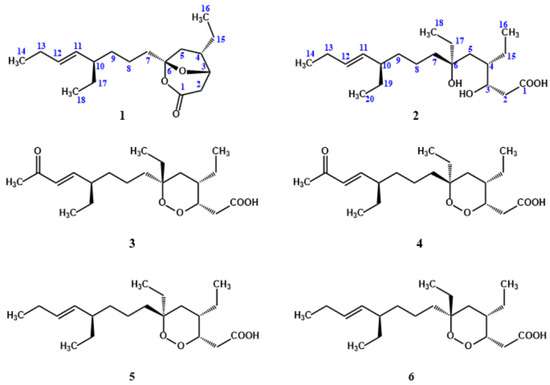
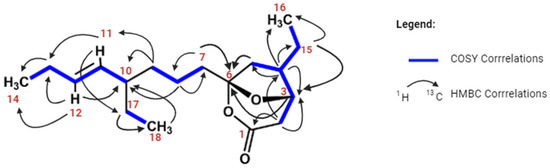
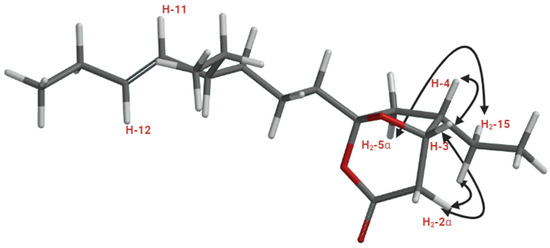
Background/Objectives: The marine sponge Plakortis halichondrioides is notable for its capacity to accumulate a large array of secondary metabolites. The present research aims at discovering new secondary metabolites from P. halichondrioides with potential applications in medicine. Methods: Plakortilactone (1) and seco-plakortide F acid (2), two new polyketides, along with known manadodioxan D (3), 13-oxo-plakortide F (4), plakortide F (5), and manadodioxan E (6), were isolated from P. halichondrioides. We achieved the structural elucidation of 1 and 2 using modern spectroscopic methods. The relative stereochemistry of 1 was proposed on the basis of 1D- and 2D-NMR data in combination with molecular modeling studies. Additionally, the absolute configuration of 2 was established through chemical correlation to 5. We screened some of the isolated compounds against the malaria parasite Plasmodium falciparum 3D7 non-resistant (wild-type resistant) strain, the tuberculosis bacterium Mycobacterium tuberculosis, the prostate cancer cell line DU-145, and the melanoma cell line A-2058. Results: minimal activity was detected for 2 against these cancer cells. In contrast, 3 and 4 displayed activity against DU-145 cells with IC50 values of 1.6 µg/mL and 4.5 µg/mL, respectively, and A-2058 cells with IC50s of 2.6 µg/mL and 7.7 µg/mL, respectively. In the antiplasmodial activity assay 3 appeared more active (IC50 = 1.7 µg/mL) than 4 (IC50 = 3.1 µg/mL). Meanwhile, 2 displayed only moderate activity (IC50 = 39.3 µg/mL). In the antimycobacterial activity assay 2 exhibited moderate inhibition (MIC = 75.1 µg/mL). In contrast, a 1:1 mixture of 3 and 4 demonstrated higher activity (MIC = 26.3 µg/mL). Conclusions: the biological activity data together with ADMET predictions indicated favorable pharmacokinetic properties for 3.
Full article
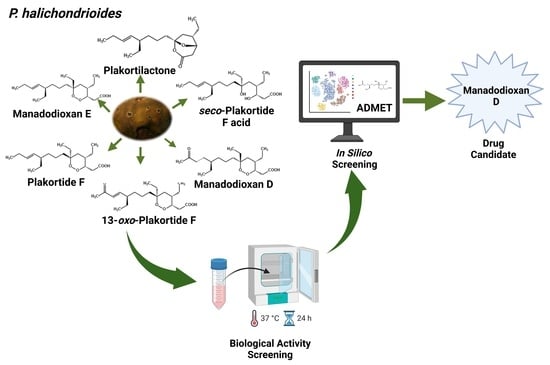
Graphical abstract