



CMAS Penetration, Thermal Insulation Degradation, and Life Prediction of Thermal Barrier Coatings
A special issue of Coatings (ISSN 2079-6412). This special issue belongs to the section "Surface Characterization, Deposition and Modification".
Deadline for manuscript submissions: 20 August 2026 | Viewed by 233
Special Issue Editors

Interests: thermal barrier coatings; environmental barrier coatings; failure mechanisms and life prediction

Interests: polymer-derived ceramics; ceramic matrix composites; environmental barrier coatings; electromagnetic wave absorption materials
Special Issues, Collections and Topics in MDPI journals

Interests: thermal/environmental barrier coatings; material design; thermodynamics database; computational materials science; CMAS corrosion
Special Issues, Collections and Topics in MDPI journals
Special Issue Information
Dear Colleagues,
The pervasive challenge of calcium–magnesium–aluminosilicate (CMAS) deposition and penetration has emerged as one of the most critical threats to the performance and durability of thermal barrier coatings (TBCs) in modern gas turbines and aero‑engines. When ingested siliceous debris (e.g., sand, dust, volcanic ash) melts under high‑temperature operations, the resulting CMAS melt can rapidly infiltrate the porous/columnar microstructure of TBCs, leading to severe degradation mechanisms such as premature coating stiffening, accelerated sintering, loss of strain tolerance, and ultimately, spallation failure. This phenomenon not only compromises the thermal insulation capability of TBCs but also significantly shortens their service life, imposing substantial limitations on engine efficiency, operational safety, and maintenance cycles.
Addressing the CMAS challenge requires a multidisciplinary effort that spans materials design, advanced processing, in‑depth characterization, and predictive modeling. Innovations in CMAS‑resistant coating architectures—including novel ceramic compositions, engineered porosity, sealed or sacrificial top layers, and functionally graded designs—are actively being explored to mitigate penetration. Concurrently, understanding the complex thermochemical interactions between CMAS melts and coating materials, as well as quantifying the consequent degradation of thermal conductivity and mechanical properties, is essential for developing robust life‑prediction frameworks. Advanced experimental techniques, such as in‑situ thermal testing, micro‑structural tomography, and high‑temperature corrosion simulation, combined with multi‑scale modeling approaches, are paving the way for more accurate assessment and forecasting of TBC performance in CMAS‑rich environments.
This Special Issue, entitled “CMAS penetration, Thermal Insulation Degradation, and Life Prediction of Thermal Barrier Coatings”, aims to consolidate the latest fundamental and applied research on the interrelated effects of CMAS attack thermal property evolution, and coating lifetime. We invite original research articles, comprehensive reviews, and case studies that contribute to the following or related themes:
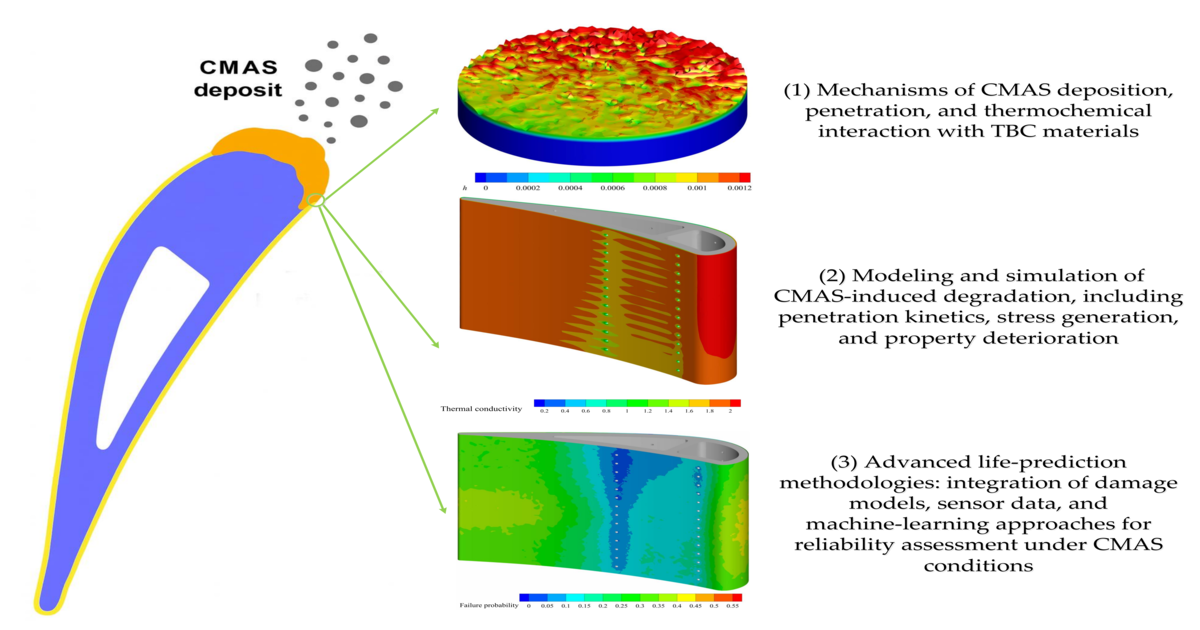
- Mechanisms of CMAS deposition, penetration, and thermochemical interaction with TBC materials.
- Design and development of CMAS‑resistant coating systems: novel ceramics, multilayer/graded structures, surface modifications, and hybrid coatings.
- Experimental characterization of thermal insulation degradation under CMAS exposure: evolution of thermal conductivity, emissivity, and thermal‑cycle performance.
- Micro‑structural, chemical, and mechanical evolution of TBCs subjected to CMAS penetration and high‑temperature exposure.
- Modeling and simulation of CMAS‑induced degradation, including penetration kinetics, stress generation, and property deterioration.
- Advanced life‑prediction methodologies: integration of damage models, sensor data, and machine learning approaches for reliability assessment under CMAS conditions.
- Field studies, engine‑test validations, and development of accelerated laboratory testing protocols for CMAS‑affected TBCs.
By bringing together contributions from academia, research institutes, and industry, this Special Issue seeks to advance the scientific understanding and engineering solutions needed to enhance the CMAS resistance and operational reliability of next‑generation thermal barrier coatings.
Dr. Li Shi
Prof. Dr. Qingbo Wen
Prof. Dr. Fan Zhang
Guest Editors
Manuscript Submission Information
Manuscripts should be submitted online at www.mdpi.com by registering and logging in to this website. Once you are registered, click here to go to the submission form. Manuscripts can be submitted until the deadline. All submissions that pass pre-check are peer-reviewed. Accepted papers will be published continuously in the journal (as soon as accepted) and will be listed together on the special issue website. Research articles, review articles as well as short communications are invited. For planned papers, a title and short abstract (about 250 words) can be sent to the Editorial Office for assessment.
Submitted manuscripts should not have been published previously, nor be under consideration for publication elsewhere (except conference proceedings papers). All manuscripts are thoroughly refereed through a single-blind peer-review process. A guide for authors and other relevant information for submission of manuscripts is available on the Instructions for Authors page. Coatings is an international peer-reviewed open access monthly journal published by MDPI.
Please visit the Instructions for Authors page before submitting a manuscript. The Article Processing Charge (APC) for publication in this open access journal is 2600 CHF (Swiss Francs). Submitted papers should be well formatted and use good English. Authors may use MDPI's English editing service prior to publication or during author revisions.
Keywords
- thermal barrier coatings
- thermal insulation degradation
- CMAS deposition and penetration
- life prediction
Benefits of Publishing in a Special Issue
- Ease of navigation: Grouping papers by topic helps scholars navigate broad scope journals more efficiently.
- Greater discoverability: Special Issues support the reach and impact of scientific research. Articles in Special Issues are more discoverable and cited more frequently.
- Expansion of research network: Special Issues facilitate connections among authors, fostering scientific collaborations.
- External promotion: Articles in Special Issues are often promoted through the journal's social media, increasing their visibility.
- Reprint: MDPI Books provides the opportunity to republish successful Special Issues in book format, both online and in print.
Further information on MDPI's Special Issue policies can be found here.
