



applsci-logo

Journal Browser

Journal Browser

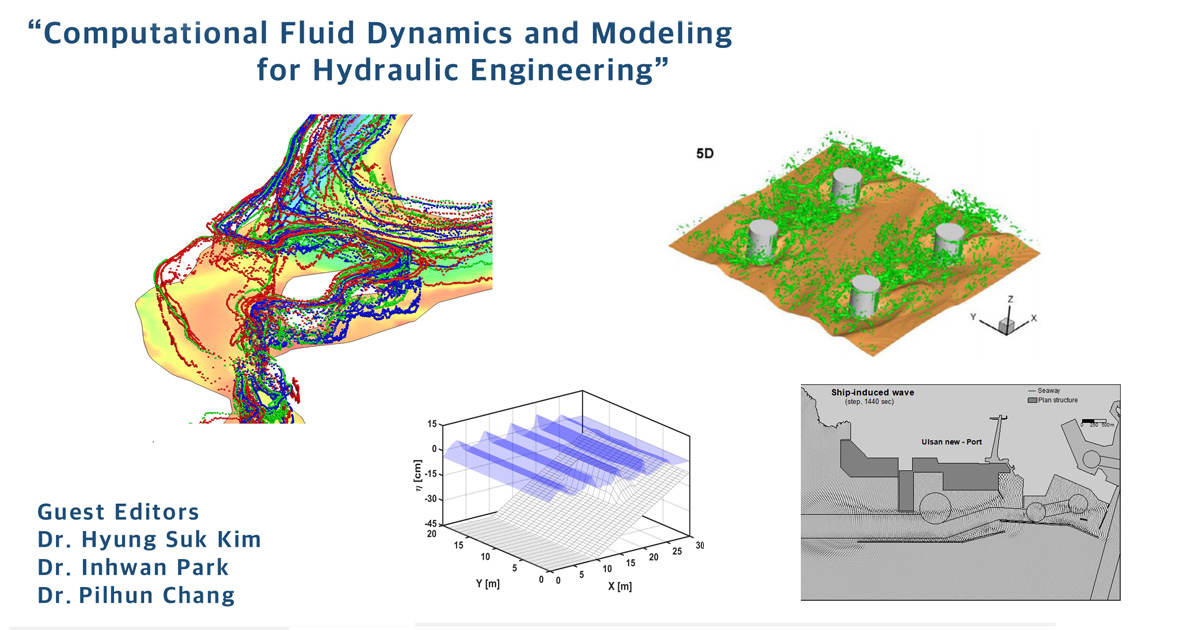
Computational Fluid Dynamics and Modeling for Hydraulic Engineering

A special issue of Applied Sciences (ISSN 2076-3417). This special issue belongs to the section "Civil Engineering".

Deadline for manuscript submissions: closed (20 November 2025) | Viewed by 2786
Special Issue Editors


E-Mail Website
Guest Editor
Department of Civil Engineering, Kunsan National University, Gunsan-si 54150, Republic of Korea
Interests: river/flood hydraulic analysis; coastal engineering

E-Mail Website
Guest Editor
Department of Civil Engineering, Seoul National University of Science and Technology, 232 Gongreung-Ro, Nowon-Gu, Seoul 01811, Republic of Korea
Interests: river hydraulic modeling
Special Issues, Collections and Topics in MDPI journals

E-Mail Website
Guest Editor
Forecast Research Department, National Institute of Meteorological Sciences, Seogwipo-si 63568, Republic of Korea
Interests: wave models; hydraulic modeling

Special Issue Information

Dear Colleagues,

This Special Issue explores the latest innovations and applications of computational fluid dynamics (CFD) and modeling within the field of hydraulic engineering. CFD technology is essential for solving complex fluid flow problems and is a key tool for understanding fluid dynamics and interactions in hydraulic engineering. This Special Issue will cover the latest CFD techniques, modeling approaches, and practical applications in hydraulic engineering problems.

Objectives:

  • To analyze the latest developments in CFD and modeling within hydraulic engineering;
  • To present case studies showcasing new CFD techniques and modeling methods;
  • To evaluate the effectiveness of CFD in solving hydraulic engineering problems and suggest future research directions.

Topics of Interest:

  • Recent advancements in CFD techniques applied to hydraulic engineering;
  • Modeling approaches for multiphase fluid flows;
  • Fluid dynamic analysis of hydraulic structures;
  • Flood prediction and management using CFD;
  • Numerical modeling of complex river and channel flows;
  • Coastal engineering applications of CFD, such as wave–structure interactions and coastal erosion modeling.

Dr. Hyung Suk Kim
Dr. Inhwan Park
Dr. Pilhun Chang
Guest Editors

Manuscript Submission Information

Manuscripts should be submitted online at www.mdpi.com by registering and logging in to this website. Once you are registered, click here to go to the submission form. Manuscripts can be submitted until the deadline. All submissions that pass pre-check are peer-reviewed. Accepted papers will be published continuously in the journal (as soon as accepted) and will be listed together on the special issue website. Research articles, review articles as well as short communications are invited. For planned papers, a title and short abstract (about 250 words) can be sent to the Editorial Office for assessment.

Submitted manuscripts should not have been published previously, nor be under consideration for publication elsewhere (except conference proceedings papers). All manuscripts are thoroughly refereed through a single-blind peer-review process. A guide for authors and other relevant information for submission of manuscripts is available on the Instructions for Authors page. Applied Sciences is an international peer-reviewed open access semimonthly journal published by MDPI.

Please visit the Instructions for Authors page before submitting a manuscript. The Article Processing Charge (APC) for publication in this open access journal is 2400 CHF (Swiss Francs). Submitted papers should be well formatted and use good English. Authors may use MDPI's English editing service prior to publication or during author revisions.

Keywords

  • computational fluid dynamics (CFD)
  • hydraulic engineering
  • fluid flow modeling
  • coastal engineering
  • wave–structure interactions
  • flood prediction
  • numerical modeling
  • hydraulic Structures
  • multiphase flow

Benefits of Publishing in a Special Issue

  • Ease of navigation: Grouping papers by topic helps scholars navigate broad scope journals more efficiently.
  • Greater discoverability: Special Issues support the reach and impact of scientific research. Articles in Special Issues are more discoverable and cited more frequently.
  • Expansion of research network: Special Issues facilitate connections among authors, fostering scientific collaborations.
  • External promotion: Articles in Special Issues are often promoted through the journal's social media, increasing their visibility.
  • Reprint: MDPI Books provides the opportunity to republish successful Special Issues in book format, both online and in print.

Further information on MDPI's Special Issue policies can be found here.

Published Papers (2 papers)

Order results
Result details
Select all
Export citation of selected articles as:

Research

19 pages, 2694 KB  
Article
CFD Investigation of Free-Surface-Pressurized Flow and Air-Vent Optimization in Combined Tailrace–Diversion Systems
by Duo Ma, Jianxu Zhou, Qing Zhang and Chenxing Huang
Appl. Sci. 2025, 15(24), 12933; https://doi.org/10.3390/app152412933 - 8 Dec 2025
Viewed by 637
Abstract
This study investigates the hydraulic transient behavior and optimization of air-vent configurations in the combined tailrace–diversion system of a hydropower station. The inlet flow boundary conditions were derived from the method of characteristics (MOC), and flow variations were incorporated into the CFD model [...] Read more.
This study investigates the hydraulic transient behavior and optimization of air-vent configurations in the combined tailrace–diversion system of a hydropower station. The inlet flow boundary conditions were derived from the method of characteristics (MOC), and flow variations were incorporated into the CFD model using a user-defined function (UDF). The CFD results were validated by comparing them to MOC-based simulations of surge oscillations in the downstream chamber. Six different air-vent configurations, varying in number and diameter, were tested under high-water-level load-acceptance and load-rejection conditions. The results demonstrate that increasing the vent diameter, particularly to 3 m, significantly improves pressure regulation and air exchange efficiency, enhancing system stability. In contrast, simply increasing the number of vents did not lead to noticeable improvements. Sensitivity analysis of vent height revealed that raising the vent height from 12 m to 15 m provides sufficient freeboard to prevent overflow, without overdesign. These findings provide practical guidance for optimizing air-vent configurations in hydropower tailrace systems, improving hydraulic stability, and ensuring safe operation. Full article
(This article belongs to the Special Issue Computational Fluid Dynamics and Modeling for Hydraulic Engineering)
Show Figures

Figure 1

18 pages, 58403 KB  
Article
Modeling and Simulation of Standing Wave Configurations for Outflow Improvement and Minimizing Undesired Recirculation
by Julien Schwalbe, Bogac Tur, Stefan Kniesburges, Nicolas Neuss, Michael Stingl, Thorsten Keck, Joachim Buff and Michael Döllinger
Appl. Sci. 2025, 15(6), 3127; https://doi.org/10.3390/app15063127 - 13 Mar 2025
Viewed by 1504
Abstract
River surfing has evolved from natural rivers to artificial standing waves, like the Fuchslochwelle in Nuremberg, where optimizing wave quality and safety remains a challenge. Key issues include recirculation zones that pose risks, particularly at higher inflows. This study addresses safety and performance [...] Read more.
River surfing has evolved from natural rivers to artificial standing waves, like the Fuchslochwelle in Nuremberg, where optimizing wave quality and safety remains a challenge. Key issues include recirculation zones that pose risks, particularly at higher inflows. This study addresses safety and performance improvements by introducing geometric modifications to reduce recirculation zones. Using STAR-CCM+ simulations, 16 configurations of baffles and inlays were analyzed. A 3D-CAD model of the Fuchslochwelle was developed to test symmetrical and asymmetrical configurations, focusing on reducing vorticity. Results showed that baffles placed 2 m from the inlay reduced recirculation zones by over 50%. Asymmetrical setups, combining wall and inlay baffles, also proved effective. Following simulations, a baffle was installed at 3 m, enhancing safety and quality. Previously, inflows above 7.5 m3/s caused dangerous backflow, requiring surfers to swim or dive to escape turbulence. With the baffle, safe operation increased to 9 m3/s, a 20% improvement, making the system suitable for surfers of all skill levels. These finding provide a novel approach to enhancing flow dynamics, applicable to a wide range of artificial standing waves. The valuable insights gained enable operators to optimize the dynamics and accessibility through geometric modifications while ensuring safety for users. Full article
(This article belongs to the Special Issue Computational Fluid Dynamics and Modeling for Hydraulic Engineering)
Show Figures

Figure 1

Back to TopTop