



applsci-logo

Journal Browser

Journal Browser

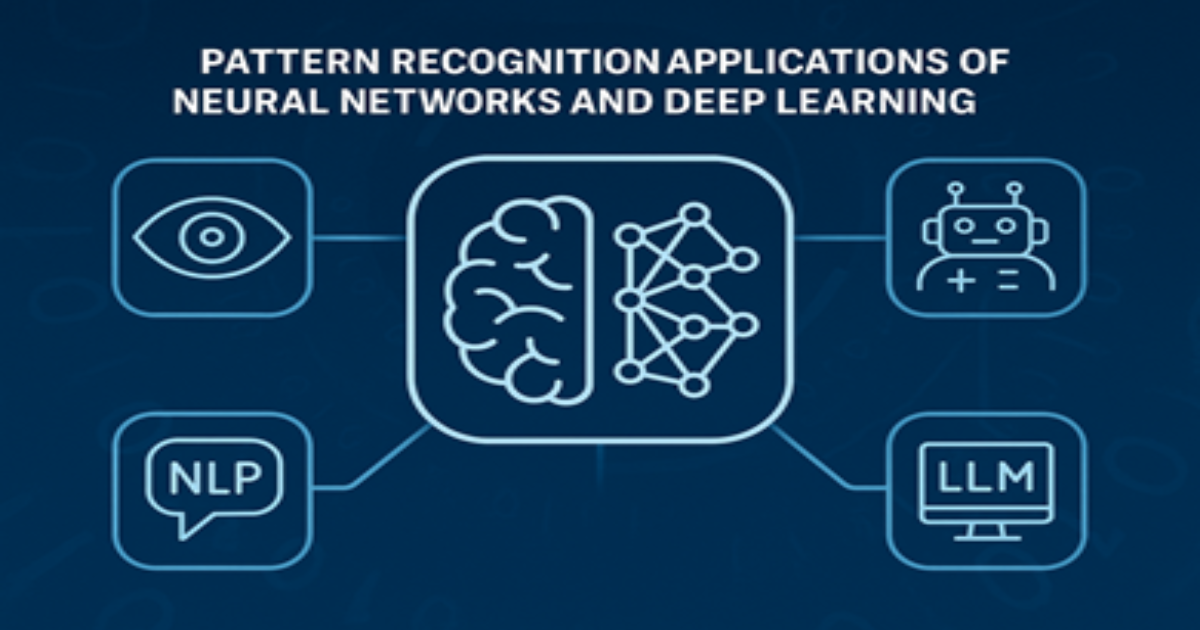
Pattern Recognition Applications of Neural Networks and Deep Learning

A special issue of Applied Sciences (ISSN 2076-3417). This special issue belongs to the section "Computing and Artificial Intelligence".

Deadline for manuscript submissions: 30 May 2026 | Viewed by 4501
Special Issue Editor


E-Mail Website
Guest Editor
Department of Information Technology and Media Design, Faculty of Advanced Engineering, Nippon Institute of Technology (NIT), Miyashiro, Japan
Interests: neural networks; fuzzy systems; deep learning; swarm intelligence; evolutionary computation; dynamical associative memory; chaotic dynamics; reinforcement learning; human-machine interaction; brain-computer interface; time series forecasting; computer vision
Special Issues, Collections and Topics in MDPI journals

Special Issue Information

Dear Colleagues,

We are pleased to announce a call for submissions to the upcoming Special Issue on "Pattern Recognition Applications of Neural Networks and Deep Learning". It aims to garner cutting-edge research and practical applications that demonstrate the power and versatility of neural networks and deep learning in solving pattern recognition problems across various domains.

In recent years, neural networks—particularly deep learning architectures—have achieved unprecedented success in pattern recognition tasks, ranging from image and speech processing to biometrics, natural language understanding, and medical diagnostics. This Special Issue seeks high-quality, original research papers that explore innovative methodologies, applications, and theoretical advancements in this field.

Topics of interest include (but are not limited to) the following:

  • Deep learning architectures for pattern recognition.
  • Reinforcement learning (RL) for adaptive and interactive pattern recognition tasks.
  • Recurrent neural networks (RNNs), LSTM, and transformers in sequential data modeling.
  • Hybrid systems combining neural networks with traditional pattern recognition techniques.
  • Applications in computer vision, speech and audio analysis, NLP, and bioinformatics.
  • Transfer learning and domain adaptation.
  • Explainability and interpretability in neural network-based recognition systems.
  • Lightweight and efficient models for deployment in edge devices.
  • Benchmark datasets and performance evaluations.
  • Large language models (LLMs) for pattern understanding and representation learning.

We look forward to receiving your contributions.

Prof. Dr. Takashi Kuremoto
Guest Editor

Manuscript Submission Information

Manuscripts should be submitted online at www.mdpi.com by registering and logging in to this website. Once you are registered, click here to go to the submission form. Manuscripts can be submitted until the deadline. All submissions that pass pre-check are peer-reviewed. Accepted papers will be published continuously in the journal (as soon as accepted) and will be listed together on the special issue website. Research articles, review articles as well as short communications are invited. For planned papers, a title and short abstract (about 250 words) can be sent to the Editorial Office for assessment.

Submitted manuscripts should not have been published previously, nor be under consideration for publication elsewhere (except conference proceedings papers). All manuscripts are thoroughly refereed through a single-blind peer-review process. A guide for authors and other relevant information for submission of manuscripts is available on the Instructions for Authors page. Applied Sciences is an international peer-reviewed open access semimonthly journal published by MDPI.

Please visit the Instructions for Authors page before submitting a manuscript. The Article Processing Charge (APC) for publication in this open access journal is 2400 CHF (Swiss Francs). Submitted papers should be well formatted and use good English. Authors may use MDPI's English editing service prior to publication or during author revisions.

Keywords

  • pattern recognition
  • neural networks
  • deep learning
  • convolutional neural networks (CNNs)
  • recurrent neural networks (RNNs)
  • transformer models
  • large language models (LLMs)
  • reinforcement learning (RL)
  • representation learning
  • transfer learning
  • explainable AI (XAI)
  • natural language processing (NLP)
  • computer vision
  • speech and audio processing
  • bioinformatics
  • hybrid AI systems
  • edge AI
  • benchmarking
  • intelligent systems
  • machine learning applications

Benefits of Publishing in a Special Issue

  • Ease of navigation: Grouping papers by topic helps scholars navigate broad scope journals more efficiently.
  • Greater discoverability: Special Issues support the reach and impact of scientific research. Articles in Special Issues are more discoverable and cited more frequently.
  • Expansion of research network: Special Issues facilitate connections among authors, fostering scientific collaborations.
  • External promotion: Articles in Special Issues are often promoted through the journal's social media, increasing their visibility.
  • Reprint: MDPI Books provides the opportunity to republish successful Special Issues in book format, both online and in print.

Further information on MDPI's Special Issue policies can be found here.

Published Papers (3 papers)

Order results
Result details
Select all
Export citation of selected articles as:

Research

Jump to: Review

15 pages, 2028 KB  
Article
Parkinson’s Disease Classification Using Gray Matter MRI and Deep Learning: A Comparative Framework
by Haotian Li, Tong Liang, Runhong Yao and Takashi Kuremoto
Appl. Sci. 2025, 15(21), 11812; https://doi.org/10.3390/app152111812 - 5 Nov 2025
Viewed by 577
Abstract
In this study, we propose multiple deep learning models for classifying gray matter MRI images of healthy individuals, prodromal Parkinson’s disease (PD) subjects, and diagnosed PD patients. The two proposed models extend conventional deep learning architectures—MedicalNet3D and 3D ResNet18—by performing feature extraction separately [...] Read more.
In this study, we propose multiple deep learning models for classifying gray matter MRI images of healthy individuals, prodromal Parkinson’s disease (PD) subjects, and diagnosed PD patients. The two proposed models extend conventional deep learning architectures—MedicalNet3D and 3D ResNet18—by performing feature extraction separately for each class and inputting these features into distinct multilayer perceptron (MLP) classifiers constructed via fine-tuning. To mitigate overfitting problem and improve generalizability, we introduce a training method based on group-wise feature fusion, in which subject IDs are separated to avoid data leakage during training. Through comparative experiments using the PPMI database, the effectiveness of the proposed approach was validated. Full article
(This article belongs to the Special Issue Pattern Recognition Applications of Neural Networks and Deep Learning)
Show Figures

Figure 1

14 pages, 3620 KB  
Article
Lung Opacity Segmentation in Chest CT Images Using Multi-Head and Multi-Channel U-Nets with Partially Supervised Learning
by Shingo Mabu, Takuya Hamada, Satoru Ikebe and Shoji Kido
Appl. Sci. 2025, 15(19), 10373; https://doi.org/10.3390/app151910373 - 24 Sep 2025
Viewed by 457
Abstract
There has been a large amount of research applying deep learning to the medical field. However, obtaining sufficient training data is challenging in the medical domain because annotation requires specialized knowledge and significant effort. This is especially true for segmentation tasks, where preparing [...] Read more.
There has been a large amount of research applying deep learning to the medical field. However, obtaining sufficient training data is challenging in the medical domain because annotation requires specialized knowledge and significant effort. This is especially true for segmentation tasks, where preparing fully annotated data for every pixel within an image is difficult. To address this, we propose methods to extract useful features for segmentation using two types of U-net-based networks and partially supervised learning with incomplete annotated data. This research specifically focuses on the segmentation of diffuse lung disease opacities in chest CT images. In our dataset, each image is partially annotated with a single type of lung opacity. To tackle this, we designed two distinct U-net architectures: a multi-head U-net, which utilizes a shared encoder and separated decoders for each opacity type, and a multi-channel U-net, which shares the encoder and decoder layers for more efficient feature learning. Furthermore, we integrated partially supervised learning with these networks. This involves employing distinct loss functions to both bring annotated regions (ground truth) and segmented regions (predictions) closer, and to push them apart, thereby suppressing erroneous predictions. In our experiments, we trained the models on partially annotated data and subsequently tested them on fully annotated data to compare the segmentation performance of each method. The results show that the multi-channel model applying partially supervised learning achieved the best performance while also reducing the number of weight parameters. Full article
(This article belongs to the Special Issue Pattern Recognition Applications of Neural Networks and Deep Learning)
Show Figures

Figure 1

Review

Jump to: Research

45 pages, 2283 KB  
Review
Agricultural Image Processing: Challenges, Advances, and Future Trends
by Xuehua Song, Letian Yan, Sihan Liu, Tong Gao, Li Han, Xiaoming Jiang, Hua Jin and Yi Zhu
Appl. Sci. 2025, 15(16), 9206; https://doi.org/10.3390/app15169206 - 21 Aug 2025
Cited by 1 | Viewed by 2578
Abstract
Agricultural image processing technology plays a critical role in enabling precise disease detection, accurate yield prediction, and various smart agriculture applications. However, its practical implementation faces key challenges, including environmental interference, data scarcity and imbalance datasets, and the difficulty of deploying models on [...] Read more.
Agricultural image processing technology plays a critical role in enabling precise disease detection, accurate yield prediction, and various smart agriculture applications. However, its practical implementation faces key challenges, including environmental interference, data scarcity and imbalance datasets, and the difficulty of deploying models on resource-constrained edge devices. This paper presents a systematic review of recent advances in addressing these challenges, with a focus on three core aspects: environmental robustness, data efficiency, and model deployment. The study identifies that attention mechanisms, Transformers, multi-scale feature fusion, and domain adaptation can enhance model robustness under complex conditions. Self-supervised learning, transfer learning, GAN-based data augmentation, SMOTE improvements, and Focal loss optimization effectively alleviate data limitations. Furthermore, model compression techniques such as pruning, quantization, and knowledge distillation facilitate efficient deployment. Future research should emphasize multi-modal fusion, causal reasoning, edge–cloud collaboration, and dedicated hardware acceleration. Integrating agricultural expertise with AI is essential for promoting large-scale adoption, as well as achieving intelligent, sustainable agricultural systems. Full article
(This article belongs to the Special Issue Pattern Recognition Applications of Neural Networks and Deep Learning)
Show Figures

Figure 1

Back to TopTop