



Application of Antimicrobial Peptides and Natural Products as Feed Additives in Animal Production
This special issue belongs to the section "Farm Animal Production".
Special Issue Information
Dear Colleagues,
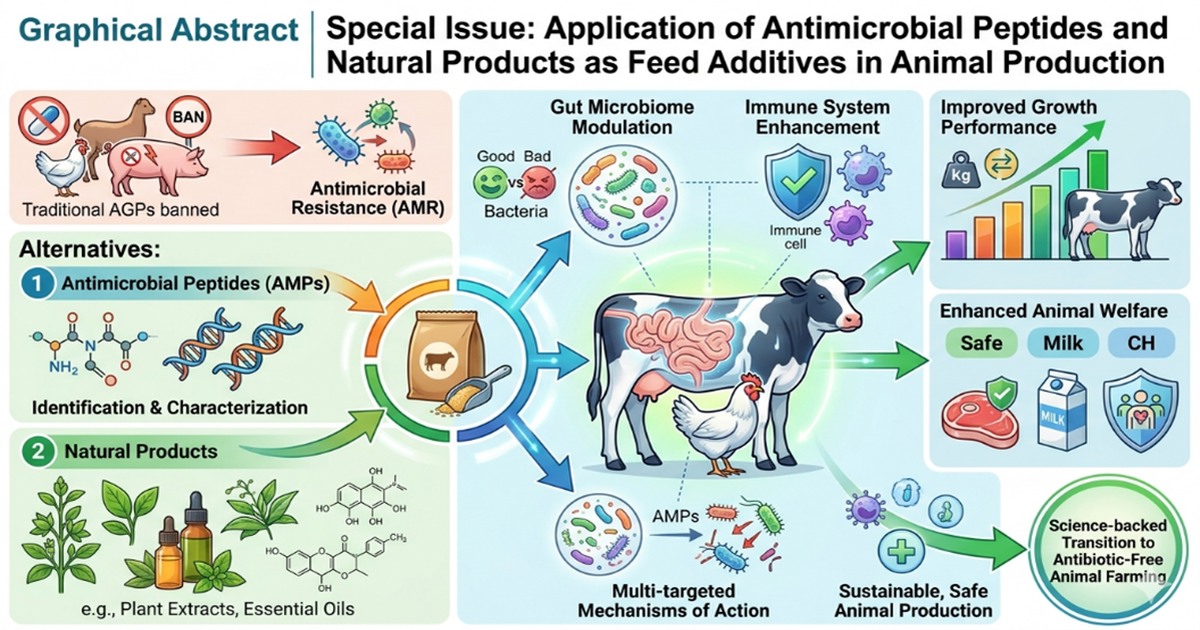
The global livestock industry faces a critical turning point as the rise in antimicrobial resistance (AMR) prompts strict regulations and bans on traditional antibiotic growth promoters (AGPs). In this changing landscape, discovering sustainable, safe, and effective alternatives is paramount to ensuring global food security, animal welfare, and public health. This Special Issue, "Application of Antimicrobial Peptides and Natural Products as Feed Additives in Animal Production" highlights the vanguard of sustainable animal nutrition.
The scope of this collection encompasses cutting-edge research on the identification, characterization, and implementation of dietary antimicrobial peptides (AMPs) and diverse natural products, including plant extracts, essential oils, phytochemicals, and others. We welcome contributions exploring their multi-targeted mechanisms of action, impacts on gut microbiome modulation, immune system enhancement, and overall growth performance across various ruminant livestock, broilers, laying hens, swine, and aquaculture species. By bridging molecular insights with practical in vivo applications, this Special Issue aims to provide a comprehensive, science-backed framework for transitioning toward antibiotic-free animal farming, offering invaluable insights for researchers, nutritionists, and industry stakeholders worldwide. In addition, this collection seeks to provide the agricultural community with actionable insights, ultimately contributing to enhanced animal welfare, safer food supplies, and more sustainable global production practices.
Dr. Eduardo Festozo Vicente
Prof. Dr. Danilo Florentino Pereira
Guest Editors
Manuscript Submission Information
Manuscripts should be submitted online at www.mdpi.com by registering and logging in to this website. Once you are registered, click here to go to the submission form. Manuscripts can be submitted until the deadline. All submissions that pass pre-check are peer-reviewed. Accepted papers will be published continuously in the journal (as soon as accepted) and will be listed together on the special issue website. Research articles, review articles as well as short communications are invited. For planned papers, a title and short abstract (about 250 words) can be sent to the Editorial Office for assessment.
Submitted manuscripts should not have been published previously, nor be under consideration for publication elsewhere (except conference proceedings papers). All manuscripts are thoroughly refereed through a single-anonymized peer-review process. A guide for authors and other relevant information for submission of manuscripts is available on the Instructions for Authors page. Agriculture is an international peer-reviewed open access semimonthly journal published by MDPI.
Please visit the Instructions for Authors page before submitting a manuscript. The Article Processing Charge (APC) for publication in this open access journal is 2600 CHF (Swiss Francs). Submitted papers should be well formatted and use good English. Authors may use MDPI's English editing service prior to publication or during author revisions.
Keywords
- antimicrobial peptides
- animal production
- feed additive
- immunomodulation
- natural products
- sustainability
Benefits of Publishing in a Special Issue
- Ease of navigation: Grouping papers by topic helps scholars navigate broad scope journals more efficiently.
- Greater discoverability: Special Issues support the reach and impact of scientific research. Articles in Special Issues are more discoverable and cited more frequently.
- Expansion of research network: Special Issues facilitate connections among authors, fostering scientific collaborations.
- External promotion: Articles in Special Issues are often promoted through the journal's social media, increasing their visibility.
- Reprint: MDPI Books provides the opportunity to republish successful Special Issues in book format, both online and in print.
Published Papers


Agriculture - ISSN 2077-0472