



Impact of Metal Nanoparticles on Crops
A special issue of Agriculture (ISSN 2077-0472). This special issue belongs to the section "Crop Production".
Deadline for manuscript submissions: 5 August 2026 | Viewed by 239
Special Issue Editors

Interests: plant production; plant biotechnology; plant breeding; in vitro tissue culture; plant molecular biology; nanobiotechnology; nanoparticles in agriculture; plant metabolites; oxidative stress in plants
Special Issues, Collections and Topics in MDPI journals

Interests: plant biotechnology; in vitro tissue culture; cryobiology; plant breeding; plant molecular biology; nanobiotechnology
Special Issues, Collections and Topics in MDPI journals
Special Issue Information
Dear Colleagues,
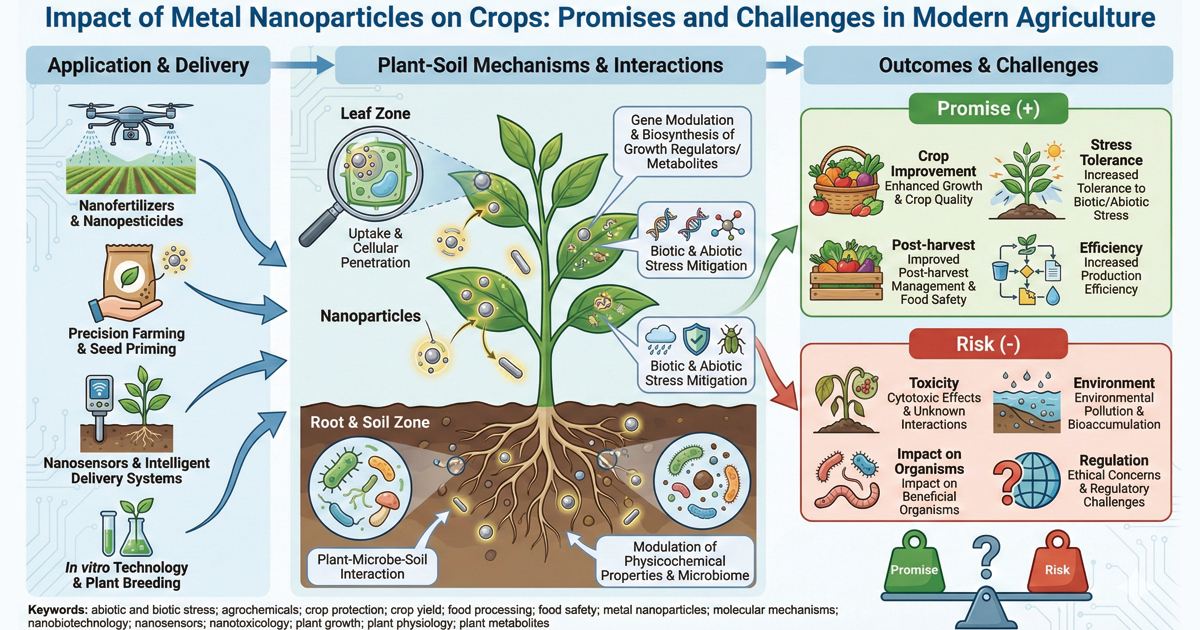
Nanotechnology has been developing intensively in recent years. The application of nanoparticles holds great promise for advancing modern plant science. The implementation of nanotechnology in agriculture is gaining considerable interest due to its potential to increase production efficiency. Nanoparticles can penetrate plant cells, modulate gene activity, and influence the biosynthesis of endogenous growth regulators and a range of secondary metabolites, thereby affecting plant growth and development. Moreover, nanoparticles affect the physicochemical properties and microbiome of the soil. Metallic nanoparticles and their oxides improve plant growth and crop quality. Their potential applications include nanofertilizers, nanopesticides, nanosensors, and intelligent systems for the delivery and controlled release of agrochemicals. Nanoparticles also play a significant role in mitigating environmental factors and enhancing plant tolerance to biotic and abiotic stress. However, plant–nanoparticle interactions are not yet fully understood and are often difficult to predict, especially due to their cytotoxic effects. Despite extensive research on this topic, the fate of nanoparticles in the environment (i.e., accumulation in plants and/or soil and their impact on beneficial organisms) is still unclear. Assessing the relationship between the dose, form, and application method of nanoparticles and the physiological response of plants to potential environmental risks remains an open area of research. Undoubtedly, the effects of nanomaterials on plants require detailed research. If nanotechnology is better understood, it can be further utilized in modern agriculture and horticulture.
This Special Issue aims to highlight impactful research on the application of metal nanoparticles in the cultivation and protection of agricultural and horticultural plants.
Potential topics include, but are not limited to, the following:
- Nanoparticles and plant–microbe–soil interactions;
- Nanofertilizers and nanoparticle-mediated delivery of biomolecules;
- Nanotechnology in post-harvest management;
- Nanomaterials in plant disease management;
- Precision farming and soilless cultivation systems;
- Environmental pollution and remediation, regulation of nanoparticle release to the environment;
- Plant breeding and in vitro technology;
- Crop quality and food safety;
- Ethical concerns.
Dr. Alicja Tymoszuk
Dr. Dariusz Kulus
Guest Editors
Manuscript Submission Information
Manuscripts should be submitted online at www.mdpi.com by registering and logging in to this website. Once you are registered, click here to go to the submission form. Manuscripts can be submitted until the deadline. All submissions that pass pre-check are peer-reviewed. Accepted papers will be published continuously in the journal (as soon as accepted) and will be listed together on the special issue website. Research articles, review articles as well as short communications are invited. For planned papers, a title and short abstract (about 250 words) can be sent to the Editorial Office for assessment.
Submitted manuscripts should not have been published previously, nor be under consideration for publication elsewhere (except conference proceedings papers). All manuscripts are thoroughly refereed through a single-blind peer-review process. A guide for authors and other relevant information for submission of manuscripts is available on the Instructions for Authors page. Agriculture is an international peer-reviewed open access semimonthly journal published by MDPI.
Please visit the Instructions for Authors page before submitting a manuscript. The Article Processing Charge (APC) for publication in this open access journal is 2600 CHF (Swiss Francs). Submitted papers should be well formatted and use good English. Authors may use MDPI's English editing service prior to publication or during author revisions.
Keywords
- abiotic and biotic stress
- agrochemicals
- crop protection
- crop yield
- food processing
- food safety
- metal nanoparticles
- molecular mechanisms
- nanobiotechnology
- nanosensors
- nanotoxicology
- plant growth
- plant physiology
- plant metabolites
Benefits of Publishing in a Special Issue
- Ease of navigation: Grouping papers by topic helps scholars navigate broad scope journals more efficiently.
- Greater discoverability: Special Issues support the reach and impact of scientific research. Articles in Special Issues are more discoverable and cited more frequently.
- Expansion of research network: Special Issues facilitate connections among authors, fostering scientific collaborations.
- External promotion: Articles in Special Issues are often promoted through the journal's social media, increasing their visibility.
- Reprint: MDPI Books provides the opportunity to republish successful Special Issues in book format, both online and in print.
Further information on MDPI's Special Issue policies can be found here.
