

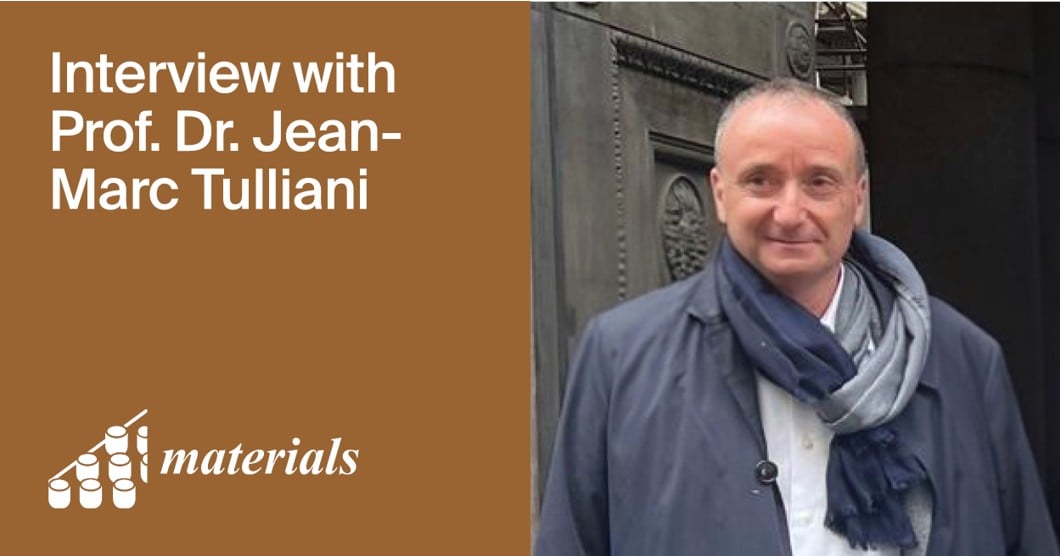
Materials | Interview with the Newsletter Author—Prof. Dr. Jean-Marc Tulliani
Prof. Dr. Jean-Marc Tulliani is one of the authors of the newsletter paper entitled “Modified Fine Recycled Concrete Aggregates with a Crystallizing Agent as Standard Sand Replacement in Mortar” published in Materials (ISSN: 1996-1944).
Prof. Dr. Tulliani completed his PhD in materials engineering at Politecnico di Torino, Italy, in 1997. His main research interests are directed towards self-healing/self-sensing concrete, carbon dioxide sequestration by means of mineral carbonation or CO2 adsorbents and innovative ceramic manufacturing through additive techniques. Currently, his main activities frame the study of the alkali activation of reservoir sludges to manufacture environmentally friendly building products and the addition of biochar to concrete to lower its carbon footprint.
Based on the positive evaluations by the reviewers and academic editors for Prof. Dr. Jean-Marc Tulliani’s group article, we have selected their article as the newsletter for display on the Materials website.
“Modified Fine Recycled Concrete Aggregates with a Crystallizing Agent as Standard Sand Replacement in Mortar”
by Daniel Suarez-Riera, Luca Lavagna, Devid Falliano, Giuseppe Andrea Ferro, Matteo Pavese, Jean-Marc Tulliani and Luciana Restuccia
Materials 2025, 18(17), 4208. https://doi.org/10.3390/ma18174208
The following is an interview with Prof. Dr. Jean-Marc Tulliani:
1. Congratulations on your published paper! Could you please briefly introduce its main research content?
This study aimed to evaluate mortar performance by partially replacing standard sand with recycled fine aggregates derived from concrete waste in order to assess their mechanical properties and durability. In addition, the use of commercial crystallizing agents was investigated to evaluate their impact on mortar properties. While coarse recycled aggregates have already been treated with active substances that react with hydration products or unhydrated cement particles to fill pores and cracks, this approach has not, to the best of our knowledge, been applied to fine recycled aggregates. Therefore, the present work proposes a novel approach to enhance the environmental and mechanical performance of mortars containing varying contents of recycled fine aggregates pre-treated with crystallizing agents.
2. What are the key takeaways you hope readers will gain from your paper?
In most cases, mortars incorporating recycled aggregates exhibited higher strength than those prepared with standard sand. The 25% and 50% replacement levels, in combination with the use of the crystallizing agent, were particularly effective, leading to strength gains of up to 15% compared with the reference mortar, without requiring superplasticizer dosages beyond conventional levels. Conversely, mortars produced with recycled sand treated with crystallizing agents demanded higher superplasticizer contents to achieve equivalent workability, which can potentially limit their practical interest. Overall, these results demonstrate that substantial replacement of natural sand with recycled concrete aggregates, enhanced through a simple treatment using commercially available products, can yield mechanical performance comparable to or superior to that of conventional mortars. This approach offers a viable and effective pathway for promoting resource efficiency and advancing circular economy practices in the construction sector.
3. Was there a specific experience or event in your research career that led you to focus on your current field of research?
Yes, of course. The concept originated from previous works on self-healing concrete, where commercial crystallizing agents are already used in practice to seal cracks in damaged structures. Extending this proven technology to fine recycled aggregates, which are inherently more porous than natural aggregates, represents a logical and potentially impactful step toward improving their performance and industrial usability.
4. Does technological progress provide new opportunities for the topic you are researching? Does it bring any potential risks? How do you think these factors will affect future research trends on this topic?
Since 2015, we have been investigating the incorporation of biochar into cementitious materials with the aim of enhancing their mechanical properties while reducing their carbon footprint. Initial experimental works focused on laboratory-produced biochar derived from various feedstocks. However, the increasing availability of industrial-scale pyrolysis facilities and commercially produced biochar now enables the transition toward large-scale production. As all biochar are not equivalent for the targeted application, either from a physical or a chemical point of view, further investigations are still needed. Nevertheless, this development will pave the way for the industrial manufacturing of biochar-based concretes and their application in buildings and infrastructure.
5. What was it about the Materials journal that appealed to you which made you want to submit your paper? In your opinion, what can authors expect when they submit to Materials?
Materials was chosen as the publication outlet based on several institutional considerations. It is a well-established, peer-reviewed journal in materials science whose scope is fully aligned with the objectives of the present research, and which ensures wide dissemination within the scientific community. Furthermore, the journal offers an efficient editorial and peer-review process, enabling timely decisions and rapid communication of research outcomes. Finally, previous publication experience with Materials, starting in 2013 to be exact, has demonstrated a consistently high standard of editorial management, as well as strong accessibility and quality for the readership.
6. How do you think the open access way of publishing impacts authors?
Open access publishing has evolved from a marginal and sometimes mistrusted practice to a widely accepted model in academia. Despite remaining challenges such as article processing charges, it is generally viewed as a positive development that enhances the accessibility, visibility, and impact of research. Supported by funding institutions and associated with higher citation rates, open access is expected to continue expanding and to play a central role in scientific publishing across disciplines.