

Article

Revision of the Genus Cyanoboletus (Boletaceae) in the Mediterranean Basin with Notes on Arsenic Hyperaccumulation


1
Jodrell Laboratory, Royal Botanic Gardens, Kew, Richmond TW9 3DS, UK
2
Association for Wild Fungi of Israel, P.O. Box 164, Pardesiya 42815, Israel
3
Institute of Evolution, University of Haifa, Aba Khoushi Ave. 199, Mt. Carmel, Haifa 3498838, Israel
4
Department of Botany and Geology, University of Valencia, Av. Vicent Andrés Estellés 19, Burjassot, E-46100 Valencia, Spain
5
Research Centre in Biodiversity and Genetic Resources, University of Porto, Vairão, 4485-661 Vila do Conde, Portugal
6
Independent Researcher, Via Bellaria 8, I-42121 Reggio Emilia, Italy
7
Institute of Biodiversity and Ecosystem Research, Bulgarian Academy of Sciences, 2 Gagarin Str., 1113 Sofia, Bulgaria
8
Laboratory of General and Agricultural Microbiology, Agricultural University of Athens, Iera Odos 75, 11855 Athens, Greece
9
Independent Researcher, P. Poeta Joan Vimbodí 5, Ontinyent, E-46870 Valencia, Spain
10
Institute of Geology of the Czech Academy of Sciences, Rozvojová 269, CZ-16500 Prague 6, Czech Republic
11
Department of Biomedical Sciences, University of Cagliari, I-09042 Monserrato, Italy
*
Authors to whom correspondence should be addressed.
These authors contributed equally to this work.
J. Fungi 2026, 12(5), 315; https://doi.org/10.3390/jof12050315
Submission received: 16 March 2026 / Revised: 18 April 2026 / Accepted: 20 April 2026 / Published: 25 April 2026
(This article belongs to the Special Issue Fungal Diversity in Europe, 4th Edition)

Abstract

This study revises the genus Cyanoboletus (Boletaceae) in the Mediterranean Basin, integrating single-locus and multi-locus phylogenetic analyses (ITS, LSU, tef1-α, and rpb2), morphological characterisation, ecology, and arsenic accumulation in basidiomes. Morphological descriptions (including a new form, Cyanoboletus mediterraneensis f. pallidus), comprehensive sampling, type studies, biogeography, macro- and microphotographs, an identification key, and a historical overview of the nomenclatural issues surrounding C. pulverulentus, C. poikilochromus, and C. mediterraneensis are given. An epitype collection is designated for C. pulverulentus. A new method to measure spore suprahilar depression has been proposed, which allowed more clear morphological separation between C. mediterraneensis and C. pulverulentus. This method may prove useful for species delimitation in other fungal groups that have asymmetric basidiospores. Additionally, we generated a new ITS sequence of the C. sinopulverulentus holotype and inferred its conspecificity with the later described C. flavocontextus. Furthermore, notes on the taxonomy of Boletus gabretae are presented, and its placement in the genus Neoboletus is suggested. Cyanoboletus is confirmed as a strongly supported generic clade encompassing 21 monophyletic species-level clades, 14 of which represent known species, and seven are undescribed taxa. The synonymy of Cupreoboletus with Cyanoboletus is also verified. This publication provides the tools to delimit Cyanoboletus species that have important conservation value, which can be used by conservationists, ecologists, and citizen scientists. It also highlights species-specific arsenic hyperaccumulation in C. pulverulentus, contributing to a better understanding of fungal metal uptake. Our study indicates that within Cyanoboletus, only C. pulverulentus demonstrates this characteristic and is the only known member of Boletales that possesses a high arsenic accumulation ability.

1. Introduction

Singer divided the genus Boletus into seven sections mainly based on morphological features such as the colour of the hymenophore, the context discolouration upon exposure and the taste of basidiomes [1]. Boletus pulverulentus Opat., the type species of the recently established genus Cyanoboletus Gelardi, Vizzini & Simonini, was placed in section Subpruinosi Fr. emend. Singer (type species B. barlae Fr. = Hortiboletus rubellus (Krombh.) Simonini, Vizzini & Gelardi), which is characterised by a xerocomoid habit, a yellowish context, a mild taste, rounded to angular yellow pores, and tissues that turn blue when injured or handled. Later, Lavorato and Simonini excluded species of Xerocomus s. l. (e.g., H. rubellus) from this section [2].
Gelardi and coauthors conducted the first phylogenetic analysis focused on sect. Subpruinosi and inferred three distinct lineages at the species level; they also described a new species, B. sinopulverulentus Gelardi & Vizzini, from China [3]. Wu et al., in their multi-locus (LSU, tef1-α, rpb1, and rpb2) megaphylogeny of the family Boletaceae, placed B. pulverulentus within the “Pulveroboletus group”, one of seven major clades at the subfamily level recognised in their study [4]. This group was further delimited to the subfamily rank Suillelloideae in the recent phylogenomic work by Tremble et al. (2024) [5].
Later, Cyanoboletus was described as a new genus, including three species: C. pulverulentus (Opat.) Gelardi, Vizzini & Simonini (type species), C. sinopulverulentus (Gelardi & Vizzini) Gelardi, Vizzini & Simonini and C. rainisiae (Bessette & O.K. Mill.) Gelardi, Vizzini & Simonini [6]. The latter species was later placed in the genus Xerocomellus, although without an examination of the type material, and is currently known as X. rainisiae (Bessette & O.K. Mill.) N. Siegel, C.F. Schwarz & J.L. Frank [7].
Cyanoboletus is characterised by small to large basidiomes, a yellowish context, intensely blueing tissues when handled or injured, and an ectomycorrhizal (ECM) lifestyle in relationships with both deciduous and coniferous host plants. Currently, the genus includes 16 species, only three of which are known in Europe and the Asian Middle East: C. pulverulentus; C. poikilochromus (Pöder, Cetto & Zuccherelli) M. Carbone, D. Puddu & P. Alvarado; and the recently described C. mediterraneensis Biketova, Rinaldi & Simonini [8,9,10,11,12,13,14]. Twelve additional species are known from North America and Asia [3,14,15,16,17,18,19,20,21,22,23,24]. Recently, Boletus gabretae Pilát was transferred to Cyanoboletus based solely on the literature interpretation and without an examination of any of the specimens [23]. A list of Cyanoboletus species was confirmed to be members of the genus in previous phylogenetic studies, and their geographical distribution is given in Table 1.
Even the most well-known Cyanoboletus species are relatively uncommon across their distribution range and are included in the Red Lists and the Red Data Books of some countries and regions. Cyanoboletus pulverulentus is listed as an endangered (EN) species with criterion B2ab(iii) in the Red Data Book of Bulgaria [25] and as vulnerable (VU) in the Red Lists of Norway and Sweden [26], as well as in the Red Data Books of two regions in the Far East of Russia: Sakhalin and Kamchatka [27,28]. Cyanoboletus poikilochromus is protected at the international level and included in the IUCN Red List under the category vulnerable (VU) criterion C2a(i) due to its small population size and continuing decline [29]. Therefore, members of the Cyanoboletus genus have important conservation value. Other Cyanoboletus species, except C. cyaneitinctus, have single or few reported collections or records and require further study. An accurate delimitation of species and data on ecology and distribution are vital for the continued assessment of species that are of conservation concern.
The ability of fungi to accumulate trace elements in their basidiomes has been known for decades [30]. Element accumulation is often species-specific [31] and not directly influenced by the element content and/or mobility in the substrate [32]. Hyperaccumulation is the extraordinary ability to accumulate a chemical element, and fungal hyperaccumulators are commonly found at sites with background soil element levels [33]. Arsenic (As) is a toxic metalloid known to accumulate in various macrofungi, including both Ascomycota [34] and Basidiomycota [35]. Hyperaccumulation of As was reported in the Sarcosphaera coronaria (Jacq.) J. Schröt. complex [36,37], Thelephora penicillata (Pers.) Fr. [38,39], and C. pulverulentus [40]. The ability to accumulate As has not been analysed in other species of Cyanoboletus, except for a single specimen of Cyanoboletus sp. from the USA, which had a low As content [40]. It is assumed that other Cyanoboletus may possess a high As accumulation ability. Therefore, such an analysis would be important to clarify the safety of the consumption of these species.
The aims of the present study were to: (1) perform a taxonomic revision of the genus Cyanoboletus by examining species occurring in the Mediterrane Basin (except North Africa), including relevant type studies; (2) clarify the morphological variability, biogeography, and ecology of the target species and provide an identification key; (3) describe a new xanthoid form of C. mediterraneensis; (4) verify the taxonomic limits of the genus and its interspecific relationships through single-locus (ITS, LSU, tef1-α, and rpb2) and multi-locus analyses and delimit species by the Genealogical Concordance Phylogenetic Species Recognition method, and (5) investigate the ability to accumulate arsenic in basidiomes of the target Cyanoboletus species.

2. Materials and Methods

2.1. Collection Site and Sampling

A total of 102 collections of C. mediterraneensis (35), C. pulverulentus (33), C. poikilochromus (33), and C. sinopulverulentus (1) were studied. The studied specimens were collected from Bulgaria, France, Greece, Hungary, Israel, Italy, Portugal, Spain, Switzerland, the UK, and China and were deposited in ACAM, HAI (defunct), HMAS, IB, K, MCVE, PO, PRM, SOMF, TO, and VAL (fungarium VAL_Myco) (acronyms from Thiers) [41], while “AB”, “ACM”, “ACR”, “GK”, “GS”, “IGB”, “MG”, and “PAn” refer to the personal fungaria of Alona Yu. Biketova, Toni Conca, Andrea C. Rinaldi, Georgios Konstantinidis, Giampaolo Simonini, Isaac Garrido-Benavent, Matteo Gelardi, and Pierluigi Angeli, respectively. In the field, latitude, longitude, and elevation were determined with a Global Positioning System (GPS) receiver using WGS 84. Herbarium numbers are cited for all samples from which morphological features were examined.
Author citations follow the Index Fungorum, Authors of Fungal Names [42]. The epitype of C. pulverulentus and holotype of Cyanoboletus mediterraneensis f. pallidus f. nov. are registered in MycoBank [43]. The distribution range and data on occurrences were checked in the specialised literature, GBIF [14] and iNaturalist [44]. An asterisk (*) indicates disputed territories with partially recognised independence (not UN members). The abbreviation “GP” (genetically proven) indicates the distribution of Cyanoboletus species by countries based on collections, whose identification was verified using DNA barcoding and phylogenetic methods. The metadata from the majority of studied collections are given in Supplementary File S1 as follows: COUNTRY, first-order administrative division (or the Nature region [45] plus district in brackets for Israel), locality, coordinates (DMS), elevation in m (if available), habitat with putative host plants, date (dd.mm.yyyy), leg. = legitur, collection number (collector’s number or additional collection number), GenBank accession number(s) of a sequence(s) or GP if available. “Ibid.” indicates that a specimen was collected in the same administrative unit as the previous collection, with fully listed location data but not necessarily in the exact location.

2.2. Morphological Study

Macroscopic characteristics, macro-chemical reactions (25% NH4OH, 30% KOH, 10% H2SO4, 10% FeSO4 and Melzer’s reagent) were observed on fresh basidiomes. For some collections, macro-morphological characteristics of the specimens were also examined using a Carl Zeiss Stemi DV4 stereo microscope (Zeiss, Jena, Germany). For characterisation of the colour, three colour charts were used: RI [46], BFF [47], and OAC [48]. Basidiospores were measured directly from the hymenophore of mature basidiomes, and the average sizes were calculated for each collection and used in the description; the dimensions of the average values (spore width, length, quotient (length/width ratio)(Q), and area (A)) are given as (minimum) average ± standard deviation (maximum), and average spore volume was approximated as a rotation ellipsoid (apV = (π × L × W2)/6 ± standard deviation). The notation (n/m/p) indicates that measurements were made on “n” randomly selected basidiospores from “m” basidiomes of “p” collections. More than 2050 basidiospores from 46 voucher collections were studied (Supplementary Table S1). Spore length and width were independently measured using 40× and 100× objectives and statistically analysed using an isoprobability ellipse (IE) [49] and kernel density estimation (KDE) methods [50]. The data for the suprahilar depression and area were blindly acquired from basidiospores in the side view and exhibiting the most pronounced suprahilar depression, using a Plan-Apochromat 100×/1.40 Oil DIC objective on a Zeiss Axio Imager Z2 microscope (Zeiss). The analysis was carried out in ImageJ v.154p [51] by segmenting the full basidiospore and subtracting its area from its computed convex hull. The resulting value is expressed as the percentage of the convex hull occupied by concavity, i.e., suprahilar depression. All variables were tested for normality using the Shapiro–Wilk test, and statistical significance was assessed with independent sample t-tests (p = 0.05, 0.01, 0.001) and Mann–Whitney tests (p = 0.05, 0.01, 0.001) in pandas and SciPy v.1.16.0 [52,53]. The data visualisations were generated with Seaborn v.0.13.2 and Matplotlib v. 3.10.0 [54].
Absolute sizes are given for the other microscopic structures. The width of each basidium was measured at the widest part, and the length was measured from the apex (sterigmata excluded) to the basal septum. Radial and/or vertical sections of the pileipellis were taken midway between the centre and margin of the pileus. Metachromatic, cyanophilic and iodine reactions were tested by staining the basidiospores in brilliant cresyl blue, cotton blue and Melzer’s reagent, respectively. The basidiospores of selected collections (C. mediterraneensis K-M000265124, K-M000265125, K-M001443116, K-M001445227, K-M001445823 and PO-F2442; C. pulverulentus K-M001445690 and PO-F2601 and C. poikilochromus K-M000156117, K-M001441531 and MG1004) were also analysed using scanning electron microscopes Zeiss Ultra-Plus FEG-SEM HR (Zeiss) (operated at 4–5 kV) equipped with an Oxford EDS SDD detector (Oxford Instruments, Abingdon, UK) and Hitachi Regulus 8230 FE-SEM (Hitachi High-Tech Corporation, Tokyo, Japan) (operated at 1–10 kV) equipped with an Oxford Ultim Extreme detector (Oxford Instruments).

2.3. DNA Extraction, PCR Amplification and DNA Sequencing

Genomic DNA of the majority of specimens was isolated from dried basidiomes using the NucleoSpin Plant II kit (MACHEREY-NAGEL, Düren, Germany), with minor modifications, and the CTAB method. The amplification of marker loci was performed following standard procedures. The following primers were used: ITS1F, ITS4B, ITS2 and ITS3 for internal transcribed spacer (ITS) [55,56] and LR0R, LR5, and LR7 for nuclear large subunit ribosomal DNA (LSU) [57,58]. The cleanup of some PCR products was achieved using ExoSAP-IT™ (Applied Biosystems™, Waltham, MA, USA) and labelling with BigDye™ Terminator v3.1 Cycle Sequencing Kit (Applied Biosystems™) using the manufacturer’s protocols. Processed PCR products were sequenced using ABI PRISM® 3700 XL Genetic Analyzer (Applied Biosystems™) at the University of Haifa (Israel), and Royal Botanic Gardens, Kew (UK), or generated by LGC Genomics (Berlin, Germany) and ALVALAB (Oviedo, Spain).
Sequences were assembled and edited using the Sequencher v. 5.4.6 (Gene Codes Corporation, Ann Arbor, MI, USA). By using the same AB1 files of the forward and reverse ITS sequences from the holotype of C. sinopulverulentus that were produced by Gelardi et al., 2013 [3], we were able to generate a higher-quality consensus sequence than previously published. All newly generated sequences were submitted to GenBank [59], and their accession numbers are listed in Supplementary Table S2.

2.4. Sequence Alignment, Phylogenetic Analyses, and Species Delimitation

Sequences of species in Cyanoboletus, either already identified or identified by us using similarity scores based on the Nucleotide Basic Local Alignment Search Tool (BLASTn in NCBI) [59,60], were obtained from the public database INSDCk. Our target loci were: the full ITS region, partial LSU (D1/D2 domains), partial translation elongation factor 1-α (tef1-α), and partial DNA-directed RNA polymerase II subunit 2 gene (rpb2; domains 5–11). The downloaded target loci sequences were restricted to complete or nearly complete (≥50% bp). The voucher number and collection country data were determined for all published sequences by consulting the information provided in the source database and relevant publications. These data are included in Supplementary Table S2. MAFFT v. 7.490 [61,62] was used to generate a multiple sequence alignment (MSA) independently for each marker with the following parameters: the FFT-NS-I x1000 algorithm, the 200PAM/k = 2 scoring matrix, a gap open penalty of 1.5 and an offset value of 0.123. The resulting alignments were manually optimised in Geneious Prime v. 2025.0.2 (a) to replace gaps at the ends of shorter sequences with an IUPAC base representing any base (“N”), (b) to trim ends of longer sequences in the ITS MSA that included part of the 18S–28S ribosomal subunits, and (c) to annotate the exon and intron regions in protein-coding markers (e.g., tef1-α, rpb2).
Phylogenetic reconstructions were performed using the maximum likelihood (ML) and Bayesian inference (BI) methods. The online version of RAxML v. 8.2.12, hosted at the CIPRES Science Gateway [63,64], was used to estimate a multi-locus phylogeny under an ML framework. Species in the genus Lanmaoa G. Wu & Zhu L. Yang and Rugiboletus G. Wu & Zhu L. Yang were included as outgroups. Prior to concatenation, and to test for topological incongruence among sequence datasets, we inferred ML trees independently for each locus with RAxML, using 1000 bootstrap pseudoreplicates, and assumed bootstrap values of ≥70% as significant for the conflicting relationships among the same set of taxa [65]. Because no conflicts were detected, the multi-locus ML analysis was run using the GTRGAMMA nucleotide substitution model and partition scheme shown in Supplementary Table S3 as estimated with PartitionFinder v. 1.1.1 [66], considering a model with linked branch lengths. Moreover, 1000 rapid bootstrap pseudoreplicates were implemented to evaluate nodal support.
The BI analysis was performed in MrBayes v. 3.2.6 [67]. Optimal substitution models and partition schemes were estimated with PartitionFinder v. 1.1.1 (Supplementary Table S3) [66], considering a model with linked branch lengths and the Bayesian information criterion. The analysis was then conducted with two parallel, simultaneous four-chain runs executed over 5 × 10⁷ generations starting with a random tree and sampling after every 500th step. The first 25% of the data were discarded as burn-in, and the 50% majority-rule consensus tree and corresponding posterior probabilities (PP) were calculated from the remaining trees. The average standard deviation of split frequency values below 0.005 and potential scale reduction factor values approaching 1.00 were considered as indicators of chain convergence.
For visualisation, only BI trees were used. Tree nodes showing bootstrap support (BS) values equal to or higher than 70% and PP equal to or higher than 0.95 were considered as significantly supported. Phylogenetic trees were visualised in FigTree v. 1.4 [68], and Inkscape v. 1.4 was used for the artwork [69].
Single-locus trees were also built with RAxML and MrBayes software following the methodology described above for the multi-locus tree, and the nucleotide substitution models and partition schemes shown in Supplementary Table S3. MEGA v. 11 [70] was employed to calculate the percentage of parsimony-informative sites for each locus.
The Genealogical Concordance Phylogenetic Species Recognition (GCPSR) method [71] was employed to delimit phylogenetic species using three independently inherited loci (ITS–LSU, tef1-α, and rpb2) using the procedure described by Biketova et al., 2025 [72].

2.5. Chemical Analysis

In order to investigate the arsenic accumulation abilities of Cyanoboletus species, we used small fragments of basidiomes (80–350 mg) taken from fungarium specimens. These were carefully cleaned from adhered substrate debris using dissection needles, roughly cracked, and weighed in 60 mL perfluoroalkoxy alkane beakers (Savillex, Eden Prairie, MN, USA). Then, 6 mL of 14 mol L−1 HNO3 was added, the beakers were closed, moved onto a hotplate, and the samples were digested for 16 h at 190 °C. Subsequently, the digests were evaporated to a drop, transferred into volumetric flasks and filled to 25 mL with 2% HNO3. Sample digestion was carried out in a clean laboratory housed at the Institute of Geology of the Czech Academy of Sciences (IG CAS) using a HEPA-filtered air environment and class-100 laminar flow hoods. Deionised water with a resistivity of 18.2 MΩ·cm (Milli-Q Element, Merck KGaA, Darmstadt, Germany) was used throughout the sample preparation. The HNO3 (65%, J.T. Baker, Phillipsburg, NJ, USA) acid was in-house double Teflon-distilled by a distillation apparatus (DST-1000 and DST-4000, Savillex, USA) before use for sample processing. Arsenic concentrations in the resulting solutions were analysed shortly after dilution (10×) in 2% HNO3 by High Resolution Inductively Coupled Plasma Mass Spectrometry (HR-IC-PMS) using the instrument Element 2 (Thermo Scientific, Waltham, MA, USA) housed at IG CAS. Standard analytical conditions of the instrument were utilised to analyse the solutions. Arsenic was quantified via external calibration using blank and monoelement As solutions (EPOND, Effretikon, Switzerland). Indium solution with a concentration of 1 µg In L−1 was added via a T-piece in the sample introduction system as the internal standard. Standard reference material SRM 1566b, Oyster Tissue (NIST, Gaithersburg, MD, USA), was processed for quality control of the procedure. Arsenic mass fractions in fungal biomass reported in this paper are expressed on a dry matter basis.

3. Results

3.1. Molecular Sequence Datasets and Phylogenetic Analyses

Forty-two ITS and six LSU sequences were newly generated in the present study for C. mediterraneensis, C. poikilochromus, C. pulverulentus, and C. sinopulverulentus collections (Supplementary Table S2). The ITS sequence for GS11161 consisted of 114 bp and, therefore, was excluded from sequences submitted to GenBank. Characteristics for the five assembled sequence datasets used for phylogenetic inference are shown in Table 2. The most variable marker was ITS, although the number of ITS sequences was more than double that of the other three markers. The aligned multi-locus matrix is provided in Supplementary File S2.
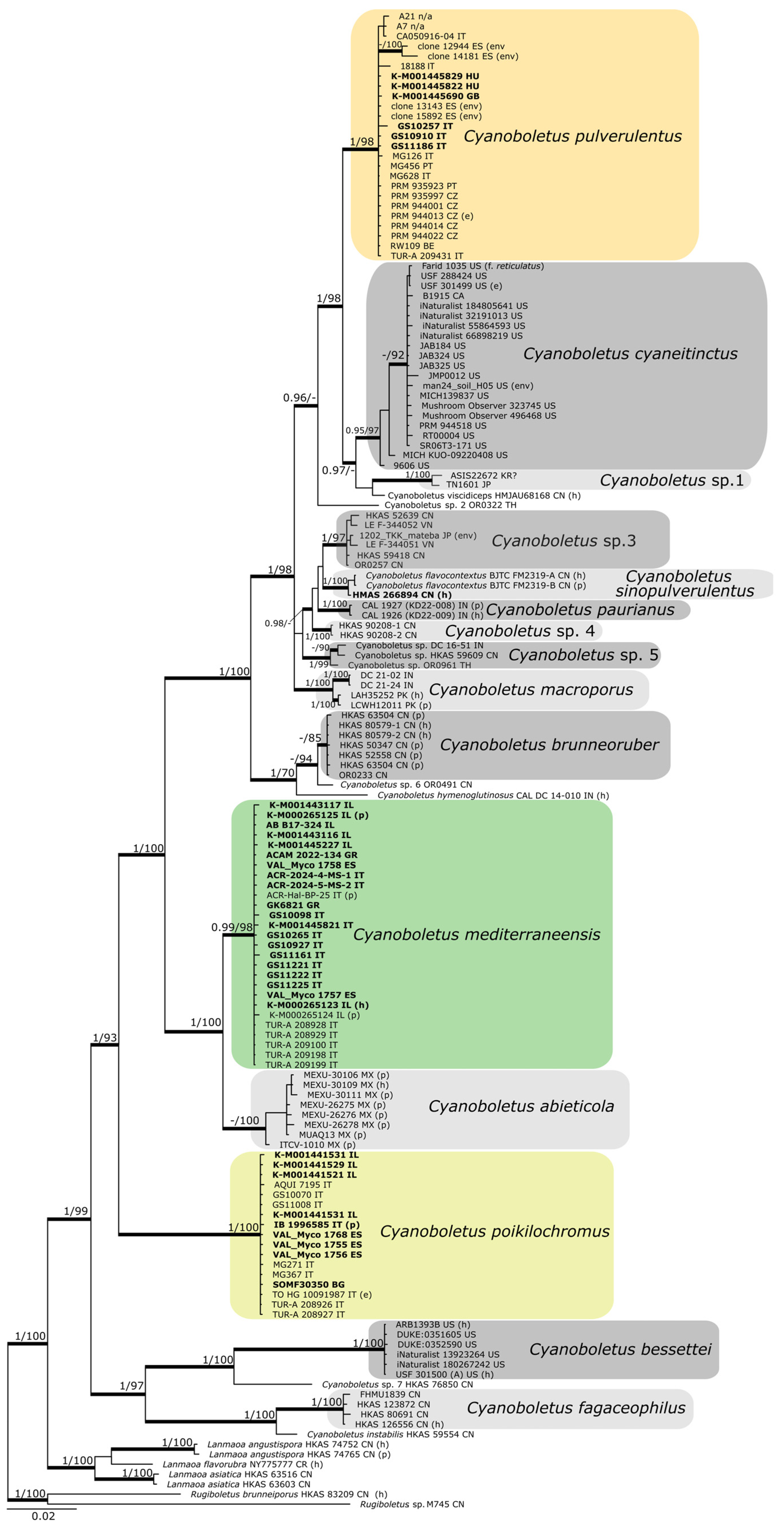
The multi-locus phylogeny produced with the ML had an lnL value of −13,425.118793, whereas the BI analysis reached an average standard deviation of split frequencies of 0.005 after 22.4 × 10⁶ generations. Average effective sample sizes (ESSs) were well above 200 in the BI analysis. Because the obtained phylogenies showed no supported conflicts, the topology inferred under a BI framework is presented in Figure 1.
Cyanoboletus is confirmed as a strongly supported generic clade (PP = 1.00, BS = 99%) encompassing 21 monophyletic species-level clades based on multi-locus analysis, 14 of which represent known species and seven undescribed taxa. However, according to the GCPSR method based on comparison of phylogenies of three independently inherited loci (ITS–LSU, tef1-α, and rpb2), we confirm 15 phylogenetic species and five putative phylogenetic species. These numbers are lower than the numbers of clades in the multi-locus phylogeny due to the fact that seven species are missing some of the analysed marker loci.
Figure 1. The BI phylogenetic tree of Cyanoboletus generated from a multilocus (ITS + LSU + tef1-a + rpb2) dataset. The BS values of ≥70% and the PP values of ≥0.95 are indicated at the nodes. Thickened branches indicate high statistical support (either BS ≥ 70% or PP ≥ 0.95). Species names of collections follow current identification, except original names of the type specimens of C. flavocontextus. Cyanoboletus species occurring in Europe and the Levant are indicated by coloured fields. Collections with newly generated sequences are indicated in bold. Two-letter country codes (ISO 3166-1[73] alpha-2) denote the origin of the specimens. At the end of the annotations of some collections, abbreviations are indicated in brackets: e—epitype, h—holotype, p—paratype, and env—environmental sample.
Jof 12 00315 g001
The majority of previously described Cyanoboletus species, including our focal species C. mediterraneensis, C. poikilochromus and C. pulverulentus, formed highly supported clades (PP ≥ 0.99, BS ≥ 98%). Only C. flavocontextus is clustered in the same species-level clade as C. sinopulverulentus, supporting its conspecificity (PP = 1.00, BS = 100%). The reconstructed phylogeny provided high support for the close relationship between the European C. pulverulentus and the North American C. cyaneitinctus (common subclade: PP = 1.00, BS = 98%), as well as the mainly Mediterranean C. mediterraneensis and the Mexican C. abieticola (common subclade: PP = 1.00, BS = 100%). A number of collections formed well-supported clades but without clear affinities to any already described Cyanoboletus species. In such cases, we have named them as Cyanoboletus sp., followed by a number (1 to 7).
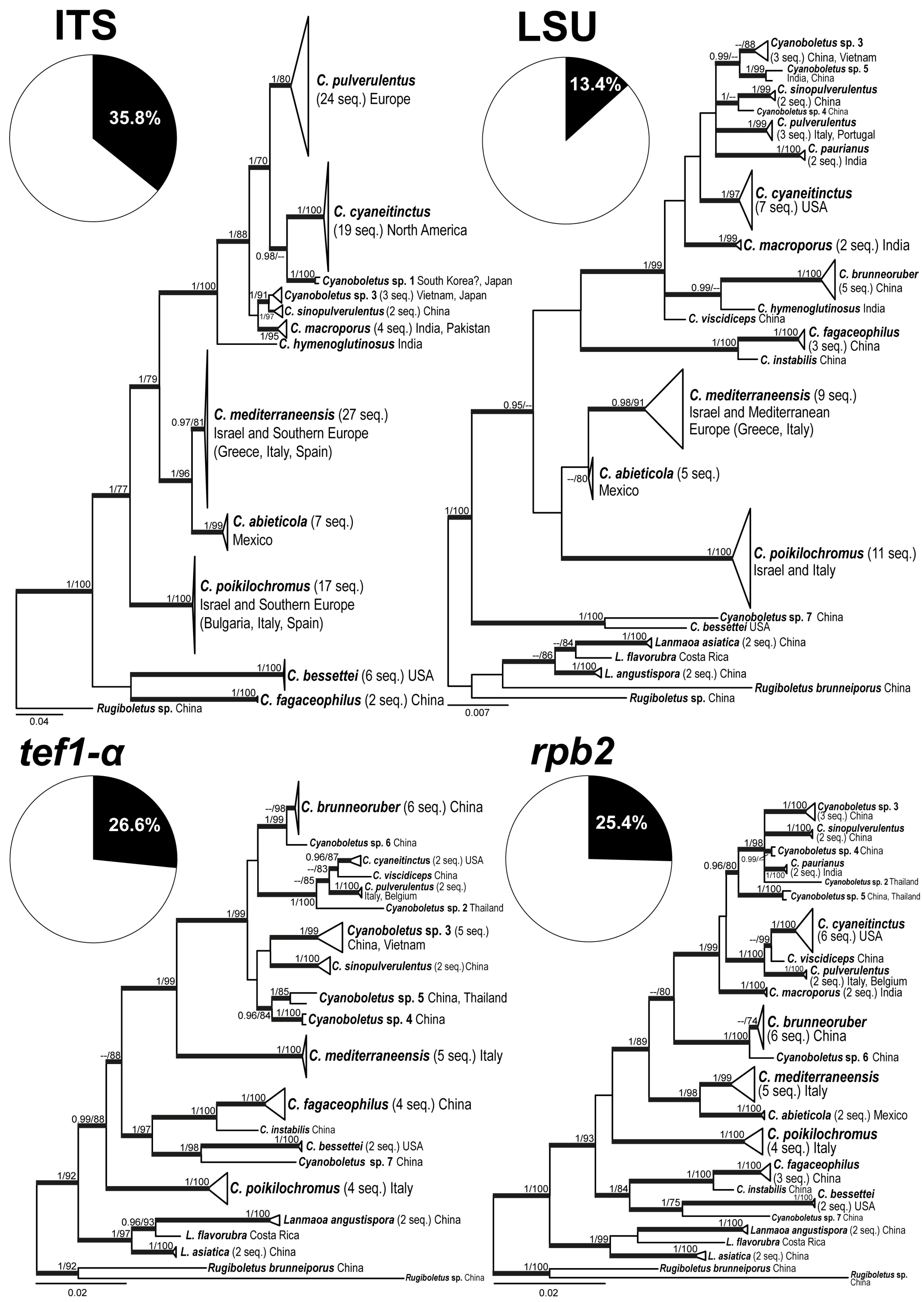
Single-locus BI phylogenies are shown in Figure 2. The base topology in all four cases matches the one obtained with the multi-locus phylogeny. PP and BS for the inner branches and sister-level relationships were generally high in phylogenies built with ITS, tef1-α, and rpb2 data. As in the multi-locus phylogeny, the study species C. mediterraneensis, C. poikilochromus, and C. pulverulentus formed highly supported clades (PP ≥ 0.97, BS ≥ 80%) in all single-locus phylogenies, and C. mediterraneensis was shown to be closely related to C. abieticola, and C. pulverulentus to C. cyaneitinctus and C. viscidiceps, whereas the close affinities of C. poikilochromus to other taxa remained elusive.

3.2. Taxonomy

Cyanoboletus Gelardi, Vizzini & Simonini, in Vizzini, Index Fungorum 176: 1, 2014, emend. Biketova.
MycoBank MB 550672
=Cupreoboletus Simonini, Gelardi & Vizzini, in Gelardi, Simonini, Ercole, Davoli & Vizzini, Mycologia 107(6): 1257 (2015); generic type: Boletus poikilochromus Pöder, Cetto & Zuccher.
Diagnosis: Basidiomes pileate-stipitate with tubular-poroid hymenophore, epigeous, small to medium, and rarely large, evelate; pileus tomentose to glabrous, dry to slightly tacky; hymenophore adnate to adnexed, sinuate or (sub)decurrent, yellow to olive green or rarely orange, yellowish brown, brownish red to reddish brown; stipe surface smooth to pruinose, sometimes with longitudinal striations in the upper half, rarely reticulate; context whitish to yellow, sometimes reddish tinged at the stipe base; tissues instantly discolouring dark indigo blue to blue–black when handled or injured and sometimes fading to copper tints, or showing changes that are much less intense, ranging from light blue or greenish blue to almost unchanging in the stipe; taste mild or slightly acidic; smell inconspicuous, fruity or sometimes peculiar and persistent; spore print olive brown; basidiospores smooth, ellipsoidal to ellipsoidal-fusoid, ellipsoidal-subamygdaliform or narrowly amygdaliform; cystidia cylindrical-fusoid to ventricose-fusoid or lageniform, rarely with abundant gloeocystidia; pileipellis a trichoderm (including intricate trichoderm), ixotrichoderm or ixocutis; hymenophoral trama bilateral divergent of the Boletus-type; lateral stipe stratum of the boletoid type; stipe base context inamyloid, rarely weakly amyloid, or occasionally weakly dextrinoid; clamp connections absent; ontogenetic development gymnocarpic.
Generic type: Boletus pulverulentus Opat. 1836.
Figure 2. The Phylogenetic trees of Cyanoboletus from separate BI analyses of each locus: ITS, LSU, tef1-a, and rpb2. BS values of ≥ 70% and PP values of ≥ 0.95 are indicated at the nodes. Thickened branches indicate high statistical support (either BS of ≥70% or PP of ≥0.95). The pie charts underneath each label are the percentage of the total characters in the alignment that are parsimony informative.
Jof 12 00315 g002
Cyanoboletus pulverulentus (Opat.) Gelardi, Vizzini & Simonini, in Vizzini, Index Fungorum 176: 1 (2014)
MycoBank MB 550673
Boletus pulverulentus Opat., Wiegm. Arch. Naturgesch. 2: 27 (1836) (Basionym).
Xerocomus pulverulentus (Opat.) J. E. Gilbert, Livres Mycol. 3: 116 (1931).
Tubiporus pulverulentus (Opat.) Imai, Trans. Mycol. Soc. Japan 8(3): 113 (1968).
=Uloporus mougeotii Quél., Enchir. Fung.: 162 (1886).
=Boletus sistotrema var. mougeotii (Quél.) Costantin & L.M. Dufour, Nouv. Fl. Champ. Edn 1: 152 (1891).
=Uloporus sistotrema var. mougeotii (Quél.) Quél., Fl. Mycol.: 411 (1888).
=Gyrodon mougeotii (Quél.) Sacc., Syll. Fung. 9: 160 (1891).
=Boletus sistotrema var. mougeotii (Quél.) Bataille, Bull. Soc. Hist. Nat. Doubs 15: 43 (1908), nom. illegit.
=Boletus mougeotii (Quél.) Bigeard & H. Guill., Fl. Ch. Sup. France: 385 (1909).
=Boletus hortensis Smotl., Sber. K. böhm. Ges. Wiss. [1911]: 40 (1912).
=Tubiporus nigricans E. A. Herrm., Pilz- und Kräuterfr. 4 (6/7): 124 (1920).
=Boletus rickenii Gramberg, Pilz- und Kräuterfr. 4: 226 (1921).
Boletus pulverulentus var. sublateritius Guinb., Lannoy & Estadès in Lannoy & Estadès, Docums Mycol. Mém. Hors Sér. 6: 91 (2001), nom. inval., Art. 39.1 (Madrid).
?Boletus hortensis f. citrinus Smotl., Časopis Čs. Houbařů 29(1–3): 31 (1952), nom. inval., Art. 39.1 (Madrid).
?Boletus hortensis f. eurothensis Smotl., Časopis Čs. Houbařů 29(1–3): 31 (1952), nom. inval., Art. 39.1 (Madrid).
?–Boletus hortensis f. lilacinus Smotl., Časopis Čs. Houbařů 29(1–3): 31 (1952), nom. inval., Art. 39.1 (Madrid).
Misapplied names:
Boletus radicans Pers. sensu Fr., 1874, Hymenomycetes Europaei: 503.
Boletus radicans Pers. sensu Rea, 1922, s. auct.; fide Checklist of Basidiomycota of Great Britain and Ireland, 2005.
Holotype: Germany, Berlin–Brandenburg: Berlin, the Royal Botanical Garden of Berlin, tab. I, figures 1 and 2 [74].
Epitype designated here (MTB10029081): Czechia, Central Bohemia: Rakovník, Jesenice, 50°05′23.1″ N, 13°29′11.0″ E, in mixed forest plantation under Quercus robur and Corylus avellana, 17.06.2016, leg. & det J. Borovička, PRM 944013, GenBank: ITS—LT714707.
Edibility: Considered edible after prolonged cooking [75]; however, it is not recommended for consumption due to high arsenic content in the basidiomes ([40] and this study).
Ecology and phenology: Growing solitary or in small groups, on acid to neutral soils during the summer and autumn ((May) June–November)) ([76] and this study). Associated with Castanea sativa, Carpinus betulus, Corylus avellana, Fagus sylvatica, Quercus (Q. cerris, Q. ilex, Q. pubescens, Q. robur), Tilia cordata, Pinus (P. nigra, P. pinea, P. sylvestris), Cedrus libani, and Tsuga spp., based exclusively on genetically proven collections ([8,40,59] and this study). Quercus coccifera, Q. pyrenaica, Q. suber, Alnus, Betula, Ostrya, Abies, and Picea abies are also hosts of reported non-genetically verified collections ([8,77,78,79,80,81] and this study).
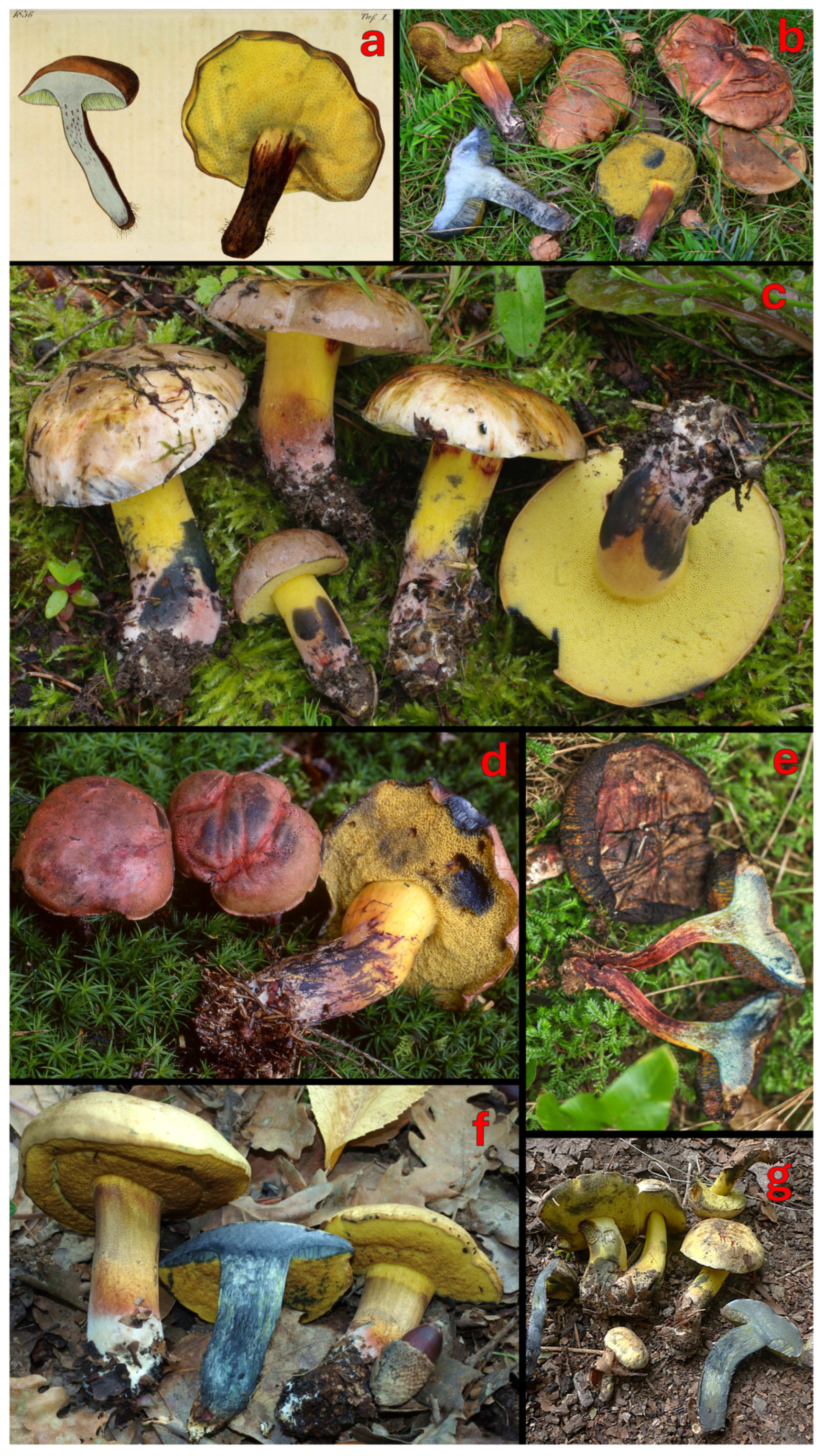
Figure 3. The macromorphology of C. pulverulentus: (a) an original holotype illustration, (b) MG1050, (c) an epitype collection PRM 944013, (d) GS1551, (e) PO-F2601, (f) GS10910, and (g) K-M001445829 (AB B18-391). Photos and pictures: (a) W. Opatowski [74], (b) M. Gelardi, (c) J. Borovička, (d) C. Lavorato, (e) V. Fachada, (f) G. Simonini, and (g) B. Bálint.
Jof 12 00315 g003
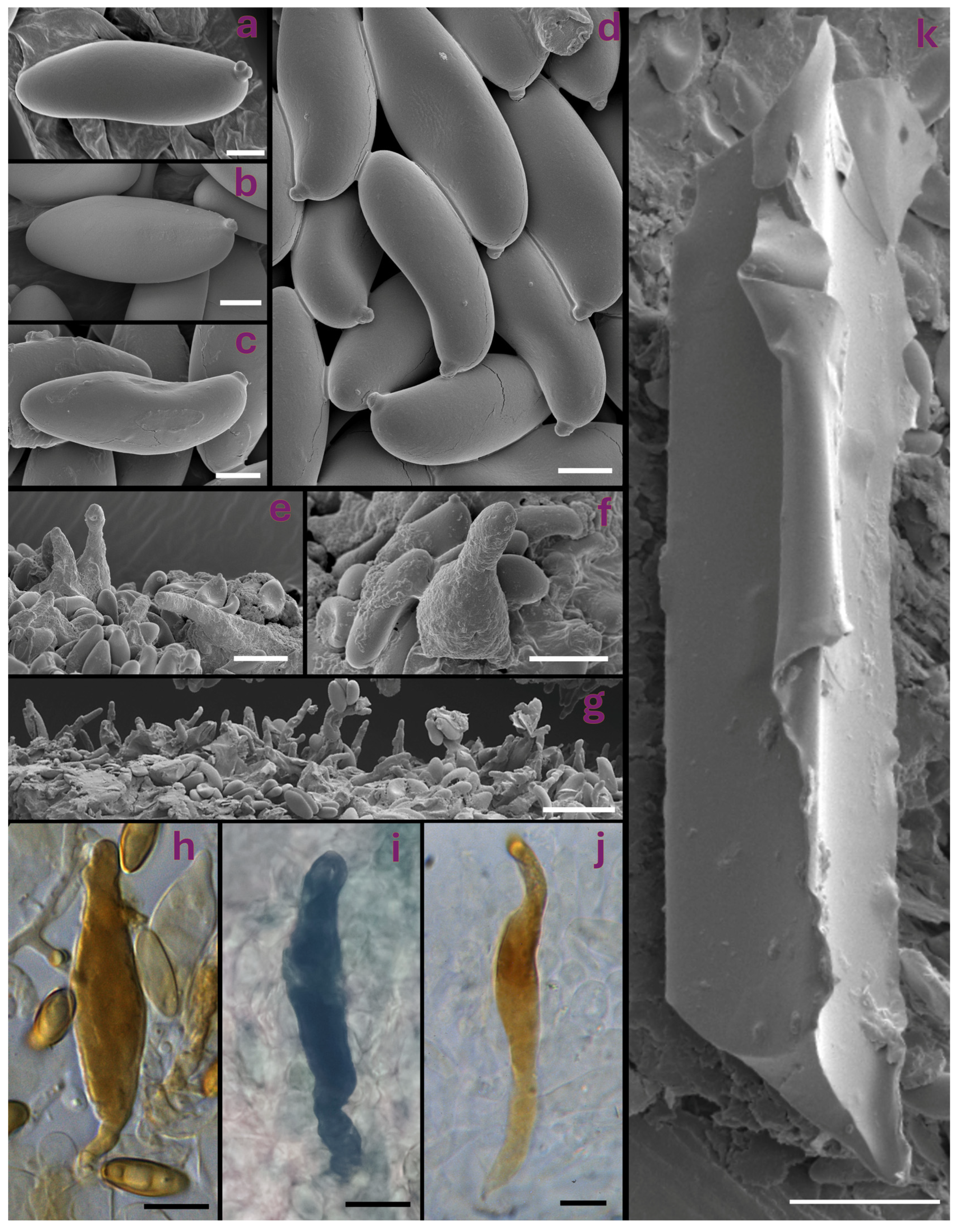
Figure 4. The microscopic features of target Cyanoboletus species: (a) typical long, narrow-subamygdaliform basidiospore of C. mediterraneensis under SEM (PO-F2442); (b) typical short, blunt-ellipsoidal basidiospore of C. poikilochromus under SEM (MG1004); (c) typical narrow-amygdaliform basidiospore of C. pulverulentus under SEM with significant suprahilar depression, lateralised apiculus, and with relatively acute apex (PO-F2601); (d) basidiospores of C. pulverulentus under SEM (PO-F2601); (e,f) hymenophore of C. pulverulentus displaying fusiform-lageniform cystidia under SEM (PO-F2601); (g) typical hymenophore of C. poikilochromus with abundant narrow-cylindrical gloeocystidia (MG1004); (h) gloeocystidium of C. pulverulentus with KOH (PO-F2601); (i) gloeocystidium of C. poikilochromus with brilliant cresyl blue (IB 19960585, paratype); (j) gloeocystidium of C. poikilochromus with KOH (GS63); (k) crystal structure from the hymenophore of C. poikilochromus under SEM (MG1004). Bars: 2 μm (ad), 10 μm (e,f,hj), and 20 μm (g,k). Micrographs: (ah,k) V. Fachada, (i) A. Yu. Biketova, and (j) G. Simonini.
Jof 12 00315 g004
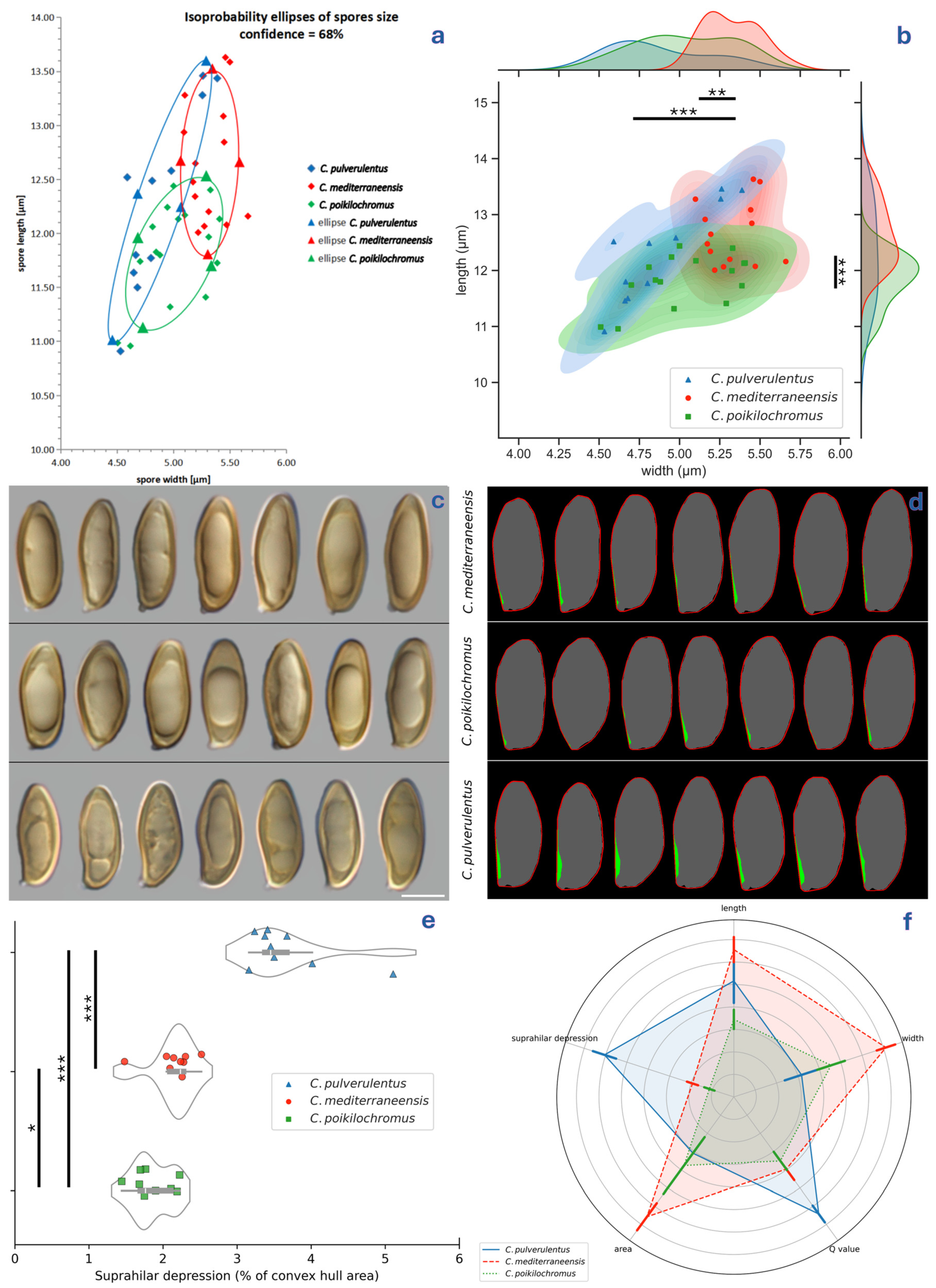
Figure 5. The basidiospore morphometry of target species of Cyanoboletus: (a) isoprobability ellipses; (b) kernel density estimate, where each mark represents a measured collection, ** p = 0.01, and *** p = 0.001 using t-tests; (c) the representative basidiospores of each species in the side view; (d) segmentation of (a) (grey silhouette), generating a respective convex hull (red line) and ultimately their difference, i.e., concave hull area equating to the suprahilar depression (green); (e) a violin plot depicting suprahilar depression represented as a percentage of the convex hull area, where each mark represents a measured collection, * p = 0.05, and *** p = 0.001 using Mann–Whitney tests; and (f) a spider chart comparing the main basidiospore morphology traits, where the bars represent the standard errors. Micrographs: (c) V. Fachada.
Jof 12 00315 g005
Known distribution: EUROPE: Andorra [14]; Austria [12,14]; Belgium ([12,14], GP—[82]); Bulgaria ([83,84,85] and this study); Czechia ([13,86,87]; GP—[40] and this study); Croatia [13,88]; Denmark [26,89]; France (incl. Corsica) [13,14,90,91,92,93]; Germany [13,74]; Greece [80,81,94,95,96,97,98,99]; Hungary ([100]; GP—this study); Ireland [101,102]; Italy (incl. Sicily and Sardinia) ([78,103,104,105,106,107]; GP—[8,108,109] and this study); Kosovo* [110]; Lithuania [14,111]; Luxemburg [14]; Malta [112]; Moldova [14]; Netherlands [113,114]; North Macedonia [115,116]; Norway [26,89]; Poland [117,118,119]; Portugal [79]; Romania [120,121,122]; Russia (European part) [123]; Serbia [124,125]; Slovakia [77]; Slovenia [126]; Spain (inc. the Balearic Islands) ([13,78,79,127,128,129]; GP—[130] and this study); Sweden [26,89]; Switzerland ([13,131] and this study); Ukraine [76,132,133]; United Kingdom ([101,102,134,135,136,137]; GP—Janke unpubl. [59] and this study). MACARONESIA: Portugal (Azores, Madeira) ([138,139]; GP—[8,40] and this study); Spain (Canary Islands) [140,141,142,143,144]. WEST ASIA: Iran [145]; Turkey (Balıkesir and Karaman Provinces) [146]. This species is also recorded in AUSTRALIA [14,44]; NORTH AFRICA (Morocco, Tunisia) [12,147,148,149]; NORTH and EAST ASIA (Japan, the Russian Far East, South Korea, Taiwan*) [14,27,28,123,150,151,152,153]; SOUTH ASIA (Pakistan) [154]; NORTH and CENTRAL AMERICA except the Western Group of the Azores (Canada, USA, Mexico, Guatemala) [14,155,156,157,158,159]; and SOUTH AMERICA (Colombia) [14,160,161]. It should be noted that extra-European, extra-Macaronesian, and extra-West Asian records may represent different Cyanoboletus species (or even other genera), and their identity should be verified by DNA sequencing.
Notes: Cyanoboletus pulverulentus was originally described by Opatowski from Germany, based on collections growing in the Berlin Botanical Garden and Botanical Museum (former Royal Botanical Garden of Berlin) [74]. The specific epithet “pulverulentus” means “covered with powder” and refers to the somewhat dry powdery surface of the young pileus and the stipe base. The holotype is an iconotype illustrating two basidiomes, where one is longitudinally cut, showing blueing flesh, and the other is in anterolateral view (Figure 3a). Due to the absence of any physical fungal type specimen and because this historical illustration is demonstrably ambiguous, lacking essential microscopic features and DNA data is required for precise modern species identification and phylogenetic placement (Art. 9.9 [162]), here we designate an epitype from a similar habitat in Central Bohemia (Czechia) that matches the original description (Figure 3c).
Cyanoboletus pulverulentus is macroscopically characterised by small to medium-sized basidiomes, growing solitary or in groups. The pileus is rather variable in colouration: yellow, buff brown, olivaceus brown to raspberry red, with a silky to slightly viscous surface and an acute pileus margin; the stipe is yellow, sometimes with brown or reddish colours in the lower part, rarely with a reticulum in the upper part [2]; tubes are lemon yellow; the context is yellow, sometimes reddish in the stipe of aged basidiomes, which turns intense blue with a turquoise tint (Figure 3). Microscopically, this species is characterised by narrow-amygdaliform, subfusiform-subamygdaliform, or amygdaliform basidiospores, often with a strongly lateralised apiculus (hilar appendix) and pronounced suprahilar depression, (10.91) 12.29 ± 0.9 (13.46) × (4.53) 4.87 ± 0.32 (5.39) µm, with the largest Q value of the European species of Cyanoboletus—(2.41) 2.53 ± 0.18 (2.73) (Figure 4c,d, Figure 5 and Figure 6). Thriving in acidic to neutral soils across temperate European and Macaronesian forests, mycorrhizal with broadleaves and conifers. It also differs from other European Cyanoboletus species and C. cyaneitinctus by arsenic hyperaccumulation ([40] and this study).
It is difficult to separate C. pulverulentus from C. mediterraneensis in the field, as both species exhibit variable macromorphological characters, although the latter tends to be confined to thermophilic Mediterranean habitats and often produces a darker pileus colour. Likewise, microscopically, there is a significant overlap in basidiospore length and width, although basidiospores are smaller on average in C. pulverulentus. Nonetheless, both species may be distinguished by basidiospore shape in the side view, as C. pulverulentus produces a large proportion of basidiospores with a pronounced suprahilar depression, emphasised by the crooked proximal end with a strongly lateralised apiculus. However, basidiospore morphology is highly variable within each basidiome; therefore, much like the apical truncation in Xerocomellus, such micromorphological features can be easily overlooked, and it is important to search for basidiospores showing key features before considering them as being absent [163].
Extra-European, extra-Macaronesian, and extra-West Asian records of C. pulverulentus likely belong to different taxa. Records from the USA and Canada represent C. cyaneitinctus, which is the most common and most similar lookalike of C. pulverulentus among Cyanoboletus species in North America [17]. All illustrated records from Mexico on GBIF likely represent a different xerocomoid genus with a reticulated stipe [14]. Reports of this species (as Boletus pulverulentus) from the Kamchatka and Sakhalin regions of Russia, judging from descriptions and illustrations in Bulakh [27,28,150], likely represent another species or perhaps even a distinct xerocomoid genus with felty reddish-brown pileus (sometimes with fine cracks), larger, more angular pores, and fibrillose vinaceous stipe surface. The records of a soil sample TUE000376 (sequences UDB04486503, UDB04486504, UDB04486505) of this species from China and specimens from Japan TN1601 (sequence LC832002) and South Korea ASIS22672 (sequences KP004920 and KF668326) belong to the undescribed Cyanoboletus sp. 1 (Figure 1 and Figure 2) [14,164]. The collection from Australia (https://www.gbif.org/occurrence/4507683076 (accessed on 17 February 2026)) also represents another species (or even genus) with a shorter hymenophore and more minute and rounded pores than in the genuine C. pulverulentus [14]. Some European, Macaronesian, and West Asian records can represent C. mediterraneensis or other bolete species, such as the case with a record from Kosovo* by Karadelev et al. [165], which likely represents Neoboletus xanthopus (Klofac & A. Urb.) Klofac & A. Urb. based on the photo.
Cyanoboletus mediterraneensis f. mediterraneensis Biketova, Rinaldi & Simonini, Index Fungorum 516: 1 (2022)
MycoBank MB 552946
Misapplied names:
Boletus pulverulentus Opat. sensu Biketova et al., Plant Biosyst. 150(5): 883 (2016).
Holotype (MBT10006276): Israel, Upper Galilee (Northern District): Goren Park, solitary basidiome under Quercus calliprinos, 01.12.2012, leg. Z. Shafranov & A. Yu. Biketova, det. A. Yu. Biketova, K-M000265123 (ex herb. HAI B12-077), GenBank: ITS—PZ244171, LSU—NG_228932.
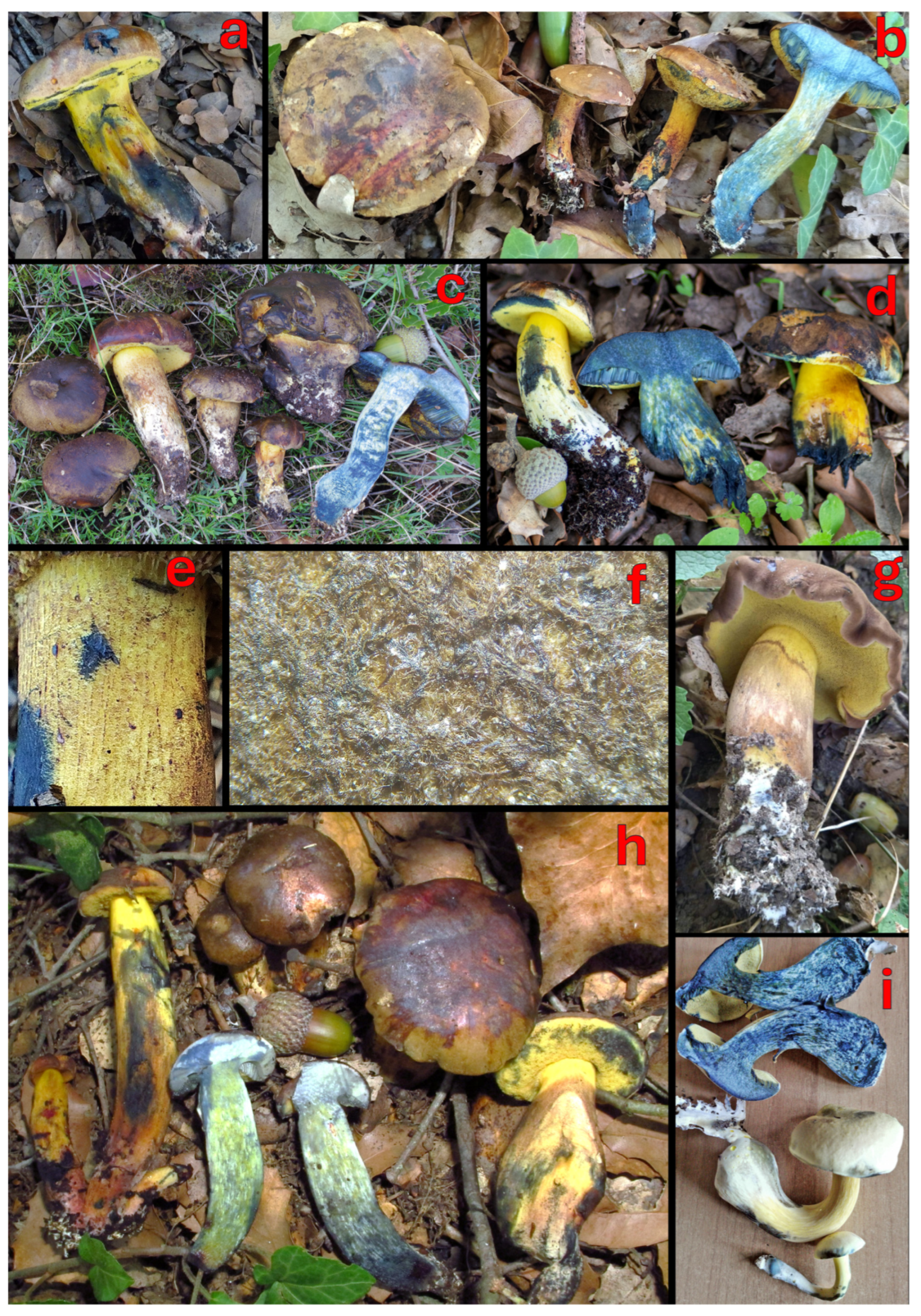
Figure 6. The macromorphology of C. mediterraneensis: (a) holotype collection K-M000265123 (AB B12-077); (b) SOMF 30989; (c) GS10265; (d) VAL_Myco 1757 (IGB1682); (e) pseudoreticulate pattern on the surface of one of SOMF 30989 basidiomes; (f) GS11225, pileus surface detail; (g) GS11190; (h) GK6821; (i) holotype of C. mediterraneensis f. pallidus, MCVE 31989 (PAn1213_13112025). Photos: (a) Z. Sahfranov, (b,e) B. Assyov, (c) A. Errico, (d) I. Garrido-Benavent, (f) M. C. Morosini, (g) G. Simonini, (h) G. Konstantinidis, and (i) P. Angeli.
Jof 12 00315 g006
Basidiomes small to medium-sized, growing solitary, in groups, or caespitose. Ontogenetic development gymnocarpic. Pileus 5.0–10.0 cm diam., convex, tomentose, matt, and dry, ranging from yellowish brown, buff brown to hazel, snuff brown, or dark brown, and becoming dark blue–black when bruised; pileus margin slightly incurved to involute, obtuse, and sometimes wavy. Stipe 7.0–9.0 × 1.0–2.8 cm, cylindrical, tapered, sometimes rooting, lemon yellow, often brownish to dark brick red at the base, without a reticulum or rarely with a pseudoreticulate pattern (Figure 6e); stipe surface becoming intensely blue–black after handling; basal mycelium white. Context rather dense, initially lemon yellow or greenish yellow, becoming intensely dark blue or cobalt blue–black when exposed to air and then gradually fading to greenish; context under tubes lemon yellow, becoming blue–green to dark blue when exposed to air. Tubes up to 12 mm long, adnate and subdecurrent, initially lemon yellow, then yellow olivaceous, turning blue–green or blue–black when bruised. Pores medium-sized, angular or irregular, lemon yellow to lemon chrome, becoming dark blue when injured. Spore print dark olive to brown olive. Smell slightly acidulous. Taste mild, slightly acidulous.
Basidiospores [703/14/17] (12.01) 12.67 ± 0.74 (13.63) × (5.10) 5.33 ± 0.32 (5.66) μm, Q = (2.15) 2.38 ± 0.15 (2.61), A = (50.7) 57.8 ± 5.6 (66.4) μm2, apV = (171.9) 189.7 ± 29.1 (216.2) μm3, long narrowly subamygdaliform, narrowly amygdaliform, and sometimes ellipsoid-fusiform to fusiform-subamygdaliform, smooth, thick-walled, guttulate, and light yellow–brown. Basidia 27–35 × 7–10 μm, 4-spored, clavate, hyaline, guttulate, without basal clamp. Hymenial cystidia 38–71 × 10–14 μm, fusiform, ventricose or lageniform, ending with papilla, some with intracellular yellowish oil content. Hymenophoral trama of the Boletus type. Caulocutis fertile. Caulocystidia 25–52 × 7–14 μm, fusiform, claviform or ventricose, some sinuous. Pileipellis is a trichoderm or ixotrichoderm of intertwined septate hyphae, consisting of cylindrical, filamentose cells (3.5–) 5–6 (–7.5) μm wide, mostly widely and finely incrusted with yellow–brown pigment.
Macrochemical spot-test reactions: 25% NH4OH: dark blue context becomes light fulvous and pileus surface becomes dark sienna; 30% KOH: context becomes light fulvous, and pileus surface becomes dark brick; 10% H2SO4: context becomes clay pink and later yellow, and pileus surface becomes sienna; 10% FeSO4: context fades to greenish yellow or lemon yellow; Melzer’s reagent: context in the stipe base is inamyloid (I).
Edibility: Edible after prolonged cooking, although with a somewhat acidic aftertaste.
Ecology and phenology: Solitary, in small groups or caespitose, growing in thermophilic Mediterranean forests on neutral or calcareous soil and in cistaceous Mediterranean low-maquis on preferably acidic, sandy soil; associated with Quercus spp. (Q. calliprinos, Q. cerris, Q. coccifera, Q. faginea, Q. ilex, Q. robur, Q. rotundifolia, Q. suber), Carpinus orientalis, Halimium halimifolium, and Pinus spp. (P. halepensis and P. pinea) ([9,10,13,164,166] and this study). It was also collected in mixed forests and woodlands with the presence of Arbutus unedo, Cistus spp. (C. albidus and C. salvifolius), and Populus ([13] and this study). Rare throughout its distribution range but likely largely overlooked.
Known distribution: EUROPE (Southern Europe): Bulgaria (Varna Province) (GP—this study), France (Corsica) [167], Greece (Crete, Epirus) ([168]; GP—this study), Italy (Apulia, Emilia Romagna, Lazio, Ligury, Lombardy, Marche, Sardinia, Sicily) ([13]; GP—[164], [166] (as Boletus sp.), Carbone et al. unpubl. [59], and this study); Portugal (Lisboa e Vale do Tejo) (GP—this study), Spain (Andalusia, Valencian Community) ([13]; GP—this study); NORTH AFRICA: Italy (Pantelleria Island) (GP—[164], from soil samples); WEST ASIA (Levant): Israel ([9], as B. pulverulentus; GP—[10] and this study).
Cyanoboletus mediterraneensis f. pallidus Angeli, Baldazzi, Gelardi & Biketova, f. nov.
MycoBank MB 862639
Holotype (MBT10031659): Italy, Marche: Rimini, Villa Verrucchio, Via Farneto 25, in a private garden, 43°59′59.3″ N 12°26′39.9″ E, 126 m, three basidiomes growing with Salix sp., Rosa hybrid, Jasminum sp., Quercus sp. (30 m away), 13.11.2025, leg. P. Angeli & L. Baldazzi, det. M. Gelardi, MCVE 31989 (collector’s number PAn1213_13112025), GenBank: ITS—PZ244160.
Etymology: “pallidus” means “pale-coloured”.
Diagnosis: Differs from the type form by light-buff to light-yellow pileus, very pale-yellow pores and light-yellow stipe.
Notes on Cyanoboletus mediterraneensis: The original specimen belonging to C. mediterraneensis was first published by Biketova et al. in 2016 under the misapplied name Boletus pulverulentus [9]. This collection (ex herb. HAI B12-077, currently K-M000265123), consisting of a single basidiome, was found in Goren Park in Israel, growing in association with Q. calliprinos [9]. Later, this collection was chosen as the holotype of C. mediterraneensis [10]. In another study by Leonardi and coauthors, this species was recorded under the name Boletus sp., growing in cistaceous Mediterranean maquis on sandy soil in association with H. halimifolium in Sardinia, Italy [166]. This collection (ACR-Hal-BP-25) of A. Rinaldi was designated as a paratype of C. mediterraneensis [10].
The xanthoid form of C. mediterraneensis, lacking brown pigments, is apparently very rare and has been detected only once (a single collection of three basidiomes) in Italy (Marche) (Figure 6i). Therefore, it is difficult to judge how stable this feature is and whether it is genetically determined or possibly caused by external factors. At the same time, the almost totally yellow basidiomes of C. pulverulentus have some traces of brown pigment either on the central part of the pileus or the stipe surface, and basidiomes of the same collection can vary in colouration—from completely lemon yellow to slightly brownish (Figure 3f,g). Moreover, their pores have an intense lemon-yellow colour, unlike those of C. mediterraneensis f. pallidus, which are very pale yellow with a greenish tint or close to cream colour.
Initially, prismatic crystals on the hymenophore surface were detected in collection K-M000265124 under SEM [10]. However, during the investigation of additional collections (K-M001443116, K-M000265125, K-M001445227 and PO-F2442) under SEM, these crystals have not been observed.
The morphological delimitation of C. pulverulentus and C. mediterraneensis can be defined as critical. As often happens between similar boletes, there is not a single stable discriminatory character, and identification must be the result of careful examination of combined features. Besides that, C. mediterraneensis also shares similarities with Lanmaoa fragrans (Vittad.) Vizzini, Gelardi & Simonini.
(1) Basidiome appearance:
C. mediterraneensis frequently occurs with specimens aggregated at the base (caespitose) and often features medium to medium–large basidiomes. This habit, combined with a long-lasting involute pileus margin and sharing the common habitat, can sometimes lead to confusion with L. fragrans. However, this ambiguity is easily resolved by observing the blue oxidation upon cutting, which is quicker and significantly more intense in C. mediterraneensis than in L. fragrans. Also, the last one has a distinct yellow-chrome colouration in the lower part of the stipe context.
(2) Pileus surface:
The pileus surface, although not showing significant differences in a microscopic analysis, has a tendency to remain felty in C. mediterraneensis (e.g., Figure 6f), compared to C. pulverulentus, which is more often slightly viscid to the touch. Under very humid climatic conditions, both species show a viscid surface. The colours appear much more variable in C. pulverulentus, ranging from yellow to raspberry red, passing through brownish tones, while also exhibiting olive shades. In contrast, the pileus colour of C. mediterraneensis f. mediterraneensis ranges within a narrow spectrum of brown tones, more or less dark, sometimes with yellowish patches. However, the xanthoid form C. mediterraneensis f. pallidus has a very light-coloured pileus: light buff to light yellow.
(3) Pileus margin:
The pileus margin tends to be more straight and acute in C. pulverulentus, but more involute, obtuse, and wavy (sometimes similar to that in L. fragrans) in C. mediterraneensis (Figure 6g).
(4) Stipe colour:
To date, innate red tints have been observed on the stipe surface of C. mediterraneensis in a single basidiome of collection MG689; these only appear occasionally in specimens in unfavourable conditions. Normally, the stipe surface of C. mediterraneensis is yellow, dull yellow, or ochre yellow in the upper part, and slightly browning due to age towards the base. The stipe surface of C. pulverulentus can sometimes exhibit evident reddish areas in the lower half to the lower third.
(5) Context discolouration on exposure:
Both species have a quick, strong and intense colour change to blue, but while the context is lemon yellow in C. pulverulentus, it appears whitish to pale yellow in C. mediterraneensis. The resulting chromatic effect is therefore an intense blue with greenish shades that lean towards dark turquoise in C. pulverulentus and a deep ink blue in C. mediterraneensis. However, this cannot be used as a key distinguishing feature due to intraspecific colour variations (see Figure 3 and Figure 6), and should be evaluated in combination with other morphological characters.
(6) Basidiospore size:
Cyanoboletus mediterraneensis has the largest basidiospores among the European Cyanoboletus species. However, the basidiospore size overlaps to some extent among these species (see Figure 5 and Supplementary Table S1). The statistical analysis shows a significant difference in (a) basidiospore width, which is wider in C. mediterraneensis (average 5.3 ± 0.3 µm) and narrower in C. pulverulentus (average 4.9 ± 0.3 µm), and (b) Q ratio, which is stouter in C. mediterraneensis (average 2.38 ± 0.15) and more slender in C. pulverulentus (average 2.53 ± 0.18).
(7) Basidiospore shape:
Basidiospores of C. mediterraneensis are long, narrowly amygdaliform, ellipsoid-fusiform, and sometimes fusiform-subamygdaliform, with an occasional obvious suprahilar depression, though much less common and pronounced than that of C. pulverulentus. Basidiospores of C. pulverulentus often show a more acute apex when compared to the other European species, particularly C. poikilochromus (Figure 4a–d and Figure 5).
Cyanoboletus poikilochromus (Pöder, Cetto & Zuccher.) M. Carbone, D. Puddu & P. Alvarado, Index Fungorum 534: 1 (2023)
Figure 4b,g,i–k, Figure 5 and Figure 7.
MycoBank MB 556234.
Boletus poikilochromus Pöder, Cetto & Zuccher., in Pöder, Mycol. Helv. 2(2): 156 (1987). (Basionym)
Cupreoboletus poikilochromus (Pöder, Cetto & Zuccher.) Simonini, Gelardi & Vizzini, in Gelardi, Simonini, Ercole, Davoli & Vizzini, Mycologia 107(6): 1257 (2015).
Suillellus poikilochromus (Pöder, Cetto & Zuccherelli) Blanco-Dios, Index Fungorum 211:1 (2015).
=Boletus martaluciae Pacioni, Micol. Veg. Medit. 11(2): 91 (1996).
Boletus pulverulentus f. reticulatipes Cetto, I Funghi dal Vero 4: 477 (1983), nom. inval., Art. 39.1 (Madrid).
Boletus pulverulentus f. reticulatipes Cetto, Enzyklopädie der Pilze, 1: 535 (1987), nom. inval., Art. 39.1 (Madrid).
Holotype (MBT77098): Italy, Emilia Romagna: Ravenna, Pineta di Classe, 44°21′31″ N, 12°16′49″ E, 5 m, with P. pinea, Q. robur, Q. ilex, and Crataegus sp., 10.09.1981, leg. A. Zuccherelli, det. A. Zuccherelli & R. Pöder, IB 19810625.
Epitype (MBT201639): Italy, Emilia Romagna: Ravenna, Pineta di Classe, with P. pinea, Q. robur, Q. ilex, and Crataegus sp., 10.09.1987, leg. A. Zuccherelli, TO HG10091987, GenBank: ITS—KT157047, LSU—KT157056.
Edibility: It is considered edible after prolonged cooking (15–20 min) and after pouring out the broth, due to the potential toxic compounds that are either water-soluble or heat-sensitive, as in some other boletes. However, because of its rarity and the intense odour, it is not recommended for consumption [9,75].
Ecology and phenology: Solitary or in small groups, ECM in thermophilous broad-leaved and mixed forests in Mediterranean regions, on basic, calcareous and sandy soils, associated with Quercus spp. (Q. alnifolia, Q. calliprinos, Q. cerrioides, Q. coccifera, Q. faginea, Q. ilex, Q. ithaburensis ssp. macrolepis, Q. pedunculatus, Q. pubescens, Q. robur, Q. rotundifolia, Q. suber), Pinus spp. (P. brutia, P. halepensis, P. pinaster, P. pinea, P. sylvestris), Ostrya carpinifolia, often with the presence of Arbutus unedo, Cistus albidus, and Crataegus sp. ([8,9,78,79,169,170,171,172,173,174,175,176] and this study).
Known distribution: EUROPE (Southern Europe): Bulgaria (Haskovo Province) (GP—this study); Croatia [177,178]; France (Corsica, Provence-Alpes-Côte d’Azur) ([179] and this study); Greece ([99,168] and this study); Italy (Abruzzo, Apulia, Calabria, Emilia Romagna, Lazio, Marche, Tuscany, Sardinia, Sicily, Veneto) ([2,75,78,107,169,170,180,181,182,183,184,185,186,187,188,189,190,191]; GP—[8] and this study); Portugal (Baixo Alentejo) [79]; Slovenia [126]; Spain (Andalucia, Balearic Islands, Castile-La Mancha, Catalonia, Valencian Community) ([78,79,90,129,171,173,175,176,192,193,194], GP—this study); WEST ASIA: Cyprus [174]; Israel ([9]; GP—this study).
Notes: This species was initially described as Boletus pulverulentus f. reticulatipes (nom. inval.) from Italy by Cetto [195] and was probably confused with Alessioporus ichnusanus (Alessio, Galli & Littini) Gelardi, Vizzini & Simonini, to which the same name was initially attributed [196]. Boletus poikilochromus was described by Pöder, Cetto and Zuccherelli as a separate species in 1987 [169], based on specimens collected in the Italian region Emilia Romagna. Later, Blanco-Dios placed this species into Suillellus Murrill, without any solid justification (likely due to tissues changing to a deep blue when cut and the presence of the reticulum on the stipe) [197]. Then Gelardi et al. [8] introduced a new genus, Cupreoboletus Simonini, Gelardi & Vizzini, sister to Cyanoboletus, to accommodate this species. Finally, Carbone et al. [11] transferred it to Cyanoboletus in 2023; this placement has been confirmed by recent phylogenetic reconstructions of García-Jiménez et al. [24], Zhang et al. [198], and our phylogenetic analyses.
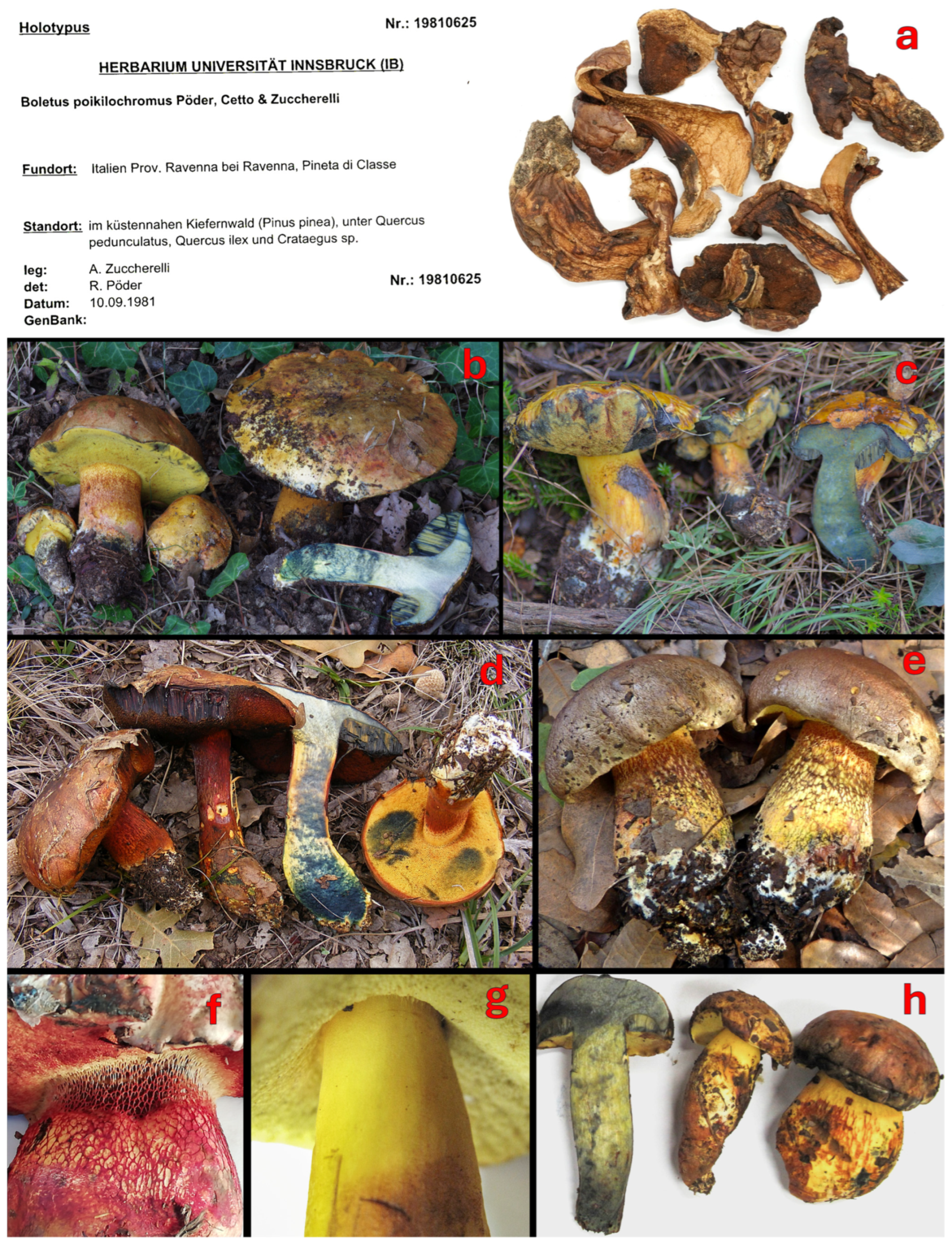
Cyanoboletus poikilochromus is macroscopically characterised by medium to medium–large basidiomes; dry or slightly viscid pileus, which is finely tomentose to glabrous, rarely areolate, sometimes cracked, initially buff, dull yellow, yellow ochre, yellowish brown or pale olivaceous brown, becoming ochraceous orange, ochraceous reddish, and dark reddish brown with scattered paler or tawny-red patches; initially involute pileus margin, then progressively expanding and sometimes uplifted, faintly wavy/lobed to regular; lemon-yellow stipe in the upper part, downwards progressively reddish brown to rusty brown, with yellow, cinnamon-brown, reddish-brown, or red reticulum, rarely without it (Figure 7e–h); white basal mycelium; roundish, relatively small pores, which are lemon yellow to slightly rusty orange and rarely red; yellow context; tissues turning intense blue with a turquoise tint then fading copper red to copper brown ([8,9,13] and this study).
Cyanoboletus poikilochromus can also be separated from other European and Western Asian Cyanoboletus spp. by its short, ellipsoidal basidiospores, (10.96) 11.83 ± 0.69 (12.44) × (4.51) 5.03 ± 0.25 (5.41) μm, Q = (2.16) 2.36 ± 0.16 (2.51), often with a blunt apex and poorly defined suprahilar depression (see Figure 4b and Figure 5). Other remarkable microscopic features of C. poikilochromus include: (a) numerous gloeocystidia (so-called “pseudocystidia” or subhymenial cystidia)—sterile honey-yellow cells with oily content, refractile, most often originating from the subhymenium and connected with oleiferous hyphae, characterised by strong absorption of brilliant cresyl blue, dextrinoid reaction with Melzer’s reagent, and that presumably have secretory function (Figure 4g,i,j); (b) presence of glassy, needle-shaped crystals forming on the hymenophore and stipe surface in dry specimens (Figure 4k) [8,9,170]. Moreover, C. poikilochromus has a very peculiar, persistent smell that resembles that of propolis, cinnamon, fermenting fruits, or poplar (Populus nigra) flower buds and cannot be confused with any other European bolete [8,9,170]. These remarkable features (fading copper-red to copper-brown tissues, peculiar smell, numerous gloeocystidia and crystals) can be connected to some chemical compounds, which are actively produced in this species.
Hyphae of the context in the stipe base of C. pulverulentus and C. mediterraneensis have an inamyloid reaction with Melzer’s reagent, the same as the majority of studied collections of C. poikilochromus, which sometimes have a positive (mostly weak) amyloid reaction [9,169]. Ecologically, C. poikilochromus may be found frequently on more alkaline substrates, despite sharing a similar geographic range with the more acidophilic C. mediterraneensis.
Therefore, C. poikilochromus is very easily recognisable in the field. However, rare misidentifications also happen, e.g., the first mention of this species in Croatia by Božac [199] was attributed to a photo of a bolete of another genus, likely Suillellus or Rubroboletus.
We studied the holotype IB 19810625 (Figure 7a), paratype IB 19960585, and epitype TO HG10091987 collections of this species in two different laboratories in parallel. Unfortunately, attempts to amplify the ITS and LSU regions of the holotype have failed. However, the sequencing of the paratype collection IB 19960585 resulted in a full-length ITS (PZ244176) and partial LSU (PZ231929) sequences. Therefore, the epitype designation in Gelardi et al. [8] can be considered redundant.
Key to the Described Mediterranean Species of the Genus Cyanoboletus
I. Macromorphological and ecological key:
1. Stipe with a well-defined reticulum (at least in the large majority of specimens); rounded pores; a peculiar smell that resembles those of fermented fruits; growing preferably on calcareous soil in Mediterranean habitats ………………………………………………………………………………………………………………………………………………………………………….C. poikilochromus
1. Stipe devoid of reticulum (or rarely with a fine reticulum restricted to the stipe apex or with a pseudoreticulate pattern); angular or irregularly-arranged pores; with an indistinct mushroomy smell …………………………………………………………………………………………………………………………………………………………………………………………………………….2
2. Pileus often slightly viscous or silky, with yellow, buff-brown, olivaceus-brown, or raspberry-red surface; pileus margin straight and acute; stipe sometimes with red tones; context lemon yellow and quickly turns dark blue with greenish shades; occurring throughout Europe, Macaronesia, and West Asia, mainly in temperate habitats with a wide range of Fagaceae, Betulaceae, Pinaceae and Tilia……………………………………………………………………………………………………………………………………………………………………………………………C. pulverulentus
2. Pileus persistently felty; pileus margin involute, obtuse or wavy; stipe generally lack innate red tones; context whitish or pale yellow, turns deep ink blue usually without evident greenish shades; growing in Mediterranean thermophilic, preferably acidophilic habitats with Quercus, Pinus or Cistaceae……………………………………………………………………………………………..3
3. Pileus snuff brown, dark brown, or buff brown; pores and stipe lemon yellow, often brownish to dark brick red at the base……………………………..C. mediterraneensis f. mediterraneensis
3. Pileus light buff to pale yellow; pores pale yellow; stipe light yellow without any brown or red shades………………………………………………………………..C. mediterraneensis f. pallidus
II. Microscopy key, to be applied to mature basidiospores in side view only:
1. Average basidiospore width < 5 µm …………………………………………………………………………………………………………………………………………………………………………………2
1. Average basidiospore width > 5 µm …………………………………………………………………………………………………………………………………………………………………………………4
2. Average basidiospore length > 12.5 µm …………………………………………………………………………………………………………………………………………………………..C. pulverulentus
2. Average basidiospore length < 12.5 µm ……………………………………………………………………………………………………………………………………………………………………………..3
3. Basidiospores mostly ellipsoid with poorly defined suprahilar depression and somewhat blunt apex; gloeocystidia abundant…………………………………………………..C. poikilochromus
3. Basidiospores often narrowly amygdaliform, with pronounced lateralised apiculus, pronounced suprahilar depression, and with relatively acute apex; gloeocystidia sparse………………………………………………………………………………………………………………………………………………………………………………………………………..C. pulverulentus
4. Average basidiospore length < 12.5 µm, mostly ellipsoidal; gloeocystidia abundant …………………………………………………………………………………………………….C. poikilochromus
4. Average basidiospore length > 12.0 µm, often narrowly subamygdaliform or amygdaliform with more or less evident suprahilar depression; gloeocystidia sparse……………………………5
5. Basidiospores often narrowly amygdaliform with strongly lateralised apiculus and pronounced suprahilar depression (generally > 3% of convex hull area)………………….C. pulverulentus
5. Basidiospores narrowly subamygdaliform, with only occasional obvious suprahilar depression (generally < 2.5% of convex hull area)……………………………………….C. mediterraneensis
Extralimital Taxa
Cyanoboletus sinopulverulentus (Gelardi & Vizzini) Gelardi, Vizzini & Simonini, in Vizzini, Index Fungorum 176: 1 (2014).
MycoBank MB 803339.
≡Boletus sinopulverulentus Gelardi & Vizzini, Sydowia 65(1): 49 (2013).
=Cyanoboletus flavocontextus L. Fan, N. Mao & T.Y. Zhao, in Mao, Zhao, Zhang, Li, Lv & Fan, Mycosphere 14(1): 2034 (2023).
Holotype (MBT174647): China, Shaanxi Province: Qinling Mountains, Heihe National Natural Forest Park, Yingbanliang village, 1432 m, on very moist and drained soil under Castanea mollissima, 30.09.2011, leg. M. Gelardi & J.-Z. Sun, HMAS 266894 (isotypes: TO HG2821, MG434), GenBank: ITS—PZ244192.
Notes: Cyanoboletus sinopulverulentus is characterised by small to medium-sized basidiomes; dark-brown pileus with glabrous to subtomentose surface; dark-brown stipe, either with glabrous yellow to yellow–brown surface in the upper part that gradually goes brown towards the stipe base, or transversely streaked scissurate in the upper half with yellowish ground colour visible in the cracks; whitish or pale-yellow context in pileus to light yellow in stipe and reddish at the stipe base, turning intensely indigo blue; unstuffed small roundish to angular pores, first bright yellow or dull yellow and then turning orange–yellow with age; ellipsoid-fusiform basidiospores, 11.5–13.5 × 4.5–5.7 μm, Q = 2.31 ± 0.14; both 2- and 4-spored basidia are common. This species is growing in association with C. mollissima and Quercus sp. in temperate montane forests [3,20].
Boletus sinopulverulentus was described from Shaanxi province of China by Gelardi et al. in 2013 [3]. There is a lot of confusion in the recognition and identification of this species. Two later records of this species reported as C. sinopulverulentus from China (HKAS 59609: KF112366, KF112193, KF112700) and India (DC 16-51: MH684757) [4,15,40] represent another species—Cyanoboletus sp. 5, based on our phylogenetic reconstructions (Figure 1 and Figure 2).
In this study, we generated a high-quality ITS sequence PZ244192 of the holotype of this species (HMAS 266894); the previously generated sequence KC579402 [3,59] had a few poorly edited fragments in the ITS2 region. The newly generated sequence has 98.81% similarity and 5 gaps (within the first 45 bases) with the holotype of C. flavocontextus BJTC FM2319-A (NR_191306) [20] based on the BLASTn analysis in NCBI [59]. In the present phylogenetic ITS analysis, type specimens of both C. sinopulverulentus and C. flavocontextus form one species-level clade. Vietnamese specimens initially identified as C. flavocontextus (LE F-344051 and LE F-344052) [18] are clustered in another clade, Cyanoboletus sp. 3, which also contains specimens from China and Japan. Therefore, the currently known distribution of C. sinopulverulentus is restricted to Shaanxi and Shanxi provinces in Northern China.
Boletus gabretae Pilát, Česká Mykol. 22(3): 167 (1968)
MycoBank MB 327043.
≡Suillellus gabretae (Pilát) Blanco-Dios, Index Fungorum 211: 1 (2015).
≡Cyanoboletus gabretae (Pilát) Yang Wang, B. Zhang & Yu Li, in Wang, Ma, Wu, Yang, Liu, Rao, Dai, Gui, Tuo, Wang, Chen, Zhang & Li, Mycosphere 15(1): 925 (2024).
Notes: The combination of Cyanoboletus gabretae (Pilát) Yang Wang, B. Zhang & Yu Li, based on B. gabretae Pilát, although formally correct [23], lacks a solid taxonomic foundation. It is based solely on data from the literature referencing the morphochromatic character of instantaneous and intense blueing, and the presence of a yellow hymenophore. No molecular data is provided, nor any epitypification of the taxon B. gabretae, necessary requirements for a justified placement in the proposed genus. Moreover, the authors have not studied any specimen of this taxon [23].
Furthermore, proponents of this combination appear to ignore or contradict without any supporting scientific evidence, the statements made in the original article describing the species B. gabretae, which deals on a clear derivation from “Boletus erythropus Fr. ex Fr.” [200] (=Boletus erythropus Pers. s. Fries 1860, =Neoboletus praestigiator (R. Schulz) Svetash., Gelardi, Simonini & Vizzini [201]), on which two overlapping already known deviations would persist: (1) the overall yellow tint of every part of the basidiomes (attributed to the taxon called Boletus junquilleus (Quél.) Costantin & L.M. Dufour [202,203]); (2) the occasional and limited presence of a reticulum (attributed to Boletus caucasicus Singer, nom. inval. (=Suillellus caucasicus (Singer ex Alessio) Blanco-Dios, nom. inval.) [13,103,197,204,205]).
The two deviations combined would contribute to forming the entity B. gabretae, clearly belonging to the genus Neoboletus Gelardi, Simonini & Vizzini, which is reiterated to be a deviation from the well-known and widespread taxon N. praestigiator (“B. erythropus Fr. ex Fr.”) [2,13]. It should be noted that the taxon B. gabretae appears well understood and described even in the popular literature and on the internet (e.g., publications, forums, social media platforms), in the sense originally given to it by Pilát [200], which removes any interest in a later combination in the genus Cyanoboletus. However, it is currently premature to propose any combination for this taxon in Neoboletus due to the presence of at least two very similar species of this genus in Europe—N. praestigiator and N. xanthopus. Moreover, B. gabretae type material requires careful analysis, including sequencing of its genetic markers.

3.3. Arsenic Content

The arsenic mass fraction of 7.72 mg kg−1 determined in the reference material SRM 1566b matches the certified value of 7.65 ± 0.65 mg kg−1, indicating the quality of our analytical procedure. In the basidiome samples, the arsenic mass fractions were in the range of 0.30 to 7.14 mg kg−1 (Table 3), with median values of 1.56 mg kg−1 in C. mediterraneensis and 0.55 mg kg−1 in C. poikilochromus.

4. Discussion

Our phylogenetic analysis shows that Cyanoboletus forms a generic clade (multilocus: PP = 1.0, BS = 100%) with strong statistical support of all major branches (Figure 1). These results correlate with previous single-locus and multi-locus concatenated phylogenetic analyses [4,8,17,19,20,23,24,205,206]. Synonymy of Cupreoboletus with Cyanoboletus has also been confirmed.
Nuhn et al., in their LSU-based analysis, merged Lanmaoa carminipes (as Boletus carminipes) and C. cyaneitinctus (as Boletus pulverulentus) into one “carminipes” clade [207]. However, their phylogenetic reconstruction does not provide any information on generic delimitation between the later described Cyanoboletus and Lanmaoa due to limited coverage across taxa (a single species from each currently recognised genus). Other authors have expressed a more well-supported view that Cyanoboletus and Lanmaoa should be placed together in one genus due to close relationships and morphological similarities [17,206]. Although Cyanoboletus tends to have dull-brown colours and Lanmaoa often has bright-red or yellow tones [4,15,206], this is not the case with L. fragrans, which has a brown pileus and usually has brown tints in the stipe, especially at the base. As mentioned above, L. fragrans and C. mediterraneensis share not only similar morphological features but also often grow in the same habitats, sharing a preference for acidic soil and having many common host plants. Cyanoboletus bessettei and C. fagaceophilus (as C. instabilis) both share the 1/3–1/5 hymenophore-to-pileal-context ratio found in Lanmaoa (and some Baorangia species) [17,206]. Similarity between some species of Cyanoboletus (especially basal lineages) and Lanmaoa could be explained either by symplesiomorphy (inherited from the common ancestor) or homoplasy (a result of convergent evolution).
Later studies revealed two other genera, Acyanoboletus G. Wu & Zhu L. Yang and Cacaoporus Raspé & Vadthanarat, which are even more closely related to Cyanoboletus than Lanmaoa [21,198,208]. Acyanoboletus is the closest, characterised by a strongly incurved pileal margin when young; a pale-yellow context and hymenophore without colour changing when bruised; a stipe lacking reticulum and sometimes nearly glabrous; a strong, unpleasant smell; an intricate trichoderm pileipellis to intermediate type between trichoderm and cutis (incorrectly called “subcutis”); and subfusoid basidiospores [21,198]. Cacaoporus is characterised by brown to blackish-brown basidiomes, with brown encrustations in the context; chocolate-brown to dark-brown hymenophore; tubes not separable from the pileus context; white to off-white basal mycelium, which turns reddish white to pale red when bruised; amygdaliform to ovoid basidiospores; and a dark-brown spore print [208]. Therefore, both of these genera are not only clearly delimited phylogenetically from Cyanoboletus but also have significant morphological differences that allow a clear separation between them in the field.
Based on the current phylogenetic analysis, the genus Cyanoboletus has 21 phylospecies, 14 of which represent known species, and seven are undescribed. The most basal branch (PP = 1.00, BS = 97%) consists of four species-level clades split into two subclades: (a) C. instabilis and C. fagaceophilus (PP = 1.0, BS = 100%) and (b) C. bessettei and Cyanoboletus sp. 7 (PP = 1.0, BS = 100%). Species from this subspecies-level branch differ from the majority of Cyanoboletus species by either a much weaker blueing of tissues or remaining almost unchanging in the stipe, sometimes fading to reddish brown, as well as by a rather short hymenophore (1/3–1/5 hymenophore-to-pileal-context ratio) [15,17,21,206]. The next basal clade (PP = 1.0, BS = 100%) belongs to C. poikilochromus, which has been treated as a separate genus, Cupreoboletus, for a decade [8]. From the majority of Cyanoboletus spp., C. poikilochromus differs by the presence of a prominent reticulum on the stipe (rarely absent); minute, roundish pores, tissues that fade after blueing from copper red to copper brown; a peculiar and strong smell; numerous gloeocystidia; and needle-shaped crystals on the hymenophore and stipe surface.
The rest of the Cyanoboletus species belong to the crown branch (PP = 1.0, BS = 100%), which divides into two subclades: (a) C. mediterraneensis and C. abieticola (PP = 1.0, BS = 100%) and (b) the remaining Cyanoboletus species, including C. pulverulentus (PP = 1.0, BS = 100%). Species within this crown branch most closely fit the original description of Cyanoboletus [6] with a few additional features: (a) the hymenophore can also be subdecurrent or decurrent (C. brunneoruber, C. viscidiceps, and Cyanoboletus sp. 5), yellow–orange, orange, yellowish brown, brownish red to reddish brown (C. brunneoruber, C. hymenoglutinosus, and C. macroporus), and (b) the pileipellis can sometimes be ixotrichoderm, ixocutis, or their intermediate type (C. abieticola, C. brunneoruber, C. hymenoglutinosus, C. mediterraneensis, C. paurianus, C. viscidiceps, and Cyanoboletus sp. 5) [15,16,18,19,23,24].
Regarding host specificity, the vast majority of Cyanoboletus species grow in association with Fagaceae (especially Quercus spp.), including three Mediterranean species: C. pulverulentus, C. mediterraneensis, and C. poikilochromus. Cyanoboletus mediterraneensis also forms associations with Cistaceae, Pinaceae, and probably Salicaceae; C. poikilochromus likewise grows with those plant families and with Betulaceae (Ostrya carpinifolia). The Cyanoboletus species can also potentially form an ECM association with Ericaceae (Arbutus unedo), but more evidence from root tip samples is required to confirm this. Cyanoboletus pulverulentus has the widest range of host plant species in the entire genus, also including Betulaceae, Pinaceae, and Malvaceae (Tilia). Cyanoboletus cyaneitinctus forms associations with Fagaceae (Quercus) and Juglandaceae (Carya) [17,24]. Cyanoboletus bessettei, C. instabilis, and C. macroporus grow with both Fagaceae and Pinaceae [15,18,19]. Cyanoboletus abieticola is the only known species of the genus that is exclusively associated with Pinaceae (Abies) [24].
Importantly, this study has shown that spore morphology is likely a more useful taxonomic character in diagnosing Cyanoboletus species than previously thought. Conventional variables, such as width or length, show a significant overlap between the European species, and the chances of identifying a given collection to the species level based on these variables are often slim (Figure 5a,b). The proposed method to measure spores’ suprahilar depression, an unconventional character—variable and hard to assess with the naked eye, which we successfully demonstrate, can further aid in distinguishing European Cyanoboletus species (Figure 5c–f). While C. poikilochromus is easily identified in the field, the challenging morphological separation between C. mediterraneensis and C. pulverulentus is now clearer after detecting a pronounced suprahilar depression on the latter. We invite other researchers to apply the same method to extra-European species and expand on our species delimitation key.
Brauer et al. discovered the hyperaccumulation of arsenic, a toxic element, in C. pulverulentus by analysing 38 collections of this species from Europe and Macaronesia [40]. As mass fractions varied in a large range of 3.2–1300 mg kg−1, with a median value of 160 mg kg−1, and correlated with neither total nor mobile As in underlying soils [40]. In the vast majority of analysed collections, As mass fractions were higher than 50 mg kg−1, and lower values were very rare. The arsenic speciation in C. pulverulentus consisted solely of dimethylarsinic acid (DMA), and no inorganic As was detected. Because of the carcinogenic potential of DMA, C. pulverulentus should not be recommended as an edible mushroom [40].
In this study, we analysed five collections of C. poikilochromus and eight collections of C. mediterraneensis, with the highest detected mass fraction of 7.14 mg As kg−1 in the latter species. Braeuer et al. [40] similarly reported a low As value of 2.4 mg kg−1 for C. cyaneitinctus (sample ASP-82/B-28, reported as Cyanoboletus sp.). We therefore conclude that it is likely that none of these tested Cyanoboletus species hyperaccumulate As, so C. pulverulentus thus remains the only known As hyperaccumulator in the Boletales order.

Supplementary Materials

The following supporting information can be downloaded at: https://www.mdpi.com/article/10.3390/jof12050315/s1. File S1: List of examined material. File S2: Aligned and concatenated dataset of Cyanoboletus and closely related genera (ITS, nrLSU, tef1-α, rpb2). Table S1: Spore size statistics of Cyanoboletus spp. from the Mediterranean Basin. Table S2: Information on specimens used in multilocus phylogenetic analysis and their GenBank accession numbers. Newly generated sequences are in boldface. Sequences submitted in public repositories, but not used in phylogeny, are marked with an asterisk (*). Table S3: Substitution models and partition schemes used in multi- and single-locus phylogenetic analyses.

Author Contributions

Conceptualisation, A.Y.B., G.S., A.C.R., and J.B.; methodology, A.Y.B., J.B., I.G.-B., and V.F.; sampling, G.S., A.Y.B., V.F., M.G., B.A., I.G.-B., E.P., A.C., A.C.R., J.B., and G.I.Z.; morpho-anatomical investigation, V.F., G.S., A.Y.B., M.G., A.C., B.A., E.P., and I.G.-B.; molecular experiments, A.Y.B., I.G.-B., V.F., and R.W.; phylogenetic data analysis, I.G.-B. and A.Y.B.; chemical analysis, J.B.; resources, A.Y.B., G.I.Z., I.G.-B., J.B., V.F., and B.A.; writing—original draft preparation, A.Y.B., I.G.-B., and J.B.; writing—review and editing, V.F., M.G., R.W., G.S., B.A., A.C.R., E.P., and G.I.Z.; visualisation, V.F., I.G.-B., G.S., and A.Y.B.; project administration, A.Y.B.; funding acquisition, A.Y.B., V.F., I.G.-B., A.C.R., B.A., and G.I.Z. All authors have read and agreed to the published version of the manuscript.

Funding

This work of A.Y.B. was supported in part by the University of Haifa (Israel) and the Creative Challenge project at the Royal Botanic Gardens, Kew (RBG, Kew, UK). V.F. was supported by his startup fund at the RBG, Kew. M.G. was partially supported by the Fungarium Sequencing Project (FSP) at the RBG, Kew. The work of J.B. was supported by the project 25-16582K (Czech Science Foundation, Czechia). Institutional support for the Institute of Geology of the Czech Academy of Sciences (J.B.) was provided by the Long-term Development Project RVO 67985831. This research was also funded by a PRIN PNRR research grant from the Italian Ministry of Research and University, awarded to A.C.R. in the project entitled “Tapping into the biological potential of wild mushrooms from a range of ecosystems in Sardinia and Abruzzi: FUNSarAbr” (F53D23012210001). The work of B.A. used specimens deposited in the Mycological Collection of the Institute of Biodiversity and Ecosystem Research, Bulgarian Academy of Sciences (SOMF), upgraded in the frames of the project DiSSCo-BG (Upgrade of the Research Infrastructure “Distributed System of Scientific Collections–Bulgaria”) funded by the National Roadmap for Research Infrastructures (Ministry of Education and Science, Bulgaria).

Institutional Review Board Statement

Not applicable.

Informed Consent Statement

Not applicable.

Data Availability Statement

The original contributions presented in this study are included in the article and Supplementary Materials. Also, some data can be found in publicly available datasets at https://www.ncbi.nlm.nih.gov/ and http://www.mycobank.org/, accessed on 13 March 2026. Further inquiries can be directed to the corresponding authors.

Acknowledgments

We are grateful to our friends and colleagues, who contributed collections and their photographs: Georgios Konstantinidis, Aristidis Sgatzos (Greece); Balázs Bálint, Torda Varga (Biological Research Center, Szeged), Bálint Dima (Eötvös Loránd University, Budapest), László Albert (Hungary); Yonah Cherniavsky (Ariel University, Ariel), Tomáš Pavlíček, Solomon P. Wasser (University of Haifa, Haifa), Ofer Copel, Netanel Gabdank, Olga Godorova, Elena Kalichman, Arkady Krishtul, Roman Kuznetsov, Aleksey Rotenberg, Yaniv Segal, Zohar Shafranov, Eitan Shafranov, Shani Shafranov, Olga Skusky, Yair Ur, Yula Vilozni (Israel); Pierluigi Angeli, Luca Baldazzi, Federica Costanzo, Giuseppe Donelli, Antonio Errico, Olivia Gelardi, Carmine Lavorato, Tomaso Lezzi, Matteo Carlo Morosini, Mauro Scano, Antonio Testoni, Gianrico Vasquez, Christian Veneroni (Italy). We wish to express our gratitude to Lee Davies, Ester Gaya, and Isabella Miles-Bunch (Fungarium, Royal Botanic Gardens, Kew, Richmond, UK; K-M); Ursula Peintner, Regina Kuhnert-Finkernagel, and Mario Baldauf (University of Innsbruck, Innsbruck, Austria; IB) for depositing and databasing of some of our collections, as well as for providing collections on loan and granting permission for molecular study. We are grateful to Tatiana Yu. Svetasheva (Tula State Lev Tolstoy Pedagogical University, Tula, Russia), Ivan V. Zmitrovich (Komarov Botanical Institute, Saint Petersburg, Russia), Elena A. Zvyagina (Yugra State University, Khanty-Mansiysk, Russia), and Neven Ferenčak (Varaždin, Croatia) for providing some literature on species distribution and conservation (red data books and red lists). We thank Manoj Kumar Mahto (Royal Botanic Gardens, Kew, UK), Yulia Pollak (University of Haifa, Israel) and Michael Kalina (Technion, Israel Institute of Technology, Haifa, Israel) for helping us with the scanning electron microscopy. We would like to express our sincere gratitude to Alice Merral (Royal Botanic Gardens, Kew, UK), Savvas Christodoulou (Agricultural University of Athens, Greece) and Ádám Kovács (Biological Research Center, Szeged, Hungary) for help with the molecular work on some specimens and to Enrico Ercole and Alfredo Vizzini (University of Turin, Italy) for providing AB1 files of ITS sequences of C. sinopulverulentus holotype HMAS 266894. Also, we are very grateful to Solomon P. Wasser (University of Haifa, Israel) for providing his laboratory resources to generate some data for the current research. Thanks are also given to the anonymous reviewers and editors for their constructive comments and valuable suggestions.

Conflicts of Interest

The authors declare no conflict of interest.

References

  1. Singer, R. The Agaricales in Modern Taxonomy, 4th ed.; Koeltz Scientific Books: Koenigstein, Germany, 1986. [Google Scholar]
  2. Lavorato, C.; Simonini, G. Boletus flavosanguineus sp. nov. Riv. Micol. 1997, 40, 37–51. [Google Scholar]
  3. Gelardi, M.; Vizzini, A.; Ercole, E.; Voyron, S.; Sun, J.-Z.; Liu, X.-Z. Boletus sinopulverulentus, a new species from Shaanxi Province (central China) and notes on Boletus and Xerocomus. Sydowia 2013, 65, 45–57. [Google Scholar]
  4. Wu, G.; Feng, B.; Xu, J.; Zhu, X.T.; Li, Y.C.; Zeng, N.K.; Hosen, M.I.; Yang, Z.L. Molecular phylogenetic analyses redefine seven major clades and reveal 22 new generic clades in the fungal family Boletaceae. Fungal Divers. 2014, 69, 93–115. [Google Scholar] [CrossRef]
  5. Tremble, K.; Henkel, T.; Bradshaw, A.; Domnauer, C.; Brown, L.M.; Thám, L.X.; Furci, G.; Aime, M.C.; Moncalvo, J.M.; Dentinger, B. A revised phylogeny of Boletaceae using whole genome sequences. Mycologia 2024, 116, 392–408. [Google Scholar] [CrossRef] [PubMed]
  6. Vizzini, A. Nomenclatural novelties. Index Fungorum 2014, 176, 1. [Google Scholar]
  7. Frank, J.L.; Siegel, N.; Schwarz, C.F.; Araki, B.; Vellinga, E.C. Xerocomellus (Boletaceae) in western North America. Fung. Syst. Evol. 2020, 5, 265–288. [Google Scholar] [CrossRef]
  8. Gelardi, M.; Simonini, G.; Ercole, E.; Davoli, P.; Vizzini, A. Cupreoboletus (Boletaceae, Boletineae), a new monotypic genus segregated from Boletus sect. Luridi to reassign the Mediterranean species B. poikilochromus. Mycologia 2015, 107, 1254–1269. [Google Scholar] [CrossRef]
  9. Biketova, A.Y.; Kosakyan, A.; Wasser, S.P.; Nevo, E. New, noteworthy, and rare species of the genus Boletus in Israel. Plant Biosyst. 2016, 150, 876–886. [Google Scholar] [CrossRef]
  10. Biketova, A.Y.; Rinaldi, A.C.; Simonini, G. Nomenclatural novelties. Index Fungorum 2022, 516, 1. [Google Scholar]
  11. Carbone, M.; Puddu, D.; Alvarado, P. Nomenclatural novelties. Index Fungorum 2023, 534, 1. [Google Scholar]
  12. Courtecuisse, R.; Duhem, B. Mushrooms & Toadstools of Britain and Europe, 1st ed.; Collins Field Guide; Harpercollins Pub Ltd.: London, UK, 1995. [Google Scholar]
  13. Mikšík, M.; Gelardi, M.; Simonini, G. European Boletes: Baorangia, Boletus, Butyriboletus, Caloboletus, Cyanoboletus, Cupreoboletus, Cyanoboletus, Exsudoporus, Hemileccinum, Imperator, Lanmaoa, Leccinellum, Leccinum, Neoboletus, Porphyrellus, Rubroboletus, Suillellus, Tylopilus; Fungi Press: Praha, Czech Republic, 2025; Volume 1. [Google Scholar]
  14. GBIF Occurrence Download. Available online: https://doi.org/10.15468/39omei (accessed on 17 February 2026).
  15. Wu, G.; Li, Y.C.; Zhu, X.T.; Zhao, K.; Han, L.H.; Cui, Y.Y.; Li, F.; Xu, J.P.; Yang, Z.L. One hundred noteworthy boletes from China. Fungal Divers. 2016, 81, 25–188. [Google Scholar] [CrossRef]
  16. Li, G.J.; Hyde, K.D.; Zhao, R.L.; Hongsanan, S.; Abdel-Aziz, F.A.; Abdel-Wahab, M.A.; Alvarado, P.; Alves-Silva, G.; Ammirati, J.F.; Ariyawansa, H.A.; et al. Fungal diversity notes 253–366: Taxonomic and phylogenetic contributions to fungal taxa. Fungal Divers. 2016, 78, 1–237. [Google Scholar] [CrossRef]
  17. Farid, A.; Bessette, A.E.; Bessette, A.R.; Bolin, J.A.; Kudzma, L.V.; Franck, A.R.; Garey, J.R. Investigations in the boletes (Boletaceae) of southeastern USA: Four novel species, and three novel combinations. Mycosphere 2021, 12, 1038–1076. [Google Scholar] [CrossRef]
  18. Sarwar, S.; Naseer, A.; Khalid, A.N. Cyanoboletus macroporus (Boletaceae), a new bolete species from Pakistani forests. Karstenia 2021, 59, 78–87. [Google Scholar] [CrossRef]
  19. Das, K.; Ghosh, A.; Chakraborty, D.; Datta, S.; Bera, I.; Layola MR, R.; Banu, F.; Vizzini, A.; Wisitrassameewong, K. Four novel species and two new records of boletes from India. J. Fungi 2023, 9, 754. [Google Scholar] [CrossRef]
  20. Mao, N.; Zhao, T.Y.; Zhang, Y.X.; Li, T.; Lv, J.C.; Fan, L. Boletaceae from Shanxi Province of northern China with descriptions of ten new species. Mycosphere 2023, 14, 2013–2091. [Google Scholar] [CrossRef]
  21. Wu, G.; Li, H.-J.; Horak, E.; Wu, K.; Li, G.-M.; Yang, Z.-L. New taxa of Boletaceae from China. Mycosphere 2023, 14, 745–776. [Google Scholar] [CrossRef]
  22. Pham, T.H.G.; Popov, E.; Alexandrova, A.; Ivanova, D.; Morozova, O. New data on Boletaceae (Agaricomycetes, Basidiomycota) from Central Vietnam with description of two new species and creation of a new combination based on morphological and phylogenetic evidence. J. Fungi 2024, 10, 223. [Google Scholar] [CrossRef]
  23. Wang, Y.; Ma, Y.H.; Wu, G.; Yang, X.Y.; Liu, Y.J.; Rao, G.; Dai, D.; Gui, X.Y.; Tuo, Y.L.; Wang, L.Y.; et al. Polyphasic taxonomy clarifies the relationships between Butyriboletus and Exsudoporus, and new taxa and reports of Boletaceae from China. Mycosphere 2024, 15, 881–953. [Google Scholar] [CrossRef]
  24. García-Jiménez, J.; Ayala-Vásquez, O.; Isaac de la Fuente, J.; Garibay-Orijel, R.; Garza-Ocañas, F.; Esquivel-Naranjo, E.U.; Ferrusca-Rico, F.M.; Landeros, F. Cyanoboletus abieticola (Boletaceae, Basidiomycota), a new species from Mexico. Rev. Mex. Biodivers. 2024, 95, e955268. [Google Scholar] [CrossRef]
  25. Assyov, B.; Denchev, C.M. Boletus pulverulentus Opat. In Red Data Book of the Republic of Bulgaria; Plants and Fungi; Peev, D., Vladimirov, V., Petrova, A.S., Anchev, M., Temniskova, D., Denchev, C.M., Ganeva, A., Gussev, C., Eds.; BAS & MOEW: Sofia, Bulgaria, 2015; Volume 1, p. 780. [Google Scholar]
  26. Knudsen, H.; Vesterholt, J. (Eds.) Funga Nordica, 2nd ed.; Nordsvamp: Kopenhagen, Denmark, 2012. [Google Scholar]
  27. Bulakh, E.M. Xerocomus pulverulentus (Opat.) Gilb. In Red Data Book of Kamchatka; Plants, fungi and thermophilic microorganisms; Chernyagina, O.A., Ed.; Kamchatsky Pechatny Dvor: Petropavlovsk-Kamchatsky, Russia, 2007; Volume 2, p. 299, (In Russian). [Google Scholar] [CrossRef]
  28. Bulakh, E.M. Cyanoboletus pulverulentus (Opat.) Gelardi et al. In Red Data Book of the Sakhalin Region: Plants and Fungi; Eremin, V.M., Taran, A.A., Eds.; Technoprint: Kemerovo, Russia, 2019; p. 293. (In Russian) [Google Scholar]
  29. Cunha, S.P.; Gonçalves, S.C. Cyanoboletus poikilochromus. The IUCN Red List of Threatened Species. 2024. e.T227506140A258434990. Available online: https://www.iucnredlist.org/species/227506140/258434990?spm=5176.28103460.0.0.96a029888KEjOJ (accessed on 15 February 2026).
  30. Kalač, P. Mineral Composition and Radioactivity of Edible Mushrooms; Academic Press: New York, NY, USA, 2019. [Google Scholar]
  31. Leonhardt, T.; Borovička, J.; Sácký, J.; Šantrůček, J.; Kameník, J.; Kotrba, P. Zn overaccumulating Russula species clade together and use the same mechanism for the detoxification of excess Zn. Chemosphere 2019, 225, 618–626. [Google Scholar] [CrossRef] [PubMed]
  32. Kubrová, J.; Žigová, A.; Řanda, Z.; Rohovec, J.; Gryndler, M.; Krausová, I.; Dunn, C.E.; Kotrba, P.; Borovička, J. On the possible role of macrofungi in the biogeochemical fate of uranium in polluted forest soils. J. Hazard. Mater. 2014, 280, 79–88. [Google Scholar] [CrossRef] [PubMed]
  33. Borovička, J.; Konvalinková, T.; Žigová, A.; Ďurišová, J.; Gryndler, M.; Hršelová, H.; Kameník, J.; Leonhardt, T.; Sácký, J. Disentangling the factors of contrasting silver and copper accumulation in sporocarps of the ectomycorrhizal fungus Amanita strobiliformis from two sites. Sci. Total Environ. 2019, 694, 133679. [Google Scholar] [CrossRef] [PubMed]
  34. Braeuer, S.; Borovička, J.; Goessler, W. A unique arsenic speciation profile in Elaphomyces spp. (“deer truffles”)-trimethylarsine oxide and methylarsonous acid as significant arsenic compounds. Anal. Bioanal. Chem. 2018, 410, 2283–2290. [Google Scholar] [CrossRef]
  35. Braeuer, S.; Borovička, J.; Glasnov, T.; Guedes de la Cruz, G.; Jensen, K.B.; Goessler, W. Homoarsenocholine—A novel arsenic compound detected for the first time in nature. Talanta 2018, 188, 107–110. [Google Scholar] [CrossRef]
  36. Braeuer, S.; Borovička, J.; Kameník, J.; Prall, E.; Stijve, T.; Goessler, W. Is arsenic responsible for the toxicity of the hyperaccumulating mushroom Sarcosphaera coronaria? Sci. Total Environ. 2020, 736, 139524. [Google Scholar] [CrossRef]
  37. Borovička, J.; Kolařík, M.; Halasů, V.; Perini, C.; Parker, A.D.; Gryndler, M.; Cohen, J.D.; Hršelová, H.; Pastorino, R.; Žigová, A.; et al. Taxonomic revision of the genus Sarcosphaera (Ascomycota: Pezizales) in Europe and North America revealed unexpected diversity. Mycol. Progress. 2024, 23, 69. [Google Scholar] [CrossRef]
  38. Borovička, J.; Braeuer, S.; Walenta, M.; Hršelová, H.; Leonhardt, T.; Sácký, J.; Kaňa, A.; Goessler, W. A new mushroom hyperaccumulator: Cadmium and arsenic in the ectomycorrhizal basidiomycete Thelephora penicillata. Sci. Total Environ. 2022, 826, 154227. [Google Scholar] [CrossRef]
  39. Borovička, J.; Sácký, J.; Kaňa, A.; Walenta, M.; Ackerman, L.; Braeuer, S.; Leonhardt, T.; Hršelová, H.; Goessler, W.; Kotrba, P. Cadmium in the hyperaccumulating mushroom Thelephora penicillata: Intracellular speciation and isotopic composition. Sci. Total Environ. 2023, 855, 159002. [Google Scholar] [CrossRef]
  40. Braeuer, S.; Goessler, W.; Kameník, J.; Konvalinková, T.; Žigová, A.; Borovička, J. Arsenic hyperaccumulation and speciation in the edible ink stain bolete (Cyanoboletus pulverulentus). Food Chem. 2018, 242, 225–231. [Google Scholar] [CrossRef]
  41. Thiers, B. Index Herbariorum: A Global Directory of Public Herbaria and Associated Staff. New York Botanical Garden’s Virtual Herbarium. Available online: http://sweetgum.nybg.org/science/ih/ (accessed on 1 February 2026).
  42. Index Fungorum. Available online: http://www.indexfungorum.org/ (accessed on 1 February 2026).
  43. MycoBank. Available online: https://www.mycobank.org/ (accessed on 1 February 2026).
  44. iNaturalist. Available online: https://www.inaturalist.org/ (accessed on 17 February 2026).
  45. Zohary, M. Flora Palaestina. V.1 Part 1: Equisetaceae to Moringaceae; Israel Academy of Science and Humanities: Jerusalem, Israel, 1966. [Google Scholar]
  46. Ridgway, R. Color Standards and Color Nomenclature; Privately published: Washington, DC, USA, 1912. [Google Scholar]
  47. Flora of British Fungi: Colour Identification Chart; Her Majesty’s Stationery Office: Edinburgh, UK, 1969.
  48. The Online Auction Color Chart; The Online Auction Color Chart Company: Stanford, CA, USA, 2004.
  49. Biketova, A.Y.; Gelardi, M.; Smith, M.E.; Simonini, G.; Healy, R.A.; Taneyama, Y.; Vasquez, G.; Kovács, Á.; Nagy, L.G.; Wasser, S.P.; et al. Reappraisal of the genus Exsudoporus (Boletaceae) worldwide based on multi-gene phylogeny, morphology and biogeography, and insights on Amoenoboletus. J. Fungi 2022, 8, 101. [Google Scholar] [CrossRef]
  50. Fachada, V.; Rahkila, P.; Fachada, N.; Turpeinen, T.; Kujala, U.; Kainulainen, H. Enlarged PLIN5-uncoated lipid droplets in inner regions of skeletal muscle type II fibers associate with type 2 diabetes. Acta Histochem. 2022, 124, 151869. [Google Scholar] [CrossRef]
  51. Schindelin, J.; Arganda-Carreras, I.; Frise, E.; Kaynig, V.; Longair, M.; Pietzsch, T.; Preibisch, S.; Rueden, C.; Saalfeld, S.; Schmid, B.; et al. Fiji: An open-source platform for biological-image analysis. Nat. Methods 2012, 9, 676–682. [Google Scholar] [CrossRef] [PubMed]
  52. McKinney, W. Data structures for statistical computing in Python. In Proceedings of the 9th Python in Science Conference; van der Walt, S., Millman, J., Eds.; SciPy: Austin, TX, USA, 2010; pp. 51–56. [Google Scholar]
  53. Virtanen, P.; Gommers, R.; Oliphant, T.E.; Haberland, M.; Reddy, T.; Cournapeau, D.; Burovski, E.; Peterson, P.; Weckesser, W.; Bright, J.; et al. SciPy 1.0: Fundamental algorithms for scientific computing in Python. Nat. Methods 2020, 17, 261–272. [Google Scholar] [CrossRef] [PubMed]
  54. Waskom, M.L. Seaborn: Statistical data visualization. J. Open Source Softw. 2021, 6, 3021. [Google Scholar] [CrossRef]
  55. White, T.; Bruns, T.; Lee, S.; Taylor, J.W. Amplification and direct sequencing of fungal ribosomal RNA genes for phylogenetics. In PCR Protocols: A Guide to Methods and Applications; Innis, M.A., Gelfand, D.H., Snisky, J.J., White, T.J., Eds.; Academic Press: San Diego, CA, USA, 1990; pp. 315–322. [Google Scholar]
  56. Gardes, M.; Bruns, T.D. ITS primers with enhanced specificity for basidiomycetes. Application to the identification of mycorrhizae and rusts. Mol. Ecol. 1993, 2, 113–118. [Google Scholar] [CrossRef]
  57. Cubeta, M.A.; Echandi, E.; Abernethy, L.; Vilgalys, R. Characterization of anastomosis groups of binucleate Rhizoctonia species using restriction analysis of an amplified ribosomal RNA gene. Phytopathology 1991, 81, 1395–1400. [Google Scholar] [CrossRef]
  58. Hopple, J.S.; Vilgalys, R. Phylogenetic relationships in the mushroom genus Coprinus and dark-spored allies based on sequence data from the nuclear gene coding for the large ribosomal subunit RNA: Divergent domains, outgroups, and monophyly. Mol. Phylogenetics Evol. 1999, 13, 1–19. [Google Scholar] [CrossRef]
  59. NCBI. Available online: https://www.ncbi.nlm.nih.gov/ (accessed on 17 February 2026).
  60. Altschul, S.F.; Madden, T.L.; Schäffer, A.A.; Zhang, J.; Zhang, Z.; Miller, W.; Lipman, D.J. Gapped BLAST and PSI-BLAST: A new generation of protein database search programs. Nucleic Acids Res. 1997, 25, 3389–3402. [Google Scholar] [CrossRef]
  61. Katoh, K.; Misawa, K.; Kuma, K.; Miyata, T. MAFFT: A novel method for rapid multiple sequence alignment based on fast Fourier transform. Nucleic Acids Res. 2002, 30, 3059–3066. [Google Scholar] [CrossRef]
  62. Katoh, K.; Standley, D.M. MAFFT multiple sequence alignment software version 7: Improvements in performance and usability. Mol. Biol. Evol. 2013, 30, 772–780. [Google Scholar] [CrossRef] [PubMed]
  63. Stamatakis, A. RAxML version 8: A tool for phylogenetic analysis and post-analysis of large phylogenies. Bioinformatics 2014, 30, 1312–1313. [Google Scholar] [CrossRef] [PubMed]
  64. Miller, M.A.; Pfeiffer, W.; Schwartz, T. Creating the CIPRES Science Gateway for Inference of Large Phylogenetic Trees. In Conference: Gateway Computing Environments Workshop (GCE); Gateway Computing Environments Workshop (GCE); IEEE: New Orleans, LA, USA, 2010; pp. 1–8. [Google Scholar]
  65. Mason-Gamer, R.J.; Kellogg, E.A. Testing for phylogenetic conflict among molecular data sets in the tribe Triticeae (Gramineae). Syst. Biol. 1996, 45, 524–545. [Google Scholar] [CrossRef]
  66. Lanfear, R.; Calcott, B.; Ho, S.Y.; Guindon, S. PartitionFinder: Combined selection of partitioning schemes and substitution models for phylogenetic analyses. Mol. Biol. Evol. 2012, 29, 1695–1701. [Google Scholar] [CrossRef]
  67. Ronquist, F.; Teslenko, M.; van der Mark, P.; Ayres, D.L.; Darling, A.; Höhna, S.; Larget, B.; Liu, L.; Suchard, M.A.; Huelsenbeck, J.P. MrBayes 3.2: Efficient Bayesian phylogenetic inference and model choice across a large model space. Syst. Biol. 2012, 61, 539–542. [Google Scholar] [CrossRef]
  68. Rambaut, A. FigTree, Version 1.4. 2012. Available online: http://tree.bio.ed.ac.uk/software/figtree (accessed on 1 March 2020).
  69. Inkscape Project. Inkscape 1.4. 2024. Available online: https://inkscape.org (accessed on 1 February 2025).
  70. Tamura, K.; Stecher, G.; Kumar, S. MEGA11: Molecular Evolutionary Genetics Analysis version 11. Mol. Biol. Evol. 2021, 38, 3022–3027. [Google Scholar] [CrossRef]
  71. Taylor, J.W.; Jacobson, D.J.; Kroken, S.; Kasuga, T.; Geiser, D.M.; Hibbett, D.S.; Fisher, M.C. Phylogenetic species recognition and species concepts in fungi. Fungal Genet. Biol. 2020, 31, 21–32. [Google Scholar] [CrossRef]
  72. Biketova, A.Y.; Svetasheva, T.Y.; Taylor, A.F.S.; Simonini, G.; Gelardi, M.; Morozova, O.V.; Polemis, E.; Muñoz, J.A.; Albert, L.; Saitta, S.; et al. Morphological and molecular re-assessment of European and Levantine species of the genus Hortiboletus (Boletaceae). IMA Fungus 2025, 16, e144731. [Google Scholar] [CrossRef]
  73. ISO 3166-1:2020; Codes for the Representation of Names of Countries and Their Subdivisions—Part 1: Country Code. ISO: Geneva, Switzerland, 2020.
  74. Opatowski, G. De familia fungorum Boletoideorum. Arch. Naturgesch. 1836, 2, 1–34. [Google Scholar]
  75. Maletti, M. Riconosciamo i Boleti (Parte 3a). Micol. Nelle Marche 2011, 5, 21–32. [Google Scholar]
  76. Zerova, M.Y.; Sosin, P.E.; Rozhenko, G.L. Identification Guide of Ukrainian Fungi; Naukova Dumka: Kiev, Ukraine, 1979. (In Ukrainian) [Google Scholar]
  77. Engel, H.; Krieglsteiner, G.; Dermek, A.; Watling, R. Dickröhrlinge. Die Gattung Boletus in Europa; Weidhausen b. Coburg: Verlag Heinz Engel, Germany, 1983. [Google Scholar]
  78. Muñoz, J.A. Boletus s.l.; Fungi Europaei; Candusso: Alassio, Italy, 2005; Volume 2. [Google Scholar]
  79. Calzada Domínguez, A.C. Guía de los boletos de España y Portugal; Náyade Editorial: Medina del Campo, Spain, 2007. [Google Scholar]
  80. Polemis, E.; Dimou, D.M.; Pountzas, L.; Tzanoudakis, D.; Zervakis, G.I. Mycodiversity studies in selected ecosystems of Greece: 5. Basidiomycetes from woods dominated by Castanea sativa (Nafpactia Mts., central Greece). Mycotaxon 2011, 115, 535. [Google Scholar]
  81. Polemis, E.; Dimou, D.M.; Tzanoudakis, D.; Zervakis, G.I. Annotated checklist of Basidiomycota (subclass Agaricomycetidae) from the islands of Naxos and Amorgos (Cyclades, Greece). Ann. Bot. Fennici 2012, 49, 145–161. [Google Scholar] [CrossRef]
  82. Raspé, O.; Vadthanarat, S.; De Kesel, A.; Degreef, J.; Hyde, K.D.; Lumyong, S. Pulveroboletus fragrans, a new Boletaceae species from Northern Thailand, with a remarkable aromatic odor. Mycol. Progress. 2016, 15, 38. [Google Scholar] [CrossRef]
  83. Gyosheva, M.; Fakirova, V.; Denchev, C. Red list and threat status of Bulgarian macromycetes. Hist. Nat. Bulg. 2000, 11, 139–145. [Google Scholar]
  84. Assyov, B. New data about Boletales in Bulgaria. Mycol. Balc. 2004, 1, 85–88. [Google Scholar]
  85. Assyov, B.; Denchev, C.M. Preliminary checklist of Boletales in Bulgaria. Mycol. Balc. 2004, 1, 195–208. [Google Scholar]
  86. Pilát, A.; Dermek, A. Hríbovité huby. Československé hríbovité a Sliziakovité Huby (Boletaceae–Gomphidiaceae); Slovenská Akadémia vied: Bratislava, Slovakia, 1974. [Google Scholar]
  87. Šutara, J.; Mikšík, M.; Janda, V. Hřibovité houby. Čeled’ Boletaceae a Rody Gyrodon, Gyroporus, Boletinus a Suillus; Academia: Praha, Czechia, 2009. [Google Scholar]
  88. Tkalčec, Z.; Mešić, A. Preliminary checklist of Agaricales from Croatia. III. Families Boletaceae, Gomphidiaceae and Paxillaceae. Mycotaxon 2003, 87, 255–282. [Google Scholar] [CrossRef]
  89. Knudsen, H.; Vesterholt, J. (Eds.) Funga Nordica, 1st ed.; Nordsvamp: Kopenhagen, Denmark, 2008; ISBN 978-87-983961-3-0. [Google Scholar]
  90. Lannoy, G.; Estadès, A. Les Bolets–Flore Mycologique d’Europe. In Documents Mycologiques-Mémoires Hors Série; Association d’Écologie et de Mycologie: Lille, France, 2001; Volume 6. [Google Scholar]
  91. Courtecuisse, R.; Duhem, B. Guide des champignons de France et d’Europe, 3rd ed.; Delachaux et Niestlé: Paris, France, 2007; ISBN 978-2603015100. (In French) [Google Scholar]
  92. Eyssartier, G.; Roux, P. Le Guide des Champignons-France et Europe; Belin: Paris, France, 2011. [Google Scholar]
  93. Van Vooren, N.; Bidaud, A.; Cochard, H.; Favre, A.; Moreau, P.-A.; Rivoire, B. Liste rouge des Champignons Menacés d’Auvergne-Rhône-Alpes; FMBDS: Annemasse, France, 2023. [Google Scholar]
  94. Diamandis, S. The mushrooms of Greece; ION Publ. Company: Athens, Greece, 1992. (In Greek) [Google Scholar]
  95. Zervakis, G.I.; Polemis, E.; Dimou, D.M. Mycodiversity studies in selected ecosystems of Greece: III. Macrofungi recorded in Quercus forests from Southern Peloponnese. Mycotaxon 2002, 84, 141–162. [Google Scholar] [CrossRef]
  96. Konstantinidis, G. Mushrooms, a Photographic Guide for Collectors; Privately published: Athens, Greece, 2009. (In Greek) [Google Scholar]
  97. Polemis, E.; Dimou, D.M.; Tzanoudakis, D.; Zervakis, G.I. Diversity of Basidiomycota (subclass Agaricomycetidae) in the island of Andros (Cyclades, Greece). Nova Hedwigia 2012, 95, 25–58. [Google Scholar] [CrossRef]
  98. Papadimitriou, A. Mushrooms of the Rhodopi Mountains National Park; Rodopi Mountain-Range National Park: Drama, Greece, 2015. (In Greek) [Google Scholar]
  99. Dimou, D.M.; Polemis, E.; Konstantinidis, G.; Kaounas, V.; Zervakis, G.I. Diversity of macrofungi in the Greek islands of Lesvos and Agios Efstratios, NE Aegean Sea. Nova Hedwigia 2016, 102, 439–475. [Google Scholar] [CrossRef]
  100. Albert, L. Colour pages. Mikol. Közlem. Clusiana 2009, 48, 93–118. [Google Scholar]
  101. Watling, R. Boletaceae: Gomphidiaceae: Paxillaceae. In British Fungus Flora, Agarics and Boleti; Henderson, D.M., Watling, R., Orton, P.D., Eds.; H.M. Stationery Office: Edinburgh, UK, 1970; Volume 1. [Google Scholar]
  102. Watling, R.; Hills, A.E. Boletes and their allies-Boletaceae, Strobilomycetaceae, Gyroporaceae, Paxillaceae, Coniophoraceae, Gomphidiaceae (revised and enlarged edition). In British Fungus Flora, Agarics and Boleti; Henderson, D.M., Watling, R., Eds.; HMSO: Edinburgh, UK, 2005; Volume 1. [Google Scholar]
  103. Alessio, C.L. Boletus Dill. ex L.; Fungi Europaei; Biella Giovanna: Saronno, Italy, 1985; Volume 2. [Google Scholar]
  104. Cazzoli, P.; Consiglio, G. Micologia di Base-Approccio al Genere Boletus–I. Riv. Micol. 2001, 44, 103–125. [Google Scholar]
  105. Papetti, C.; Consiglio, G.; Simonini, G. Atlante Fotografico dei Funghi d’Italia; A.M.B. Fondazione Centro Studi Micologici: Trento, Italy, 2001; Volume I. [Google Scholar]
  106. Boccardo, F.; Traverso, M.; Vizzini, A.; Zotti, M. Funghi d’Italia; Zanichelli: Bologna, Italy, 2008. [Google Scholar]
  107. Galli, R. I Boleti, Atlante Pratico-Monografico per la Determinazione dei Boleti, 4th ed.; Micologica: Vergiate, Italy, 2013. [Google Scholar]
  108. Osmundson, T.W.; Robert, V.A.; Schoch, C.L.; Baker, L.J.; Smith, A.; Robich, G.; Mizzaan, L.; Garbelotto, M.M. Filling Gaps in Biodiversity Knowledge for Macrofungi: Contributions and Assessment of an Herbarium Collection DNA Barcode Sequencing Project. PLoS ONE 2013, 8, e62419. [Google Scholar] [CrossRef] [PubMed]
  109. Salvatore Saitta: Cyanoboletus pulverulentus. Available online: https://www.salvatoresaitta.it/pages/fungi/cyanoboletus_pulverulentus.htm (accessed on 17 February 2026).
  110. Ramshaj, Q.; Rusevska, K.; Tofilovska, S.; Karadelev, M. Checklist of macrofungi from oak forests in the Republic of Kosovo. Czech Mycol. 2021, 73, 21–42. [Google Scholar] [CrossRef]
  111. Singer, R. Die Röhrlinge. Teil I. Die Boletaceae (ohne Boletoideae). In Die Pilze Mitteleuropas; J. Klinkhardt: Bad Heilbrunn, Germany, 1965; Volume 1. [Google Scholar]
  112. Briffa, M.; Lanfranco, E. The Macrofungi of the Maltese Islands: Additions and Notes. Central. Medit. Naturalist. 1986, 1, 69–79. [Google Scholar]
  113. Noordeloos, M.E. Hoe raak ik thuis in de boleten–6: Sleutel tot the geslachten van de Boletales in Nederland. Introduction to the boletes–6: A key to the genera of Boletales occurring in the Netherlands. Coolia 2006, 49, 67–69. [Google Scholar]
  114. Noordeloos, M.E.; den Bakker, H.C.; van der Linde, S. Order Boletales. In Flora Agaricina Neerlandica; Noordeloos, M.E., Kuyper, T.W., Somhorst, I., Vellinga, S., Eds.; Candusso Editrice: Origgio, Italy, 2018; Volume 7. [Google Scholar]
  115. Karadelev, M.; Rusevska, K.; Spasikova, S. Ecology and distribution of the genus Boletus (Boletaceae) in the Republic of Macedonia. Mycol. Montenegrina 2006, 9, 7–23. [Google Scholar]
  116. Karadelev, M.; Rusevska, K.; Kost, G.; Kopanja, D.M. Checklist of macrofungal species from the phylum Basidiomycota of the Republic of Macedonia. Acta Mus. Maced. Sci. Nat. 2018, 21, 23–112. [Google Scholar]
  117. Wojewoda, W. Checklist of Polish Larger Basidiomycetes. In Biodiversity of Poland; Mirek, Z., Ed.; W. Szafer Institute of Botany, Polish Academy of Sciences: Krakow, Poland, 2003; Volume 7. [Google Scholar]
  118. Łuszczyński, J. Diversity of Basidiomycetes in Various Ecosystems of the Góry Świętokrzyskie Mts; Monographiae Botanicae; Polish Botanical Society: Warsaw, Poland, 2007; Volume 97. [Google Scholar]
  119. Stasińska, M.; Sotek, Z. New data to the knowledge of macrofungi of Wolin National Park. Acta Mycol. 2016, 51, 1089. [Google Scholar] [CrossRef]
  120. Pál-Fám, F.; Benedek, L. Boletes from Székelyföld, Transylvania (Boletus, Leccinum, Chalciporus, Gyroporus, Porphyrellus, Strobilomyces). Occurrence and habitat characterisation. Moeszia 2010, 5–6, 18–24. [Google Scholar]
  121. Szász, B. Data concerning the knowledge of macrofungi of Hoghiz and its surroundings. Moeszia 2010, 7–8, 25–42. [Google Scholar]
  122. Pál-Fám, F.; Szász, B.; Benedek, L. Checklist and habitats of macrofungi of Székelyland, Transylvania, Romania. Moeszia 2023, 13–14, 3–76. [Google Scholar]
  123. Bolshakov, S.; Kalinina, L.; Palomozhnykh, E.; Potapov, K.; Ageyev, D.; Arslanov, S.; Filippova, N.; Palamarchuk, M.; Tomchin, D.; Voronina, E. Agaricoid and boletoid fungi of Russia: The modern country-scale checklist of scientific names based on literature data. Commun. Biol. 2021, 66, 316–325. [Google Scholar] [CrossRef]
  124. Lukić, N. The distribution and diversity of Boletus genus in Central Serbia. Kragujevac J. Sci. 2009, 31, 59–68. [Google Scholar]
  125. Uzelac, B. Gljive Srbije i Zapadnog Balkana; BGV Logik: Belgrade, Serbia, 2009. [Google Scholar]
  126. Jurc, D.; Ogris, N.; Piltaver, A.; Dolenc, A. Seznam Vrst in Razširjenost Makromicet v Sloveniji z Analizo Stopnje Ogroženosti: Ciljni Raziskovalni Program “Konkurenčnost Slovenije 2001–2006”. Projekt št. V4-0703; Gozdarski inštitut Slovenije: Ljubljana, Slovenia, 2004. [Google Scholar]
  127. Melis, J.L.L.; Mir, G.; Prats, M.C. Aportación al catálogo micológico de las illes Balears. Menorca, II. Micobotánica-Jaén 2017, 12, 1–32. [Google Scholar]
  128. Raya López, L.; Moreno Arroyo, B. (Eds.) Flora Micológica de Andalucía; Consejería de Medio Ambiente y Ordenación del Territorio, Junta de Andalucía: Sevilla, Spain, 2018. [Google Scholar]
  129. Marcos Martinez, J.; Martin Calvo, J.J. Boletales del Parque de la Sierra de Espadán. Más Que Setas 2019, 10, 6–9. [Google Scholar]
  130. Rodriguez-Una, A.; Salcedo, I.; Rodríguez-Echeverría, S.; Moreno-Mateos, D. Century-long recovery of mycorrhizal interactions in European beech forests after mining. Plant Soil 2024, 504, 895–909. [Google Scholar] [CrossRef]
  131. Breitenbach, J.; Kränzlin, F. Fungi of Switzerland; Boletes and Agarics (1st Part); Mykologia: Luzern, Switzerland, 1991; Volume 3. [Google Scholar]
  132. Akulov, O.Y.; Prydiuk, M.P. The preliminary checklist of boletoid fungi of Ukraine. Pagine Micol. 2007, 27, 117–144. [Google Scholar]
  133. Sukhomlyn, M.M.; Dzhagan, V.V. Fungi of Ukraine–Atlas-Handbook, 2nd ed.; KM-Buks: Kyiv, Ukraine, 2023. (In Ukrainian) [Google Scholar]
  134. Phillips, R. Mushrooms and Other Fungi of Great Britain and Europe, the Most Comprehensively Illustrated Book; Pan Books: London, UK, 1981. [Google Scholar]
  135. Hills, A.E. The genus Xerocomus. A personal view, with a key to the British species. Field Mycol. 2008, 9, 77–96. [Google Scholar] [CrossRef]
  136. Ainsworth, A.M.; Smith, J.H.; Boddy, L.; Dentinger, B.T.M.; Jordan, M.; Parfitt, D.; Rogers, H.J.; Skeates, S.J. Red List of Fungi for Great Britain: Boletaceae—A Pilot Conservation Assessment Based on National Database Records, Fruit Body Morphology and DNA Barcoding. Species Status 14; Joint Nature Conservation Committee: Peterborough, UK, 2013. [Google Scholar]
  137. Kibby, J. British Boletes with Keys to Species, 8th ed.; Privately published: London, UK, 2017. [Google Scholar]
  138. Iglesias, P.; Fernandéz, J.; Oyarzabal, M.; Undagoitia, J. Aportaciones al catálogo micológico de la isla de Terceira (Islas Azores; Portugal) (Macaronesia). Errotari 2012, 18, 159–276. [Google Scholar]
  139. Souto, M.; Raposeiro, P.M.; Balibrea, A.; Gonçalves, V. Checklist of Basidiomycota and new records from the Azores Archipelago. Diversity 2024, 16, 170. [Google Scholar] [CrossRef]
  140. Bañares Baudet, A.; Beltrán Tejera, E. Adiciones a la flora micológica canaria. I. Anales Jard. Bot. Madrid 1982, 39, 19–30. [Google Scholar]
  141. Dähncke, R.M. Las setas en La Palma; Cabildo Insular de La Palma & Caja Canarias: Santa Cruz de Las Palmas, Spain, 1998. [Google Scholar]
  142. Fernández Vicente, J.; Iglesias, P.; Hidalgo, F.; Oyarzabal, M. Aportaciones al conocimiento micológico de la isla de La Palma II, y una nueva especie de Tricholosporum. Errotari 2010, 7, 84–131. [Google Scholar]
  143. Escobio García, V.J.; Beltrán-Tejera, E.; Rodríguez-Armas, J.L. Contribución al conocimiento de los hongos de la Finca de Osorio (Gran Canaria), (1992–1995). Cantarela 2013, 59, 1–8. [Google Scholar]
  144. García, V.J.E.; Barreto, D.C.; Calderín, J.L.L.; Castillo, J.S.; Hernández, Y.T.; Rodríguez, R.N.; Barroso, L.J.; López-Quintanilla, J.F.; Pérez, J.D.R.; Vergara, J.I.V. Últimas aportaciones al Orden Boletales en las Islas Canarias. Cantarela 2016, 71, 1–4. [Google Scholar]
  145. Ershad, D. Fungi of Iran, 3rd ed.; Iranian Research Institute of Plant Protection: Tehran, Iran, 2009. [Google Scholar]
  146. Sesli, E.; Denchev, C.M. Checklists of the Myxomycetes, larger Ascomycetes, and larger Basidiomycetes in Turkey. Mycotaxon 2009, 106, 65–68. [Google Scholar] [CrossRef]
  147. Bertault, R. Bolets du Maroc. Bull. Soc. Mycol. Fr. 1979, 95, 297–318. [Google Scholar]
  148. Outcoumit, A.; Kholfy, S.E.; Ouazzani Touhami, A.; Douira, A. 2014: Bibliographic Inventory of Tangier Fungi: Catalogue of the Basidiomycetes Fungal Flora. Int. J. Plant Anim. Environm. Sci. 2014, 4, 205–256. [Google Scholar]
  149. El Mokni, R.; El Aouni, M.H. Hidden diversity of wild macrofungi in oak (Quercus spp.) forests of Kroumiria (northern west of Tunisia): Occurrence, rarety and new records. Nova Hedwigia 2019, 108, 101–172. [Google Scholar] [CrossRef]
  150. Bulakh, E.M. For Health–to the Forest with a Basket; Russkiy Ostrov: Vladivostok, Russia, 2017. (In Russian) [Google Scholar]
  151. Ministry of Ecology and Environment of the People’s Republic of China; Chinese Academy of Sciences. Red List of China’s Biodiversity–Macrofungi. 2018. Available online: https://big5.mee.gov.cn/gate/big5/www.mee.gov.cn/xxgk2018/xxgk/xxgk01/201805/W020180926382630924936.pdf (accessed on 11 March 2026).
  152. Yu, J.S.; Yeom, J.H.; Kim, T.W.; Kim, J.S.; Hyeon, C.W.; Kim, C.M.; Kim, J.H.; Lee, Y.Y. National Species List of Korea: Plants, Fungi, Algae, Prokaryotes; National Institute of Biological Resources: Incheon, Republic of Korea, 2019. (In Korean) [Google Scholar]
  153. Liu, D.-M.; Wang, S.-H.; Wang, K.; Li, J.-X.; Yang, W.-Q.; Han, X.-X.; Cao, B.; He, S.-H.; Liu, W.-W.; Zhao, R.-L. Species Diversity and Resource Status of Macrofungi in Beijing: Insights from Natural and Urban Habitats. J. Fungi 2025, 11, 607. [Google Scholar] [CrossRef]
  154. Iqbal, S.H.; Khalid, A.N. Material for the fungus flora of Pakistan. I. Check list of Agarics, their distribution and association with the surrounding vegetation. Sci. Int. 1996, 8, 51–64. [Google Scholar]
  155. Singer, R. The Boletoideae of Florida with Notes on Extralimital Species III. Am. Midl. Nat. 1947, 37, 1–135. [Google Scholar] [CrossRef]
  156. Smith, A.H.; Thiers, H.D. The Boletes of Michigan; University of Michigan Press: Ann Arbor, MI, USA, 1971. [Google Scholar]
  157. Bessette, A.E.; Roody, W.C.; Bessette, A.R. North American Boletes: A Color Guide to the Fleshy Pored Mushrooms; Syracuse University Press: Syracuse, NY, USA, 2000. [Google Scholar]
  158. Bessette, A.E.; Roody, W.C.; Bessette, A.R. Boletes of Eastern North America; Syracuse University Press: Syracuse, NY, USA, 2017. [Google Scholar]
  159. Flores Arzú, R.; Comandini, O.; Rinaldi, A.C. A preliminary checklist of macrofungi of Guatemala, with notes on edibility and traditional knowledge. Mycosphere 2012, 3, 1–21. [Google Scholar] [CrossRef]
  160. Halling, R.E. A synopsis of Colombian boletes. Mycotaxon 1989, 34, 93–113. [Google Scholar] [CrossRef]
  161. Vasco-Palacios, A.M.; Franco-Molano, A.E. Diversity of Colombian macrofungi (AscomycotaBasidiomycota). Mycotaxon 2012, 121, 100–158. [Google Scholar]
  162. Turland, N.J.; Wiersema, J.H.; Barrie, F.R.; Gandhi, K.N.; Gravendyck, J.; Greuter, W.; Hawksworth, D.L.; Herendeen, P.S.; Klopper, R.R.; Knapp, S.; et al. (Eds.) International Code of Nomenclature for Algae, Fungi, and Plants (Madrid Code); University of Chicago Press: Chicago, IL, USA, 2025. [Google Scholar]
  163. Peintner, U.; Ladurner, H.; Simonini, G. Xerocomus cisalpinus sp. nov., and the delimitation of species in the X. chrysenteron complex based on morphology and rDNA-LSU sequences. Mycol. Res. 2003, 107, 659–679. [Google Scholar] [CrossRef]
  164. UNITE. Available online: https://unite.ut.ee/index.php (accessed on 20 February 2026).
  165. Karadelev, M.; Rusevska, K.; Murati, E.; Mitic-Kopanja, D. Rare fungi of Kosovo; The Rufford foundation: Skopje, Macedonia, 2018. [Google Scholar]
  166. Leonardi, M.; Furtado, A.N.M.; Comandini, O.; Geml, J.; Rinaldi, A.C. Halimium as an ectomycorrhizal symbiont: New records and an appreciation of known fungal diversity. Mycol. Prog. 2020, 19, 1495–1509. [Google Scholar] [CrossRef]
  167. Moreau, P.-A.; Chalange, R.; Cochard, H.; Corriol, G.; Favre, A.; Gruhn, G.; Herve, R.; Jolivet, C.; Maurice, J.-P.; Sellier, Y.; et al. Matériaux pour un catalogue actualisé des Mycota français-1re partie: Bolets, lactaires et tricholomes. Bulletin. ADONIF 2023, 4, 39–116. [Google Scholar]
  168. Konstantinidis, G. Mushrooms, a Photographic Guide for Collectors; Privately published: Grevena, Greece, 2025; Volume 2. (In Greek) [Google Scholar]
  169. Pöder, R. Eine neue Boletus-Art aus der Sektion Luridi. Mycol. Helv. 1987, 2, 155–163. [Google Scholar]
  170. Simonini, G.; Donelli, G.; Fiandri, F. Ritrovamenti nelle province di Reggio Emilia e Modena di Boletus poikilochromus Pöder, Cetto et Zuccherelli. In Proceedings of the “Il Fungo”, Atti I Seminario Internazionale di Ricerca e Studio Micologico sui Generi “Russula e Boletus”, Castelnovo Monti, Italy, 27–30 August 1987; Suppl. 6. Cromotipografica: Correggio, Italy, 1987; pp. 17–33. [Google Scholar]
  171. Calonge, F.D.; Redeuilh, G. Boletus poikilochromus Pöder, Cetto & Zuccherelli, una especie mediterránea hallada por primera vez en España. Bol. Soc. Micol. Madrid 2000, 25, 277–280. [Google Scholar]
  172. Vila, J.; Llimona, X.; Cortés, C.; Hoyo, P.; Alentorn, R.M. Els fongs de la vall d’Alinyà (primeres dades). In Els Sistemes Naturals de la Vall d’Alinyà; Germain, J., Ed.; Treballs de la Institucio Catalana d’Historia Natural; Institucio Catalana d’Historia Natural: Barcelona, Spain, 2000; pp. 167–196. [Google Scholar]
  173. Illescas Ferrezuelo, T.; Pérez-Daniëls, P. Boletales raros o nuevos para Andalucía. Boletín de la Asociación Micológica Lactarius 2008, 17, 20–26. [Google Scholar]
  174. Loizides, M. Quercus alnifolia: The indigenous Golden Oak of Cyprus and its fungi. Field Mycol. 2011, 12, 81–88. [Google Scholar] [CrossRef]
  175. Bometón, J. Boletus poikilochromus Pöder, Cetto & Zuccher. Nueva cita para Cataluña. Moixeró Fongs I Flora Del Pirin. 2011, 2, 8–11. [Google Scholar]
  176. Mir, G.; Melis, J.L.L. Aportació al coneixement micològic de les Illes Balears. Menorca. I. Rev. Catalana Micol. 2008, 30, 79–92. [Google Scholar]
  177. Širić, I.; Božac, R.; Kos, I.; Vrhovec, R. Zastupljenost gljiva iz porodice Boletaceae u Parku prirode Medvednica. Zbornik radova 1. In 47th Croatian and 7th International Symposium on Agriculture, Opatija; Agronomski fakultet Sveučilišta u Zagrebu: Zagreb, Croatia, 2012; pp. 121–125. [Google Scholar]
  178. Đurđević, S. Gljive Dubrovačkog Kraja. Nedovršeno djelo; Studia DOO Moderna: Zagreb, Croatia, 2025. [Google Scholar]
  179. Redeuilh, G.; Alpago Novello, L. Boletus poikilochromus Pöder, Cetto & Zuccherelli, Première Récolte Française. In Proceedings of the XIe Journées Mycologiques de la CEMM, La Colle sur Loup, France, 19–25 October 2003; Annales CEMM. Confederatio Europaea Mycologiae Mediterraneensis: Nice, France, 2005; pp. 89–92. [Google Scholar]
  180. Alessio, C.L. Boletus poikilochromus . Micol. Veget. Medit. 1991, 6, 133–138. [Google Scholar]
  181. Cazzoli, P. Contributo allo studio dei boleti del gruppo purpureus-torosus. In Proceedings of the “Il Fungo”, Atti III Seminario Internazionale di Ricerca e Studio Micologico sugli Ordini “Russulales e Boletales”, Castelnovo Monti, Italy, 6–9 September 1990; Suppl. 3. Cromotipografica: Correggio, Italy, 1991; pp. 29–36. [Google Scholar]
  182. Migliozzi, V.; Coccia, M. Segnalazione per il territorio laziale di Boletaceae interessanti e descrizione di Boletus poikilochromus Pöder, Cetto & Zuccherelli. Boll. Am. 1991, 24, 9–15. [Google Scholar]
  183. Sitta, N. Boletus poikilochromus Pöder, Cetto & Zuccherelli. Micol. Veneta 1991, 7, 16–17. [Google Scholar]
  184. Zuccherelli, A. I Funghi Delle Pinete Delle Zone Mediterranee; Longo Editore: Ravenna, Italy, 1993. [Google Scholar]
  185. Simonini, G. I Boleti della Sez. Luridi a viraggio violento: Problemi tassonomici. Micol. Veget. Medit. 1995, 10, 88–112. [Google Scholar]
  186. Migliozzi, V.; Camboni, M. La micoflora del litorale romano. 1° Contributo. Descrizione di Clitocybe nivea, Lepista metachroa, Leucopaxillus paradoxus, Tephrocybe striaepilea, Boletus radicans fo. sanguineipes, Boletus poikilochromus e Gyroporus cyanescens. Boll. Gr. Micol. Bres. 1999, 42, 15–45. [Google Scholar]
  187. Lunghini, D.; Perrone, L. Contributo allo studio e al monitoraggio delle Boletaceae del litorale laziale. 2. Boll. Am. 2002, 54–55, 39–60. [Google Scholar]
  188. Rodà, P. Funghi aspromontani comparati. Boletales; AZ Editrice: Reggio Calabria, Italy, 2012. [Google Scholar]
  189. Errico, A. Funghi del Salento; Mario Congedo Editore: Galatina, Italy, 2014. [Google Scholar]
  190. Vasquez, G. Indagini Micologiche Sulle Boletales Epigee del Terittorio Siciliano—Mappatura e Censimento Delle Specie. Ph.D. Thesis, Università degli Studi Catania, Catania, Italy, 2014. [Google Scholar]
  191. Ferraro, V.; Venturella, G.; Cirlincione, F.; Mirabile, G.; Gargano, M.L.; Colasuonno, P. The checklist of Sicilian macrofungi: Second edition. J. Fungi 2022, 8, 566. [Google Scholar] [CrossRef] [PubMed]
  192. Siquier, J.L.; Galli, R.; Salom, J.C. Contribución al conocimiento micológico de las Islas Baleares (España) XII. Bol. Soc. Micol. Madrid 2005, 29, 67–71. [Google Scholar]
  193. Mir, G. Cuatro especies poco frequentes del orden Boletales recolectadas en la isla de Mallorca. Errotari 2007, 4, 17–26. [Google Scholar]
  194. Boix, S.; Moisés, J.; Llistosella, J.; Van Waveren, L.L. Boletus poikilochromus Pöder, Cetto & Zuccher., una rara espècie mediterrània trobada a Catalunya. Rev. Catal. Micol. 2011, 33, 95–99. [Google Scholar]
  195. Cetto, B. I Funghi dal Vero; Arti Grafiche Saturnia: Trento, Italy, 1983; Volume 4, 696p. [Google Scholar]
  196. Cetto, B. 1000 Funghi; ERPI: Milan, Italy, 1982; Volume 1. [Google Scholar]
  197. Blanco Dios, J.B. Nomenclatural novelties. Index Fungorum 2015, 211, 1–2. [Google Scholar]
  198. Zhang, X.; Li, G.; Wang, Y.; Wu, G. A new species of the subfamily Suillelloideae (Boletaceae, Boletales) from China. Phytotaxa 2025, 89, 204–212. [Google Scholar] [CrossRef]
  199. Božac, R. Enciklopedija gljiva; Školska knjiga: Zagreb, Croatia, 2008; Volume 2, 967p. [Google Scholar]
  200. Pilát, A. Boletus gabretae sp. nov. bohemica ex affinitate Boleti junquillei (Quél.) Boud. Česká Mykol. 1968, 22, 167–170. [Google Scholar] [CrossRef]
  201. Vizzini, A. Nomenclatural novelties. Index Fungorum 2016, 300, 1. [Google Scholar]
  202. Quélet, L. Quelques espèces critiques ou nouvelles de la Flore Mycologique de I France. C. R. Ass. Franç. Av. Sei. 1898, 26, 446–453. [Google Scholar]
  203. Costantin, J.; Dufour, L.M. Nouvelle Flore des Champignons, 3rd ed.; Librairie Classique et Administrative: Paris, France, 1901. [Google Scholar]
  204. Singer, R. Die Röhrlinge. II. In Die Boletoideae und Strobilomycetaceae. Die Pilze Mitteleuropas 6: 1–151; Julius Klinkhardt Verlag: Bad Heilbrunn, Germany, 1967. [Google Scholar]
  205. Wang, Y.; Wang, L.-Y.; Dai, D.; Qi, Z.-X.; Zhang, Z.-H.; Liu, Y.-J.; Hu, J.-J.; Zhang, P.; Li, Y.; Zhang, B. Boletaceae in China: Taxonomy and phylogeny reveal a new genus, two new species, and a new record. Front. Microbiol. 2023, 13, 1052948. [Google Scholar] [CrossRef]
  206. Chai, H.; Liang, Z.-Q.; Jiang, S.; Fu, X.-L.; Zeng, N.-K. Lanmaoa rubriceps, a new bolete from tropical China. Phytotaxa 2018, 347, 71–80. [Google Scholar] [CrossRef]
  207. Nuhn, M.E.; Binder, M.; Taylor, A.F.S.; Halling, R.E.; Hibbett, D.S. Phylogenetic overview of the Boletineae. Fungal Biol. 2013, 117, 479–511. [Google Scholar] [CrossRef]
  208. Vadthanarat, S.; Lumyong, S.; Raspé, O. Cacaoporus, a new Boletaceae genus, with two new species from Thailand. MycoKeys 2019, 54, 1–29. [Google Scholar] [CrossRef]
Figure 7. The macromorphology of C. poikilochromus: (a) holotype collection IB 19810625, (b) GS10070, (c) VAL_Myco 1756 (IGB1673), (d) SOMF 30350, (e) K-M001441529 (AB B12-070), (f) GS11063, and (g,h) K-M001441523 (AB B15-262). Photos: (a) M. Baldauf, (b) G. Simonini, (c) I. Garrido-Benavent, (d) B. Assyov, (e) O. Godorova, (f) E. Ponzi, and (g,h) A. Yu. Biketova.
Jof 12 00315 g007
Table 1. The list of known Cyanoboletus species worldwide.
Species NameDistribution RegionReferences
C. abieticola J. García, Ayala-Vásquez & LanderosCentral and Southern Mexico [24]
C. bessettei A.R. Bessette, L.V. Kudzma & A. FaridSoutheastern USA[17]
C. brunneoruber G. Wu & Zhu L. YangChina (Yunnan)[15]
C. cyaneitinctus (Murrill) A. Farid, A.R. Franck & J.A. BolinCanada and the USA[14,17]
C. fagaceophilus G. Wu, Hai J. Li & Zhu L. YangSouthwest and South China[21]
C. flavocontextus L. Fan, N. Mao & T.Y. ZhaoChina (Shanxi) and Central Vietnam[20,22]
C. hymenoglutinosus D. Chakr., K. Das, A. Baghela, S.K. Singh & DentingerIndia (Sikkim)[16]
C. instabilis (W. F. Chiu) G. Wu & Zhu L. YangSouthwestern China[15]
C. macroporus Sarwar, Naseer & KhalidIndia (Himachal Pradesh) and Northwestern Pakistan[15,19]
C. mediterraneensis Biketova, Rinaldi & SimoniniSouthern Europe and Israel[10,13]
C. paurianus K. Das & A. GoshIndia (Uttarakhand)[19]
C. poikilochromus (Pöder, Cetto & Zuccherelli) M. Carbone, D. Puddu & P. AlvaradoSouthern Europe and the Levant[8,9,13,14]
C. pulverulentus (Opat.) Gelardi, Vizzini & SimoniniEurope, Asia, Australia, North Africa, North America, and Colombia[9,12,13,14]
C. sinopulverulentus (Gelardi & Vizzini) Gelardi, Vizzini & SimoniniWestern China and India[3,15,19]
C. viscidiceps Yang Wang, G. Rao, B. Zhang & Y. LiChina (Jilin)[23]
Table 2. A summary of the characteristics of each DNA sequence alignment used for phylogenetic inference in the present work.
AnalysisNo. of Aligned SequencesNo. of CollectionsAlignment Length (bp)No. of Variable SitesNo. of Parsimony Informative SitesNo. of Singleton Sites
Multi-locus2851493051961762195
ITS11511479336528480
LSU676685314811434
tef1484762421316647
rpb2555477923519834
Table 3. Arsenic content in dry basidiomes of Cyanoboletus mediterraneensis and C. poikilochromus.
MaterialOriginFungarium SampleAs
(mg kg−1)
C. mediterraneensisGreeceACAM 2022-1341.33
 IsraelK-M0014431163.39
 IsraelK-M0014431174.67
 ItalyACR-Hal-BP-252.74
 ItalyK-M0014458210.30
 ItalyGS102701.43
 SpainVAL_Myco 17581.68
 SpainVAL_Myco 17570.72
C. poikilochromusIsraelK-M0014415210.34
 IsraelK-M0014415237.14
 IsraelK-M0014415290.55
 SpainVAL_Myco 17550.36
 SpainVAL_Myco 17560.55
Reference material   
NIST SRM 1566b  7.72
Disclaimer/Publisher’s Note: The statements, opinions and data contained in all publications are solely those of the individual author(s) and contributor(s) and not of MDPI and/or the editor(s). MDPI and/or the editor(s) disclaim responsibility for any injury to people or property resulting from any ideas, methods, instructions or products referred to in the content.