Abstract
Raising a child with autism spectrum disorder (ASD) presents severe difficulties that adversely affect the mother’s quality of life (QoL). However, very limited research has examined the impacts of support programs on the QoL of mothers of children with ASD in the Palestinian context. This study assesses the effectiveness of Mindful Motherhood, a comprehensive intervention, in improving QoL in this population. A quasi-experimental design was employed, with 56 mothers assigned to experimental or control groups. Quality of Life (QoL) was measured using the WHOQOL-BREF at baseline, post-intervention, and at a six-month follow-up. The 12-week group-based program led to significant improvements in all QoL domains for the experimental group compared to the controls, with the highest effect sizes in psychological (|δ| = 0.70) and overall QoL (|δ| = 0.68) domains; furthermore, these gains were largely sustained at the six-month follow-up assessment. The results are expected to inform policymakers in developing sustainable support systems for mothers and promoting inclusive, family-centered approaches to ASD care in the Palestinian context.
1. Introduction
Autism spectrum disorder (ASD) is a pervasive neurodevelopmental condition characterized by persistent difficulties in social interaction and communication, as well as restricted and repetitive behaviors or interests [1]. Parents experience several difficulties upon learning that their children have ASD [2,3,4], with research indicating that they tend to feel overwhelmed as they must dedicate significant time and energy to caring for their child and teaching essential life skills, which can lead to physical and psychological health problems [5,6,7]. Research has shown that parents of children with ASD commonly experience high levels of stress, anxiety, depression, frustration, and guilt [8,9,10]. These challenges are particularly pronounced among mothers, who frequently bear the primary caregiving role and face unique psychological and social burdens, especially in the Palestinian context, where mothers face ongoing challenges in meeting their child’s medical, developmental, and educational needs while also coping with caregiving responsibilities, financial hardship, and social stigma. Additional barriers include delayed diagnosis, a shortage of qualified professionals, and limited access to evidence-based services, all of which contribute to confusion and dissatisfaction [11,12,13,14]. Collectively, these pressures can severely impact mothers’ overall quality of life (QoL) [15,16]. The World Health Organization (WHO) defines QoL as a multidimensional construct reflecting an individual’s perception of their life within their cultural and value systems, encompassing physical health, psychological state, social relationships, and environmental factors [17]. For mothers of children with ASD, these domains are often disrupted, necessitating targeted interventions to restore balance [18,19]. Empirical studies have underscored that continuous support addressing these areas through psychoeducation, peer networks, and stress management training can significantly enhance maternal well-being and, consequently, family stability [20,21,22]. Research has shown that psychoeducational programs can significantly reduce stress by equipping caregivers with the knowledge and skills needed to cope with ASD-related problems [20,23]. It has been observed that parents can overcome problems through problem-focused coping methods, which positively affects their quality of life [24,25,26,27].
While a robust body of literature has examined support for mothers of children with ASD in an international context [21,28], research focusing specifically on Arab countries is notably limited [23]. A systematic scoping review by Alallawi et al. (2020) initially highlighted significant gaps and the weak quality of existing studies in Arab countries, calling for more high-quality, culturally sensitive research [23,29]. In the Palestinian context, the needs of mothers raising children with ASD remain critically under-addressed, with minimal formal or community-based support available to alleviate their caregiving while the analytical study by Assaf et al. investigates into the family culture surrounding children with ASD in Palestine, underscoring the critical role of familial support systems and the complex cultural dynamics these mothers navigate [30]. Furthermore, emerging graduate research has directly explored the quality of life and coping mechanisms of Palestinian mothers of children with ASD, consistently documenting high levels of stress and a pronounced need for formal support [31,32]. Our study contributes directly to this gap by developing, implementing, and rigorously evaluating the effectiveness of the Mindful Motherhood program, in terms of the improvement of overall QoL in mothers raising children with ASD. This study further examines the program’s impacts on the physical, psychological, social, and environmental domains of QoL, including an assessment of the consistency of these effects at six months post-intervention. It is hypothesized that participants in the intervention group will exhibit statistically significant improvements across all QoL domains compared to a non-intervention control group, with these gains maintained at the six-month follow-up assessment. The findings are expected to inform policymakers in developing sustainable support systems that empower mothers promote more inclusive, family-centered approaches to ASD care within the Palestinian context.
2. Materials and Methods
2.1. Study Design
This study utilized a quasi-experimental design to assess the impact of the support program on the quality of life of mothers of children with ASD. This approach was selected for its robustness and practicality in evaluating interventions within real-world, resource-limited community settings without randomization where random assignment is often not feasible or ethical [33]. Quasi-experimental designs are recognized as a key methodology for generating evidence of intervention effectiveness when randomized controlled trials are not possible, as they allow for the estimation of causal effects through the use of pre-existing groups and controlled comparisons [34,35].
Participants were split into control and experimental groups. QoL was measured for both intervention and control groups at three times: before the program’s implementation, at two weeks after completing the intervention and a follow-up assessment conducted six months later to evaluate long-term effects. Meanwhile, the control group received no support program, after which a post-test assessment was performed.
This study was conducted at two purposively selected locations to ensure diverse representation of Palestinian communities: Hope Flowers School in Bethlehem (recruiting mothers from the southern West Bank) and Jannati Academy Center (recruiting mothers from the central and northern West Bank). The study followed a longitudinal design. A baseline assessment was conducted on 25 May 2024, prior to the intervention. The program was then implemented from 25 May to 15 September 2024. Follow-up questionnaires were administered at two weeks (1 October 2024) and six months (March 2025) post-intervention.
2.2. Study Sample
Purposive sampling was used to select participants, mostly with the assistance of healthcare professionals at different rehabilitation centers that serve children with ASD, who notified prospective participants of the study. Mothers were eligible to participate if they had at least one child aged 4–12 years with a confirmed clinical diagnosis of ASD and provided informed consent. A total of 56 mothers consented to participate in this study, recruited from the South (n = 30) and the combined Middle and Northern regions (n = 26). Participants from each region were then evenly divided into experimental and control groups, resulting in 15 per group from the South and 13 per group from the Middle/North.
The sample size was calculated using G*Power version 3.1.9.2 [36,37]. The minimum sample size for each of the two groups was calculated as 26, based on the two-tailed test of the difference between two independent means with a 1:1 ratio, test power of 0.80, significance level of 0.05, and a hypothesized large effect size (Cohen’s d = 0.80), based on the comprehensive nature of the intervention. Thus, the analysis indicated a required total sample size of 52. To account for the potential lower efficiency of the non-parametric Mann–Whitney U test, this number was inflated by approximately 15%, yielding a target sample size of 60. Although we recruited 60 participants, 2 participants from each group withdrew from the study, resulting in a final analyzable sample of 56. This final sample was deemed sufficient, as it closely approximated the initial target.
2.3. Instruments
2.3.1. Demographic Questionnaire
A structured demographic questionnaire was developed to collect socio-demographic and health-related information from mothers and their children diagnosed with ASD. Maternal variables included age, education level, marital status, employment status, family income, and place of residence. Household composition was also recorded; specifically the number of adults over 18 years, the number of children under 18, and the number of children diagnosed with ASD.
Child-related variables encompassed gender, current age, age at diagnosis, the duration between symptom recognition and formal diagnosis, and health coverage status. These data were collected at the pretest stage and provided a comprehensive profile of participants, allowing for examination of potential associations with quality-of-life outcomes.
2.3.2. World Health Organization Quality of Life Assessment–Brief (WHOQOL-BREF)
The World Health Organization Quality of Life Assessment–Brief (WHOQOL-BREF) was used to evaluate mothers’ perceived quality of life [38]. This instrument consists of 26 items across four domains: Physical health (7 items), psychological well-being (6 items), social relationships (3 items), and environmental health (8 items).
Validity and reliability were assessed for the questionnaire. It was piloted with 10 mothers for clarity, and its content and face validity were confirmed through expert review. Internal consistency was confirmed using Cronbach’s alpha, which indicated a high overall reliability of 0.94, while domain-specific Cronbach’s alpha coefficients were 0.85 for physical, 0.84 for psychological, 0.72 for social, and 0.86 for environmental health. The test–retest reliability was evaluated by re-administering the questionnaire to the same group 15 days later, showing significant correlation across all items.
2.4. Ethical Considerations
Approval to conduct the study was obtained from the Research Ethical Review Committee at Al-Quds University, Palestine. Mothers received a clear explanation of the study’s nature and objectives and were informed that participation is voluntary, with the right to withdraw without consequence, and that all collected data would be treated confidentially. Informed consent was obtained from the participating mothers after they agreed to take part in the study. Following data collection, de-identified data were entered into SPSS and stored in secure files on the researcher’s computer with restricted access. The researcher stored hard copies of the completed data sheets in a locked file cabinet. The research team only used the data for research purposes.
2.5. Developing the Intervention—Mindful Motherhood: A Support and Education Program for Mothers Raising Children with ASD
The Mindful Motherhood program is a comprehensive 12–14-week support and education initiative designed specifically for mothers of children with ASD. Developed through collaboration with psychological counselors and experts in family therapy, the program integrates relevant research outcomes to address the emotional, cognitive, and social challenges faced by these mothers [21,22,23,25,34,39]. Drawing from QoL research and the psychological counseling literature, the program provides a structured yet flexible framework to enhance maternal well-being, foster resilience, and build a supportive community.
Each weekly session lasts two hours and is facilitated by two trained professionals, ensuring a balanced approach between psychoeducation, group discussion, and skill-building exercises. The program maintains a small group setting of 13–15 participants to promote trust, confidentiality, and meaningful engagement. Attendance is carefully monitored to preserve group cohesion, as consistent participation is key to the program’s effectiveness.
Crucially, the program was culturally and contextually adapted for Palestinian mothers. This included integrating discussions on navigating social stigma and leveraging extended family networks, framing coping strategies within cultural and religious values, and focusing on practical problem-solving tailored to a context with limited access to professional resources and financial hardship. In addition, recruitment for the intervention was conducted during a period of political instability in Palestine. Consequently, we enrolled only mothers who could safely and reliably access the program site to ensure consistent participation.
2.6. Intervention Description
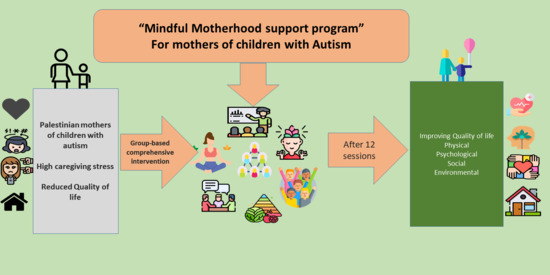
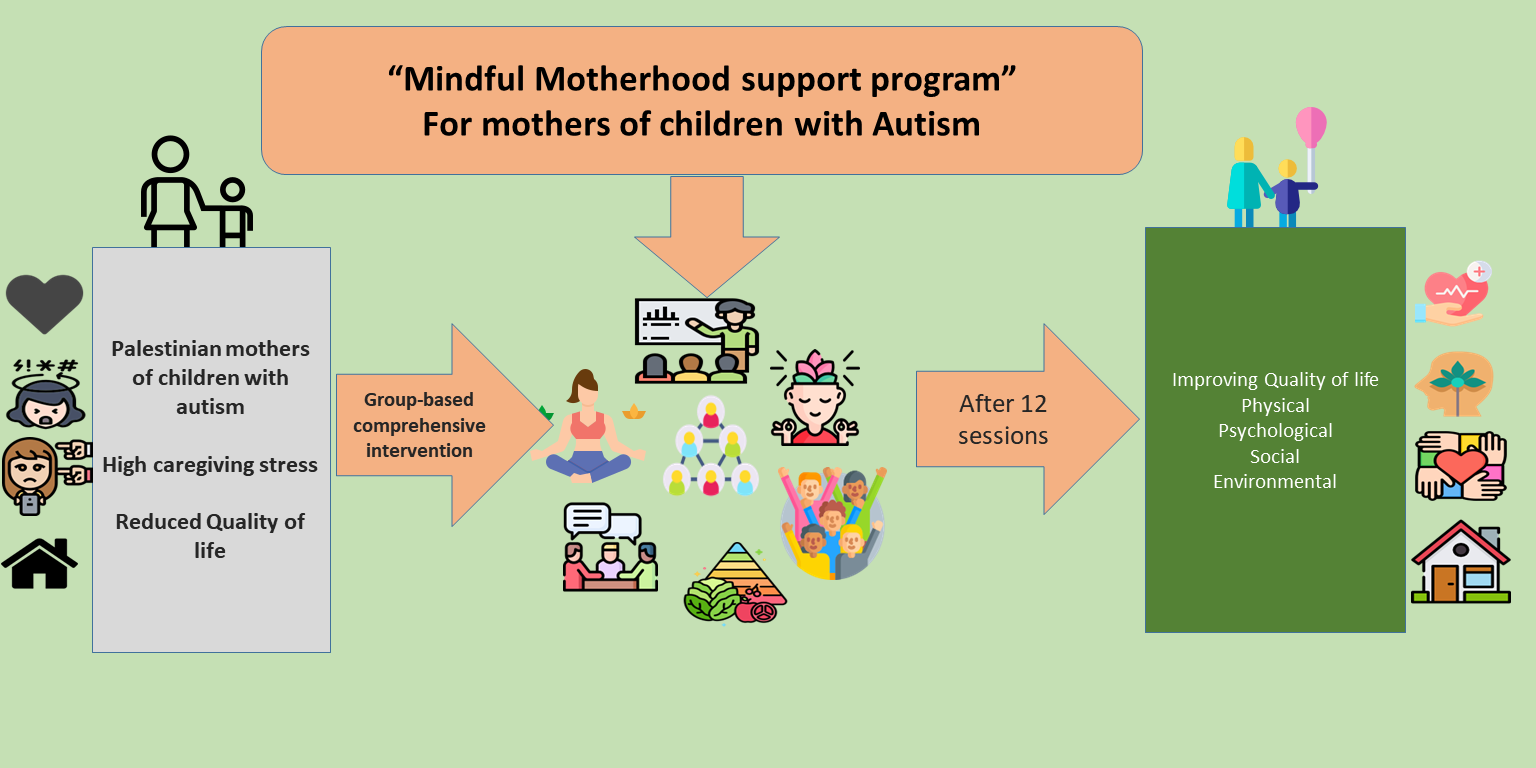
The Mindful Motherhood program is a structured, group-based support intervention designed to holistically support mothers of children with ASD. The program is sequenced into three progressive phases to mirror the natural caregiving journey. The initial foundation phase (Sessions 1–3) focuses on building a safe and trusting environment by providing education about ASD and validating common experiences of grief and loss, thereby guiding mothers toward acceptance. This foundational work is essential for engaging in the subsequent skill-building phase (Sessions 4–9), which empowers mothers by teaching practical, actionable skills in cognitive restructuring, self-care, boundary setting, communication, and stress management, moving beyond talk therapy to ensure tangible outcomes.
The final phase (Sessions 10–12) focuses on integration and future-oriented growth, helping mothers to cultivate a positive self-concept, manage future concerns, and instill a sense of hope for sustainable well-being. Throughout all phases, the program adopts a multi-dimensional approach, simultaneously addressing cognitive, emotional, behavioral, social, and physical aspects of the mothers’ lives. Furthermore, the group format itself is a key intervention component, actively building a vital peer support network to combat isolation. In essence, the program’s compassionate focus is not on changing the child with autism, but on strengthening the mother as the primary caregiver by equipping her with the emotional tools, practical skills, and social support necessary to navigate her challenges with greater resilience and well-being. Table A1 in Appendix A details all session agendas throughout the program. Ultimately, Mindful Motherhood aims to shift mothers from survival mode to empowered advocacy, fostering resilience that benefits both themselves and their children with ASD.
2.7. Statistical Analysis
Statistical analysis was performed using IBM SPSS Statistics, version 23, with a significance level set at p = 0.05. Descriptive statistics are used to summarize the data, including frequencies and percentages for categorical variables and means with standard deviations for continuous variables. The Shapiro–Wilk test was conducted to assess the normality of the data, which yielded a significant result (p = 0.025), thus indicating that the data were not normally distributed. Accordingly, nonparametric tests were used for subsequent analysis. Within-group comparisons of QoL scores were conducted using Wilcoxon Signed-Rank Tests. Between-group comparisons at three time points (pre-intervention, post-intervention, and six-month follow-up) were performed using the Mann–Whitney U test. Effect sizes for between-group comparisons were calculated using Cliff’s Delta (δ), with the following conventional thresholds applied: |δ| = 0.147 (small), 0.147–0.33 (medium), and ≥0.33 (large). Additionally, the Friedman test followed by the Wilcoxon sign test was applied to assess changes in QoL scores across the three time points within each group.
3. Results
3.1. Descriptive Analysis
Table 1 presents the sociodemographic characteristics of the study sample, divided by group (Experimental, n = 28; Control, n = 28). The majority (approximately 59%) were aged 30–39 years. In terms of education, 37.5% held a bachelor’s degree, followed by 30.1% with secondary school education or less. Geographically, 50.0% were from southern governorates, 26.8% from central governorates, and 23.2% from northern governorates. Regarding residence, 53.6% lived in cities, 41.1% in villages, and 5.4% in refugee camps.
Table 1.
Sociodemographic characteristics of the study sample (Experimental, n = 28; Control, n = 28).
Most participants (92.9%) were married, and 69.6% were unemployed. Additionally, the largest subgroup (37.5%) had three children under the age of three. The vast majority (92.9%) had one child diagnosed with autism. Monthly family income was reported as moderate by 58.9%, while 21.4% reported it as below or well below average. Regarding the diagnosis timeline, 60.7% indicated that less than two years passed between noticing developmental concerns and receiving an ASD diagnosis. Additionally, 55.4% stated that their child was diagnosed at age three or older, while 44.6% received the diagnosis before the age of three.
Table 2 presents the median and interquartile range (IQR) for QoL domains at baseline, post-intervention, and at the 6-month follow-up. The data reveal a clear divergent trend between the control and experimental groups. In the control group, median scores across all domains—namely, Physical, Environmental, Psychological, Social, and Overall QoL—demonstrated a slight decline or remained relatively stable from pre-intervention to the 6-month follow-up. In stark contrast, the experimental group showed a marked improvement immediately after the intervention, with substantially higher median scores post-intervention compared to their baseline. Notably, these gains in the experimental group were largely sustained at the 6-month follow-up, with scores remaining well above both their own baseline levels and the corresponding scores of the control group at the same time point. This pattern suggests a positive and persistent effect of the intervention on QoL outcomes.
Table 2.
Median and interquartile range for each QoL domain pre- post intervention and six months follow-up for experimental and control groups.
3.2. Between-Group Comparisons of Overall QoL and Its Domains
Table 3 shows the non-parametric test results. Mann–Whitney U tests were conducted to evaluate the differences in QoL domain scores between the experimental and control groups across three time points: pre-intervention, post-intervention, and at the 6-month follow-up. At baseline, there were no significant differences between the groups in any QoL domain (all Cliff’s Delta |δ| < 0.147, negligible effect sizes), indicating that the groups were equivalent before the intervention.
Table 3.
Between-group comparisons of overall QoL and its domains: Experimental vs. Control at Baseline (Pre-I), Post-Intervention (Post-I), and 6-Month Follow-up.
Following the intervention, the experimental group demonstrated statistically significant and large improvements compared to the control group across all four QoL domains and overall QoL at the post-test assessment (all p < 0.05; Physical: δ = −0.64; Environmental: δ = −0.66; Psychological: δ = −0.70; Social: δ = −0.47; Overall QoL: δ = −0.68). These substantial gains were largely maintained at the 6-month follow-up, with large effect sizes persisting for the physical (δ = −0.63), environmental (δ = −0.59), psychological (δ = −0.70), and overall QoL (δ = −0.68) domains. Although the social domain showed a sustained improvement, the effect size decreased from large to medium (δ = −0.34).
3.3. Within-Group Changes in Quality-of-Life Scores from Baseline to Post-Intervention and 6-Month Follow-Up
To analyze changes over time within each group, Friedman tests were conducted for each QoL domain, followed by Wilcoxon signed-rank post hoc tests as shown in Table 4.
Table 4.
Friedman tests followed by Wilcoxon post-hoc analyses.
The experimental group showed a significant overall change in physical scores over time (p = 0.005), with a highly significant improvement immediately after the intervention (p < 0.001). This improvement was maintained at the 6-month follow-up and remained significant in comparison to baseline (p = 0.015). No significant change was observed between the end of the intervention and the 6-month mark, indicating a stable improvement. There was no significant change in physical domain in the control group.
In the psychological domain, there was a significant overall change in the experimental group (p < 0.001), with the most significant improvement between before and after the intervention (p < 0.001). Although the improvement was still statistically significant at six months, there was a trend towards a decline (p = 0.043). In contrast, the control group showed no significant change over time in this domain.
Although the overall test for the environmental domain was not significant (p = 0.120), the Pre vs. Post difference in the experimental group was significant (p = 0.004); meanwhile, the control group showed no significant difference. In addition, a significant improvement in social outcomes was observed in the experimental group (p = 0.41), with a significant improvement observed between the pre- and post-intervention timepoints (p = 0.017). However, this improvement did not persist at six months. There was no significant difference in the control group between all three time points.
The results demonstrate a significant change in the overall QoL (total score) in the experimental group (p < 0.001), with a large and immediate improvement between the pre- and post-intervention timepoints (p < 0.001). However, a marginal or borderline significant decline from the post-intervention peak to the 6-month follow-up was observed, indicating that some of the peak benefits were not fully maintained. In contrast, the control group showed no significant change over time, as per the Friedman analysis.
4. Discussion
This study examined the effectiveness of the Mindful Motherhood intervention among mothers of children with ASD in Palestine. The post-test QoL scores for the experimental group increased significantly, with the most significant improvement in psychological and overall QoL domains, while those for the control group remained stable or showed slight declines. These results are consistent with the findings of a study conducted in Jordan—which is similar to the Palestinian context—demonstrating the effectiveness of structured support interventions in improving QoL among parents of children with ASD [25]. The significant improvement in QoL could be attributed to the nature of the program, as a comprehensive and holistic intervention that addresses the multifaceted areas of QoL. The findings are further supported by another study reporting that parents of children with ASD need ongoing support for their physical, psychological, social, and environmental health, which can improve families’ quality of life and ability to address behavioral difficulties [40,41].
By acquiring knowledge, engaging in psychoeducation, enhancing their skills, and developing practices, mothers can formulate coping strategies and transition from emotional distress to fostering hope and empowerment within a group setting [42]. This environment promotes teamwork and interaction, enabling them to cultivate a sense of value within a supportive social context, thus enhancing overall satisfaction and well-being in a therapeutic manner.
At the six-month follow-up evaluation, the intervention’s effectiveness remained significant, with most gains maintained—particularly those in the psychological and overall QoL domains. The effect size remained high, indicating improvement in QoL over time. However, there was some decline in the social and environment domains, suggesting the need for further support to achieve sustained improvements.
The most substantial enhancements were observed in the psychological realm. Initial sessions focused on assisting mothers in accepting their child’s diagnosis and processing grief. Research findings have indicated that Acceptance and Commitment Therapy (ACT) enhances psychological flexibility and alleviates stress, with parents adhering to the ACT protocol reporting notable improvements in psychological flexibility, emotional states, personal values in daily life, and a reduction in parental stress and distress regarding their children’s behaviors [43,44]. Subsequent sessions used cognitive restructuring strategies—a crucial element of cognitive-behavioral therapy (CBT) models—which focus on altering negative thought patterns to alleviate emotional distress. These findings align with recent research examining the efficacy of group counseling rooted in psychoeducation and cognitive behavioral therapy (CBT) in alleviating depression among mothers of children with ASD [45,46,47].
The intervention produced a short-term improvement in social outcomes that disappeared by the 6-month follow-up. Group-based interventions improved social domains and reduced feelings of isolation in mothers by creating social support networks facilitated by peers. These networks provide emotional strength, shared problem-solving, and long-term social bonds, enabling mothers to implement strategies in real life contexts [48]. The program also strengthened family relationships through modules on communication, boundary-setting, and culturally sensitive parenting strategies, leading to better balance between caregiving and personal needs.
The study underscores the significance of social support in alleviating caregiver stress and enhancing mother–child relationships through varied participation. This finding aligns with Rayan & Ahmad (2016) [39], who indicated that scores in the health domain of social relationships were significantly improved following a mindfulness-based intervention, resulting from the non-judgmental acceptance of the child’s condition, while Rezq et al. highlighted the importance of social support in improving mothers’ QoL who are raising children with ASD [39,49].
The impact on the environmental domain was tenuous and inconsistent. A transient effect may have occurred, but it lacked robustness and sustainability. Despite the intervention’s emphasis on imparting practical knowledge regarding ASD, problem-solving skills, advocacy for children’s needs, self-care, boundary-setting, and strategies for fostering more manageable and supportive home environments, the enhancement in this area was not substantial. This finding aligns with a previous study indicating that parents of children with ASD remain unsatisfied with various aspects of the environmental domain, including income, housing circumstances, and healthcare services for their children [39].
Furthermore, maintaining hope is very important. Snyder’s concept of hope is a cognitive behavioral structure with three main components: Goals, agency, and pathways. Success generates positive emotions, while failure leads to negative emotions. Hopeless individuals perceive themselves to have less agency and pathways, causing depression and other negative impacts in mothers with autistic children [50,51]. The most commonly suggested helpful method for parents of children with ASD is to learn how to cope and solve problems. Training parents in this way can lead to healthier children, as it helps to better organize their environment, expand their problem-solving skills, and improve the ability to cope with their situation [52,53].
Ultimately, the Mindful Motherhood program appeared to initiate a positive feedback loop in the lives of participants. By first addressing psychological acceptance and distress, then equipping mothers with practical tools for coping, communication, and self-care, the intervention enabled them to reframe their challenges and make meaningful improvements across all QoL domains. This transformation from surviving to thriving underscores the power of well-designed, culturally sensitive, and group-based psychosocial interventions.
Several limitations of this study should be acknowledged. The use of a quasi-experimental design with non-random assignment, while pragmatic, introduced potential for selection bias. Furthermore, the reliance on self-reported measures for the primary outcome may have led to social desirability bias. The use of purposive sampling also limits the generalizability of the findings to all Palestinian mothers of children with ASD. Future research would benefit from a randomized controlled trial design incorporating more objective biomarkers of stress and well-being.
5. Conclusions
Initiatives designed to alleviate stress and enhance the welfare of caregivers of children with ASD provide beneficial results for caregivers and, consequently, for the children themselves. Such an intervention must be a comprehensive procedure that benefits and attends to every family member.
The Mindful Motherhood program was found to be highly effective in improving various QoL domains for mothers of children with ASD, addressing physical, psychological, social, and environmental needs through structured sessions and peer support, helping mothers to transition from crisis management to proactive coping. The peer support component fosters long-term resilience and social connections. Future implementations should consider scaling the program through telehealth and training community health workers, ensuring accessibility in low-resource settings. Local health and education authorities could integrate the Mindful Motherhood curriculum into existing community health centers or parent support networks. Training experienced social workers and special education teachers to be “master trainers” could facilitate the studied intervention’s wider dissemination. Additionally, adapting the program to a hybrid or fully telehealth format could overcome geographical barriers and increase accessibility for mothers in remote villages, ensuring a more family-centered approach to ASD care across Palestine.
Author Contributions
Conceptualization, B.A.-N. and A.I.; data curation, B.A.-N.; formal analysis, B.A.-N.; investigation, B.A.-N. and A.I.; methodology, B.A.-N. and A.I.; supervision, A.I.; validation, A.I.; writing—original draft, B.A.-N.; writing—review and editing, B.A.-N. and A.I. All authors have read and agreed to the published version of the manuscript.
Funding
This research was supported by the Palestinian American Research Center (PARC) through a grant of $3500, with an additional $1000 awarded upon submission of the final report.
Institutional Review Board Statement
The study was approved by the Research Ethical Review Committee at Al-Quds University, Palestine (REF. 11/24, dated 19 February 2024). Informed consent was obtained from all individual participants included in the study.
Informed Consent Statement
Informed consent was obtained from all subjects involved in the study.
Data Availability Statement
The data that support the findings of this study are available on request from the corresponding author on reasonable request at besho.natsheh@gmail.com.
Acknowledgments
The authors would like to express their gratitude to all participants in this study.
Conflicts of Interest
The authors have no competing interests to declare.
Abbreviations
The following abbreviations are used in this manuscript:
| ASD | Autism Spectrum Disorder |
| QoL | Quality of Life |
Appendix A

Table A1.
Session agendas for the Mindful Motherhood support program.
Table A1.
Session agendas for the Mindful Motherhood support program.
| Session and Title | Agenda |
|---|---|
| Preparatory session |
|
| Session One Introduction and education about autism |
|
| Session two Common responses and the process of loss and grief |
|
| Session Three Acceptance |
|
| Session Four The Cognitive model and ASD: Cognitive restructuring for acceptance and coping |
|
Session Five
|
|
| Session Six Establishing healthy boundaries for maternal well-being |
|
Session Seven
|
|
| Session Eight Coping and support |
|
| Session Nine Problem-solving and relaxation |
|
| Session Ten Positive self-concept and outlook on life |
|
| Session Eleven The future and adopting a better outlook on life |
|
| Session Twelve Instilling hope and closure |
|
References
- American Psychiatric Association. Diagnostic and Statistical Manual of Mental Disorders, 5th ed.; DSM-5; American Psychiatric Publishing: Washington, DC, USA, 2013. [Google Scholar]
- Reddy, G.; Fewster, D.L.; Gurayah, T. PARENTS’ VOICES: Experiences and Coping as a Parent of a Child with Autism Spectrum Disorder. S. Afr. J. Occup. Ther. 2019, 49, 43–50. [Google Scholar] [CrossRef]
- Yaacob, W.N.W.; Yaacob, L.H.; Zulkifli, M.M.; Muhamad, R. A Journey towards Resilience: Coping Strategies Adopted by Parents with Children Having Autism Spectrum Disorder in Northeast Malaysia. Int. J. Environ. Res. Public Health 2022, 19, 2458. [Google Scholar] [CrossRef] [PubMed]
- DesChamps, T.D.; Ibañez, L.V.; Edmunds, S.R.; Dick, C.C.; Stone, W.L. Parenting Stress in Caregivers of Young Children with ASD Concerns Prior to a Formal Diagnosis. Autism Res. 2020, 13, 82–92. [Google Scholar] [CrossRef]
- Kara, K.; Kara, O.K.; Sutcu, G.; Tonak, H.A. The Relationship Between Fatigue and Quality of Life in the Turkish Mothers of Children with Autism Spectrum Disorder. J. Autism Dev. Disord. 2025, 55, 2696–2705. [Google Scholar] [CrossRef] [PubMed]
- Shattnawi, K.K.; Bani Saeed, W.M.; Al-Natour, A.; Al-Hammouri, M.M.; Al-Azzam, M.; Joseph, R.A. Parenting a Child with Autism Spectrum Disorder: Perspective of Jordanian Mothers. J. Transcult. Nurs. 2021, 32, 474–483. [Google Scholar] [CrossRef]
- Cloete, L.G.; Obaigwa, E.O. Lived Experiences of Caregivers of Children with Autism Spectrum Disorder in Kenya. Afr. J. Disabil. 2019, 8, 1–9. [Google Scholar] [CrossRef]
- Ilias, K.; Liaw, J.H.J.; Cornish, K.; Park, M.S.A.; Golden, K.J. Wellbeing of Mothers of Children with “A-U-T-I-S-M” in Malaysia: An Interpretative Phenomenological Analysis Study. J. Intell. Dev. Disabil. 2017, 42, 74–89. [Google Scholar] [CrossRef]
- Papadopoulos, D. Mothers’ Experiences and Challenges Raising a Child with Autism Spectrum Disorder: A Qualitative Study. Brain Sci. 2021, 11, 309. [Google Scholar] [CrossRef] [PubMed]
- Bramhe, V. Depression and Anxiety in Mothers of Children with Autism Spectrum Disorders and Intellectual Disabilities. Indian J. Ment. Health 2019, 6, 272. [Google Scholar] [CrossRef]
- Dardas, L.A.; Ahmad, M.M. Predictors of Quality of Life for Fathers and Mothers of Children with Autistic Disorder. Res. Dev. Disabil. 2014, 35, 1326–1333. [Google Scholar] [CrossRef]
- Dardas, L.A.; Ahmad, M.M. Coping Strategies as Mediators and Moderators between Stress and Quality of Life among Parents of Children with Autistic Disorder. Stress Health 2015, 31, 5–12. [Google Scholar] [CrossRef] [PubMed]
- Abu-Ras, W.; Birani, A. Psychological Stressors Among Palestinian Parents of Children with Disabilities: Challenges, Coping, and Determination. J. Fam. Issues 2018, 39, 2757–2780. [Google Scholar] [CrossRef]
- Shawahna, R.; Jaber, M.; Yahya, N.; Jawadeh, F.; Rawajbeh, S. Are Medical Students in Palestine Adequately Trained to Care for Individuals with Autism Spectrum Disorders? A Multicenter Cross-Sectional Study of Their Familiarity, Knowledge, Confidence, and Willingness to Learn. BMC Med. Educ. 2021, 21, 1–13. [Google Scholar] [CrossRef] [PubMed]
- Vasilopoulou, E.; Nisbet, J. The Quality of Life of Parents of Children with Autism Spectrum Disorder: A Systematic Review. Res. Autism Spectr. Disord. 2016, 23, 36–49. [Google Scholar] [CrossRef]
- Karlov, L.; John, J.R.; Beneytez, C.; Grimes, P.Z.; Kang, Y.Q.; Mardare, I.; Minca, D.G.; Voicu, L.; Volgyesi-molnar, M. Quality of Life in Parents of Autistic Children: A Transcultural Perspective. Front. Psychol. 2023, 14, 1022094. [Google Scholar] [CrossRef]
- WHO. WHOQOL-BREF: Introduction, Administration, Scoring and Generic Version of the Assessment: Field Trial Version, December; World Health Organization: Geneva, Switzerland, 1996; pp. 1–16.
- Seymour, M.; Wood, C.; Giallo, R.; Jellett, R. Fatigue, Stress and Coping in Mothers of Children with an Autism Spectrum Disorder. J. Autism Dev. Disord. 2013, 43, 1547–1554. [Google Scholar] [CrossRef]
- Fante, C.; De Luca Picione, R.; Barbara, P.; Manari, T.; Raffin, C.; Capelli, F. Parental Quality of Life and Impact of Multidisciplinary Intervention for Children with Autism Spectrum Disorders: A Qualitative Study. J. Autism Dev. Disord. 2023, 55, 310–322. [Google Scholar] [CrossRef]
- Singh, N.N.; Lancioni, G.E.; Winton, A.S.W.; Karazsia, B.T.; Myers, R.E.; Latham, L.L.; Singh, J. Mindfulness-Based Positive Behavior Support (MBPBS) for Mothers of Adolescents with Autism Spectrum Disorder: Effects on Adolescents’ Behavior and Parental Stress. Mindfulness 2014, 5, 646–657. [Google Scholar] [CrossRef]
- Marino, F.; Failla, C.; Chilà, P.; Minutoli, R.; Puglisi, A.; Arnao, A.A.; Pignolo, L.; Presti, G.; Pergolizzi, F.; Moderato, P.; et al. The Effect of Acceptance and Commitment Therapy for Improving Psychological Well-being in Parents of Individuals with Autism Spectrum Disorders: A Randomized Controlled Trial. Brain Sci. 2021, 11, 880. [Google Scholar] [CrossRef]
- Catalano, D.; Holloway, L.; Mpofu, E. Mental Health Interventions for Parent Carers of Children with Autistic Spectrum Disorder: Practice Guidelines from a Critical Interpretive Synthesis (CIS) Systematic Review. Int. J. Environ. Res. Public Health 2018, 15, 341. [Google Scholar] [CrossRef]
- Abdelaziz, E.M.; Alsadaan, N.; Alqahtani, M.; Elsharkawy, N.B.; Ouda, M.M.A.; Ramadan, O.M.E.; Shaban, M.; Shokre, E.S. Effectiveness of Cognitive Behavioral Therapy (CBT) on Psychological Distress among Mothers of Children with Autism Spectrum Disorder: The Role of Problem-Solving Appraisal. Behav. Sci. 2024, 14, 46. [Google Scholar] [CrossRef]
- Ulu, A.E.; Karacasu, G. Burnout, Anxiety and Coping Attitudes in Parents of Children with Autism Spectrum Disorder. Int. J. Disabil. Sport. Health Sci. 2022, 5, 122–135. [Google Scholar] [CrossRef]
- Al-Masa’deh, M.M.; Younis, N.A.; Al-Zoud, N.S.; Homidi, M.A.; Rahahleh, Z.J. The Effectiveness of Counseling Programs in Enhancing Quality of Life for Families of Children With Autism Spectrum Disorder in Jordan. Humanit. Soc. Sci. Lett. 2022, 10, 75–87. [Google Scholar] [CrossRef]
- Hajat, C.; Stein, E. The Global Burden of Multiple Chronic Conditions: A Narrative Review. Prev. Med. Rep. 2018, 12, 284–293. [Google Scholar] [CrossRef]
- Kasem, A.; Abuhammad, S.; Jamal, N. Parents of Children with Autism Spectrum Disorder Quality of Life in Jordan: A Comparative Study. Futur. Sci. OA 2024, 10, FSO909. [Google Scholar] [CrossRef]
- Alkhateeb, J.M.; Hadidi, M.S.; Mounzer, W. The Impact of Autism Spectrum Disorder on Parents in Arab Countries: A Systematic Literature Review. Front. Psychol. 2022, 13, 955442. [Google Scholar] [CrossRef] [PubMed]
- Alallawi, B.; Hastings, R.P.; Gray, G. A Systematic Scoping Review of Social, Educational, and Psychological Research on Individuals with Autism Spectrum Disorder and Their Family Members in Arab Countries and Cultures. Rev. J. Autism Dev. Disord. 2020, 7, 364–382. [Google Scholar] [CrossRef]
- Assaf, M.; Al-Hayeh, H. Family Culture in Dealing with Children with Autism Spectrum Disorder (Analytical Study). J. Educ. Sci. 2024, 8, 534–546. [Google Scholar]
- Qaddan, E. Investigating the Coping Strategies and the Needs of Parents of Children with ASD Applied During Confrontation with Community Stigma in the West Bank. Master’s Thesis, Arab American University, Jenin, Palestine, 2025. [Google Scholar]
- Muhsen, W.N.H. Exploring Mental Health Status and Occupational Balance among Palestinian Mothers of Children with Autism Spectrum Disorder (ASD): A Cross Sectional Study. Master’s Thesis, Arab American University, Jenin, Palestine, 2024. [Google Scholar]
- Capili, B.; Anastasi, J.K. An Introduction to the Quasi-Experimental Design (Nonrandomized Design). Am. J. Nurs. 2025, 124, 50–52. [Google Scholar] [CrossRef]
- Kousha, M.; Eslamdoust-siahestalkhi, F.; Rafieian, S.; Shoar, Y. Effectiveness of Supportive and Educational Group Therapy on Mental Health Improvement of Mothers of Children with Autism Spectrum Disorder. SRPH J. Med. Sci. Healthc. Manag. 2021, 3, 1–6. [Google Scholar] [CrossRef]
- Ndata, C.W.; Studies, G.; Elechi, C.; Polytechnic, A.; Harcourt, P.; Ineme, M.E.; Umoh, D.I. Improving Quality of Life among Primary Caregivers of Children with Autism Spectrum Disorder: The Efficacy of Psychoeducation. Int. J. Psychother. Afr. 2025, 10, 89–101. [Google Scholar]
- Erdfelder, E. G* Power 3: A Flexible Statistical Power Analysis Program for the Social, Behavioral, and Biomedical Sciences. Behav. Res. Methods 2007, 39, 175–191. [Google Scholar]
- Han, J.W.; Park, J.; Lee, H. Analysis of the Effect of an Artificial Intelligence Chatbot Educational Program on Non-Face-to-Face Classes: A Quasi-Experimental Study. BMC Med. Educ. 2022, 22, 1–10. [Google Scholar] [CrossRef] [PubMed]
- WHO; Whoqol Group. The World Health Organization Quality of Life Assessment (WHOQOL): Position Paper from the World Health Organization. Soc. Sci. Med. 1995, 41, 1403–1409. [Google Scholar] [CrossRef]
- Rayan, A.; Ahmad, M. Effectiveness of Mindfulness-Based Interventions on Quality of Life and Positive Reappraisal Coping among Parents of Children with Autism Spectrum Disorder. Res. Dev. Disabil. 2016, 55, 185–196. [Google Scholar] [CrossRef] [PubMed]
- Frantz, R.; Hansen, S.G.; Machalicek, W. Interventions to Promote Well-Being in Parents of Children with Autism: A Systematic Review. Rev. J. Autism Dev. Disord. 2018, 5, 58–77. [Google Scholar] [CrossRef]
- Wang, R.; Liu, Q.; Zhang, W. Coping, Social Support, and Family Quality of Life for Caregivers of Individuals with Autism: Meta-Analytic Structural Equation Modeling. Pers. Individ. Dif. 2022, 186, 111351. [Google Scholar] [CrossRef]
- Mhango, W.; Crowter, L.; Michelson, D.; Gaysina, D. Psychoeducation as an Active Ingredient for Interventions for Perinatal Depression and Anxiety in Youth: A Mixed-Method Systematic Literature Review and Lived Experience Synthesis. BJPsych Open 2023, 10, e10. [Google Scholar] [CrossRef]
- Ryan, C. Everyday Resilience as Resistance: Palestinian Women Practicing Sumud. Int. Polit. Sociol. 2015, 9, 299–315. [Google Scholar] [CrossRef]
- Panahpouri, S. Effectiveness of Acceptance and Commitment-Based Therapy on Psychological Flexibility and Resilience in Mothers of Children with Autism Spectrum Disorders. J. Health Sci. Surveill. Syst. 2022, 10, 434–438. [Google Scholar]
- Cachia, R.L.; Anderson, A.; Moore, D.W. Mindfulness, Stress and Well-Being in Parents of Children with Autism Spectrum Disorder: A Systematic Review. J. Child Fam. Stud. 2016, 25, 1–14. [Google Scholar] [CrossRef]
- Zaki, R.A.; Moawad, G.E.N.A. Influence of Autism Awareness on the Psychological Well-Being of Mothers Caring for Their Children with Autism. J. Nurs. Educ. Pract. 2016, 6, 90–100. [Google Scholar] [CrossRef]
- Wolgensinger, L. Cognitive Behavioral Group Therapy for Anxiety: Recent Developments. Dialogues Clin. Neurosci. 2015, 17, 347–351. [Google Scholar] [CrossRef] [PubMed]
- Paynter, J.; Gilmore, L. Social Support and Coping Strategies of Parents Raising a Child with Autism Spectrum. Early Child Dev. Care 2021, 188, 1392–1404. [Google Scholar]
- Rezq, K.A.; Albalawi, H.M.H.; Alharbi, H.F. Exploring Social Support and Quality of Life Among Mothers of Children with Autism Spectrum Disorders: A Cross-Sectional Study. Healthcare 2025, 13, 95. [Google Scholar] [CrossRef] [PubMed]
- Snyder, C.R. (Ed.) Hand Book of Hope; Academic Press: New York, NY, USA, 2000. [Google Scholar]
- Rasheed, A. Hope, Quality of Life, and Self-Efficacy among Mothers with Special Needs Children. Inspira Indones. J. Psychol. Res. 2022, 3, 1–7. [Google Scholar] [CrossRef]
- Navroodi, S.O.S.; Nicknam, M.; Ahmadi, A.; Roodbarde, F.P.; Azami, S. Examining the Effectiveness of Group Positive Parenting Training on Increasing Hope and Life Satisfaction in Mothers of Children with Autism. Iran. J. Psychiatry 2018, 13, 129–135. [Google Scholar]
- Zhou, T.; Luo, Y.; Xiong, W.; Meng, Z.; Zhang, H.; Zhang, J. Problem-Solving Skills Training for Parents of Children With Chronic Health Conditions: A Systematic Review and Meta-Analysis. JAMA Pediatr. 2024, 178, 226–236. [Google Scholar] [CrossRef]
Disclaimer/Publisher’s Note: The statements, opinions and data contained in all publications are solely those of the individual author(s) and contributor(s) and not of MDPI and/or the editor(s). MDPI and/or the editor(s) disclaim responsibility for any injury to people or property resulting from any ideas, methods, instructions or products referred to in the content. |
© 2025 by the authors. Licensee MDPI, Basel, Switzerland. This article is an open access article distributed under the terms and conditions of the Creative Commons Attribution (CC BY) license.