
You are currently on the new version of our website. Access the old version .
  • 44 days
    Time to First Decision

International Journal of Cognitive Sciences

International Journal of Cognitive Sciences is an international, peer-reviewed, open access journal on theoretical or experimental studies related to the interdisciplinary study of cognition published quarterly online by MDPI.

All Articles (6)

Background: Studies on the association between cognitive dysfunction and criminality have shown that individuals in prison, particularly repeat offenders and those convicted of violent crimes, tend to exhibit difficulties in cognitive, social, and emotional functioning. The objective of this study was to evaluate and characterize cognitive and executive functioning of incarcerated individuals, while also seeking to understand the impact of incarceration on executive functions. Methods: The sample consisted of 30 participants at various stages of their sentences. Neuropsychological assessments were conducted using cognitive screening tests and tests directed to assess executive functions and decision making. Results: Neurocognitive performance was within normative ranges. Selective associations between sentence duration and specific executive functions were observed, suggesting a relationship with criminal severity indicators. Decision-making also appeared impaired, as no evidence of learning was found and deck selection focused on more disadvantageous decks. Conclusions: These findings a relationship between indicators of criminal severity and specific aspects of executive functioning and decision making, rather than a generalized cognitive impairment. However, these conclusions require further research under this topic in larger and more diverse samples.

8 January 2026
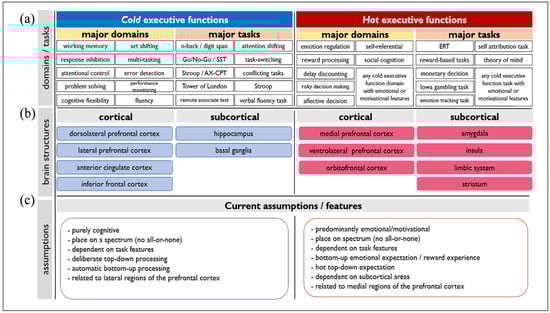
Current knowledge about domains and behavioral tasks of executive functions (a), involved brain structures (b) and underlying assumptions/features (c) of hot versus cold executive functions. SST: stop signal task; AX-CPT: AX Continuous Performance Task; ERT: emotional regulation task. Note: Reprinted from “Hot and cold executive functions in the brain: A prefrontal–cingular network,” by (Salehinejad et al., 2021, p. 2).

Numerous attempts to define art have been made from antiquity to the present, yet historical overviews often adopt a Eurocentric (and American-centric) perspective focused mainly on culturally dependent aesthetic approaches. As a universal social and cultural phenomenon, art resists center-periphery models. The cognitive turn reshaped art theory by reconsidering art as a cognitive dimension of humanity. Art has no limits on who can create or enjoy it. The ability to use and understand metaphor, for instance, demonstrates everyday human artistic cognition. The analysis relies on both field research (case studies) and academic literature; it argues for a revised theoretical frame for defining art and organizes it into a dynamic model of three main vectors: (1) art as communication (including art as agency); (2) art as creation; and (3) art as experience (involving both audience and artist). The model can incorporate the study of emotions into the third criterion while remaining open to both materialist and non-materialist approaches. Rather than offering a new definition, the study integrates the perspective of cognitive anthropology, cognitive semantics, and the anthropology of art in order to broaden understanding. Instead of searching for special aesthetic or economic values, these three dimensions of art appear more universal. A pragmatic analysis of how art “works” in individuals and groups provides a useful model for cognitive sciences. Instead of binary codes, it is a vectorial model, a 3D space for expressing family resemblance, since there is no common denominator (prototype) for all kinds of art.

31 December 2025

Multidimensional (3D), model of art is based on the three universal vectors: creativity, communication, and experience. (It also shows an example of an exact artwork as a ball within the abstract space of the model).

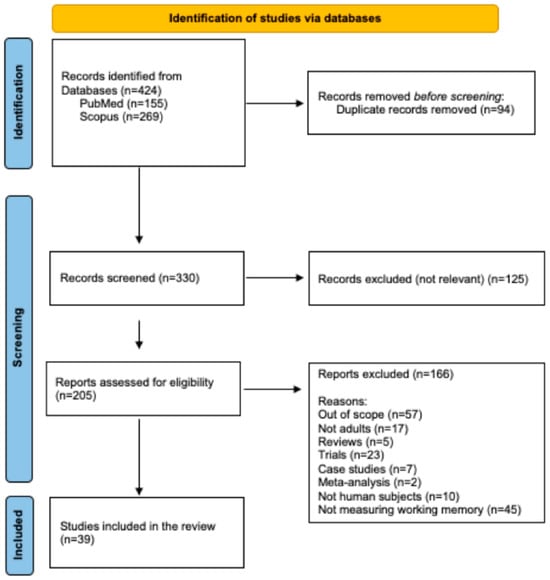
Post-Traumatic Stress Disorder (PTSD) is consistently linked to multidimensional working memory (WM) impairments, encompassing deficits in sustained attention, verbal and visuospatial processing, and executive control, with inhibitory dysfunction emerging as a key feature. This scoping review synthesizes evidence from 39 studies examining neurobiological mechanisms, trauma-related factors, genetic and hormonal influences, gender differences, and task-specific variability. Findings indicated that PTSD is associated with altered activation and connectivity in the prefrontal cortex, hippocampus, and related neural networks, often resulting in compensatory but inefficient recruitment patterns. Emotional distraction and comorbidities such as depression, alcohol use, and traumatic brain injury can exacerbate cognitive deficits. Performance impairments are evident across both emotional and neutral WM tasks, with visuospatial and updating processes being particularly vulnerable. Risk factors include chronic trauma exposure, older age, APOE ε4 allele, and the BDNF Val66Met (rs6265) polymorphism, while modulators such as oxytocin, cortisol, and physical activity show potential cognitive benefits under specific conditions. Methodological heterogeneity and limited longitudinal data restrict generalizability. These findings underscore the importance of early screening, targeted cognitive interventions, and inclusion of underrepresented populations to refine prevention and treatment strategies for PTSD-related WM deficits.

16 December 2025

Study flow diagram.

The Illusion of Political Independence

  • Gavriel Knafo and
  • Joel Weinberger

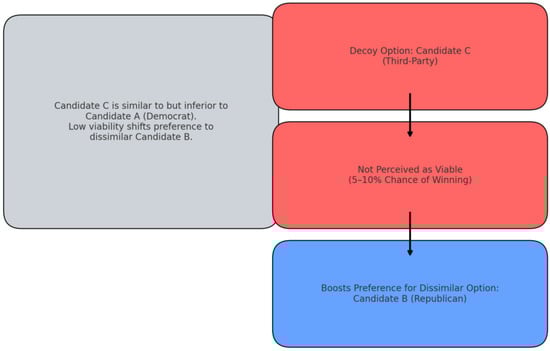
This study discusses the asymmetric dominance effect in the context of political elections with third-party candidates. Animal and human research both show that the addition or removal of a third option influences choices between the remaining two options. The direction of sway created by the addition/removal of the 3rd option is context-dependent and unconsciously regulated. The results confirmed our hypotheses that both the timing and perceived viability of third-party candidates significantly influence voter preferences, with the strongest effects observed when third-party candidates remain present through election day. These findings suggest that the impact of third-party candidates extends beyond simple vote-splitting and is at least partly unconscious, though direct implicit measures were not employed. This study is situated in the context of U.S. presidential elections and focuses on moderate voters.

4 December 2025

Visual Representation of H1.

News & Conferences

Issues

Open for Submission

Editor's Choice

Get Alerted

Add your email address to receive forthcoming issues of this journal.

XFacebookLinkedIn
Int. J. Cogn. Sci. - ISSN 3042-8084