Article

Cognitive Dysfunction and Criminal Behavior: Investigating Executive Functions in Convicted Individuals

1
School of Psychology and Health Sciences, University Lusófona, Campo Grande 376, 1749-024 Lisboa, Portugal
2
HEI-Lab: Digital Human-Environment Interaction Labs, Lusófona University, Campo Grande 376, 1749-024 Lisboa, Portugal
3
William James Center for Research, Department of Education and Psychology, University of Aveiro, 3810-193 Aveiro, Portugal
*
Author to whom correspondence should be addressed.
Int. J. Cogn. Sci. 2026, 2(1), 2; https://doi.org/10.3390/ijcs2010002
Submission received: 21 October 2025 / Revised: 31 December 2025 / Accepted: 5 January 2026 / Published: 8 January 2026

Abstract

Background: Studies on the association between cognitive dysfunction and criminality have shown that individuals in prison, particularly repeat offenders and those convicted of violent crimes, tend to exhibit difficulties in cognitive, social, and emotional functioning. The objective of this study was to evaluate and characterize cognitive and executive functioning of incarcerated individuals, while also seeking to understand the impact of incarceration on executive functions. Methods: The sample consisted of 30 participants at various stages of their sentences. Neuropsychological assessments were conducted using cognitive screening tests and tests directed to assess executive functions and decision making. Results: Neurocognitive performance was within normative ranges. Selective associations between sentence duration and specific executive functions were observed, suggesting a relationship with criminal severity indicators. Decision-making also appeared impaired, as no evidence of learning was found and deck selection focused on more disadvantageous decks. Conclusions: These findings a relationship between indicators of criminal severity and specific aspects of executive functioning and decision making, rather than a generalized cognitive impairment. However, these conclusions require further research under this topic in larger and more diverse samples.

1. Introduction

In 2022, Portugal had a total of 12.383 convicted individuals, out of which 9.913 were serving prison sentences. Crimes against people accounted for the highest number of convictions resulting in imprisonment, with 3.063 people, followed by crimes against property with 2.394 people (Direção Geral de Reinserção e Serviços Prisionais, 2022a, 2022b). According to data from the Organization for Economic Cooperation and Development (Organização para a Cooperação e Desenvolvimento Económico, 2020), as of May 2020, Portugal ranked 15th in terms of imprisonment rates. The country had 124 imprisoned individuals per 100.000 inhabitants.
Crime represents not only a threat to security but also imposes a substantial financial burden on society across various dimensions, including social, economic, legal, and political aspects (Cruz et al., 2020). Specifically, it incurs significant costs for funding prisons, law enforcement, and security systems (Burgess, 2020). Globally, the prison population has surpassed 10 million, with an approximate 20% increase since the year 2000. This rise could be attributed to criminal recidivism (Balafoutas et al., 2020), which ranges from 35% to 67% in several countries (Meijers et al., 2015). Although defining what constitutes criminal recidivism poses certain difficulties, it can generally be understood as a relapse into criminal behavior that may result in a new conviction and/or imprisonment. Contrary to the recorded global crime rates, it seems that the rate of criminal recidivism has not decreased in recent years (Fazel & Wolf, 2015).
The concept of crime can be defined as “the intentional practice of an act considered socially harmful or dangerous and specifically defined, prohibited, and punishable under criminal law” (Thomas et al., 2020, p. 1). Criminal behavior is a complex phenomenon, both in a social and clinical context and presents a constant challenge in society. It requires an integrative and multidisciplinary approach based on the heterogeneity of criminal acts and individual’ behavior (Broomhall, 2005; Cruz et al., 2020; Reddy et al., 2018; Sullivan, 2019). Factors such as emotional stress, low socioeconomic status, educational and cultural background, peer groups, living in socially disadvantaged contexts, substance use, physical and sexual abuse, prenatal complications, parental dynamics, genetic predisposition, and brain damage can serve as predictors of aggressive and violent behavior (Braga et al., 2017; Broomhall, 2005; Brower & Price, 2001; Cruz et al., 2020; Derzon, 2010; Stanley & Goddard, 2004).
Antisocial behavior is analyzed based on clinical and legal concepts. The clinical perspective involves the use of diagnostic criteria defined in the DSM-5 (American Psychiatric Association, 2014), which categorizes the behavior under personality disorders. The overall manifestation of this disorder includes contempt and violation of others’ rights, irresponsible behavior, lack of respect for others, inappropriate behavior that is difficult to control, and an inability to conform and adapt to social norms. Typically, it begins in childhood and persists into adulthood (American Psychiatric Association, 2014; Morgan & Lilienfeld, 2000; Ogilvie et al., 2011). On the other hand, the legal perspective examines criminality and delinquency as unlawful actions that may result in imprisonment (Morgan & Lilienfeld, 2000; Ogilvie et al., 2011).
Executive functions which comprise a set of higher-order cognitive functioning seem to play a major role in engaging in antisocial, aggressive, and/or violent behavior (Altikriti, 2020; Griffith et al., 2024; Morgan & Lilienfeld, 2000; Ogilvie et al., 2011). Executive dysfunction, commonly associated with damage to the frontal lobes, is characterized by maladaptive and inappropriate behavior, along with personality changes (Griffith et al., 2024; Morgan & Lilienfeld, 2000; Ogilvie et al., 2011). It is also associated with committing aggressive acts (Altikriti, 2020; Griffith et al., 2024; Morgan & Lilienfeld, 2000; Ogilvie et al., 2011; Seruca & Silva, 2016; Shumlich et al., 2019).
Executive functioning has been associated with the frontal lobes, specifically the pre-frontal and subcortical areas. These regions are involved in regulating behavior through processes such as planning, self-monitoring, problem-solving, response inhibition, strategy development and implementation, and working memory (Ardila, 2013; Márquez et al., 2013). These cognitive processes contribute to the resolution of complex problems and are influenced by both external and internal factors (Tirapu-Ustárroz et al., 2012; Verdejo & Bechara, 2010).
An important factor in individuals with violent and aggressive behavior is their ability (or inability) to make decisions, often guided by impulsivity and, consequently, leading to less appropriate or disadvantageous choices (Kuin et al., 2019; Yechiam et al., 2008). There is evidence that the tendency to take greater risks in decision-making is positively related to aggressive and impulsive behaviors, particularly in emotionally activating situations (Kuin et al., 2019; Yechiam et al., 2008). This phenomenon can be explained by the somatic marker hypothesis (Bechara, 2005), which proposes that decision-making can be based on long-term outcomes using cognitive and emotional processes. According to the author, the ability to make decisions depends on neuronal substrates that regulate homeostasis, emotions, and feelings. The ventromedial pre-frontal cortex and the amygdala are involved in this process, triggering somatic states (i.e., a collection of stored affective and emotional responses that influence actions and decisions). The amygdala responds to environmental events, while the ventromedial pre-frontal cortex does so through memories, knowledge, and cognition. The result, whether positive or negative, depends on the decision based on the immediate and future perspectives of an option, which can trigger various affective responses (Bechara, 2005).
Although executive functions operate together in a coordinated system, they can be distinguished between purely cognitive processes (i.e., cold), which are associated with non-affective and abstract situations, and more intuitive processes linked to situations with emotional and affective meaning (i.e., hot) (Zelazo & Carlson, 2012). From a neuroanatomical point of view, cold processes are associated with the lateral pre-frontal cortex, while hot processes are associated with the orbitofrontal cortex (Zelazo & Carlson, 2012). Cold executive functions tend to involve inhibitory control, working memory, cognitive flexibility, planning, and attentional processes (De Brito et al., 2013). Hot executive functions, on the other hand, include delayed gratification and affective decision-making (De Brito et al., 2013; Kuin et al., 2019; Tsermentseli & Poland, 2016). Additionally, the literature shows that individuals with lesions in the orbitofrontal cortex generally exhibit deficits in measures that assess hot executive functions (e.g., Iowa Gambling Task), but their performance is not compromised in measures that assess cold executive functions (e.g., Wisconsin Card Sorting Test) (Zelazo & Carlson, 2012).
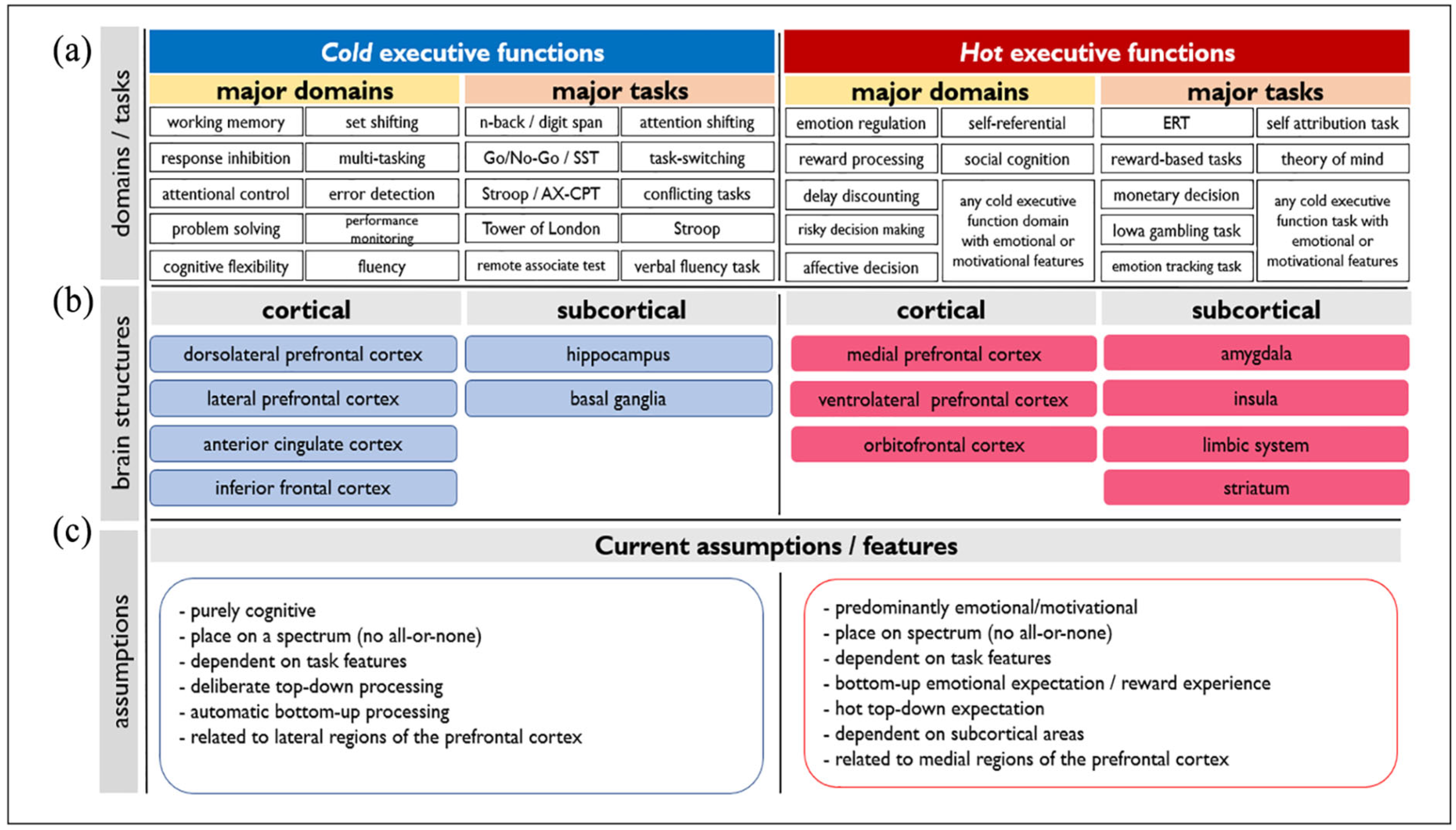
Taking this approach to executive functions into account has important implications for the research violent and aggressive behavior, it presents a more nuanced neuroanatomical and neuropsychological conceptualization of these functions (see Figure 1) responsible for directing behavior, assisting in decision-making, and inhibiting inappropriate responses or actions (Griffith et al., 2024; Ogilvie et al., 2011). Although the relationship between executive functions and crime is well established (as deficits in brain functioning, particularly in the frontal and pre-frontal regions, are associated with violent and criminal behavior (e.g., Kuin et al., 2019; Reddy et al., 2018) or the impact of prison duration on increasing or accentuating executive deficits (e.g., Ligthart et al., 2019; Meijers et al., 2015), less is known from the association between hot and cold executive functions and distinct criminal behaviors and recidivism.
Generally, individuals with violent and aggressive behavior are characterized by immaturity and impulsivity and executive deficits contribute to difficulties in regulating and controlling behavior (Miyake et al., 2000; Reddy et al., 2018). They tend to have deficits in social and cognitive skills, such as problem-solving ability, effectively interpreting social cues, flexibility in adapting to norms, empathetic behavior towards others, poor judgment in situations, difficulties in planning and decision-making, and difficulties in inhibiting inappropriate responses (Bergeron & Valliant, 2001; Chandler, 1973; Slaby & Guerra, 1988), which suggests a possible impairment in hot executive functions. When evaluated, they tend to score lower on tests of executive processes, particularly those assessing inhibitory control (Cruz et al., 2020; Hancock et al., 2010; Meijers et al., 2017; Wallinius et al., 2019). Nevertheless, decision-making requires both subcomponents (hot and cold) to work together since a useful way of solving a hot, affective driven problem might be by its reconceptualization into a more neutral, cognitive, and relatively abstract approach (Zelazo & Cunningham, 2007).
Furthermore, the literature shows a relationship between executive dysfunctions and manifestations of criminal behavior, such as recidivism. Although it remains unclear whether executive deficits are more severe in repeat offenders (e.g., Seruca & Silva, 2015), Ross and Hoaken (2011), for example, demonstrated that recidivist individuals show lower performance in executive measures compared to first time inmates. Meijers et al. (2015) stated that executive dysfunction, along with difficulty in self-regulation, can lead to an increased rate of recidivism. Therefore, the question arises as to whether executive dysfunctions are the direct cause of repeated criminal behavior over time or whether the prison environment also contributes to an exacerbation of these deficits and, consequently, a greater risk of recidivism (Meijers et al., 2018).
Based on the relationship between executive functions and criminal behavior, this study aims to evaluate and characterize the executive functioning of a group of inmates sentenced for different types of crime. Specifically, it seeks to understand the influence of incarceration through the length of imprisonment variable on neurocognitive functioning and decision making through measures assessing hot executive functions (performance on the Iowa Gambling Task) and cold executive functions (performance on the Wisconsin Card Sorting Test and digit span of the Wechsler Adult Intelligence Scale). In sum, the present study aimed to move beyond traditional conceptualizations of executive functions by examining whether performance in ‘cold’ and ‘hot’ subcomponents was associated with legal variables. Given the exploratory nature of the study, the following research question was raised: Is performance on measures of hot and cold executive functions related to length of imprisonment among incarcerated individuals?

2. Materials and Methods

2.1. Participants

The sample consisted of 30 male individuals in prison. Only individuals without a formal diagnosis of psychopathology and with at least a completed first cycle of basic education were included (i.e., four years of formal education). The participants had an average age of 29.13 years (SD = 6.19) and the majority (46.7%) had incomplete education at the second cycle level (i.e., six years of formal education). They were serving effective prison sentences in a prison located in the Lisbon metropolitan area. Out of the total participants, 22 were serving their first effective prison sentence, while the remaining eight were repeat offenders. In terms of the types of crime, five participants were incarcerated for non-violent crimes (e.g., theft; drug traffic), while the remaining 25 were incarcerated for violent crimes (e.g., murder; robbery). Furthermore, out of these participants, 17 were primary offenders involved in violent crimes, and five were involved in non-violent crimes. Only eight participants were both repeat offenders and involved in violent crimes. Regarding the participants’ criminal history, recidivism was determined through self-reporting, considering whether they had previously complied with another measure, whether it involved deprivation of liberty or not. Twenty participants (66.7%) reported having used psychoactive substances before incarceration. The most used substances were alcohol and cannabis resin. As regards medication use, most participants reported no use of medication (90%). Among those who did report medication use, two participants were taking medication for epilepsy, and one participant was taking the benzodiazepine clonazepam for anxiety. The duration of the sentences ranged from 42 to 366 months, with an average of 173.40 months (SD = 83.11). The participants had been incarcerated on average for 92.53 months (SD = 50.92), with a minimum of 11 months and a maximum of 180 months. The interval data for Duration of Sentence Imposed and Length of Imprisonment were converted to binary variables based on the median value in months (Duration of Sentence Imposed, Mdn = 180 months; Length of Imprisonment, Mdn = 94.50 months). Detailed information on the sociodemographic characteristics of the sample is provided in Table 1.

2.2. Measures

Sociodemographic Questionnaire—The sociodemographic questionnaire aims to collect information regarding age, gender, education, marital status, profession before imprisonment, length of sentence assigned, reason for the sentence, years of sentence already served, criminal record, substance use, and clinical history.
  • General cognitive function assessment:
Montreal Cognitive Assessment (MoCA) (Nasreddine et al., 2005; Portuguese version by Simões et al., 2008) is a brief screening tool for mild cognitive impairment. This test consists of eleven tasks that assess cognitive domains such as executive functions, visuospatial capacity, memory, attention, concentration, working memory, language, and spatial and temporal orientation. The administration time is approximately 10 to 15 min, and the maximum score is 30 points (Freitas et al., 2011) and a cut-off below 24 points to the prisoner sample of the Portuguese validation study (Lima Pereira et al., 2023). It was used to assess a global indicator of cognitive function.
  • Executive functions screening:
Frontal Assessment Battery (FAB) (Dubois et al., 2000; Portuguese version by Lima et al., 2008) is a brief battery of neuropsychological assessment focused on frontal functions and executive functioning. This test consists of six subtests that assess abstract thinking, mental flexibility, motor programming, sensitivity to interference, inhibitory control, and environmental autonomy. Each subtest is scored between 0 and 3 points, with a total score of 18 points. The test administration time is approximately 10 min (Dubois et al., 2000) We have used the Portuguese version adapted by Meireles et al. (2007), applying normative data (Lima et al., 2008) to interpret the scores obtained from the prison sample.
  • Cold executive functions assessment:
Digit Span—The Wechsler Adult Intelligence Scale III (WAIS-III) (Wechsler, 1997; Portuguese version by Wechsler, 2008) allows evaluation of the capacity for recall, immediate repetition, and working memory. It consists of two tasks: one for repeating digits in direct order and another for repeating digits in reverse order. Each item has two trials that are scored from 0 to 2 points. The total score is 30 points, which corresponds to the sum of the direct order digits task (16 points) and the reverse order digits task (14 points) (Wechsler, 2008).
Wisconsin Card Sorting Test (WCST) (Heaton et al., 1993; normative data available from Faustino et al., 2022) is a test that assesses cognitive flexibility. The test consists of four stimulus cards and 128 response cards represented by different shapes, colors, and numbers. The objective is to match each response card to one of the stimulus cards, alternating between the three classification categories (i.e., color, shape, and number). During the test, the classification principles are not revealed to the participant; they are only told if their answer is right or wrong. The results of the test are translated into percentiles based on the raw score of the classification indexes. The test administration time varies between 20 and 30 min (Heaton et al., 2005).
  • Hot executive functions assessment:
Iowa Gambling Task (IGT) (Bechara et al., 1994) is a computerized test that evaluates decision-making capacity based on real-life situations, specifically the anticipation of risk in long-term decision-making. The IGT consists of four decks of cards (A, B, C, and D), each with different characteristics in terms of losses and/or gains during the task. The objective is to reach the end of the task with a positive balance, avoiding significant losses. The participant chooses a card from one of the four possible decks over 100 moves. Decks vary in terms of rewards and punishments, with some being more advantageous than others. The test results are obtained by subtracting the sum of all advantageous choices (decks C + D) from the sum of all risky choices (decks A + B) (Bechara et al., 1994). There are no normative data available, and results were compared between sentence length groups.

2.3. Procedures

This study is part of a broader project called “Neurocognitive Assessment of the Prison Population,” with data collected between 2017 and 2018 in a prison facility in the metropolitan area of Lisbon, Portugal. After obtaining ethical clearance from the Committee on Ethics and Deontology of Scientific Research at the School of Psychology and Life Sciences of Lusófona University (CEDIC) and authorization from the Directorate-General for Reintegration and Prison Services of Portugal (DGRSP), the data collection process took place with a guarantee of anonymity and confidentiality.
Participant recruitment was conducted in collaboration with prison staff. Individuals were invited to participate and were preliminarily screened for eligibility by the correctional professionals based on the study’s inclusion/exclusion criteria. Eligible participants were then invited to participate in the study after reading the informed consent form. All individuals who were invited and met the eligibility criteria agreed to participate. No participants were excluded after consent, and all consented participants completed the assessment and were included in the analyses. The participants signed an informed consent form, and it was clarified that participation did not involve any physical or psychological risks.
To assess the cognitive profile, five neuropsychological assessment measures were applied in two sessions. Only MoCA had comparison data from a validation study with prisoners (Lima Pereira et al., 2023). For the other measures (FAB, WCST, Digit Span), we compared our sample results with normative data from community samples and conducted comparisons between sentence length groups. In the first session, the socio-demographic questionnaire, the MoCA test, the digit span test, and the WCST were administered. For the WCST, the following indices were analyzed: Perseverative Errors, Perseverative Responses, Conceptual Level Responses, Number of Categories Completed, and Successful Trials to Complete the 1st Category. These indices are considered the most suitable in the literature for evaluating abilities such as problem-solving, planning, and cognitive flexibility (e.g., Angrilli et al., 2013; Kelly et al., 2002; Ross & Hoaken, 2011; Sreenivasan et al., 2008; Veneziano & Veneziano, 2004).
In the second session, the FAB and IGT tests were administered. In addition to analyzing the decks of cards (Deck A, Deck B, Deck C, and Deck D) selected by the participants, which indicate the number of times each deck (advantageous or disadvantageous) was chosen, data related to the blocks (Net1, Net2, Net3, Net4, and Net5) were considered to evaluate the participants’ performance and learning progression in each block. The total value (Net_Total) variable was also used to assess the participants’ overall performance in the task (Areias et al., 2013). Furthermore, a survey was conducted to gather sociodemographic data. Information regarding sentence duration and length of imprisonment was collected from the individual records. The neurocognitive assessment was conducted individually in a room, guaranteeing the conditions of privacy and confidentiality. A trained student enrolled in the Neuropsychology Master’s program conducted the assessments. The entire procedure of neurocognitive assessment lasted two one-hour sessions.

2.4. Statistical Analysis

The data were analyzed using IBM SPSS Statistics (Version 30.0) for the non-parametric procedures. Descriptive statistics were used to characterize the sample, whereas inferential statistical methods were employed to test the study objectives. Given the small sample size in the group comparisons, non-parametric tests, rank-based MANCOVAs, and Linear Mixed Models (LMM) for repeated measures were applied. LLM were performed using R (Version 4.5.2). Comparisons between two independent groups were conducted using the Mann–Whitney U test. Comparisons among several related samples were performed using the Friedman test, followed by Wilcoxon signed-rank tests for pairwise comparisons. Analyses involving covariates were conducted using rank-based ANCOVAs, and multivariate constructs were examined using rank-based MANCOVAs. Effect sizes were reported for all analyses. For the Mann–Whitney test, Rosenthal’s r was provided, whereas for the Friedman test, Kendall’s W was used for the effect size. For ANOVA-based analyses, partial eta squared (η2p) were reported throughout the procedures. The independent variables were related to length of imprisonment, whereas the dependent variables reflected neurocognitive performance in executive functions (Digit Span, FAB and WCST and IGT). The significance level was set at α = 0.05, and Bonferroni corrections were applied to adjust for multiple comparisons.

3. Results

3.1. Descriptive Statistics for Neurocognitive Variables

The first aim was to describe the variables related to neurocognitive functioning using mean scores, standard deviation, and lower and upper levels for a 95% confidence level. The mean scores indicate that overall cognitive function measured with (MoCA, Digit Span, WCST, FAB and IGT) is lower than the mean score of a normative sample. However, these scores fall within two standard deviations of the normative scores, suggesting no significant deviations from the normative data. The same applies to the WCST, for which normative data for the Portuguese population is available. In the WCST, we utilized approximate age and education levels from our sample. Table 2 provides a summary of the descriptive statistics for the five measures used to assess participants’ executive functioning.

3.2. Decision-Making in the Iowa Gambling Task

The IGT was analyzed according to Net (performance in 20 card bins) and Deck (number of choices of each card deck). This analysis was conducted using separate Friedman tests to compare performance for Net and for Deck. The results from this analysis for Net, which had five levels, did not reveal statistically significant differences across the levels of this variable (i.e., each set of 20 card picks).
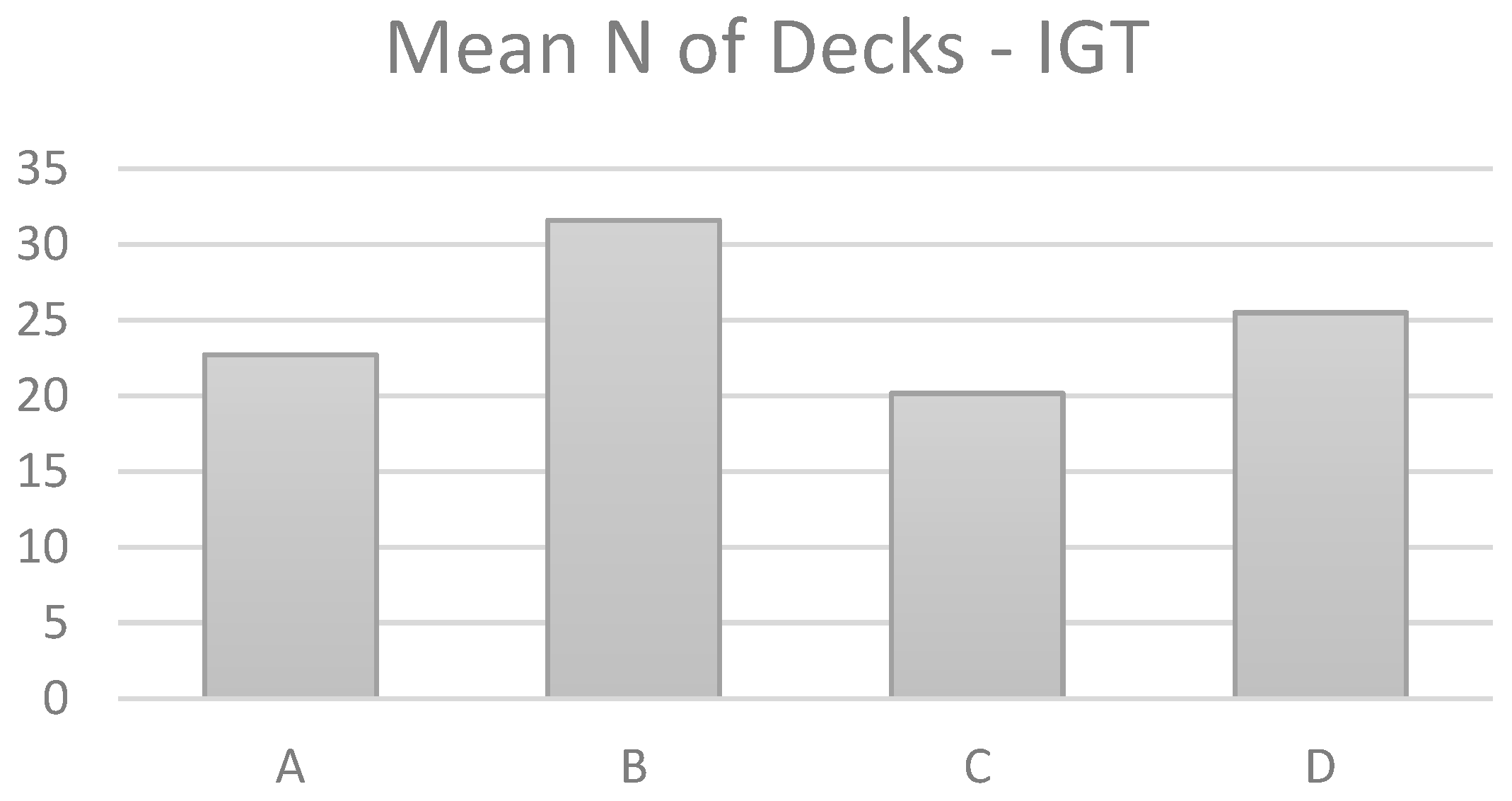
However, the same analysis conducted on Deck, which had four levels, showed a main effect (X2 = 11.848, W = 0.219, p < 0.01), indicating a significant difference in the number of card picks from each deck. The Kendall’s W effect size indicates a small-to-moderate effect size. Wilcoxon matched-pair signed-rank tests for 2 samples were conducted to identify the significant pair of differences using Bonferroni adjustment for the alpha level. This analysis indicated that Deck B was chosen significantly more often than Deck A and Deck C (p < 0.01). Figure 2 illustrates the number of cards picked for decks A, B, C, and D, where decks A and B were disadvantageous decks, and decks C and D were advantageous decks.

3.3. Association Between Length of Imprisonment, Education and Age

Before testing the objectives, an exploratory analysis was conducted to determine whether the independent variable, length of imprisonment (below/above Mdn), could be influenced by factors such as age or education. A Chi-square association test was performed to examine the associations between years of formal education and the independent variable. The results indicated no significant associations (all p-values > 0.05). However, when considering age, Mann–Whitney revealed a difference for the variable length of imprisonment (U = 31.500, r = −0.62, p < 0.001), suggesting that individuals with longer imprisonment time tend to have a higher mean age, while the effect size based on Rosenthal’s r indicates a large effect in this analysis.
To account for the potential covariance between age and the independent variable, age was controlled in subsequent analyses. Table 3 presents the means and standard deviations for better interpretation. These statistics are depicted for each subgroup, specifically focusing on the age variable.

3.4. Differences in Groups of Length of Imprisonment in Executive Functions

This analysis was conducted to test whether the length of imprisonment affected executive functions (Digit Span, FAB and WSCT). For the Digit Span a Mann–Whitney test was conducted. For the FAB and WCST, considering that these concepts involve several variables, this analysis utilized two ranked MANCOVAs to test separately these effects on the underlying dimensions of the FAB and the WCST, while controlling for age effects.
For the Digit Span, a marginal significant effect was found through the Mann–Whitney test for this task (U = 67.000, r = −0.35, p = 0.054) suggesting poorer scores in the group with longer imprisonment time (above Mdn). The effect size reflects a medium effect (Table 4).
Regarding the FAB, the MANCOVA included the six dimensions (abstract thinking, mental flexibility, motor programming, sensitivity to interference, inhibitory control, and environmental autonomy) and the duration of the sentence imposed (below/above Mdn) as fixed effects, with age included as a covariate. The analysis revealed a significant multivariate effect of the independent variable (F(5, 29) = Wilks’ Lambda = 0.616; F = 2.872; η2p = 0.384, p < 0.05) corresponding to a large multivariate effect size. This effect was further examined through between-subjects univariate tests, which indicated better results in executive functions in the group with the lower duration of incarceration for conflicting instructions subtest—sensitivity to interference (F(1, 27) = 4.251, η2p = 0.136, p < 0.05), corresponding to a medium-to-large effect size (Table 5).
The same analysis was performed on the WCST to assess whether this test exhibited differences based on the duration of the sentence imposed while controlling for age effects. However, the ranked MANCOVA did not demonstrate a multivariate effect or univariate effects on the dimensions of the WCST (all p’s > 0.05). Table 6 illustrates the mean scores in each domain of the WCST.

3.5. Analysis to Imprisonment Duration and Decision-Making Through the IGT

The analysis on the Iowa Gambling Task (IGT) was conducted using LMM on, two separate models for Net and Deck scores. This analysis included length of imprisonment as independent variable to test its effects on decision-making, while age was used as a covariate given its association with length of imprisonment.
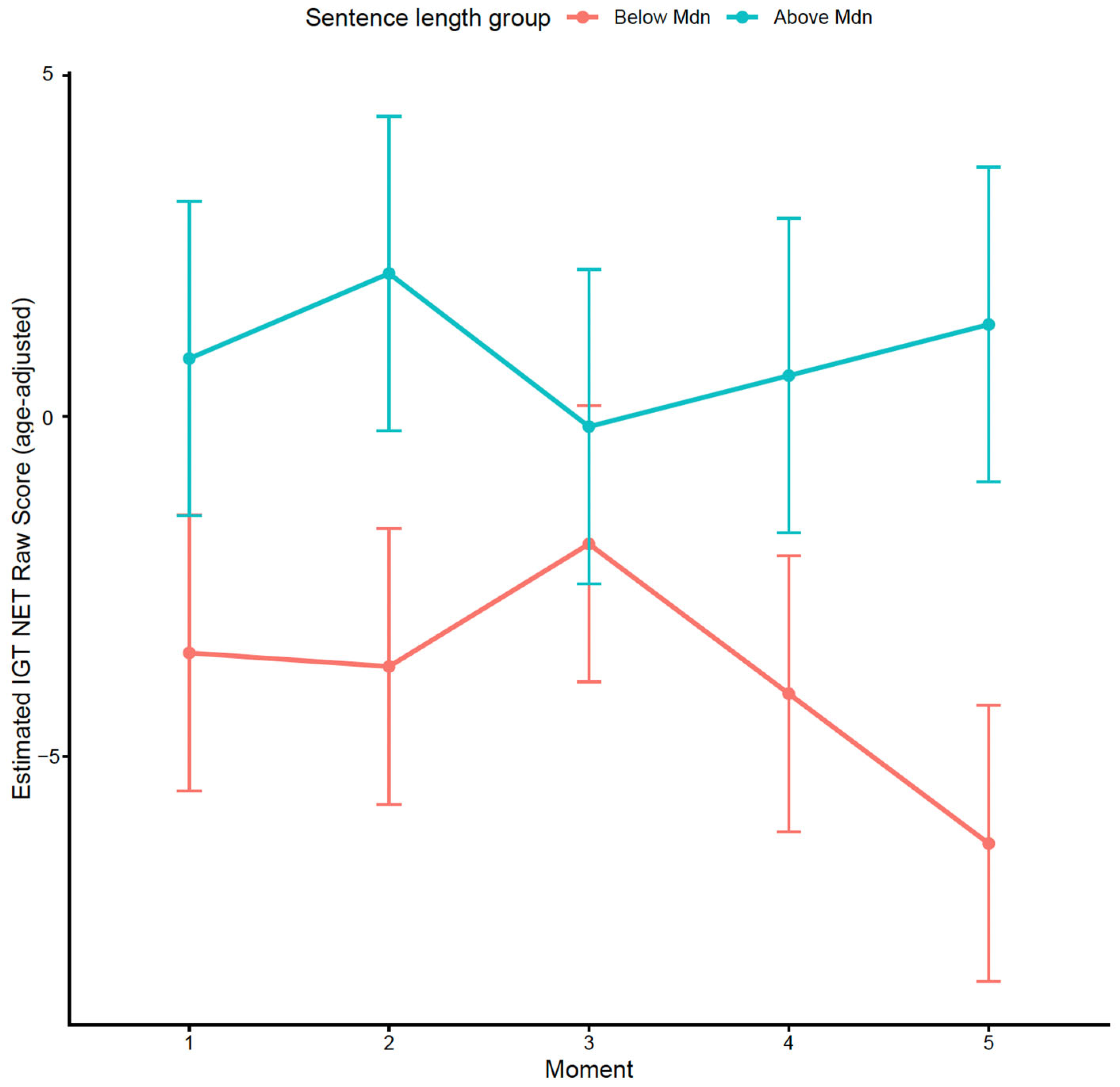
For the Net variable, the LMM included the within-subjects factor Net (ranks) with 5 levels (Net1 vs. Net2 vs. Net3 vs. Net4 vs. Net5). Sentence length groups (below vs. above Mdn) and age was included as a covariate were included in the model. This analysis revealed no main effect of the with-subjects factor (F(4, 72) = 0.37, p = 0.83) indicating no learning across the task. A trend towards significance was found for the main effect of sentence length group (F(1, 18) = 3.26, p = 0.088, with participants having longer sentences showing higher Net scores. The effects of age were not significant (p = 0.27). The interaction with the independent variable was not significant (F(4, 72) = 0.98, p = 0.43). These results are depicted in Figure 3.
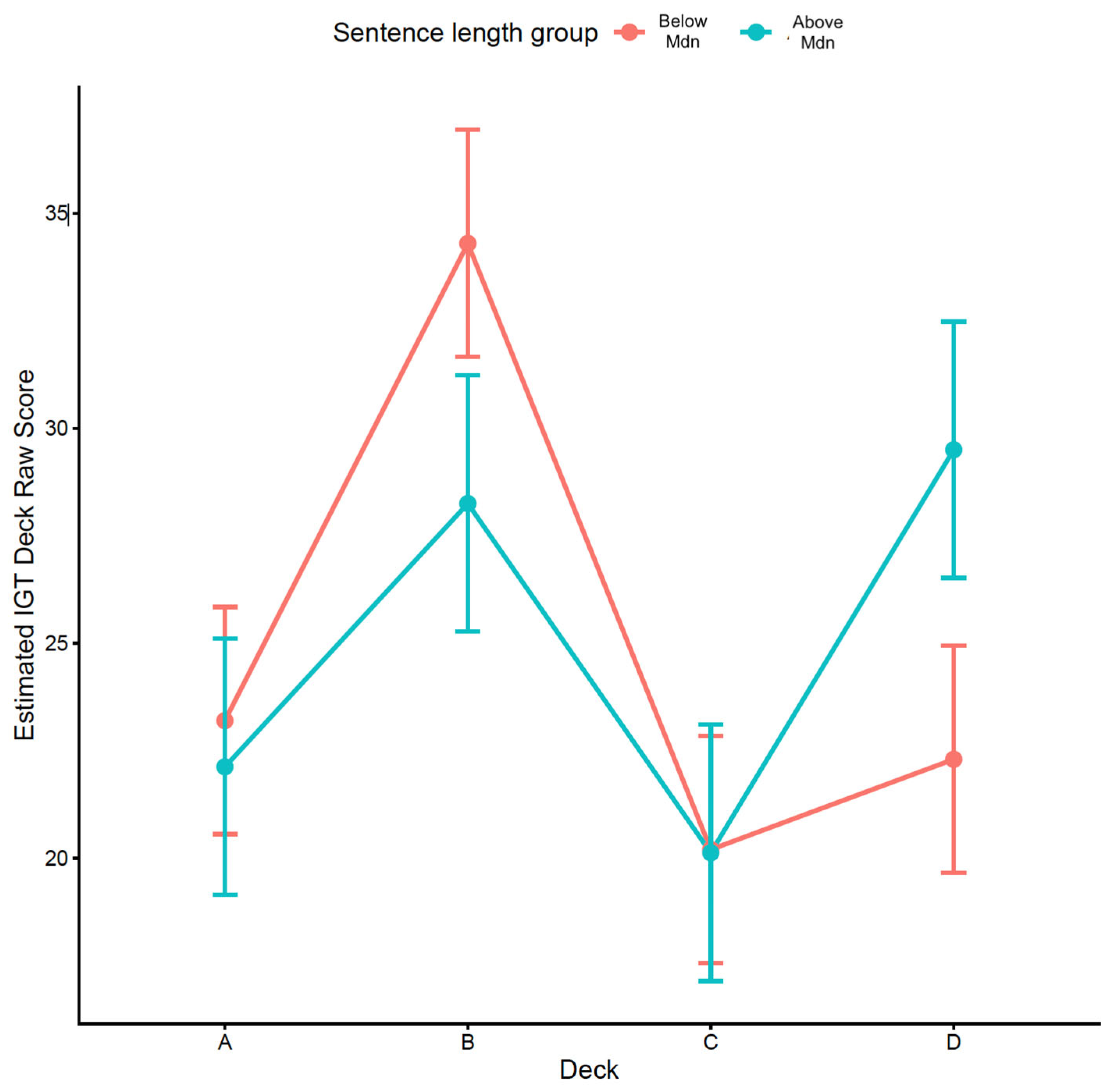
Regarding the Deck variable, the same analysis for the within-subjects factor Deck with 4 levels (Deck A vs. Deck B vs. Deck C vs. Deck D) with sentence length group according to the Median being treated as between-subjects factor and age was used as a covariate, with random intercepts for participants. This analysis showed a significant main effect of the within-subjects factor Deck (F(3, 72) = 6.35, p < 0.001) indicating differences between deck selections. No main effect of sentence length group or age was observed (all p’s > 0.05). The interaction between factors was also not significant (F(3, 72) = 2.06, p = 0.11), suggesting similar deck selection patterns across groups of participants. These results are shown in Figure 4.

4. Discussion

This study aimed to evaluate and characterize the performance of imprisoned individuals on hot and cold executive tasks. To explore whether the prison environment impacts executive functions (Meijers et al., 2018) we have chosen to study the effect of the length of imprisonment duration in the domains of executive functioning. Our research question was as follows: Is performance on measures of hot and cold executive functions related to length of imprisonment among incarcerated individuals?
Executive dysfunction is considered one of the main predictors of criminal behavior. Generally, individuals in a situation of seclusion demonstrate deficits in cognitive (e.g., Lima Pereira et al., 2023), social, and emotional skills (Altikriti, 2020; Ogilvie et al., 2011) and executive functioning (Cruz et al., 2020; Griffith et al., 2024; Ligthart et al., 2019; Meijers et al., 2015; Seruca & Silva, 2016). This pattern of deficits has been previously associated with the severity of criminal behavior (Chaguendo-Quintero et al., 2023; Meijers et al., 2017; Ross & Hoaken, 2011; Valliant et al., 2003) and the pattern of aggression exhibited (Choy et al., 2024; Cruz et al., 2020).
To explore whether the prison environment impacts executive functions (Meijers et al., 2018) we have chosen to study the effect of the length of imprisonment in executive functions (hot and cold components of executive functions).
The results were first explored to test the relationship between age and education with the independent variable; only age was associated with the independent variable related to sentence length groups. This can be explained by the accelerated aging observed in prison samples (Novisky et al., 2025) that might be accompanied by an increase in EF difficulties (Jansen & Franse, 2024). However, other factors can contribute to executive impairment, such as substance use (that was not associated with our independent variable in the current study) or mental disorders (Combalbert & Pennequin, 2020; Meijers et al., 2017; Ross & Hoaken, 2011; Tuominen et al., 2017; Verhülsdonk et al., 2021).
The results from global cognitive functioning are in accordance with the cut-off value of the validation study in a sample of Portuguese prisoners (see Lima Pereira et al., 2023). As for executive functions performance, the results did not suggest marked impairments in individuals in prison; nevertheless, the sample size and the absence of normative data for prison samples impede the generalization of current data.
Previous studies have found that offenders who perpetrate violent crimes or repeat offenders tend to have greater difficulties at the level of executive functions, given their greater cognitive rigidity (Chaguendo-Quintero et al., 2023; Griffith et al., 2024); this is because they may have greater difficulties in terms of learning new behavioral rules, as well as in the use of external references, to plan, monitor, regulate and adapt their behavior to new situations (Barbosa & Monteiro, 2008; Chaguendo-Quintero et al., 2023). In our study, we have found a similar pattern on the measure of frontal screening (FAB) and the Digit Span task for individuals with longer imprisonment times. This suggests that individuals with longer periods of imprisonment may show greater executive deficits, specifically in working memory (Digital Span) and sensitivity to interference (FAB—Conflicting Instructions) because of the prison environment characterized as impoverished and sedentary (Meijers et al., 2015).
Both working memory and sensitivity to inference are important executive functions for monitoring and modifying behaviors. Working memory concerns the ability to temporarily store and process relevant information during the execution of a task (Funahashi, 2001). Therefore, it enables the resolution of problems and the directing of behaviors towards certain objectives, through access to previously acquired learning and the acquisition of new ones (Funahashi, 2001).
Nevertheless, the small sample size limits the generalizability of these conclusions. Also, the results found for working memory need to be confirmed in other more demanding tasks as n-back tasks or the Corsi Blocks, as they simultaneously require the updating domain of executive functions (i.e., ability to maintain and manipulate information; Gajewski et al., 2018; Miyake et al., 2000).
Despite these findings for the Digit Span and FAB, no effects were found in the WCST, which is intriguing and contrary to the literature on the WCST results in offender samples (for a review see Burgess, 2020). The WCST is a measure of set-shifting, a domain of executive functions (Diamond, 2013) that relates to mental flexibility. According to Funahashi (2001), the ability to shift attention to a given stimulus and keep it in working memory is necessary to perform the WCST test, and this ability may be related to the inhibition of behavioral responses to inappropriate stimuli. It is possible that the working memory and sensitivity to interference functions assessed by these tests (for instance, performance in the FAB may be more related with basic motor inhibition) are different from the demands of the WCST that is more complex and taps other functions, such as planning. It is possible that the deficits of the inmate population were mostly captured by verbal fluency instead of the performance in the set-shifting measures of cognitive flexibility as the WCST.
The prison context can lead to an accelerated, and more severe, decline in cognitive abilities in individuals (Novisky et al., 2025), even proposing a greater risk of developing neurodegenerative diseases such as dementia. This is because it is a context considered to promote a sedentary lifestyle, with little social interaction and low cognitive stimulation (Combalbert & Pennequin, 2020; Meijers et al., 2017; Verhülsdonk et al., 2021). For example, the literature has shown that brain processes involved in self-regulation (i.e., self-control and planning) and attention are reduced after three months of confinement, suggesting that this difficulty may lead to a higher risk of recidivism (Ligthart et al., 2019; Meijers et al., 2018).
We have used the length of the imprisonment period to study whether staying in a prison context would impact executive functions (hot component). The results from the IGT revealed no learning evidence through the Net scores, while disadvantageous decks (Deck B) were the most chosen deck type. However, no effects of sentence length were found, evidencing that this result from the IGT was true for the whole sample without a group effect. We explored these results considering the type of crime group. The results were consistent in all the variables analyzed in the IGT in relation to the subgroup of individuals considered violent, indicating a greater tendency to choose disadvantageous decks and, consequently, a more significant risk in decision-making. These results although exploratory are aligned with previous studies (for a review see Umbach et al., 2019). For example, in a systematic review of impulsive control among individuals in seclusion, there was a pronounced deficit in the control of impulsivity in decision-making, particularly in individuals considered violent, exhibiting greater difficulties in delaying gratification and in the ability to inhibit inappropriate and impulsive responses. Moreover, these difficulties can also be predictors of criminal recidivism (Vedelago et al., 2019). Hence, even though deck choices can either be associated with working memory deficits, lack of comprehension of instructions, attention to the frequency or proportion of advantage (reward) and disadvantage (punishment) decks, or immediate gratification (Umbach et al., 2019) from our analysis we can only propose possible explanations that need to be tested in future research. Other factors might compromise decision-making, such as substance use which was tested but revealed no effects.
As for the limitations, the main was the sampling method along with the small sample size (it was not included an a priori sample size or power calculation since the study had an exploratory design). Being a convenience sample and collected from one site, it limits the generalizability of our results. Given the exploratory nature of the study, we relied also in effect sizes to better support the conclusions drawn from these results. On the other hand, the role of mediators/moderators was not completely controlled in our analysis as this would require a large sample size.
Another issue pertains to the adoption of comparison data from validation studies conducted in community samples. We recognize it as a potential weakness, that opens the possibility for future studies on the forensic validation of those measures.
In future studies, it would be important to use measures that allow evaluating and controlling the impact of intelligence on cognitive decline, since one of the factors that can also explain lower performance in complex neuropsychological tasks is intelligence (Griffith et al., 2024; Ross & Hoaken, 2011). Alongside, the use of a more comprehensive battery of tests (CANTAB), with more ecologic validity (e.g., BADS), at the same time with complementary tests of brain functioning (e.g., Raven’s Matrices or The Test of Non-Verbal Intelligence) or premorbid intelligence (e.g., NART), would be recommended. Also, numerous other factors can contribute to executive impairment, such as substance use or mental disorders (Combalbert & Pennequin, 2020; Griffith et al., 2024; Jansen & Franse, 2024; Meijers et al., 2017; Ross & Hoaken, 2011; Tuominen et al., 2017; Verhülsdonk et al., 2021) that should be accounted and analyzed in future studies. Moreover, it would be important to understand the predominant pattern of aggressiveness in the sample (e.g., Choy et al., 2024), whether it is a reactive type of aggression that is manifested by impulsivity, or an instrumental type of aggression that is characterized by premeditated and planned behaviors, considering that the two demonstrate distinct associations with different cognitive deficits and crime severity (Broomhall, 2005; Choy et al., 2024; Cruz et al., 2020). Finally, the exploratory nature of the current study impedes the generalization of the results for all prison populations. Nevertheless, understanding the cognitive functioning of individuals in prison, specifically the deficits they present, is vital for their monitoring and rehabilitation (e.g., cognitive behavioral techniques or cognitive remediation techniques based on the Risk-Needs-responsivity model; Griffith et al., 2024), especially in cases of criminal recidivism (Ross & Hoaken, 2011). Moreover, this analysis must include an integrative and multidisciplinary approach in a large, multisite sample, as several factors contribute to cognitive and executive impairment and the involvement of these individuals with the justice system (Griffith et al., 2024; Sullivan, 2019).

Author Contributions

Conceptualization, J.O., P.G. and J.C.; methodology, J.O., P.G. and J.C.; formal analysis, I.G. and J.O.; investigation, I.M. and J.C.; data curation, J.O.; writing—original draft preparation, I.G., J.O. and A.R.C.; writing—review and editing, P.G. and J.C.; visualization, J.O.; supervision, J.O., P.G. and J.C. All authors have read and agreed to the published version of the manuscript.

Funding

This study was funded by the Foundation for Science and Technology—FCT (Portuguese Ministry of Science, Technology and Higher Education), under the grant UIDB/05380/2020 https://doi.org/10.54499/UIDB/05380/2020.

Institutional Review Board Statement

The study was conducted in accordance with the Declaration of Helsinki and approved by the Ethics Committee of CEDIC—Committee on Ethics and Deontology of Scientific Research (reference CEDIC-2025-2-30, date of approval 28 May 2025).

Informed Consent Statement

Informed consent was obtained from all subjects involved in the study.

Data Availability Statement

The data used for this study is available upon request.

Conflicts of Interest

The authors declare no conflicts of interest. The funders had no role in the design of the study; in the collection, analyses, or interpretation of data; in the writing of the manuscript; or in the decision to publish the results.

Abbreviations

The following abbreviations are used in this manuscript:
APAAmerican Psychological Association
ANOVAAnalysis of Variance
CEDICCommittee on Ethics and Deontology of Scientific Research
CIConfidence Interval
DGRSPGeneral Directorate for Reinsertion and Prison Services
DSM 5Diagnostic and statistical manual of mental disorders 5
FABFrontal Assessment Battery
IGTIowa Gambling Task
MMean
MdnMedian
MoCAMontreal Cognitive Assessment
OECDOrganization for Economic Cooperation and Development
SDStandard Deviation
WAISWechsler Adult Intelligence Scale
WCSTWisconsin Card Sorting Test

References

  1. Altikriti, S. (2020). Toward integrated processual theories of crime: Assessing the developmental effects of executive function, self-control, and decision-making on offending. Criminal Justice and Behavior, 48(2), 215–233. [Google Scholar] [CrossRef]
  2. American Psychiatric Association. (2014). DSM-V: Manual de diagnóstico e estatística das perturbações mentais (5th ed.). Climepsi Editores. [Google Scholar]
  3. Angrilli, A., Sartori, G., & Donzella, G. (2013). Cognitive, emotional and social markers of serial murdering. The Clinical Neuropsychologist, 27(3), 485–494. [Google Scholar] [CrossRef]
  4. Ardila, A. (2013). There are two different dysexecutive syndromes. Journal of Neurological Disorders, 1(1), 1–4. [Google Scholar] [CrossRef]
  5. Areias, G., Paixão, R., & Figueira, A. P. C. (2013). O iowa gambling task: Uma revisão crítica. Psicologia: Teoria e Pesquisa, 29(2), 201–210. [Google Scholar] [CrossRef][Green Version]
  6. Balafoutas, L., García-Gallego, A., Georgantzis, N., Jaber-Lopez, T., & Mitrokostas, E. (2020). Rehabilitation and social behavior: Experiments in prison. Games and Economic Behavior, 119, 148–171. [Google Scholar] [CrossRef]
  7. Barbosa, M., & Monteiro, L. (2008). Recurrent criminal behavior and executive dysfunction. The Spanish Journal of Psychology, 11(1), 259–265. [Google Scholar] [CrossRef] [PubMed]
  8. Bechara, A. (2005). Decision making, impulse control and loss of willpower to resist drugs: A neurocognitive perspective. Nature Neuroscience, 8(11), 1458–1463. [Google Scholar] [CrossRef] [PubMed]
  9. Bechara, A., Damasio, A. R., Damasio, H., & Anderson, S. W. (1994). Insensitivity to future consequences following damage to human prefrontal cortex. Cognition, 50(1–3), 7–15. [Google Scholar] [CrossRef] [PubMed]
  10. Bergeron, T. K., & Valliant, P. M. (2001). Executive function and personality in adolescent and adult offenders vs. non-offenders. Journal of Offender Rehabilitation, 33(3), 27–45. [Google Scholar] [CrossRef]
  11. Braga, T., Gonçalves, L. C., Basto-Pereira, M., & Maia, Â. (2017). Unraveling the link between maltreatment and juvenile antisocial behavior: A meta-analysis of prospective longitudinal studies. Aggression and Violent Behavior, 33, 37–50. [Google Scholar] [CrossRef]
  12. Broomhall, L. (2005). Acquired sociopathy: A neuropsychological study of executive dysfunction in violent offenders. Psychiatry, Psychology and Law, 12(2), 367–387. [Google Scholar] [CrossRef]
  13. Brower, M. C., & Price, B. H. (2001). Neuropsychiatry of frontal lobe dysfunction in violent and criminal behaviour: A critical review. Journal of Neurology Neurosurgery and Psychiatry, 71(6), 720–726. [Google Scholar] [CrossRef]
  14. Burgess, J. (2020). A brief review of the relationship of executive function assessment and violence. Aggression and Violent Behavior, 54, 101414. [Google Scholar] [CrossRef]
  15. Chaguendo-Quintero, M. A., Quintero-Monjes, D., Cuervo, M. T., & Sanabria-Mazo, J. P. (2023). Alterations in executive functions in inmates convicted for violent behavior: A systematic review. Frontiers in Psychology, 14, 1066474. [Google Scholar] [CrossRef]
  16. Chandler, M. J. (1973). Egocentrism and antisocial behavior: The assessment and training of social perspective-taking skills. Developmental Psychology, 9(3), 326–332. [Google Scholar] [CrossRef]
  17. Choy, O., Tan, G., & van Dongen, J. D. (2024). Executive functions and aggression in “hot” and “cold” contexts: Two meta-analyses. Aggression and Violent Behavior, 80, 102024. [Google Scholar] [CrossRef]
  18. Combalbert, N., & Pennequin, V. (2020). Effect of age and time spent in prison on the mental health of elderly prisoners. Annales Medico-Psychologiques, 178(3), 264–270. [Google Scholar] [CrossRef]
  19. Cruz, A. R., de Castro-Rodrigues, A., & Barbosa, F. (2020). Reprint of “Executive dysfunction, violence and aggression”. Aggression and Violent Behavior, 54, 101404. [Google Scholar] [CrossRef]
  20. De Brito, S. A., Viding, E., Kumari, V., Blackwood, N., & Hodgins, S. (2013). Cool and hot executive function impairments in violent offenders with antisocial personality disorder with and without psychopathy. PLoS ONE, 8(6), e65566. [Google Scholar] [CrossRef]
  21. Derzon, J. H. (2010). The correspondence of family features with problem, aggressive, criminal, and violent behavior: A meta-analysis. Journal of Experimental Criminology, 6(3), 263–292. [Google Scholar] [CrossRef]
  22. Diamond, A. (2013). Executive functions. Annual Review of Psychology, 64, 135–168. [Google Scholar] [CrossRef]
  23. Direção Geral de Reinserção e Serviços Prisionais. (2022a). Lotação e reclusos existentes em 31 de dezembro. Available online: https://dgrsp.justica.gov.pt/Portals/16/Estatisticas/%C3%81rea%20Prisional/Anuais/2022/Q-03-Rcls.pdf?ver=DfvcYTHi3B_jrVnMZ_4JYA%3d%3d (accessed on 2 May 2025).
  24. Direção Geral de Reinserção e Serviços Prisionais. (2022b). Reclusos condenados existentes em 31 de dezembro, segundo as penas e medidas aplicadas, por sexo e nacionalidade. Available online: https://dgrsp.justica.gov.pt/Portals/16/Estatisticas/%C3%81rea%20Prisional/Anuais/2022/Q-07-Rcls.pdf?ver=aH09F-_bQXmbTHgEM7n9Kw%3d%3d (accessed on 2 May 2025).
  25. Dubois, B., Slachevsky, A., Litvan, I., & Pillon, B. (2000). The FAB: A frontal assessment battery at bedside. Neurology, 55(11), 1621–1626. [Google Scholar] [CrossRef]
  26. Faustino, B., Oliveira, J., & Lopes, P. (2022). Normative scores of the Wisconsin Card Sorting Test in a sample of the adult Portuguese population. Applied Neuropsychology: Adult, 29(4), 767–774. [Google Scholar] [CrossRef]
  27. Fazel, S., & Wolf, A. (2015). A systematic review of criminal recidivism rates worldwide: Current difficulties and recommendations for best practice. PLoS ONE, 10(6), e0130390. [Google Scholar] [CrossRef]
  28. Freitas, S., Simões, M. R., Alves, L., & Santana, I. (2011). Montreal Cognitive Assessment (MoCA): Normative study for the Portuguese population. Journal of Clinical and Experimental Neuropsychology, 33(9), 989–996. [Google Scholar] [CrossRef]
  29. Funahashi, S. (2001). Neuronal mechanisms of executive control by the prefrontal cortex. Neuroscience Research, 39(2), 147–165. [Google Scholar] [CrossRef] [PubMed]
  30. Gajewski, P. D., Hanisch, E., Falkenstein, M., Thönes, S., & Wascher, E. (2018). What does the n-back task measure as we get older? Relations between working-memory measures and other cognitive functions across the lifespan. Frontiers in Psychology, 9, 2208. [Google Scholar] [CrossRef]
  31. Griffith, R. L., Nowalis, S., & Monroe-Gulick, A. (2024). Executive functioning and offending behavior: An updated meta-analysis. Criminal Justice and Behavior, 51(4), 528–551. [Google Scholar] [CrossRef]
  32. Hancock, M., Tapscott, J. L., & Hoaken, P. N. S. (2010). Role of executive dysfunction in predicting frequency and severity of violence. Aggressive Behavior, 36(5), 338–349. [Google Scholar] [CrossRef]
  33. Heaton, R., Chelune, G., Talley, J., Kay, G., & Curtiss, G. (2005). Manual do teste wisconsin de classificação de cartas. In I. B. Guntert, & S. D. Tosi (Eds.), Adaptação e padronização brasileira (1st ed.). Casa do Psicólogo. [Google Scholar]
  34. Heaton, R. K., Chelune, G. J., Talley, J. L., Kay, G., & Curtiss, G. (1993). Wisconsin card sorting test: Manual (Rev. ed.). Psychological Assessment Resources. [Google Scholar]
  35. Jansen, J. M., & Franse, M. E. (2024). Executive functioning in antisocial behavior: A multi-level systematic meta-analysis. Clinical Psychology Review, 109, 102408. [Google Scholar] [CrossRef] [PubMed]
  36. Kelly, T., Richardson, G., Hunter, R., & Knapp, M. (2002). Attention and executive function deficits in adolescent sex offenders. Child Neuropsychology, 8(2), 138–143. [Google Scholar] [CrossRef]
  37. Kuin, N. C., de Vries, J., Scherder, E. J. A., van Pelt, J., & Masthoff, E. D. M. (2019). Cool and hot executive functions in relation to aggression and testosterone/cortisol ratios in male prisoners. Annals of Behavioral Neuroscience, 2(1), 206–222. [Google Scholar] [CrossRef]
  38. Ligthart, S., van Oploo, L., Meijers, J., Meynen, G., & Kooijmans, T. (2019). Prison and the brain: Neuropsychological research in the light of the European Convention on Human Rights. New Journal of European Criminal Law, 10(3), 287–300. [Google Scholar] [CrossRef]
  39. Lima, C. F., Meireles, L. P., Fonseca, R., Castro, S. L., & Garrett, C. (2008). The Frontal Assessment Battery (FAB) in Parkinson’s disease and correlations with formal measures of executive functioning. Journal of Neurology, 255(11), 1756–1761. [Google Scholar] [CrossRef]
  40. Lima Pereira, V., Freitas, S., Simões, M. R., & Gerardo, B. (2023). Montreal Cognitive Assessment (MoCA): A validation study among prisoners. Criminal Behaviour and Mental Health, 33(5), 330–341. [Google Scholar] [CrossRef]
  41. Márquez, M., Salguero Alcañiz, M., Paíno Quesada, S., & Alameda Bailén, J. (2013). La hipótesis del Marcador Somático y su nivel de incidencia en el proceso de toma de decisiones. Rema, 18(1), 17–36. [Google Scholar] [CrossRef]
  42. Meijers, J., Harte, J. M., Jonker, F. A., & Meynen, G. (2015). Prison brain? Executive dysfunction in prisoners. Frontiers in Psychology, 6, 43. [Google Scholar] [CrossRef] [PubMed]
  43. Meijers, J., Harte, J. M., Meynen, G., & Cuijpers, P. (2017). Differences in executive functioning between violent and non-violent offenders. Psychological Medicine, 47(10), 1784–1793. [Google Scholar] [CrossRef]
  44. Meijers, J., Harte, J. M., Meynen, G., Cuijpers, P., & Scherder, E. J. A. (2018). Reduced self-control after 3 months of imprisonment; A pilot study. Frontiers in Psychology, 9, 69. [Google Scholar] [CrossRef]
  45. Meireles, L. P., Lima, C. F., Fonseca, R., Gago, M., Guimarães, J., & Lencastre, L. (2007). Portuguese version of the Frontal Assessment Battery: Normative values in a healthy population sample (abstract). Livro de resumos da 213 reunião do Grupo de Estudos do Envelhecimento Cerebral e Demência, 50.
  46. Miyake, A., Friedman, N. P., Emerson, M. J., Witzki, A. H., Howerter, A., & Wager, T. D. (2000). The unity and diversity of executive functions and their contributions to complex “frontal lobe” tasks: A latent variable analysis. Cognitive Psychology, 41(1), 49–100. [Google Scholar] [CrossRef]
  47. Morgan, A. B., & Lilienfeld, S. O. (2000). A meta-analytic review of the relation between antisocial behavior and neuropsychological measures of executive function. Clinical Psychology Review, 20(1), 113–136. [Google Scholar] [CrossRef] [PubMed]
  48. Nasreddine, Z. S., Phillips, N. A., Bédirian, V., Charbonneau, S., Whitehead, V., Collin, I., Cummings, J. L., & Chertkow, H. (2005). The Montreal Cognitive Assessment, MoCA: A brief screening tool for mild cognitive impairment. Journal of the American Geriatrics Society, 53(4), 695–699. [Google Scholar] [CrossRef]
  49. Novisky, M. A., Prost, S. G., Fleury-Steiner, B., & Testa, A. (2025). Linkages between incarceration and health for older adults. Health & Justice, 13(1), 23. [Google Scholar] [CrossRef] [PubMed]
  50. Ogilvie, J. M., Stewart, A. L., Chan, R. K., & Shum, D. H. K. (2011). Neuropsychological measures of executive function and antisocial behavior: A meta-analysis. Criminology, 49(4), 1063–1107. [Google Scholar] [CrossRef]
  51. Organização para a Cooperação e Desenvolvimento Económico. (2020). Incarceration rates in OECD countries as of may 2020. Available online: https://www.statista.com/statistics/300986/incarceration-rates-in-oecd-countries/ (accessed on 2 May 2025).
  52. Reddy, K. J., Menon, K. R., & Hunjan, U. G. (2018). Neurobiological aspects of violent and criminal behaviour: Deficits in frontal lobe function and neurotransmitters. International Journal of Criminal Justice Sciences, 13(1), 44–54. [Google Scholar] [CrossRef]
  53. Ross, E. H., & Hoaken, P. N. S. (2011). Executive cognitive functioning abilities of male first time and return Canadian federal inmates. Canadian Journal of Criminology and Criminal Justice, 53(4), 377–403. [Google Scholar] [CrossRef]
  54. Salehinejad, M. A., Ghanavati, E., Rashid, M. H. A., & Nitsche, M. A. (2021). Hot and cold executive functions in the brain: A prefrontal–cingular network. Brain and Neuroscience Advances, 5, 23982128211007769. [Google Scholar] [CrossRef]
  55. Seruca, T., & Silva, C. F. (2015). Recidivist criminal behaviour and executive functions: A comparative study. Journal of Forensic Psychiatry and Psychology, 26(5), 699–717. [Google Scholar] [CrossRef]
  56. Seruca, T., & Silva, C. F. (2016). Executive functioning in criminal behavior: Differentiating between types of crime and exploring the relation between shifting, inhibition, and anger. International Journal of Forensic Mental Health, 15(3), 235–246. [Google Scholar] [CrossRef]
  57. Shumlich, E. J., Reid, G. J., Hancock, M., & N. S. Hoaken, P. (2019). Executive dysfunction in criminal populations: Comparing forensic psychiatric patients and correctional offenders. International Journal of Forensic Mental Health, 18(3), 243–259. [Google Scholar] [CrossRef]
  58. Simões, M. R., Freitas, S., Santana, I., Firmino, H., Martins, C., Nasreddine, Z., & Vilar, M. (2008). Montreal cognitive assessment (MoCA). Manual de Administração e Cotação. [Google Scholar]
  59. Slaby, R. G., & Guerra, N. G. (1988). Cognitive mediators of aggression in adolescent offenders: 1. Assessment. Developmental Psychology, 24(4), 580–588. [Google Scholar] [CrossRef]
  60. Sreenivasan, S., Walker, S. C., Weinberger, L. E., Kirkish, P., & Garrick, T. (2008). Four-facet PCL–R structure and cognitive functioning among high violent criminal offenders. Journal of Personality Assessment, 90(2), 197–200. [Google Scholar] [CrossRef] [PubMed]
  61. Stanley, J., & Goddard, C. (2004). Multiple forms of violence and other criminal activities as an indicator of severe child maltreatment. Child Abuse Review, 13(4), 246–262. [Google Scholar] [CrossRef]
  62. Sullivan, J. A. (2019). Achieving cumulative progress in understanding crime: Some insights from the philosophy of science. Psychology, Crime & Law, 25(6), 561–576. [Google Scholar] [CrossRef]
  63. Thomas, D. A., Clarke, D. C., Edge, I. D., Bernard, T. J., & Allott, A. N. (2020). Crime. In Encyclopedia britannica. Available online: https://www.britannica.com/topic/crime-law (accessed on 5 May 2025).
  64. Tirapu-Ustárroz, J., García-Molina, A., Luna Lario, P., Verdejo García, A., & Ríos Lago, M. (2012). Funciones ejecutivas y regulación de la conducta. Neuropsicología de La Corteza Prefrontal y Las Funciones Ejecutivas, 89–120. Available online: https://autismodiario.com/wp-content/uploads/2013/12/Neuropsicología-de-la-corteza-prefrontal-y-las-funciones-ejecutivas-y-Conducta.pdf (accessed on 5 May 2025).
  65. Tsermentseli, S., & Poland, S. (2016). Cool versus hot executive function: A new approach to executive function. Encephalos, 53(1), 11–14. [Google Scholar]
  66. Tuominen, T., Korhonen, T., Hämäläinen, H., Katajisto, J., Vartiainen, H., Joukamaa, M., Lintonen, T., Wuolijoki, T., Jüriloo, A., & Lauerma, H. (2017). The factors associated with criminal recidivism in Finnish male offenders: Importance of neurocognitive deficits and substance dependence. Journal of Scandinavian Studies in Criminology and Crime Prevention, 18(1), 52–67. [Google Scholar] [CrossRef]
  67. Umbach, R., Leonard, N. R., Luciana, M., Ling, S., & Laitner, C. (2019). The iowa gambling task in violent and nonviolent incarcerated male adolescents. Criminal Justice and Behavior, 46(11), 1611–1629. [Google Scholar] [CrossRef]
  68. Valliant, P. M., Freeston, A., Pottier, D., & Kosmyna, R. (2003). Personality and executive functioning as risk factors in recidivists. Psychological Reports, 92(1), 299–306. [Google Scholar] [CrossRef]
  69. Vedelago, L., Amlung, M., Morris, V., Petker, T., Balodis, I., McLachlan, K., Mamak, M., Moulden, H., Chaimowitz, G., & MacKillop, J. (2019). Technological advances in the assessment of impulse control in offenders: A systematic review. Behavioral Sciences & the Law, 37(4), 435–451. [Google Scholar] [CrossRef]
  70. Veneziano, C., & Veneziano, L. (2004). Neuropsychological executive functions of adolescent sex offenders and nonsex offenders. Perceptual and Motor Skills, 98, 661–674. [Google Scholar] [CrossRef]
  71. Verdejo, A., & Bechara, A. (2010). Neuropsicología de las funciones ejecutivas. Psicothema, 22(2), 227–235. [Google Scholar]
  72. Verhülsdonk, S., Folkerts, A.-K., Höft, B., Supprian, T., Kessler, J., & Kalbe, E. (2021). Cognitive dysfunction in older prisoners in Germany: A cross-sectional pilot study. International Journal of Prisoner Health, 17(2), 111–127. [Google Scholar] [CrossRef]
  73. Wallinius, M., Nordholm, J., Wagnström, F., & Billstedt, E. (2019). Cognitive functioning and aggressive antisocial behaviors in young violent offenders. Psychiatry Research, 272, 572–580. [Google Scholar] [CrossRef] [PubMed]
  74. Wechsler, D. (1997). Wechsler adult intelligence scale (3rd ed.): Administration and scoring manual. The Psychological Corporation. [Google Scholar]
  75. Wechsler, D. (2008). Escala de Inteligencia de Wechsler para Adultos [Wechsler adult intelligence scale] (3rd ed.). CEGOC-TEA. [Google Scholar]
  76. Yechiam, E., Kanz, J. E., Bechara, A., Stout, J. C., Busemeyer, J. R., Altmaier, E. M., & Paulsen, J. S. (2008). Neurocognitive deficits related to poor decision making in people behind bars. Psychonomic Bulletin and Review, 15(1), 44–51. [Google Scholar] [CrossRef] [PubMed]
  77. Zelazo, P. D., & Carlson, S. M. (2012). Hot and cool executive function in childhood and adolescence: Development and plasticity. Child Development Perspectives, 6(4), 354–360. [Google Scholar] [CrossRef]
  78. Zelazo, P. D., & Cunningham, W. A. (2007). Executive function: Mechanisms underlying emotion regulation. In J. J. Gross (Ed.), Handbook of emotion regulation (pp. 135–159). Guilford Press. [Google Scholar]
Figure 1. Current knowledge about domains and behavioral tasks of executive functions (a), involved brain structures (b) and underlying assumptions/features (c) of hot versus cold executive functions. SST: stop signal task; AX-CPT: AX Continuous Performance Task; ERT: emotional regulation task. Note: Reprinted from “Hot and cold executive functions in the brain: A prefrontal–cingular network,” by (Salehinejad et al., 2021, p. 2).
Ijcs 02 00002 g001
Figure 2. Mean number of decks selected in the Iowa Gambling Task.
Ijcs 02 00002 g002
Figure 3. Iowa Gambling Task (Net score 1–5) for sentence length groups.
Ijcs 02 00002 g003
Figure 4. Iowa Gambling Task (Deck selection) for sentence length groups.
Ijcs 02 00002 g004
Table 1. Sociodemographic characteristics of the sample.
Sociodemographic Variablesn%
Education
     First cycle26.7
     Second cycle723.3
     Incomplete second cycle1446.7
     High school413.3
     Incomplete High school310
Marital Status
     Single2893.3
     Married13.3
     Free union13.3
Profession
     Restoration620
     Construction723.3
     Professional futsal26.7
     Student413.3
     Other categories516.7
     No job identification620
Reason for imprisonment
     Murder930
     Attempted murder26.7
     Theft26.7
     Robbery413.3
     Drug dealing26.7
     Kidnapping13.3
     More than a type of crime1033.3
Type of crime
     Violent2583.3
     Non-violent516.7
Criminal background
     Repeat826.7
     First offender2273.3
Substance use
     Yes 2066.7
     No 1033.3
Medication
     Yes310.0
     No2790.0
Duration of Sentence Imposed
     Below Mdn (≤180 months)1860
     Above Mdn (>180 months)1240
Length of Imprisonment
     Below Mdn (≤94.5 months)1550
     Above Mdn (>94.5 months)1550
Table 2. Mean and Standard Deviation of Neuropsychological Assessment Tests.
TestsMSD95% CI
MoCA23.704.01[22.20, 25.20]
FAB161.28[15.52, 16.48]
Digit Span 16.673.18[11.48, 13.86]
Wisconsin Card Sorting Test
   Perseverative Errors16.779.55[13.20, 20.33]
   Perseverative Answers18.5010.99[14.30, 22.61]
   Number of Categories Completed4.571.94[3.84, 5.29]
   Tests to Complete the 1st Category25.5030.21[14.22, 36.78]
Iowa Gambling Task
   Net_Total−8.675.61[−20.51, 3.18]
   Net_1−1.560.83[−3.31, 0.20]
   Net_2−1.111.65[−4.59, 2.37]
   Net_3−1.111.16[−3.58, 1.35]
   Net_4−21.67[−5.53, 1.53]
   Net_5−2.891.99[−7.10, 1.32]
   Deck_A22.721.30[19.96, 25.48]
   Deck_B31.612.47[26.40, 36.82]
   Deck_C20.171.39[17.22, 23.11]
   Deck_D25.502.58[20.04, 30.96]
   ∑ Advantageous Decks (C + D)45.6711.91[30.75, 51.58]
   ∑ Disadvantageous Decks (A + B)54.3311.91[48.41, 60.25]
Table 3. Mean age by sentence length groups.
Age
MSD
Length of imprisonmentBelow Mdn25.273.37
Above Mdn335.98
Table 4. Digit Span scores by sentence length groups.
Digital Span
MSD
Length of imprisonmentBelow Mdn5.531.36
Above Mdn4.402.23
Table 5. FAB scores according to sentence length groups.
M (SD)Lower 95% CIUpper 95% CI
SimilaritiesBelow Mdn1.80 (0.77)1.372.23
Above Mdn1.93 (0.79)1.492.38
Fluency/FlexibilityBelow Mdn2.53 (0.64)2.182.89
Above Mdn2.33 (0.90)1.842.83
Motor seriesBelow Mdn3.00 (0.00)3.003.00
Above Mdn2.87 (0.51)2.583.15
Conflicting instructionsBelow Mdn3.00 (0.00)3.003.00
Above Mdn2.73 (0.59)2.403.06
Go-no-goBelow Mdn3.00 (0.00)3.003.00
Above Mdn2.80 (0.41)2.573.03
Prehension behaviorBelow Mdn3.00 (0.00)3.003.00
Above Mdn3.00 (0.00)3.003.00
Table 6. WCST according to sentence length groups.
M (SD)Lower 95% CIUpper 95% CI
N of trialsBelow Mdn101.20 (17.27)91.64110.76
Above Mdn115.00 (21.29)103.21126.79
Total errorsBelow Mdn25.73 (15.43)17.1934.28
Above Mdn42.53 (20.81)31.0154.05
Perseverative responsesBelow Mdn13.87 (8.36)9.2418.49
Above Mdn23.13 (11.61)16.7129.56
Perseverative errorsBelow Mdn12.47 (6.71)8.7516.18
Above Mdn21.07 (10.22)15.4126.72
Non-perseverative errorsBelow Mdn13.27 (9.22)8.1618.37
Above Mdn21.53 (12.19)14.7828.28
Conceptual level responsesBelow Mdn68.40 (10.15)62.7274.02
Above Mdn58.00 (16.33)48.9667.04
N of categories completedBelow Mdn5.30 (1.29)4.686.12
Above Mdn3.73 (2.15)2.544.93
N trials to complete 1st catBelow Mdn17.60 (11.64)11.1624.04
Above Mdn33.40 (30.21)14.2236.78
Failure to maintain setBelow Mdn1.33 (1.18)0.681.98
Above Mdn1.47 (1.16)0.971.83
Disclaimer/Publisher’s Note: The statements, opinions and data contained in all publications are solely those of the individual author(s) and contributor(s) and not of MDPI and/or the editor(s). MDPI and/or the editor(s) disclaim responsibility for any injury to people or property resulting from any ideas, methods, instructions or products referred to in the content.