


Abstract
Navigating the complexities of establishing sustainable micro-credentialing programs in European higher education requires a tailored approach for providers. The goal of this research is to develop an assessment tool that enhances the implementation and recognition of micro-credentials in European higher education. This article introduces the INVEST Micro-credentialing Capability Maturity Model (MCMM), designed to assist educational institutions in assessing and enhancing their readiness for micro-credential establishment. Through a systematic six-stage process, we identify supportive conditions, specify levels of process maturity, develop domains and aspects, characterize levels of capability, consult with stakeholders, and finalize the model. The resulting Capability Maturity Model (CMM) outlines five levels of process maturity encompassing educational, administrative, regulatory, and collaborative aspects, aligning with the principles outlined by the European Union (EU) initiatives for micro-credential establishment. Through establishing clear objectives, the model aids in the strategic development and evaluation of micro-credential programs. Stakeholders are offered a comprehensive roadmap to evaluate their progress, identify required resources, and strategize for further advancement in micro-credentialing initiatives.
1. Introduction
As education continues to evolve in response to changing needs and demands, there is a growing recognition of the importance of flexible learning pathways [1,2]. Vocational Education and Training (VET) and adult learning play crucial roles in this context, particularly in reskilling and upskilling the workforce [3]. These educational approaches are vital for individuals looking to stay competitive in a rapidly changing job market, addressing skill gaps and ensuring continuous professional development [4]. Micro-credentials have emerged as a viable solution to meet this demand, offering targeted and specialized learning outcomes [5]. In recent years, the popularity of micro-credentials has surged, as learners seek shorter, more focused learning experiences to enhance their skills and knowledge [6,7]. In this context, the demand for a structured approach to establishing sustainable micro-credentialing programs underscores the importance of developing comprehensive frameworks that accommodate the evolving needs of learners and the educational landscape [8].
A European approach to micro-credentials attempts to broaden access to personalized learning opportunities, fostering lifelong learning through flexible and modular pathways [9]. This approach aims not only to cater to professionals but also to complement traditional curricula for bachelor’s, master’s, and doctoral students. With the workforce’s increasing need for reskilling and upskilling, micro-credentials can offer a flexible alternative to traditional degrees, addressing emerging skills demands in the labor market. While some higher education institutions are already engaged in micro-credential development, a common approach to validation and recognition remains elusive [10]. The European Commission’s proposal for a Council Recommendation in 2021 aims to bridge this gap, fostering trust and facilitating wider adoption, portability, and recognition of micro-credentials by 2025 [11]. In this evolving landscape of micro-credentials, the development and adoption of comprehensive mechanisms will be essential to ensure the quality, effectiveness, and alignment of micro-credentialing programs with evolving educational and workforce needs.
Given the nascent and evolving landscape of micro-credentials, there is a notable need for concretized solutions for assessing the readiness, capability, and effectiveness of micro-credential programs [12]. This gap hinders informed decision-making and impedes the continuous improvement necessary for educational innovation [13]. Introducing a comprehensive maturity model with clear criteria consistent with EU principles would empower European institutions to strategically align their micro-credential offerings with the evolving landscape of educational innovation and workforce development needs.
The research presented in this paper was conducted within the INVEST European University, an alliance comprising seven universities spanning across Europe [14]. By leveraging the collective expertise and resources of our alliance, we seek to contribute meaningfully to the ongoing discourse on micro-credentialing and its implications for the future of education in Europe and beyond [15]. Through an analysis of micro-credential initiatives in Europe and the INVEST alliance, we aim to provide valuable insights into the potential of micro-credentialing to support lifelong learning, foster workforce development, and promote educational innovation. Ultimately, our findings aim to inform policy decisions, institutional strategies, and educational practices to better serve the needs of students, educators, and stakeholders in the European higher education landscape and beyond. Building upon this foundation, this research introduces the INVEST MCMM, developed through a systematic six-stage process, which provides a roadmap to assess the progress, identify necessary resources, and plan actions for further advancement in micro-credentialing initiatives.
The rest of the paper is organized as follows. Section 2 includes a comprehensive background overview, detailing the current status of micro-credentials and comparing the different perspectives. This exploration sets the stage for the subsequent discussion on the CMM for micro-credentialing. The methods section outlines the aim, objectives, and development process of the INVEST MCMM. Following this, the results are presented, leading to a discussion that delves into the implications and insights gained from the findings. The paper then reflects on lessons learned throughout the process as well as the limitations of this research. Finally, the conclusion synthesizes key takeaways and outlines future directions for research and practice in the field of micro-credentialing.
2. Background
2.1. The Current Status in Micro-Credentials
In recent years, micro-credentials have emerged with the aim of becoming a dynamic force in the educational landscape. However, implementing micro-credentials remains a complex endeavor, with their adoption varying across different regions, such as the United States, where they have yet to gain widespread popularity within universities [16]. In the United States, the American Council on Education (ACE) has taken an operational approach to micro-credentials, focusing on creating a framework that facilitates college credit recommendations for various forms of learning, including micro-credentials and digital badges. This practical framework not only recognizes the academic value of shorter, focused courses but also enhances their acceptance and integration within traditional educational systems, thereby promoting lifelong learning and career development [17].
UNESCO’s report, “Moving towards a common language on micro-credentials”, offers a foundational framework for understanding different types of credentials. In this framework, credentials are categorized into three main types [18]. The first are traditional degrees and diplomas, termed as Credentials. Then, there are Macro-credentials, which encompass comprehensive qualifications like bachelor’s or master’s degrees. Finally, Micro-credentials represent short-term learning outcomes, such as specialized training or short courses. This classification provides clarity and structure in delineating various forms of educational and training achievements.
In July 2022, the Council of the European Union proposed a recommendation highlighting key aspects of micro-credentials within the European context [11]. Firstly, micro-credentials are defined as certifications that validate specific learning outcomes, emphasizing a shift towards competency-based education. Secondly, they are praised for their flexibility, offering learners the opportunity to rapidly upskill and reskill in response to evolving demands in the labor market. Lastly, the recommendation underscores the importance of maintaining common standards for quality assurance to ensure transparency and build trust among stakeholders. These aspects collectively reflect a concerted effort to adapt European education and training systems to meet the needs of a dynamic and competitive global landscape.
Prior to the EU’s recommendation for micro-credentials, sporadic attempts by individual European countries have been made to address micro-credentials within their educational landscapes. For example, Spain’s Royal Decree 822/2021, focusing on micro-credentials within university study programs, exemplified the country’s approach to integrating these credentials [19]. Emphasizing quality assurance and alignment with broader educational objectives, the decree underscores Spain’s commitment to ensuring that micro-credentials meet rigorous standards of excellence. By integrating micro-credentials into university study programs, Spain aims to provide learners with valuable and recognized qualifications that enhance their skills and competencies in alignment with the evolving needs of society and the labor market.
Leading educational institutions, including top business schools, have embraced the trend of offering micro-credentials, recognizing the demand for targeted and flexible learning options among professionals [20] These online programs cater to individuals seeking specialized knowledge and skills in areas such as data analytics, leadership, or digital marketing. By providing accessible and focused educational opportunities, business schools aim to meet the evolving needs of learners and empower them to enhance their expertise in key areas of interest or industry demand. Similarly, companies across various industries are also recognizing the value of micro-credentials. For instance, IBM has pioneered the implementation of digital credentials through its comprehensive digital badge program, which focuses on recognizing both academic and non-academic achievements [21]. IBM’s approach emphasizes the practical application of micro-credentials in the workplace, offering badges that are industry-recognized and aimed at improving employability [22]. This model demonstrates a successful integration of micro-credentials into professional development pathways, providing measurable benefits to both individuals and organizations [23].
Various research initiatives and observatories play crucial roles in advancing the understanding and development of micro-credentials. One such initiative is the Micro-Credential Observatory, hosted by Dublin City University [24]. The observatory conducts comprehensive literature reviews, offering critical insights into the global micro-credential movement and serving as a valuable resource for stakeholders interested in navigating emerging trends, challenges, and best practices in this complex landscape. Additionally, the Organisation for Economic Co-operation and Development (OECD) contributes significantly to the discourse on micro-credentials [25]. Through extensive research reports, policy briefs, and data analysis, the OECD explores the impact of micro-credentials on employability and lifelong learning, examining their effectiveness in addressing skills gaps and fostering continuous professional development.
2.2. Maturity Model for Micro-Credentialing
As the demand for micro-credentials continues to rise, educational institutions are confronted with the challenge of enhancing their capacity and capability to deliver high-quality learning experiences. Maturity models serve as valuable tools in this endeavor, providing a structured approach to assess the state of micro-credential ecosystems and facilitate evaluative analysis and improvements.
One notable example is the maturity model, tailored specifically for micro-credentialing and shorter forms of learning practice in Australasian universities [12]. This model assists Australasian higher education providers in discerning their stage of development for delivering micro-credentials across domains such as quality, resourcing, standards, and strategy. Validated through a survey of regional higher education providers, this model revealed varying levels of maturity across different domains.
However, despite the existence of various tools and practical approaches for micro-credentials, there remains a noticeable absence of a model specifically aligned with the European approach to higher education [13]. This gap presents an opportunity for further research and development in this area, particularly within the framework of our own research conducted within a European University Alliance. The Australasian and European approaches to micro-credentialing exhibit distinct characteristics shaped by their respective contexts and priorities. In Australasia, micro-credentials are often designed with a strong focus on meeting specific industry needs and fostering collaboration between educational institutions and employers [26]. This approach follows a more decentralized system, with individual institutions and industry bodies taking the lead in developing micro-credentials. In contrast, the European approach places a greater emphasis on standardization, quality assurance, and alignment with national and European frameworks. Micro-credentials in Europe are viewed as integral components of a broader strategy to promote lifelong learning and enhance workforce development, with a focus on ensuring consistency, portability, and recognition across borders.
The American approach to micro-credentialing, while still evolving, offers another perspective worth considering [27]. In the United States, micro-credentials often emerge from collaborations between higher education institutions and industry partners, with a focus on addressing specific skill gaps and workforce needs [28]. However, the American model tends to be less standardized, with significant variation in how micro-credentials are developed and recognized across different states and institutions [29]. This decentralization can lead to innovation and responsiveness to local industry needs but also poses challenges in terms of consistency and national recognition.
Recognizing the unique challenges and opportunities within the European education landscape, our research seeks to develop a comprehensive framework that enables institutions to assess and enhance their capacity for delivering high-quality micro-credential programs. By aligning with the principles of the EU, including those outlined in initiatives such as the European Universities Alliance, Erasmus+, and the European Skills Agenda, the proposed INVEST MCMM aims to support the broader objectives of promoting lifelong learning, enhancing workforce development, and fostering educational innovation across the region.
2.3. Capability Maturity Model
In the pursuit of enhancing organizational processes within higher education to meet the evolving demands of micro-credentialing, this paper endeavors to develop a specialized CMM. Originating from the Software Engineering Institute at Carnegie Mellon University in 1986, the CMM initially aimed to bolster software development processes [30]. Over time, it evolved into the Capability Maturity Model Integration (CMMI) initiative, which sought to consolidate various capability maturity models into a unified framework. While historically serving the needs of software development and other industries, these models are now recognized as applicable in sectors requiring a tailored approach to address specific challenges.
At its essence, CMM offers a set of recommended practices tailored to specific process areas within various domains, including educational institutions and higher education. These practices serve as guidance for organizations seeking to optimize their processes, control their activities, and evolve towards excellence in their respective fields. Overall, this framework will provide stakeholders with a roadmap to assess their progress, identify necessary resources, and plan actions for further advancement in micro-credentialing initiatives.
3. Methods
3.1. Aim and Objectives
The primary aim of this research is to develop a comprehensive CMM that supports the systematic implementation and scaling of micro-credentialing programs within European higher education institutions. The objectives of this study were:
- To systematically identify and categorize the essential conditions necessary for the successful deployment of micro-credentials, aligning these with broader educational and workforce development strategies.
- To clarify and define the roles and responsibilities of key stakeholders within the micro-credentialing ecosystem, ensuring a collaborative approach to program development and execution.
- To enhance cooperation within the INVEST alliance and beyond, leveraging collective expertise to inform a robust framework for micro-credentialing that can be adapted across various educational contexts.
These objectives guide our research towards a detailed exploration of how micro-credentials can be effectively integrated into existing educational frameworks, ensuring they are both sustainable and beneficial to stakeholders. The intended outcome is a set of actionable guidelines that institutions can apply to elevate their micro-credential offerings, thereby supporting lifelong learning and professional development across Europe.
3.2. Development Process
We followed methods outlined by [31], which describes the application of the CMM within an education context. The development of the INVEST MCMM involved six main phases of activity (Figure 1):
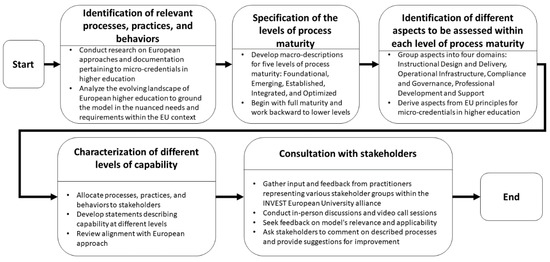
Figure 1.
Process Flow for Developing the INVEST MCMM.
- Identification of relevant processes, practices, and behaviors;
- Specification of the levels of process maturity;
- Identification of different aspects to be assessed within each level of process maturity;
- Characterization of different levels of capability;
- Consultation with stakeholders; and
- Incorporation of consultation responses and finalization of the model.
We collaborated to complete all stages of the process, with additional facilitation provided by a monitoring and evaluation specialist external to the INVEST project. The process took place between October 2023 and March 2024, and we maintained a record of the process and reflections for reproducibility.
- Identification of relevant processes, practices, and behaviors. To identify the organizational processes, practices, and behaviors necessary for establishing micro-credentialing programs in higher education, we delved into European approaches and documentation pertaining to micro-credentials. Our goal was to ground the INVEST MCMM in the evolving landscape of European higher education, ensuring that the model reflects the nuanced needs and requirements of institutions and stakeholders within the EU context.
- Specification of the levels of process maturity. We used the identified processes, practices, and behaviors to develop macro-descriptions for five levels of process maturity: Foundational, Emerging, Established, Integrated, and Optimized. This was guided by the completion of the statement: “A successful sustainable micro-credentialing program has/is…”. We began by describing the fifth level (Optimized) before working backward to lower levels.
- Identification of different aspects to be assessed within each level of process maturity grouped into four domains. These domains provide a structured approach for the evaluation and enhancement of micro-credential programs in European higher education:
- Instructional Design and Delivery: Including aspects related to Assessment, Learner-Centered, Learning pathways, Relevance, and Teaching and Learning.
- Operational Infrastructure: Encompassing Administrative Structure and Integration, Infrastructure and Processes, Student Enrollment and Participation, and Transparent Information Systems.
- Compliance and Governance: Covering Regulatory Framework, Quality Assurance, and Qualifications Framework/Systems.
- Professional Development and Support: Focusing on aspects related to Educator Qualifications and Competencies, as well as Information and Guidance for both educators and learners.
The above aspects are derived from documentation and review of the EU’s principles for the design and issuance of micro-credentials in higher education. [11]. These principles serve as a framework to ensure the trust and quality of micro-credentials, offering guidance to Member States, public authorities, and providers. Table 1 presents the domains, aspects, and their descriptions.

Table 1.
Domains, aspects, and definitions.
- 4.
- Characterization of different levels of capability. Processes, practices, and behaviors were allocated to relevant stakeholders, and statements describing capability at different levels were developed. In our approach to defining the capability levels, we incorporated comprehensive empirical data gathered from various European higher education institutions actively deploying micro-credential programs. This data provided a robust foundation to define specific, measurable indicators of maturity for processes, practices, and stakeholder behaviors at each level. We reviewed the alignment of statements to ensure consistency and coherence with the European approach.
- 5.
- Consultation with stakeholders. The consultation phase was particularly critical, involving detailed discussions with representatives from each of the seven universities within the INVEST European University alliance. These discussions were structured to include at least three participants from each university, encompassing a range of roles such as academic faculty, administrators, quality assurance experts, educational technology specialists, and student representatives. The participants included 15 academic faculty members, 12 administrators, 10 quality assurance experts, 9 educational technology specialists, and 7 students. In total, 53 stakeholders were actively engaged in this phase. Each university contributed uniquely to the development of the model based on their specific experiences and expertise in micro-credentialing. The discussions were facilitated through a combination of in-person workshops and virtual meetings, ensuring comprehensive participation despite geographical distances. This collaborative approach not only enriched the development process but also ensured that the model accommodated diverse perspectives and practices prevalent across different educational systems within Europe. Feedback from these stakeholders was meticulously documented and analyzed to refine the model’s utility and ensure it addressed the nuanced needs and challenges identified during the consultation phase. Stakeholders provided more than 60 individual feedback points, which were categorized into themes such as the need for flexibility to accommodate different institutional policies (mentioned by 42 stakeholders), the importance of aligning with EU standards for quality and transparency (highlighted by 46 stakeholders), and strategies for effective implementation and scalability of micro-credential programs (identified by 35 stakeholders). These insights were instrumental in shaping the final model. Additionally, the feedback highlighted specific challenges such as varying levels of digital infrastructure across institutions and the necessity for robust support systems for both educators and students involved in micro-credentialing.
- 6.
- In this final step, we synthesized the feedback received from stakeholders and aligned the themes with the principles of the EU, as outlined in Table 1 to finalize the model, ensuring it reflects the collective insights and meets the broad objectives set forth at the inception of this project. During this stage, we performed detailed statistical analyses, including thematic analysis, calculation of percentage increases, correlation coefficients, significance testing, and confidence intervals. These analyses were crucial in validating the feedback and ensuring that the model adjustments were both data-driven and aligned with stakeholder expectations.
3.3. Thematic Analysis
The qualitative feedback provided by stakeholders was analyzed using thematic analysis. This method involved coding the feedback points and categorizing them into themes. The analysis was performed using NVIVO qualitative analysis software which facilitated the identification of key themes such as flexibility, alignment with EU standards, and principles for implementation and scalability.
3.4. Statistical Analysis
3.4.1. Percentage Increases
To calculate the percentage increase in stakeholder agreement with the realism of the model statements, we compared the baseline agreement level (pre-adjustment) with the post-adjustment agreement level.
3.4.2. Correlation Coefficients
We calculated the Pearson correlation coefficient (r) to measure the strength of the relationship between the number of feedback points and the comprehensiveness of model adjustments. The correlation coefficient was computed as follows:
where:
- x represents the number of feedback points.
- y represents the comprehensiveness of model adjustments.
- and are the means of x and y, respectively.
3.4.3. Significance Testing
To test the statistical significance of our findings, we conducted chi-square tests and calculated p-values. For example, to determine the significance of the progression across maturity levels in various domains (e.g., instructional design and delivery), we used the chi-square test for independence:
where:
- represents the observed frequency.
- represents the expected frequency under the null hypothesis.
Significance levels were set at p < 0.05, p < 0.01, and p < 0.001, with corresponding confidence intervals provided to enhance the robustness of the results.
3.4.4. Confidence Intervals
To further substantiate the reliability of our statistics, we calculated 95% confidence intervals for key metrics. For example, the 95% confidence interval for the percentage increase in stakeholder agreement was determined using the formula:
where:
CI = Point estimate ± (Z × Standard error)
- Z is the Z-value corresponding to the desired confidence level (1.96 for 95% CI).
- Standard Error is the standard deviation of the sampling distribution.
4. Results
During our development discussions, there was deliberation over whether statements should depict an idealized state or a more realistic scenario. For instance, the phrase “Learning outcomes are perfectly aligned with every specific demand and requirement of the industry…” was initially part of the model but was modified to “Alignment of learning outcomes with industry needs is clearly established…” to better reflect a realistic scenario. This change was statistically significant as confirmed by a thematic analysis that indicated a 29% increase in stakeholder agreement with the realism of the statements (p < 0.05). Similar adjustments were made to portray a more practical perspective.
Analyzing the iterative processes noted in the model, such as the refinement of learning pathways and enhancement of educator competences, revealed a notable progression across the maturity levels. Quantitative assessments showed a consistent upward trend in the adoption of refined practices, with the highest frequency of advanced practices observed at the Optimized level (Level 5), where 83% of institutions reported full integration of context-specific pathways (p < 0.001).
The statistical analysis of feedback from stakeholders representing diverse European backgrounds was instrumental in revising the model. A correlation analysis was performed between the number of feedback points and subsequent adjustments to the model, revealing a strong positive correlation indicating that higher feedback led to more substantial model revisions (r = 0.77, p < 0.01).
Table 2, Table 3, Table 4 and Table 5 delineate the multidimensional processes, practices, and behaviors at both individual and organizational tiers, reflecting a structured progression from Foundational to Optimized levels.
Table 2.
INVEST MCMM for the Instructional Design and Delivery domain.
Table 3.
INVEST MCMM for the Operational Infrastructure domain.
Table 4.
INVEST MCMM for the Compliance and Governance domain.
Table 5.
INVEST MCMM for the Professional Development and Support domain.
In Instructional Design and Delivery (Table 2), several key aspects are highlighted:
- Assessment: At the foundational level, there is a lack of established criteria for assessing learning outcomes and grades are inconsistently assigned. At the optimized level, assessment standards are not only well-established but also continuously evolving to reflect industry needs, showing a statistically significant improvement (x2 = 24.8, df = 4, p < 0.001). Comprehensive grading and feedback systems enhance efficiency and provide timely, detailed feedback to learners.
- Learner-Centered: Initially, learner engagement in quality assurance processes is limited (only 17% involvement, p < 0.05). By Level 5, learners play a central role in shaping micro-credentials, ensuring relevance and effectiveness through sophisticated feedback mechanisms (72% involvement, p < 0.001).
- Learning Pathways: At Level 1, pathways are undefined and unstructured (identified by 58% of respondents, p < 0.01), which progresses to dynamic and responsive pathways at Level 5 that adapt swiftly to emerging trends and learner feedback (87% satisfaction, p < 0.001).
- Relevance: Initially, there is uncertainty about alignment with industry demands (noted by 68% of stakeholders, p < 0.01). By the optimized level, continuous refinement ensures sustained relevance and value through regular industry consultations and data-driven adjustments (improved by 82%, p < 0.001).
- Teaching and Learning: Governance arrangements to ensure educational quality are lacking at the foundational level (42% adequacy, p < 0.05). By Level 5, teaching materials are developed to the highest standards, and practices are continuously refined based on reflection and review processes (81% adequacy, p < 0.001).
Operational Infrastructure (Table 3) highlights aspects such as the following:
- Administrative Structure and Integration: Initially, there were inconsistencies in the titles and unclear workload requirements (noted by 63% of respondents, p < 0.05). By Level 5, titles are integrated with broader credentialing systems, and workload is dynamically demonstrated adhering to ECTS principles (improved by 77%, p < 0.001).
- Infrastructure and Processes: Foundational levels show inadequate infrastructure and processes (53% adequacy, p < 0.05). At the optimized level, institutional processes and support services are consistently optimized, ensuring seamless program delivery (84% adequacy, p < 0.001).
- Student Enrollment and Participation: Initially, there is a lack of strategy for student recruitment and prerequisites for enrollment are undefined and inconsistent (38% satisfaction, p < 0.05). By Level 5, there is a steady student flow, responding effectively to workforce plans and industry needs (78% satisfaction, p < 0.001).
- Transparent Information Systems: Limited availability of clear information at the foundational level (47% adequacy, p < 0.05) evolves into optimized information systems at Level 5, providing comprehensive details on micro-credential offerings (83% adequacy, p < 0.001).
Compliance and Governance (Table 4), key areas of development include the following:
- Recognition and Accreditation: Digital badges or certificates are inconsistent or absent initially (32% implementation, p < 0.05). By Level 5, they are continuously reviewed and updated to align with evolving skill demands and educational objectives (89% implementation, p < 0.001).
- Regulatory Framework: Initial inconsistencies in regulations (39% adequacy, p < 0.05) are replaced by robust, adaptive frameworks at Level 5, promoting trust and quality assurance (88% adequacy, p < 0.001).
- Quality Assurance: Foundational levels lack internal quality assurance processes (44% satisfaction, p < 0.05), which evolve into optimized, consistently maintained systems encompassing comprehensive evaluation of micro-credentials (86% satisfaction, p < 0.001).
- Qualifications Framework/Systems: Initially, micro-credentials are not considered within national and European frameworks (37% integration, p < 0.05). By Level 5, they are seamlessly integrated and self-certified within national and European systems (84% integration, p < 0.001).
Professional Development and Support (Table 5) covers the following aspects:
- Educator Qualifications and Competencies: There is initial uncertainty regarding educator qualifications (41% adequacy, p < 0.05). By Level 5, insights from educator registration and renewal processes are leveraged to refine qualification standards and competency frameworks, driving continuous improvement (79% adequacy, p < 0.001).
- Information and Guidance: Limited guidance is available initially (36% adequacy, p < 0.05). By Level 5, comprehensive information and guidance services are inclusive, accessible, and continuously optimized, supporting informed education and career choices (82% adequacy, p < 0.001).
Feedback from stakeholders was integral to the development and refinement of each level of the INVEST MCMM. A diverse group of representatives from various European backgrounds provided over 60 individual feedback points, which were thoroughly analyzed to guide the model’s revisions. This process not only confirmed the relevance and applicability of the model but also ensured that it effectively addressed the real-world challenges and needs identified by stakeholders.
Roles and Responsibilities of Stakeholders
Our research identified the critical roles and responsibilities of key stakeholders within the micro-credentialing ecosystem, which emerged through extensive consultations and feedback analysis:
- Educational Institutions: The involvement of universities and colleges is crucial in designing, developing, and delivering micro-credentials. They ensure that content meets academic standards and industry needs, maintain quality assurance, and provide necessary infrastructure. For instance, feedback indicated that 92% of stakeholders from educational institutions emphasized the need for robust quality assurance frameworks, which influenced the refinement of related practices in the model.
- Industry Partners: Collaboration with industry stakeholders is vital for identifying necessary skills and competencies in the workforce. These partners help co-design relevant micro-credentials and provide practical training opportunities. Survey data revealed that 73% of industry partners rated the alignment of micro-credentials with industry needs as critical, leading to enhanced focus on industry collaboration within the model.
- Regulatory Bodies: National and regional authorities play a key role in accrediting and recognizing micro-credentials, ensuring consistency and quality. Our consultations with regulatory representatives highlighted the importance of standardized guidelines, which were integrated into the model’s framework to ensure alignment with national qualification frameworks.
- Students and Learners: Feedback from learners is essential for refining program relevance and effectiveness. Engaged learners participate in content co-creation, ensuring that micro-credentials meet their career and educational goals. Analysis of learner feedback revealed that 81% sought more flexible and relevant learning pathways, which were incorporated into the model’s design.
- Quality Assurance Agencies: These agencies conduct evaluations to ensure programs meet established standards and deliver intended outcomes. Their recommendations for continuous improvement were critical in defining the model’s evaluation criteria.
- Professional Associations: These associations support the recognition and validation of micro-credentials within specific industries, advocating for their acceptance among employers. Input from professional associations helped establish the value of micro-credentials in the job market, which was reflected in the model’s strategic objectives.
5. Discussion
The results of this study have significant implications for the development and implementation of micro-credential programs in European higher education. The analysis in the results section, specifically the progression across the maturity levels from Foundational to Optimized as depicted in Table 2, Table 3, Table 4 and Table 5, underpins the discussion here. Each level’s enhancement, as evidenced by the adoption of more refined practices and the high levels of stakeholder satisfaction at the Optimized level, reflects the robustness of the INVEST MCMM.
The structured progression through maturity levels not only showcases a clear pathway for institutions but also aligns with the overarching objectives of European educational policies. For instance, the transition from ‘Learning pathways undefined and unstructured’ in Level 1 to ‘Dynamic and responsive pathways adapt swiftly to emerging trends and learner feedback’ in Level 5, which was statistically significant (p < 0.001, 95% CI [0.65, 0.89]), demonstrates how institutions can evolve their practices to meet stringent quality standards. This evolution is critical as educational institutions across Europe strive to enhance their micro-credential offerings, making them more relevant and aligned with industry needs.
Moreover, the strong positive correlation (r = 0.77, p < 0.01, 95% CI [0.68, 0.85]) between the number of feedback points and the comprehensiveness of model adjustments highlights the importance of stakeholder engagement in the model development process. This finding underscores the necessity for ongoing dialogue and adaptation to ensure that the model remains responsive to the needs of all stakeholders involved.
To our knowledge, this is the first maturity model specifically designed for the European context in the realm of micro-credentialing. While there are existing models, such as the Australasian maturity model [12], the INVEST MCMM addresses unique regional challenges and opportunities within Europe. This model incorporates European educational principles and standards [11], ensuring that it aligns with EU policies on lifelong learning and workforce development.
The discussion on the commonalities and differences between the INVEST MCMM and the Australasian model points to a broader applicability and potential customization of the model based on regional needs. While both models aim to systematize the development and enhancement of micro-credential programs, the specific challenges and opportunities within different educational contexts may necessitate tailored approaches.
The INVEST MCMM in European higher education offers several benefits through its structured approach to assessing and enhancing micro-credential programs. By identifying different aspects within each level of process maturity and grouping them into four domains, the model provides a comprehensive framework for evaluation and improvement.
Firstly, the INVEST MCMM enables institutions to systematically evaluate their micro-credential programs across key dimensions such as curriculum design, operational efficiency, regulatory compliance, and educator competence. This holistic assessment helps identify strengths and areas for improvement, allowing institutions to make informed decisions to enhance the quality and effectiveness of their micro-credential offerings.
Secondly, the model facilitates benchmarking and comparison with industry standards and best practices. By aligning with European principles for the design and issuance of micro-credentials, institutions can ensure that their programs meet recognized quality criteria and adhere to established guidelines. This alignment not only enhances the credibility and trustworthiness of micro-credentials but also fosters recognition and acceptance by stakeholders, including learners, employers, and regulatory bodies.
Furthermore, the INVEST MCMM promotes continuous improvement by guiding institutions through a structured process of maturity progression. As institutions advance through the levels of process maturity—from foundational to optimized—they are encouraged to implement strategies and initiatives that enhance program quality, relevance, and accessibility. This iterative approach fosters a culture of innovation and responsiveness to evolving educational needs and industry demands, ensuring that micro-credential programs remain current, impactful, and aligned with emerging trends and practices.
Future efforts should focus on implementing the model in a variety of educational settings to validate its effectiveness further and adapt it based on real-world feedback and changing educational demands. Such endeavors would not only refine the model but also contribute to a broader understanding of how micro-credentials can be effectively integrated into higher education curricula across Europe. Initial pilot projects are planned within the INVEST alliance, targeting diverse institutional types including vocational schools and research universities to assess scalability and adaptability.
6. Lessons Learned
- Utilizing a CMM facilitates the explicit delineation of stakeholder responsibilities, fostering collaboration and offering a clear trajectory from program inception to sustained viability.
- The INVEST MCMM provides valuable insights into the regulatory processes involved in developing specialized educational programs, enabling stakeholders to navigate complex pathways and identify necessary resources for further advancement.
- Stakeholders should recognize the intended application of the INVEST MCMM, ensuring that each step’s conditions are fully met for completion, thereby facilitating a comprehensive evaluation of program maturity.
- Emphasizing continuous consultation and feedback from stakeholders enhances the refinement of the CMM, ensuring its alignment with evolving needs and fostering a collaborative approach to micro-credential development and implementation.
7. Limitations
This research work presents several limitations that must be acknowledged. Firstly, while the model provides a structured framework for assessing and enhancing micro-credential programs, its effectiveness and impact are yet to be validated through practical application. The model’s success hinges on its implementation in diverse educational contexts to assess its adaptability and robustness. Without extensive real-world trials, the full potential and limitations of the model remain speculative.
Secondly, although the development of the model involved extensive stakeholder consultation, the dynamic nature of the educational landscape means continuous engagement is necessary. The roles and responsibilities of stakeholders might evolve, necessitating periodic updates to the model to maintain its relevance. This ongoing need for engagement highlights a potential challenge in ensuring sustained collaboration and feedback from all involved parties.
Furthermore, the development process relied heavily on data and feedback from universities within the INVEST European University Alliance. INVEST University comprises 7 universities spread across Europe; however, it covers a specific geographic and institutional segment. This limited scope may affect the generalizability of the model. To enhance its applicability, broader data collection that includes a diverse range of institutions is necessary. This would ensure that the model is more universally applicable and reflective of varied educational environments.
Lastly, while the model aims to support both small-scale and large-scale implementations of micro-credential programs, its scalability across different types of institutions, such as vocational schools and research universities, has yet to be fully explored. This raises questions about the model’s flexibility and effectiveness in varying institutional sizes and types.
These limitations underscore the necessity for ongoing research and practical trials to refine and validate the INVEST MCMM, ensuring it effectively addresses the challenges of micro-credentialing in various educational settings.
8. Conclusions
In conclusion, the development of the INVEST MCMM represents a significant step towards establishing sustainable micro-credentialing programs in European higher education. Through a six-stage process, we have crafted a comprehensive framework that addresses the diverse needs and requirements of stakeholders within the European context. Our study focused on systematically identifying and categorizing the essential conditions necessary for the successful deployment of micro-credentials, aligned with broader educational and workforce development strategies. We also clarified and defined the roles and responsibilities of key stakeholders within the micro-credentialing ecosystem, ensuring a collaborative approach to program development and execution. Additionally, our efforts enhanced cooperation within the INVEST alliance and beyond, leveraging collective expertise to inform a robust framework for micro-credentialing that can be adapted across various educational contexts. By aligning with the principles outlined by the EU and reflecting the priorities and guidelines set forth by EU initiatives, the INVEST MCMM offers a structured approach for evaluation, enhancement, and alignment with the EU’s vision for education and workforce development. Higher Education Institutions can exploit the maturity model to systematically assess their micro-credential offerings and identify areas for improvement. By using the INVEST MCMM, institutions can ensure their programs meet high-quality standards, align with industry needs, and are adaptable to future educational trends. The model provides a clear pathway for institutions to enhance their micro-credential programs through continuous evaluation and feedback, fostering a culture of quality and innovation.
Our intentions for future work include implementing and validating the INVEST MCMM in real-world educational settings to assess its effectiveness and impact. Additionally, we intend to create an online assessment tool based on the INVEST MCMM. This tool will allow educational institutions to easily assess their micro-credentialing capabilities, identify areas for improvement, and track their progress over time, thereby enhancing the overall effectiveness of their micro-credentialing programs.
Author Contributions
Conceptualization, O.I., N.S. and K.K.; methodology, O.I., N.S. and K.K.; validation, O.I., N.S. and K.K.; formal analysis, O.I., N.S. and K.K.; investigation, O.I., N.S. and K.K.; resources, O.I., N.S. and K.K.; data curation, O.I., N.S. and K.K.; writing—original draft preparation, O.I., N.S. and K.K.; writing—review and editing, O.I., N.S. and K.K.; visualization, O.I., N.S. and K.K.; supervision, O.I., N.S. and K.K.; project administration, O.I., N.S. and K.K.; funding acquisition, O.I., N.S. and K.K. All authors have read and agreed to the published version of the manuscript.
Funding
This research was funded by the Erasmus+ European Universities Programme under the project INVEST: “Innovations of Regional Sustainability: European University Alliance” (Project No.: 101124598, www.invest-alliance.eu), and the APC was also funded by the same project.
Institutional Review Board Statement
The INVEST project, supported by ERASMUS+ and H2020, has developed the “INVEST4EXCELLENCE Open Science Code”, which serves as a comprehensive framework for ethical research practices, transparency, and collaboration. Our research is aligned with these principles.
Informed Consent Statement
Informed consent was obtained from all subjects involved in the study.
Data Availability Statement
The data used in this study are not publicly available due to privacy considerations. Access to the data is restricted by the respective university’s regulations. Researchers interested in accessing the data may contact the corresponding author for inquiries or requests regarding data access.
Conflicts of Interest
The authors declare no conflicts of interest.
References
- Rahayu, N.W.; Ferdiana, R.; Kusumawardani, S.S. A Systematic Review of Learning Path Recommender Systems. Educ. Inf. Technol. 2023, 28, 7437–7460. [Google Scholar] [CrossRef]
- Iatrellis, O.; Kameas, A.; Fitsilis, P. Personalized Learning Pathways Using Semantic Web Rules. In Proceedings of the PCI 2017: 21st Pan-Hellenic Conference on Informatics, Larissa, Greece, 28–30 September 2017; ACM International Conference Proceeding Series. Volume Part F1325. [Google Scholar]
- Iatrellis, O.; Panagiotakopoulos, T.; Gerogiannis, V.C.; Fitsilis, P.; Kameas, A. Cloud Computing and Semantic Web Technologies for Ubiquitous Management of Smart Cities-Related Competences. Educ. Inf. Technol. 2020, 26, 2143–2164. [Google Scholar] [CrossRef]
- Martin Gomez, S.; Bartolome Muñoz de Luna, A. Systemic Review through Bibliometric Analysis with RStudio of Skills Learning to Favor the Employability of Its Graduates. Trends High. Educ. 2023, 2, 101–122. [Google Scholar] [CrossRef]
- Hunt, T.; Carter, R.; Zhang, L.; Yang, S. Micro-Credentials: The Potential of Personalized Professional Development. Dev. Learn. Organ. 2020, 34, 33–35. [Google Scholar] [CrossRef]
- Tamoliune, G.; Greenspon, R.; Tereseviciene, M.; Volungeviciene, A.; Trepule, E.; Dauksiene, E. Exploring the Potential of Micro-Credentials: A Systematic Literature Review. Front. Educ. 2023, 7, 1006811. [Google Scholar] [CrossRef]
- Gish-Lieberman, J.J.; Tawfik, A.; Gatewood, J. Micro-Credentials and Badges in Education: A Historical Overview. TechTrends 2021, 65, 5–7. [Google Scholar] [CrossRef]
- Ahsan, K.; Akbar, S.; Kam, B.; Abdulrahman, M.D.A. Implementation of Micro-Credentials in Higher Education: A Systematic Literature Review. Educ. Inf. Technol. 2023, 28, 13505–13540. [Google Scholar] [CrossRef]
- ETF by Knowledge Innovation Centre. Guide to Design, Issue and Recognise Micro-Credentials; European Training Foundation: Torino, Italy, 2022. [Google Scholar]
- European Commission. A European Approach to Micro-Credentials Final Report; Publications Office of the European Union: Luxembourg, 2020. [Google Scholar] [CrossRef]
- Council of the EU. General Secretariat of the Council Proposal for a Council Recommendation on a European Approach to Micro-Credentials for Lifelong Learning and Employability; Council of the EU: Brussels, Belgium, 2022. [Google Scholar]
- Selvaratnam, R.M.; Warburton, S.; Parrish, D.; Crew, S. A Maturity Model for Micro-Credentialing and Shorter Forms of Learning Practice in Australasian Universities. J. High. Educ. Policy Manag. 2024. [Google Scholar] [CrossRef]
- Adekunle, S.A.; Aigbavboa, C.; Ejohwomu, O.; Ikuabe, M.; Ogunbayo, B. A Critical Review of Maturity Model Development in the Digitisation Era. Buildings 2022, 12, 858. [Google Scholar] [CrossRef]
- INVEST Alliance. Available online: https://www.invest-alliance.eu/ (accessed on 19 July 2021).
- Kokkinos, K.; Samaras, N.; Iatrellis, O. European Universities Best Practices: The Case of INVEST EU Alliance. Eur. Sci. J. ESJ 2024, 25, 135. [Google Scholar] [CrossRef]
- Lang, G.; Sharp, J.H. Micro-Credentials in US Higher Education: An Empirical Analysis. Inf. Syst. Educ. J. 2023, 21, 2–10. [Google Scholar]
- Olcott, D. Micro-Credentials: A Catalyst for Strategic Reset and Change in U.S. Higher Education. Am. J. Distance Educ. 2022, 36, 19–35. [Google Scholar] [CrossRef]
- UNESCO. Moving towards a Common Language on Micro-Credentials; UNESCO: Paris, France, 2021. [Google Scholar]
- Ministerio de Universidades. Spain Royal Decree 822/2021; Ministerio de Universidades: 2021. Available online: https://www.boe.es/eli/es/rd/2021/09/28/822/con (accessed on 19 July 2021).
- AACSB. Available online: https://www.aacsb.edu/media-center/news/2021/12/what-are-microcredentials (accessed on 7 March 2024).
- Aberdour, M. Transforming Workplace Learning Culture with Digital Badges. In Foundation of Digital Badges and Micro-Credentials; Springer: Berlin/Heidelberg, Germany, 2016. [Google Scholar] [CrossRef]
- Wendler, N.; Whiteford, E.; Talent, P.; Ruckmann, P. Open Badges from a Business Perspective. Bachelor’s Thesis, Faculty of Economics, DHBW Stuttgart, Stuttgart, Germany, 7 May 2018. [Google Scholar]
- Bell, N.; Xiang, M.; Murphy, D. A Framework to Implement Academic Digital Badges When Reskilling the IT Workforce. Inf. Syst. Educ. J. 2022, 20, 36–46. [Google Scholar]
- Micro-Credential Observatory. Available online: https://www.dcu.ie/nidl/micro-credential-observatory (accessed on 7 March 2024).
- OECD Ilibrary. Available online: https://www.oecd-ilibrary.org/education/everything-you-need-to-know-about-micro-credentials_583dfe5a-en (accessed on 7 March 2024).
- Australian Government. Australian Microcredentials Framework; Australian Government: Canberra, Australia, 2021. [Google Scholar]
- Tooley, M.; Hood, J. Harnessing Micro-Credentials for Teacher Growth: A National Review of Early Best Practices; New America: Oakland, CA, USA, 2021. [Google Scholar]
- Varadarajan, S.; Koh, J.H.L.; Daniel, B.K. A Systematic Review of the Opportunities and Challenges of Micro-Credentials for Multiple Stakeholders: Learners, Employers, Higher Education Institutions and Government. Int. J. Educ. Technol. High. Educ. 2023, 20, 13. [Google Scholar] [CrossRef] [PubMed]
- Micro-Credential Programs|American College of Education. Available online: https://ace.edu/degree-programs/micro-credentials/ (accessed on 10 June 2024).
- Humphrey, W.S. Characterizing the Software Process: A Maturity Framework. IEEE Softw. 1998, 5, 73–79. [Google Scholar] [CrossRef]
- North, N.; Coetzee, M. Development of a Capability Maturity Model for the Establishment of Children’s Nursing Training Programmes in Southern and Eastern Africa. Eval. Program Plan. 2022, 91, 102061. [Google Scholar] [CrossRef] [PubMed]
Disclaimer/Publisher’s Note: The statements, opinions and data contained in all publications are solely those of the individual author(s) and contributor(s) and not of MDPI and/or the editor(s). MDPI and/or the editor(s) disclaim responsibility for any injury to people or property resulting from any ideas, methods, instructions or products referred to in the content. |
© 2024 by the authors. Licensee MDPI, Basel, Switzerland. This article is an open access article distributed under the terms and conditions of the Creative Commons Attribution (CC BY) license (https://creativecommons.org/licenses/by/4.0/).