


Abstract
An electronic nose, designed to replicate human olfaction, captures distinctive ‘fingerprint’ data from mixed gases or odors. Comprising a gas sensing system and an information processing unit, electronic noses have evolved significantly since their inception in the 1980s. They have transitioned from bulky, costly, and energy-intensive devices to today’s streamlined, economical models with minimal power requirements. This paper presents a comprehensive and systematic review of the electronic nose technology domain, with a special focus on advancements over the last five years. It highlights emerging applications, innovative methodologies, and potential future directions that have not been extensively covered in previous reviews. The review explores the application of electronic noses across diverse fields such as food analysis, environmental monitoring, and medical diagnostics, including new domains like veterinary pathology and pest detection. This work aims to underline the adaptability of electronic noses and contribute to their continued development and application in various industries, thereby addressing gaps in current literature and suggesting avenues for future research.
1. Introduction
The sense of smell is one of the oldest human senses, as living organisms throughout history have used it to detect odors and interact with the surrounding world. Since the introduction of the concept of electronic noses in the 1980s [1], this technology has witnessed significant development. Electronic noses now represent a standard tool that simulates the human sense of smell, detecting and analyzing odors and providing precise information, known as a ‘fingerprint,’ about mixed gases and scents [2].
Electronic noses (e-noses) typically consist of two main parts: a gas sensing system, which includes a set of gas sensors and gas transmission pathways, and an information processing system, which includes a precise processor, related devices, and pattern recognition algorithms [2,3,4,5,6]. Over the past thirty years and since the introduction of the electronic nose concept in the 1980s, we have seen significant advancement in this field. These technologies have transitioned from being large, costly, and energy-consuming devices to being small, cost-effective, and energy-efficient ones.
Since it is a tool used daily in food analysis [7,8], medical diagnosis [7,9], environmental monitoring [9,10], security, and various other fields, the response speed is a key driver for the development of the electronic nose. It is expected that the integrated electronic nose will be capable of detecting, identifying, and measuring volatile compounds in less than a few minutes, ideally in seconds [2].
Despite their broad applications and significant technological advancements, the most recent innovations and developments in recent years have not been thoroughly reviewed. This paper aims to bridge this gap by synthesizing cutting-edge research that leverages newer sensor technologies and computational methods, thus expanding the application spectrum of e-noses.
Our systematic review is distinct in its focus on the latest innovations that have emerged since traditional reviews. It presents a fresh perspective on the challenges, solutions, and future directions of e-nose technology. This timely contribution is crucial, as it reflects current trends and emerging needs within the scientific community, providing a pivotal reference point for researchers and industry professionals alike.
In order to differentiate this review paper from existing articles, we conducted a keyword search within the Scopus database, employing terms such as ‘electronic nose’, ‘integrated’, ‘mobile e-nose’, ‘wearable e-nose’, and ‘gas sensor array’ within the relevant literature. We included the relevant review literature found, as shown in Table 1. Currently, the predominant focus in existing reviews revolves around sensor devices, diverse applications, and data processing algorithms related to electronic noses, with limited attention paid to the progress in achieving transportability and rapid response in integrated electronic nose devices.

Table 1.
Comprehensive overview of e-nose reviews.
2. E-Nose System
2.1. Historical Evolution of Sensory Technologies
The inception of odor examination tools dates back to 1954, when Hartman introduced a pivotal advancement—a microelectrode featuring a platinum wire connected to a millivoltmeter [43]. This innovation paved the way for subsequent developments. A few years later, Moncrieff unveiled a mechanical olfactory system, laying the groundwork for discriminating between both simple and intricate aromas [44,45].
The pursuit of replicating the complexities of the human olfactory system led to remarkable breakthroughs. In 1982, Persaud and Dodd achieved a significant milestone at Warwick University by unveiling the first intelligent model of an artificial nose [44]. Comprising three metal oxide sensors, this innovation displayed the remarkable capability to identify up to 20 distinct odorants. Following this, Ikegami and Kaneyasu introduced an integrated sensor, equipped with six diverse metal oxide semiconductors, which demonstrated the ability to identify and quantify scents [46]. These strides marked significant progress in emulating the intricate human olfactory system [20,47].
In a pivotal moment in 1988, Gardner and Bartlett introduced the term “electronic nose,” drawing a parallel to the biological sense of smell. This terminology has since gained widespread recognition, underscoring the essence of the technology [1]. Notably, the electronic nose (e-nose) system consists of several essential components: a sampling system for handling and storing samples during analysis, a sensor array to capture signals resulting from interactions between sensing materials and volatile compounds, and a computer responsible for data storage, pre-processing, and processing [48,49,50], as illustrated in Figure 1.
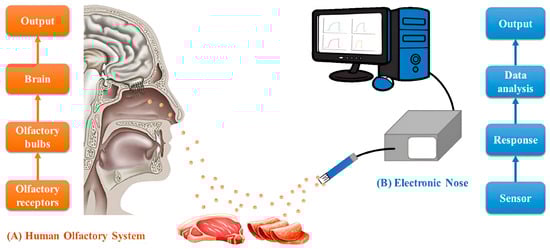
Figure 1.
Schematic illustration of the biological olfactory system (A) and e-nose technology (B) [50].
The 1990s witnessed the commercialization of electronic noses, with the advent of offerings by pioneers like AlphaMOS (1993), followed by Neotronics and Aromascan (1994). The burgeoning potential of applications propelled the growth of the electronic nose systems market, leading to the development of a diverse array of devices utilizing various sensing technologies. While several companies currently serve the market, it is worth noting that certain e-nose systems, previously prominent in the literature, are no longer available [51].
Building upon the triumphs of electronic noses, the journey expanded toward crafting devices capable of mimicking the human gustatory system. In 1985, Otto and Thomas took a significant step by unveiling a system designed for analyzing liquid samples. This pioneering system hinged on a sensor array, marking a novel approach in taste detection technology [52].
Furthermore, the historical progression of e-nose technology has seen an exploration of novel applications beyond traditional odor analysis. These include areas such as disease diagnosis through breath analysis, food quality assessment, environmental monitoring, and even security and defense applications [53]. This diversification underscores the versatility and utility of e-nose technology across different domains, paving the way for its widespread adoption in various fields.
2.2. Principle of Odor Sensors
At the heart of the e-nose technology lies the fundamental principle of odor sensors, mirroring the intricate mechanisms of the human olfactory system. In analogy to the human nose’s olfactory receptors, the e-nose employs an electronic sensor array to detect even minute traces of diverse chemicals present in the ambient air [54]. This technological counterpart parallels the human olfactory system, where receptors in the nose identify volatile molecules, initiating the transmission of signals to the olfactory bulb. Here, the odor is transformed into a recognizable stimulus, ultimately interpreted by the brain [54].
In the e-nose realm, the symbiotic relationship between hardware and software components becomes paramount. The software aspect serves as the system’s “brain”, while the hardware component, represented by an array of sensors, emulates the function of “olfactory receptors”. This array engages with volatile compounds, generating distinct signal patterns that are subsequently subjected to processing and classification using digital signatures associated with specific chemicals, culminating in precise odor identification [54].
Comparatively, while the human olfactory system relies on approximately 100 million sensors for odor perception, the e-nose achieves this feat through its sensor array. This divergence leads to the replacement of the olfactory bulb’s recognition role with a computer equipped with advanced algorithms, enabling feature extraction and pattern recognition [54].
A diverse range of sensor materials contribute to the e-nose’s efficacy, encompassing options such as semiconducting metal oxides, MOX sensors (Honeywell, Charlotte, NC, USA), field-effect metal-oxide-semiconductor transistor sensors (MOSFET) (Metoree, Tokyo, Japan), mass-sensitive sensors (JLM Innovation, Tübingen, Germany), conductive organic polymers (CP), solid electrolyte sensors (SES) (SES AI, Woburn, MA, USA), and optic fiber sensors (Omega Engineering, Inc., Norwalk, CT, USA) [21]. Among these, MOX sensors, extensively employed in commercial applications, operate based on the alteration of oxide conductivity upon exposure to oxidant or reducing gases, triggering surface-based reduction and oxidation reactions [49].
2.3. Gas Sensing Mechanism
Gas sensors based on MOX operate on the fundamental principle of resistance changes in semiconductor sensor elements when exposed to oxidative or reductive gases at elevated temperatures [55,56]. These sensors exhibit remarkable energy conversion capabilities, effectively transforming various input signals, whether physical, chemical, or biological in nature, into electrical output signals. For resistive gas sensors, two crucial aspects play a vital role: the recognition of target gas molecules and the subsequent transduction of their signals.
At temperatures ranging from 100 to 500 °C, MOX exhibits a fascinating interaction with atmospheric oxygen, known as ionosorption, which involves the adsorption of oxygen ions in various forms, including molecular O2−, O−, and O²− [57]. This intriguing adsorption of oxygen ions on the surface of MOX forms the basis of its gas sensing mechanism [57].
The excitation of MOX electrons occurs when the material is exposed to thermal or light energy, causing them to transition from the top of the valence band to the bottom of the conduction band [58]. This process of electron excitation plays a pivotal role in facilitating the subsequent ionosorption of oxygen on the MOX surface.
Consequently, various forms of oxygen ions, such as O−, O²−, and O²−, are formed on the MOX surface due to the extraction of electrons from its conduction band when exposed to atmospheric air during the sensing process, as shown in Figure 2a,b [59,60]. The specific types of oxygen ions formed depend on the working temperature of the sensor.
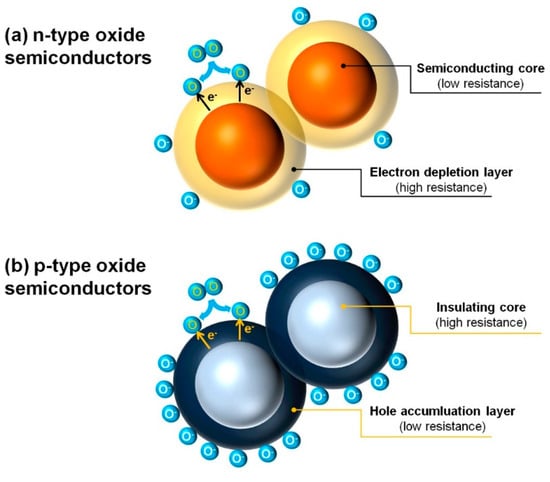
Figure 2.
Generation of electronic core–shell configurations in (a,b) [59].
At relatively lower working temperatures, typically below 200 °C, the dominant process involves electrons attaching to oxygen molecules (O2−) on the MOX surface, leading to the formation of O²− ions as indicated by Equation (1) [61]. However, as the working temperature increases beyond 250 °C, a more intricate dissociation process takes place. The higher temperature facilitates the breaking of oxygen molecules, resulting in the formation of oxygen ions, including O− and O2−, along with the extracted electrons from the MOX conduction band [61].
The temperature-dependent formation of oxygen ions is described by the following equations [61]:
These equations represent the dynamic processes of oxygen ions’ adsorption and formation on the surface of MOX at different temperatures during the gas sensing operation. At temperatures below 200 °C (Equation (2)), electrons combine with oxygen molecules to form O2− ions. As the temperature increases beyond 250 °C, more complex dissociation processes take place. At temperatures below 250 °C (Equation (3)), 1/2 O2 molecules combine with electrons to form O− ions. However, at temperatures above 250 °C (Equation (4)), 1/2 O2 molecules combine with two electrons to form O²− ions. These temperature-dependent processes significantly influence the sensitivity and response of the MOX gas sensor to various gases.
Metal oxide semiconductors, which play a crucial role in gas sensing applications, are divided into two distinct groups based on their majority carriers. N-type MOSs, such as ZnO [62,63], In2O3 [64,65], Fe3O2 [62,66], TiO2 [67,68], WO3 [69,70], and SnO2 [71,72], exhibit electrons as their majority carriers, whereas p-type semiconductors, including NiO [73], Co3O4 [74], Cr2O3 [75], Mn3O4 [76], and CuO [77], have holes as their majority carriers.
In the field of gas sensing, n-type MOX gas sensors have been extensively studied and well documented. However, p-type MOX gas sensors have received comparatively less attention, and the research in this area is still in its early stages. Figure 3 illustrates the research landscape for p-type and n-type MOX gas sensors, gathered from Web of Knowledge on 1 March 2024, utilizing keywords like “gas sensor” and “ZnO”. Out of all of the articles related to MOX gas sensors, only a mere 13% pertain to p-type MOX gas sensors.
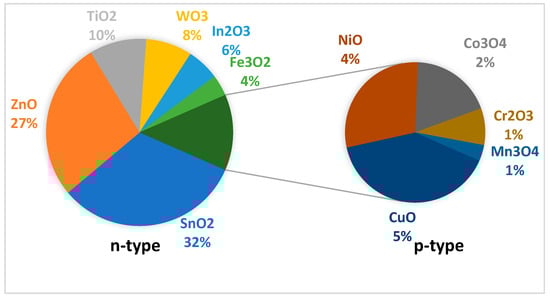
Figure 3.
An analysis of research activities concerning n-type and p-type oxide semiconductor gas sensors derived from an internet search on Web of Knowledge, conducted on 15 March 2024.
The process of adsorbing atmospheric oxygen onto the surface of metal oxides is uniform for both n-type and p-type semiconducting metal oxides. However, the resulting effects are notably distinct. In the case of n-type semiconductors, this ionosorption of oxygen results in a depleted surface area, leading to high resistivity. Conversely, for p-type semiconductors, the ionosorption process leads to the formation of an accumulation layer, resulting in a highly conductive surface region.
However, despite significant advancements, MOX sensors continue to face challenges such as susceptibility to poisoning, drift, low selectivity, low repeatability, and prolonged response and recovery times. These issues hinder their reliability and applicability in diverse settings, impeding their utility for real-time monitoring and precise gas identification. Addressing these challenges is essential for advancing MOX sensor technology and broadening its practical utility in various fields.
2.4. The Electronic Nose’s Brain: Algorithms and Visualization
A crucial element within the realm of electronic noses is their cognitive core, often referred to as the “brain”. This section delves into the intricate processes of visualization methods and algorithms, elucidating their significance in achieving selectivity and discernment in sensor array responses.
The essence of an electronic nose’s efficacy hinges on the processing and synthesis of responses from an array of sensors, which generally include signal filtering, switching, and feature extraction. The manipulation of data matrices derived from these sensors is pivotal for optimal performance.
Once the signal has undergone preprocessing, it undergoes another round of analysis through pattern recognition. Through training, the electronic nose system grasps the traits of the odor under examination and predicts attributes of samples with unknown concentrations using a predefined model based on characteristic relationships. Commonly employed pattern recognition algorithms in electronic nose detection systems include principal component analysis (PCA) [78], linear discriminant analysis (LDA) [79], partial least squares regression (PLSR) [80], support vector machines (SVMs) [81], and artificial neural networks [82].
2.4.1. Principal Component Analysis
PCA, an age-old yet increasingly relevant technique in the realm of sensors, functions as a data reduction strategy within multivariate statistics. This method aims to transform the initial N variables of a dataset into a new coordinate system of dimension N, while preserving the majority of the information contained in the original variables. Through this transformation, the variable with the highest variance is projected onto the primary axis, followed by the next most variant variable onto the second axis, and so forth. While originally designed to address unwieldy datasets, its application in the context of e-noses often centers around condensing a limited number of variables (typically 6–12) into two or three dimensions for visualization. This graphical representation facilitates qualitative classification, where distinctive clusters of points linked to specific gases become discernible. Such clusters offer an intuitive basis for classifying new measurements, assuming proximity to a relevant cluster. However, this approach leans heavily on human interpretation, making it subjective and vulnerable to biases. To enhance the objectivity of PCA analysis, alternative classification techniques have been developed, employing algorithmic autonomy to assign labels that denote the class to which a new data point belongs [83].
2.4.2. Linear Discriminant Analysis
LDA, a frequently employed discriminant technique, optimizes the variance ratio between classes and within classes by transforming original variables through linear combinations, ensuring effective separation of classes. Its primary goal is to project datasets onto lower dimensional spaces that enhance class distinguishability, mitigating overfitting concerns and reducing computational complexity. Serving as a method of linear transformation for dimensionality reduction, LDA shares similarities with PCA [84,85].
Going a step further, LDA presents itself as a robust tool with parallels to PCA in dimensionality reduction, visualization, and as a dependable classification approach. It undertakes a linear transformation from an N-dimensional space to a lower dimensional space (M < N), aiming to retain essential information and minimize noise. Unlike PCA, LDA specifically enhances inter-class variance and maximizes inter-class separation, optimizing distinction. This property facilitates dividing space into regions associated with specific classes, such as gases in our context.
Distinguishing itself from PCA, LDA operates as a supervised method, employing a training dataset to construct a model that evaluates new data against the established model [86]. This enables LDA to serve as a classifier, comparing incoming data to the trained model and labeling the data based on proximity to certain groups (in our case, different gases). This method yields a direct classification label as output, eliminating the need for subjective interpretation and ensuring true classification. As with other supervised methods, it is essential to test models on independent datasets, distinct from the training data.
2.4.3. Partial Least Squares Regression
PLSR is a method that amalgamates the attributes of both PCA and multiple linear regression MLR. Its primary objective is the analysis or prediction of dependent variables based on independent variables or predictors. This predictive capability is harnessed by extracting orthogonal factors termed latent variables from the predictors [87]. These latent variables encapsulate the most potent predictive insights. PLSR is especially advantageous when it comes to forecasting dependent variables from an extensive array of independent variables. This technique not only captures underlying patterns and relationships but also handles situations where there might be multicollinearity among predictors. In essence, PLSR combines the strengths of PCA and linear regression to offer a comprehensive and robust approach to predictive modeling.
2.4.4. Support Vector Machines
SVM is a powerful supervised machine learning algorithm utilized primarily for classification tasks, though it also extends to regression. The core principle of an SVM involves mapping labeled data points onto an N-dimensional space with the aim of maximizing the separation between distinct categories. When new data points are introduced, they are projected into this space and assigned to a category based on their position within that space [88].
Operating in a binary fashion, SVM handles two classes at a time, seeking to identify a hyperplane that can optimally segregate the classes. If a straightforward hyperplane does not suffice, SVM identifies the hyperplane that maximizes the distance between data points from the two considered classes, utilizing support vectors. If a clear hyperplane is not possible even in the expanded feature space, SVM employs nonlinear transformations through kernels to elevate dimensionality of the data, facilitating effective classification without excessive data manipulation.
In regression scenarios, SVM applies comparable principles to those used in classification, though with some nuances. The central objective remains minimizing errors by defining a hyperplane (a subspace of N − 1 dimensions) that maximizes the margin while accounting for potential error tolerance [89,90,91,92]. By harnessing SVM’s capabilities both as a classifier and a regressor (with independent regressors for each class), exceptional outcomes are attainable for classification and quantification tasks alike.
2.4.5. Artificial Neural Networks
ANNs replicate brain-like problem-solving and data processing. Composed of interconnected processing elements, ANNs excel at handling complex, nonlinear data. They consist of input, hidden, and output layers, with nodes transmitting signals for decision-making. ANNs originated from McCulloch and Pitts’ concept in 1943 [93] and have been applied to electronic noses.
In ANNs, data are processed in two phases: forward-pass (signal propagation) and backward-pass (error correction). Synaptic weights connecting nodes are adjusted to minimize output errors. ANNs are adept at supervised learning when trained with labeled data using algorithms like the vanishing gradient method [94,95,96].
In electronic noses, ANNs learn from labeled data, recognizing patterns and making accurate predictions. Their strength lies in efficiently capturing and analyzing complex, multi-dimensional data patterns, which is crucial in the diverse and variable-rich environments wherein electronic noses are deployed. This capability makes ANNs exceptionally well suited for enhancing the accuracy and reliability of odor detection and classification in these systems. Table 2 provides a succinct overview of the fundamental features and functionalities of the discussed computational treatments.
Table 2.
Summary of computational treatment features and trends.
3. Application Areas
Throughout its evolution, electronic nose (e-nose) technology has undergone extensive development and evaluation across a diverse range of applications. This section offers a comprehensive exploration of the various domains wherein e-noses have found utility. A sweeping perspective will be provided, encompassing different fields of application while also delving into specific instances to elucidate their significance in greater detail. This review aims to showcase the versatile nature of e-noses by shedding light on their multifaceted applications and highlighting notable examples that exemplify their efficacy in diverse scenarios.
3.1. Food Analysis
3.1.1. Quality Assurance
Quality assurance in food analysis through e-nose technology involves meticulous control measures to mitigate the impact of ambient odors or environmental factors on scent-based measurements. Researchers conduct experiments in controlled environments with regulated temperature, humidity, and airflow to minimize external factors. Before scent-based measurements, the background odor in the testing environment is analyzed and characterized to identify any potential interference. Electronic nose systems are calibrated to account for baseline readings and variations in ambient odor levels. Machine learning algorithms and advanced signal processing techniques are then employed to distinguish between the target odor of the food sample and background odors. Validation studies compare electronic nose system results to reference methods or human sensory evaluations to ensure accuracy and reliability.
3.1.2. Applications in Different Food Sectors
The electronic nose has emerged as a versatile and indispensable tool within the food industry, offering a multifaceted array of applications that significantly contribute to quality assurance, origin tracking, process optimization, and waste reduction. Specifically designed to detect and analyze VOCs emitted by diverse food products, these sophisticated devices serve as catalysts for a range of functions that bolster food safety, ensure freshness, and elevate overall quality management.
The prowess of electronic noses in discerning varying product qualities and provenances has become pivotal across diverse food sectors, encompassing commodities such as olive oil, green tea, and wine [97,98,99]. These advanced olfactory systems possess an innate ability to delve into the intricate aromatic profiles inherent to distinct products, facilitating precise categorization based on their unique quality attributes. This inherent capability not only shields against deceptive practices but also stands as a cornerstone of consumer satisfaction and trust. A compelling illustration of this potential is highlighted by the groundbreaking research conducted by Yu et al. [98], who adeptly employed an electronic nose equipped with a sophisticated array of ten SMOX-based sensors. In their study, the headspace emanating from a range of tea samples was methodically introduced into the sensor chamber at a steady flow rate of 50 mL/min. Each measurement was conducted for a duration of 60 s. As a result of their innovative approach, the research yielded precise differentiation among various grades of green tea.
The vigilance exercised in overseeing and regulating production processes forms the bedrock of sustaining a consistent and superior food quality standard. Within this realm, the integration of e-nose technology emerges as a pivotal player, endowing the capability to meticulously track and evaluate complex manufacturing procedures, as exemplified by the intricate process of coffee bean roasting [100]. By meticulously scrutinizing the nuanced changes embedded within aroma profiles during the roasting process, electronic noses enable real-time assessments of roasting degrees, thereby serving as custodians of product uniformity.
A landmark achievement in this domain is embodied by the groundbreaking work of Romani et al. [100]. Leveraging an e-nose equipped with state-of-the-art SMOX-based sensors and an artificial neural network, developed by AIRSENSE Analytics in Milan, Italy, their research culminated in quantifying degrees of coffee bean roasting. This endeavor marks a pivotal stride towards the realization of an in-line monitoring system tailored to the intricacies of the coffee bean roasting process. The fusion of cutting-edge sensor technology and advanced data analysis methodologies facilitated the detection of subtle variations in aroma profiles during roasting, providing a comprehensive insight into the dynamic transformations occurring within the beans. This innovation significantly contributes to optimizing the roasting process, thereby elevating the final product’s consistency and sensory attributes.
The accurate assessment of food freshness stands as an imperious goal in mitigating food wastage and safeguarding consumer well-being. Within this endeavor, electronic noses emerge as indispensable tools, orchestrating a multifaceted approach to trace the complex trajectory of odorous transformations inherent in food spoilage. Notably, these devices, fortified by semiconductor thin film sensors and dynamic principal component analysis, have been harnessed to scrutinize the degradation of milk freshness [101]. This application underscores the device’s adeptness at scrutinizing evolving scent profiles, enabling a comprehensive evaluation of the milk’s susceptibility to rancidity.
Beyond milk, the proficiency of electronic noses extends to diverse meat categories, most notably encompassing beef, poultry, and fish. These electronic olfactory systems adeptly capture volatile compounds arising during the decomposition process, thereby facilitating nuanced assessments of spoilage [102,103,104]. By discerning the distinctive odors emanating from different meat types as they undergo degradation, electronic noses serve as invaluable resources in identifying early signs of spoilage, preempting potential health hazards, and advancing the overarching goal of minimizing food waste.
The integration of electronic noses for freshness monitoring transcends the purview of individual food items, projecting their potential impact in revolutionizing food storage practices and distribution networks. As these devices continue to evolve, incorporating advanced sensing technologies and pattern recognition algorithms, their efficacy in detecting and deciphering the intricate spectrum of volatile compounds associated with food deterioration is poised to intensify. Ultimately, the adoption of electronic noses as stalwart guardians of freshness bolsters the commitment towards sustainability, food security, and the assurance of untainted and safe consumption experiences.
The convergence of e-nose technology with intelligent packaging systems embodies a nascent frontier teeming with transformative potential in curbing food wastage. In this burgeoning arena, the amalgamation of compact e-nose devices, exemplified by products like the FOODsniffer, has already made inroads into the consumer market, empowering individuals to independently assess the freshness status of their food items [Retrieved from www.myfoodsniffer.com, accessed on 12 August 2023 at 09:30]. Yet the true metamorphic potential crystallizes in the ongoing research endeavors aimed at seamlessly integrating e-nose sensors directly into the fabric of food packaging materials. Rieu et al. successfully inkjet printed SnO2 sensors onto polyimide foil [105].
The trajectory of embedding e-nose sensors within packaging materials heralds an unprecedented paradigm shift in minimizing food wastage. By enabling continuous monitoring of packaged food conditions, this approach addresses a fundamental challenge: the uncertainty surrounding item integrity and freshness, even prior to reaching the consumer. Through this integration, food producers, distributors, and consumers stand to glean a comprehensive understanding of the product’s status across its lifecycle, empowering timely interventions and informed decision-making.
This transformative potential is rooted in the bedrock of sensor technology advancements and innovative integration methodologies currently under exploration. As electronic noses evolve to discern an expanding spectrum of volatile compounds associated with freshness, their efficacy in safeguarding food quality is poised for a meteoric rise. This advancement seamlessly aligns with the overarching objective of reducing food waste, as the monitoring-centric approach guarantees consumption at the optimal point of freshness. In the symphony of technological innovation and sustainability aspirations, electronic noses are poised to orchestrate a harmonious evolution in the food industry—a revolution characterized by quality, efficiency, and reduced waste.
3.2. Environmental Monitoring
Electronic noses find applications in various environmental contexts, encompassing several key areas: (i) analysis of air quality parameters, (ii) monitoring water quality, (iii) facilitating process control, (iv) safeguarding worker health, especially in confined industrial environments such as factories and mines, and (v) evaluating the efficiency of odor control systems [29].
In each of these contexts, electronic noses serve as either viable alternatives to or supportive tools alongside traditional analytical methods. In the realm of air quality assessment, for instance, an electronic nose based on metal oxide (MOX) sensors can stand in for gas chromatography to identify and quantify a range of pollutants [106]. Similarly, for process control, where conventional analysis methods can be resource-intensive and time-consuming, an e-nose offers an economical solution. As an illustration, preventing undesired anaerobic processes in a composting facility necessitates measurements of temperature, oxygen levels, pH, and microbial activity [107]. Alternatively, a specialized e-nose tailored to the composting process can yield similar data at reduced costs and complexity, employing a descriptive approach.
Beyond acting as complements or substitutes for analytical methods, electronic noses uniquely possess the ability to evaluate and categorize odors, making them essential for quantifying olfactory perceptions. Consequently, appropriate sensing techniques are harnessed to quantitatively assess odors.
Indeed, the preservation of workers’ health in coal mines stands as a paramount reason that propelled the development of gas sensors.
Historically, the coal mining industry faced substantial challenges due to the presence of perilous gases like hydrogen sulfide (H2S) and methane (CH4) in mine shafts [108]. To address this, ingenious solutions were developed. John Scott Haldane, a Scottish physiologist, introduced the use of canaries as live indicators of gas presence. Canaries, being sensitive to toxic gases, served as early warning systems. If the birds exhibited distress or stopped singing, it signaled the presence of hazardous gases, prompting miners to evacuate [109].
Technological progress spurred the evolution of gas sensors. Dr. Jiro Tsuji’s work in the 1920s involving sensors based on light wave interference demonstrated a pivotal step forward [110]. Oliver Johnson’s patent for combustion-type sensors in the 1950s further contributed to the field’s advancement [110,111]. The introduction of solid-state metal-oxide gas (SMOX) sensors by Naoyoshi Taguchi in the 1960s marked a transformative milestone [110,111]. This progression paved the way for the integration of gas sensing technology into broader monitoring systems.
Today, electronic noses stand as remarkable embodiments of this evolution. These noses, equipped with sophisticated gas sensors, offer real-time and accurate detection of a diverse range of volatile compounds and gases. For instance, they enable the continuous monitoring of air quality in urban environments, alerting authorities to the presence of pollutants such as nitrogen dioxide (NO2), sulfur dioxide (SO2), and ozone (O3) [112]. A thorough summary of air quality monitoring is meticulously presented in Table 3. Moreover, in industrial zones, electronic noses play a crucial role in identifying noxious emissions emanating from factories and plants, enabling swift intervention to alleviate potential detrimental effects on both human well-being and the ecosystem.
Table 3.
Overview of studies on electronic nose applications for gas analysis in the environment.
S. Licen et al. conducted a comprehensive study investigating ambient air composition in proximity to a gas and oil pretreatment plant located southwest of COVA (see Figure 4), utilizing a cutting-edge electronic nose equipped with 10 metal oxide semiconductor (MOX) sensors [122]. The research spanned three months, involving the continuous outdoor deployment of the electronic nose to oversee air quality [122].
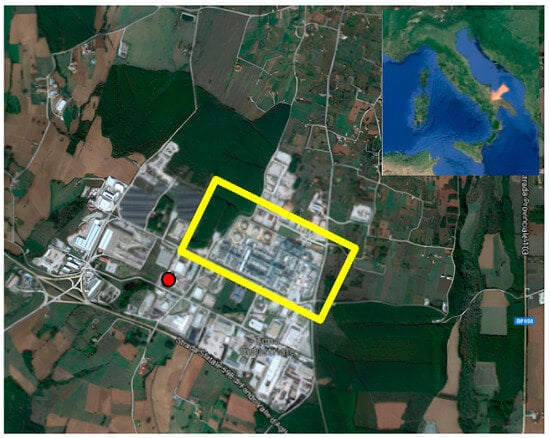
Figure 4.
Map of the monitored site [122].
As depicted in Figure 4, a map detailing the monitored site offers a visual depiction of the geographical context of the investigation. The red dot signifies the precise placement of the deployed electronic nose, while the adjacent yellow rectangle outlines the position of the gas and oil pretreatment plant. To provide a broader geographical context, an inset in the upper right corner, indicated by an arrow, signifies the site’s location within Italy. This spatial insight provides a comprehensive overview of the monitoring setup’s relation to the surrounding area.
Employing advanced data analysis techniques, such as the self-organizing map (SOM) algorithm and k-means clustering, Lisen proficiently processed the extensive e-nose dataset, successfully uncovering anomalous data clusters that pointed to dynamic multisensory system responses (Lisen, Year). Through SOM analysis, distinct air type profiles emerged, including a sensor profile associated with odor fugitive emissions from the industrial plant [122].
Supplementary data, encompassing wind speed and direction alongside total volatile organic compound (VOC) detector information, were amalgamated to validate the sensor responses and further substantiate the detection of odor-related emissions (Lisen, Year). This refined model empowered Lisen to ascertain not only the temporal extent but also the frequency of industrial-emission-related air presence at the monitoring site [122].
In recent research, C. Pace et al. [123] developed an innovative electronic nose (e-nose) system for safety monitoring applications in refinery environments. Their study focused on the early and distributed detection of dangerous gas mixtures, employing a selection of commercial off-the-shelf (COTS) sensors (PEKO Precision Products, Rochester, NY, USA). The e-nose system incorporated efficient algorithms for gas classification, concentration estimation, and risk threshold warnings, while considering factors such as oxygen concentration, temperature, and relative humidity. This work showcases the potential of low-cost e-nose technology to contribute to wide-area monitoring of hazardous situations in industrial settings.
The developed system (see Figure 5), as reported by Pace et al. [123] is designed to address the critical need for timely detection of hazardous gases in refinery environments. It employs a range of sensors, including semiconductor, catalytic, and electrochemical types, to ensure enhanced selectivity and accurate gas detection. The system’s architecture includes a multifunction board for signal conditioning and data sampling, connected to a personal computer for advanced data analysis and processing. The integration of pattern recognition techniques further enhances the system’s ability to discriminate between different gas mixtures.
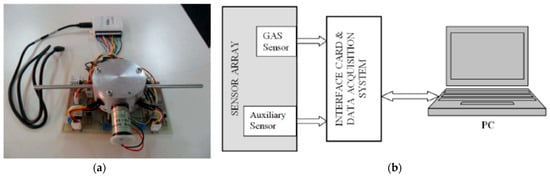
Figure 5.
(a) The e-nose system hardware, showing the inlet and outlet ducts for the constant mixture flux training phase that is made in the laboratory. (b) Block diagram of the proposed system [123].
In contemporary environmental studies, Pasquale Giungato et al. [124] have made a significant contribution to addressing odor emissions from waste management plants. This issue has gained regulatory attention in Italy due to environmental and economic concerns. The researchers explored the use of electronic noses to capture real-time odor emissions data. By employing various sensor technologies, including MOSs and polymer/black carbon nano composite array (NCA) sensors, along with multidisciplinary methods such as dynamic olfactometry and gas chromatography–mass spectrometry/olfactometry, the study aimed to enhance odor recognition and implement cleaner production technologies.
The study identified key odor sources in waste management plants, including biogas and dehydrated sludge. A variety of sensor technologies were evaluated, achieving successful recognition rates of 86.7% for MOSs, 53.3% for NCA, and an impressive 93.3% for a subset of sensors carefully chosen based on their selectivity toward odor-active molecules. These recognition rates were determined through linear discriminant analysis and cross-validation techniques. Additionally, the research showcased the potential of electronic noses for monitoring odor abatement processes. The work by Giungato et al. offers valuable insights for designing effective odor control systems and advancing sustainable waste management practices.
In another environmental research endeavor, Laura Capelli et al. [125] conducted a critical and comparative examination of odor assessment methods at a landfill site. Through the utilization of chemical analyses, dynamic olfactometry, and electronic noses [126], the study offers valuable insights into the intricate nature of odor emissions evaluation.
The authors emphasize the unique contributions of each method. While chemical analyses unveil odor composition, they do not correlate directly with dynamic olfactometry’s odor concentration measurements. Olfactometric analyses offer a quantification of sensory impacts, aiding in understanding off-site effects.
The study’s innovative use of electronic nose technology for real-time ambient air monitoring unveils temporal odor presence percentages at landfill boundaries and receptors. Remarkably, these percentages consistently remained below the 15% limit stipulated by the German guideline “GIRL Geruchsimmission-Richtlinie.” [125].
Carmen Bax et al. [127] present a notable advancement in odor monitoring using the EOS507F electronic nose (SACMI, Imola, Italy), developed in collaboration with the Olfactometric Laboratory of Politecnico di Milano (Figure 6). Their research is centered around developing and implementing a performance testing protocol for Instrumental Odor Monitoring Systems (IOMS). The study involves monitoring odors from a tire storage area, which experiences varying emissions over time. By utilizing the EOS507F equipped with MOX gas sensors, the authors showcase the efficacy of electronic nose technology in assessing odor impacts, particularly in scenarios where traditional dispersion modeling methods are impractical. Their work contributes to the standardization of odor measurement tools and offers novel strategies for managing odor pollution.
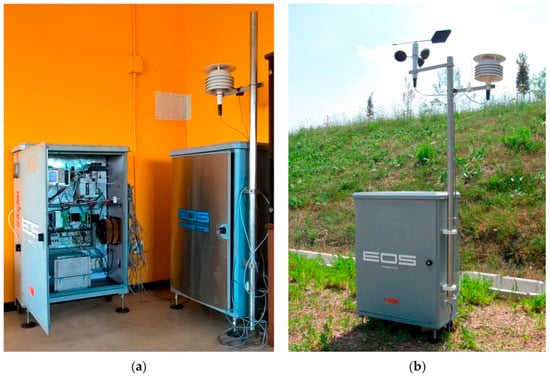
Figure 6.
Electronic noses used for the tests in laboratory (a) and EOS 507 in the field (b) [128].
The emissions produced by these industries not only pose risks to their employees but also contribute to urban discomfort. Presently, efforts are underway to develop e-noses that provide ongoing monitoring of urban odors. The Port of Rotterdam, the largest port in Europe, features extensive industrialization, including four major oil refineries and over 40 chemical/petrochemical firms [129]. This high level of industrial activity has resulted in elevated odor levels, leading to an annual average of 5000–6000 odor complaints from residents [129]. To address this issue and pinpoint odor sources, a collaborative initiative known as the We-Nose network was established, bringing together companies, municipalities, and residents.
To combat odor nuisances and identify their origins, a network of over 250 e-noses, each equipped with four semiconductor-based sensors, was strategically placed across the expansive 10 km × 10 km port area in Rotterdam.
These e-noses underwent training to recognize the distinctive odor patterns associated with residents’ complaints [110]. Following a learning phase, the sensors were able to successfully match over 90% of reported odor complaints [129]. By comparing the identified odor patterns with an existing database, the system gained the ability to attribute odors to specific sources. The placement of the e-noses considered topography and meteorological conditions, enabling a spatial understanding of odor origins.
Additionally, Figure 7 demonstrates another instance of an e-nose system, this time designed for the continuous monitoring of environmental odors. This figure includes a map that indicates the locations of the EOS507F electronic noses in relation to water treatment plants, as cited in reference [130]. This system plays a crucial role in reducing accidental emissions and has substantially decreased the number of odor complaints from nearby residents.
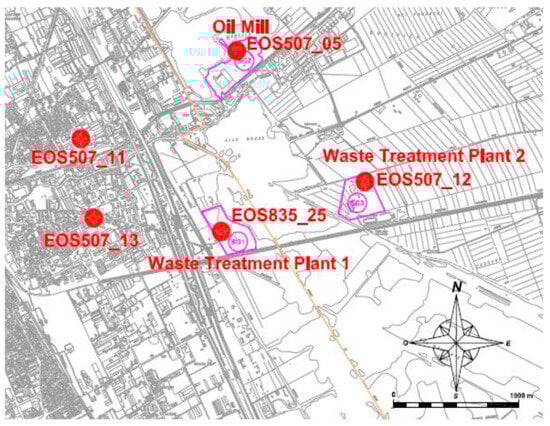
Figure 7.
Map of e-nose locations relative to water treatment plants [130].
Electronic nose (e-nose) systems are also utilized to comprehensively assess various parameters related to environmental sources of malodors and air pollution. This extensive application covers sources including waste disposal sites, wastewater treatment facilities, incineration plants, composting operations, and livestock farms. A detailed review of these varied uses is thoroughly presented in Table 4.
Table 4.
Applications of electronic noses for environmental odor monitoring.
The realm of environmental monitoring has been significantly transformed by the integration of e-noses, showcasing their adaptability and efficacy in addressing diverse challenges. E-noses have emerged as versatile tools that hold the potential to revolutionize the assessment and management of environmental odors and air quality. These innovative devices find application in various contexts, including air and water quality analysis, process control, worker health preservation, and evaluating the efficiency of odor control systems. Notably, e-noses can act as alternatives or complementary tools to traditional analytical methods, offering cost-effective and real-time solutions.
Research endeavors have shed light on e-noses’ capability to identify pollution sources, enhance safety in industrial settings, and contribute to sustainable waste management practices. These advancements underscore the pivotal role that e-noses play in shaping our understanding of environmental odors and pollutants. As technology continues to evolve, e-noses are poised to become even more sophisticated and integrated into the fabric of smart cities and industries. Their potential extends to various domains, and ongoing research is crucial to fully unlock their capabilities. Furthermore, the development of enhanced sampling techniques could potentially replace expensive analytical tools for e-noses, notably in areas such as explosive and drug detection. As technology advances, the widespread adoption of e-noses is expected to expand, playing a pivotal role in the ongoing advancement of smart cities and industries.
3.3. Disease Diagnosis
The distinct odor profiles detected by electronic noses stem from specific metabolic pathways associated with various diseases [140,141]. For instance, in diabetes, volatile organic compounds (VOCs) like acetone, ethanol, and isoprene are produced as metabolic byproducts of abnormal glucose metabolism [142,143,144,145,146], reflecting processes such as ketogenesis and glycolysis. Similarly, lung infections trigger the release of VOCs such as nitric oxide and volatile fatty acids due to inflammatory responses initiated by bacterial or viral pathogens [147,148,149,150]. In certain cancers, metabolic dysregulation leads to the production of unique VOC signatures [151,152,153,154]; for example, lung cancer often showcases elevated levels of volatile alkanes and benzene derivatives indicative of tumor-associated metabolic activities like oxidative stress and lipid peroxidation. Understanding these specific metabolic pathways and their corresponding VOC profiles enables the development of more targeted diagnostic approaches using electronic noses, thereby enhancing early detection and intervention strategies for improved patient outcomes.
3.3.1. Human Clinical Pathology
In recent years, the field of human clinical pathology and diagnostic medicine has witnessed significant strides in the development of innovative electronic methods and approaches aimed at enhancing the accuracy and speed of early diagnoses for human diseases [155].
A notable achievement in the realm of medical diagnostics was realized by Parry et al. in 1995, when they successfully identified beta-streptococcal infections in leg ulcers. This groundbreaking advancement involved the comprehensive analysis of bacterial cultures obtained from a group of 21 patients [156]. Intriguingly, researchers delved into the metabolic processes of fungi and bacteria, revealing the emission of VOCs known as microbial volatile organic compounds (MVOCS) [110]. These compounds, formed as byproducts of microbial metabolism, contributed to unique aromatic profiles for different microorganisms. With each bacterium and fungus releasing its distinct composition of MVOCS, these emissions emerged as olfactory signatures with great potential for detection applications.
Taking this knowledge forward, Gardner et al. [157] expanded the horizons of this field in 1998. They achieved the differentiation of six pathogenic bacterial species: Clostridium perfringens, Proteus, Haemophilus influenzae, Bacteroides fragilis, Oxford staphylococcus, and Pseudomonas aeruginosa. This remarkable feat was made possible by analyzing the headspace surrounding bacterial cultures. Utilizing an electronic nose armed with four commercially available metal oxide sensors, the researchers effectively captured the distinct VOC profiles of these bacterial entities [157].
Moving on to gastrointestinal (GI tract) diseases [155], the focus on improving diagnostics for inflammatory bowel disease (IBD), including Crohn’s disease (CD) and ulcerative colitis (UC), stands out as a prominent research area. IBD manifests as a chronic, relapsing condition characterized by gut inflammation, leading to symptoms such as abdominal cramping, diarrhea, vomiting, fatigue, and weight loss [2]. It is worth noting that while UC predominantly affects the colon, CD can impact the entire digestive system, highlighting the need for early and precise detection to mitigate complications [2].
However, the diagnostic landscape for IBD is not devoid of challenges. Current diagnostic methods entail invasive and costly procedures, such as endoscopic investigations, imaging of the lower GI tract, histological examination, and analysis of fecal inflammatory biomarkers [2]. Despite its invasiveness and discomfort for patients, colonoscopy with histology remains the gold standard, involving multiple biopsies and associated morbidity [2].
Amid these challenges, recent research has explored promising avenues for enhanced IBD diagnostics, particularly through the analysis of VOCs present in exhaled breath. Tiele et al. [155] conducted a study on breath analysis utilizing both an experimental electronic nose (Wolf eNose) and a commercial gas chromatograph–ion mobility spectrometer (G.A.S. BreathSpec GC-IMS). Their findings underscored the significance of specific VOCs, such as butanoic acid and acetic acid, in differentiating IBD patients from healthy controls [155]. These VOCs, arising from the fermentation of cellulosic fiber in the colon, emerged as potential biomarkers for IBD. Notably, this technology exhibited advantages over conventional methods, being cost-effective, portable, non-invasive, and suitable for various patient demographics [155], including vulnerable patients such as children and the elderly.
In the context of urinary tract infections, electronic noses (e-noses) have been utilized to analyze urine samples either directly or after brief incubations in test tube systems with complex media [158,159,160]. Various data reduction and pattern recognition techniques have been proposed to differentiate between bacterial species and their distinct metabolic states [161,162]. Specifically, a study reported the successful differentiation of uninfected and infected urine samples containing Escherichia coli, Proteus mirabilis, and Staphylococcus species using an e-nose [161]. This underscores the potential of e-noses in medical diagnostics and advancing our understanding of microbial intricacies.
Breath analysis using e-nose technology faces numerous challenges in detecting volatile organic compounds (VOCs) associated with respiratory diseases like chronic obstructive pulmonary disease (COPD) amidst the complex mixture of compounds present in breath. Breath composition is diverse, encompassing VOCs originating from metabolic processes, environmental exposures, and physiological factors, posing a significant challenge in isolating COPD-linked VOCs accurately. One major hurdle is the presence of background noise in breath samples, consisting of various VOCs unrelated to the targeted respiratory condition. These background compounds can obscure the signals of interest, complicating the identification of VOCs indicative of COPD. Overcoming this challenge necessitates advanced sensor arrays capable of detecting a broad spectrum of VOCs while maintaining selectivity for disease-specific compounds [163,164,165].
Additionally, breath samples from COPD patients may exhibit variability in VOC concentrations due to factors like disease severity, comorbidities, and individual physiological differences. This variability adds complexity to breath analysis, requiring robust statistical methods and machine learning algorithms to distinguish between COPD-related VOC patterns and non-specific fluctuations. Moreover, confounding factors such as environmental contaminants, dietary influences, and medications further complicate breath sample analysis. These factors introduce additional variability and ambiguity into VOC profiles, demanding careful consideration and data preprocessing techniques to mitigate their impact on analysis results.
Despite these challenges, the Cyranose 320 e-nose, developed by Cyrano Sciences and later known as Smiths Detection–Pasadena Inc. (Stateline, NV, USA), has demonstrated notable success in deciphering breath patterns associated with COPD [163,164,165]. Equipped with the patented NoseChip™ containing an array of 32 sensors utilizing single-wall carbon nanotubes, metallic nanoparticles, and conductive composites, the Cyranose 320 (Cyrano Sciences Inc., Pasadena, CA, USA) offers a modular design for the exchange of thin film nanosensors, enhancing its versatility [166].
Through the integration of its sensor array and sophisticated data analysis algorithms, the Cyranose 320 has proven proficient in distinguishing between breath profiles of COPD patients and those of healthy individuals. Additionally, it has played a pivotal role in discriminating volatile organic compounds (VOCs) among patients with COVID-19 and post-COVID syndrome (see Figure 8) [167]. Notably, the device exhibits an impressive ability to differentiate between the breath fingerprints of COPD patients and non-infected subjects, achieving a success rate of 75% [163].
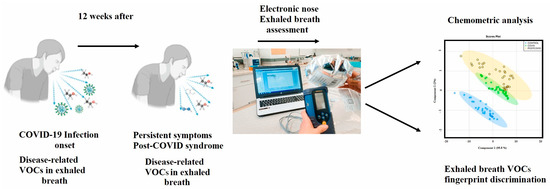
Figure 8.
Analysis of exhaled breath VOCs in COVID-19 onset and post-COVID syndrome using e-nose [167].
Furthermore, studies have showcased the Cyranose 320’s proficiency in delineating breath profiles between lung cancer patients and individuals with COPD [167]. Its contribution extends beyond COPD, as it has been instrumental in identifying distinct VOC signatures associated with various respiratory conditions, underscoring its potential as a valuable diagnostic tool in respiratory medicine.
To further contextualize the broad landscape of e-nose applications in medical diagnostics, we present Table 5, showcasing a comprehensive range of biomedical applications developed using commercial and experimental electronic noses.
Table 5.
Biomedical applications developed using electronic noses.
This table serves as a compelling testament to the expansive horizons that technology can unlock in the realm of medical diagnostics. The utilization of electronic noses in medical diagnosis stands as an immensely captivating domain, harboring the potential to transform contemporary medicine by enabling the noninvasive identification of diseases through the analysis of breath or urine headspace. Despite the remarkable strides taken in research, the practical application of this technology remains a formidable challenge. The delicate nature of odorous compounds emitted by the human body, often present in minute concentrations amidst complex backgrounds, necessitates the development of highly responsive sensors. Furthermore, the standardization of sampling protocols and data analysis methods in medical diagnostics becomes imperative for meaningful progress. This ensures consistency and reliability in results, enabling accurate comparison between studies and facilitating the development of robust diagnostic tools.
A comprehensive and rigorous testing regimen, spanning both controlled laboratory settings and real-world scenarios, will be requisite before achieving regulatory approval for medical diagnostic applications. This journey towards realizing the full potential of electronic noses in healthcare underscores the need for perseverance, innovation, and interdisciplinary collaboration.
3.3.2. Veterinary-Wildlife Pathology
The accurate and timely detection of infectious diseases affecting wildlife is paramount, especially with the potential of virulent microbial pathogens to swiftly spread and cause substantial mortality within native animal populations. Traditional diagnostic methods often rely on observing clinical symptoms, which may only manifest after the disease has taken hold. However, there is a growing need for specialized diagnostic methods that can provide early indications of disease processes before visible symptoms emerge. This proactive approach is crucial for effectively managing and mitigating the impact of such diseases on wildlife health and conservation efforts. Leveraging advancements in e-nose technology offers a promising avenue for non-invasive disease detection in animals by analyzing the array of VOCs present in clinical samples. E-nose instruments detect differences in VOC concentrations to discriminate between healthy and diseased states, akin to metabolomic approaches. However, using e-noses for wildlife disease detection in field conditions presents several potential limitations, primarily influenced by environmental variability and animal behavior. Environmental factors such as temperature, humidity, and background odors can affect the accuracy and reliability of e-nose measurements, obscuring or altering the VOC profiles emitted by animals [182]. Additionally, animal behavior, including movement patterns, feeding habits, and social interactions, can impact the accessibility and sampling consistency required for e-nose measurements. Animals may exhibit stress-induced changes in VOC emissions unrelated to disease, further complicating interpretation. Moreover, the specificity and sensitivity of e-noses may vary across different animal species and diseases, necessitating thorough validation and calibration for each application. Addressing these limitations through robust study designs, data interpretation techniques, and technological advancements tailored to the complexities of natural ecosystems is essential to enhance the effectiveness of e-noses for wildlife disease detection in field conditions.
Among the infectious diseases affecting wildlife, White Nose Syndrome (WNS) stands out as a significant affliction targeting Nearctic cave-dwelling bats [183]. This virulent malady has precipitated remarkable declines in bat populations, even reaching an alarming 99% reduction [184]. Its origins are traced back to the nonnative dermatophytic fungus Pseudogymnoascus destructans (Pd) [185,186]. This pathogenic agent triggers a cascade of detrimental consequences in bats, encompassing dehydration, starvation, riboflavin-induced dermal and hypodermal necrosis, membranous wing disintegration, physiological shocks, and hypothermia (Figure 9). The affliction compels WNS-affected bats to venture outside of Pd-infested caves during the winter, exacerbating their already dire circumstances [187,188,189,190].

Figure 9.
Lesions on the skin of a bat due to P. destructans (license: common use).
The repercussions of WNS extend beyond the realm of wildlife conservation, given that insectivorous bats play an indispensable role in controlling agricultural pests and curtailing the propagation of disease vectors.
Nevertheless, the existing diagnostic methods for WNS are intrusive and post-mortem in nature, often conducted after the onset of clinical symptoms. This temporal gap hampers the swift implementation of therapeutic interventions. Hence, there is an undeniable urgency for enhancing early detection techniques that facilitate management interventions before symptomatic manifestations arise. These advancements are pivotal for effective disease control and the successful execution of mitigation strategies.
Doty et al. [191] significantly contributed to assessing the C-320 electronic nose (e-nose) for differentiating bat species through their VOC emissions. This study captured healthy bats from nine species, collecting VOCs with new portable devices. By comparing sensor-array responses to bat VOCs and pure standards, unique smell print signatures were generated. Two-dimensional and three-dimensional principal component analysis (PCA) created aroma map plots, revealing notable species discrimination. The study suggests the e-nose’s potential for detecting species-specific VOC metabolites, crucial for early bat disease detection. This work forms the basis for next phase of testing in White Nose Syndrome (WNS) detection in bats during hibernation. Further research on disease-related VOCs in various bat species could expand e-nose health monitoring capabilities during hibernation.
In another application of electronic nose technology, Cramp et al. [192] delved into its potential for detecting Cutaneous myiasis, a debilitating disease primarily caused by Lucilia cuprina flies in sheep in Australia [193,194]. Cutaneous myiasis involves the infestation of larvae in moist or stained areas of sheep fleece, leading to tissue damage and potential lethality. The challenge of early disease detection necessitates continuous flock monitoring for timely intervention.
To confront this challenge, the researchers harnessed the capabilities of an electronic nose equipped with six metal oxide semiconductor sensors, along with temperature and humidity sensors, to capture the odors emitted during flystrike development. Through the application of nonlinear signal measurement techniques and linear discriminant analysis (LDA), they effectively extracted and processed signal features to categorically distinguish between different odor groups.
Their results highlighted the electronic nose’s proficiency in accurately discerning flystrike odors from those of dry wool across multiple experimental scenarios, even within 24 h of larval implantation. Furthermore, the technology demonstrated the ability to differentiate flystrike odors from fleece stained with urine and feces. These encouraging outcomes lay the foundation for the viability of using electronic nose technology for early flystrike detection.
3.3.3. Invasive Insect-Pest Infestations
In modern agriculture, electronic noses are indispensable tools, particularly in combating invasive insect-pest infestations. By discerning unique odor signatures emitted by distressed plants, electronic noses empower farmers to swiftly address issues, leading to minimized crop losses and reduced dependence on chemical interventions. This not only aligns with sustainable practices but also significantly bolsters overall food security. These electronic noses differentiate between healthy and diseased plants by analyzing volatile organic compounds (VOCs) emitted in response to stress, pathogens, or insect damage. These VOCs create distinct profiles, with specific compounds such as methyl salicylate, jasmonic acid, and ethylene serving as reliable biomarkers for plant health [195]. Utilizing sensor arrays, e-noses detect VOCs and generate unique patterns for different samples, enabling the identification of characteristic differences between healthy and diseased plants. The prevalence of bacterial plant diseases, including common pathogens like Pseudomonas syringae pathovars, Ralstonia solanacearum, and Agrobacterium tumefaciens [57], poses a significant global challenge, causing substantial annual economic losses. Furthermore, the presence of quarantine pathogens escalates the issue, as their eradication is mandated by European Union directives, imposing additional financial burdens. Consequently, there is an urgent need for sophisticated analytical tools capable of promptly identifying diseases in their early stages. Several studies have highlighted the potential of electronic noses in addressing these challenges.
Biondi et al. [196] utilized a commercial electronic nose (PEN 3) to differentiate between healthy and infected potatoes affected by Ralstonia solanacearum or Clavibacter michiganensis ssp. Their work focused on optimizing gas sampling methods, highlighting the effectiveness of VOC-sorbent cartridges in enhancing sensitivity by concentrating volatile compounds. Importantly, they discovered that passive gas sampling, when compared to active sampling, achieved higher classification accuracy.
A pivotal discovery in their research was the influence of sensor response correlation. Through the strategic exclusion of highly correlated sensor responses using PCA loading plots, the researchers achieved a substantial enhancement in classification results. This underscores the critical importance of selecting uncorrelated sensor responses for constructing effective classification models. Additionally, their study showcased the potential of PCA score plots to reflect disease incidence and severity, providing valuable insights into disease characterization.
Furthermore, Biondi et al. [196] introduced an innovative method for assessing disease severity by creating a five-class phytopathometric ladder based on visual sample analysis. This novel approach not only enriched their findings but also introduced a tool for evaluating disease severity within similar contexts.
Chang et al. [197] conducted research on potato soft rot disease severity detection using five MOX sensors. They introduced an optimized bionic electronic nose gas chamber and a well-designed sampling device to effectively detect changes in volatile substances associated with the infected soft rot disease in potato tubers. Through the utilization of the RBF neural network and SVM algorithms, they successfully detected and identified the presence of soft rot disease in potato tuber samples. The results showcased that their proposed bionic electronic nose system holds potential for early disease detection. Notably, the SVM algorithm demonstrated a remarkable recognition rate of up to 89.7%, outperforming the RBF algorithm. This research addresses the need for sensitive and rapid disease detection methods, offering the potential to significantly impact potato industry practices and economics.
In a significant application of electronic nose technology, the work of Wilson et al. [198] delved into the realm of forest pest management, with a particular focus on combating the threat posed by the Emerald ash borer (EAB). This highly destructive nonnative insect pest has emerged as a major concern, exerting a detrimental impact on various ash tree species since its introduction from Eurasia to the United States in the 1990s.
The primary focus of their study was to assess the efficiency of a dual-technology electronic nose/gas chromatograph device for the early identification of EAB infestations in green ash trees. This technology offers the potential to enhance the planning and implementation of EAB pest control measures across various settings, including natural hardwood stands, plantations, and urban environments. Detecting concealed EAB galleries during the early stages of infestation is crucial for optimizing pest management strategies.
Wilson et al. [198] investigated VOC emissions from sapwood to discern the presence of EAB infestations across distinct EAB decline class levels. They unveiled significant variations in VOC sapwood profiles among trees categorized under different EAB decline classes. VOC metabolites present in sapwood headspace volatiles exhibited varying types, quantities, and composition across different sample types. An important discovery emerged as they identified distinctive e-nose “smellprint” patterns, originating from diverse VOC compositions in the headspace volatiles of sapwood cores. These patterns provided insights into the severity of EAB infestations (decline classes) and functioned as chemical signatures of varying infestation levels.
Moving beyond pattern identification, the study introduced specific VOC metabolites as chemical biomarkers for differentiating healthy trees from those infested by EAB. This breakthrough held promise for assessing the health status of individual trees based on their VOC emissions. Despite limited differentiation between ash decline classes using UHPLC-MS for major bark phenolic compounds, the dual-technology e-nose exhibited significant capabilities in distinguishing between uninfested and EAB-infested trees through sapwood VOC emissions.
Table 6 provides a comprehensive overview of various studies that utilize electronic nose technology for the early detection of invasive insect-pest infestations in plants. Each study employed distinct methods and approaches, resulting in valuable insights and potential solutions for managing such infestations. The results showcase the promising capabilities of electronic noses in contributing to improved agricultural practices and sustainable pest management.
Table 6.
Electronic nose applications in invasive insect-pest infestations.
In summary, the application of electronic nose technology has demonstrated remarkable potential across diverse domains of pathology and diagnostics. From human clinical pathology to veterinary-wildlife pathology and invasive insect-pest infestations, these studies collectively highlight the versatility and effectiveness of electronic noses in detecting VOCs and unique odor profiles associated with diseases. By harnessing the power of sensors and data analysis algorithms, researchers have been able to differentiate between disease states, monitor disease progression, and even predict disease presence. These advancements hold significant promise for revolutionizing disease detection and monitoring practices, offering non-invasive, rapid, and accurate solutions.
As we move forward, addressing the challenges inherent in electronic nose technology’s practical implementation becomes paramount. Standardizing sampling techniques, sensor selection, and data processing methods will be essential for ensuring reliable and reproducible results. Additionally, interdisciplinary collaboration between scientists, engineers, and medical professionals will be crucial for refining these techniques and translating them into real-world clinical and field applications. Overcoming these challenges will pave the way for a future in which electronic noses play a pivotal role in early disease detection, enhancing healthcare outcomes, preserving wildlife populations, and ensuring the sustainability of agricultural practices.
4. Challenges
The growing prominence of the e-nose for detection and classification has illuminated a complex web of challenges that span crucial domains. These challenges are intricate, encompassing key aspects that demand meticulous consideration to ensure the seamless implementation of e-nose technology.
A. Data Challenges: in the era of burgeoning big data, the distribution of collected data has evolved into a diverse landscape due to varying experimental and analysis conditions. Acquiring labeled e-nose data remains labor-intensive and time-consuming. However, relying on a limited number of labeled data samples for classification purposes [206], particularly in large-scale scenarios, often results in suboptimal simplification and unreliable model performance. Furthermore, grappling with data drift correction algorithms, especially when dealing with data from disparate sources, presents a formidable challenge [207,208]. The task of maintaining precise and consistent data collection across diverse domains remains intricate, influencing the dependability of classification models.
B. Sample Size Complexities: the process of gas sample sensing revolves around the manipulation of the electrical resistance value of metal oxide semiconductors. This manipulation is influenced by various factors, including sensor sensitivity, environmental shifts, sensor lifespan, and instrumental fluctuations. Consequently, there is a possibility of the testing sample distributions drifting from their training counterparts. Such drift can render previously established regression or classification models ineffective. Achieving an optimal equilibrium concerning sample dataset sizes and compositions is critical in navigating this challenge.
Furthermore, the attributes of the authentic dataset, its size, the number of samples, and potential distribution patterns, combined with contextual background information, can introduce variations in validation approaches. Notably, a model that relies on a limited number of samples is highly vulnerable to unpredictable outcomes [209].
C. Calibration and Validation: the limited temporal validity of multivariate calibration models poses a significant challenge to the practical use of electronic noses. Frequent recalibration of these systems is costly and time-consuming due to the need for numerous reference samples, which are often limited in availability. Various factors can invalidate these calibration models, including sensor drift, changes in sample composition, and the need to replace sensors or transfer calibration models between different sensor sets. To address these challenges, alternative methods such as drift correction and calibration update have been proposed:
- Drift correction involves modeling sensor drift using a series of measurements and using it to correct new data.
- Calibration standardization aims to correct new measured data by establishing a relationship between two experimental conditions using a reduced set of samples measured under both conditions.
- Calibration update involves incorporating new sources of variance into the calibration model by recalculating it using initial calibration samples and a reduced set of samples measured under new conditions, which can be either standard or unknown samples.
For further insights into protocols or guidelines for calibrating and validating e-nose data, please refer to Rudnitskaya [210].
D. Feature Extraction Struggles: the process of feature extraction constitutes a pivotal phase in e-nose systems. It involves mapping high-dimensional data into a lower dimensional subspace that captures essential data structures while enhancing discriminative capabilities [211,212,213]. While deep learning approaches have been explored for extracting features from unlabeled gas samples [207], the challenge lies in uncovering the ideal combination of extracted features and preprocessing techniques. The task of extracting meaningful insights from instrumental responses while preserving data integrity and enhancing model efficiency is akin to solving a complex puzzle [78]. Previous studies have resorted to utilizing a single steady response from each sensor before standardization, underscoring the need for comprehensive feature extraction methodologies.
E. Technical Intricacies: e-nose sensor arrays encompass a diverse range of partially overlapping selectivity, facilitating the measurement of volatile compounds in sample headspaces. The challenge lies in harnessing the capabilities of this sensor array to deliver accurate odor fingerprints. Moreover, the interplay between sensor temperature and heating voltage introduces technical complexities, where temperature modulation significantly impacts e-nose performance. The nuanced differences between static and dynamic temperature modulation mechanisms warrant meticulous attention in temperature-controlled e-nose applications [212].
F. Sensor-Specific Challenges:
- Sensor Cross-Sensitivity: one of the enduring challenges in the realm of electronic noses is the issue of cross-sensitivity among sensors. Each sensor in an e-nose array is designed to be sensitive to specific types of VOCs. However, many sensors may respond to multiple VOCs, leading to overlapping response patterns that can confuse the system’s ability to accurately identify and quantify specific odors. This cross-sensitivity necessitates the development of sophisticated algorithms capable of dissecting complex sensor outputs to distinguish between similar chemical signatures. Enhancing sensor selectivity or employing advanced computational techniques like machine learning for pattern recognition are potential approaches to mitigate this issue.
- System Power Consumption: e-noses, particularly those deployed in portable or remote settings, face significant constraints related to power consumption. The need for continuous operation without frequent battery replacements or recharges is essential for practical usability. This is especially challenging given that the sensor arrays and the associated data processing units typically require substantial power to operate effectively. Innovations in low-power electronics, energy-efficient sensors, and power management strategies are critical to extending the operational lifespan of e-nose systems in field applications.
- Time Acquisition: the time taken to acquire and process sensor data is another significant challenge, particularly in industrial applications where rapid decision-making is crucial. The acquisition time not only depends on the sensor’s response time to the target VOCs but also on the time required for the system to reset between samples. Reducing acquisition and processing times without compromising the accuracy and reliability of the e-nose system is a key area for technological improvement. Techniques such as optimizing sensor materials for quicker response and recovery times and enhancing data processing algorithms for speedier analysis are vital.
G. Managing Technical Noise: the meticulous handling of outliers and noise within transferred samples assumes critical importance in preserving the integrity of data distributions and model accuracy. Identifying outliers often draws upon tacit knowledge or past experiences [207]. Noise within transferred samples can wield considerable influence over the entire process, potentially compromising accuracy. Given the multivariate nature of e-nose data analysis, employing preprocessing methods that effectively scale and eliminate uninformative systematic variations is indispensable to the adept management of technical noise. Diverse strategies for preprocessing prior to data analysis strive to counteract noise presence and scatter effects, underscoring the pivotal role of data noise management in e-nose applications [209].
H. Evaluation Dilemmas: e-nose technology holds immense promise in detecting volatile compound fingerprints of food samples, enriching organoleptic evaluations encompassing aspects like flavor and aroma [214]. However, the challenge persists in establishing consistent and reliable evaluation methodologies. Traditional sensory evaluations hinge on expert panels, a practice that can be time-intensive, expensive, and susceptible to evaluator-related inconsistencies arising from factors such as fatigue or stress. The fusion of artificial sensing systems into standardizing evaluation approaches represents a leap forward, although this domain’s evolution is still in its nascent stages, warranting further exploration [215].
I. Reliability and Prediction: e-nose sensor arrays translate chemical changes into electrical signals, contributing to measurement, control, and prediction systems. Sustaining predictive model performance becomes intricate due to factors such as sensor sensitivity fluctuations, signal source dynamics, and evolving operational conditions. While model training establishes a predictive linkage between input and output, model performance may degrade during testing due to temporal shifts and instrument variability [216].
J. Time Efficiency Pressures: conventional quality evaluations, often involving expert panels, are renowned for their time-intensive nature and resource-heavy demands. These evaluations can be plagued by inconsistencies and subjective biases stemming from evaluator elements like mental and physical states [217]. While e-nose technology opens avenues for streamlining evaluation processes, guaranteeing efficient and objective assessment methodologies across various industries presents an ongoing challenge compared to traditional paradigms [218].
K. Mitigating Over-Fitting: overfitting, a perennial concern in data analysis, is exacerbated by the intricate interplay of numerous variables within e-nose applications. Tackling this challenge mandates the identification of pivotal variables for data analysis and computation. Striking a harmonious balance between transfer sample sizes while evading an undue focus on transfers to avert overfitting stands as a pivotal task. Tailoring models to adequately encompass variations and intricacies in e-nose data and applications is paramount to forestall overfitting and ensure steadfast performance [219].
L. Nuanced Classification: e-nose systems confront challenges stemming from sensor drift, influenced by factors such as sensor longevity and environmental fluctuations. The evolving nature of sensor responses over time can erode the quality of regression and classification models [207]. Crafting classification mechanisms that embody robustness, incorporating stage classifiers and advanced signal processing techniques, emerges as a necessity to precisely capture and classify evolving data patterns. Navigating these challenges assumes pivotal significance in upholding accurate classification within dynamic environments [220].
5. Conclusions
In conclusion, electronic nose (e-nose) technology presents a compelling avenue for innovation with vast potential across various sectors, from ensuring food safety to enhancing environmental monitoring and healthcare diagnostics, including the non-invasive early detection of various diseases in plants, animals, and humans. The adaptability and efficiency of e-noses are evident, representing groundbreaking technology capable of analyzing complex gaseous mixtures of volatile organic compounds (VOCs) to provide composite metabolite profiles, thus making them highly desirable in healthcare settings.
While e-nose devices are increasingly garnering interest from healthcare providers, several key challenges must be addressed to fully realize their potential in disease detection and monitoring. These include the standardization of e-nose instruments, sampling protocols, and analytical methodologies to facilitate data comparisons across studies. Additionally, the development of disease-specific e-nose databases, identification of effective VOC biomarkers, expansion of clinical applications, and advancements in electronics and diagnostic software are crucial for widespread acceptance and integration into clinical procedures.
Collaboration emerges as a key principle in navigating the complexities of e-nose technology. The convergence of expertise from sensor specialists, data analysts, and domain experts is essential for overcoming obstacles and unlocking the full potential of e-noses. This collaborative effort holds the promise of reshaping our perception and interaction with the environment through the integration of olfactory data.
In essence, continued research and innovation are essential for maximizing the accuracy, reliability, and effectiveness of e-nose instruments as indispensable tools in clinical diagnostics. With concerted efforts and advancements in various facets of e-nose technology, these instruments hold the promise of revolutionizing disease detection and monitoring in healthcare settings worldwide.
Author Contributions
Conceptualization, A.R., E.C. and D.Z.; methodology, A.R.; validation, A.R., H.H., E.C. and D.Z.; writing—original draft preparation, A.R., D.Z. and E.C.; writing—review and editing, A.R. and H.H.; visualization, A.R.; supervision, E.C. and D.Z.; funding acquisition, E.C. and D.Z. All authors have read and agreed to the published version of the manuscript.
Funding
This research received no external funding.
Data Availability Statement
Not applicable.
Conflicts of Interest
The authors declare no conflicts of interest.
References
- Gardner, J.W.; Bartlett, P.N. A brief history of electronic noses. Sens. Actuators B Chem. 1994, 18, 210–211. [Google Scholar] [CrossRef]
- Cheng, L.; Meng, Q.-H.; Lilienthal, A.J.; Qi, P.-F. Development of compact electronic noses: A review. Meas. Sci. Technol. 2021, 32, 062002. [Google Scholar] [CrossRef]
- El Barbri, N.; Llobet, E.; El Bari, N.; Correig, X.; Bouchikhi, B. Application of a portable electronic nose system to assess the freshness of Moroccan sardines. Mater. Sci. Eng. C 2008, 28, 666–670. [Google Scholar] [CrossRef]
- Lee, J.W.; Shin, D.W.; Kim, S.M. Development of a Portable Electronic Nose System to Analyze Flavour Signal Patterns of Kochujang. Key Eng. Mater. 2006, 321–323, 1217–1220. [Google Scholar] [CrossRef]
- O’Connell, M.; Valdora, G.; Peltzer, G.; Martı, R. A practical approach for fish freshness determinations using a portable electronic nose. Sens. Actuators B Chem. 2001, 80, 149–154. [Google Scholar] [CrossRef]
- Hong, H.-K.; Kwon, C.H.; Kim, S.-R.; Yun, D.H.; Lee, K.; Sung, Y.K. Portable electronic nose system with gas sensor array and artificial neural network. Sens. Actuators B Chem. 2000, 66, 49–52. [Google Scholar] [CrossRef]
- Loutfi, A.; Coradeschi, S.; Mani, G.K.; Shankar, P.; Rayappan, J.B.B. Electronic noses for food quality: A review. J. Food Eng. 2015, 144, 103–111. [Google Scholar] [CrossRef]
- Paknahad, M.; Ahmadi, A.; Rousseau, J.; Nejad, H.R.; Hoorfar, M. On-Chip Electronic Nose For Wine Tasting: A Digital Microfluidic Approach. IEEE Sens. J. 2017, 17, 4322–4329. [Google Scholar] [CrossRef]
- Wojnowski, W.; Dymerski, T.; Gębicki, J.; Namieśnik, J. Electronic Noses in Medical Diagnostics. Curr. Med. Chem. 2019, 26, 197–215. [Google Scholar] [CrossRef]
- Zhang, L.; Tian, F.; Nie, H.; Dang, L.; Li, G.; Ye, Q.; Kadri, C. Classification of multiple indoor air contaminants by an electronic nose and a hybrid support vector machine. Sens. Actuators B Chem. 2012, 174, 114–125. [Google Scholar] [CrossRef]
- Craven, M.A.; Gardner, J.W.; Bartlett, P.N. Electronic noses—Development and future prospects. TrAC Trends Anal. Chem. 1996, 15, 486–493. [Google Scholar] [CrossRef]
- Schaller, E.; Bosset, J.O.; Escher, F. ‘Electronic Noses’ and Their Application to Food. LWT—Food Sci. Technol. 1998, 31, 305–316. [Google Scholar] [CrossRef]
- Strike, D.J.; Meijerink, M.G.H.; Koudelka-Hep, M. Electronic noses—A mini-review. Fresenius J. Anal. Chem. 1999, 364, 499–505. [Google Scholar] [CrossRef]
- Thaler, E.R.; Kennedy, D.W.; Hanson, C.W. Medical Applications of Electronic Nose Technology: Review of Current Status. Am. J. Rhinol. 2001, 15, 291–295. [Google Scholar] [CrossRef] [PubMed]
- García-González, D.L.; Aparicio López, R. Sensors: From Biosensors to the Electronic Nose. Grasa Aceites 2002, 53, 96–114. [Google Scholar] [CrossRef]
- Ampuero, S.; Bosset, J.O. The electronic nose applied to dairy products: A review. Sens. Actuators B Chem. 2003, 94, 1–12. [Google Scholar] [CrossRef]
- Turner, A.P.F.; Magan, N. Electronic noses and disease diagnostics. Nat. Rev. Microbiol. 2004, 2, 161–166. [Google Scholar] [CrossRef] [PubMed]
- James, D.; Scott, S.M.; Ali, Z.; O’Hare, W.T. Chemical Sensors for Electronic Nose Systems. Microchim. Acta 2005, 149, 1–17. [Google Scholar] [CrossRef]
- Casalinuovo, I.; Di Pierro, D.; Coletta, M.; Di Francesco, P. Application of Electronic Noses for Disease Diagnosis and Food Spoilage Detection. Sensors 2006, 6, 1428–1439. [Google Scholar] [CrossRef]
- Röck, F.; Barsan, N.; Weimar, U. Electronic Nose: Current Status and Future Trends. Chem. Rev. 2008, 108, 705–725. [Google Scholar] [CrossRef]
- Chen, P.-C.; Shen, G.; Zhou, C. Chemical Sensors and Electronic Noses Based on 1-D Metal Oxide Nanostructures. IEEE Trans. Nanotechnol. 2008, 7, 668–682. [Google Scholar] [CrossRef]
- Wilson, A.; Baietto, M. Applications and Advances in Electronic-Nose Technologies. Sensors 2009, 9, 5099–5148. [Google Scholar] [CrossRef] [PubMed]
- Berna, A. Metal Oxide Sensors for Electronic Noses and Their Application to Food Analysis. Sensors 2010, 10, 3882–3910. [Google Scholar] [CrossRef] [PubMed]
- Wilson, A.D.; Baietto, M. Advances in Electronic-Nose Technologies Developed for Biomedical Applications. Sensors 2011, 11, 1105–1176. [Google Scholar] [CrossRef] [PubMed]
- Falasconi, M.; Concina, I.; Gobbi, E.; Sberveglieri, V.; Pulvirenti, A.; Sberveglieri, G. Electronic Nose for Microbiological Quality Control of Food Products. Int. J. Electrochem. 2012, 2012, 715763. [Google Scholar] [CrossRef]
- Wilson, A. Diverse Applications of Electronic-Nose Technologies in Agriculture and Forestry. Sensors 2013, 13, 2295–2348. [Google Scholar] [CrossRef] [PubMed]
- Montuschi, P.; Mores, N.; Trové, A.; Mondino, C.; Barnes, P.J. The Electronic Nose in Respiratory Medicine. Respiration 2013, 85, 72–84. [Google Scholar] [CrossRef] [PubMed]
- Zohora, S.E.; Khan, A.M.; Hundewale, N. Chemical Sensors Employed in Electronic Noses: A Review. Adv. Comput. Inf. Technol. 2013, 178, 177–184. [Google Scholar] [CrossRef] [PubMed]
- Capelli, L.; Sironi, S.; Del Rosso, R. Electronic Noses for Environmental Monitoring Applications. Sensors 2014, 14, 19979–20007. [Google Scholar] [CrossRef]
- Yan, J.; Guo, X.; Duan, S.; Jia, P.; Wang, L.; Peng, C.; Zhang, S. Electronic Nose Feature Extraction Methods: A Review. Sensors 2015, 15, 27804–27831. [Google Scholar] [CrossRef]
- Capelli, L.; Taverna, G.; Bellini, A.; Eusebio, L.; Buffi, N.; Lazzeri, M.; Guazzoni, G.; Bozzini, G.; Seveso, M.; Mandressi, A.; et al. Application and Uses of Electronic Noses for Clinical Diagnosis on Urine Samples: A Review. Sensors 2016, 16, 1708. [Google Scholar] [CrossRef]
- Górska-Horczyczak, E.; Guzek, D.; Molęda, Z.; Wojtasik-Kalinowska, I.; Brodowska, M.; Wierzbicka, A. Applications of electronic noses in meat analysis. Food Sci. Technol. 2016, 36, 389–395. [Google Scholar] [CrossRef]
- Gliszczyńska-Świgło, A.; Chmielewski, J. Electronic Nose as a Tool for Monitoring the Authenticity of Food. A Review. Food Anal. Methods 2017, 10, 1800–1816. [Google Scholar] [CrossRef]
- Liang, Z.; Tian, F.; Yang, S.; Zhang, C.; Sun, H.; Liu, T. Study on Interference Suppression Algorithms for Electronic Noses: A Review. Sensors 2018, 18, 1179. [Google Scholar] [CrossRef] [PubMed]
- Hu, W.; Wan, L.; Jian, Y.; Ren, C.; Jin, K.; Su, X.; Bai, X.; Haick, H.; Yao, M.; Wu, W. Electronic Noses: From Advanced Materials to Sensors Aided with Data Processing. Adv. Mater. Technol. 2019, 4, 1800488. [Google Scholar] [CrossRef]
- Baldini, C.; Billeci, L.; Sansone, F.; Conte, R.; Domenici, C.; Tonacci, A. Electronic Nose as a Novel Method for Diagnosing Cancer: A Systematic Review. Biosensors 2020, 10, 84. [Google Scholar] [CrossRef] [PubMed]
- Karakaya, D.; Ulucan, O.; Turkan, M. Electronic Nose and Its Applications: A Survey. Int. J. Autom. Comput. 2020, 17, 179–209. [Google Scholar] [CrossRef]
- Jońca, J.; Pawnuk, M.; Arsen, A.; Sówka, I. Electronic Noses and Their Applications for Sensory and Analytical Measurements in the Waste Management Plants—A Review. Sensors 2022, 22, 1510. [Google Scholar] [CrossRef] [PubMed]
- Khorramifar, A.; Karami, H.; Lvova, L.; Kolouri, A.; Łazuka, E.; Piłat-Rożek, M.; Łagód, G.; Ramos, J.; Lozano, J.; Kaveh, M.; et al. Environmental Engineering Applications of Electronic Nose Systems Based on MOX Gas Sensors. Sensors 2023, 23, 5716. [Google Scholar] [CrossRef]
- Alfieri, G.; Modesti, M.; Riggi, R.; Bellincontro, A. Recent Advances and Future Perspectives in the E-Nose Technologies Addressed to the Wine Industry. Sensors 2024, 24, 2293. [Google Scholar] [CrossRef]
- Abideen, Z.U.; Arifeen, W.U.; Bandara, Y.M.N.D.Y. Emerging trends in metal oxide-based electronic noses for healthcare applications: A review. Nanoscale 2024, 16, 9259–9283. [Google Scholar] [CrossRef] [PubMed]
- Wang, M.; Chen, Y. Electronic nose and its application in the food industry: A review. Eur. Food Res. Technol. 2024, 250, 21–67. [Google Scholar] [CrossRef]
- Hartman, J.O.H.N. A possible objective method for the rapid estimation of flavors in vegetables. Proc. Am. Soc. Hort. Sci 1954, 64, 335. [Google Scholar]
- Moncrieff, R.W. An instrument for measuring and classifying odors. J. Appl. Physiol. 1961, 16, 742–749. [Google Scholar] [CrossRef] [PubMed]
- Moncrieff, R.W. The characterization of odours. J. Physiol. 1954, 125, 453–465. [Google Scholar] [CrossRef] [PubMed]
- Ikegami, A.; Kaneyasu, M. Olfactory detection using integrated sensors. In Proceedings of the 3rd International Conference on Solid-State Sensors and Actuators, Philadelphia, PA, USA, 1–14 June 1985; pp. 136–139. [Google Scholar]
- Dymerski, T.M.; Chmiel, T.M.; Wardencki, W. Invited Review Article: An odor-sensing system—Powerful technique for foodstuff studies. Rev. Sci. Instrum. 2011, 82, 111101. [Google Scholar] [CrossRef] [PubMed]
- Behera, B.; Joshi, R.; Vishnu, G.K.A.; Bhalerao, S.; Pandya, H.J. Electronic nose: A non-invasive technology for breath analysis of diabetes and lung cancer patients. J. Breath Res. 2019, 13, 024001. [Google Scholar] [CrossRef]
- Calvini, R.; Pigani, L. Toward the Development of Combined Artificial Sensing Systems for Food Quality Evaluation: A Review on the Application of Data Fusion of Electronic Noses, Electronic Tongues and Electronic Eyes. Sensors 2022, 22, 577. [Google Scholar] [CrossRef]
- Munekata, P.E.S.; Finardi, S.; de Souza, C.K.; Meinert, C.; Pateiro, M.; Hoffmann, T.G.; Domínguez, R.; Bertoli, S.L.; Kumar, M.; Lorenzo, J.M. Applications of Electronic Nose, Electronic Eye and Electronic Tongue in Quality, Safety and Shelf Life of Meat and Meat Products: A Review. Sensors 2023, 23, 672. [Google Scholar] [CrossRef]
- Leeson, P.T. Related Titles. In The Secrets of Pirate Management; Princeton University Press: Princeton, NJ, USA, 2012; p. 14. [Google Scholar] [CrossRef]
- Otto, M.; Thomas, J.D.R. Model studies on multiple channel analysis of free magnesium, calcium, sodium, and potassium at physiological concentration levels with ion-selective electrodes. Anal. Chem. 1985, 57, 2647–2651. [Google Scholar] [CrossRef]
- Winquist, F.; Hornsten, E.G.; Sundgren, H.; Lundstrom, I. Performance of an electronic nose for quality estimation of ground meat. Meas. Sci. Technol. 1993, 4, 1493–1500. [Google Scholar] [CrossRef]
- Wijaya, D.R.; Sarno, R.; Zulaika, E.; Sabila, S.I. Development of mobile electronic nose for beef quality monitoring. Procedia Comput. Sci. 2017, 124, 728–735. [Google Scholar] [CrossRef]
- Pham, T.; Li, G.; Bekyarova, E.; Itkis, M.E.; Mulchandani, A. MoS 2 -Based Optoelectronic Gas Sensor with Sub-parts-per-billion Limit of NO2 Gas Detection. ACS Nano 2019, 13, 3196–3205. [Google Scholar] [CrossRef] [PubMed]
- Lee, K.; Cho, I.; Kang, M.; Jeong, J.; Choi, M.; Woo, K.Y.; Yoon, K.J.; Cho, Y.H.; Park, I. Ultra-Low-Power E-Nose System Based on Multi-Micro-LED-Integrated, Nanostructured Gas Sensors and Deep Learning. ACS Nano 2023, 17, 539–551. [Google Scholar] [CrossRef] [PubMed]
- Barsan, N.; Weimar, U. Conduction Model of Metal Oxide Gas Sensors. J. Electroceramics 2001, 7, 143–167. [Google Scholar] [CrossRef]
- Varghese, S.S.; Lonkar, S.; Singh, K.K.; Swaminathan, S.; Abdala, A. Recent advances in graphene based gas sensors. Sens. Actuators B Chem. 2015, 218, 160–183. [Google Scholar] [CrossRef]
- Kim, H.J.; Lee, J.H. Highly sensitive and selective gas sensors using p-type oxide semiconductors: Overview. Sens. Actuators B Chem. 2014, 192, 607–627. [Google Scholar] [CrossRef]
- Kumar, M.; Bhati, V.S.; Ranwa, S.; Singh, J.; Kumar, M. Pd/ZnO nanorods based sensor for highly selective detection of extremely low concentration hydrogen. Sci. Rep. 2017, 7, 236. [Google Scholar] [CrossRef]
- Bhati, V.S.; Kumar, M.; Banerjee, R. Gas sensing performance of 2D nanomaterials/metal oxide nanocomposites: A review. J. Mater. Chem. C 2021, 9, 8776–8808. [Google Scholar] [CrossRef]
- Jing, Z.; Zhan, J. Fabrication and gas-sensing properties of porous ZnO nanoplates. Adv. Mater. 2008, 20, 4547–4551. [Google Scholar] [CrossRef]
- Wan, Q.; Li, Q.H.; Chen, Y.J.; Wang, T.H.; He, X.L.; Li, J.P.; Lin, C.L. Fabrication and ethanol sensing characteristics of ZnO nanowire gas sensors. Appl. Phys. Lett. 2004, 84, 3654–3656. [Google Scholar] [CrossRef]
- Yakovlev, N.N.; Almaev, A.V.; Nikolaev, V.I.; Kushnarev, B.O.; Pechnikov, A.I.; Stepanov, S.I.; Chikiryaka, A.V.; Timashov, R.B.; Scheglov, M.P.; Butenko, P.N.; et al. Low-resistivity gas sensors based on the In2O3-Ga2O3 mixed compounds films. Mater. Today Commun. 2023, 34, 105241. [Google Scholar] [CrossRef]
- Xie, D.; Zhang, F.; Yu, K.; Li, X.; Qu, F. A bimetallic MOF-derived α-Fe2O3/In2O3 heterojunction for a cyclohexane gas sensor. New J. Chem. 2023, 17, 7995–8001. [Google Scholar] [CrossRef]
- Kim, H.J.; Choi, K., II; Pan, A.; Kim, I.D.; Kim, H.R.; Kim, K.M.; Na, C.W.; Cao, G.; Lee, J.H. Template-free solvothermal synthesis of hollow hematite spheres and their applications in gas sensors and Li-ion batteries. J. Mater. Chem. 2011, 21, 6549–6555. [Google Scholar] [CrossRef]
- Gupta, A.; Dargar, S.K.; Dargar, A. TiO2 Thick film Gas sensor for Detection H2S Gas Using ANN and Machine Learning Technique. In Proceedings of the ICCECE 2023—International Conference on Computer, Electrical and Communication Engineering, Kolkata, India, 20–21 January 2023; Institute of Electrical and Electronics Engineers Inc.: Piscataway, NJ, USA, 2023. [Google Scholar] [CrossRef]
- Moon, J.; Haeng, J.I.; Gyeong, Y.; Choi, M. Selective Gas Detection of SnO2-TiO2 Gas Sensors; Kluwer Academic Publishers: Alphen aan den Rijn, The Netherlands, 2004. [Google Scholar]
- Moon, H.G.; Shim, Y.S.; Kim, D.H.; Jeong, H.Y.; Jeong, M.; Jung, J.Y.; Han, S.M.; Kim, J.K.; Kim, J.S.; Park, H.H.; et al. Self-activated ultrahigh chemosensitivity of oxide thin film nanostructures for transparent sensors. Sci. Rep. 2012, 2, 588. [Google Scholar] [CrossRef] [PubMed]
- Deme Megersa, D.; Cho, H.H.; Kim, Y.; Teshome Gudena, G.; Lee, J.; Seong Bae, J.; Chae, S.; Yu, H.K. (n.d.). Supporting information Position-Selective Growth of WO3 Nanosheet for NH3 Gas Sensors. Cryst. Growth Des. 2023, 23, 3447–3454. [Google Scholar] [CrossRef]
- Yin, X.T.; Dastan, D.; Gity, F.; Li, J.; Shi, Z.; Alharbi, N.D.; Liu, Y.; Tan, X.M.; Gao, X.C.; Ma, X.G.; et al. Gas sensing selectivity of SnO2-xNiO sensors for homogeneous gases and its selectivity mechanism: Experimental and theoretical studies. Sens. Actuators A Phys. 2023, 354, 114273. [Google Scholar] [CrossRef]
- Liu, X.; Zhao, J.; Wang, Y.; Hu, Y.; Xu, L.; Yao, L.; Zheng, C.; Yang, J.; Gao, X. Enhanced toluene gas-sensing properties of MEMS sensor based on Pt-loaded SnO2 nanoparticles. Nanotechnology 2023, 34, 365502. [Google Scholar] [CrossRef]
- Qin, L.; Gao, H.; Meng, F. Perovskite-Structured NiTiO3 Modified NiO Gas Sensor for Xylene Detection. Chemosensors 2023, 11, 264. [Google Scholar] [CrossRef]
- Guo, W.Q.; Niu, J.Y.; Hong, B.; Xu, J.C.; Han, Y.B.; Peng, X.L.; Ge, H.L.; Li, J.; Zeng, Y.X.; Wang, X.Q. Mesoporous Co3O4/In2O3 nanocomposites for formaldehyde gas sensors: Synthesis from ZIF-67 and gas-sensing behavior. Mater Res Bull 2023, 164, 112264. [Google Scholar] [CrossRef]
- Yao, Y.; Wang, Z.; Han, Y.; Xie, L.; Zhao, X.; Shahrokhian, S.; Barsan, N.; Zhu, Z. Conductometric Cr2O3/TiO2/Ti3C2Tx Gas Sensor for Detecting Triethylamine at Room Temperature. Sens Actuators B Chem 2023, 381, 133412. [Google Scholar] [CrossRef]
- Doubi, Y.; Hartiti, B.; Siadat, M.; Labrim, H.; Fadili, S.; Tahri, M.; Stitou, M.; Thevenin, P.; Losson, E. Experimental Investigation of Pure Spinel Mn3O4 Properties Synthesized through Chemical Spray Pyrolysis for Future Gas Sensor Application. Eur. J. Inorg. Chem. 2023, 26, e202300047. [Google Scholar] [CrossRef]
- Tsymbalenko, O.; Lee, S.; Lee, Y.M.; Nam, Y.S.; Kim, B.C.; Kim, J.Y.; Lee, K.B. High-sensitivity NH3 gas sensor using pristine graphene doped with CuO nanoparticles. Microchim. Acta 2023, 190, 134. [Google Scholar] [CrossRef] [PubMed]
- Borràs, E.; Ferré, J.; Boqué, R.; Mestres, M.; Aceña, L.; Busto, O. Data fusion methodologies for food and beverage authentication and quality assessment—A review. Anal. Chim. Acta 2015, 891, 1–14. [Google Scholar] [CrossRef] [PubMed]
- Zakaria, A.; Shakaff, A.Y.; Masnan, M.J.; Saad, F.S.; Adom, A.H.; Ahmad, M.N.; Jaafar, M.N.; Abdullah, A.H.; Kamarudin , L.M. Improved Maturity and Ripeness Classifications of Magnifera Indica cv. Harumanis Mangoes through Sensor Fusion of an Electronic Nose and Acoustic Sensor. Sensors 2012, 12, 6023–6048. [Google Scholar] [CrossRef] [PubMed]
- Abdi, H. Partial least squares regression and projection on latent structure regression (PLS Regression). WIREs Comput. Stat. 2010, 2, 97–106. [Google Scholar] [CrossRef]
- Śliwińska, M.; Wiśniewska, P.; Dymerski, T.; Namieśnik, J.; Wardencki, W. Food Analysis Using Artificial Senses. J. Agric. Food Chem. 2014, 62, 1423–1448. [Google Scholar] [CrossRef] [PubMed]
- Zou, Y.; Wan, H.; Zhang, X.; Ha, D.; Wang, P. Electronic Nose and Electronic Tongue. In Bioinspired Smell and Taste Sensors; Springer: Dordrecht, The Netherlands, 2015; pp. 19–44. [Google Scholar] [CrossRef]
- El-Amarty, N.; Marzouq, M.; El Fadili, H.; Bennani, S.D.; Ruano, A.; Rabehi, A. A new evolutionary forest model via incremental tree selection for short-term global solar irradiance forecasting under six various climatic zones. Energy Convers. Manag. 2024, 310, 118471. [Google Scholar] [CrossRef]
- Guermoui, M.; Fezzani, A.; Mohamed, Z.; Rabehi, A.; Ferkous, K.; Bailek, N.; Bouallit, S.; Riche, A.; Bajaj, M.; Dost Mohammadi, S.A.; et al. An analysis of case studies for advancing photovoltaic power forecasting through multi-scale fusion techniques. Sci. Rep. 2024, 14, 6653. [Google Scholar] [CrossRef]
- Khelifi, R.; Guermoui, M.; Rabehi, A.; Taallah, A.; Zoukel, A.; Ghoneim, S.S.M.; Bajaj, M.; AboRas, K.M.; Zaitsev, I. Short-Term PV Power Forecasting Using a Hybrid TVF-EMD-ELM Strategy. Int. Trans. Electr. Energy Syst. 2023, 2023, 6413716. [Google Scholar] [CrossRef]
- Hamdani, M.; Youcefi, M.; Rabehi, A.; Nail, B.; Douara, A. Design and Implementation of a Medical TeleMonitoring System based on IoT. Eng. Technol. Appl. Sci. Res. 2022, 12, 8949–8953. [Google Scholar] [CrossRef]
- Guermoui, M.; Boland, J.; Rabehi, A. On the use of BRL model for daily and hourly solar radiation components assessment in a semiarid climate. Eur. Phys. J. Plus 2020, 135, 214. [Google Scholar] [CrossRef]
- Guermoui, M.; Abdelaziz, R.; Gairaa, K.; Djemoui, L.; Benkaciali, S. New temperature-based predicting model for global solar radiation using support vector regression. Int. J. Ambient Energy 2022, 43, 1397–1407. [Google Scholar] [CrossRef]
- Khelifi, R.; Guermoui, M.; Rabehi, A.; Lalmi, D. Multi-step-ahead forecasting of daily solar radiation components in the Saharan climate. Int. J. Ambient Energy 2020, 41, 707–715. [Google Scholar] [CrossRef]
- Rabehi, A.; Rabehi, A.; Guermoui, M. Evaluation of Different Models for Global Solar Radiation Components Assessment. Appl. Sol. Energy 2021, 57, 81–92. [Google Scholar] [CrossRef]
- Guermoui, M.; Gairaa, K.; Rabehi, A.; Djafer, D.; Benkaciali, S. Estimation of the daily global solar radiation based on the Gaussian process regression methodology in the Saharan climate. Eur. Phys. J. Plus 2018, 133, 211. [Google Scholar] [CrossRef]
- Guermoui, M.; Rabehi, A.; Gairaa, K.; Benkaciali, S. Support vector regression methodology for estimating global solar radiation in Algeria. Eur. Phys. J. Plus 2018, 133, 22. [Google Scholar] [CrossRef]
- McCulloch, W.S.; Pitts, W. A logical calculus of the ideas immanent in nervous activity. Bull. Math. Biol. 1990, 52, 99–115. [Google Scholar] [CrossRef] [PubMed]
- Rabehi, A.; Guermoui, M.; Lalmi, D. Hybrid models for global solar radiation prediction: A case study. Int. J. Ambient Energy 2020, 41, 31–40. [Google Scholar] [CrossRef]
- Rabehi, A.; Guermoui, M.; Khelifi, R.; Mekhalfi, M.L. Decomposing global solar radiation into its diffuse and direct normal radiation. Int. J. Ambient Energy 2020, 41, 738–743. [Google Scholar] [CrossRef]
- Guermoui, M.; Rabehi, A. Soft computing for solar radiation potential assessment in Algeria. Int. J. Ambient Energy 2020, 41, 1524–1533. [Google Scholar] [CrossRef]
- Cynkar, W.; Dambergs, R.; Smith, P.; Cozzolino, D. Classification of Tempranillo wines according to geographic origin: Combination of mass spectrometry based electronic nose and chemometrics. Anal. Chim. Acta 2010, 660, 227–231. [Google Scholar] [CrossRef] [PubMed]
- Yu, H.; Wang, J.; Zhang, H.; Yu, Y.; Yao, C. Identification of green tea grade using different feature of response signal from E-nose sensors. Sens. Actuators B Chem. 2008, 128, 455–461. [Google Scholar] [CrossRef]
- Cosio, M.S.; Ballabio, D.; Benedetti, S.; Gigliotti, C. Geographical origin and authentication of extra virgin olive oils by an electronic nose in combination with artificial neural networks. Anal. Chim. Acta 2006, 567, 202–210. [Google Scholar] [CrossRef]
- Romani, S.; Cevoli, C.; Fabbri, A.; Alessandrini, L.; Rosa, M.D. Evaluation of Coffee Roasting Degree by Using Electronic Nose and Artificial Neural Network for Off-line Quality Control. J. Food Sci. 2012, 77, C960–C965. [Google Scholar] [CrossRef] [PubMed]
- Panigrahi, S.; Balasubramanian, S.; Gu, H.; Logue, C.; Marchello, M. Neural-network-integrated electronic nose system for identification of spoiled beef. LWT 2006, 39, 135–145. [Google Scholar] [CrossRef]
- Gram, L.; Dalgaard, P. Fish spoilage bacteria—Problems and solutions. In Current Opinion in Biotechnology; Elsevier Ltd.: Amsterdam, The Netherlands, 2002; Volume 13, pp. 262–266. [Google Scholar] [CrossRef]
- Timsorn, K.; Thoopboochagorn, T.; Lertwattanasakul, N.; Wongchoosuk, C. Evaluation of bacterial population on chicken meats using a briefcase electronic nose. Biosyst. Eng. 2016, 151, 116–125. [Google Scholar] [CrossRef]
- Capone, S.; Epifani, M.; Quaranta, F.; Siciliano, P.; Taurino, A.; Vasanelli, L. Monitoring of rancidity of milk by means of an electronic nose and a dynamic PCA analysis. Sens. Actuators B Chem. 2001, 78, 174–179. [Google Scholar] [CrossRef]
- Rieu, M.; Camara, M.; Tournier, G.; Viricelle, J.P.; Pijolat, C.; De Rooij, N.F.; Briand, D. Inkjet printed SnO2 gas sensor on plastic substrate. Procedia Eng. 2015, 120, 75–78. [Google Scholar] [CrossRef]
- Ozmen, A.; Dogan, E. Design of a Portable E-Nose Instrument for Gas Classifications. IEEE Trans. Instrum. Meas. 2009, 58, 3609–3618. [Google Scholar] [CrossRef]
- Romain, A.C.; Godefroid, D.; Kuske, M.; Nicolas, J. Monitoring the exhaust air of a compost pile as a process variable with an e-nose. Sens. Actuators B Chem. 2005, 106, 29–35. [Google Scholar] [CrossRef]
- Heriyadi, B.; Zakri, R.S. Evaluation and Analysis of Needs for Air Ventilation Systems in Underground Coal Mine (Case Study in Underground Coal Mine, Sawahlunto City). J. Phys. Conf. Ser. 2021, 1940, 012077. [Google Scholar] [CrossRef]
- Sekhar, K.C.; Rao, S.S.C.C. John Scott Haldane: The father of oxygen therapy. Indian J. Anaesth. 2014, 58, 350–352. [Google Scholar] [CrossRef] [PubMed]
- Staerz, A.; Roeck, F.; Weimar, U.; Barsan, N. Electronic Nose. In Surface and Interface Science; Wiley: Hoboken, NJ, USA, 2020; pp. 335–379. [Google Scholar] [CrossRef]
- Barandun, G.; Gonzalez-Macia, L.; Lee, H.S.; Dincer, C.; Güder, F. Challenges and Opportunities for Printed Electrical Gas Sensors. ACS Sens. 2022, 7, 2804–2822. [Google Scholar] [CrossRef] [PubMed]
- Castelli, M.; Clemente, F.M.; Popovič, A.; Silva, S.; Vanneschi, L. A Machine Learning Approach to Predict Air Quality in California. Complexity 2020, 2020, 8049504. [Google Scholar] [CrossRef]
- Abbas, M.N.; Moustafa, G.A.; Gopel, W. Multicomponent analysis of some environmentally important gases using semiconductor tin oxide sensors. Anal. Chim. Acta 2001, 431, 181–194. [Google Scholar] [CrossRef]
- Helli, O.; Siadat, M.; Lumbreras, M. Qualitative and quantitative identification of H2S/NO2 gaseous components in different reference atmospheres using a metal oxide sensor array. Sens. Actuators B Chem. 2004, 103, 403–408. [Google Scholar] [CrossRef]
- Negri, R.M.; Reich, S. Identification of pollutant gases and its concentrations with a multisensor array. Sens. Actuators B Chem. 2001, 75, 172–178. [Google Scholar] [CrossRef]
- Wolfrum, E.J.; Meglen, R.M.; Peterson, D.; Sluiter, J. Metal oxide sensor arrays for the detection, differentiation, and quantification of volatile organic compounds at sub-parts-per-million concentration levels. Sens. Actuators B Chem. 2006, 115, 322–329. [Google Scholar] [CrossRef]
- Lee, D.-S.; Jung, J.-K.; Lim, J.-W.; Huh, J.-S.; Lee, D.-D. Recognition of volatile organic compounds using SnO2 sensor array and pattern recognition analysis. Sens. Actuators B Chem. 2001, 77, 228–236. [Google Scholar] [CrossRef]
- Cho, J.; Kim, Y.; Na, K.; Jeon, G. Wireless electronic nose system for real-time quantitative analysis of gas mixtures using micro-gas sensor array and neuro-fuzzy network. Sens. Actuators B Chem. 2008, 134, 104–111. [Google Scholar] [CrossRef]
- Lilienthal, A.; Loutfi, A.; Duckett, T. Airborne Chemical Sensing with Mobile Robots. Sensors 2006, 6, 1616–1678. [Google Scholar] [CrossRef]
- Conti, P.P.; Andre, R.S.; Mercante, L.A.; Fugikawa-Santos, L.; Correa, D.S. Discriminative detection of volatile organic compounds using an electronic nose based on TiO2 hybrid nanostructures. Sens. Actuators B Chem. 2021, 344, 130124. [Google Scholar] [CrossRef]
- Shooshtari, M.; Salehi, A. An electronic nose based on carbon nanotube -titanium dioxide hybrid nanostructures for detection and discrimination of volatile organic compounds. Sens. Actuators B Chem. 2022, 357, 131418. [Google Scholar] [CrossRef]
- Licen, S.; Di Gilio, A.; Palmisani, J.; Petraccone, S.; de Gennaro, G. Barbieri Pattern recognition and anomaly detection by self-organizing maps in a multi month e-nose survey at an industrial site. Sensors 2020, 20, 1887. [Google Scholar] [CrossRef] [PubMed]
- Pace, C.; Khalaf, W.; Latino, M.; Donato, N.; Neri, G. E-nose development for safety monitoring applications in refinery environment. Procedia Eng. 2012, 46, 1267–1270. [Google Scholar] [CrossRef]
- Giungato, P.; de Gennaro, G.; Barbieri, P.; Briguglio, S.; Amodio, M.; de Gennaro, L.; Lasigna, F. Improving recognition of odors in a waste management plant by using electronic noses with different technologies, gas chromatography–mass spectrometry/olfactometry and dynamic olfactometry. J. Clean. Prod. 2016, 133, 1395–1402. [Google Scholar] [CrossRef]
- Capelli, L.; Sironi, S.; Del Rosso, R.; Céntola, P.; Grande, M.I. A comparative and critical evaluation of odour assessment methods on a landfill site. Atmos. Environ. 2008, 42, 7050–7058. [Google Scholar] [CrossRef]
- Gostelow, M.P.; Parsons, S.A.; Stuetz, R.M. Odour measurements for sewage treatment works. Water Res. 2001, 35, 579–597. [Google Scholar] [CrossRef]
- Bax, C.; Sironi, S.; Capelli, L. Definition and application of a protocol for electronic nose field performance testing: Example of odor monitoring from a tire storage area. Atmosphere 2020, 11, 426. [Google Scholar] [CrossRef]
- Eusebio, L.; Capelli, L.; Sironi, S. Electronic nose testing procedure for the definition of minimum performance requirements for environmental odor monitoring. Sensors 2016, 16, 1548. [Google Scholar] [CrossRef] [PubMed]
- Milan, B.; Bootsma, S.; Bilsen, I. Advances in Odour Monitoring with E-Noses in the Port of Rotterdam. 2012. Available online: www.aidic.it/cet (accessed on 9 January 2023).
- Dentoni, L.; Capelli, L.; Sironi, S.; Rosso, R.; Zanetti, S.; Torre, M. Development of an Electronic Nose for Environmental Odour Monitoring. Sensors 2012, 12, 14363–14381. [Google Scholar] [CrossRef]
- Micone, P.G.; Guy, C. Odour quantification by a sensor array: An application to landfill gas odours from two different municipal waste treatment works. Sens. Actuators B Chem. 2007, 120, 628–637. [Google Scholar] [CrossRef]
- Sironi, S.; Capelli, L.; Céntola, P.; Del Rosso, R. Development of a system for the continuous monitoring of odours from a composting plant: Focus on training, data processing and results validation methods. Sens. Actuators B Chem. 2007, 124, 336–346. [Google Scholar] [CrossRef]
- Haas, T.; Lammers, P.; Diekmann, B.; Horner, G.; Boeker, P. A method for online measurement of odour with a chemosensor system. Sens. Actuators B Chem. 2008, 132, 545–550. [Google Scholar] [CrossRef]
- Dewettinck, T.; Van Hege, K.; Verstraete, W. The electronic nose as a rapid sensor for volatile compounds in treated domestic wastewater. Water Res. 2001, 35, 2475–2483. [Google Scholar] [CrossRef] [PubMed]
- Nicolas, J.; Romain, A.-C.; Ledent, C. The electronic nose as a warning device of the odour emergence in a compost hall. Sens. Actuators B Chem. 2006, 116, 95–99. [Google Scholar] [CrossRef]
- Pan, L.; Yang, S.X. A new intelligent electronic nose system for measuring and analysing livestock and poultry farm odours. Environ. Monit. Assess. 2007, 135, 399–408. [Google Scholar] [CrossRef]
- Boholt, K.; Andreasen, K.; den Berg, F.; Hansen, T. A new method for measuring emission of odour from a rendering plant using the Danish Odour Sensor System (DOSS) artificial nose. Sens. Actuators B Chem. 2005, 106, 170–176. [Google Scholar] [CrossRef]
- Bitter, F.; Müller, B.; Müller, D. Estimation of odour intensity of indoor air pollutants from building materials with a multi-gas sensor system. Build. Environ. 2010, 45, 197–204. [Google Scholar] [CrossRef]
- Sohn, J.H.; Pioggia, G.; Craig, I.P.; Stuetz, R.M.; Atzeni, M.G. Identifying major contributing sources to odour annoyance using a non-specific gas sensor array. Biosyst. Eng. 2009, 102, 305–312. [Google Scholar] [CrossRef]
- Thorn, R.M.S.; Greenman, J. Microbial volatile compounds in health and disease conditions. J. Breath Res. 2012, 6, 024001. [Google Scholar] [CrossRef] [PubMed]
- Belizário, J.E.; Faintuch, J.; Malpartida, M.G. Breath Biopsy and Discovery of Exclusive Volatile Organic Compounds for Diagnosis of Infectious Diseases. Front. Cell Infect. Microbiol. 2021, 10, 564194. [Google Scholar] [CrossRef] [PubMed]
- Trefz, P.; Obermeier, J.; Lehbrink, R.; Schubert, J.K.; Miekisch, W.; Fischer, D.-C. Exhaled volatile substances in children suffering from type 1 diabetes mellitus: Results from a cross-sectional study. Sci. Rep. 2019, 9, 15707. [Google Scholar] [CrossRef] [PubMed]
- Brownlee, M. Biochemistry and molecular cell biology of diabetic complications. Nature 2001, 414, 813–820. [Google Scholar] [CrossRef] [PubMed]
- Zaccardi, F.; Pitocco, D.; Ghirlanda, G. Glycemic risk factors of diabetic vascular complications: The role of glycemic variability. Diabetes Metab. Res. Rev. 2009, 25, 199–207. [Google Scholar] [CrossRef] [PubMed]
- Smith-Palmer, J.; Brändle, M.; Trevisan, R.; Federici, M.O.; Liabat, S.; Valentine, W. Assessment of the association between glycemic variability and diabetes-related complications in type 1 and type 2 diabetes. Diabetes Res. Clin. Pr. 2014, 105, 273–284. [Google Scholar] [CrossRef]
- Epstein, F.H.; Atkinson, M.A.; Maclaren, N.K. The Pathogenesis of Insulin-Dependent Diabetes Mellitus. N. Engl. J. Med. 1994, 331, 1428–1436. [Google Scholar] [CrossRef] [PubMed]
- Hanson, C.W.; Thaler, E.R. Electronic Nose Prediction of a Clinical Pneumonia Score: Biosensors and Microbes. Anesthesiology 2005, 102, 63–68. [Google Scholar] [CrossRef]
- Franchina, F.A.; Mellors, T.R.; Aliyeva, M.; Wagner, J.; Daphtary, N.; Lundblad, L.K.A.; Fortune, S.M.; Rubin, E.J.; Hill, J.E. Towards the use of breath for detecting mycobacterial infection: A case study in a murine model. J. Breath Res. 2018, 12, 026008. [Google Scholar] [CrossRef]
- Purcaro, G.; Nasir, M.; Franchina, F.A.; Rees, C.A.; Aliyeva, M.; Daphtary, N.; Wargo, M.J.; Lundblad, L.K.A.; Hill, J.E. Breath metabolome of mice infected with Pseudomonas aeruginosa. Metabolomics 2019, 15, 10. [Google Scholar] [CrossRef] [PubMed]
- Sukul, P.; Oertel, P.; Kamysek, S.; Trefz, P. Oral or nasal breathing? Real-time effects of switching sampling route onto exhaled VOC concentrations. J. Breath Res. 2017, 11, 027101. [Google Scholar] [CrossRef] [PubMed]
- Xiang, L.; Wu, S.; Hua, Q.; Bao, C.; Liu, H. Volatile Organic Compounds in Human Exhaled Breath to Diagnose Gastrointestinal Cancer: A Meta-Analysis. Front. Oncol. 2021, 11, 606915. [Google Scholar] [CrossRef] [PubMed]
- Xu, Z.; Broza, Y.Y.; Ionsecu, R.; Tisch, U.; Ding, L.; Liu, H.; Song, Q.; Pan, Y.; Xiong, F.; Gu, K.; et al. A nanomaterial-based breath test for distinguishing gastric cancer from benign gastric conditions. Br. J. Cancer 2013, 108, 941–950. [Google Scholar] [CrossRef] [PubMed]
- Mazzone, P.J.; Wang, X.-F.; Xu, Y.; Mekhail, T.; Beukemann, M.C.; Na, J.; Kemling, J.W.; Suslick, K.S.; Sasidhar, M. Exhaled Breath Analysis with a Colorimetric Sensor Array for the Identification and Characterization of Lung Cancer. J. Thorac. Oncol. 2012, 7, 137–142. [Google Scholar] [CrossRef]
- Hakim, M.; Broza, Y.Y.; Barash, O.; Peled, N.; Phillips, M.; Amann, A.; Haick, H. Volatile Organic Compounds of Lung Cancer and Possible Biochemical Pathways. Chem. Rev. 2012, 112, 5949–5966. [Google Scholar] [CrossRef]
- Tiele, A.; Wicaksono, A.; Kansara, J.; Arasaradnam, R.P.; Covington, J.A. Breath Analysis Using eNose and Ion Mobility Technology to Diagnose Inflammatory Bowel Disease—A Pilot Study. Biosensors 2019, 9, 55. [Google Scholar] [CrossRef] [PubMed]
- Parry, A.D.; Chadwick, P.R.; Simon, D.; Oppenheim, B.; McCollum, C.N. Leg ulcer odour detection identifies β-haemolytic streptococcal infection. J. Wound Care 1995, 4, 404–406. [Google Scholar] [CrossRef] [PubMed]
- Gardner, J.W.; Craven, M.; Dow, C.; Hines, E.L. The prediction of bacteria type and culture growth phase by an electronic nose with a multi-layer perceptron network. Meas. Sci. Technol. 1998, 9, 120–127. [Google Scholar] [CrossRef]
- Kodogiannis, V.; Wadge, E. The use of gas-sensor arrays to diagnose urinary tract infections. Int. J. Neural. Syst. 2005, 15, 363–376. [Google Scholar] [CrossRef]
- Guernion, N.; Ratcliffe, N.M.; Spencer-Phillips, P.T.N.; Howe, R.A. Identifying Bacteria in Human Urine: Current Practice and the Potential for Rapid, Near-Patient Diagnosis by Sensing Volatile Organic Compounds. Clin. Chem. Lab. Med. 2001, 39, 893–906. [Google Scholar] [CrossRef] [PubMed]
- Aathithan, S.; Plant, J.C.; Chaudry, A.N.; French, G.L. Diagnosis of Bacteriuria by Detection of Volatile Organic Compounds in Urine Using an Automated Headspace Analyzer with Multiple Conducting Polymer Sensors. J. Clin. Microbiol. 2001, 39, 2590–2593. [Google Scholar] [CrossRef] [PubMed]
- Pavlou, A.K.; Magan, N.; McNulty, C.; Jones, J.M.; Sharp, D.; Brown, J.; Turner, A.P.F. Use of an electronic nose system for diagnoses of urinary tract infections. Biosens. Bioelectron. 2002, 17, 893–899. [Google Scholar] [CrossRef] [PubMed]
- Yates, J.W.T.; Chappell, M.J.; Gardner, J.W.; Dow, C.S.; Dowson, C.; Hamood, A.; Bolt, F.; Beeby, L. Data reduction in headspace analysis of blood and urine samples for robust bacterial identification. Comput. Methods Programs Biomed. 2005, 79, 259–271. [Google Scholar] [CrossRef] [PubMed]
- Shafiek, H.; Fiorentino, F.; Merino, J.L.; López, C.; Oliver, A.; Segura, J.; de Paul, I.; Sibila, O.; Agustí, A.; Cosío, B.G. Using the Electronic Nose to Identify Airway Infection during COPD Exacerbations. PLoS ONE 2015, 10, e0135199. [Google Scholar] [CrossRef] [PubMed]
- Fens, N.; de Nijs, S.B.; Peters, S.; Dekker, T.; Knobel, H.H.; Vink, T.J.; Willard, N.P.; Zwinderman, A.H.; Krouwels, F.H.; Janssen, H.-G.; et al. Exhaled air molecular profiling in relation to inflammatory subtype and activity in COPD. Eur. Respir. J. 2011, 38, 1301–1309. [Google Scholar] [CrossRef] [PubMed]
- de Heer, K.; van der Schee, M.P.; Zwinderman, K.; van den Berk, I.A.H.; Visser, C.E.; van Oers, R.; Sterk, P.J. Electronic Nose Technology for Detection of Invasive Pulmonary Aspergillosis in Prolonged Chemotherapy-Induced Neutropenia: A Proof-of-Principle Study. J. Clin. Microbiol. 2013, 51, 1490–1495. [Google Scholar] [CrossRef]
- Dutta, R.; Hines, E.L.; Gardner, J.W.; Boilot, P. Bacteria classification using Cyranose 320 electronic nose. Biomed. Eng. Online 2002, 1, 4. [Google Scholar] [CrossRef]
- Zamora-Mendoza, B.N.; de León-Martínez, L.D.; Rodríguez-Aguilar, M.; Mizaikoff, B.; Flores-Ramírez, R. Chemometric analysis of the global pattern of volatile organic compounds in the exhaled breath of patients with COVID-19, post-COVID and healthy subjects. Proof of concept for post-COVID assessment. Talanta 2022, 236, 122832. [Google Scholar] [CrossRef]
- Dragonieri, S.; Schot, R.; Mertens, B.J.A.; Le Cessie, S.; Gauw, S.A.; Spanevello, A.; Resta, O.; Willard, N.P.; Vink, T.J.; Rabe, K.F.; et al. An electronic nose in the discrimination of patients with asthma and controls. J. Allergy Clin. Immunol. 2007, 120, 856–862. [Google Scholar] [CrossRef]
- Santonico, M.; Zompanti, A.; Vernile, C.; Pennazza, G.; Brinkman, P.; Wagener, A.H.; Sterk, P.J.; D’Amico, A.; Montuschi, P. An investigation on e-nose platform relevance to respiratory diseases. In Proceedings of the IEEE Sensors 2014 Proceedings, Valencia, Spain, 2–5 November 2014; pp. 688–690. [Google Scholar] [CrossRef]
- Cavaleiro Rufo, J.; Paciência, I.; Mendes, F.C.; Farraia, M.; Rodolfo, A.; Silva, D.; de Oliveira Fernandes, E.; Delgado, L.; Moreira, A. Exhaled breath condensate volatilome allows sensitive diagnosis of persistent asthma. Allergy 2019, 74, 527–534. [Google Scholar] [CrossRef] [PubMed]
- Hattesohl, A.D.M.; Jörres, R.A.; Dressel, H.; Schmid, S.; Vogelmeier, C.; Greulich, T.; Noeske, S.; Bals, R.; Koczulla, A.R. Discrimination between COPD patients with and without alpha 1-antitrypsin deficiency using an electronic nose. Respirology 2011, 16, 1258–1264. [Google Scholar] [CrossRef] [PubMed]
- Dymerski, T.; Gębicki, J.; Wiśniewska, P.; Śliwińska, M.; Wardencki, W.; Namieśnik, J. Application of the Electronic Nose Technique to Differentiation between Model Mixtures with COPD Markers. Sensors 2013, 13, 5008–5027. [Google Scholar] [CrossRef] [PubMed]
- Bos, L.D.; Schultz, M.J.; Sterk, P.J. Exhaled breath profiling for diagnosing acute respiratory distress syndrome. BMC Pulm. Med. 2014, 14, 72. [Google Scholar] [CrossRef] [PubMed]
- Saasa, V.; Malwela, T.; Beukes, M.; Mokgotho, M.; Liu, C.-P.; Mwakikunga, B. Sensing Technologies for Detection of Acetone in Human Breath for Diabetes Diagnosis and Monitoring. Diagnostics 2018, 8, 12. [Google Scholar] [CrossRef]
- Bruins, M.; Rahim, Z.; Bos, A.; van de Sande, W.W.J.; Endtz, H.P.; van Belkum, A. Diagnosis of active tuberculosis by e-nose analysis of exhaled air. Tuberculosis 2013, 93, 232–238. [Google Scholar] [CrossRef] [PubMed]
- Coronel Teixeira, R.; Rodríguez, M.; Jiménez de Romero, N.; Bruins, M.; Gómez, R.; Yntema, J.B.; Chaparro Abente, G.; Gerritsen, J.W.; Wiegerinck, W.; Pérez Bejerano, D.; et al. The potential of a portable, point-of-care electronic nose to diagnose tuberculosis. J. Infect. 2017, 75, 441–447. [Google Scholar] [CrossRef] [PubMed]
- Mohamed, E.I.; Mohamed, M.A.; Moustafa, M.H.; Abdel-Mageed, S.M.; Moro, A.M.; Baess, A.I.; El-Kholy, S.M. Qualitative analysis of biological tuberculosis samples by an electronic nose-based artificial neural network. Int. J. Tuberc. Lung Dis. 2017, 21, 810–817. [Google Scholar] [CrossRef]
- Dragonieri, S.; van der Schee, M.P.; Massaro, T.; Schiavulli, N.; Brinkman, P.; Pinca, A.; Carratú, P.; Spanevello, A.; Resta, O.; Musti, M.; et al. An electronic nose distinguishes exhaled breath of patients with Malignant Pleural Mesothelioma from controls. Lung Cancer 2012, 75, 326–331. [Google Scholar] [CrossRef]
- D’Amico, A.; Pennazza, G.; Santonico, M.; Martinelli, E.; Roscioni, C.; Galluccio, G.; Paolesse, R.; Di Natale, C. An investigation on electronic nose diagnosis of lung cancer. Lung Cancer 2010, 68, 170–176. [Google Scholar] [CrossRef]
- Paff, T.; van der Schee, M.P.; Daniels, J.M.A.; Pals, G.; Postmus, P.E.; Sterk, P.J.; Haarman, E.G. Exhaled molecular profiles in the assessment of cystic fibrosis and primary ciliary dyskinesia. J. Cyst. Fibros. 2013, 12, 454–460. [Google Scholar] [CrossRef] [PubMed]
- Chiu, S.-W.; Wang, J.-H.; Chang, K.-H.; Chang, T.-H.; Wang, C.-M.; Chang, C.-L.; Tang, C.-T.; Chen, C.-F.; Shih, C.-H.; Kuo, H.-W.; et al. A Fully Integrated Nose-on-a-Chip for Rapid Diagnosis of Ventilator-Associated Pneumonia. IEEE Trans Biomed. Circuits Syst. 2014, 8, 765–778. [Google Scholar] [CrossRef] [PubMed]
- Wilson, A.D. Applications of Electronic-Nose Technologies for Noninvasive Early Detection of Plant, Animal and Human Diseases. Chemosensors 2018, 6, 45. [Google Scholar] [CrossRef]
- Blehert, D.S.; Hicks, A.C.; Behr, M.; Meteyer, C.U.; Berlowski-Zier, B.M.; Buckles, E.L.; Coleman, J.T.H.; Darling, S.R.; Gargas, A.; Niver, R.; et al. Bat White-Nose Syndrome: An Emerging Fungal Pathogen? Science 1979 2009, 323, 227. [Google Scholar] [CrossRef] [PubMed]
- Frick, W.F.; Pollock, J.F.; Hicks, A.C.; Langwig, K.E.; Reynolds, D.S.; Turner, G.G.; Butchkoski, C.M.; Kunz, T.H. An Emerging Disease Causes Regional Population Collapse of a Common North American Bat Species. Science 1979 2010, 329, 679–682. [Google Scholar] [CrossRef] [PubMed]
- Ballmann, A.E.; Torkelson, M.R.; Bohuski, E.A.; Russell, R.E.; Blehert, D.S. Dispersal Hazards of Pseudogymnoascus Destructans by Bats and Human Activity at Hibernacula in Summer. J. Wildl. Dis. 2017, 53, 725. [Google Scholar] [CrossRef] [PubMed]
- Lorch, J.M.; Meteyer, C.U.; Behr, M.J.; Boyles, J.G.; Cryan, P.M.; Hicks, A.C.; Ballmann, A.E.; Coleman, J.T.H.; Redell, D.N.; Reeder, D.M.; et al. Experimental infection of bats with Geomyces destructans causes white-nose syndrome. Nature 2011, 480, 376–378. [Google Scholar] [CrossRef] [PubMed]
- Verant, M.L.; Meteyer, C.U.; Speakman, J.R.; Cryan, P.M.; Lorch, J.M.; Blehert, D.S. White-nose syndrome initiates a cascade of physiologic disturbances in the hibernating bat host. BMC Physiol. 2014, 14, 10. [Google Scholar] [CrossRef] [PubMed]
- Warnecke, L.; Turner, J.M.; Bollinger, T.K.; Misra, V.; Cryan, P.M.; Blehert, D.S.; Wibbelt, G.; Willis, C.K.R. Pathophysiology of white-nose syndrome in bats: A mechanistic model linking wing damage to mortality. Biol. Lett. 2013, 9, 20130177. [Google Scholar] [CrossRef]
- Reeder, D.M.; Frank, C.L.; Turner, G.G.; Meteyer, C.U.; Kurta, A.; Britzke, E.R.; Vodzak, M.E.; Darling, S.R.; Stihler, C.W.; Hicks, A.C.; et al. Frequent Arousal from Hibernation Linked to Severity of Infection and Mortality in Bats with White-Nose Syndrome. PLoS ONE 2012, 7, e38920. [Google Scholar] [CrossRef]
- Cryan, P.M.; Meteyer, C.U.; Boyles, J.G.; Blehert, D.S. Wing pathology of white-nose syndrome in bats suggests life-threatening disruption of physiology. BMC Biol. 2010, 8, 135. [Google Scholar] [CrossRef] [PubMed]
- Doty, A.C.; Wilson, A.D.; Forse, L.B.; Risch, T.S. Assessment of the Portable C-320 Electronic Nose for Discrimination of Nine Insectivorous Bat Species: Implications for Monitoring White-Nose Syndrome. Biosensors 2020, 10, 12. [Google Scholar] [CrossRef]
- Cramp, A.P.; Sohn, J.H.; James, P.J. Detection of cutaneous myiasis in sheep using an ‘electronic nose’. Vet. Parasitol. 2009, 166, 293–298. [Google Scholar] [CrossRef] [PubMed]
- Scholtz, A.J.; Cloete, S.W.P.; Laubscher, J.M.; De Beer, E.F. A preliminary evaluation of a sheep blowfly trap in the Western Cape. J. S. Afr. Vet. Assoc. 2000, 71, 148–152. [Google Scholar] [CrossRef] [PubMed]
- Heath, A.C.G.; Bishop, D.M. Flystrike in New Zealand: An overview based on a 16-year study, following the introduction and dispersal of the Australian sheep blowfly, Lucilia cuprina Wiedemann (Diptera: Calliphoridae). Vet. Parasitol. 2006, 137, 333–344. [Google Scholar] [CrossRef]
- Cellini, A.; Blasioli, S.; Biondi, E.; Bertaccini, A.; Braschi, I.; Spinelli, F. Potential Applications and Limitations of Electronic Nose Devices for Plant Disease Diagnosis. Sensors 2017, 17, 2596. [Google Scholar] [CrossRef] [PubMed]
- Biondi, E.; Blasioli, S.; Galeone, A.; Spinelli, F.; Cellini, A.; Lucchese, C.; Braschi, I. Detection of potato brown rot and ring rot by electronic nose: From laboratory to real scale. Talanta 2014, 129, 422–430. [Google Scholar] [CrossRef] [PubMed]
- Chang, Z.; Lv, J.; Qi, H.; Ma, Y.; Chen, D.; Xie, J.; Sun, Y. Bacterial Infection Potato Tuber Soft Rot Disease Detection Based on Electronic Nose. Open Life Sci. 2017, 12, 379–385. [Google Scholar] [CrossRef]
- Wilson, A.D.; Forse, L.B.; Babst, B.A.; Bataineh, M.M. Detection of Emerald Ash Borer Infestations in Living Green Ash by Noninvasive Electronic-Nose Analysis of Wood Volatiles. Biosensors 2019, 9, 123. [Google Scholar] [CrossRef]
- Konduru, T.; Rains, G.C.; Li, C. Detecting sour skin infected onions using a customized gas sensor array. J.Food Eng. 2015, 160, 19–27. [Google Scholar] [CrossRef]
- Spinelli, F.; Noferini, M.; Vanneste, J.L.; Costa, G. Potential of the electronic-nose for the diagnosis of bacterial and fungal diseases in fruit trees. EPPO Bull. 2010, 40, 59–67. [Google Scholar] [CrossRef]
- Jiarpinijnun, A.; Osako, K.; Siripatrawan, U. Visualization of volatomic profiles for early detection of fungal infection on storage Jasmine brown rice using electronic nose coupled with chemometrics. Measurement 2020, 157, 107561. [Google Scholar] [CrossRef]
- Xu, S.; Zhou, Z.; Li, K.; Jamir, S.; Luo, X. Recognition of the Duration and Prediction of Insect Prevalence of Stored Rough Rice Infested by the Red Flour Beetle (Tribolium castaneum Herbst) Using an Electronic Nose. Sensors 2017, 17, 688. [Google Scholar] [CrossRef] [PubMed]
- Mishra, G.; Srivastava, S.; Panda, B.K.; Mishra, H.N. Sensor array optimization and determination of Rhyzopertha dominica infestation in wheat using hybrid neuro-fuzzy-assisted electronic nose analysis. Anal. Methods 2018, 10, 5687–5695. [Google Scholar] [CrossRef]
- Fuentes, S.; Tongson, E.; Unnithan, R.R.; Viejo, C.G. Early Detection of Aphid Infestation and Insect-Plant Interaction Assessment in Wheat Using a Low-Cost Electronic Nose (E-Nose), Near-Infrared Spectroscopy and Machine Learning Modeling. Sensors 2021, 21, 5948. [Google Scholar] [CrossRef]
- Ghaffari, R.; Laothawornkitkul, J.; Iliescu, D.; Hines, E.; Leeson, M.; Napier, R.; Moore, J.P.; Paul, N.D.; Hewitt, C.N.; Taylor, J.E. Plant pest and disease diagnosis using electronic nose and support vector machine approach. J. Plant Dis. Prot. 2012, 119, 200–207. [Google Scholar] [CrossRef]
- Zhang, L.; Zhang, D. Domain Adaptation Extreme Learning Machines for Drift Compensation in E-Nose Systems. IEEE Trans. Instrum. Meas. 2015, 64, 1790–1801. [Google Scholar] [CrossRef]
- Yan, K.; Zhang, D.; Xu, Y. Correcting Instrumental Variation and Time-Varying Drift Using Parallel and Serial Multitask Learning. IEEE Trans. Instrum. Meas. 2017, 66, 2306–2316. [Google Scholar] [CrossRef]
- Yan, K.; Zhang, D. Improving the transfer ability of prediction models for electronic noses. Sens. Actuators B Chem. 2015, 220, 115–124. [Google Scholar] [CrossRef]
- Ropodi, A.I.; Panagou, E.Z.; Nychas, G.-J.E. Data mining derived from food analyses using non-invasive/non-destructive analytical techniques; determination of food authenticity, quality & safety in tandem with computer science disciplines. Trends Food Sci. Technol. 2016, 50, 11–25. [Google Scholar] [CrossRef]
- Rudnitskaya, A. Calibration Update and Drift Correction for Electronic Noses and Tongues. Front. Chem. 2018, 6, 433. [Google Scholar] [CrossRef]
- Zhang, L.; Zhang, D. Efficient Solutions for Discreteness, Drift, and Disturbance (3D) in Electronic Olfaction. IEEE Trans. Syst. Man. Cybern. Syst. 2018, 48, 242–254. [Google Scholar] [CrossRef]
- Yin, X.; Zhang, L.; Tian, F.; Zhang, D. Temperature Modulated Gas Sensing E-Nose System for Low-Cost and Fast Detection. IEEE Sens. J. 2016, 16, 464–474. [Google Scholar] [CrossRef]
- Zhang, L.; Zhang, D.; Yin, X.; Liu, Y. A Novel Semi-Supervised Learning Approach in Artificial Olfaction for E-Nose Application. IEEE Sens. J. 2016, 16, 4919–4931. [Google Scholar] [CrossRef]
- Ghasemi-Varnamkhasti, M.; Mohtasebi, S.S.; Siadat, M.; Ahmadi, H.; Razavi, S.H. From simple classification methods to machine learning for the binary discrimination of beers using electronic nose data. Eng. Agric. Environ. Food 2015, 8, 44–51. [Google Scholar] [CrossRef]
- Di Rosa, A.R.; Leone, F.; Cheli, F.; Chiofalo, V. Fusion of electronic nose, electronic tongue and computer vision for animal source food authentication and quality assessment—A review. J. Food Eng. 2017, 210, 62–75. [Google Scholar] [CrossRef]
- Yan, K.; Zhang, D. Correcting Instrumental Variation and Time-Varying Drift: A Transfer Learning Approach With Autoencoders. IEEE Trans. Instrum. Meas. 2016, 65, 2012–2022. [Google Scholar] [CrossRef]
- Kiani, S.; Minaei, S.; Ghasemi-Varnamkhasti, M. Fusion of artificial senses as a robust approach to food quality assessment. J. Food Eng. 2016, 171, 230–239. [Google Scholar] [CrossRef]
- Peng, Q.; Tian, R.; Chen, F.; Li, B.; Gao, H. Discrimination of producing area of Chinese Tongshan kaoliang spirit using electronic nose sensing characteristics combined with the chemometrics methods. Food Chem. 2015, 178, 301–305. [Google Scholar] [CrossRef]
- Hong, X.; Wang, J.; Qi, G. E-nose combined with chemometrics to trace tomato-juice quality. J. Food Eng. 2015, 149, 38–43. [Google Scholar] [CrossRef]
- Wijaya, D.R.; Sarno, R.; Daiva, A.F. Electronic nose for classifying beef and pork using Naïve Bayes. In Proceedings of the 2017 International Seminar on Sensors, Instrumentation, Measurement and Metrology (ISSIMM), IEEE, Surabaya, Indonesia, 25–26 August 2017; pp. 104–108. [Google Scholar] [CrossRef]
Disclaimer/Publisher’s Note: The statements, opinions and data contained in all publications are solely those of the individual author(s) and contributor(s) and not of MDPI and/or the editor(s). MDPI and/or the editor(s) disclaim responsibility for any injury to people or property resulting from any ideas, methods, instructions or products referred to in the content. |
© 2024 by the authors. Licensee MDPI, Basel, Switzerland. This article is an open access article distributed under the terms and conditions of the Creative Commons Attribution (CC BY) license (https://creativecommons.org/licenses/by/4.0/).