


Abstract
Self-medication (SM) of antibiotics has become a prevalent reason for the development of antibiotic resistance. This study aims to assess the use of self-medication practices with antibiotics and related factors among the population of Ernakulam district, Kerala. Sore throat (34%) and cough (26%) are found to be the major reasons for the self-usage of antibiotics among people. Various antibiotics commonly used for self-medication were amoxicillin, ciprofloxacin, and azithromycin. Reasons for the use of antibiotic self-medication were previous successful experiences (7.7%), convenience (11.5%), and to save costs (3.8%). Improper antibiotic use may lead to drug overuse and thereby antibiotic resistance. Hence, it should be taken only under strict supervision by an expert.
1. Introduction
SM is the process by which people choose and take medications to cure ailments or symptoms they have recognized for themselves without any medical expert advice [1]. It also includes reusing prescriptions without appropriate expert consultation [2]. Many studies show that self-medication can create delays in obtaining health care in life-threatening situations [3]. The World Health Organization (WHO) declared that self-medication and inappropriate use of antibiotics are due to a lack of proper knowledge of its dosage and time durations, leading to adversarial effects and an increase in antibiotic resistance [1,4,5,6]. Antibiotic resistance is a subject of major concern worldwide as it may result in an increased risk of health-related infection and even death [7].
The global dilemma of antibiotic usage has worsened the issue of antibiotic resistance more in countries or places where they are overused or disposed of without any proper guidelines [8]. The potency of antibiotics may decrease as they are used as primary care for the treatment of various infectious ailments, which may be due to an increase in the level of antimicrobial resistance (AMR) throughout the globe [9]. Antibiotic resistance can occur naturally, as bacteria evolve and adapt to their environment. However, frequent use of antibiotics may increase multidrug-resistant infections. Antimicrobial medication without prescription has increased in Asia (58%), Europe (47%), and South America (25%) [8].
In developing countries such as India, self-medication with antibiotics has been a significant issue due to the easy availability of medications and the lack of health facilities. According to a study conducted in the urban area of Kerala, self-medicated use of antibiotics was found in only 3.31% of people compared to the other districts of India, which may be due to greater awareness among people with high literacy rates [10]. Developing countries are facing a dilemma of antibiotic resistance as the percentage of antibiotic usage without proper doctor consultation is very high. Most studies regarding the self-use of antibiotics were conducted within the hospitals, and the prevalence and pattern of self-medication with antibiotics were not well documented within the local community in Ernakulam. This study aims to assess the self-medicated usage of antibiotics and their various influencing factors in the Ernakulam district, Kerala.
2. Materials and Methods
The area selected for the study represents the central part of Kerala; it holds 9% of Kerala’s population, has a high literacy rate, and a high level of urbanization. A literature review was conducted during the months of January to August 2023; based on it, a cross-sectional survey was conducted to evaluate the self-medicated usage of antibiotics and its related issues in the Ernakulam district, Kerala. The SM survey was completed within the period from July 2023 to August 2023. In total, 200 participants aged above 18 years who could read and write the local language (Malayalam) or English were randomly selected from both urban and rural areas for the study. A questionnaire was prepared and all information regarding antibiotic usage was obtained through a survey (Appendix A). The survey tool included questions regarding age, gender, education, occupation, disease, name of antibiotics, frequency of antibiotic usage in the past 6 months, the reason for stopping antibiotics, source of antibiotics, the reason for antibiotic self-medication, disposal method of leftover antibiotics, etc. Participants were briefed about the objective of the study and their consent was verbally obtained before the administration of the questionnaire.
Data collected were entered into a database system using Microsoft Excel 2016. All data were statistically analyzed using Origin Pro 8.5.1. The chi-square test was used to evaluate the statistical significance of associations of self-medication with various independent variables. p value less than 0.05 was considered to be statistically significant.
3. Results and Discussion
A total of 200 participants were selected for the questionnaire survey, which included participants from both rural and urban communities of the Ernakulam district. In total, 63% of the participants were female, as shown in Table 1. SM is very common among people all over the world. Only 18% of participants reported that they have taken antibiotics by themselves in the present study compared to the results of other studies carried out in Uttar Pradesh (88.6%) [11], “which may be due to the high literacy rate in Kerala as compared to other states of India”. The most common antibiotics used were amoxicillin (34%), azithromycin (14%), and ampicillin (12%), as shown in Figure 1.

Table 1.
Demographic characteristics of participants.
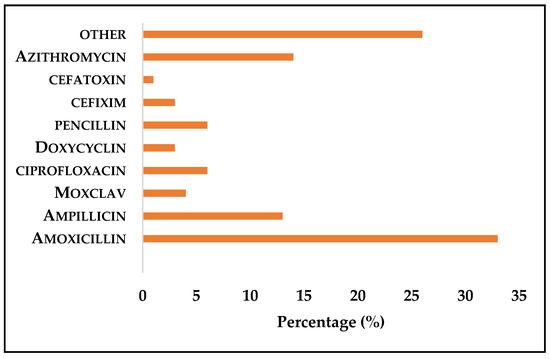
Figure 1.
Antibiotics used by participants in the Ernakulam district.
Amoxicillin was the most common type of antibiotic used, similar to other studies [12,13]. Sore throat (34%) and cough (26%) are one of the main symptoms of the self-usage of antibiotics. Figure 2 shows that about 33% of the participants completed the antibiotics course, as suggested by the doctor, whereas 42% discarded the leftover antibiotics to the environment and 25% stored for later use. This study also revealed that 67% of participants do not complete the full course of antibiotics as they stop once their symptoms disappear. Poor dosing, incomplete courses, and hap-hazard drug usage have further led to the development and extent of AMR. The participants stated the reasons for antibiotic SM were due to a previous successful experience (7.7%), to save time (11%), and for the convenience (11.5%) of quickly relieving their symptoms without visiting a doctor, which saves their time and money, as shown in Figure 3. Participants used antibiotics by themselves based on a pharmacist (57.3%), prescription of previous illness (21.5%), friends (12.5%), and the internet (5.5%).
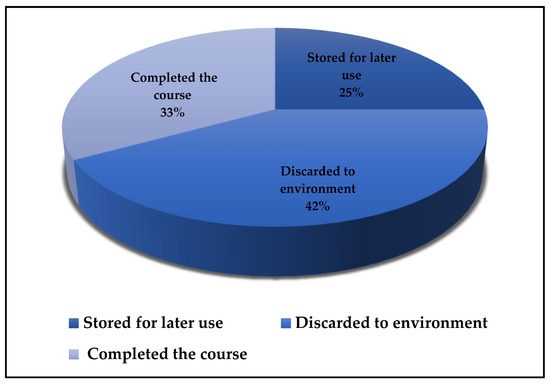
Figure 2.
Future of leftover antibiotics, as revealed by participants.
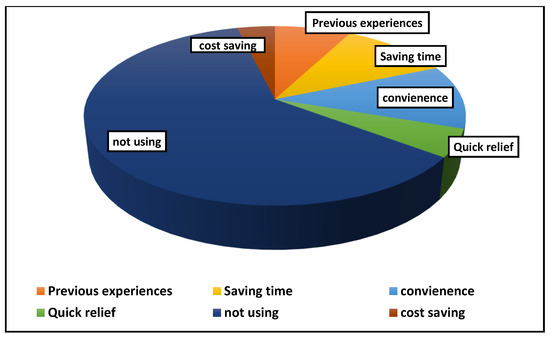
Figure 3.
Participants’ reasons for antibiotic self-medicated usage.
The chi-square test was used to find the association between the SM usage of antibiotics with certain independent variables such as age, gender, and area; it was found that participants from urban areas were more likely to use antibiotics by themselves than participants from rural areas (p value = 0.0001). The gender and age of participants (p-value = 0.71, 0.76, respectively) were not significantly associated with the SM use of antibiotics, similar to other studies [14,15], as depicted in Table 2 and Table 3. When the participant was asked about antibiotic resistance, only 5% were aware of it; this may be due to a lack of awareness about it.
Table 2.
Pearson correlation between gender and self-medicated use of antibiotics.
Table 3.
Pearson correlation between age and self-medicated use of antibiotics.
4. Conclusions
This study showed that 18% of people from the Ernakulam district use antibiotics without prescriptions. The findings proved that there is a lack of knowledge among people about the proper use of antibiotics. The most common antibiotics used were amoxicillin (34%), azithromycin (14%), and ampicillin (12%). Usage of antibiotics without a prescription is influenced by pharmacies, relatives, and social media. The public should understand that proper dosages and frequent use of antibiotics can cause the development of antibiotic resistance, which damages humans and the environment. Public awareness campaigns can educate people about the dangers of self-medication and antibiotic resistance. Healthcare providers should educate patients and the general public about the appropriate use of antibiotics, emphasizing the importance of completing the full course even if symptoms improve. Strict rules and regulations on the sale of antibiotics should be enforced to ensure that they are only available by prescription from a qualified healthcare professional. Furthermore, monitoring and researching the prevalence of antibiotic resistance and self-medication to inform local healthcare policies and interventions should be continued.
5. Study Limitations
A specific study was conducted among the population of the Ernakulam district (common people aged between 18 and 45 years). As a result, more investigations in other contexts with greater sample sizes might be beneficial to further validate the findings. Because of the sampling technique utilized (i.e., convenience sampling), the population may be under- or over-represented.
Author Contributions
D.N. screened the titles and abstracts, conducted the survey, and wrote the manuscript. G.G. participated in the planning of the study, checked the extracted data, and contributed to the manuscript. P.V.G. contributed to the final editing of the manuscript. All authors have read and agreed to the published version of the manuscript.
Funding
This research received no external funding.
Institutional Review Board Statement
Study did not require ethical approval.
Informed Consent Statement
Informed consent was obtained from all subjects involved in the study.
Data Availability Statement
Data is unavailable due to privacy or ethical restrictions.
Conflicts of Interest
The authors declare no conflicts of interest.
Appendix A. Questionnaire of Self-Medication Survey: A Small Survey of Antibiotic Use in Kochi
- Name
- Age (Years)
- <18 years
- 18–29 years
- 30–39 years
- 40–49 years
- 50–59 years
- >60 years
- Gender
- Male
- Female
- Other
- Education
- 12th
- graduation
- diploma
- Other
- Location
- Gram Panchayat/Municipality
- Corporation
- Residential Area/address
- Occupation
- Marital status
- Single
- Married
- Job
- Medical field
- Non-medical field
- Other
- Pattern of antibiotic self-medication
- Usage of antibiotics without prescription (self-medication) is growing globally and is associated with increased bacterial resistance, ineffective treatment and adverse reactions.
- Multiple responses Illness for which antibiotic consumed
- Sore throat
- Fever
- Cough
- Running nose
- Nasal congestion
- Aches
- No disease
- Diarrhea
- Vomiting
- Skin wounds
- Never
- Other
- Name of antibiotic. If used any?
- Ampilicin
- cefixim
- ceftazidime
- ceftriaxone
- vancomycin
- piptaz
- moxclov
- amoxicillin
- doxycycline
- piperacillin
- taxim
- gentamicin
- ciprofloxacin
- norfloxacin
- penicillin
- Azithromycin
- clindamycin
- metronidazole
- sulfamethoxazole and trimethoprim
- clavulanate
- Never
- Other
- How many days did you use this antibiotics?
- One day to two days, if necessary
- Three to seven days
- More than week
- Never
- When did you last take antibiotics?
- In the last month
- In the last 6 months
- In the last year
- More than a year ago
- Never
- Can’t remember
- Number of times antibiotics administered in the past 6 months
- Once
- Twice
- Thrice
- More than three times
- Not using
- Other
- Reason for stopping antibiotics
- At the completion of course
- After symptoms disappeared
- After a few days regardless of the outcome
- A few days after the recovery
- Not using
- Other
- Source of antibiotics
- Family or friends
- From pharmacy
- Leftover from previous prescription
- Hospital
- Clinic
- Never
- Other
- Basis of selecting antibiotics
- Doctor’s previous prescription
- Own experience
- Opinion of family members
- Recommended by pharmacists
- Other
- Habit of checking instructions on the package before taking medicine.
- Always
- Sometimes
- Never
- Ever obtained antibiotics without prescription.
- Yes
- No
- Reasons for antibiotic self-medication.
- Convenience
- Illness is minor
- Lack of time
- Cost saving
- Not using
- Others (easier, doctors tend to prescribe the same antibiotic, recommended by health professionals)
- Never used without prescription
- Previous successful experiences
- Other
- Disposal of leftover method
- Household rubbish bin
- Flush into toilet bowl
- Return to pharmacist or doctor
- Previous successful experiences
- Stored for later use
- Returned to shop
- Other
- Ever save or retained leftover antibiotics for future use
- Yes
- No
- Knowledge of the functions of antibiotics
- Yes
- No
- Awareness of bacterial resistance due to antibiotic use
- Yes
- No
- Respondents’ opinion about antibiotic self-medication practice
- Good practice
- Acceptable practice
- Not an acceptable practice
- Other
- If a person feels better after partially completing an antibiotic course, one can discontinue therapy immediately.
- Yes
- No
- The remaining antibiotics can be stored for personal future use or given to someone else.
- Totally agree
- Don’t agree at all
- Don’t know
- Other
- Leftover antibiotics should be taken back to the pharmacy.
- Totally agree
- Don’t agree at all
- Don’t know
- Other
- The more antibiotics we use in society, the higher is the risk of resistance develops and spreads.
- Yes
- No
- Don’t know
- Have you ever heard about Antibiotic resistance?
- Yes
- No
- Maybe
References
- World Health Organization. Guidelines for the Regulatory Assessment of Medicinal Products for Use in Self-Medication (No. WHO/EDM/QSM/00.1); World Health Organization: Geneva, Switzerland, 2000; Available online: https://asksource.info/resources/guidelines-regulatory-assessment-medicinal-products-use-self-medication (accessed on 15 April 1999).
- Eticha, T.; Mesfin, K. Self-Medication Practices in Mekelle, Ethiopia. PLoS ONE 2014, 9, e97464. [Google Scholar] [CrossRef] [PubMed]
- Bennadi, D. Self-medication: A current challenge. J. Basic Clin. Pharm. 2013, 5, 19. [Google Scholar] [CrossRef] [PubMed]
- McElnay, J.; Hughes, C.; Flemming, G.F. Benefits and risks of self-medication. Drug Saf. 2001, 24, 1027–1037. [Google Scholar]
- WHO. Antimicrobial Resistance. Available online: http://www.who.int/mediacentre/factsheets/fs194/en/ (accessed on 20 October 2020).
- World Health Organization. Antimicrobial Resistance Fact Sheet February. Available online: http://www.who.int/world-health-day/2011 (accessed on 1 January 2019).
- Centers for Disease Control and Prevention. Antibiotic Resistance Threats in the United States; CDC: Atlanta, GA, USA, 2013. Available online: https://stacks.cdc.gov/view/cdc/20705 (accessed on 11 April 1999).
- Morgan, D.J.; Okeke, I.N.; Laxminarayan, R.; Perencevich, E.N.; Weisenberg, S. Non-prescription antimicrobial use worldwide: A systematic review. Lancet Infect. Dis. 2011, 11, 692–701. [Google Scholar] [CrossRef] [PubMed]
- Levy, S.B. Antibiotic resistance—The problem intensifies. Adv. Drug Deliv. Rev. 2005, 57, 1446–1450. [Google Scholar] [CrossRef] [PubMed]
- Rajendran, A.; Kulirankal, K.G.; Rakesh, P.S.; George, S. Prevalence and pattern of antibiotic self-medication practice in an urban population of Kerala, India: A cross-sectional study. Indian J. Community Med. Off. Publ. Indian Assoc. Prev. Soc. Med. 2019, 44 (Suppl. S1), S42. [Google Scholar]
- Pankaj, C.K.; Arvind, M.K.; Atul, J.; Neha, S.; Ajitesh, M. Self medication practices with antibiotics among health care professional in Uttar Pradesh, India: A questionnaire based study. Indo Am. J. Pharm. Res. 2015, 5, 752–759. [Google Scholar]
- Gunawardhana, C.; Sakeena, M.; Sivayoganthan, C. Awareness of Rational Medication Use and Antibiotic Self- Medication Practices among Undergraduate Students in a University in Sri Lanka. Trop. J. Pharm. Res. 2015, 14, 723. [Google Scholar] [CrossRef][Green Version]
- Abasaeed, A.; Vlcek, J.; Abuelkhair, M.; Kubena, A. Self-medication with antibiotics by the community of Abu Dhabi Emirate, United Arab Emirates. J. Infect. Dev. Ctries. 2009, 3, 491–497. [Google Scholar] [CrossRef] [PubMed]
- Donkor, E.S.; Tetteh-Quarcoo, P.B.; Nartey, P.; Agyeman, I.O. Self-Medication Practices with Antibiotics among Tertiary Level Students in Accra, Ghana: A Cross-Sectional Study. Int. J. Environ. Res. Public Health 2012, 9, 3519–3529. [Google Scholar] [CrossRef] [PubMed]
- Shah, S.J.; Ahmad, H.; Rehan, R.B.; Najeeb, S.; Mumtaz, M.; Jilani, M.H.; Rabbani, M.S.; Alam, M.Z.; Farooq, S.; Kadir, M.M. Self-medication with antibiotics among non-medical university students of Karachi: A cross-sectional study. BMC Pharmacol. Toxicol. 2014, 15, 74. [Google Scholar] [CrossRef]
Disclaimer/Publisher’s Note: The statements, opinions and data contained in all publications are solely those of the individual author(s) and contributor(s) and not of MDPI and/or the editor(s). MDPI and/or the editor(s) disclaim responsibility for any injury to people or property resulting from any ideas, methods, instructions or products referred to in the content. |
© 2024 by the authors. Licensee MDPI, Basel, Switzerland. This article is an open access article distributed under the terms and conditions of the Creative Commons Attribution (CC BY) license (https://creativecommons.org/licenses/by/4.0/).