


Abstract
Sugar is essential to organisms, but excessive consumption can lead to certain diseases. Overconsumption is a major concern in modern society, especially in developed countries. The purpose of this study was to convert sucrose present in sucrose-rich fruit concentrates into fructooligosaccharides (FOS) using the enzymes invertase (Inv) or fructosyltransferase (FTase). FOS are oligosaccharides (OS) that bypass part of the digestive system and reach the colon, where they are metabolized by gut bacteria. This can simultaneously exert prebiotic effects while reducing a product’s calories. Based on these results, it was concluded that there is potential for enzymatically reducing a product’s caloric value while converting sucrose into FOS, thus enriching the product’s dietary fiber content.
1. Introduction
Sugar consumption is a major concern in modern society, especially in developed countries. While sugar is essential to organisms; excessive intake can lead to the development of dental caries and diseases such as obesity, Type-2 Diabetes Mellitus, cardiovascular diseases, and metabolic dysregulation [1]. A common source of sugar in our diets is fruit. While the consumption of whole fruits entails a more complex metabolism in the body, sugars from fruit-derived products, such as fruit juices and concentrates, are easily absorbed. These products, containing high concentrations of sugars, are consumed directly or used as ingredients in other foods. In addressing this issue,, we aim to find a solution while adhering to the Clean Label concept. Although not legally defined, Clean Label foods are currently a rising trend among consumers, driven by health, sustainability, and environmental concerns. This concept focuses on producing foods that are minimally processed, organic, “natural”, and free from artificial ingredients, resulting in the shortest possible list of ingredients [2]. One approach to reduce the sucrose content in sucrose-rich fruit concentrates is to use the enzymes invertase or fructosyltransferase, capable of converting sucrose into fructooligosaccharides (FOS). Enzymatic applications are mostly classified as processing aids since enzymes are not functional in the final products and are not labeled. FOS have few calories and a sweet taste, contribute to satiety and body weight control, have a low glycemic index, are non-carcinogenic, and are well-known prebiotics [3]. Therefore, this work aimed to enzymatically convert sucrose into FOS, potentially representing a Clean Label process for reducing the calories of a product while simultaneously providing beneficial effects for our health.
2. Materials and Methods
2.1. Enzymatic Reaction
Samples of strawberry fruit concentrate were weighed into 4 Falcon tubes. Fructosyltransferase and invertase enzymes were added to two tubes each at a concentration of 12 U/g of initial sucrose. Next, enzymatic reactions were evaluated at different temperatures and time points at the endogenous pH values of the samples. One tube of each enzyme was maintained at 10 °C, and the other at 35 °C, during the reaction. Each reaction lasted for 24 h and was kept in constant agitation, with an aliquot collected at the 0, 2, 4, 6, and 24 h time points for sugar content analysis. The enzymatic reaction was stopped after heating at 90 °C in a water bath for 20 min.
2.2. Determination of Sugar Content in Strawberry Fruit Concentrate and Its Evolution during Enzymatic Treatment
Briefly, aliquots collected at each time point were centrifuged, and the supernatant was used to characterize the sugar profile via high-performance anion-exchange chromatography with pulsed amperometric detection (HPAEC-PAD, ICS 3000, Dionex, Sunnyvale, CA, USA). Quantification was performed using the calibration curve method (1.0–2000.0 mg/L) with pure commercial standards of glucose, fructose, and sucrose. Other oligosaccharides present in the sample were not quantified. Analyses were performed in a single run. The estimation of glucose, fructose, sucrose, and oligosaccharide content over time was performed by extracting areas from the chromatograms of the analyzed samples and expressing them as percentages. Sucrose, glucose, and fructose peaks were identified using pure commercial standards of sucrose, glucose, and fructose. Peaks not identified as sucrose, glucose, or fructose were considered and assumed to be oligosaccharides.
2.3. Determination of Energetic Reduction
The caloric reduction of the samples was calculated by considering the variation in the concentration of the main sugars present in the sample, namely, glucose, fructose, and sucrose, over the reaction period. Approximately 4 kcal corresponds to every gram of sugar. Therefore, the calculations were conducted by multiplying the quantified grams of sugar by 4 [4].
3. Results and Discussion
3.1. Estimation of Glucose, Fructose, Sucrose, and Oligosaccharide Content after Incubation with Invertase and Fructosyltransferase
The content of free sugars after incubation with the enzymes is shown in Figure 1. Sucrose content sharply decreased over time in the presence of both enzymes at both temperatures. In contrast, glucose, fructose, and oligosaccharide (OS) content increased. Fructosyltransferase (Ftase) at 10 °C (Figure 1a) and 35 °C (Figure 1b), showed a higher increase in glucose, followed by OS and fructose; this is a different pattern compared to that of invertase (Figure 1c,d), which presented a higher content of fructose than OS.
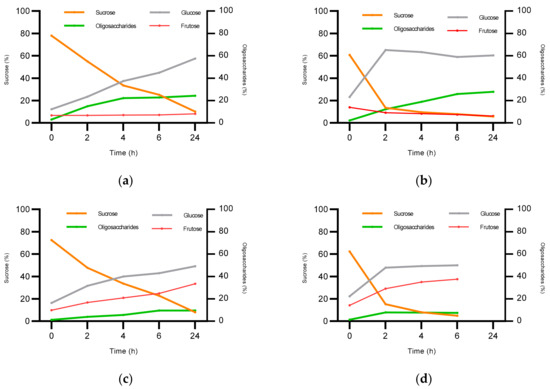
Figure 1.
The content of glucose, fructose, sucrose, and oligosaccharides (expressed as %) in strawberry fruit concentrate after enzymatic reaction with Fructosyltransferase (FTase) at 10 °C (a) and 35 °C (b) and with Invertase at 10 °C (c) and 35 °C (d) (n = 1).
3.2. Determination of Energetic Reduction
The number of initial calories present in the sample decreased after the activity of FTase and invertase at 10 °C and 35 °C. Both enzymes showed a time-dependent increase in energetic reduction, which was most notable early in the reaction and slowly plateaued over time. FTase proved to be more efficient at both 10 °C and 35 °C (Figure 2a,b) when compared to invertase under the same conditions (Figure 2c,d).
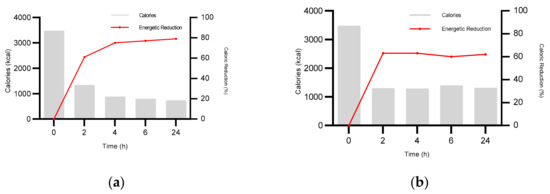
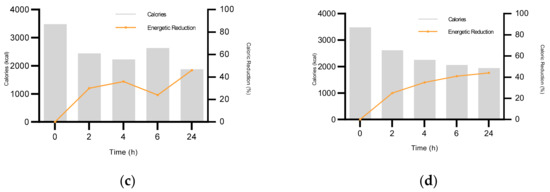
Figure 2.
Energetic reduction (expressed as %) and the number of calories derived from free sugars (expressed as kcal) in strawberry fruit concentrate after enzymatic reaction with Fructosyltransferase (FTase) at 10 °C (a) and 35 °C (b) and with invertase at 10 °C (c) and 35 °C (d) (n = 1).
The number of calories and their energetic content are important factors that can not only impact a consumer’s acceptance of a product but also serve as markers of nutritional value. Products like fruit concentrates are highly caloric, making the reduction of calories and energetic content a promising approach to improving the nutritional value of such products while meeting consumers’ demands for high quality and improved health impacts. The preliminary results obtained here show that enzymes, especially FTase, are capable of reducing the number of calories in a strawberry fruit concentrate (Figure 2).
FTase and invertase are enzymes with hydrolytic and transfructosylating activity towards sucrose. Their hydrolytic activity hydrolyses sucrose into its monosaccharides, glucose, and fructose, while their transfructosylating activity catalyzes the transfer of a fructose moiety from sucrose to another sucrose or an alternate acceptor. This transfer can generate FOS, oligosaccharides composed of one unit of glucose attached to several fructose units. These compoundscannot be metabolized by human digestive enzymes; upon reaching the colon, they can exert a prebiotic action. FOS can act as acceptors for fructose moieties from sucrose, reducing the sucrose content of a product while generating FOS [3]. As presented in Figure 1, the reduction in sucrose is accompanied by an increase in oligosaccharide content. The enzymes appear to exhibit at least some degree of transfructosylating activity, especially FTase, which exhibits a higher increase in OS than fructose.
4. Conclusions
The results indicate that the enzymes invertase and, especially, Ftase are capable of reducing the number of calories and energetic content of strawberry fruit concentrate by converting sucrose into FOS. This transformation gives rise to a product with reduced energetic content and additional effects, such as prebiotic activity derived from the presence of FOS. Such a product meets the consumer demand for products with improved nutritional value and may be adequate for patients with certain diseases (e.g., obesity, metabolic dysregulation, etc.). Nevertheless, these results are preliminary, and more detailed studies must be conducted.
Author Contributions
Conceptualization, F.C. and F.M.N.; methodology, T.D.; analysis, T.D.; investigation, T.D.; resources, T.D., M.A., F.C. and F.M.N.; data curation, T.D.; writing—original draft preparation, T.D.; writing—review and editing, T.D., M.A., F.C. and F.M.N.; supervision, M.A., F.C. and F.M.N. All authors have read and agreed to the published version of the manuscript.
Funding
This study received the financial support of the CQ-VR Chemistry Research Centre-Vila Real (UIDB/00616/2020 and UIDP/00616/2020, https://doi.org/10.54499/UIDP/00616/2020),) FCT–Portugal and COMPETE. T.D. also thanks the financial support provided by FCT/MCTES PhD studentship (2023.02910.BDANA).
Institutional Review Board Statement
Not applicable.
Informed Consent Statement
Not applicable.
Data Availability Statement
The data supporting the findings of this study are available within the proceeding paper.
Acknowledgments
We would like to thank Decorgel-Produtos Alimentares SA, which kindly provided the samples for this work.
Conflicts of Interest
Author Miguel Azevedo was employed by the company Decorgel—Produtos Alimentares SA. The remaining authors declare that the research was conducted in the absence of any commercial or financial relationships that could be construed as a potential conflict of interest.
References
- Evans, C.E.L. Sugars and health: A review of current evidence and future policy. Proc. Nutr. Soc. 2017, 76, 400–407. [Google Scholar] [CrossRef] [PubMed]
- Asioli, D.; Aschemann-Witzel, J.; Caputo, V.; Vecchio, R.; Annunziata, A.; Næs, T.; Varela, P. Making sense of the “clean label” trends: A review of consumer food choice behavior and discussion of industry implications. Food Res. Int. 2017, 99, 58–71. [Google Scholar] [CrossRef] [PubMed]
- Michel, M.R.; Rodríguez-Jasso, R.M.; Aguilar, C.N.; Gonzalez-Herrera, S.M.; Flores-Gallegos, A.C.; Rodríguez-Herrera, R. Fructosyltransferase sources, production, and applications for prebiotics production. In Probiotics and Prebiotics in Human Nutrition and Health; IntechOpen: London, UK, 2016; pp. 169–190. [Google Scholar]
- Schakel, S.F.; Jasthi, B.; Van Heel, N.; Harnack, L. Adjusting a nutrient database to improve calculation of percent calories from macronutrients. J. Food Compos. Anal. 2009, 22, S32–S36. [Google Scholar] [CrossRef]
Disclaimer/Publisher’s Note: The statements, opinions and data contained in all publications are solely those of the individual author(s) and contributor(s) and not of MDPI and/or the editor(s). MDPI and/or the editor(s) disclaim responsibility for any injury to people or property resulting from any ideas, methods, instructions or products referred to in the content. |
© 2024 by the authors. Licensee MDPI, Basel, Switzerland. This article is an open access article distributed under the terms and conditions of the Creative Commons Attribution (CC BY) license (https://creativecommons.org/licenses/by/4.0/).