


Abstract
We present the novel idea of using the atomic radiative emission of neutrino pairs to test physics beyond the Standard Model, including light vector/scalar mediators and the anomalous neutrino electromagnetic moments. With (eV) momentum transfer, atomic transitions are particularly sensitive to light mediators and can improve their coupling strength sensitivity by 3∼4 orders of magnitude. In particular, the massless photon belongs to this category. The projected sensitivity with respect to neutrino electromagnetic moments is competitive with dark matter experiments. Most importantly, neutrino pair emission provides the possibility of separating the electric and magnetic moments, even identifying their individual elements, which is not possible by existing observations.
1. Introduction
The neutrino oscillation, and hence neutrinos being massive, have been experimentally established as the first new physics beyond the Standard Model (BSM) of particle physics. However, the reason behind massive neutrinos, and in particular non-standard interactions (NSIs), retain various possibilities [1,2,3,4]. This is especially true for light mediators. A mediator with mass m and coupling g produces a matrix element . For , the contribution of a light mediator is typically suppressed by the momentum transfer, . To improve the sensitivity, smaller momentum transfer is better.
Laboratory-based experiments typically have momentum transfer at the keV∼MeV scale, which makes it difficult to constrain very light mediators. In this work, we present a new possibility: we propose using the atomic radiative emission of neutrino pairs (RENP) [5,6,7,8] to look for light mediators. With intrinsically energy, RENP provides a suitable environment to significantly improve the sensitivity of searching light particles.
Our study proceeds in two steps: (1) a general light vector/scalar mediator between electron and neutrino [9] and (2) the neutrino electric and magnetic moment interactions with a massless photon [10]. The latter is particularly interesting. Energy thresholds can be used to separate the electric from the magnetic moments and probe their individual elements. With a suitable design, future RENP experiments can greatly improve the sensitivity on BSM mediators and NSI.
2. Atomic Radiative Emission of Neutrino Pairs
The RENP is an atomic E1×M1 transition from an atomic excited state to a ground state via an intermediate virtual state with energies [5,6,7,8,11,12]. A neutrino pair is emitted in the transition and a photon is emitted in .
The whole reaction chain is
Because , the transition is second order in perturbation and the two steps cannot happen separately. In SM, RENP involves both electromagnetic and weak interactions. The E1-type photon emission is contributed by the electric dipole moment, while the M1-type neutrino pair emission is mediated by the bosons. The weak Hamiltonian contains both the vector and the axial vector coefficients
where is the PMNS matrix element. The M1 transition selects only the axial part of .
The atomic spontaneous decay rate s is extremely small [5]. Enhancing the decay is possible via two quantum mechanical effects [12]: stimulated photon emission and macroscopically coherent atoms [13]. The enhancing factors are proportional to the photon number density and the coherent atom number density , respectively. The total decay width [14,15,16]
scales linearly with the material volume V. The spectral function is defined as
where with momentum transfer and . The Heaviside function imposes kinematics requirements on the frequency . Energy–momentum conservation allows the process to occur only if the trigger laser frequency is smaller than the a frequency threshold as a function of the emitted neutrino masses and .
The last term in the square bracket of Equation (4) is non-zero if neutrinos are Majorana particles () and zero otherwise (). The first term appears in both cases, and is additionally a function of the neutrino masses
3. Non-Standard Interactions with Light Mediators
The gauge boson masses are much larger than the momentum transfer, and their propagators shrink to a contact term . The relative size between the scale and the atomic momentum transfer is ∼. For NSI with mediator mass of 1 ∼, the decay width can be significantly enhanced over the SM one. In other words, RENP is very sensitive to light mediators.
3.1. Vector Mediators
The relevant new interactions with a vector-like mediator are
Because the neutrino pair emission transition ( is of the M1 type, it has even parity and selects the component of the electron coupling. The neutrino interaction may contain both left and right axial currents, which generalizes Equation (2):
The spectral function in Equation (4) becomes
In Figure 1, we present the spectral function versus the trigger laser frequency . The lines have sudden dips around the kinematic thresholds. As expected, even for a tiny coupling ∼ (dashed red), the presence of a mediator results in a sizable contribution when compared with the SM one (the black curve).
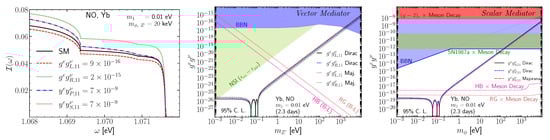
Figure 1.
(Left) The spectral function of Yb as a function of the trigger laser frequency for the normal ordering and lightest neutrino mass eV for light vector/scalar mediators; also shown are the projected sensitivities for vector (Middle) and scalar (Right) mediators.
We estimate the sensitivity to the combination using the experimental setup proposed in [15]. The target is exposed to the trigger laser beam at three different frequencies eV. The total number of events for each trigger laser frequency is obtained using the total decay width times exposure time T:
For days, a target volume cm3, and cm−3, we expect events at each . We use Poisson [17] to compare the expected event numbers with and without new physics. The sensitivity curves are shown in the middle panel of Figure 1. Across almost the whole range from meV to keV, RENP can improve the sensitivity by 2∼3 orders.
3.2. Scalar Mediator
A general spin-0 particle can couple with an electron via both scalar () and pseudo-scalar () interactions. The M1 transition selects only the pseudo-scalar coupling to contribute. However, the neutrino side can have both types:
Correspondingly, the spectral function becomes
where the correction term is
In addition, the left panel of Figure 1 shows the new contribution of the spectral function . Notice that the scalar coupling constant has to be larger than when compared with the vector one () to produce a similar change to the SM curve. This happens because nonrelativistic atomic transitions with pseudo-scalar couplings are suppressed by , as , where is the spin operator. Consequently, the sensitivity to in the right panel of Figure 1 is five orders less stringent than the vector case, although it remains much better than the existing ones.
4. Neutrino Electromagnetic Moments
The neutrino magnetic () and electric () dipole moments are parameterized as [18]
A non-zero () can be tested in various ways. The electron recoil measurements in neutrino and dark matter experiments provide a constraint [19,20], where is the Bohr magneton. In addition, the red giant cooling due to plasmon decay () provides [21] and white dwarf pulsation/cooling puts ∼ [22,23,24] at 90% C.L. All these constraints have serious limitations. The astrophysical bounds are prone to various systematic uncertainties [25], while the electron recoil measurements only probe a combination of magnetic and electric moments with severe degeneracy and blind spots in the allowed parameter space [26].
In comparison, RENP does not suffer from any of these limitations. The decay rate for the magnetic (electric) moment, (), with
is a function of individual or . These spectral functions are shown in the left and middle panels of Figure 2. The kinematic thresholds allow each non-zero contribution of and to be pinpointed, as well as for to be separated from . To accomplish this, instead of scanning three different frequencies, as in Section 3.1, we need to scan six: = (1.069, 1.07, 1.0708, 1.0712, 1.0716, 1.07164) eV. In this way, along with the individual matrix element, we can identify another one, eV, to disentangle from . The sensitivity in the right panel of Figure 2 as a function of the exposure time is competitive with current experiments, and can be further improved with longer exposure time.
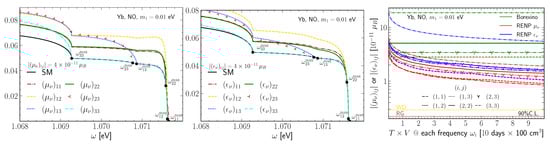
Figure 2.
The first two panels show the spectral functions for the electric (Left) and magnetic (Middle) moments; also shown are the projected sensitivities for various elements of the neutrino electromagnetic moments (Right). In all cases, we use normal ordering and take the lightest neutrino mass to be eV.
5. Conclusions
We have presented the novel idea of using the atomic radiative emission of neutrino pairs to probe the neutrino NSI with light mediators. The typical atomic transition energy improves current constants by several orders of magnitude for vector and scalar mediators with masses below keV. With the photon being a massless mediator, the searching neutrino magnetic moments additionally benefits from the eV momentum transfer of RENP. Most importantly, the kinematics thresholds allow different coupling constants to be separated and their individual matrix elements to be identified, which is not possible for current probes.
6. Notes Added
Constraints on light mediators and neutrino electromagnetic properties exist from various sources. A detailed survey of the current bounds can be found in our third paper on RENP [27], which appears after the submission of this proceeding. The two most recent constraints are due to the DM detection, [28], and coherent nuclei scatterings experiments, , with the current bounds being and [29]. While the RENP experiment can achieve similar bounds to coherent scattering within a few days, it should take more than a hundred days to obtain bounds comparable to the DM direct detection measurements. However, the neutrino mass eigenstates cannot be disentangled in either DM or coherent scattering experiments. Consequently, the bounds always involve a combination of the neutrino mixing matrix elements. In contrast, the RENP process does not suffer from such degeneracies. The detection of the kinematics thresholds together with scanning of the photon frequency spectrum allows for the separation of the individual matrix elements of each interaction type. In this sense, the RENP experiment is a unique probe of neutrino interactions and light mediators.
Author Contributions
Both S.-F.G. and P.P. contributed equally in conceptualization, formal analysis, investigation, writing—original draft preparation; writing—review and editing. All authors have read and agreed to the published version of the manuscript.
Funding
This work is supported by the National Natural Science Foundation of China (12375101, 12090060 and 12090064), the SJTU Double First Class start-up fund (WF220442604), and the Chinese Academy of Sciences Center for Excellence in Particle Physics (CCEPP). PSP is also supported by the Grant-in-Aid for Innovative Areas No. 19H05810. SFG is also an affiliate member of Kavli IPMU, University of Tokyo.
Institutional Review Board Statement
Not applicable.
Informed Consent Statement
Not applicable.
Data Availability Statement
All the codes used in this work can be shared uppon request.
Conflicts of Interest
The authors declare no conflict of interest.
References
- Farzan, Y.; Tortola, M. Neutrino oscillations and Non-Standard Interactions. Front. Phys. 2018, 6, 10. [Google Scholar] [CrossRef]
- Bhupal Dev, P.S.; Babu, K.S.; Denton, P.B.; Machado, P.A.N.; Argüelles, C.A.; Barrow, J.L.; Chatterjee, S.S.; Chen, M.C.; de Gouvêa, A.; Dutta, B.; et al. Neutrino Non-Standard Interactions: A Status Report. SciPost Phys. Proc. 2019, 2, 001. [Google Scholar] [CrossRef]
- Smirnov, A.Y.; Xu, X.J. Wolfenstein potentials for neutrinos induced by ultra-light mediators. J. High Energy Phys. 2019, 12, 046. [Google Scholar] [CrossRef]
- Babu, K.S.; Chauhan, G.; Bhupal Dev, P.S. Neutrino nonstandard interactions via light scalars in the Earth, Sun, supernovae, and the early Universe. Phys. Rev. D 2020, 101, 095029. [Google Scholar] [CrossRef]
- Yoshimura, M. Neutrino Pair Emission from Excited Atoms. Phys. Rev. D 2007, 75, 113007. [Google Scholar] [CrossRef]
- Fukumi, A.; Kuma, S.; Miyamoto, Y.; Nakajima, K.; Nakano, I.; Nanjo, H.; Ohae, C.; Sasao, N.; Tanaka, M.; Taniguchi, T.; et al. Neutrino Spectroscopy with Atoms and Molecules. Prog. Theor. Exp. Phys. 2012, 2012, 04D002. [Google Scholar] [CrossRef]
- Hiraki, T.; Hara, H.; Miyamoto, Y.; Imamura, K.; Masuda, T.; Sasao, N.; Uetake, S.; Yoshimi, A.; Yoshimura, K.; Yoshimura, M. Coherent two-photon emission from hydrogen molecules excited by counter-propagating laser pulses. J. Phys. B 2019, 52, 045401. [Google Scholar] [CrossRef]
- Tashiro, M.; Das, B.P.; Ekman, J.; Jönsson, P.; Sasao, N.; Yoshimura, M. Macro-coherent radiative emission of neutrino pair between parity-even atomic states. Eur. Phys. J. C 2019, 79, 907. [Google Scholar] [CrossRef]
- Ge, S.F.; Pasquini, P. Probing light mediators in the radiative emission of neutrino pair. Eur. Phys. J. C 2022, 82, 208. [Google Scholar] [CrossRef]
- Ge, S.F.; Pasquini, P. Unique Probe of Neutrino Electromagnetic Moments with Radiative Pair Emission. Phys. Lett. B 2023, 841, 137911. [Google Scholar] [CrossRef]
- Yoshimura, M. Solitons and Precision Neutrino Mass Spectroscopy. Phys. Lett. B 2011, 699, 123–128. [Google Scholar] [CrossRef]
- Yoshimura, M.; Sasao, N.; Tanaka, M. Dynamics of paired superradiance. Phys. Rev. A 2012, 86, 013812. [Google Scholar] [CrossRef]
- Dicke, R.H. Coherence in Spontaneous Radiation Processes. Phys. Rev. 1954, 93, 99–110. [Google Scholar] [CrossRef]
- Dinh, D.N.; Petcov, S.T.; Sasao, N.; Tanaka, M.; Yoshimura, M. Observables in Neutrino Mass Spectroscopy Using Atoms. Phys. Lett. B 2013, 719, 154–163. [Google Scholar] [CrossRef]
- Song, N.; Garcia, R.B.; Gomez-Cadenas, J.J.; Gonzalez-Garcia, M.C.; Conde, A.P.; Taron, J. Conditions for Statistical Determination of the Neutrino Mass Spectrum in Radiative Emission of Neutrino Pairs in Atoms. Phys. Rev. D 2016, 93, 013020. [Google Scholar] [CrossRef]
- Zhang, J.; Zhou, S. Improved Statistical Determination of Absolute Neutrino Masses via Radiative Emission of Neutrino Pairs from Atoms. Phys. Rev. D 2016, 93, 113020. [Google Scholar] [CrossRef]
- Particle Data Group; Zyla, P.A.; Barnett, R.M.; Beringer, J.; Dahl, O.; Dwyer, D.A.; Groom, D.E.; Lin, C.-J.; Lugovsky, K.S.; Pianori, E.; et al. Review of Particle Physics. Prog. Theor. Exp. Phys. 2020, 2020, 083C01. [Google Scholar] [CrossRef]
- Giunti, C.; Studenikin, A. Neutrino electromagnetic interactions: A window to new physics. Rev. Mod. Phys. 2015, 87, 531. [Google Scholar] [CrossRef]
- Beda, A.G.; Brudanin, V.B.; Egorov, V.G.; Medvedev, D.V.; Pogosov, V.S.; Shevchik, E.A.; Shirchenko, M.V.; Starostin, A.S.; Zhitnikov, I.V. Gemma experiment: The results of neutrino magnetic moment search. Phys. Part. Nucl. Lett. 2013, 10, 139–143. [Google Scholar] [CrossRef]
- Agostini, M.; Altenmüller, K.; Appel, S.; Atroshchenko, V.; Bagdasarian, Z.; Basilico, D.; Bellini, G.; Benziger, J.; Bick, D.; Bonfini, G.; et al. Limiting neutrino magnetic moments with Borexino Phase-II solar neutrino data. Phys. Rev. D 2017, 96, 091103. [Google Scholar] [CrossRef]
- Díaz, S.A.; Schröder, K.P.; Zuber, K.; Jack, D.; Barrios, E.E.B. Constraint on the axion-electron coupling constant and the neutrino magnetic dipole moment by using the tip-RGB luminosity of fifty globular clusters. arXiv 2019, arXiv:1910.10568. [Google Scholar]
- Córsico, A.H.; Althaus, L.G.; Bertolami, M.M.M.; Kepler, S.O.; García-Berro, E. Constraining the neutrino magnetic dipole moment from white dwarf pulsations. J. Cosmol. Astropart. Phys. 2014, 8, 054. [Google Scholar] [CrossRef]
- Bertolami, M.M.M. Limits on the neutrino magnetic dipole moment from the luminosity function of hot white dwarfs. Astron. Astrophys. 2014, 562, A123. [Google Scholar] [CrossRef]
- Hansen, B.M.S.; Richer, H.; Kalirai, J.; Goldsbury, R.; Frewen, S.; Heyl, J. Constraining Neutrino Cooling using the Hot White Dwarf Luminosity Function in the Globular Cluster 47 Tucanae. Astrophys. J. 2015, 809, 141. [Google Scholar] [CrossRef]
- Stancliffe, R.J.; Fossati, L.; Passy, J.-C.; Schneider, F.R.N. Confronting uncertainties in stellar physics. II. Exploring differences in main-sequence stellar evolution tracks. Astron. Astrophys. 2016, 586, A119. [Google Scholar] [CrossRef][Green Version]
- Sierra, D.A.; Miranda, O.G.; Papoulias, D.K.; Garcia, G.S. Neutrino magnetic and electric dipole moments: From measurements to parameter space. Phys. Rev. D 2022, 105, 035027. [Google Scholar] [CrossRef]
- Ge, S.F.; Pasquini, P. Disentangle Neutrino Electromagnetic Properties with Atomic Radiative Pair Emission. arXiv 2023, arXiv:2306.12953. [Google Scholar]
- Khan, A.N. Light new physics and neutrino electromagnetic interactions in XENONnT. Phys. Lett. B 2023, 837, 137650. [Google Scholar] [CrossRef]
- Khan, A.N. Neutrino millicharge and other electromagnetic interactions with COHERENT-2021 data. Nucl. Phys. B 2023, 986, 116064. [Google Scholar] [CrossRef]
Disclaimer/Publisher’s Note: The statements, opinions and data contained in all publications are solely those of the individual author(s) and contributor(s) and not of MDPI and/or the editor(s). MDPI and/or the editor(s) disclaim responsibility for any injury to people or property resulting from any ideas, methods, instructions or products referred to in the content. |
© 2023 by the authors. Licensee MDPI, Basel, Switzerland. This article is an open access article distributed under the terms and conditions of the Creative Commons Attribution (CC BY) license (https://creativecommons.org/licenses/by/4.0/).