
Abstract
We present a short summary of a phenomenological analysis of all available electron scattering data on (about 6600 differential cross-section measurements) and on (about 250 measurements) within the framework of the quasielastic (QE) superscaling model (including Pauli blocking). All QE and inelastic cross-section measurements are included down to the lowest momentum transfer 3-vector (including photo-production data). We find that there is enhancement of the transverse QE response function () and quenching of the QE longitudinal response function () at low (in addition to Pauli blocking). We extract parameterizations of a low “longitudinal quenching factor” and an “transverse enhancement” contribution. The fit can be used as a proxy to validate the modeling of cross sections in Monte Carlo event generators for electron and neutrino () scattering. Additionally, we find that the excitation of nuclear states contributes significantly (up to 30%) to the Coulomb sum rule . We extract the most accurate determination of to date and find it to be in disagreement with random phase approximation (RPA) based calculations but in reasonable agreement with recent theoretical calculations, such as “first-principle Green’s function Monte Carlo”.
1. Introduction
We present a short summary of our recent publications which report on a fit [1,2] to all available electron scattering data on (about 6600 differential cross section measurements) and (about 250 measurements) within the framework of the quasielastic (QE) superscaling model (including Pauli blocking). The cross-section measurements include the available data on QE (down to the lowest momentum transfer (), inelastic production, and photoproduction. As the fit provides an accurate description of the data, the fit includes inelastic structure functions and empirical parameters to model both an enhancement of the transverse (T) QE response function and quenching of the longitudinal (L) QE response function [3,4] at low . The fit can be used as a proxy to validate the modeling of cross sections in Monte Carlo event generators for electron and neutrino () scattering. The “transverse enhancement” TE()) of and the “quenching factor” of are of great interest to scattering experiments. The electron-scattering differential cross section can be written as
Here, is the incident electron energy, and are the energy and angle of the final state electron, , , , is the square of the 4-momentum transfer (defined to be positive), and = . In the analysis, we also use the invariant hadronic mass .
2. Analysis and Results
The inelastic Coulomb sum rule is the integral of , excluding the elastic peak and pion production processes. It has contributions from QE scattering and from the electro-excitations of nuclear states. Dividing by the square of the proton electric form factor , we obtain the normalized inelastic Coulomb sum rule . Careful consideration of the nuclear excitations is critical for an accurate extraction of the normalized Coulomb sum rule at low , as these states can contribute up to 30%. At high , it is expected that because both nuclear excitation form factors and Pauli suppression are small. At small , it is expected that because by gauge invariance, the structure function for all inelastic processes must be zero [5] at = 0.
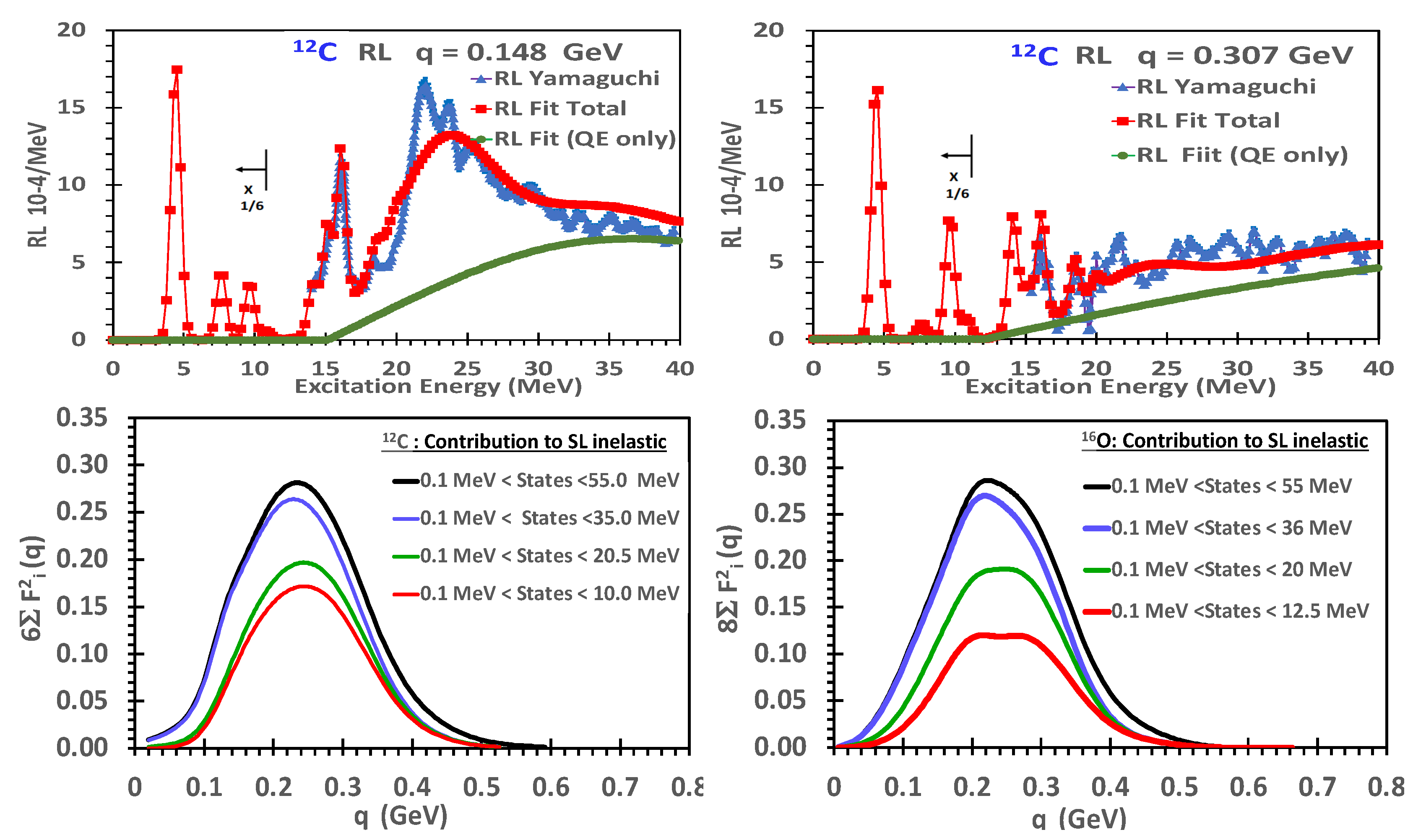
In addition to performing a universal fit to all and electron-scattering data, we also parameterize the measurements of the L and T form factors for the electro-excitation of all nuclear states with excitation energies () less than 50.0 MeV. The contributions of nuclear excitation to are calculated using the parametrizations of the form factors. The bottom two panels of Figure 1 show the contributions of nuclear excitations to for and . The contribution of all excitations is largest (≈0.29) at = 0.22 GeV. Although the contributions of different regions to is different for and , the total contribution turns out to be similar for the two nuclei. The top two panels of Figure 1 show comparisons of our fit to some of the measurements by Yamaguchi et al. [6]. The universal fit to the data is an update of the 2012 fit by Bosted and Mamyan [7,8] We include all available data down to the lowest q. The QE contribution is modeled by the superscaling approach with Pauli blocking calculated using the Rosenfelder method. The superscaling function extracted from the fit is similar to the superscaling functions of Amaro et al., 2005 [9] and Amaro et al., 2020 [10] and yields similar Pauli suppression.
Figure 1.
Top two panels: comparison of extracted from our fit to a sample of experimental data [6]. For excitation energies <12 MeV, the values are multiplied by 1/6. Bottom two panels: the contributions of longitudinal nuclear excitations (between 2 and 55 MeV) to the Coulomb sum rule for and .
In modeling the QE response, we use the same scaling function for both and and fit for empirical corrections to the response functions. For , we extract an additive “transverse enhancement” TE() contribution (which includes both single nucleon and two nucleon final states, and meson exchange currents (MECs)). TE() increases with the largest fractional contribution around = 0.3 GeV. For we extract a multiplicative -dependent “longitudinal quenching factor”, , which decreases at low .
Since measurements span a range of and , parametrizations of both TE() and can be extracted. The analysis includes all data for a range of nuclei. However, in this paper, we only include electron scattering data on , , and . Briefly, the fit includes the following:
- Coulomb corrections using the effective momentum approximation (EMA) in modeling scattering from nuclear targets.
- Updated nuclear elastic+excitation form factors.
- Superscaling parameters are re-extracted, including the broadening parameter .
- Parameterizations of the free nucleon form factors are re-derived from all and data.
- Rosenfelder Pauli suppression, which reduces and changes the QE distribution at low and .
- Updates of fits to inelastic electron scattering data (in the nucleon resonance region and inelastic continuum) for and .
- A -dependent parameter accounting for the optical potential of final state nucleons.
- Photo-production data in the nucleon resonance region and inelastic continuum.
- Gaussian Fermi smeared nucleon resonance and inelastic continuum. The (Fermi smearing) parameters for pion production and QE can be different.
- Parametrizations of the medium modifications of both the L and T structure functions responsible for the EMC effect (nuclear dependence of inelastic structure functions). These are applied to the free nucleon cross sections prior to the application of the Fermi smearing.
- Parametizations of TE() and as described below.
- QE data at all values of down to = 0.01 GeV (which were not included in the Bosted–Mamyan fit).
The average (over ) Pauli suppression factor for ( , = 0.228 GeV) is described by
For the superscaling function used in this analysis, = 0.3054, = 0.7647, = −0.2768 and = 0.0328. The Pauli suppression factor for is 1.0.
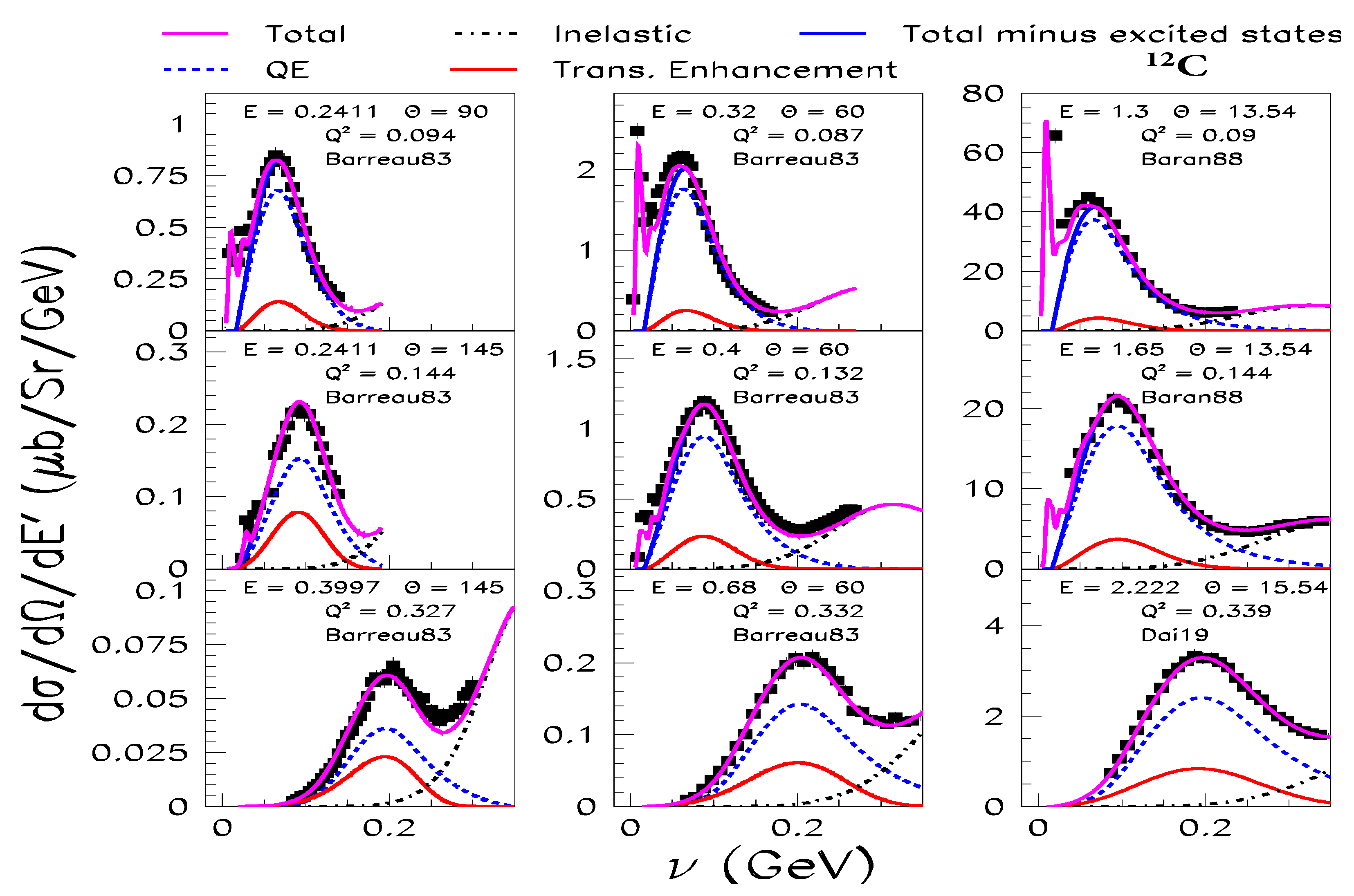
Comparisons of the fit to electron scattering measurements at different values of for values close to 0.30, 0.38 and 0.57 GeV (corresponding to extractions of and by Jourdan [3,4]) are shown in Figure 2. Shown are the total cross section (solid purple line), the total minus the contribution of nuclear excitations (solid blue), the QE cross section without TE (dashed blue), the TE contribution (solid red), and inelastic pion production (dot-dashed black). The fit is in good agreement with all electron scattering data for both small and large .
Figure 2.
Comparison of the fit to electron scattering measurements at values close to 0.30, 0.38 and 0.57 GeV (and different scattering angles). Shown are total (solid purple line), total minus the contribution of the nuclear excitations (solid blue), the QE cross section without TE (dashed blue), the TE() contribution (solid red) and inelastic pion production (dot-dashed black line).
The extracted QE “longitudinal quenching factor” is unity for x > 3.75 and zero for x < 0.35. For , it is parameterized by
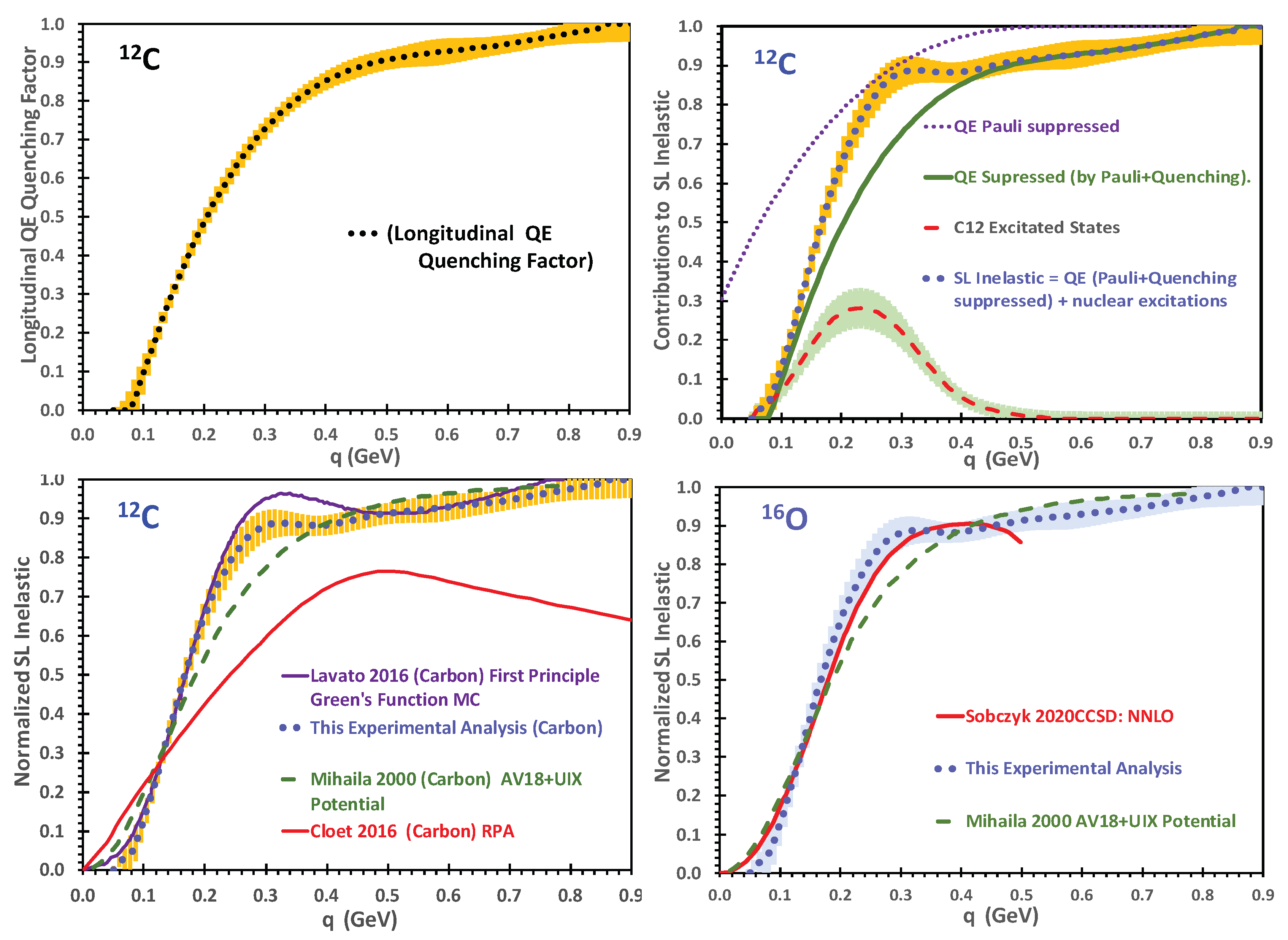
with = −0.13152 = 0.11693, and = −0.03675. The top-left panel of Figure 3 shows the extracted . (black-dotted line). The yellow band includes the statistical (from the fit), parameterization (different functional forms) and a normalization error of 2% (all added in quadrature).
Figure 3.
Top left panel: QE “longitudinal quenching factor” (dotted-black line with yellow error band). Top right panel: the various contributions to for (dotted blue with yellow error band) including QE with Pauli suppression only (dotted purple), QE suppressed by both “Pauli” and “longitudinal quenching” (solid green), and the contribution of nuclear excitations (red dashed with green error band). Bottom left panel: for (dotted blue with yellow error band) compared to theoretical calculations including Lovato et al. [11] (solid purple), Mihaila and Heisenberg [12] (dashed green), and RPA Cloet et al. [13] (solid red). Bottom right panel: for (dotted dark blue with light blue error band) compared to theoretical calculations of Sobczyk et al. [14] (red dashed) and Mihaila and Heisenberg [12] (dotted dashed).
If another formalism is used to model QE scattering (e.g., RFG or spectral functions), then the quenching factor for the model is given by
The top right panel of Figure 3 shows the various contributions to the measured for (dotted blue line with yellow error band). Shown are the QE contributions with only Pauli suppression (dotted purple), QE suppressed by both “Pauli suppression” and labeled as QE total suppression (solid green), and the contribution of nuclear excitations (red dashed line). The green error band is 15% (from the comparison of form factor parameterizations [2] with data) plus 0.01 added in quadrature.
The top right panel of Figure 3 shows the various contributions to the measured for (dotted blue line with yellow error band). Shown are the QE contribution with only Pauli suppression (dotted purple), QE suppressed by both “Pauli Suppression” and labeled as QE total suppression (solid-green), and the contribution of nuclear excitations (red dashed line). The green error band is 15% plus 0.01 added in quadrature. The left panel on the bottom of Figure 3 shows a comparison of the extracted for (dotted blue curve with yellow error band) to the theoretical calculations. These include the Lovato et al. [11] “first-principle Green’s function Monte Carlo” (GFMC) calculation (solid purple line), Mihaila and Heisenberg [12] coupled-clusters-based calculation (AV18+UIX potential, dashed green), and Cloet et al. [13] RPA calculation (RPA solid red). Our measurement for is in disagreement with Cloet et al. [13] RPA and in reasonable agreement with Refs. [11,12], except near 0.30 GeV, where the contribution from nuclear excitations is significant.
The bottom right panel of Figure 3 shows for (dotted-blue with green error band) compared to theoretical calculations. These include the Sobczyk et al. [14] “coupled-cluster with singles and doubles (CCSD) ” (red dashed line), and Ref. [12] coupled-cluster calculation (AV18+UIX potential, dashed green line). The data are in reasonable agreement with the calculations of Refs. [12,14] for except near 0.30 GeV, where the contribution from nuclear excitations is significant.
The contribution to the QE transverse structure function for is parameterized as a distorted Gaussian centered around GeV and a Gaussian at GeV with -dependent width and amplitude. = 0 for ( = 16.5 MeV). For , it is given by , where
where Q2 is in units of GeV, Mp is the proton mass, A is the atomic weight, , = 0.77023, , = 1.275, and = 0.375.
In summary, using all available electron scattering data, we extract parameterizations of the quenching of and the enhancement of over a large range of and . We obtain the best measurement of the Coulomb sum rule to date and compare to the theoretical models. The fit can be used as a proxy to validate the modeling of cross sections in Monte Carlo event generators for electron and neutrino () scattering. The contribution of nuclear excitations to is significant (up to 29%). Theoretical studies show that nuclear excitations are also significant in scattering [15,16,17]. Therefore, nuclear excitations should be included in both e-N and -N MC generators.
Author Contributions
Conceptualization, methodology, software, writing—original draft preparation, review and editing, A.B.; Conceptualization, methodology, software, writing—review and editing, M.E.C. All authors have read and agreed to the published version of the manuscript.
Funding
This research is supported by the U.S. Department of Energy, Office of Science, under University of Rochester grant number DE-SC0008475, and the Office of Science, Office of Nuclear Physics under contract DE-AC05-06OR23177.
Institutional Review Board Statement
Not applicable.
Informed Consent Statement
Not applicable.
Data Availability Statement
Not applicable.
Conflicts of Interest
The authors declare no conflict of interest.
References
- Bodek, A.; Christy, M.E. Extraction of the Coulomb sum rule, transverse enhancement, and longitudinal quenching from an analysis of all available e-12C and e-16O cross section data. Phys. Rev. C 2022, 106, L061305. [Google Scholar] [CrossRef]
- Bodek, A.; Christy, M.E. Contribution of nuclear excitation electromagnetic form factors in 12C and 16O to the Coulomb sum rule. Phys. Rev. C 2023, 107, 054309. [Google Scholar] [CrossRef]
- Jourdan, J. Quasielastic response functions: The Coulomb sum revisited. Nucl. Phys. A 1996, 603, 117. [Google Scholar] [CrossRef]
- Jourdan, J. Longitudinal response functions: The Coulomb sum revisited. Phys. Lett. B 1995, 353, 189. [Google Scholar] [CrossRef]
- Dieperink, A.E.L.; Nagorny, S.I. Electromagnetic form-factors of the proton in the ‘unphysical’ region from the gamma p —> p e+ e- reaction. Phys. Lett. B 1997, 397, 29. [Google Scholar] [CrossRef]
- Yamaguchi, Y.; Terasawa, T.; Nakahara, K.; Torizuka, Y. Excitation of the Giant Resonance in C-12 by Inelastic Electron Scattering. Phys. Rev. C 1971, 3, 1750–1769. [Google Scholar]
- Bosted, P.E.; Mamyan, V. Empirical Fit to electron-nucleus scattering. arXiv 2012, arXiv:1203.2262. [Google Scholar]
- Mamyan, V. Measurements of F2 and R = σL/σT on Nuclear Targets in the Nucleon Resonance Region. Ph.D. Thesis, The University of Virginia, Charlottesville, VA, USA, 2010. [Google Scholar]
- Amaro, J.E.; Barbaro, M.B.; Caballero, J.A.; Donnelly, T.W.; Molinari, A.; Sick, I. Using electron scattering superscaling to predict charge-changing neutrino cross sections in nuclei. Phys. Rev. C 2005, 71, 015501. [Google Scholar] [CrossRef]
- Amaro, J.E.; Barbar, M.B.; Caballero, J.A.; Gonzalez-Jimenez, R.; Megias, G.D.; Ruiz Simo, J. Electron- versus neutrino-nucleus scattering. J. Phys. G Nucl. Part. Phys. 2020, 47, 124001. [Google Scholar] [CrossRef]
- Lovato, A.; Gandolfi, S.; Carlson, J.; Pieper, S.C.; Schiavilla, R. Electromagnetic response of 12C: A first-principles calculation. Phys. Rev. Lett. 2016, 117, 082501. [Google Scholar] [CrossRef] [PubMed]
- Mihaila, B.; Heisenberg, J.H. Microscopic calculation of the inclusive electron scattering structure function in O-16. Phys. Rev. Lett. 2000, 84, 1403. [Google Scholar] [CrossRef] [PubMed]
- Cloet, I.C.; Bentz, W.; Thomas, A.W. Relativistic and Nuclear Medium Effects on the Coulomb Sum Rule. Phys. Rev. Lett. 2016, 116, 032701. [Google Scholar] [CrossRef] [PubMed]
- Sobczyk, J.E.; Acharya, B.; Bacca, S.; Hagen, G. Coulomb sum rule for 4He and 16O from coupled-cluster theory. Phys. Rev. C 2020, 102, 064312. [Google Scholar] [CrossRef]
- Pandey, V.; Jachowicz, N.; Van Cuyck, T.; Ryckebusch, J.; Martini, M. Low-energy excitations and quasielastic contribution to electron-nucleus and neutrino-nucleus scattering in the continuum random-phase approximation. Phys. Rev. C 2015, 92, 024606. [Google Scholar] [CrossRef]
- Martini, M.; Jachowicz, N.; Ericson, M.; Pandey, V.; Van Cuyck, T.; Van Dessel, N. Electron-neutrino scattering off nuclei from two different theoretical perspectives. Phys. Rev. C 2016, 94, 015501. [Google Scholar] [CrossRef]
- Pandey, V.; Jachowicz, N.; Martini, M.; Gonzalez-Jimenez, R.; Ryckebusch, J.; Van Cuyck, T.; Van Dessel, N. Impact of low-energy nuclear excitations on neutrino-nucleus scattering at MiniBooNE and T2K kinematics. Phys. Rev. C 2016, 94, 054609. [Google Scholar] [CrossRef]
Disclaimer/Publisher’s Note: The statements, opinions and data contained in all publications are solely those of the individual author(s) and contributor(s) and not of MDPI and/or the editor(s). MDPI and/or the editor(s) disclaim responsibility for any injury to people or property resulting from any ideas, methods, instructions or products referred to in the content. |
© 2023 by the authors. Licensee MDPI, Basel, Switzerland. This article is an open access article distributed under the terms and conditions of the Creative Commons Attribution (CC BY) license (https://creativecommons.org/licenses/by/4.0/).